


Listen on Spotify, Apple Podcasts or YouTube.
Before you press play: this episode discusses genocide and suicide. Given the subject it could hardly not, but you should know that going in rather than discovering it at minute forty.
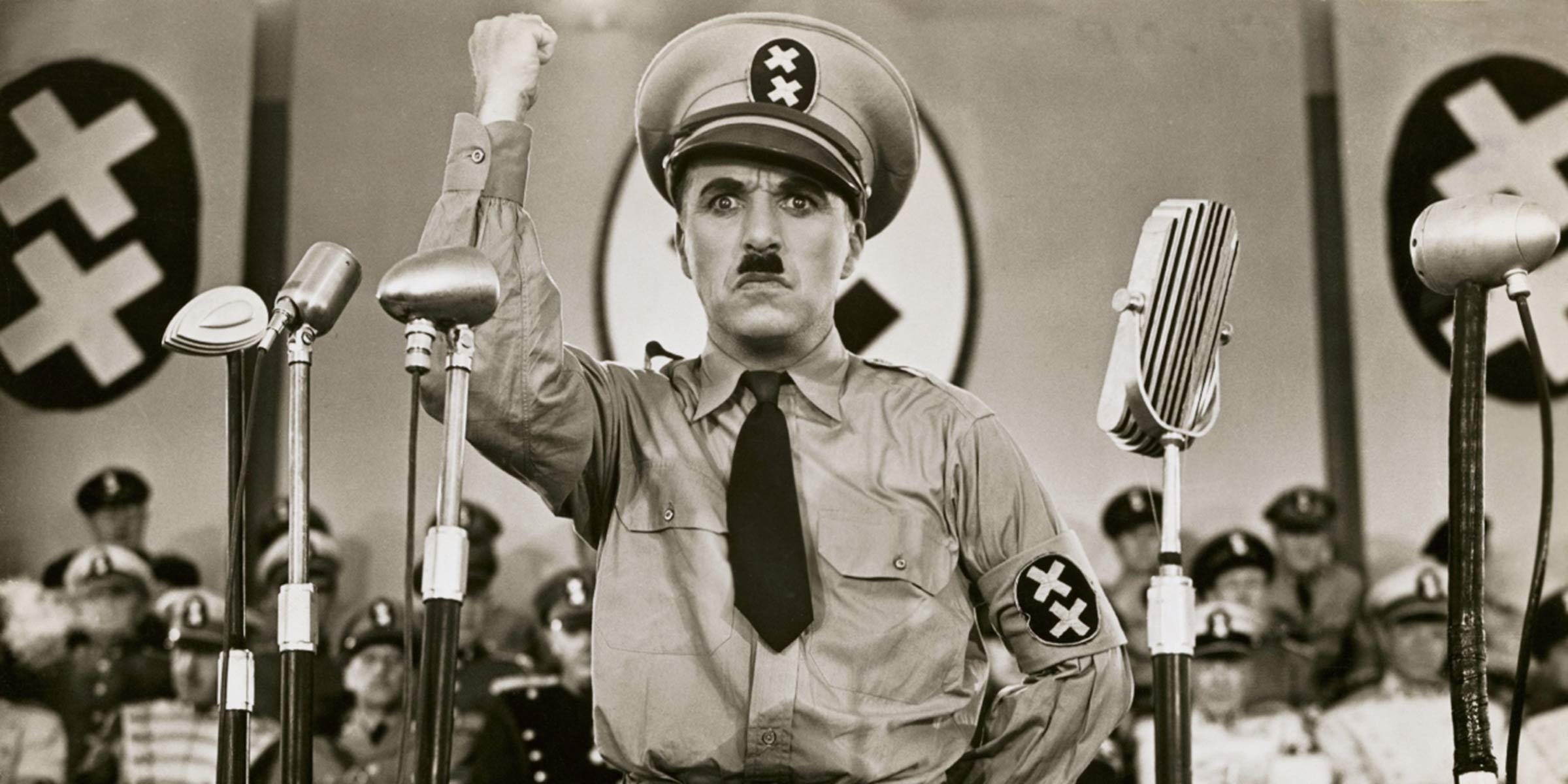
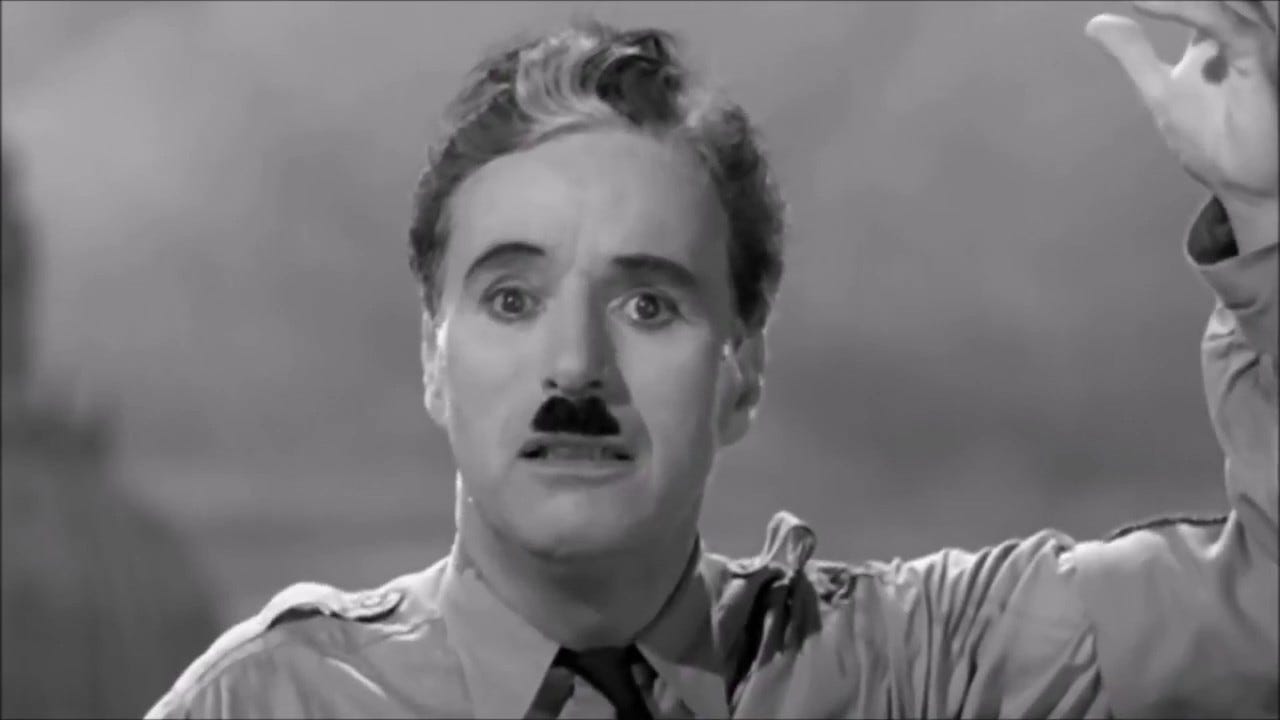
Last year I added a new type of show to the Reversing Climate Change podcast where I read some poetry or literature and discuss it literarily as well as its relevance to climate work. Today I released an episode of my reading Charlie Chaplin’s wonderful speech from the end of his film, The Great Dictator.
Reading poetry in the midst of serious climate work is not a new thing to do. Go back and read All We Can Save, the climate anthology edited by Drs. Ayana Elizabeth Johnson & Katharine K. Wilkinson , and the link to poetry is in plain sight. The riff on Adrienne Rich is right there in the title:
My heart is moved by all I cannot save:
so much has been destroyed

I have to cast my lot with those
who age after age, perversely,

with no extraordinary power,
reconstitute the world.

— Adrienne Rich in "Natural Resources" from The Dream of a Common Language (1978)
Ayana Johnson continues including poetry and other art in the followup anthology, What If We Get It Right? and it’s all over the Katharine Wilkinson’s new book, Climate Wayfinding. I believe this is such a wise way to mix media. It makes sense to my brain to find literary links to a topic that cannot help but produce some of the strongest feelings of faith and hope but also despair. Climate deserves its poetry and literature.1
Sometimes naivety is correct
I have loved this speech of Charlie Chaplin’s from The Great Dictator at least since my undergraduate days. I do associate its tone as being of that developmental stage. Can’t you just imagine the tie-dyed tapestry billowing from your dorm room fan? But in saying that, I undermine it and knock youth’s naivety. After being pummeled by “real life” in the post-collegiate years of one’s twenties, it becomes time to put away childish things. Noting that the world could be free and beautiful for everyone? So cringe.
But I’ve come back through the other end of that developmental loop, recognized that the “real world” has its own naiveties it nurses while it pretends to be practical, and am coaching myself and those who will listen to change and become like little children, or we will never enter the kingdom of heaven. Unsurprisingly, it’s Gospel phrasing like this that Chaplin cribs in his speech.
As the world’s situation gets more precarious, we will need spiritual wisdom to see us through to whatever we become on the other side of climate change. Reminders of this can only serve to prepare us for what will be expected of us in the years to come.
It’s a truly moving work of rhetoric. Here it is to watch in its entirety. Do that now, then come back:
I’m sorry, but I don’t want to be an emperor. That’s not my business. I don’t want to rule or conquer anyone. I should like to help everyone if possible: Jew, Gentile, black man, white. We all want to help one another. Human beings are like that. We want to live by each other’s happiness—not by each other’s misery. We don’t want to hate and despise one another. In this world there is room for everyone. And the good earth is rich and can provide for everyone. The way of life can be free and beautiful, but we have lost the way.
Greed has poisoned men’s souls, has barricaded the world with hate, has goose-stepped us into misery and bloodshed. We have developed speed, but we have shut ourselves in. Machinery that gives abundance has left us in want. Our knowledge has made us cynical. Our cleverness, hard and unkind. We think too much and feel too little. More than machinery we need humanity. More than cleverness we need kindness and gentleness. Without these qualities, life will be violent and all will be lost.
The aeroplane and the radio have brought us closer together. The very nature of these inventions cries out for the goodness in men; cries out for universal brotherhood, for the unity of us all. Even now my voice is reaching millions throughout the world—millions of despairing men, women, and little children—victims of a system that makes men torture and imprison innocent people.
To those who can hear me, I say: do not despair. The misery that is now upon us is but the passing of greed; the bitterness of men who fear the way of human progress. The hate of men will pass, and dictators die, and the power they took from the people will return to the people. And so long as men die, liberty will never perish.
Soldiers! Don’t give yourselves to brutes! Men who despise you, enslave you, who regiment your lives! Tell you what to do, what to think, and what to feel! Who drill you, diet you, treat you like cattle, use you as cannon fodder. Don’t give yourselves to these unnatural men—machine men with machine minds and machine hearts! You are not machines! You are not cattle! You are men! You have the love of humanity in your hearts! You don’t hate! Only the unloved hate; the unloved and the unnatural! Soldiers! Don’t fight for slavery! Fight for liberty!
In the 17th Chapter of St. Luke it is written: “The Kingdom of God is within man”. Not one man nor a group of men, but in all men! In you! You, the people have the power; the power to create machines. The power to create happiness! You, the people, have the power to make this life free and beautiful, to make this life a wonderful adventure.
Then in the name of democracy, let us use that power. Let us all unite. Let us fight for a new world; a decent world that will give men a chance to work, that will give youth a future, and old age a security. By the promise of these things, brutes have risen to power. But they lie! They do not fulfil that promise. They never will!
Dictators free themselves but they enslave the people! Now let us fight to fulfil that promise! Let us fight to free the world. To do away with national barriers. To do away with greed, with hate and intolerance. Let us fight for a world of reason, a world where science and progress will lead to all men’s happiness. Soldiers! in the name of democracy, let us all unite!
— Charlie Chaplin in The Great Dictator (1940)
Stunning, right?
Understanding Hitler
I actually did not mean to record about an hour on World War II, political comedy, and the personality of Adolf Hitler in this episode. Most of the poetry episodes are tiny. Most of them are bonus content that I put out for the love of the game. This turned into something else entirely though.
I started off explaining my theory of what makes political comedy work, and then exploring the historical moment when this film was being made. It was before Pearl Harbor and before many of Hitler’s ideas had been enacted upon the world. And from there, it connects to so many threads: Hannah Arendt, Louis Theroux’s manosphere documentary2, Mel Brooks, Carless People, and why there’s something so clownish and adolescent about the men (and it usually is men) who rule the world and create such valuable systems of extraction.
Albert Speer’s3 book Inside the Third Reich has these stories of Hitler’s dinner parties where he would get his colleagues (and presumably people he considered “friends”, though I get the sense that he didn’t quite understand friendship), and give them repeated four-hour lectures on things they had heard from him at length many times before. They would go into the wee hours of the night and no one was much having that good of a time. Did that bother Hitler? It is unclear if he didn't notice or didn’t care, but when I imagine it, it’s always the former. It strikes me as childish and pitiful, and someone who so desperately wants to connect and be valued but is so blocked from doing so appropriately.
His closest relationships are misunderstood by him. The dinner guests mere prisoners to their boss’s Greatest Hits recollections. He is theatrically a brilliant performer—capable of ensorcelling the masses—and yet cannot break through the cage of his solitude that he may have never surfaced to consciousness.
Tempting Godwin’s Law
At this point we have such great visibility into the leaders of our world since they post their thoughts often and they believe and do so many bizarre things. And it reads very similarly to me. Donald Trump is the obvious example. He is cruel and seemingly enjoys the process of throwing his weight around for its own sake, and is absolutely not a serious person. Of the many examples that could be chosen, have you been following the sage by which engineering reviews are being done to see if the island on aircraft carriers can be moved so they look cooler? Or that they can switch from modern electromagnetic devices to launch planes back to the older steam technology for the idiosyncratic preferences of the commander-in-chief? What about the basic public relations point of, “hey, everyone is watching the sailor of the USS Abraham Lincoln. Maybe don’t make a bunch of strange comments about aircraft carriers now and let the story die down.” But no, that would be far too sensible and something about power includes the power to behave as both a tyrant and a clown.
It’s hard not to read and watch Mark Zuckerberg talk about anything and not think he is a dork who seemingly barely understands what it means to connect to another human, but he got rich designing a social network ostensibly for that purpose. Careless People has a story which alleges Mark always won at Settlers of Catan because his opponents got into the habit of letting him win. When Sarah Wynn-Williams pointed this out to him, she claims she was met with Zuckerberg’s incredulity. Of course they weren’t letting him win. He’s so smart that he wins a game with variance (impossible for the best player to always win due to the randomness introduced by dice-rolling) every single time. Mark Zuckerberg should almost certainly be nowhere near the possibility of Artificial General Intelligence.
Robert Moses (podcast forthcoming on the Robert Caro books…) presumably thought that he was helping New Yorkers by building his parkways and roads and parks. Even when the people who lived in these neighborhoods tried to tell him he misunderstood their needs or that they wanted to minorly adapt the plans to improve their use of it based upon local knowledge, he would basically say “take it or leave it.” He would serve these foolish citizens whether they liked it or not and only as he saw fit.
Many of these people strike me as petty. Hitler (and other leaders) sometimes have such a strong Governor Lepetomane quality to them. It both tyrannizes and feels just straight up silly. Somehow, behavior from leaders can simultaneously be both terrifying and goofy.
And other times, they’re just boring in the same horrifying way that Hannah Arendt documents Adolf Eichmann’s banality of evil. He wasn’t some serial killer who did his work with pleasure. He was just a very effective functionary who kept the trains moving on time. And isn’t that more terrifying, how absolutely dull his monstrosity is?
It rhymes with Hitler’s dreadful repeat speeches at his dinners that Speer notes. Monstrosity has some sort of potential overlap with being absolutely boring and being a clown. It isn’t just the viciousness of Hitler’s antisemitism. It’s the true lack of accurate self-understanding that propels these leaders, that causes them to believe in their own greatness, while also isolating themselves from the feedback they would need to moderate their own overreach. But if they had that humility, they may not seek to do these things and be these people in the first place. Is it actually a requirement, and not an accident?
This is not the end
I’m going to keep returning to these themes, so be sure to subscribe below. They impact so much of the world around us, how decisions get made, and what insulates our leaders from the kindness and gentleness we will need to carry us through this century. The wisdom we need in charge will not come from whatever set of incentives puts these men in such high places.
I will continue investigating this link between the lack of self-awareness and those who climb the heights of history in subsequent posts.
Thanks for reading! I appreciate you.
Sincerely,
Ross Kenyon
CW: this episode discusses genocide and suicide.
I swear I didn't mean to make this episode. All I intended to do was to read the wonderfully moving speech at the end of Charlie Chaplin's The Great Dictator. But somehow that meant that I had to process so much about World War II, the personality of Adolf Hitler, and why monsters can also be boring and/or extremely goofy.
This monologue episode wends its way through the particular moment in history this film was made and why that is significant (as well as what the film got wrong as a result), Hannah Arendt, Mel Brooks, Louis Theroux's manosphere documentary, the banality of evil, why so many huge leaders of countries and companies feel so adolescent, how weird the History Channel was with Hitler content when I was a kid, and so much more.
There is still so much that didn't make it in, but I think I'll share some more soon, in particular about what I find to be the most terrifying part of Mein Kampf. To be continued...
Subscribe to the Reversing Climate Change Substack
Become a paid subscriber for bonus content and ad-free episodes
This Episode's Sponsor
EcoEngineers: a full-service advisory and consulting firm focused on carbon dioxide removal, decarbonization, and carbon markets
2026 EcoForums Training Series: Navigating Global Carbon and Fuel Regulations, Market Mechanisms, and Life-Cycle Analysis Fundamentals
Check out my new show, Climate Workers Anonymous
Watch the full Charlie Chaplin speech here
Full Transcript
Ross Kenyon: Hey, thank you for listening to Reversing Climate Change. This is Ross Kenyon. I’m the host of the podcast, and I’ve been working in climate for about a decade.
Do you know right now that I’m curating another podcast? It’s called Climate Workers Anonymous. I’m an elder millennial, so I have strong memories of PostSecret, where people would decorate postcards and write an unsayable truth that they wanted to share with the world without attribution and mail it in. And I started a new thing called Climate Workers Anonymous to allow people to share things about working in climate that they are finding difficult to say. Whether they are too naive and beautiful and end up feeling a bit maudlin or purple to share in mixed company, or whether they’re cynical and experiences of disappointment and hypocrisy about working in climate. And lots of things in between.
If you like Reversing Climate Change, I think you’ll at least enjoy some of Climate Workers Anonymous, and you should check it out, because that’s going right now. The link is in the show notes if you’d like to do that. But also, if you look up Climate Workers Anonymous on Substack, Apple Podcasts, Spotify, YouTube, all of the regular places you listen to podcasts, it will be there.
Today’s show is a monologue episode. I’ve loved this speech for so very long. You’ve probably heard it before. It ends up sampled in songs. It’s one of those speeches that has broken through and remains popular nearly 100 years after it was released. I am referring to Charlie Chaplin’s speech at the end of The Great Dictator, from 1940.
I’m going to read it, or maybe it’s better to say I’m going to act it. I’m not even sure. It’s a real risk having to recite a Charlie Chaplin speech for which there is a recording of him giving it himself. The Great Dictator is his first talkie. Chaplin, of course, is from the silent film era. He’s a vaudevillian, very strong physical comedy actor, and one of those early film pioneers that was able to make the transition to talkies from silent films. Not everyone was able to do that.
If you haven’t seen any silent films, I would recommend going back and watching some of them. They do a lot with so little. It’s amazing to see how much of that was pioneered then. There’s a scene in The Deuce where Maggie Gyllenhaal is talking to her mentor after coming out of an Akira Kurosawa film, and her mentor says something like, “Yeah, and they did that with nothing.” He was able to pull a masterpiece from behind his ear, essentially, after World War II, being a filmmaker in Japan. And knowing the context of how Kurosawa was able to make such amazing cinema after his country was rocked to its foundations and so poor and struggling only makes his artistic contribution to humanity that much more impressive.
And Charlie Chaplin is like that too. I can’t say this is my favorite Chaplin film. Let me put it this way. You know when you watch a comedian who is political, of basically any stripe? Political comedy is good when the comedy is first and the politics are second. When the politics drive it too much, it loses its aesthetic sense of what is comedic about what they’re telling, and then it starts feeling more like spoken word, or politics. Or think of something like Henry Rollins, for example. Basically a lecturer, someone who talks about politics. And sure, he can be funny.
But many of the comics that I loved when I was in my teen and college years and beyond, the albums that I kept coming back to over and over, they were from people who had clear political convictions. I think I listened to David Cross’ Shut Up You Fucking Baby dozens of times. Such a great album. I bet it has not aged well because it is so topical. He is talking about things that are happening of the moment. But a lot of the album is about being a New Yorker during 9/11. And they’re great stories, and they’re genuinely funny and humane and hopeful and sardonic. And of course, there’s politics involved, but it never feels like the politics is driving this so much. I always really respected that album because it has great balance in that way. It respects the craft of comedy by putting the comedy first, and the politics come later.
Some of the David Cross stuff that would come out during the same era. I remember one time I saw him do comedy live. I forget when it was. I think it was late Bush W years, maybe early Obama years. It was just an hour straight, or 90 minutes, of pointing out Republican absurdity and foolishness and mendaciousness and stuff that, you know, it’s like, if you like David Cross, none of that’s gonna be some great surprise and it’s fun to hear him talk about it. But also I ended up feeling disappointed by it because I had wanted storytelling outside of mere political entertainment or political comedy. I respect it, by the way. I think if you have something to say about politics and you’re able to connect with people in any way, that’s fine. Maybe not every version of that or every flavor of that is gonna connect with one at every moment, and it’s possible I just wasn’t in the right head space to appreciate him that night. I don’t know.
But even still, I look back and I think about the Patton Oswalt jokes that I remember, and basically none of them are him analyzing whether or not George W. Bush is the stupidest man who ever existed. I think a lot of that’s fairly forgettable. But there’s some stories about him being in New York that I still think about as hilarious.
And you can even see this the other direction too. With Dave Chappelle, I think I’ve seen Killin’ Them Softly more than any other comedy special ever. I think I can quote every line in that thing. I adore it. I think it’s great. But if you watch any of his recent specials, just ignore for a second whether or not you agree with what his politics have become, they come off as politics first and the comedy second. Watching him do comedy feels like he’s trying to justify himself in past imbroglios that he is in. He’s trying to make sure he has a chance to get everyone’s attention so he can clear the air about some topic, and it never feels that funny to me. It always feels serious, and there’s an attempt to be profound. But it’s often left me cold, and it’s not just because I don’t love the politics that he has at this point. I think some part of it is because the comedy is secondary to the spoken word element to it. He’s trying to deliver a message and not be funny, and it’s really hard to be didactic, to teach people stuff, and also to be funny. And if you are going to do that, it has to be funny first, or just be didactic. When that comedy mixes, I think it creates a sort of conflict of interest aesthetically.
I think you can see this in The Great Dictator. I think Chaplin, working from the right place ethically, he’s watching what’s happening in Europe. This is made before Pearl Harbor. This is made before the US is in the war. This is released in 1940, so it was released in October. Germans invade Poland on September 1st, 1939. Then you have the so-called Phoney War, and then Paris falls in June of 1940. So this is released in October of 1940, and the film was produced during 1939, but he was writing it and working on it for what looks like several years before that.
So Chaplin had a really strong sense of the moment, that what these authoritarians were doing was wrong and destructive and also worthy of mockery, and he brought it. I think that’s a really courageous thing to do, because he didn’t know how that would end. In the film, he’s predicting war, or nearly so, between authoritarians, the sort of faux Mussolini character and this faux Hitler character going to war over an independent country that borders them.
I admire that he was willing to do this in the moment and to stick his neck out like this. One thing that maybe you don’t know is that before Pearl Harbor, there was actually a fairly strong movement against US intervention in Europe. I’ve never read the book, but I certainly intend to. I thought the miniseries was great. It’s an adaptation of Philip Roth’s The Plot Against America, which is about what the world would look like if Charles Lindbergh, the aviator, had become the American president. He was strongly isolationist and thought that America should stay out of European politics and not get involved in any of their conflicts. The Plot Against America really leans into his alleged Nazi racial politics. I actually don’t know enough about Lindbergh to say whether or not that was fair or not. Suffice it to say, I think it’s a really interesting thought experiment.
But Chaplin is making this film about how terrible these authoritarians are at a moment before I think most Americans had thought that America should be super concerned with this. This is before there’s a lot of details about what’s happening to the Jews in Europe. There’s not great information about a lot of it. Certainly not what happens under the General Government in the East, in parts of Poland and Ukraine, where much of the worst parts of the Holocaust happened, that it’s less industrial like you might have at Dachau or Auschwitz and more just, there’s a big hole in the ground and the soldiers are gonna keep shooting people and having them fall into the pit until the pit is full, and then they move on to the next pit, essentially.
I just read Ken Krimstein’s book on Hannah Arendt, The Three Escapes of Hannah Arendt: A Tyranny of Truth. Really cool graphic novel. I’ve read a lot of Hannah Arendt, and she’s a great one to engage with. Highly recommend digging into her stuff.
Hannah Arendt very narrowly escaped the Nazis in Berlin. She was engaged in the artistic and intellectual circles there in the pre-war period and was asked by a Zionist organization to go into the German state archives and gather up the regional papers of the Nazi Party, and just German publications in general, and to find documented cases of antisemitism so that this organization could use it to show to the world how bad it had gotten in Germany. That’s my understanding of what was happening. A librarian flagged her, and she was interrogated for several days by a Nazi officer. By some happenstance she ends up getting out for, I think, like a day. She just barely got out, and it seemed like there was going to be a follow-up, so her and her mother just left immediately and went through the one area where I guess the border police for exit purposes were less guarded, on the Czech side of Germany, and got out. And so she makes her way to Paris and falls in with the circle there. Another one of those Forrest Gumpian, everyone who’s anyone in continental philosophy is hanging out, kind of things.
Then the Germans invade France. During the Phoney War, so between what happens in Poland at the end of ‘39 and the middle of the year in 1940, there’s a sort of redeployment. Germans from the east are moving to the west, consolidating. It’s unclear what’s gonna happen. As you probably know, during the First World War, the German invasion of France didn’t go super well. It bogged down into trenches. The French learned the wrong lessons from World War I. Rather than thinking about mobility and breakthrough and blitzkrieg as people like Heinz Guderian did, they end up thinking about how to make static warfare better. How do we make the Maginot Line tougher to break through and make this wall impenetrable so the Germans could never get through again? And so we’ll just defend the entire eastern border of France perfectly.
What the Germans do with combined arms is attack a very, very narrow part of the front, concentrate all of their air power and artillery and tanks, and just send as many through as possible, as fast as possible, and then get into the backfield, and then they can start outflanking and rounding up the lines of their enemy. And this becomes very, very effective, and the German invasion of France happens fast. Once that happens, there’s not this long, slow grind that then slows down and gets stuck at the Somme and blah, blah, blah, all the stuff you know about World War I being so awful. The Germans basically win as soon as they start trying. In my memory, it lasts like a couple of weeks. It’s not long. And after that happens, the Germans, rather than trying to govern all of France, they set up a collaborationist government based in Vichy, France, under Philippe Pétain, army general.
And once again, Hannah’s on the run. They hear from friends near Marseille that there’s some sort of safe house that they can stay with people without being noticed, but they have to go into Marseille all the time to wait in line trying to get an exit visa, and there’s multiple visas that they have to get, and it’s this huge hassle. And if you’ve ever seen Casablanca, you know there’s a whole process of how do you get the right stamps on a piece of paper in order to flee successfully and to get out. Because it’s not as simple as just buying a ticket on a steamer and going. They’re trying to make sure that the people that they would like to have under their control remain there for processing. If you haven’t seen Casablanca, here’s a little clue. It’s great. You should absolutely go watch Casablanca, because that one is pretty much just a perfectly told story. No notes. Go watch it.
There’s a page in The Three Escapes of Hannah Arendt where Hannah says, I think it was in 1939 or maybe it was even in 1940, they had heard rumors of what was happening to the Jews in the East and didn’t believe it. The circle that she rolled in was very Jewish. Walter Benjamin, for example, was one of her close friends. He died by suicide trying to escape into Spain from their little area in the south of France.
So even when Chaplin is making this film, it’s not clear how much of Nazi propaganda and speechifying about the Jews is bluster and how much of it is true intent. In fact, The Great Dictator is interesting because it makes several comments about how Hynkel can use the Jews as an economic scapegoat. Post-war, in all of Europe, radical politics are big, and Hitler is certainly a part of that, just from the right-wing persuasion. Economic insecurity, no surprise, is a recipe for political radicalism. When people don’t know where their next meal is coming from, they’re going to interpret that the system has failed them in some way. And one way that political figures and operatives will deal with this is to scapegoat some other group. So the film implies here that, opportunistically, Hitler, sorry, Hynkel, who’s the Hitler stand-in in The Great Dictator, can blame the Jews for economic suffering in the country of Tomainia, Germany.
It’s almost wielded more as something to be done just opportunistically. At one point in the film, he tries to solicit a loan from a Jewish banker and agrees to pause all the antisemitism to get the loan and to just make it work. And there’s sort of a question here with regard to how serious Hynkel’s, and by proxy Hitler’s, antisemitism is, which in hindsight is really bizarre. I do not get the sense that Hitler was an anti-Semite for instrumental reasons. In fact, many of the resources that he had would have been, just for war-winning capacities alone, much better spent in not doing basically the Holocaust. The opportunity cost of the Holocaust for the Germans fighting World War II, very high. If all you care about is winning the war, you probably should not be engaging in the world’s worst extracurricular activity.
It’s something that you would only do if you genuinely thought this was good. And this is true also for how he treated other groups like the Slavs. The Ukrainians hated the Soviet Union for the Holodomor, the great famine of Ukraine, and would have welcomed Nazi, quote-unquote, “liberation” because they hated the Soviets so much. When the Germans came in, they were also terrible to the Ukrainians and basically threw away any possible goodwill of the Ukrainians wanting to fight on the side of the Germans, wanting to collaborate. It ended up just being like, everyone hates Ukraine. This is terrible. And it just turned into carnage.
So that is one of those things when you watch The Great Dictator and look back, you think, “Okay, this is probably not historically accurate. This would not stand scrutiny here.”
Some things I like about how Chaplin characterizes Hitler, sorry, Hynkel. You know what? I’m just gonna say both, and they both mean the same thing. The film is weird because the opening of the film talks about Lindbergh flying across the Atlantic a few decades earlier. It talks about World War I, and yet he’s talking about Germany and Italy, and very obviously Hitler. You’ve got the mustache. The person who’s the Mussolini character, Napaloni, is so obviously Benito Mussolini. There’s no attempt to hide it at all, and all the dates are the same, and I don’t understand why they didn’t try to do something a little bit more obscure or just have it be Germany and Italy. I wonder. I’m sure Chaplin had his reasons. He was a smart guy. It kinda cracks me up, though.
But the question of Hitler’s character, I think he probably missed the mark a little bit, but we also have the benefit of decades and decades of study of Hitler.
World War II was actually the first part of history that I got interested in. I went on a camping trip in Boy Scouts, and I think I was 11 or 12, and I remember being in a tent with my friend Danny, and I should probably send Danny a message, because it’s been several decades since I’ve said hello. He was talking about World War II. I’m like, “What? Have I heard of this? What happened with World War II?” And so, as an 11-year-old might explain, he said something like, “All right, so there’s this guy, Hitler, and he’s really bad, and he’s in Germany, and he starts whatever.” I remember being totally captivated. I’m like, “I gotta learn more about this. This is so interesting.”
And during that time, the History Channel in the US was like Hitler mania, nonstop shows about World War II and Hitler, and there were even shows I remember of things being like, “Was Hitler secretly gay?” Whatever customer research they did, it was like people just want to know more about this person who’s so hateful and bizarre and theatrical. There’s something about it that feels kind of entertainery. But there’s also so many other things that I’ve read about his character that make him both more human and banal, in that Hannah Arendtian banality of evil. This is humanizing, but it’s humanizing in a deeply negative way.
There’s stories from Albert Speer’s book, Inside the Third Reich. I still to this day do not know how much to trust this book. So Speer was an architect, did a bunch of the grand building projects, the neoclassical building stuff that the Nazis loved. But he also was the armaments minister, and he was responsible for logistics and making sure enough shells got made and munitions got made and shipped to the right place and stuff like that, and was very good at his job. And he had a front row seat to Hitler’s social life.
He tells these stories in the book of dinner parties where Hitler would invite these guests over, and they were all upper echelon Nazi functionaries, and some of these people would get regular invitations, and it’s like, if your boss invites you to a dinner, you probably should say yes if you care about keeping your job. And these dinners would go super late, and Hitler would just start going and give like a four-hour speech on something that they’ve all heard hundreds of times. His theory of how Germany was stabbed in the back by politicians at the end of World War I, and the military actually won World War I, but I guess he would’ve called it the Great War. And the guests are just like, “Oh, I so desperately want to go home, mein Führer. I’m so tired.” But you can’t say that. You can’t say that to your boss. Your job there is to let him say his thing, and he’s working himself up and wants to talk about this, but it just sounds terrible. So either he doesn’t realize that he’s boring these people, or he doesn’t care. He lacks this awareness, or this compassion for others, this empathy. He obviously lacks empathy for people, but I think stories like this, if we can trust the characterization of these dinners, strike me as someone who’s so used to adulation that he doesn’t realize that people would not be hanging off of every word.
There’s a story in Careless People where the author tells a story in which she alleges that Mark Zuckerberg would have people play Settlers of Catan with him, and allegedly people would just let Mark Zuckerberg win, or Mark never lost a game, or almost never lost a game, and if he lost a game, in my memory, I think he was fairly upset about it. Don’t quote me. I may not be remembering that exactly correctly, but it’s something kinda like that. And at one point, the author gets really upset with Mark and says something like, “You know they’re just letting you win, right?” And he goes, “No, they’re not. They would never do that.” She is so flabbergasted by him thinking that he is so good at Catan that he could never, ever possibly lose a game because he’s that much smarter than everyone else.
And so I think the dinner party stories about Hitler are probably closer to that. He’s so used to adulation that he doesn’t realize that the people who work with him... One of my favorite ways of interpreting the passage from the gospel where Jesus says, “No prophet is without honor, save in his home country,” is, okay, you might have a reputation in the world as being a smart, competent person, but sometimes to your spouse, your partner, they might think you’re a schmuck. They see you when you have done something unhygienic, or you fell asleep eating snacks on the couch and there’s crumbs all over your chest. If you’re that close to people, it’s really easy to notice their humanity and how difficult things are for them, and therefore the mystique is gone. The bloom’s off the rose when you live with someone. You see them getting dressed in the morning and you don’t see them when they’re only super well put together. It’s just different. You see them when they’re cranky. You see them when they’re sleepy. When they make maybe not the best decisions. They’re not giving their best performance 24/7, obviously.
The reason why I said that I don’t know if I can trust it so much is that Speer spends a fair amount of that book, which he wrote in Spandau, which was the prison that many of the captured higher-up Nazis were kept in awaiting the Nuremberg trials. And in fact, if you watched Band of Brothers, I always thought this was really interesting. Speirs, who I think is a lieutenant in Band of Brothers, yeah, that’s right, a lieutenant, who is courageous and ridiculous in several capacities, later ended up being the governor of Spandau. So I always thought that was a really interesting Forrest Gumpian, everyone knows each other and history just loops around in these funny kinds of ways.
It’s also interesting to see Hitler portrayed comedically. This was at a moment before the Holocaust and all of its horror was fully displayed. So the liberation of the camps in ‘45 hasn’t happened yet. It’s really unclear what exactly is happening and to what extent. Once all of the horror is undeniable and out in the open, things change. The world no longer feels like Hitler as a comedic topic is appropriate anymore. They’re not ready to laugh. It has this sort of too soon phenomenon to it.
There’s a fascinating couple of pages, actually, in that Hannah Arendt graphic novel where one of her books, Eichmann in Jerusalem: A Report on the Banality of Evil, it’s from 1963. I basically just need to reread all of Hannah Arendt. I’ve been thinking about her work so much lately. But maybe you don’t even realize how polarizing that book and that phrase is. Now we say the banality of evil with some regularity. It’s entered the lexicon. People know what it means to be a good German, someone who just follows orders, someone who’s not questioning things.
This book pissed a lot of people off, and for various reasons. One of which is that the Jewish councils that the Nazis composed to sort of internally govern the ghettos in Europe, there’s some sense that some of the Jews that were on the Judenrat governing bodies, some of them were more collaborationist than maybe they strictly needed to be. Some of them used power for their own purposes. It wasn’t only a noble thing. In my recollection, and I haven’t read this book in a while, but in my recollection she was trying to honor that, as Alexander Solzhenitsyn put it, the line between good and evil cuts through every person’s heart.
People don’t become more public-spirited by necessity by having a public role. Sometimes people will enter into a public role and have their own motivations run wild. I’ve actually been reading Robert Caro’s book at long last about Robert Moses and how he remade New York and urban planning. Fascinating book. I’m going to do a show about Robert Caro, Robert Moses, and tie it to some other themes that I’ve been noticing in climate work and things adjacent to it. But this is a great example. Robert Moses had things that he believed about what was in the welfare of New Yorkers, and there were also parts of the book where maybe he believed that or maybe he just wanted to expand his own power. It’s hard to know what was in his heart. But I think it honors his whole humanity to look at his actions and say, at some points this is motivating him, at other points this other thing was motivating him that was maybe less noble. And not all of us are as kind or as decent as we always can be, and that’s something that I think is important.
And so Hannah Arendt talking about this banality of evil, of watching Adolf Eichmann, who was the logistician who made sure that the trains carrying Jews and other disfavored people by the Nazis to death camps and to work camps ran efficiently. And so Mossad and the Israelis had been trying to track down Nazis who escaped judgment at Nuremberg since World War II ended. They’re sort of like the rat lines out of Europe that the Nazis ran down to escape. And many of them famously ended up in Argentina, like Adolf Eichmann.
As she’s watching the trials take place in Israel, she’s noticing that this guy’s boring. He’s not a monster or a serial killer in the way that we might think. He’s sort of a boring functionary, which humanizes him, but also makes it more terrifying, I think. If someone was a unidimensional, enjoys doing bad, knowing that it’s bad but thinking that it’s good, they’re just sort of a cartoon villain, that’s a sort of straightforward antagonist. It’s easy. You either have to kill this person or disable their ability to harm others through incarceration. Hannibal Lecter them. Put them in the thing over the face and put them in the backboard so they can’t move, and you just keep them away from other humans because they’ll do something terrible as soon as they get the first chance.
What was terrifying to Hannah Arendt about Adolf Eichmann was that he was just sort of a normal guy who did heinous, heinous things. And that message did not jive with the moment. Many Holocaust survivors and Jewish leaders did not want to tell a story about the line of good and evil cutting through everyone’s heart in this kind of way. There was still so much anger and sadness and true despair at the destruction of Yiddish civilization and family members and all that cultural legacy that was just obliterated to absolutely no one’s benefit at all. Just pure dead weight loss and suffering. And he was able to stand by his actions, saying that he had just done his job. He was just following orders and therefore he can’t be held accountable.
I think in trying to understand how people can do such awful things, and do it in a way that is so boringly human, is a sophisticated story that is hard to tell. And I think it takes a lot of the power out of the pure good versus evil story. It’s not about these Nazis who are almost a different species from you and I that did these things. Much of Arendt’s work on totalitarianism, about communism and Nazism, is that these tendencies lurk inside of the personalities of humans collectively and individually. There are certain circumstances that can trigger this even in people who are just normal, boring, run-of-the-mill people. And the lesson there about how do we make sure this never happens again is truly a difficult story to communicate and to have action according to.
One brief example. If we’re just talking about good and evil, if someone’s a Nazi, then you basically need to do the Hannibal Lecter thing that I just explained. In the Hannah Arendt story, it’s all of us together watching our own spirituality, our own hearts, and making sure that what leads to the inhumanity, what leads to the cruelty, what leads to the genocide, what leads to us treating humans as means and not ends. And that’s something that all of us need to be watching all the time, and that’s true of Germans, that’s true of Jews, that’s true of people who were on the Judenrat, that’s true of middle class, sort of right of center conservative people in Germany in the ‘30s who maybe missed stability, but they overlooked what they were trading for this alleged stability. They were willing to accept some amount of cruelty, or maybe even indulge in it themselves, because they wanted stability, peace, a return to normalcy, a return to German greatness, something like that.
I still don’t think we’re ready for a message quite like that. It doesn’t fit well on a picket sign. It’s really hard to explain. And I hope you can understand now why Eichmann in Jerusalem made people so angry.
And there is a page or two in the book about how five years after Eichmann in Jerusalem came out, and people were so offended by her book, The Producers comes out, which is Mel Brooks. The producers are trying to intentionally make the worst play of all time, because that would allow them to basically defraud investors and make the most money possible from a theatrical production. And the worst play that they can find out of all the ones that they read is called Springtime for Hitler, and it’s a musical about how Deutschland is happy and gay under Hitler. Of course, in perfect ironic fashion, the audience goes bananas for it because it’s so camp and so ridiculous that it becomes a hit, and the plan of the fraudulent producers backfires. It’s beautiful. I love stories like that, where there’s such a perfect little twist in it.
But there’s a period where I think it’s pretty much from Chaplin, and I think there’s a couple of other films that portrayed Nazis. I’m not sure if any of them portrayed them in a comedic light, certainly not in a mainstream way after Chaplin. There might be a couple, but almost certainly nothing as famous as The Great Dictator. But between that and The Producers, I don’t think there’s much content at all that treats authoritarianism, and certainly not Nazism, as something that is laughable. Actually, that’s not true for European literature. There’s stuff that’s coming out of Czechoslovakia during this time that is mocking of Soviet rule, and stuff that’s happening in Hungary, and there’s stuff happening in literature in Europe. But at least in American cinema, the world is not ready to treat Nazism as a sort of bumbling guy who is so unself-aware that he tells the same story for four hours every night to the same audience expecting huge praise and not getting it and being unaware of this.
There’s something about that that’s so foolish. It’s funny and it’s humanizing, because you have this absolute monster who just does not understand himself and his role here. It’s goofy. This monster is goofy in this way. Goofy almost in the Taika Waititi way, in Jojo Rabbit. Hitler’s just, like, so, so silly.
One of the parts of alternative history that people love to do is, at what point could a different decision have been made that would have changed the course of the war? And you can do it for so many things. But there’s several of them that deal with Hitler’s leadership style, where Hitler has probably the best general staff in the war. Hitler’s generals are best in class. They’re doing really interesting military innovation, the Blitzkrieg, lightning war. Their hardware is better than anyone else’s. They have the best tanks. They have highly trained infantry. They have Fallschirmjäger, the parachute troops that are very effective light infantry. They developed the first jet fighter plane, but it’s too late in the war to change things. They develop offensive rocketry capabilities. They would have likely had a nuclear weapon had they not deemed nuclear physics a Jewish science and sent all of the major physicists, people like Einstein, fleeing for their lives.
But Hitler also, because he was a frontline soldier, he was a corporal, as people likely know, in World War I on the Western Front, was gassed, ended up hospitalized and sort of attritioned out as sick. But he thought he was a supreme military commander. He thought he was a military genius. He did things like, during Overlord, the Allied invasion of Europe, he held tanks in reserve that should have been deployed much earlier, that would have potentially broken some of the connecting sites like Carentan and Caen and some of these other places, had intervention happened earlier. It would have complicated the Allied invasion by a lot. I’m not sure if it would have been decisive, but it’s one of those things that you should have rolled the dice on, because they’re never going to be more vulnerable than when they have very little room to maneuver and they’re very close to the water and they’re sort of penned in in this horrible hedgerow country that’s very easy to defend. And it should have just been released.
But Hitler was able to intuit, he thought, that the main strike had not yet occurred, and he was holding his elite tanks back waiting to figure out what the Allies were actually going to do before he committed them. Major goof. But his generals did not want to do that. And moreover, and this will ring true for anyone who’s worked for or with anyone who’s scary, his staff didn’t want to wake him up to tell him the situation has changed and the generals want to deploy the tanks, or something very much like that, because if you wake Hitler up, he’s going to be really, really pissed off and no one wants that.
So there’s also these parts of leadership, which is that your staff is scared to tell you bad information. They’re scared to wake you up even when your leadership is urgently needed. And this person thinks that they are way smarter and way more competent than they actually are. And they bottleneck decisions around themselves in ways that are highly inappropriate, especially given how masterful the staff around them is. To me it’s just beyond ridiculous.
There’s so many other things. That’s just one example of so many other parts of things that went wrong. Choosing to declare war on the US after Pearl Harbor. That might be the simplest one of all. I think it was like six days between Pearl Harbor and when Germany declared war on the US. There was serious concern in the Roosevelt administration that Germany would not declare war on the US, and America would only have the casus belli to fight Japan in the Pacific, but not do anything in Europe. So you have Lend-Lease and things like that, where they’re helping the Allies, but they’re not engaged in the war effort in a full capacity. And Roosevelt’s worried that there is not enough support to go fight in Europe. And then Hitler is just like, “Okay. Well, we’re just gonna declare war on the US now.” And Roosevelt’s like, “Oh, well, that solves everything for us. How wonderful for us.”
Hitler also just rolled the dice several times and won. His push on the Sudetenland worked. The Anschluss, where Germany unified with Austria, was tolerated. The non-aggression pact with the Soviet Union. All these things were just like, “Uh, what is happening? Okay.” But the Allies drew the final line at attacking Poland. By that point I think it was pretty clear that that was gonna be the final straw, because the Allies had issued a security guarantee for Poland and had to honor that. And in my understanding, that did not exist previously for any of the other parts of this.
Okay, I’m gonna get to actually the speech now very soon. I think it’s hard to even dive into these topics because they touch so many things. How do you start talking about World War II and not have to talk about everything that preceded it and everything that came after, and all of the thinking around the personalities and the questions about how much do individual personalities matter? It’s sort of endless.
I have two remaining things to say and then I’ll get to the thing. Gosh, this show ended up just being enormous. I’ll say one more thing before I get into the speech, which, oh man, this is getting extreme here. But if you watch The Great Dictator and see how Charlie Chaplin plays Hynkel, it’s almost like, I wish it was almost more silly. It reminds me of something like, I’m certain Mel Brooks was a fan of this film. But when I think about how Mel Brooks plays authority figures, and especially someone like Governor Le Petomane from Blazing Saddles, “We gotta protect our phony baloney jobs here,” or the, “I didn’t get a harrumph out of that guy.” It would’ve been good to maybe ham up some of the ways that authority of this kind goes to people’s heads, and also how venal a lot of their desires are.
Like Hitler, at the end of the day, seems like he wanted people to just listen to him and think that he was smart. I think some part of the horror of him is thinking about the emotional disconnect here that sublimated into politics, of just seeing now that he has a captive audience of people who can’t leave, how desperately he wants to share with them the thoughts that turn over in his brain all day long. There’s something about that that I find tragic and sad and pitiful, and it’s hard to look away from. And it also makes me think of Governor Le Petomane from Blazing Saddles with Mel Brooks. There’s something about it that is boyish and kind of childish. It just seems goofy.
But also, just reading so many stories and seeing so much about the titans of industry that rule our world today, many of them strike me as extremely adolescent. They’re blustery. They think they’re smarter than everyone else. Many of them find it hard to believe that they may not, in fact, be smarter than everyone else. They believe very strongly that they deserve their position where they are, and how distorting that can be. There’s something psychologically that happens there that I can’t fully put my finger on.
But in that show I mentioned earlier about Robert Moses and New York, I’m trying to turn over some of these lessons for leadership and cultural health and organizational health and why this happens. And, in the words of F.A. Hayek, why do the worst get on top? They’re not the wisest people, that’s for sure. Their personalities have optimized for something else. And why do we let them do it? And why do they think that they deserve it? I don’t know. Questions I’ll be asking for a long time.
But okay, that is the longest prologue by far that I’ve ever done for a reading show, a poetry show. But okay, I’m gonna go into this now.
So the point of The Great Dictator, as you may have guessed, is Chaplin plays the most thinly veiled Hitler of all time. Chaplin plays two roles. He plays a Jewish barber who looks identical to Hynkel because they’re played by the same actor, and it goes through the worsening process of being in the ghetto and Nazi persecution and getting worse. And then later in the film, the barber version of Chaplin is trying to escape, and in escaping he ends up wearing the Nazi uniform of Tomainia, and then ends up at the sort of troop review. The Tomainian troops are about to invade this country. Hynkel is not there to give the speech. And because everyone also thinks that the barber is Hynkel, because they look identical, and he’s in the uniform for it, the barber is escorted to the stage, and he does a speech which I can only do in poor form relative to Charlie Chaplin, one of the best actors and creative visionaries of all time.
But I’m gonna try my best to honor this speech. I hope you connect with it. If you like this show, you’ll certainly connect with it. And you should go and watch this speech, the Chaplin version of it, immediately, because it’s beautiful, and it’s something that for twenty years or so I will return to every so often and feel inspired and find it to be so beautiful.
This is Charlie Chaplin’s final speech from The Great Dictator.
[Charlie Chaplin’s closing speech from The Great Dictator (1940) is recited here in full.]
Ross Kenyon: There you have it. There are so many lines here that I think are just beautiful.
I like that it centers feeling, and that thinking has not necessarily helped us as much as we had hoped. Our inventions make it easier for us to hurt one another, but not to connect us. And yet Chaplin seems to not link this to reason and science. He thinks those are things that can be rehabilitated. In the beginning of this, he talks like a romantic, that intuition and feeling are more important than science and empirical results and material progress. But by the end of it, he’s talking about how reason and science can lead the way. And what’s fascinating about this is faith and religious ethics don’t seem to play much of a role in it, even though he quotes Luke in the Gospel.
He also likens this to democracy, and there’s questions about, does he mean universal suffrage kind of democracy, or some thoroughgoing economic democracy, democratic socialism? What exactly is he pointing to here? Because we have democracy now, or at least nominally we do, and yet it has not produced the results that we want, and seemingly democracy gets harder every year that time goes by with the various types of media that we have access to.
I think he’s spot on that the technology that should be bringing us together has oftentimes monetized suffering and anger in ways that drive us apart and make our media landscape extremely fragmented and dangerous. For instance, if you haven’t seen the Louis Theroux Manosphere documentary, there’s a section in there about one of the influencers, and Louis asks him, “This sort of anti-Semitic stuff that you’re saying out here, you don’t actually believe this, do you? Are you an anti-Semite?” Something like that he asks him. And the influencer just says, “No, I don’t believe that at all, but it’s what gets clicks. It’s how we monetize.” I think that’s the scariest part of the entire film. Platforms are encouraging you to be shocking and basically be race-baiting and Jew-baiting in order to earn money, and that’s just a state of affairs that we’ve determined is totally acceptable. It’s crazy.
And I think Chaplin looking at that, like, “Cool, we have speed, but do we have humanity?” No. We’ve sort of put a price tag on it and are effectively paying people to act monstrously. And that part of the Louis documentary is the banality of evil. The influencer that he’s profiling had a rough childhood with an absent father that he clearly has a lot of anger towards, is trying to make it in a difficult world. And he’s just following the orders of the algorithm. The algorithm rewards a behavior, and therefore people rise to the occasion and supply the algorithm with what works on the algorithm. It’s truly horrifying.
Those minor quibbles, or questions that I have about democracy and how Chaplin views science and reason and faith and the relationship between these things, and how do we live humane, ethical lives, whatever. You can listen to this, and whatever insufficient words we drape onto the sentiment that’s behind what Charlie Chaplin is saying here, I think we all know what he’s saying, and it’s that we need kindness.
And however we need to get there, okay, that’s on you to figure out, basically. Good luck. If it’s an issue of reason, okay. Some people still argue that. It’s like Steven Pinker, Sam Harris. But there’s also plenty of people who think that reason and science don’t necessarily lead to the right conclusions ethically here. IG Farben, real good at science, made Zyklon B. You can use reason for purposes out of line with dignity very easily.
But also the feeling that he points to can also be turned in toxic ways. The feelings that are active in the people’s hearts of Tomainia are hate and fear and a desire not to stand out. It’s not just feeling or reason.
Look, I like romanticism. It comes up a lot on the show. But also there are parts of it, or versions of it, where I’m like, okay, but we also do need the other parts of our reason. We do not benefit by partitioning our personalities, our brains, who we are as humans, and saying this part is human and this part is not. We need these things working together, guided by a system of philosophy and ethics that is humane. We don’t solve this by saying reason is the enemy, we’re going back to the garden, we’re giving up symbolic language, and we’re just not doing this anymore. And we don’t say that feeling is so easily manipulated by social media, that feeling often ends up in anger, and therefore we need a much more reasonable populace. We need both of those things. We need intuition and reason that check each other, that make sure we’re working with our whole bodies, our whole minds, and that’s how we’re approaching this.
And so at the end of this, these are all the most minor quibbles for what is in fact a truly beautiful speech, a humane one. More than cleverness, we need kindness and gentleness. More than machinery, we need humanity. Our cleverness has made us hard and unkind. The good earth is rich and can provide for everyone. The way of life can be free and beautiful, but we have lost the way. I say that a lot. Actually, in rereading this, I’m wondering how much this has influenced me in terms of rhetoric, because I say that all the time. I’m like, “Things could be so nice here. We could be living in paradise, essentially.” We are choosing misery for the worst possible deal. It doesn’t make any sense to me. I’m okay being simple and naive in saying that. I’m like, “What are we... Guys, what are we doing? This is not working so well.” And I love that someone could just say this like this 80 years ago.
Millions of despairing men, women, and little children, victims of a system that makes men torture and imprison innocent people. Oh man, so many lines here are just great.
I hope you enjoyed. I didn’t mean to go into full who is Hitler, World War II comedy. Ugh. I guess it’s no surprise, really. That’s just kinda how it goes sometimes. I’m not gonna read the entire thing again, because it’s just too long, but I hope you enjoyed it. Have a wonderful day, and thanks for listening to this monologue episode of Reversing Climate Change. I’m Ross Kenyon.
So far, I’ve done episodes on Moby-Dick, Walt Whitman, W.B. Yeats, and John McCrae. A listener sent in a reading from Rudyard Kipling (which you are welcome to do as well!) I didn’t mean for it to be demographically so static, not least of which because I love Mary Oliver as much as everyone else.
I tried to find the clip I discuss in the podcast where Louis Theroux asks hstikkytokky about why he says antisemitic things and he basically says the algorithm pays him too. This clip is similar.
I just realized that Speer has such a similar and surely a version of “Speirs” from Band of Brothers, which I discuss in the podcast.


