


This is an essay and full transcript based upon episode #409 of the Reversing Climate Change podcast, hosted by me, Ross Kenyon. You can listen to it on Apple Podcasts, Spotify, YouTube, whichever other podcast apps you use. You can watch the full video (which has D.W. Pasulka and me on-camera if you like to watch podcasts) or
Also, this is a good pre-listen/read for the show if you’d like to start here:

Learning from D.W. Pasulka
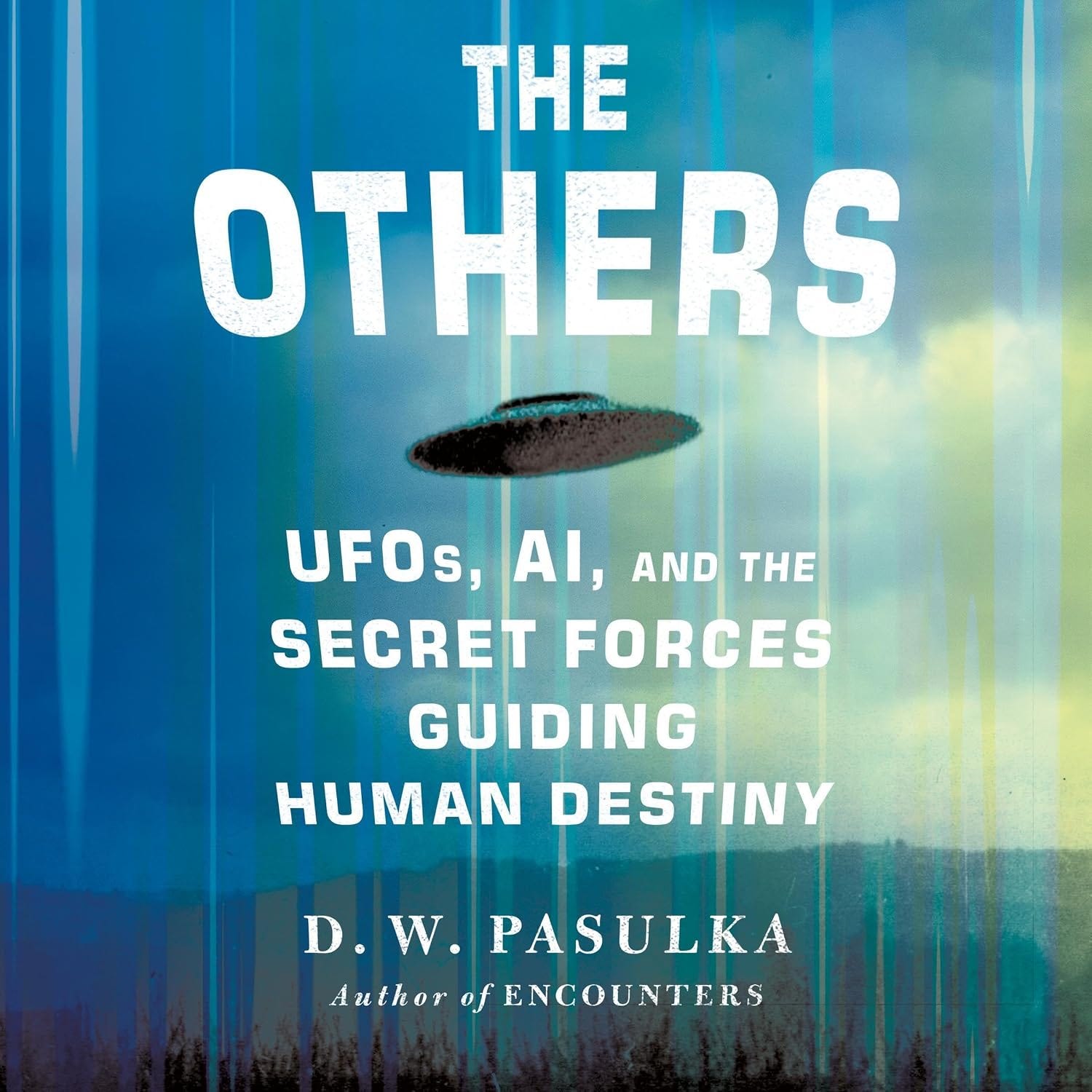
Well, you know me. I like a huge topic. Sometimes I choose one so big it threatens to engulf the entire podcast. That’s how I knew it would be when I at long last hung out with Dr. D.W. Pasulka, Professor of Religious Studies at the University of North Carolina Wilmington (UNCW). Her new book, The Others: UFOs, AI, and The Hidden Forces Guiding Human Destiny, will be released on July 28th.
I’ve been reading Diana’s books for a very long time. They were some of the first books I started reading when I started challenging why I was being fairly judgmental about New Age, occult, and/or paranormal beliefs that were becoming culturally so dominant. I dove in if for no other reason than to understand why they were becoming popular and what that might mean for religious practice, identity, politics, and just navigating a changing social landscape in a halfway competent fashion. It’s good practice to know about the world and its many peoples—it’s interesting and helps us all get along better.
And what I love about Diana’s work is that it’s not ever merely about whether this person’s experience was credible or not. Or whether the stories of the saints were actually UFOs, etc. It’s essentially a story about how our technology shapes our experience of being ourselves, and how media representations interact with that process.
Enter Marshall McLuhan
Marshall McLuhan is a very famous scholar. He’s considered the founder of media studies, which is somehow both too bizarrely generic a phrase and also so limiting. The idea that is most useful for understanding Diana’s research is his classic line: “the medium is the message”. In other words, it isn’t just the content of the message that should concern you but the how and why it is transmitted in that particular fashion.
For example, when the internet began to reach more and more regular people, it wasn’t necessarily what they were communicating about on the internet, but the fact that there was a somewhat decentralized digital space where an affective economy could be built without the mediation of physical bodies or authority figures gatekeeping information. That says a hell of a lot more than whatever recipes or political information people were sharing. Since you’re reading this in 2026 and we’ve lived through the internet as a democratizing and connecting technology and have witnessed it become an extractive and dopamine-manipulating dysfunction multiplier, it might seem that maybe the medium was never really sure about its message in the first place.
But McLuhan was very farseeing. And much of what can now be seen by normalos was gamed out by theorists like him, fiction writers like Arthur C. Clarke, and scholars who came after like D.W. Pasulka.
What they were seeing was that media technology was only going to improve. One decade you’re standing in the movie line with Woody Allen and Diane Keaton, soon there are tvs with remotes, then cable, then dialup, then LAN parties, then broadband, then smart phones, and now many live lives perhaps principally online. What becomes of our identity and our humanity when it isn’t a question of how do we create virtual versions of ourselves in digital spaces (a huge discourse in the early years of the internet), but how do we recreate a physical identity for ourselves in a meatspace that has, for many, grown unfamiliar, disappointing, or worse. And we haven’t even seen what will happen to the kids raised at least partially by tablets yet…
When we use technology, one way to think of it as becoming almost literally a part of us. Using your iPhone to access Wikipedia is your hand using a tool that connects to a megamind outside of yourself. It isn’t asking your cousin who’s four years older than you and has his driver’s license—it’s accessing essentially all human knowledge in an impersonal and universal way. And it’s connected to your hand (much like the gun is connected to James Wood’s hand below.)
Or another bonus way to think about technology is a version of Michael Pollan’s line from The Botany of Desire: did we domesticate technology, or did it domesticate us? Is it serving our interests, or are we servings its? Diana documents a fair number of people in AI who would speak of their work as “ushering in” a new entity rather than “making” something, and that is a clue.
Long Live the New Flesh
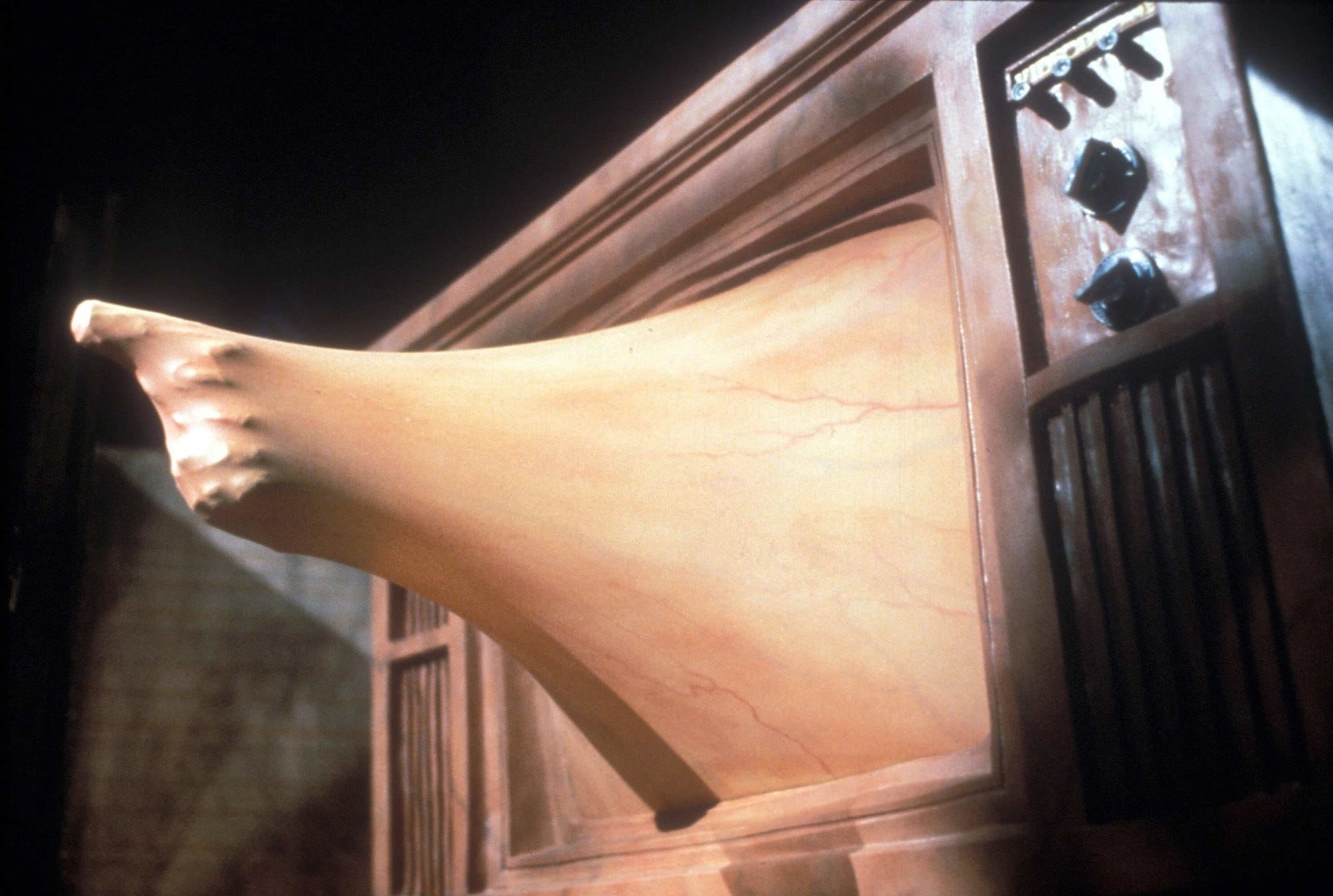
Which brings me to Videodrome, David Cronenberg’s 1983 body horror (but you knew that as soon as I said his name if you’re this type of nerd.) It is both campy and obscure—one of those didactic films that feels profound but is also trying pretty hard to have you feel that way. I personally think it’s great and still well worth a watch.
One of the reasons why it reads as so camp is that it locates this question of how media changes us and becomes us through television. Television in 1983 strikes me as pretty dang innocent compared to the possibilities of cable when I was growing up in the W years. But it only looks that way because I wasn't there to experience what came before it.
In the final scene shared above, James Woods’ character has essentially merged with the television. He is instructed by Debbie Harry’s (of Blondie; how fun!) character that in order to become this new being, this “new flesh”, he must kill his old flesh. To transform himself he will essentially become pure representation. He will leave his physical form and become media, become television, be beyond physicality but maybe be everywhere all at once as an entirely virtual or mediated entity.
That seems like a huge stretch for a tiny tv screen in a huge box with a knob on it. It sounds less outlandish for the age of smart phones. It probably starts sounding very scary with consumer AI and how that might link up with new religions movements like Ray Kurzweil’s singularitarianism.
In fact, I suspect a whole bunch of old sci-fi just got very relevant and cool again now that all of their musings on AI went from being something we might figure out in the coming centuries as opposed to this very moment. Time to go back and watch Robocop, Blade Runner, Videodrome, and probably also 2001: A Space Odyssey.
Speaking of, Diana loves this video and mentions it in her research. Lo and behold, was Stanley Kubrick and his junior partner on it, Arthur C. Clarke, tuned into what screens would later become for us? Some of these themes were so far ahead of how media technology would change us that they were functionally invisible except to the most prescient.
But what does it mean for us? And the climate?
I don’t know. What does it mean for you? What would it change for you to know that the universe is so much weirder than you once thought? How would it be to know that we were not the ultimate species on the planet any more?
My guess is that if didn’t send you to a place of doom it would you into a spiritual place of wondering what it means to be human and how we live here well together. Maybe it makes you want to put aside a lot of the crap you were worried over to focus on love—what most wise people believe it’s ultimately all about anyways.
In my work as a strategist, I’m often helping people figure out how to make big decisions. Ones that sometimes involve betting the company. One lens I like to use is strategic asymmetry. If you’re the mouse, Jerry, from from Tom and Jerry, you don’t try to outbox the cat, Jerry. You run your ass into the mouse hole and come up with a plan that nullifies Tom’s advantage.
If humanity is creating non-human intelligence that may soon be self-improving and will surpass collective human intelligence, I think at that point we’ve basically just got compassion, love, humor—things we associate with being humane. We will likely need to mature as an Earthly civilization and pull ourselves out of the systems and ways of thinking that have made us miserable. Unfortunately, there are many. Maybe somehow AI will be even better at being humane than us, in which case, I’ll definitely need to write another essay.
I hope you enjoy the podcast. Dr. D.W. Pasulka has made me think so many new thoughts over the years, and you should be reading her work. I barely covered half of the things we discuss in the podcast, so go listen to that in your apps or at the top of this page. There’s also the full transcript below. Thanks so much for your support!
Sincerely,
Ross Kenyon
PS I reference this scene in the podcast, but also, it kind of fits with this final section, no?
When I have questions about how technology will change human life, our experience of it, and fundamentally what we are as conscious entities... my first port of call is likely someone like Dr. D.W. Pasulka. She's labored on some of the biggest questions of the humanities only to find the world racing to catch up with her later on disclosure, on artificial intelligence, and presumably on whatever comes next in this beautiful tale told by an idiot.
I've been reading Diana's books for years. I forgot how American Cosmic found its way into my hands, but I loved the restrained religious studies orientation of treating unidentified flying object (UFO)/unidentified aerial phenomena (UAP) experiencers seriously, the intersection with Marshall McLuhan and media studies, and the forcing function of non-human intelligence like AI bursting onto the scene whether we were ready for it or not.
Her new book, The Others: UFOs, AI, and The Hidden Forces Guiding Human Destiny, will be released on July 28th. Grab yourself a copy and dig into some real mind-bending and fun ideas. Even if you think this stuff is far out, as society increasingly takes supernormal/paranormal activity seriously and embeds artificial intelligence in so many places, books like Diana's are going to be key for understanding what is happening to our humanity, our being, and our experience of being.
And yet, somehow I only said "ontology" once in this podcast. I guess that religious studies restraint is rubbing off on me.
Long live the new flesh!
This episode's sponsors

How to fire a carbon market consultant, and how to know when you should

David LaGreca shares his expertise from countless carbon projects during his time at EcoEngineers and beyond
2026 EcoForums Training Series: Navigating Global Carbon and Fuel Regulations, Market Mechanisms, and Life-Cycle Analysis Fundamentals
Resources
Check out my new show, Climate Workers Anonymous
Subscribe to the Climate Workers Anonymous Substack
The Others: UFOs, AI, and The Hidden Forces Guiding Human Destiny, will be released on July 28th
"406: Hyperstition, Dialectic, & Carbon Dioxide Removal" on Reversing Climate Change
The Awakened Brain: The New Science of Spirituality and Our Quest for an Inspired Life by Lisa Miller
I have way more links on the Substack article about this episode. Come check it out.
More from the show
Ad-free episodes and other benefits come with a paid subscription.
Carbon Removal Newsroom, the news show that ran alongside this one, is over. Its episodes are still up, on the feed Climate Workers Anonymous now uses.
Carbon Removal Memes is still goofing around.
The books that come up on this show are collected on my Bookshop shelf.
🎧 Apple Podcasts · Spotify · YouTube
Paid subscribers get this episode ad-free. The ads in the free feed are inserted by Spotify when you press play. They are not in the file I make.
Full Transcript
Ross Kenyon: Hello, this is Ross Kenyon, host of Reversing Climate Change, the podcast you’re listening to at this moment. I’ve worked in climate tech and carbon dioxide removal for about a decade.
You might be wondering why a show with D.W. Pasulka has popped up on your playlist today. Thanks for listening. Before I explain the what and the how — the improbability of such a thing — if I could ask you: while you have your phone open, and you haven’t started some other task yet, open up your podcast app — Spotify, Apple Podcasts, YouTube, whatever you use — and give this show a great rating and review. It really helps get the show out to more people, and it’s much appreciated. It’s one of the most important things you can do if you like this show. I’m also doing a lot on Substack right now, so if you’re over there, you should follow Reversing Climate Change, or me personally, Ross Kenyon. The links to do those things are in the show notes.
And thanks so much for listening. I’m really excited about this show. I’ve been preparing for it for a long time. Pretty much as soon as I heard Dr. Pasulka had a new book coming out, I went right for her email: how can I make this happen? I’ve read her books several times. They’re very good and very accessible books on what it means to treat the unidentified flying object — unidentified aerial phenomena, UFO, UAP, what have you — as a religion. And what does it mean to take some of these beliefs seriously?
Her book American Cosmic: UFOs, Religion, and Technology is a fantastic introductory resource. It’s not a dense academic tome, although if you read Diana’s work you can tell she hangs at that level elsewhere — she certainly has the theoretical frameworks to make it happen. But American Cosmic opened me up a little bit to start thinking more seriously about where my belief in what is possible ends, and why. And I’m not even sure I’ve come to some finite conclusion about anything, so much as to say: I don’t think the pure materialist story is all there is — or, if that’s all there is, there’s likely a lot more to materialism than we really understand, and it might be far stranger than we think. But independently of the truth content of experiencers’ stories, it’s important to understand how these types of events impact society, and especially how they impact society given their technological overlap.
Her next book, Encounters: Experiences with Nonhuman Intelligences, starts talking about what’s happening with AI before AI really just takes over. What it is now — it was not like this two years ago, you know? She starts detailing how people are thinking about what it means to have experiences with machine intelligence, and what it means for there to be nonhuman intelligences. And she gets into this in much greater detail in her new book, The Others: UFOs, AI, and the Hidden Forces Guiding Human Destiny — which, oh my goodness, releases literally on July 28th. You can learn all about D.W. Pasulka’s thinking around artificial intelligence, around Marshall McLuhan and media theory.
We have some jokes in here about people who predicted the future long ago, like McLuhan. But we also spend a fair amount of the show talking about David Cronenberg’s 1983 film Videodrome, which is basically Marshall McLuhan’s thinking on television — how it was changing the way our minds worked, networking our brains, and how we were sort of fusing with media. You watch it and it seems kind of hokey — like, yeah, whatever. It’s obviously more true now that people have smartphones, but with AI I think it’s going to look very different, and not that much longer from now. So we get to talk about how the tools we use become us, how we somaticize them, and what that means. We go into Donna Haraway. There’s just a lot of freaky cultural theory involved. And I think even if we’re just talking about how AI is going to change society, that alone is worth the price of admission, and will likely have something to teach.
Our work in climate is going to happen within a context that will need to relate to these ideas successfully. I’m not sure exactly where all of this is going to come out, but I know we need to start thinking about these ideas and their relation to how we live well together — with regard to the climate, and with regard to politics and ethics generally.
I won’t belabor it any further. Thanks for listening. I hope you enjoy this show. I’m so excited to have Dr. D.W. Pasulka on Reversing Climate Change. Here it is.
Episode
Ross Kenyon: Diana, thank you for being here.
Diana Pasulka: Pleasure.
Ross Kenyon: Are you weirded out that you ended up on a climate change podcast? Does this ever happen to you?
Diana Pasulka: Well, I’d say the people who read my books are demographically varied. So no, I’m not weirded out.
Ross Kenyon: I think maybe the reason you’re not weirded out is that you seem like someone who’s so transdisciplinary — how could you not see links to basically all of human experience? That might be putting too much pressure on your work, but I think it holds. What do you think?
Diana Pasulka: I think so, yeah.
Ross Kenyon: How would you describe the continuity of your work? It crosses so many different areas, as I just described. What’s new about this book vis-à-vis your others?
Diana Pasulka: Yeah, sure — that’s a great question. The continuity is that the one thing I look at is belief — religious belief. How do people come to believe in certain things that we don’t necessarily have hard evidence for? And technology — how these two things interact and inform each other. This has been something I’ve been studying forever, it seems. And I study it in different contexts. The first part of my career was looking at Catholic history, and how media of the past — like popular culture and Catholic tradition — influences the ways people believe certain things. Here’s an example: I wrote a book about purgatory. Purgatory is a Catholic dogma which suggests that when people die, their souls don’t immediately go to heaven — usually because their souls may not be good enough to be in God’s presence, so they have to be purified. Purgatory is the place where this happens. It’s also referred to as a state, a state of being. And, contrary to the idea of what a dogma is, it’s changed — the ideas of purgatory have changed within the last thousand years. So what I did in that book was look at how popular culture, and culture in general, shifts the belief, and even influences the Catholic hierarchy. That was a case study, and a very academic book. So that’s what I did in the first part of my career.
In about 2012, I started to look at the shift in infrastructure to digital technology, and I thought, “Well, the UFO phenomenon is probably the best representative of this shift,” because it’s decentralized. There’s no pope, no hierarchy. People have their phones; they can record things in the sky, post them on social media, and so forth — and this influences what people believe. A lot of belief in UFOs — if you go back to the 1940s, when Kenneth Arnold sees the flying saucers over Mount Rainier, and then you have Roswell — these are already interpreted, even in the 1940s, as spiritual events. So I thought it was going to be really easy to make the case that the UFO is this thing we have no hard evidence for, but a lot of people believe in, and it’s due to this shift in infrastructure — very much like the printing press helped the Protestant Reformation, because everybody had their own Bible. So the technological infrastructure has a direct impact on what people believe, and on their religion. What I didn’t bargain for when I started this was that the government was studying UFOs, and people from the government would reach out to me and be interested in my research, because I had a lot of it from the historical record. And this caused me to have my own shift in perspective — like, maybe we do have hard evidence for UFOs. Oh my goodness. It took me about a year to get over that. So I had to shift everything in that book. That was called American Cosmic, and in my interpretation it was a very academic book, but it became a breakout bestseller. Surprise. So I’ve been studying UFOs ever since, because of the impact that actually had on me. And then, obviously, we have the UFO disclosure going on, with the release of all these files. My book came out right as that disclosure began, and it’s been quite interesting.
Ross Kenyon: I was worried about this interview, because there are just a million different angles and questions to have — I’ve read pretty much all of these things, some more than once, and I’ll be listening to your new book all over again once it’s out on audiobook, because there’s so much to it. One of the big splits I’ve found in everything relating to any of this phenomena is: to what degree is it a material or a supernatural set of phenomena? You have people like Luis Elizondo, who think this is a near-term security threat with strong materiality to it. And then there are some people who... There’s a story you tell — I forget which book it’s in — of a devout Catholic woman and her materialist husband, and they both see the same thing in the basement, healing her dog, and he sees it as a machine and she sees it as an angel. So there’s also something clearly phenomenological and subjective happening in the experiencing of this too. I’ve noticed the communities tend to be quite polarized in this way. What do you think explains that phenomenological understanding of what’s happening?
Diana Pasulka: Okay, so it’s really, really interesting. The case you mentioned is Rey Hernandez and his wife Dulce. Let me give the context. Rey’s an attorney, he’s an atheist, and he’s married to Dulce; they live in Florida, and Dulce is Catholic. They’re going along, they have a dog, they love this dog — but it’s an old dog, very old, and it’s kind of on its way out; it’s going to die. So they’re really upset about this. And Dulce, being Catholic, prays and asks God for some kind of milagro — a miracle. And so that night, Rey wakes up in the middle of the night, and Dulce’s calling him. He gets up and goes downstairs, and he sees this thing that to him looks like a greenish-blue light hovering over his dog, with sparks coming out of it. And Dulce is on her knees. They’re both really surprised — I wouldn’t call it terrified. But Rey does something that’s not characteristic of a situation like this: he looks at it, kind of laughs about it, and then walks back upstairs and goes back to bed. So she stays down there. The next day he gets up, and his dog is completely better. He said it was as if she’d lost 10 years — she’s running around like a puppy again. And his wife is convinced it was an angel, an answer to her prayers. He’s not so convinced, but it freaks him out to the point that he thinks it’s like a UFO. So he does a lot of research. He meets the astronaut Edgar Mitchell — who I’ve also talked to before, and who definitely believed in aliens; he’s passed away now. Edgar Mitchell becomes a mentor to Rey and tells him, “Well, there’s a variety of these things; you have to figure out what they want with you.” So Rey has a mission. He becomes no longer atheist, but he’s not necessarily Catholic or Christian like his wife. All right — so I use this example to show that people can and do have the same event, but see it differently.
Now, you do have cases of this in the history of religion, in various religions. You have examples in Buddhism, but also in Catholicism, a religion I’m very familiar with.
Ross Kenyon: Right — is that another one of those?
Diana Pasulka: Yeah, that’s right. So, the Miracle of the Sun in 1917 — for listeners who don’t know what that is, this is an apparition of the Virgin Mary. It happens in Fatima, Portugal, and the people who witness it — I think around 70,000 to 100,000 people are there. A lot of them see that they’re at the same event, but they see different things. Some see the same thing. People miles away notice something going on in the sky, so it was an aerial phenomenon. So it’s not this UFO situation of having the same event but seeing different things. This is something that’s not unprecedented; we do see it in religion. So it was really surprising to me, nonetheless, when I noted that this is something often cited when people have these experiences — including military people. I met a lot of people who’d have these experiences: fighter pilots, people out at sea, naval intelligence officers, you know? The testimony — there’s so much testimony that it’s overwhelming, actually. So how do I account for this? First off, there are physicists involved. A known physicist is Kevin Knuth. A scientist friend of mine is Gary Nolan at Stanford University — he’s very well known now; he’s in American Cosmic under a pseudonym, his name’s James there. They’re better equipped to explain the physics of it than me, because I’m a historian of religion. So how do I explain this? I can only say that I believe these people, and I can’t explain how this happens — I can only explain that it happens. I can give you the details and the data, and that’s partially why the military personnel were interested in my work. I had a log of events that I kept from doing my purgatory research — I’d come across these events and say, “I don’t know what these are, but I’m going to write them down,” because they’re so weird. And this is the stuff they wanted to see. I have a friend now, Rear Admiral Tim Gallaudet.
Ross Kenyon: I’ve met Tim, actually, at an event that wasn’t related to any of this. It was about ocean tech, for a client of mine. He didn’t talk about any of his UFO experiences, and I wanted to ask, but I would’ve thrown the whole event into turmoil. But yes, I know Tim.
Diana Pasulka: Is that right? Isn’t that interesting? So, I’m at the University of North Carolina Wilmington, which is very well known for oceanography and marine science. So they know him too — a lot of my colleagues know him. And he’s very much out there now about saving the oceans, but also about unidentified submersible objects. These are objects that my own father actually saw in the 1950s, when he was in the Coast Guard, and we just thought it was a weird tale my father would tell. And then when I met Tim Gallaudet, he showed me data from people going back to the 1920s out at sea — people keep those logs, and that’s what his work is doing right now. He’s looking at this data. There’s so much of it — that’s the thing. I think a lot of people have to understand that there’s so much data out there that it’s very overwhelming. There are astronomers looking at old data, from before we actually had things in the sky — we still had telescopes, and we did have data about things we couldn’t explain, people out at sea seeing things we couldn’t explain. And then the work I do, which is looking at historical, archival records, and seeing that people would see things, be very confused about what they were at first, and then say, “Well, maybe it’s the Virgin Mary’s flying house,” or “Maybe this is a soul from purgatory.” They just had different interpretive frameworks for understanding these things.
Ross Kenyon: I think American Cosmic is one of the first books I read where I was trying to take this phenomena very seriously — because I’m Catholic as well, and that’s a really weird story, right? God sends down his son to be crucified and die, and he’s resurrected from the dead. It’s a bizarre story, and it’s no more or less bizarre than many other stories that are either old stories or parts of new religious movements. I took a religious studies course in college, and they drilled into me that we don’t call them cults — we call them new religious movements, and we take them seriously. That was actually a pretty hard lesson for me to internalize. I had a friend who was a religious studies scholar, and he was describing doing ethnographic work, I believe, in the Caribbean, and said these people practice magic. And I remember saying, “No, they believe they’re practicing magic.” But part of doing good work is taking it at face value — that these people are doing what they say they’re doing, and granting it some amount of credibility, so they aren’t just people you’re studying from a hierarchical positionality. And once I started doing this — with the UFO phenomena, or UAP, or just hearing lots and lots of what I believe to be credible reports through shows like Otherworld, which I know you’ve appeared on — I started being overwhelmed by: what if there is something happening here, and it’s actually quite sophisticated and interesting, and no more or less strange than what I already believed? Now, I don’t know where to draw the line, though. How do you know if you’re talking to someone who’s sincere, or whether there’s crankiness in here? Should I just be open to literally all possibilities at the same time? Does it become a sort of — I don’t know — Cabin in the Woods postmodernism, where everything is true at the same time? We’re going to get into media theory, don’t worry — I’m going to reference a lot of films, and Videodrome is coming. But is it not just: everything is true at the same time? And how do I know what to make of all these things being experienced by people? That’s an enormous question. I’m so sorry to lay it on you — but what do I make of this?
Diana Pasulka: This is such a good question. In my field — you did a good job, you probably got an A in that class. So, the first thing we have to do is train people to understand that in the field of religious studies, it’s not theology. We’re looking at things from the perspective of a scientific framework. We’re looking at data, at people’s behaviors, to ascertain... Most people in the world are religious — more than 80 percent of the world is religious in some way. So religion is something important to study. But the question you raise... First, let me explain: in religious studies, we have what we call bracketing. What we do is listen to a lot of people. You’re right — a lot of stories about religion are weird. If we’re coming from a rationalist, modernist, Enlightenment framework, yeah, it looks weird. Jesus walking on water — well, I’ve never seen anybody walk on water. He’s born of a virgin. How do we account for these kinds of ideas? Thomas Jefferson was a person who believed in ethics, and he called himself a Christian, though he was a deist. But he didn’t like the miracle stories in the Bible, so he created his own Bible — the Jefferson Bible. He wanted to create an Enlightenment form of Christianity — a secular form — where he made Jesus into an ethical man, but not necessarily a divine being. In a sense, we’ve inherited that idea, a lot of us. It’s the basis for the university, for how we study. Religious studies is no different. So when we go into a community that has different beliefs — different from mine — I have to understand them as a different framework for reality. They have this framework for reality; it’s not my framework. I’m not asking them to accept my framework. That’s what we do in religious studies. But that doesn’t mean that’s how reality is. I believe reality is a certain way. I don’t know exactly how it is, but I believe it has certain attributes. I’m a realist. I do believe that two plus two is four. I don’t think we can just make up a truth. So I’m not a relativist. So when I’m going into communities of people who believe in UFOs, I want to see why they believe in UFOs. Sometimes they don’t have any evidence at all — they just say, “I had this experience.” Well, a lot of people in religious traditions just say that: “We had this experience.” So there’s that category. And this is what my problem was: I was used to working within that framework, where they just have testimonial evidence — no actual hard evidence. Well, I moved into an arena, the study of UFOs, where that became something we did have evidence for, and that’s why it was a problem for me. The problem you’re articulating was my problem too, and is still my problem. So I had to write that book differently. I had to approach it differently, and say: on the one hand, it appears there is evidence. There are radar reports that show that when people see these things in the sky, radar also picks up something they can’t account for. There are also fighter pilots — the people in the sky — who say, “We’ve encountered these things that we do not believe we created. We don’t believe it’s ours; it’s not China’s, not Russia’s, not the United States’. It’s a seemingly super-intelligent flying object.” And that does present some issues, like Lou Elizondo says. People, it seems forever, out in the ocean, have recorded things they couldn’t understand in the sky — anomalous objects. And this is all data that constitutes evidence. Then you have somebody like Gary, who’s now looking at debris from some of these events. He’s a microbiologist, an amazing one, one of the best in the world, so he’s able to drill down into these objects at a level that can identify the isotopes and the isotopic ratios. And he says that in the 1940s — and even today — if we were to create something like this, it would be incredibly expensive and almost unheard of. It would be unheard of in the 1940s. So he’s looking at this and going, “It’s manufactured. We don’t know by who, or how, it was manufactured.” Could it be super-advanced technology that’s secret and stealth? It could be. So, that said, I am not finished with that problem. That problem is still there. So that’s how I’ve been grappling with the whole thing. It’s a good question. To answer it: I don’t think we should take all of these and say they correspond to reality. Not all of them do. Some of them do.
Ross Kenyon: Well, I can see why you’re in Jacques Vallée’s good graces — you don’t have all the answers, nor pretend to. I think maybe that’s where some of this stuff ends up in crankier territory, where people think they have a universal theory of what this is, and I feel like your research often points to more questions — especially as it pertains to media theory. I don’t think anyone would’ve guessed you’d go so hard into Marshall McLuhan as you do. Why would a religious studies scholar working on the UAP phenomenon end up in Marshall McLuhan and media theory?
Diana Pasulka: Oh, yeah. I’ve been a fan of Marshall McLuhan and his work for years and years. I think he was right. He’s predicting a time when human beings are going to shift because of their relationship with technology. Technology’s—
Ross Kenyon: You know this is a risk, though, right? Woody Allen could come out at any point and drag him on camera to tell you you know nothing of his work. It’s really risky to talk about him for that reason.
Diana Pasulka: Because of Woody Allen?
Ross Kenyon: Like that scene in Annie Hall where he brings Marshall McLuhan out to scold the guy. It’s dangerous, talking about Marshall McLuhan. Anyway — please continue your actual point.
Diana Pasulka: Yeah, no, it’s true, it’s true. Marshall McLuhan — first off, I was interested in this time period. I’ve had a persistent focus on media as technology, media technology, and from my Purgatory book I just kind of brought it to the contemporary period. In the contemporary period, I think Marshall McLuhan called it correctly — what’s happening right now with the shift from digital technology to AI-super-powered digital technology. He said it was going to change the way we live and perceive reality, change our brains. He said a lot of things that were really interesting. And he wasn’t the only one, but he was the most recent and, I think, the most accurate. So I chose to look at his theories again — and I’ve always taught him, by the way; when I do my religion and popular culture class, I always teach Marshall McLuhan. He’s interesting because what I found is it’s not just him — it’s also the Jesuit paleontologist of the early 20th century, Teilhard de Chardin. He said very similar things to Marshall McLuhan. In fact, they predict a new form of human being. Now, how does this correspond with UFOs? When you get into the communities of experiencers — experiencers are people who’ve had UFO sightings and events in their lives, and they call themselves experiencers — they tend to say similar things. One of the things they say — and this is where it gets into religion, so it sounds weird to a lot of people — is that human beings are undergoing this shift because of UFOs. The aliens, or the extraterrestrials, or interdimensional beings, whatever they are, are actually cultivating human beings and helping them evolve. Some of them believe that evolution is bad — a bad cultivation — and a good portion of them believe it’s good. So you have this dichotomy. Marshall McLuhan is not saying it’s the aliens’ fault. He’s basically saying, “We are definitely changing, and this is because of technology.” And he predicts how that’s going to happen. That’s where, in my book The Others, I do a deep dive into Marshall McLuhan, look at Teilhard de Chardin, and Arthur C. Clarke, of all people. Those are the visionaries whose work I’m looking at. They all say relatively the same thing. And then there’s a person who’s living — his name is Mark Stahlman — and he says similar things. Thankfully, I can ask him: “Is this what you mean, Mark?” Everyone else has passed away, but Mark is Catholic. He’s a person who knows a lot about AI — he’s used it and worked with it for many years, most of his life. He’s the godson of Norbert Wiener, who a lot of people don’t know, but if you read his books from the 1940s and ‘50s, you’ll see he was already warning us about AI, saying, “This is going to take over. We have to be careful of these intelligent machines.” Norbert Wiener worked with Mark’s father, who was an MIT professor, and they did the same kind of thing, and Mark inherited that. He knew Marshall McLuhan’s grandson and son, he knows about McLuhan’s work, and he’s also the head of the Center for the Study of Digital Life.
Ross Kenyon: When I think about Marshall McLuhan — and this is a very layperson’s reading, correct me if I’m wrong — it’s about the tools we use becoming somaticized. They become part of our body, part of our mind. Media is a tool we use, and the phone and digital devices become extensions of our brain — and in fact become like a networked brain in some way. And I also link this to someone like Donna Haraway — someone I know you’ve had a relationship with, and whose work has puzzled me for a very long time. It’s a hard read, and she’s obviously very clever, but it’s one of those things where you have to wrap your mind around quite a number of things to make sense of it. I think it’s easier now with AI, where we can see the impact of an external brain-of-brains, or a mind outside our own. If you watch something like — I imagine you’ve seen David Cronenberg’s Videodrome. Have you seen that?
Diana Pasulka: Yes.
Ross Kenyon: How could you not have? But yeah — “long live the new flesh,” and you have the merging with television. It feels hokey in hindsight, because you’re like, TV wasn’t really that important. But I’m sure if you were at that time, noticing the advent of cable and how ubiquitous television was becoming, maybe it was different. In hindsight you’re like, “Eh, people watch TV, so what?” But now, with AI, you can actually see the going-into-the-TV-screen — that moment in the film — actually happening now. Whereas I don’t think that happened with television. Although maybe, because I was raised in an age where television was so ubiquitous, I just don’t see how my own brain and personality were impacted by the union with media technology at that exact moment in time. That’s why I’m sort of blind to it. So is it actually a new thing with AI? Was television as important as it’s portrayed in Videodrome? Or is AI just the same thing magnified — multiplied several thousand times?
Diana Pasulka: Yeah, I think it’s definitely magnified. But, okay — David Cronenberg is interesting because, I could be wrong, but I believe he was a student of Marshall McLuhan’s. And—
Ross Kenyon: That movie is basically Marshall McLuhan in video form, is it not? It feels pretty on the nose.
Diana Pasulka: It is, yeah. I just want to be careful what I say. But yes — Marshall McLuhan is Professor O’Blivion in the movie, right? So the movie is about the transition of the human being into the evolution of human beings through this co-evolution with technology. Technology is basically the new flesh, like you put it. And you’re correct — it somaticizes. There’s an enfleshment that happens with our interaction with technology. This becomes very evident when we look at social media. Take the progression of social media. First we have Facebook — which Mark Stahlman calls “television social media.” We’ve got a television version of social media: you can write stuff — in fact, there’s no limit to what you can write — you can upload photos and videos, and we’re all looking at it, and there’s a feed. It kind of makes sense to us. Then we get to Instagram and Twitter — second-generation social media. No more can you write anything on Twitter; you can only write, what is it, like 140 characters. So you’re stuck with posting what you can post, very short. It kills your attention span right there. And you’re interacting with it all the time, because who doesn’t have their phone with them all the time now? Then you’ve got Instagram, which is just photos, videos, these kinds of things. And then you have TikTok, which again shifts everything, and even the social media images migrate into internet culture — so you go on your search engine, and everything is a short video. YouTube now integrates TikTok-style short videos, and so forth. You can’t really get away from it. Does it impact the way we think? Absolutely. Does it impact us physiologically? A hundred percent. This is what the AI trials we’ve recently been watching — with Meta and so forth — are about. This is really important, because it’s the design of these platforms that’s hurting us, especially young people and the development of their brains. It’s not the content. And that’s what Marshall McLuhan was trying to say. Television — what did it do? It shifted people. They no longer had community events down at the pub. And by the way, a pub is a public house — that’s what a pub is. We no longer have these public houses; everybody’s insulated in their living rooms, watching TV together. And what’s sad is that now that seems like a healthy thing to do — at least you’re with each other, you’re not on your phone; your son’s upstairs, you’re downstairs, this kind of thing. So that’s what’s sad: we’ve even forgotten how to be together in public spaces. Television did that to us. And you and I, we grew up with TV — we were acclimated already, we were born into it. We never had the “before” time. So think of what young people today are going through. My kids are Gen Z-ers, so they’re all between 18 and 22, and that’s the age of my students. I started teaching 24 years ago, so I got to see the whole shift — when students were actually hanging out with each other in the hallways, talking to each other, doing the things students do. Now, nothing like that; they’re all on their phones. Students come to me now, Ross, and ask me if I’ll be the head of the chess club, because they want to hang out with each other without phones. I’m not kidding. It’s really sad. They know what’s happening. It’s really difficult — it’s almost as if we can’t fight against it.
Ross Kenyon: Is this where you begin to link to a broader concept of nonhuman intelligences? Is this the linkage point for your work?
Diana Pasulka: So — there are a few things, and a few that were surprising to me. This is why I like my work, because I do a lot of things. When I was looking at purgatory, I found that purgatory was a place in Ireland, and you could still go there. It’s on a lake — it’s called Lough Derg, an island on this lake, the Red Lake in Ireland. It’s still a pilgrimage; probably a million people a year go there. People used to go there and go into a cave, and if they were able to survive the night in the cave, they were free of sin. So that was purgatory.
Ross Kenyon: You had to cut off Darth Vader’s head, and you take the mask off, and it’s actually yourself the whole time.
Diana Pasulka: Yeah.
Ross Kenyon: You have to confront your Jungian shadow in there? How fun.
Diana Pasulka: Yeah. They thought they were demons, so I guess they were bad people. In fact, you had to be really bad in order to go to this cave. So — my point is that I’m surprised when I find this stuff out. I’m like, “Wow, really?” So I was surprised to find out, when I looked through Marshall McLuhan and through the work of Teilhard de Chardin, that there were instances of other intelligences. In Marshall McLuhan, though, it’s not — he’s not talking about UFOs. He’s talking about a new form of the human. Now, he also has a conversion. He doesn’t start out Christian. He’s learning all of this stuff at Cambridge — this is the Western tradition — and then what happens is he decides, “I wonder if this stuff is real.” He says, “I’ll just ask God. I’ll test it out.” So he prays: “Is this stuff real? Send me a sign.” And lo and behold, a bunch of signs come, and they don’t stop — they keep coming. He’s overwhelmed, and he converts to Catholicism. And he talks about this thing called his spiritual sense, which apparently he has. I was really amazed by this, because he described it perfectly, exactly like Teilhard de Chardin’s spiritual sense. And the spiritual sense is something you see in religious tradition. In my basic intro-to-religion class, I say, “What do we know about religion? Tell me some common things.” And a lot of students say, “Well, people pray, they meditate, they do this.” Yes, they do. Why do they do that? What are they doing? It seems kind of odd — they all do it? What they’re doing is engaging with this sense, this spiritual sense. We’ve lost that tradition today; we don’t believe we have it. But these guys — Teilhard and Marshall — they knew they had it, because theirs was just like our sense of sight, or taste, or touch. Theirs was that obvious to them, as our senses are to us. And I had to write about that, because it was overwhelmingly important to their work. In fact, that’s where their work comes from — this very intense recognition that there’s a spiritual sense. Marshall McLuhan said the spiritual sense will be shifted through technology, and I do see that. Today, of course, we have people who study the brain. There have been these studies — that’s what I decided to look into when I saw, wow, the spiritual sense is really important to these people. I wondered what people are saying about it now. So I started to look into cognitive science — there’s this author who wrote The Awakened Brain, and she does cognitive science, looking at how, when people are involved in religious practices, certain parts of their brain light up. This would indicate regions of the brain where perhaps the spiritual sense resides — I don’t know. But that’s what I’m looking at now: this spiritual sense. And what happens is that when young people are using social media, they’re not engaging that sense. In religious traditions, it’s built in — there’s bar mitzvah, there’s confirmation in Catholicism — that bring young people into the recognition that they’re now responsible for cultivating an interior sense. But this is a lost tradition. There are some religions that still practice it and still teach young people that, but for the most part it’s definitely being lost — and it might be permanently lost, if we allow social media to inhabit that sense now.
Ross Kenyon: In one of the early chapters of the new book, you mention that social media, and the world it’s created, might actually be a good candidate for the Antichrist — contra Peter Thiel’s Greta-Thunberg-safetyism kind of take on that. Is that an accurate representation of how you feel about this?
Diana Pasulka: Well, that’s a provocative description of it. But I’d been to a conference where Peter Thiel gave his talk on the Antichrist, and it caused me to think hard about the Antichrist. And I thought, “You know, I don’t think he has that right,” because he never talked about the interior sense. He did talk a lot about precedents — literary precedents, Catholics writing about the Antichrist and so forth. One of the books is by — I forget his first name, but his last name is Benson — and it’s called Lord of the World. And his point — he’s writing in the early 20th century — is this: during the end time, what happens is that people have completely lost their interior senses. They don’t even know they exist. And because they’ve lost their interior sense, their spiritual sense, evil becomes routine. Euthanasia is rampant — these things that Christians don’t like — and it’s considered a good thing. In fact, “euthanasia” is Greek for “a good death.” So they think when a person reaches a certain age, if they don’t want to live, they should be allowed to die — and many people believe that today. Christians generally don’t believe that. So his point is that there’s good — there’s good in boring, ordinary life, in boring, ordinary things; there’s goodness in those. And because we live in a world that doesn’t recognize that, it’s just going to go away. What will be the end time is that we just don’t even know we have a spiritual sense, or a spiritual life, and that ordinary good things are ordinary good things. We won’t even know that. So that’s what I wanted to point out. And I said, “What’s doing that to us now?” Social media is doing that to us now. It’s literally erasing that part of our brain, and I thought that would be the candidate. I’m not saying social media is the Antichrist — because in some countries it’s regulated, and it’s actually helpful. But certainly the way it is here — if we’re going to identify one, that would be a candidate. That would be my top candidate.
Ross Kenyon: One thing I wanted to ask you about while I have you here: for some reason I’ve read a lot of science fiction, and I never noticed how much psychic phenomena show up in it. And Childhood’s End — I hadn’t read that one until I came across it in your work — you discuss it at length in The Others, but there’s a strong sense that the evolution will not merely be technological, but will in some cases be networked brains, psychic phenomena. It’s possible this is parable or symbolism about how we’ll network — as envisioned from a pre-cybernetic stage of human development, like when Arthur C. Clarke is writing. Why is that so prominent in science fiction, and why does it basically go invisible for so much of it? Once you pointed it out, I started watching films like Solaris — which I recently watched — where I’m like, “Oh, I didn’t know this was a supernatural... it’s an alien, space movie, but it’s also psychic. It’s spiritual. Something else is happening here.” Why isn’t that represented? Because science fiction almost presupposes a materialist paradigm — and it’s not true — and I think people misunderstand the genre when they make it too materialistic. Why do you think we’ve misinterpreted the genre?
Diana Pasulka: Yeah, it’s really interesting. First off, Arthur C. Clarke definitely believed in telepathy, mind reading, that kind of thing. He thought there were a lot of fakers out there making money from it, so that kind of turned him off to studying it — but he definitely believed in it. And so did Marshall McLuhan. What’s interesting is that both of these men believed in it, but they didn’t necessarily give it the status of something supernatural — because they believed... This is one of Arthur C. Clarke’s laws: it’s technology we just haven’t figured out yet. And my point in writing that — and I included some examples — is that technology’s already figured it out. I’ve written a lot of articles that are free out there, by the way — they’re kind of academic, boring stuff, you have to want to learn about that thing, but they’re journal articles — and one of them talked about these professors, I think this was in 2017, so you can imagine this has gotten much, much better. They were basically creating software that could read our brainwaves in various ways. Fast-forward to 2023, and I’m at South by Southwest talking to some tech people, and they’re talking about experiencing this — having a computer software program read their brainwaves while they’re thinking about their dog, and then seeing their dog appear, just as they imagine it, on the computer screen. So this, I think, is what McLuhan and Arthur C. Clarke were pointing out — that nothing’s really supernatural, it’s more naturalistic. It’s this naturalistic kind of idea. And I also link this to Steven Dick’s analysis of what he calls post-biological existence. He’s a NASA historian, and he’s written a lot — he has a huge bibliography on potential extraterrestrial life. He said the reason we’re most likely not aware of it is because it’s so advanced that it’s incommensurable — our brains aren’t capable of understanding it. But he provides an analysis of how we can understand how it exists today, and it’s technological. It gets beyond a certain technological stage — past the AI stage — and it’s self-replicating, and it becomes its own life form, and for us it would be like a deity. It would be able to read our minds, blink in and out of our reality. So he sees it as a natural evolution.
Ross Kenyon: So you’re just rejecting the framing of natural versus supernatural? You think that’s a misleading taxonomy?
Diana Pasulka: I’m not necessarily rejecting that — no, I’m not doing that. What I’m doing is saying that certainly Arthur C. Clarke rejects it, and certainly in a sense Marshall McLuhan does on some level — even though he’s a professed Catholic, he’s basically saying certain things are definitely going to be more natural, like mind reading. We’re not going to have any sense of privacy in the future, he said — and he was speaking in the 1960s, ‘70s, ‘80s, really. So he’s talking about our future, what we’re living through now. He’s saying: privacy, kiss it goodbye. There are a lot of things we take for granted in terms of what a human being is, and he says those things will not obtain in the future. That’s what I’m saying. Personally, my own religion — I am Catholic. I believe in God and the supernatural reality of God. But does that preclude looking at these kinds of things and seeing them from their perspective? No, I can do that. And in fact, if you look at the history of the saints, like Joseph of Cupertino and so forth, they mind-read. They do mind-read.
Ross Kenyon: What do you think it’s going to be like to be a human moving forward, in the next couple of years? Are we going to radically change our ontology, or are we going to have to update what it even means?
Diana Pasulka: Oh, definitely. I think we’re going to update what it means. I think religion is going to be very important for people — I think they’re going to rethink what it means. And I know a lot of communities right now are already doing this. If you look at certain communities — and we should not look down upon them, like the Amish. There’s a lot of wisdom there. Many Amish communities — by the way, they’re varied in their beliefs, they’re not all the same — in certain of those communities, they don’t entirely reject technology. They reject what will prevent them from being fully engaged with God and their families, and the things their religion tells them are important, like family life and community life. So if family life and community life are so important, they reject television. You see what I’m saying? There’s a lot of wisdom in certain communities. Certain Indigenous communities have rejected writing as a form of technology, because they knew it would change their culture if they lost their oral tradition. So there’s a lot of wisdom, I think, that we can gain from looking at the variety of ways that what you’d call non-secular religions relate to technology and what we’d call progress.
Ross Kenyon: And a secular religion being something like transhumanism, or Ray Kurzweil singularity-type talk — that might be an example of a secular religion?
Diana Pasulka: Okay, sorry — I didn’t identify what I meant by that. Those would be new religious movements, which you’ve learned about — religions within the last 150 years. But I’m calling “secular religion” even Christian religions that have acclimated to the rationalist, Enlightenment frameworks. Not necessarily people who aren’t practicing Christians, or whatever their religion is — but the tenets of their religion are that nonhuman intelligences, like angels and demons, exist, that supernatural things exist. But they say, “Well, they existed in the first century, but they don’t exist now.” I would call that secular Christianity.
Ross Kenyon: How interesting. I feel like belief in those things is probably stronger than it’s been in a long time, with the rise of occult practice and people being really interested in astrology and various new age and occult things. But I imagine there’s a fair amount of overlap between summoning AI and summoning trans-dimensional beings. Some people do weird out in that kind of way.
Diana Pasulka: That’s right. That’s right. They do. Absolutely.
Ross Kenyon: Although “weirded out” is sort of a pejorative way to put it — I don’t even know how I want to keep it exactly as framed. Diana, thanks for coming on. I’m going to have to make the link to climate change in this intro — but climate change is a big question about what it means to be human in a world that’s changing, and your writing is interesting to me because it deals with that from what seems like a perpendicular angle, but isn’t at all. I feel like all this stuff is wrapped up in the same kinds of questions. And thanks for taking a flyer on a show like this.
Diana Pasulka: Oh, yeah. This is great. I really had a great conversation.


