



Episode 374 of the Reversing Climate Change podcast. You can listen on Spotify (subscribe there for ad-free), Apple Podcasts, YouTube, or wherever else you listen. Paid subscribers get the ad-free version right here on the page.
World War I profoundly changed the world. Nation-states replaced empires. Russia went communist. Fascism arrived. The West's claim to being the most civilized peoples on Earth was supremely undermined. And out of so much suffering, we received a holiday prioritizing grief and mercy.
This bonus episode is me speed-running World War I and sharing some reflections on Armistice Day, Remembrance Day, Veterans Day, or however you might call it.
If you carry any of this grief with you personally, I hope you are able to forgive yourself and others. The choices of this world are not always easy, and we make mistakes.
This episode's sponsors

Absolute Climate: the only standard that’s developed independent of registries
Philip Lee LLP: legal resources for carbon removal buyers and suppliers
Listen to the RCC episode with Peter Minor from Absolute Climate
Listen to the RCC episode with Ryan Covington from Philip Lee LLP
Resources
"In Flanders Fields" by John McCrae
There are a lot of references in this show. Normally I'd link, but for now, maybe just look some of them up if you feel so inclined.
More from the show
Ad-free episodes and other benefits come with a paid subscription.
Carbon Removal Newsroom, the news show that ran alongside this one, is over. Its episodes are still up, on the feed Climate Workers Anonymous now uses.
Carbon Removal Memes is still goofing around.
The books that come up on this show are collected on my Bookshop shelf.
🎧 Apple Podcasts · Spotify · YouTube
Paid subscribers get this episode ad-free. The ads in the free feed are inserted by Spotify when you press play. They are not in the file I make.
Full Transcript
Ross Kenyon: Hello, thank you for listening to Reversing Climate Change. I really appreciate that. My name is Ross Kenyon. I’m the host of Reversing Climate Change, and I have been for about eight and a half years now. I’ve been working in climate for that same amount of time as well. This podcast is a repository of learnings, observations, thoughts, feelings, the gathering of so much content about so many different topics. This is a little bonus episode. The topic is so broad, I couldn’t hope to do justice to it.
But my goal is to say something that might make you think as a little bite-sized episode before you go about your day. Normally, I run a little segment at the beginning of the show talking about our sponsors. I’ll just tell you about them now very quickly. Absolute Climate, Peter Minor, one of their co-founders, was on the show a few months ago talking about how they are actually supporting registries within carbon removal and carbon offsetting. So that registries do not need to develop their own methodologies. They actually think it’s a better system if that function is not affiliated with the registries themselves.
And that’s typically how it’s been done. So absolute is proposing a new way of doing things through which registries are not the main actors in methodological development. They have a very interesting business model. And that episode is great. I highly recommend it. The link is in the show notes. The other sponsor of this show is Phillip Leat LLP. Once you’ve been in carbon removal or climate tech long enough, it probably doesn’t even take that long before you realize that you need competent legal advice.
The big deals that happen in business, the big deals that happen in the carbon removal or climate business, They need representation. Philip Lee LLP has received accolades for their work supporting VCM actors. So if you’re working in the voluntary carbon market space, working on a big deal, you need legal advice, consider Philip Lee LLP. Guess what? I’m also just going to skip telling you about why you should give the show five stars, rate and review it, blah, blah, blah, and become a paid subscriber. I’m going to skip that today.
You know, I just don’t feel like doing it. I don’t always love the begging. So hey, I’m just going to give this one to you. Do what thou wilt shall be the whole of the law. Who said that? I think Jesus said that. He did not say that, actually. I think that was Aleister Crowley or someone like that. Okay, whatever. Weird start. Weird start to this show. Okay. So actually, today, I’m going to talk about Veterans Day. I have long appreciated this holiday.
Many of the big holidays, they’re treated as a day off. There’s not much of a remembrance. There’s not much of a I actually think Veterans Day is one that can be really beautiful. I like thinking of it in its original method of celebration. It’s Veterans Day. But I actually like referring to it and thinking of it and casting my mind backwards into when it was called Armistice Day. After World War I, on the 11th hour of the 11th day of the 11th month, World War I ended.
World War I is not a very well understood war situation. As an American, we very much look to World War II as our sort of defining war. I think for the most part, it’s the most easily understood of them. In actuality, it’s much more complicated than it looks, but the story is seductive. The bad guys, very obvious. The Nazis are the bad guys. And... Obviously, this is complicated, though, because the U.S. was allied. It did Lend-Lease and then was allied with the Soviet Union.
And this created a whole bunch of storytelling difficulties here that I don’t necessarily need to go into right now. But suffice it to say, allies good, Nazis bad, is like a suitable stand-in story for the most part. World War I does not have that. If you ask people what World War I is about, I think in many cases they probably couldn’t tell you. I think if you do get an answer, the answer is something like treaties and it was about why you shouldn’t be allied to so many countries because once the diplomatic deals start triggering...
One is forced into war, and therefore we should be very careful about which kinds of alliances we should actually seek with other nations, which is a fine point. And there are books that explain this and document this very well. Books like The Guns of August by Barbara Tuchman. This book has come up on a number of shows. It’s a great book. She’s an amazing writer, amazing popular historian. Highly recommend reading any and all Barbara Tuchman books, even ones that maybe haven’t aged as well as others.
Like I think her book on Vinegar Joe’s Stillwell in China. I read a book recently that really challenged some of her scholarship about China. But whatever, like Barbara Tuchman is an amazing author, great storyteller, and she documents how the Western powers essentially sleepwalked their way into World War I. One of the common things that gets said about it is that it was an alliance system built by Otto von Bismarck, Prussian unifier of the modern German state, who is such a skilled statesman that only he could have unwound the sort of doomsday machine of August 1914 when Archduke Franz Ferdinand was assassinated.
He was the only one who maybe could have kept the alliance system from clanking onward into large-scale protracted war. And when one thinks about World War I, they’re pretty much always thinking about trench warfare and how brutal and slow-moving and how pointless it all felt. I recently watched the new All Quiet on the Western Front, the new one from 2022 on Netflix. I thought it was a brilliant film. It had a lot of humanity in it and a lot of the big WTF of World War I.
You have the death of idealism. You have kids who are brought up with the Latin is dulce et decorum est pro patria mori. How sweet it is to die for one’s country, essentially. And the war is going to be over by Christmas. And of course, it ends with most of your friends or nearly all of your friends dying in gruesome ways, being put in a position where you have to enact intensely brutal violence against others. Witness suffering. And the suffering is for goals that hardly seem worth the sacrifice.
I mean, people think of the Western Front as going over the top, as it was called, going out of the trenches and running across no man’s land. And even if you took the first system of trenches of the enemy, there is defense in depth where there’s lots and lots of trenches behind that on both sides. And there’s troops kept in reserve so that when that does happen and there is a breakthrough, the troops in reserve can rush back in and push the enemy back out. Static. Now, we associate World War II and German generals like Heinz Guderian with the Blitzkrieg, lightning warfare.
This is a reaction to getting bogged down in World War I. How do you create, in a system of very long trenches, like there were in World War I, the Blitzkrieg in World War II was... Using air power and armor and mechanized and motorized troops, how do you create a very small breakthrough in the line and rush a lot of troops through there and get into the backfield, essentially? And that was done to amazing effect in World War II. Once the German invasion of France in 1940, here, I’m looking at right now how long it took.
It took about six weeks. To conquer France in World War II. Just because of the focus on mobility, speed, concentrating power at very narrow points, breaking through, and new types of weapons for which trenches were not successful at stopping. The classic thing that people point to here as well is the Maginot line. An old yarn is that generals are always fighting the previous war. And one of the lessons learned from World War I in France was that they need to better prepare static defenses to make sure that when Germany invades again, they will be able to hold them at the French borders and not give any ground.
This was the wrong lesson, the wrong conclusion to draw from World War I. It was much more fluid on the Eastern Front. Battles like Missouri and Lakes are famous for German mobility. It was not uniformly static trench warfare like it was on the Western Front. And there are even places that are very important to Australians and New Zealanders like Gallipoli. That started off as being a zany Winston Churchill-based outflanking maneuver. How can we break the Western Front and open up another front? And knock Turkey out of the central powers.
And it didn’t work. It just led to massive amounts of death and bogging down in another system of static fighting in Turkey. Though I suppose I should really be saying the Ottoman Empire. It’s confusing sometimes because Mustafa Kemal Ataturk, who was the founder of the modern Turkish state after the Ottoman Empire collapsed at the end of World War I, commanded at Gallipoli, which is one of those funny parts of history there. So whatever. It was in Turkey slash the late Ottoman Empire. You can watch All Quiet on the Western Front to get a sense of what it was like.
1917, I think, is a brilliant film, too. There’s so much good writing in There’s so many good memoirs. And one brief side note is that if you haven’t seen All Quiet on the Western Front, it’s worth reading for another reason, which is that it is the book that Donald Trump, I’ve seen him say several times that his favorite book of all time is All Quiet on the Western Front, which is a really interesting book to name because it does not have that dulce et de cor mes pro patria mori vibe to it, you would expect.
It has a sense of the futility of war, of generals commanding troops to do things that are there to preserve the troops' honor that actually don’t make any sense, that might lead to them losing their lives for a very small amount of ground. It doesn’t even matter. And the sort of disregard of human life. It’s a really interesting sort of pacifistic book to appreciate. Like it has sophisticated themes. It’s such a mournful book. It’s hard for me to watch or to read Anything about World War I and not think about the lost generation, what came after in terms of art with modernism.
Read someone like Ernest Hemingway or look at the art of Pablo Picasso and it’s hard not to just see that the assumptions of the old world being obliterated. In fact, the quality of life globally after World War I was much lower than it was during the turn of the century period. It was a hard time to exist. It just seemed such a rupture. Much of the world order was based upon how much more civilized we were than the rest of the world and how there was a sort of presumed right to rule that had this sort of Rudyard Kipling, white man burden kind of feel that Western civilization...
Western Europe, America deserved to dominate the world because they were so much more civilized and elevated than everyone else. And World War I was one of these great fracturing moments when I think it became clear to everyone, especially those from the countries that fought in World War I, how big of a fraud that was. It’s hard to make a claim of being the most civilized people on earth only then to see what happened at the Somme or Passchendaele and still with a straight face claim to have world leadership.
And so you see art that is So disillusioned, so much breaking, can’t even represent reality in a straightforward way at this point. Like it doesn’t even make sense to do so anymore. Of humanity losing its way in such a desperately, tremendously horrific way is the legacy of World War I. It isn’t even like it ended and the bad guys lost. It’s actually really hard to just say the bad guys in World War I for several reasons. But my understanding of it, this is one of those topics that people will always be fighting about.
So please don’t think that I have the final word on any of this. Me summing up World War I in like half an hour is not enough time to understand World War I. Please understand that. But one way to understand what happened in World War I was that it was a Thucydides trap, essentially. Germany was a rising power. It was industrializing, becoming more and more powerful. But it’s also surrounded on all sides. There’s no natural barriers, really, with Germany. It’s not a great place to be.
You have Russia to the east, you have France to the west, and then you have the UK right above you. And then they’ll do things like... And this is maybe where the ally system comes in that is really touchy. But the Triple Entente alliance between France, the UK, which, by the way, are historical enemies, France and England, I should say, and Russia. I mean, that is that doesn’t feel good at all. Functionally surrounded by And so for various reasons that were set off by the assassination of Archduke Franz Ferdinand, the Habsburg state that governed the Austro-Hungarian Empire, Germany essentially tried to win a two-front war as fast as possible doing something called the Schlieffen Plan, blah, blah, blah.
I’m trying not to get bogged down in details. It’s too much. In any case, though... Why do I love Armistice Day? These battles were so destructive. So disgusting. Truly hell on earth. I think if you were trying to find which of the historical moments were truly the worst on earth at any given point, I think being on the Western Front in World War I is a top contender. Real close. Like there’s some things that I can think of that I can give it a run for its money, but I think that’s pretty close.
And when Armistice Day happened, it wasn’t like, when you think about World War II ending, World War II had BE Day and BJ Day, victory in Europe and victory over the Japanese days. And those have a really clear story. The U.S. won, the other side surrendered. And it was a total capitulation. World War I ends with a negotiated settlement. And it’s a really intensely difficult deal for Germany. They had to give up a lot of their industrial capacity. They couldn’t really have a military.
They owed a ridiculously huge indemnity that they had to pay back. It was such a bad deal that it so delegitimized the system that far right and far left parties after the Versailles Treaty were basically guaranteed. How could there not be? Soldiers are going home. Workers are hungry. What’s going to happen? The mainstream has so... Let us down. Can we trust mainstream institutions? And this is also a period where, as you probably know, Lenin was sent in a sealed boxcar to Russia, basically to knock Russia out of the war.
And the Soviet Union is now also simultaneously happening here. The October Revolution, 1917. Stuff’s going on. Lenin’s at work in Russia. This is a really difficult time to enforce a strict peace deal here. And what I liked about it is that even though the U.S. came in and helped tip the scale on the sides of the Entente against the Central Powers, the day was declared Armistice Day because it was more of a day of mourning. It wasn’t about victory. It was about the lives that were lost.
And about the tragedy of the conflict overall. And I think that’s a really humane way to understand war and to understand forgiveness and to understand just how do we bring people home in a way that helps them heal and acknowledges it’s not just thank you for your service. It’s not just did you kill anybody over there? I think there’s something that’s much more important about having a day of asking, what was it ultimately for? I think this is a really common feeling for people who fought in America’s wars in the Middle East.
It certainly is a thought for people who fought in Vietnam. There’s a sense of, what was this thing that happened to us? That we were both actors within, but also history acting upon us. And I suspect a fair amount of those feelings are puzzlement. It’s like trying to make sense of what even happened. It’s so bad in hindsight that how do we go in there thinking that we are going to be able to do this and it would be quick and easy and not ruin so many lives.
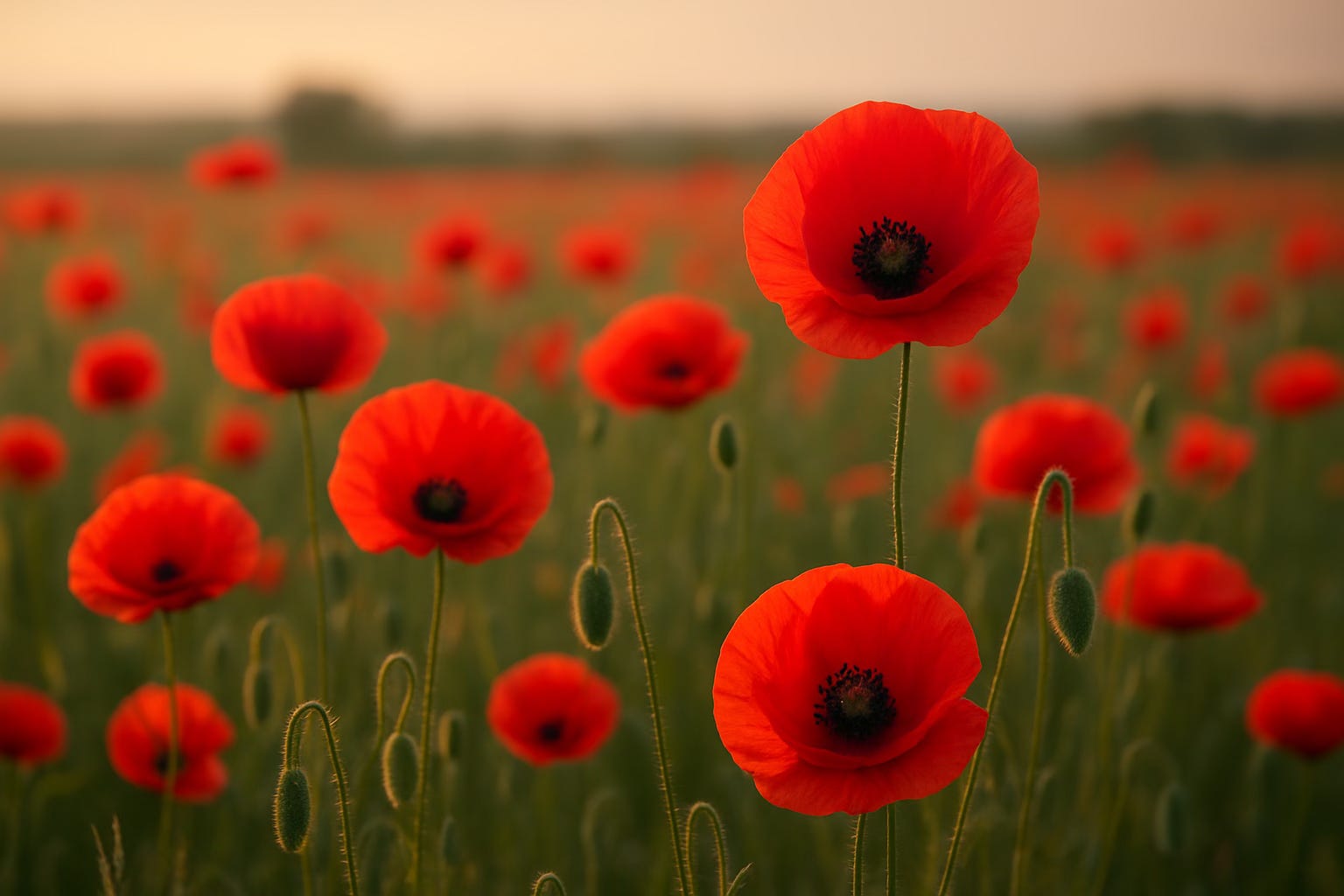
I think Armistice Day does such a beautiful job It’s a pause to conflict. It’s a moment where, even if it’s temporary, as armistices often are, it’s a moment of turning swords into plowshares. The symbol of Armistice Day, Remembrance Day, Veterans Day is less common in the U.S., but in Commonwealth and U.K., And other allied powers, as far as I know, I think it’s mostly like UK and UK derived people’s kind of celebration. It’s very much focused around the poppy. And the poppy is the symbol of remembrance, of hope, of mercy, of sadness, of just what the hell happened to us, essentially.
It’s a day to remember the dead. It’s a day to remember what can happen to all of us when things truly get out of hand. I think it’s really important that the default option should be towards peace. And to remember that even when one’s cause is just, war is not a simple matter. I like reminders of our humanity. The poppy, Armistice Day, Remembrance Day. Those make me feel mercy for the soldiers who fought and died, who did brutal things to one another in places they’d never been.
It makes me hope that there’s an afterlife where they can be reconciled to one another. I think anything that stresses the mistakes that we’ve made as a species where we’ve picked up arms against one another Asphyxiated each other with mustard gas, stabbed each other with triangular bayonets, buried men alive under artillery shells collapsing dugouts. I think we should remember are the people who were put into that position through naivety, through bloodlust, through earnest patriotism, and remember how easily it can be us in our lives too. We aren’t above the people who are put into these positions.
Thinking about it in this way is one of the ways that I think equality and universality can be so important because in your life, you may have cause to interact with war, with soldiers. And Armistice Day asked this question of, was it worth it? Can we honor these men? Can we honor these people who died by not putting people in this position unnecessarily? Can we avoid this in the future? The poppy, it’s hard for me to even know why is that such a beautiful symbol?
Flowers are such a wonderful symbol, are seemingly universal or very nearly so. The transient nature of beauty, the flowering of youth, the awareness of one’s mortality and of how brief and how fragile life is. I’m actually going to read the poem that the poppy tradition derives from. It’s by a Canadian doctor from the Western Front named John McCray. The poem is called In Flanders Fields. Here it is, In Flanders Fields. In Flanders fields the poppies blow, Between the crosses row on row, That mark our place and in the sky, The larks still bravely singing fly, Scarce heard amid the guns below.
We are the dead, short days ago, We lived, felt dawn, saw sunset glow, Loved and were loved, and now we lie In Flanders fields. Take up our quarrel with the foe. To you from failing hands we throw. The torch be yours to hold it high. If ye break faith with us who die, we shall not sleep, though poppies grow in Flanders fields. One thing I like about this poem is that poppies as a narcotic, there’s also a sense that the dead are not merely dead, they’re sleeping.
There’s a Christian resurrection of the dead. There will come a time when they might live again. Don’t mourn for us. We’re merely sleeping that I find to be a really beautiful, comforting thought. Happy Armistice day. I hope you enjoyed my, I can’t believe I’m going to say this, Blitzkrieg through copies of pacifism, of Armistice Day, of all of World War I. It’s really too much. Sorry, I try not to get distracted. There’s too many interesting stories, too many things that happened. I think a lot more attention needs to be paid to World War I for so many reasons.
It’s a great, great place to look where empires are collapsing, nations are coming about. The modern world is being born at this time. It’s worth your time to study World War I, I’d say. I love World War II as well, but World War I is extremely impactful. Thanks for listening. Happy Armistice Day. Happy Remembrance Day. Happy Veterans Day.


