


Listen on Spotify, Apple Podcasts or YouTube.
Paid subscribers get the ad-free version of this episode, minus the sponsor I actually like, whose read is mine and stays in. If you are not a paid subscriber, the whole episode is in the podcast feed in whatever app you already use (Apple, Spotify), ads and all.
Wendell Berry told me no, twice
Wendell Berry died on 31 August, at 92. I recently tallied up all of the books that have been mentioned on Reversing Climate Change over the course of about ten years of podcasting. Wendell Berry has the most books referenced of anyone.
I did not expect him to die. In my head, maybe he didn’t even die. Maybe he’s just overlooking us as a ghost, like at the end of Return of the Jedi. There’s something about that that strikes me as wrong. But of course, if you read any Wendell Berry, the idea that he would not live a normal human life with death at the end of it might even be offensive to him.
Early in Nori’s life, in maybe the worst case of knowing your audience in my entire career, I wrote him a letter explaining that Nori was a carbon removal marketplace using soil as a means to reverse climate change, and that we were doing so by trying to make tonnes truly fungible against one another, by which I mean exchangeable. If you know anything about Wendell Berry, you will know that Wendell Berry does not think units of carbon stored in soil should be equated with others by virtue of that. He is someone who cares so strongly about specificity and place and being rooted, and he had watched commodity markets hollow out the way of life he thought was important to preserve. So goofy. I don’t know why I thought that would work.
I think I wrote him twice, trying to persuade him why he should come on the show. He kindly rebuffed me twice, and I will always keep those letters of Wendell Berry telling me no. They remind me to know my audience, but also that my clever schemes trying to outwit the crisis we find ourselves in, with a riff on what already existed but in a more heavily financialized way, are likely a wrong turn.
That take on carbon markets, and how Nori was meant to supersede the problems that plagued earlier carbon markets, is really the point of the piece I wrote for Rainbow, which follows. But there’s a lot of extra content in the podcast that isn’t represented in the writing below.
Six of his books sit on the Soil, Farms and the Regenerative Argument shelf, along with most of what this show has argued about for a decade.
Book links here go to Bookshop.org. They pay me a commission at no extra cost to you, and the rest goes to independent bookshops.
This essay was originally published on Rainbow’s blog here. You can also listen to the companion podcast episode of Reversing Climate Change here. It riffs on many of these ideas but also deals quite a bit with the death of Wendell Berry.
A registry expands from avoidances to removals
When the cofounder and CEO of Rainbow, Ludovic Chatoux, talks about why Rainbow exists, he said something almost disarmingly plain. “The idea was to quite simply enable the financing of relevant climate solutions,” he told me.
Notice what is missing from that sentence. There is no mention of carbon removal. But that’s only because removals are just one of many relevant climate solutions.
In its early days, Rainbow primarily looked at projects where emissions get avoided, rather than pulled out of the sky, like industrial decarbonization, biobased construction materials for buildings, biogas, and e-waste. As removals left the lab and became commercially deployable, Rainbow built methodologies for and started certifying those projects, too. But caring about both carried a polarizing valence during those early years.
“When we entered the carbon removal space,” Ludo said, “many carbon removers criticized anything other than purely removal. Explaining our belief in avoidance to those focused entirely on removal was tricky, even though working on avoidances taught us valuable lessons about operationalizing removals. That expertise has compounded over time in ways that may not be obvious to those who have only done removals.”
From roughly 2018 to 2024, he figures, the removal market needed to establish itself, and it did so by building a narrative against avoidance and most other kinds of credit. “What’s good is that removals are taken seriously,” he said. “But the war footing was always meant to be temporary. The two sides shouldn’t be battling. They’re complementary.”
All those years in the supposed minor leagues of avoidances turned out to be training. The expertise the team built assessing biobased building projects now feeds straight into its mineralization work, since both live in the world of building materials. The years spent on biogas show up again in BioCCS. This portfolio approach is increasingly mainstream as big commercial players also stand up in support of it.
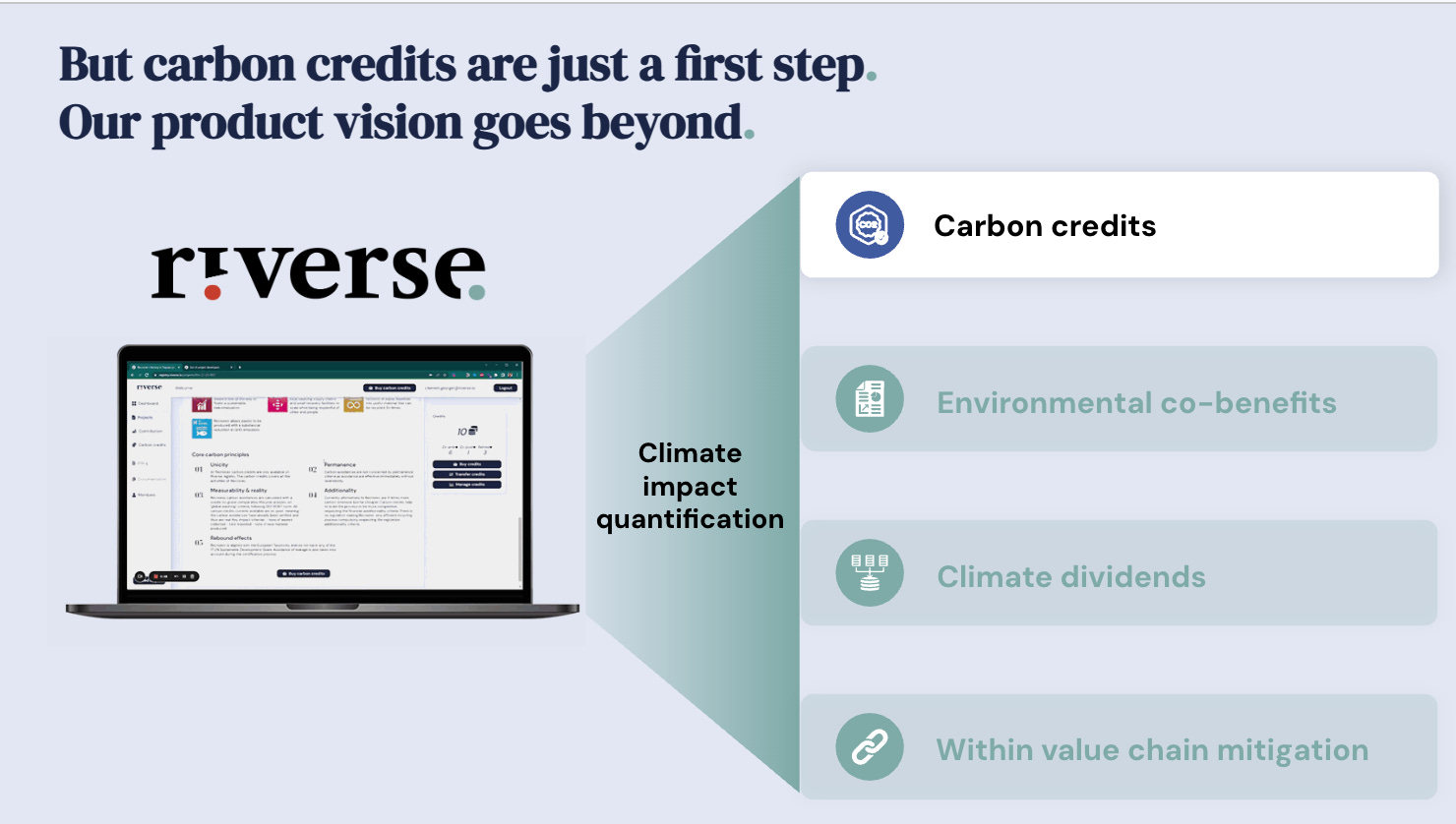
An early company slide, from before Riverse rebranded to Rainbow. The philosophy was always to finance whatever was climatically relevant, whether avoidance or and removal.
The rise of superpollutants
The market is further validating Rainbow’s belief that removals and non-removals are complementary. Registries that launched as removal-only purists are expanding to cover everything. And the more seasoned avoidances registries are developing removals methodologies. One of the most salient examples of this is the recent rush to develop higher credibility approaches to superpollutant mitigation to avoid the worst effects from methane, refrigerants, and other compounds with powerful climate impacts.
Perhaps most interestingly, corporate conversations within and adjacent to carbon dioxide removal are taking on a portfolio approach, with removals and avoidances such as superpollutant mitigation financed side by side. Google’s recent paper lays out its thinking on stacking and bridging scenarios, and argues for thinking in terms of impact on global warming and how specific molecules affect the atmosphere.
There is a careless and dangerous way to read the Google paper. If all you take from it is that methane is cheaper and faster and therefore we should focus on that over CDR, you have misread the assignment in a way that could be genuinely damaging. You cannot finish all the methane abatement, flip a switch, and expect carbon removal to be sitting there ready to scale to gigatonnes. CDR has to be built out now, in the background, while the short-term work of methane abatement happens.
Google’s wealthier posture allows them to plan this far in advance and with a sophisticated portfolio of climate assets. The portfolio view as advocated by Google is fully supported by Ludo. But the lazy version of it, where CDR competes with funding for more urgent climate needs now, is a trap.
The good news is: the learnings from avoidances transfer in novel ways to removals.
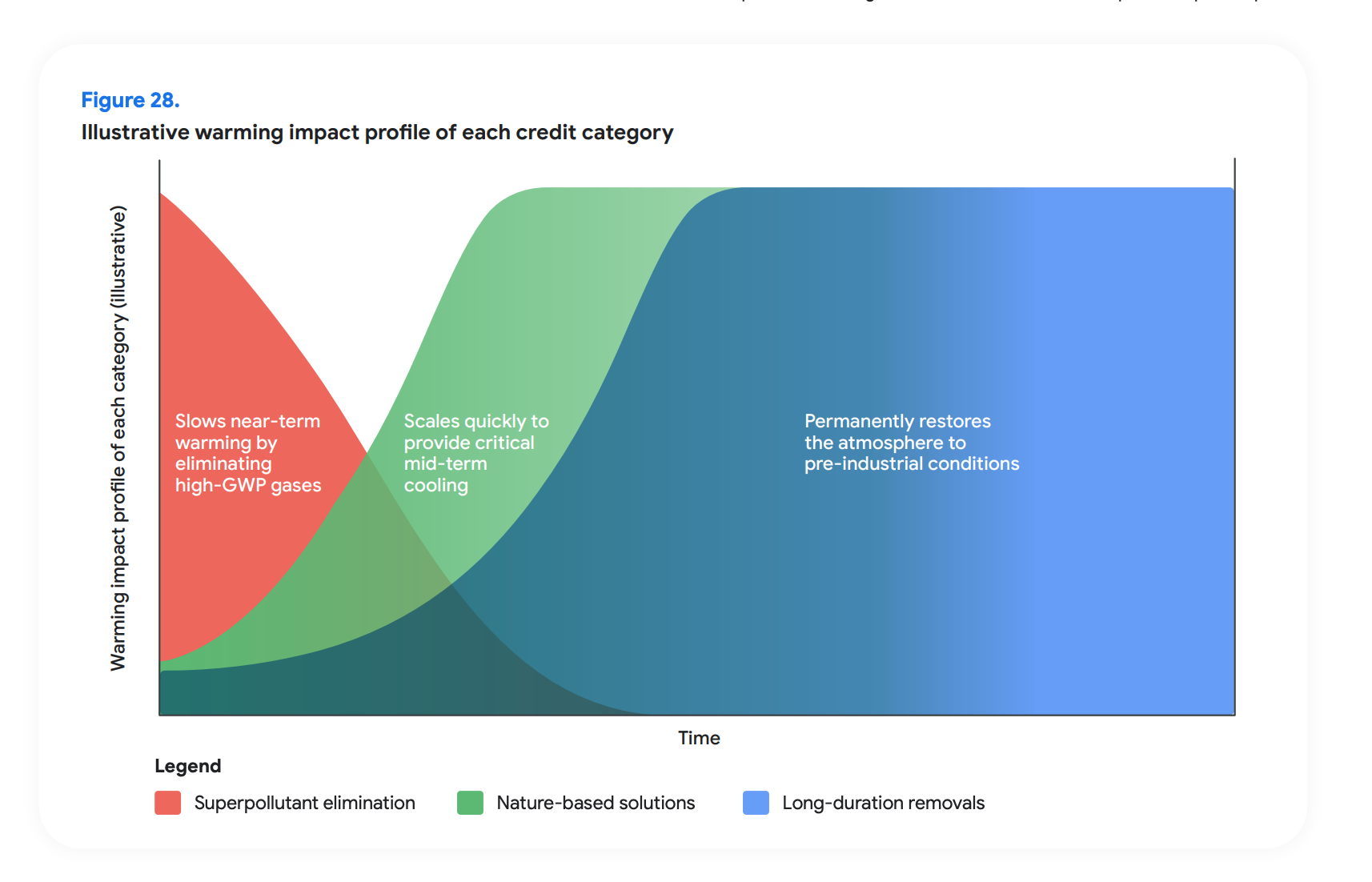
Page 76 of Google’s 2026 Environmental Report. Superpollutant mitigation, nature-based solutions, and long-term removals are all essential.
Getting good at avoidances makes you better at removals
Rainbow’s quantification engine—the core of their operation—has been sharpened on avoidance projects that are, in Ludo’s telling, often harder to model than removal.
“Modeling the life-cycle assessment of an avoidance project is actually more complex than some removal projects,” he said. Counterfactuals and attribution challenges make it hard to define where exactly carbon impact happens in the circular economy refurbishment value chain. By the time you can do that cleanly, a straightforward removal lifecycle analysis feels almost restful. It also speeds up the team’s certification and audit processes, because they’ve already been tested against more mature projects.
My favorite example, and the one Rainbow is happiest to talk about, is e-waste. A refurbished iPhone carries something like eighty to ninety percent less embodied emission than a new one, and the refurbishment work is stubbornly, beautifully manual, with people sitting and fixing phones one at a time. The margins are thin, the work does not easily scale, and plenty of these businesses go bankrupt for want of capital.
“It’s a great case of carbon finance,” Ludo said, and he is right. It is exactly the sort of real, unglamorous climate work that a thoughtful registry can keep alive, down to the difficult problem of allocating who along the chain actually earns the carbon gain.
It is also a useful mirror. There is no removal in it whatsoever, and yet it is plainly worth doing.
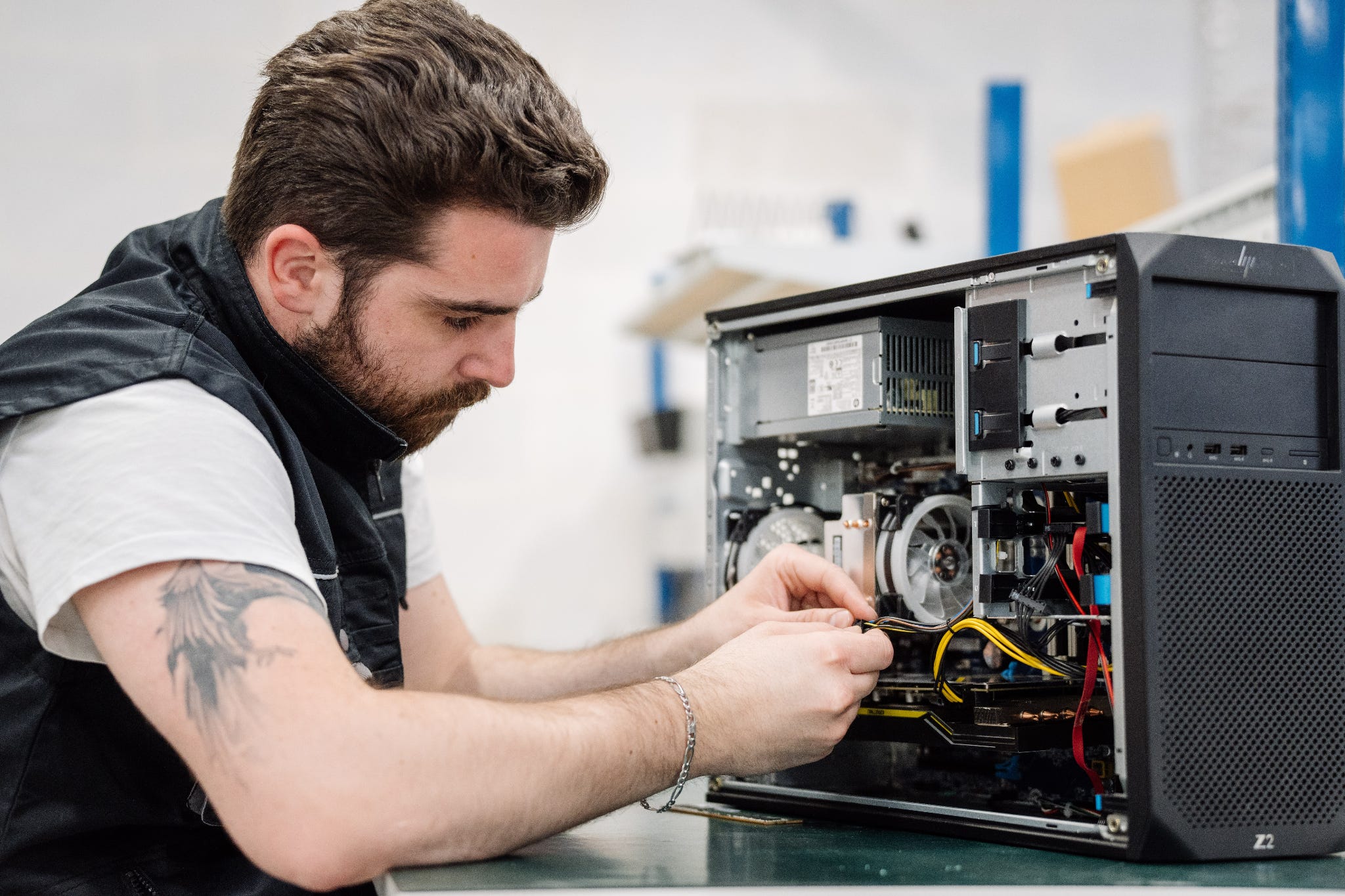
https://registry.rainbowstandard.io/projects/RIV-2023-PROJ-16?mechanism=AVOIDANCE
Alt Eco takes electronics like computers that would otherwise be retired and refurbishes them for reuse. Their avoidance credits are certified by Rainbow.
The portfolio paradigm arrives in carbon dioxide removal
So Rainbow’s arc turns out to be the industry’s arc, run a few years early and in reverse. It started out trying to finance whatever was climatically relevant, and is now watching the most sophisticated carbon removal buyers in the world validate the portfolio view it has long wanted to foster.
It’s hard to stay the course this long in business. And it’s hard to believe in something that isn’t canonical in one’s industry. There is immense pressure to conform, in rhetoric if not in actual practice. When companies are jockeying to be seen as the most credible and high-performing to Fortune 100 buyers, outsider views pose an asymmetric risk: it’s either a great thing or a terrible thing, and likely nothing in between. Developing competent corporate strategy lies in knowing which kind of asymmetry your divergent beliefs are. Because sometimes companies and their leaders take iconoclastic stances that aren’t courageous, but delusional.
This avoidances vs. removals dichotomy should have been an easier falsity to spot though. Whenever you have a binary split there’s usually some truth content in each which is why one of the positions hasn’t already won the debate. The truth always was that some avoidances are high-quality and some removals are low-quality. The details here matter, and the more comfortable we get in that careful kind of analysis, the more robust and trustworthy our carbon market institutions will become.
In Rainbow’s case, I’m glad they stayed true to what they believed was the truth long enough for the carbon dioxide removal industry to begin to converge upon the portfolio mentality in a much more thorough capacity. Being convicted in this way is how one builds something that could last decades.
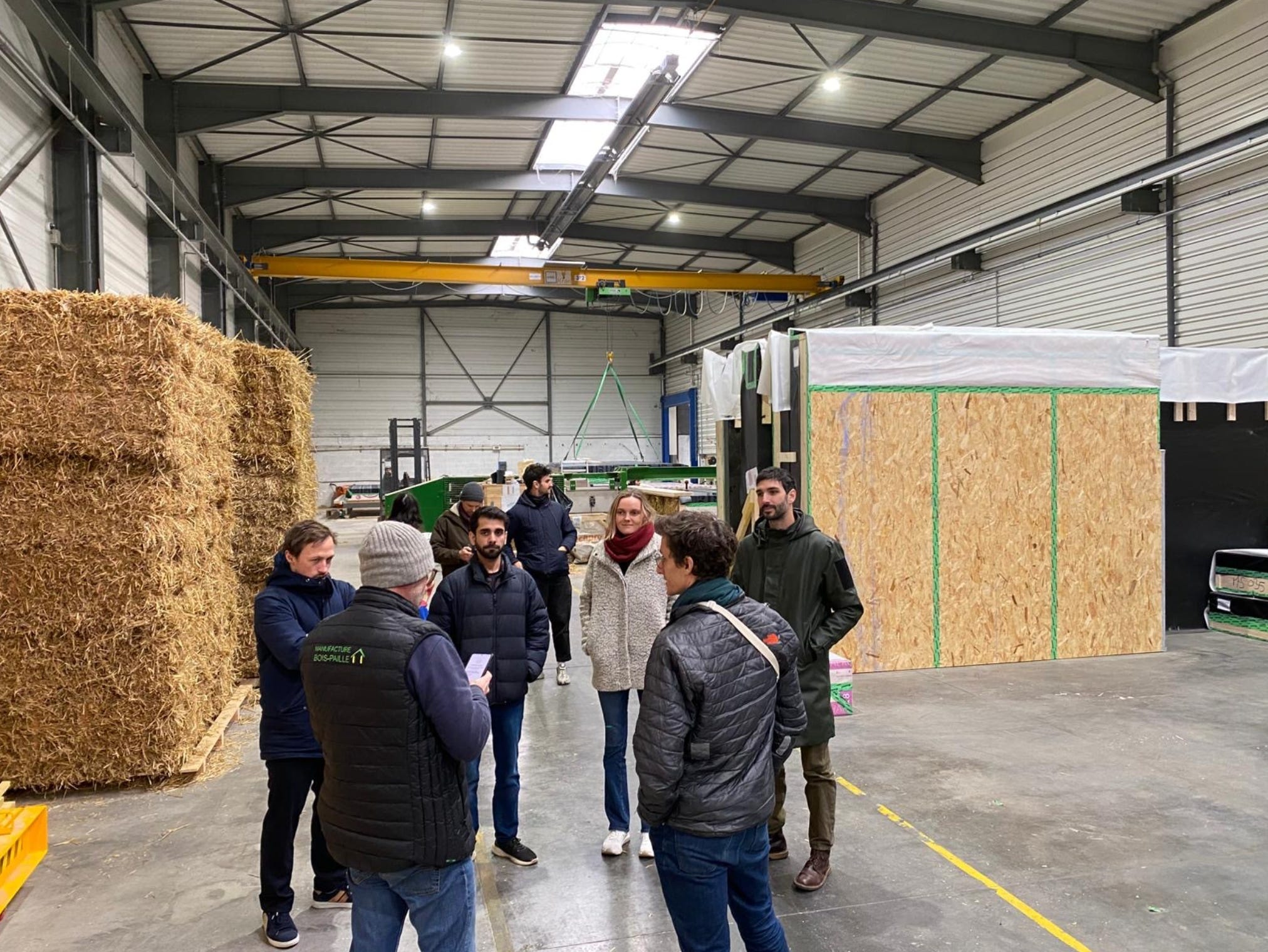
The Rainbow team at Manufacture Bois Paille, a biobased construction material company, in 2023 - back in its (first) avoidance and mitigation era.
What the categories were actually describing
Take it from me, someone who tried to build the better thing. I’m not sure we ended up being that much better in any respect. If I meet people who work at Verra now, one of the first things out of my mouth is, I used to think I was better than you. Many of the hard parts of building integrity infrastructure in carbon markets are not about individual willpower. Much of it is structural. The fact that all of the older registries look similar is not because they’re not creative or not smart. The dynamics of competition and the game of bringing carbon credits to market mean that those designs converge.
These are idea sets that should be in conversation with one another. It is your job to engage with the major dialectics of your time. In this case, it’s wizards and prophets. Prophets who think that we should respect limits, that we’ve gone too far, that we should turn back. Wizards who think that we will continue to solve problems faster than they are created. And they each can have part of that puzzle.
Ultimately this is a show about getting beyond categories that mislead us. It seems like we’re making progress because we’ve defined the in-group and the out-group, the good credits and the bad credits, the good climate action and the bad climate action, and it turns out what we described was group membership and not quality.
Rainbow came into carbon dioxide removal from the outside, kept financing avoidances the whole time, and has watched the market arrive at the position it started from. The company I cofounded, Nori, was merciless about avoidance for its entire existence, so some of that is on me.
Wendell Berry died on 31 August, at 92. He has more books referenced on this show than any other author. Early in Nori's life I wrote to him twice inviting him onto this very podcast by explaining that we were making tonnes of soil organic carbon fungible with one another, which may be the worst reading of an audience in my career. He said no both times, kindly. I still have the letters.
Listen in to hear more about what it is like to meet someone from Verra and have the first sentence out of your mouth be "I used to think I was better than you", why the hardest parts of carbon market integrity turn out to be structural rather than a failure of anyone's willpower, what the Scouring of the Shire has to do with a methodology list, why I would keep rainforest over carbon removal if someone made me choose, and those ever-present wizards and prophets.
This episode’s sponsor

How to fire a carbon market consultant, and how to know when you should

David LaGreca shares his expertise from countless carbon projects during his time at EcoEngineers and beyond
2026 EcoForums Training Series: Navigating Global Carbon and Fuel Regulations, Market Mechanisms, and Life-Cycle Analysis Fundamentals
Rainbow is a client of mine and I say so in the episode. They are not sponsoring this episode. I was just inspired by the work itself.
Resources
Soil, Farms and the Regenerative Argument, the Wendell Berry shelf, one of thirteen lists on my Bookshop storefront.
Removals, avoidances, and the rise of the portfolio mentality, the original at Rainbow.
Sustained Neutralization of the Warming Response to Emissions through a Portfolio of GHG Mitigation Strategies, Hughes, Hausfather, Spock and Van Arsdale, CDRXIV, May 2026. The Google paper on stacking and bridging.
The Prodigal Son of Carbon Markets, with Martin Freimüller of Octavia Carbon, on his change of heart about the voluntary carbon market.
Jason Grillo writes Climagination, and was on the show for The Culture of Carbon Removal.
Robert Höglund writes Marginal Carbon.
Rereading The Wizard and the Prophet six years deeper into climate work, with Charles C. Mann, where the wizards and prophets framing comes from.
The impossible taxonomy of carbon dioxide removal, the previous episode about categories that mislead.
Wendell Berry, 1934 to 2026, in the Kentucky Lantern.
Check out my other show, Climate Workers Anonymous.
Cover image: Pieter Bruegel the Elder, The Harvesters, 1565, The Metropolitan Museum of Art, Open Access.
Subscribe to the Reversing Climate Change Substack
Become a paid subscriber for bonus content and ad-free episodes
Full Transcript of Podcast Episode
Ross Kenyon: Hey, thank you for listening to Reversing Climate Change. This is Ross Kenyon. I’m the host of the show, and I work in climate tech and carbon dioxide removal.
If you’re new to Reversing Climate Change, this is a show that grew out of carbon dioxide removal. But to paraphrase John Muir’s legendary line about how once you start to pick at anything you find it hitched to everything else, it is a show about everything else. I don’t know how to make a climate show that isn’t about everything else. A climate show that isn’t about everything else would almost certainly just be incomplete.
I used to think that if we could only narrow our gaze down to focus on making climate change an economic win-win, on developing the right technology that’s better for health, more sophisticated, more profitable, then maybe we could fix this whole climate thing without having to become mechanics of the human heart and the human soul. I’ve grown doubtful of that. There’s just too much that’s too deep to avoid.
I wasn’t planning on sharing this story, but perhaps I will, in honor of Wendell Berry’s passing. I recently tallied up all of the books that have been mentioned on Reversing Climate Change over the course of about ten years of podcasting. Wendell Berry has the most books referenced of anyone. That isn’t to say he’s the single most referenced author, because some of those authors just get name-checked a lot, but Wendell is one of them.
I did not expect him to die. In my head, maybe he didn’t even die. Maybe he’s just overlooking the rest of the gang as ghosts, like at the end of Return of the Jedi. There’s something about that that strikes me as wrong. But of course, if you read any Wendell Berry, the idea that he would not live a normal human life with death at the end of it might even be offensive to him.
I’ve struggled with his writing a lot. I think anyone who makes a practice of pointing to limits, of reminding us that nature has the final say, that the larger our ambitions the more likely we are to run afoul of what makes life simple. Not to say easy, but simple, beautiful, good. Those are words I associate with Wendell. He was obviously a very smart person, but plainspoken as well, and in a gorgeous way.
I think of Wendell Berry’s concerns for industrial civilization and its pace as, unsurprisingly, pretty much what Isengard is in Lord of the Rings.
If you haven’t read Tolkien directly, one of the scenes that asks some of the biggest questions is not in the film at all. I haven’t read a lot of the criticism of the Peter Jackson Lord of the Rings films. If anyone is listening, send me a note on Substack for where I should go for some of the best criticism of those films. But of the things that I missed, though I can understand why they were cut, there are two sequences that open up so many questions that it doesn’t really help you tell a linear story. And films basically require a linear story. Films that don’t give you one oftentimes feel disappointing, artsy, confusing.
Even I feel that way sometimes, and I understand what they’re meant to do and why one would not do that. I remember the first time I saw Paul Thomas Anderson’s The Master, being like, “What the heck?” Joaquin Phoenix goes on an adventure and comes back basically in the same depressed, sad state as when he left. There wasn’t fundamental transformation that I could tell, except for more scars and disappointment and wounds. I may be mischaracterizing it. I saw it a long time ago. I should probably just rewatch it now. I suspect it has more to say to me.
But that’s not even what’s happening here. The two scenes that come to mind, which I bet you can guess, are Tom Bombadil, for one, and the Scouring of the Shire. So at the end, after Mordor, after Mount Doom, after the ring is destroyed, the Fellowship wanders back to where they’re all going. Sam and Frodo are going back to the Shire. But in this time the Shire was not protected, and in fact Isengard has invaded and sort of corrupted it.
And when you think about Tolkien, he’s someone who is nothing if not a pastoral Englishman who loved the sort of Downton Abbey but non-aristocratic version of it. Country, peasantry, simple, good-hearted, basically the hobbits. And contrast that with the ruthlessness, the industrialization of Isengard. Mordor too, but it’s easier to see for Isengard, because Mordor already just looks inherently destroyed, and Isengard once was lovely and now is not.
What does it mean when war comes to the Shire? And what does that do to the people who live there in these simple lives? How does it corrupt them? How does it change them? How does it make them lose their innocence? It’s hard to measure, and if you didn’t grow up with what Wendell writes about, it would be hard to know about. It would be hard to understand.
If you were born into the Shire after the scouring, and you never made it back, and it never reverted to rule by the good hobbits once again, then you wouldn’t even exactly know what you were missing. It would sound nice, but people would hector you for romanticizing the past, and the past was never that good, and things like that.
And even in reading Wendell Berry, all of his novels, they have such a strong sense of a world that even at the time of writing might be passing away. I’ve never known it. I’ve never known what that was like, to live in a small town. Let alone a small town without everyone glued to their TVs or their phones. A town where, of course, people have their issues. It’s not a perfect place, but it is a good place. And we run roughshod over it at our own peril.
Forget about the Scouring of the Shire. Imagine a world where there are normal humans living in Isengard. You might just be thinking about how, if we get this much more efficient at processing all of these trees which happen to be alive, think about how good that will be for the economy and my portfolio and things of that nature. And I think Tolkien and Wendell Berry both would say we’ve made a grievous wrong turn. We’re no longer understanding ourselves, our relationship to everything that is. And this causes us to treat all that is in an expedient fashion that not only is not good for the Earth, but also is not good to us.
This type of dysfunction can be psychological in nature. We all are blind to ourselves in some ways, of character flaws that maybe are obvious to others. Maybe people have even told you of things that you do, but yet it’s hard for you to see. Or maybe once the crisis has passed, it’s easy to put those things away and think, “You know, I’m fine. I don’t need to think that much about that.”
Still psychological, but dramaturgical. Zoom out a little bit. I think about the nature of tragedy, specifically Greek tragedy. The end is written into the beginning and is often based upon some character flaw, being born under a bad sign. Most famously with Oedipus, being told he would kill his father and marry his mother. No way, José. That’s not gonna happen to me. Of course it does happen, and he ends up blinding himself.
Oedipus blinding himself due to his failure of self-knowledge, I think, is an amazing image. So powerful. It’s good personally. Feel free to use it in your personal life. There’s a lot of depth to all of us, and some moments in life involve feeling that feeling. But I think humanity as a whole is likely going to have this Oedipal moment, and skip the obvious connection you’re making in your brain. This is where one’s failure of self-knowledge is revealed all at once. It involves, if you’re reading the Old Testament, rending of garments, wailing, putting out one’s own eyes in despair. The truth that one could not see, and now you cannot see anymore.
Wendell Berry did a great job of pointing to humanity’s failure to learn our place and limits. But he also did it in a very joyful way. His poems are oftentimes very uplifting. They remind us to see the beauty in very small things, that life itself is a miracle. It does not require special adornment or being wrapped in bacon to be a wonderful thing.
And I respect that kind of thought. In fact, that is what I most admire about conservative political thought. I think it’s safe to include Wendell Berry as a type of conservative, or at least this is the type of conservative I have in my head. These are the best critics of modernity, of technology, of speed, of a lack of roots, saying that no, actually, humanity is a rooted species. Tabula rasa is a lie. We cannot endlessly redefine our conditions and be happy. That’s not who we are. What is good about life is what we can do in a community where we have trust, where we know each other, where we know our place. But it’s a good way of knowing your place. You belong there.
If you’ve listened to this show for a long time, you know that I work best when I have ideas that can contrast against one another. I often feel uncomfortable when people put out a strong reality definition, because any way that you define reality, it’s very easy to think of objections, other ways of seeing. If you are able to understand reality in many different ways, ideally you can make connections that other people are not able to make. People who have this strongly linear way of thinking might just find themselves deeper into the groove of what they believe. I used to be as bad at that as anyone else.
I’m thinking that I’m going to have to retell this story at some point soon, but it won’t be today. But I have been thinking quite a lot about this because of this piece that I wrote for Rainbow, the standard and registry in carbon dioxide removal and avoidances. And it reminded me of this Wendell Berry story that I teased at the beginning here.
It was sometime early within Nori’s history. It was certainly before 2020. I can’t remember how far back it was. Nori was a carbon dioxide removal registry and marketplace. We launched in 2017. We were focused initially on soil organic carbon. And if you work in agriculture at all, if you have any lofty understanding of your work as pertains to climate or ecology, you eventually end up at Wendell Berry. There are, of course, others, but Wendell’s one of those that you’d have to make a lot of weird turns to avoid reading if you work in agriculture.
So here I am doing this very podcast for about a decade, so two years into it maybe. One of my friends had previously corresponded with Wendell Berry. He’s someone, was someone, with whom you could just write a letter and expect to receive a response. It may not be the response that you want, but you can get a response. For instance, Noam Chomsky also had this reputation, and I corresponded with Noam back in the day, too. Not because I’m special, but because part of their public praxis was to just be available for some amount of communication with randos. You could write to these people and engage with them.
And in maybe the worst case of knowing your audience in my entire career, I wrote a letter to Wendell Berry talking about how Nori was this carbon removal marketplace using soil as a means to reverse climate change, and we were doing so by trying to make tonnes truly fungible against one another, by which I mean exchangeable.
If you know anything about Wendell Berry, you will know that Wendell Berry does not think units of carbon stored in soil should be equated with others by virtue of that. He is someone who cares so strongly about specificity and place and being rooted. The idea that one would create a commodity market, and that was the problem with agriculture, after he had seen commodity markets essentially hollow out the way of life that he thought was important to preserve. So goofy. I don’t know what got into me. It was honestly one of the worst cases of knowing your audience possible.
I think I wrote him twice, trying to persuade him why he should come on the show for that reason. He kindly rebuffed me twice, and I will always keep those letters of Wendell Berry telling me no. To remind me to know your audience, but also that my clever schemes trying to outwit the crisis we find ourselves in with a riff on what already existed, but in a more heavily financialized way, is likely a wrong turn.
This take on carbon markets, and how Nori was meant to supersede the problems that plagued earlier carbon markets, is really the point of this article I wrote about Rainbow. They’re a client of mine. I do some writing for them. And one of the themes that I’ve noticed is that Rainbow is one of the new registries that is big in carbon dioxide removal, but also did not start there. They started with other types of avoidance methodologies and grew into carbon removal.
I think that process can be fairly tricky. People who work in CDR have a fairly strong antipathy toward most of the legacy offset players. They have a reputation of being slow and expensive. It’s unclear how many of the credits do what they say on the tin. And wouldn’t it be amazing if we could build something over from scratch that would actually solve this problem?
Take it from me, someone who tried to do it. I’m not sure we ended up being that much better in any respect. If I meet people who work at Verra now, one of the first things out of my mouth is, I used to think I was better than you.
And now I’m realizing that many of the hard parts of building integrity infrastructure in carbon markets is not about individual willpower. Much of it is structural. The fact that all of the older registries look similar is not because they’re not creative, is not because they’re not smart. But the dynamics of competition and the game of bringing carbon credits to market means that those designs converge.
I really respect that Rainbow started this way and also didn’t give up on what they believed, that they just wanted to fund good climate projects, some of which are going to be avoidances.
I think part of it is that we’re so used to seeing companies buy cheap offsets and use them to enable their continued emissions in ways that are not appropriate. I don’t think you should be able to buy a REDD+ credit and then claim that you negated a tonne of fossil emissions. Protecting rainforest, without a doubt, one of the most important things we can do. I think if you ask me right now if I had to choose whether to keep carbon removal or saving rainforest, rainforest. I don’t even have to think about it. That’s obviously the more urgent thing to be doing right now. We’re all just hanging on hoping that other people figure that out while we’re trying to scale up carbon removal.
I don’t think that what I’m saying here is shocking. Rainbow’s been saying it for a long time. Others have been saying it for a long time. I saw a piece recently from Jason Grillo that was several years old where he was arguing something similar. There are people who are pointing to this, saying that there’s good reasons to see CDR as part of a portfolio and actually mean it. Because I’ve also heard a lot of people say we need more shots on goal, you know, silver buckshot, we need it all. But somehow that boundary ends up being drawn around CDR only.
I think that’s been a real mistake. I did an episode with Martin Freymüller from Octavia about his change of heart. He’s doing direct air capture in Kenya and is trying to find ways to actively work with developers of avoidance projects, because the whole thing matters. If we want to criticize methodologies and projects that don’t do what they claim to do, I think that’s fair game. I think that’s fair game for CDR too. But I also think this rigid hierarchical thinking can be mistaken.
I didn’t expect to wrap this Rainbow-oriented removals and non-removals essay commentary episode in Wendell Berry. Did not expect to do that. But there’s a sense in which he both exemplifies this and violates this.
I think being skeptical of the future can open up its own mistakes. I’ve been seeing Robert Höglund recently post quite a bit on things like Greenpeace blocking golden rice, and how that part of the Green Revolution and GMOs likely would have saved a ton of lives due to vitamin A deficiency. Environmentalists of that particular flavor at that particular time were so focused on what sounded like environmentalism that they couldn’t see the reality of the lives that would be lost in the process.
Technology can also be a really powerfully good thing. I’m not feeling especially great about it at this exact moment in time. I think there’s a lot to be concerned about. But I think those that stress the need for limits are wise to check those who have an unlimited orientation of humans. I think those who don’t believe in a sense of their own limits can run some real risks. And even if technology can be good, and people like Wendell Berry sometimes might miss the ways that they are holding back humanity and their desires, they are wise to check the lack of limits of many technologists who rule the planet, and who are also maybe listening to this show.
These are idea sets that should be in conversation with one another. It is your job to engage with the major dialectics of your time. In this case, it’s wizards and prophets. Prophets who think that we should respect limits, that we’ve gone too far, that we should turn back. Wizards who think that we will continue to solve problems faster than they are created. And they each can have part of that puzzle.
I think Wendell Berry might have had a misstep. I came at him hard with some financial logic that is hard to say out loud because of how foolish I was in presenting it this way. But that is how very large amounts of money change hands and goods cross the planet. Maybe that’s a bad thing on net for human wellbeing and their experience of this place. Maybe.
But so long as we’re being critical of dichotomy here, anyone who focuses on place and rootedness and being close to things. I’m thinking of people like Wendell Berry, Robin Wall Kimmerer, Mary Oliver, Aldo Leopold. The line from I Heart Huckabees of what happens when you sit in a meadow at dusk. Everything, nothing. Everything. Everything. Everything happens if you just sit in a meadow at dusk. Can we just sit there and be with it?
You don’t need categories when you can have unmediated reality, and being able to tune in without needing endless taxonomy is a way of breaking down these categories that rule us. And ultimately this is a show about getting beyond categories that mislead us. It seems like we’re making progress because we’ve defined the in-group and the out-group, the good credits and the bad credits, the good climate action and the bad climate action, and it turns out what we described was group membership and not quality.
I’m glad that Rainbow held the line on this one. It’s nice to see the world collectively go beyond rhetoric around the portfolio approach and actively trying to bring in super pollutants, other kinds of avoidances, removals, into the broad VCM conversation. CDR likes to hold itself apart. I get it. We think that we’re a little bit elite. Yeah, that’s kinda true. There’s a little bit of that vibe. I’ve perpetuated that vibe as much as probably anyone else has, for which I am feeling not so great about. I’m wondering how many things in my life I will look back on and be like, oh, I thought I had it figured out at that moment, but then two years later I’m still learning how many things it’s possible to be wrong about.
I’m really grateful that Rainbow gave me the chance to explore these ideas for this essay. The link is in the show notes. It’s on Substack. If you’re not already following the show on Substack, please go over there and subscribe. You’ll get all of these episodes in your email inbox. If you become a paid subscriber over there, there’s bonus content, there’s ad-free listening you can get on Substack. And I’m also just trying to make a better go of things over there. The memes are over there now. My other show that I’m working on, Climate Workers Anonymous, is there. Reversing Climate Change is there. RossKenyon.com, that’s the same thing, it just is the proper .com of it.
If you want to talk about these ideas, message me over there. Thanks so much for listening. Have a great rest of your day.


