



I did something I have not done before: I rereleased an old episode of Reversing Climate Change. You can listen to this rerelease on Apple Podcasts, Spotify, YouTube, wherever you get your podcasts, or the entire episode in full
Lately, it seems it’s been all about Charles C. Mann. Wizards and prophets as a conceptual schema keeps coming up. Over and over. His split between the wizards, who think that progress and technology will continue to solve more problems than they create, and prophets, those who think we’re beyond limits and need to find balance, order, and simplicity, is applicable to so much in climate and environmentalism. In fact, I did a whole monologue show about how his framework helps us make sense of splits over things like Ezra Klein’s Abundance and Paul Kingsnorth’s entire corpus.
For Climate, It's Wizards vs. Prophets All the Way Down

Paul Kingsnorth, Ezra Klein, and the unresolved question of whether technology will save us or unmake us.
And it also recently came up in the episode I did on science fiction and literary theory…

I am going to continue experiment with rereleasing some of the excellent old content buried in this catalogue. The ones that might still be relevant and add some modest value to your life.
I hope you enjoy the quaint strut down memory lane, with the old Nori branding no less!
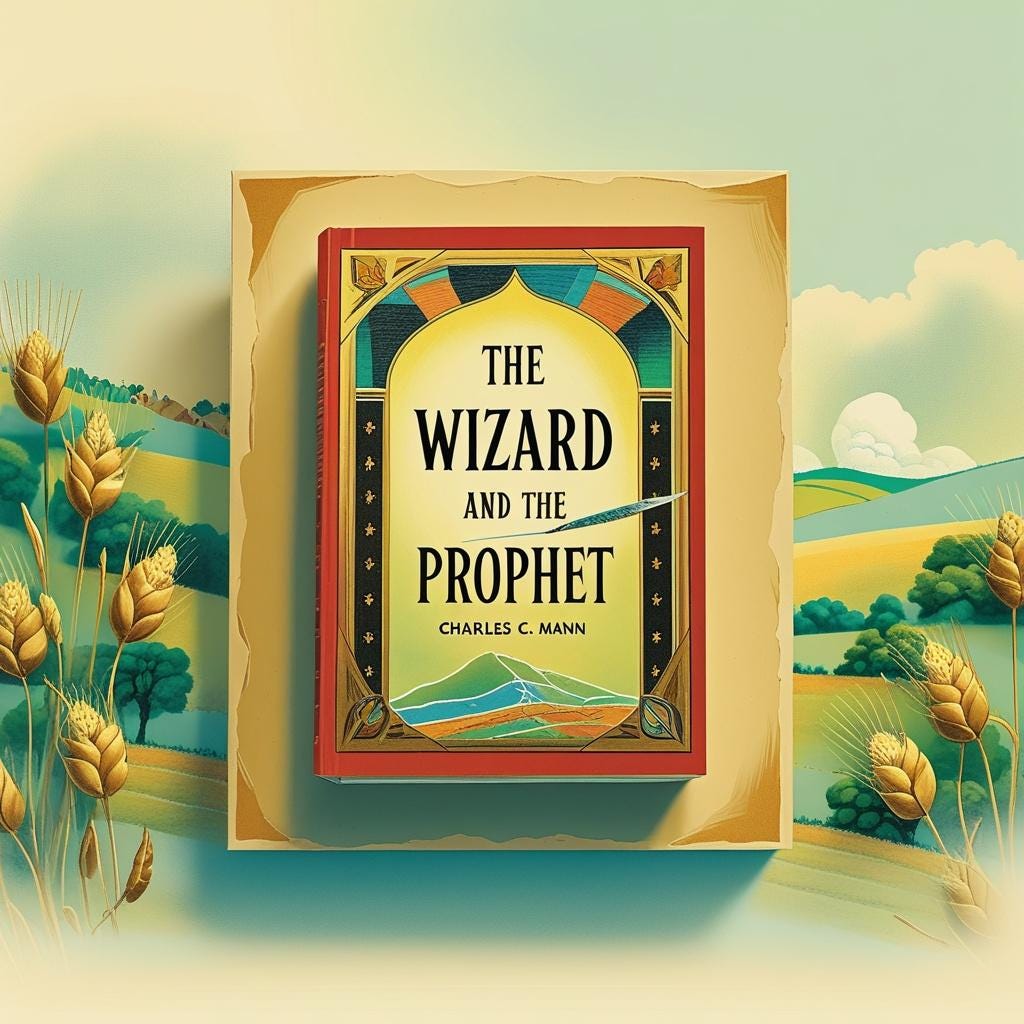
I interviewed Charles C. Mann in 2020 about his book, The Wizard and the Prophet: Two Remarkable Scientists and Their Dueling Visions to Shape Tomorrow's World. This episode is a personal favorite of mine.
Somehow, I don't believe I've ever rereleased any old episodes. But there are many great ones buried in the archives. I am going to start bringing more of them out that remain relevant.
If you aren't familiar with Charles C. Mann, he's written a bunch of great books including 1491 and 1493, both of which I'd recommend.
This episode's sponsors

How to fire a carbon market consultant, and how to know when you should

David LaGreca shares his expertise from countless carbon projects during his time at EcoEngineers and beyond
2026 EcoForums Training Series: Navigating Global Carbon and Fuel Regulations, Market Mechanisms, and Life-Cycle Analysis Fundamentals
Resources
Check out my new show, Climate Workers Anonymous
Subscribe to the Climate Workers Anonymous Substack
The Wizard and the Prophet by Charles C. Mann
More from the show
Ad-free episodes and other benefits come with a paid subscription.
Carbon Removal Newsroom, the news show that ran alongside this one, is over. Its episodes are still up, on the feed Climate Workers Anonymous now uses.
Carbon Removal Memes is still goofing around.
The books that come up on this show are collected on my Bookshop shelf.
🎧 Apple Podcasts · Spotify · YouTube
Paid subscribers get this episode ad-free. The ads in the free feed are inserted by Spotify when you press play. They are not in the file I make.
Full Transcript
Ross Kenyon: Hello, this is Ross Kenyon, host of the Reversing Climate Change podcast. I’m not sure I’ve ever done this before: I’m re-releasing an old episode. There are so many great episodes buried in the catalog — including bonus episodes, there are probably the better part of 500 of them on Reversing Climate Change — including some of the ones that have influenced the show the most.
Recently, Charles C. Mann’s taxonomy of wizard and prophet has come up on several shows. It’s such a great shorthand for understanding some of the big disagreements in climate politics and environmentalism. I recently did a monologue episode where I contrasted Ezra Klein with Paul Kingsnorth and discussed the abundance paradigm as paradigmatic of being a wizard, and I contrasted it with Paul Kingsnorth’s prophet status.
Sometimes I’ll be catching up with someone and they’ll ask me, “Hey, did you ever read 1491?” And I try not to pat myself on the back too much, but I’ll say, “Well, since you mention it, Charles was on the show once upon a time, and I was so happy to get him, because he’s a wonderful writer and has taught me a lot.” This happened with a friend recently, and if she didn’t know this episode existed, I suspect there are probably a lot of great episodes that should be resurfaced in this way.
In any case, enjoy this time capsule. You’ll hear all of the old Nori branding for the podcast — this used to be a project of a company I co-founded called Nori. Don’t let that distract you; it’s the same show. There have been a lot of new listeners since. But whatever — enjoy the show. Take this walk down memory lane with me, and enjoy this episode with Charles C. Mann.
Ross Kenyon: Hello, and welcome to the Reversing Climate Change podcast. I’m Ross Kenyon. Today I have with me Charles C. Mann, journalist and author of 1491, 1493, and The Wizard and the Prophet. He’s also a correspondent for The Atlantic, Wired, and Science. Thanks for being here, Charles.
Charles C. Mann: It’s my pleasure.
Ross Kenyon: Your work comes up all the time, and we recently did a Nori Patreon book club for The Wizard and the Prophet for the month of April. It generated a lot of discussion and debate. I think this is a great book, and a great way to frame various schools of thought within the environmental movement. Why don’t you give us a nice baseline here: what exactly are these camps? Who are the avatars of each that you feature in the book, and how are you conceptualizing the split?
Charles C. Mann: Basically, I’m a journalist, as you said, and I’ve been reporting on environmental issues since the late 1980s — talking to activists, politicians, and above all, researchers. Over time, I came to realize that the answers I was getting to my questions fell into two broad camps. Not always, but generally, and I thought of them as wizards and prophets. Wizards essentially are the people who want what’s disparagingly called the techno-fix. Their argument is, “Look, we have these technical challenges from the things we want to do and the growth of our economies, and so what we need to do is switch on the science-and-technology machine and essentially produce our way out of our dilemmas.” The prophets, on the other hand, say, “That’s completely wrong. That’s exactly the wrong direction. It’s doing more of what’s gotten us into trouble in the past, and what we need to do is conserve and radically cut back and reduce the human footprint.”
And a while ago, it suddenly dawned on me that these two approaches were kind of the opposite of each other, and that many of the conflicts I saw — both within the environmental movement and between the environmental movement and society — were expressions of the conflict between wizards and prophets. And I thought, “Geez, I’d really like to read something about that.” And then I didn’t find it, so I decided, well, okay, I’ll try to do it, since nobody else is.
Ross Kenyon: And I think you do a very good job of being fair to both of these camps, because they each have a part of the puzzle. Depending on the issue or the application within environmental concerns, you might find yourself leaning one way or the other. I think you do a very good job of steelmanning for the listener — the opposite of strawmanning. You treat both of these schools of thought maybe even more fairly than you had to in order to write this book.
Charles C. Mann: Well, thank you very much. I think it’s important, and the reason is that relatively soon in my research, it dawned on me that these differences were not just pragmatic differences about how you do this or that — they expressed values. And they’re values that everybody shares, in one proportion or another; we just give different weights to them. So typically, prophets value community and the idea that we’re all part of nature, that we’re embedded in this much, much larger system in which we should play our assigned role. And the wizards, on the contrary, are much more about individual liberty and freedom — the idea of maximizing human potential and people living in the best possible way they can. And we all like both of these things in different amounts. It’s just that they come into conflict, and where you end up on which side of that conflict determines a lot about whether you’re appealed to by the wizards or the prophets.
Ross Kenyon: And in the book you use a very interesting framing device. I saw your book described as a joint biography, or some such. So you have these two avatars of these two ways of being and thinking. Who are they, and what, broadly, are their life arcs?
Charles C. Mann: Well, as I said, I’ve been a journalist for a long time, and over the years I realized I’d often heard this name, Norman Borlaug. People who I later came to think of as wizards would say, “I want to do for X what Borlaug did for wheat.” Norman Borlaug is the main figure in what’s called the Green Revolution, which is the mix of high-yielding hybrid seeds, high-intensity fertilizer, and high-volume irrigation that doubled, tripled, or even quadrupled global grain yields in the 1960s, ‘70s, and ‘80s. It had a huge impact on our lives. One way of putting it is that as far back as historians can go, the majority of humankind has faced hunger at some point in the year. When I graduated from high school, the UN Food and Agriculture Organization estimated that between 40 and 60 percent of the world’s population was malnourished. Now those same people estimate it’s on the order of 8 to 10 percent. So you see this enormous, dramatic decline that the Green Revolution had a lot to do with. People saw that, and took a very powerful lesson from it: you switch on the science machine, and you can have this dramatic impact on life — and they hope they can do the same in whatever field they’re in. So that’s the reason for looking at Borlaug as this sort of prototypical wizard.
At about the same time, I realized that when I talked to especially older environmentalists, I’d hear this name occasionally that I’d certainly never heard in public discourse: a guy named William Vogt. Essentially, he put together the ideas behind the modern environmental movement. He wrote the first modern “we’re all going to hell” book, if you know what I mean — and that was back in 1948. It was called Road to Survival. If you read people like Jared Diamond, or Paul Ehrlich, or Bill McKibben to some extent, or Naomi Klein — all these kinds of people — their ideas directly trace back to William Vogt. And then I was fascinated to realize that they both got their ideas, which are diametrically opposed to each other, at the same time and in the same place: rural central Mexico, in the mid-1940s.
Ross Kenyon: Yeah, I bet the journalist in you loved that you found that nice little connection.
Charles C. Mann: Oh, absolutely. I was like, “Wait a minute. There’s a way you could actually tell this story — the two people got their ideas at the same place and time, met, had this immediate collision, and never spoke to each other again.”
Ross Kenyon: Wow. Yeah, I like that. Nice intersection. I’m trying to think — you just gave a great list of other people who may qualify as prophets that are currently operating. Who might be some of the great wizards? The first person who comes to mind is also an alumnus of this podcast: Ted Nordhaus of the Breakthrough Institute. Do you think that’s fair? And who else might be in his company?
Charles C. Mann: Sure. There are lots of those kinds of people. Hans Rosling, the guy who wrote Factfulness, would probably be another. Jesse Ausubel; lots of people with Resources for the Future. And one of your guests, Ramez Naam — a good friend of mine — would certainly count as one; he’s told me so himself. You can find them all over. They’re the people boosting the idea of huge solar installations, huge wind installations; the people who want to do next-generation nukes; the people who argue — I think Emma Marris recently argued in Wired that GMOs are necessary to save nature. So that kind of approach is a wizard’s approach. And by the way, just by naming them, I’m not trying to single them out or criticize them. I’m just saying they’re exemplars of a kind of tendency that’s been around in the environmental movement since the very beginning. Norman Borlaug, the guy described as an agricultural scientist, also saw himself as an environmentalist, because he believed that intensifying production and having this much more, quote-unquote, “scientific method of agriculture” would lead to increased yields and fewer demands on nature — so you wouldn’t have hungry people going out into the forests and meadows and stripping them bare.
Ross Kenyon: Yeah, absolutely. And it’s my intention not to name and shame these people either, because I think it’s very useful in learning to split ideas into their various camps. I like that there’s a wizard and a prophet group, and that helps me really wrap my head around this in a clear way. If one of them clearly was right about 100 percent of everything, there would no longer be a dichotomy and this partition between them — one of them would’ve just concretely won, once and for all. So I think that means each of them has something to say here. That being said, when you create a nice partition and there are two broad schools of thought within an issue group, that’s just begging to be disrupted and complicated. So what are some of the complexities that might face such a divide?
Charles C. Mann: Well, first I should say that what I’m talking about is a kind of mental model, for how to sort things. There’s a famous expression that all models are wrong, but some are useful. So the first thing to stipulate is that there are tons of exceptions and caveats in this model. The question is: is it a useful way to break things down? I think it is. And one of the complexities is that, say, take Ted Nordhaus at the Breakthrough Institute. I think Ted would be appalled if any of this were taken as somehow meaning that his belief in technological solutions equals a lack of love of nature and a lack of respect for the natural world. And similarly, I think prophets who are, say, in favor of organic farming, embedding themselves in the community, are very upset at being taken for anti-science. There’s a guy just down the road — I live in a small town in Massachusetts, and just down the road from me is a small organic farm, and they regard themselves as highly scientific, because they see themselves as embedded in the ecosystems around them, and they’ve gone to considerable trouble to understand how these work. So one way to put it is that they both express different parts of a love of nature and different parts of a love of science.
Ross Kenyon: Okay, that’s useful. One of the other axes that seems like it might map onto wizards and prophets is: to what degree do you believe in economies of scale versus decentralization?
Charles C. Mann: Yes, that’s exactly it. The wizards typically — not always — look to centralized solutions and economies of scale. The prophets regard those as brittle, and tend to look for decentralized networks. And there’s a whole division about whether they are democratic or not.
Ross Kenyon: Yeah, because I could definitely think of counterexamples too, especially with something like the potential of blockchain to be radically decentralizing in an important way. A lot of the people who are extremely wizardly about blockchains are also some of the strongest advocates I know against centralized institutions. That isn’t to say it breaks the model, just maybe—
Charles C. Mann: Well, take solar power, for example. There are sort of two models of solar power. One is gigantic installations. You hear this calculation: you cover X amount of the Arizona desert in solar panels, and that would be enough to power the entire country. And the idea is that on some level you should actually do that — we should have these huge places in the desert, pipe it around the country, and leave the rest for nature. And the prophets tend to viscerally react against that, because they see it as creating a kind of sacrifice zone. What they like is the idea of these immense networks of neighborhood solar — lots and lots of rooftop and small-scale installations, all networked together, passing power back and forth. They see that as under much more local control, much more decentralized, much more resilient in case of disaster. So you get an identical technology, the PV panel, thought of in two remarkably different ways.
Ross Kenyon: Another axis I’d like to plop on top of this and see if it maps at all: do you see it fitting along partisan lines, or even just political-philosophy lines? Or is it more complicated than that?
Charles C. Mann: Well, it’s a little bit. It’s certainly the case that at various times... For instance, as we speak, there’s a relatively recent, Michael Moore–produced documentary, Planet of the Humans—
Ross Kenyon: Oh, I saw this. Everyone’s been yelling about it, so let’s dig in.
Charles C. Mann: Yeah. Well, in my opinion, it’s not particularly good — let’s put it that way. But one of the things it does is it calls various environmentalists who have embraced larger-scale solutions — which are typically wizards — corporate sellouts, and the implication is that they’re sort of playing into the hands of the right and the capitalists. So there’s a kind of political gloss you can put on it. But I think at bottom it isn’t really like that, so much, because there are plenty of people on both sides who like the different values. Typically wizards are the ones who argue that technology will let everybody pack in together into these super-dense cities, where knowledge can be centralized and accumulated and passed on better, leaving the rest of the world for nature. And the prophets typically are small-town-type people, who like the idea of these smaller-scale communities and regard the mega-cities embraced by people like Ted at the Breakthrough Institute as kind of cesspools of corruption and inequality. And you’ll find people on the right and left on both sides of that debate.
Ross Kenyon: Absolutely. And when I think about this too, especially within the prophet camp, I can think of many conservatives I know, thinkers I like, who prefer much smaller institutions that are much more local. And I also know a lot of people who are more in the permaculture, small-farms movement, who very well might end up neighbors and agreed on that one thing, even though their lives may look very different.
Charles C. Mann: Yes. And one of the things I was pleased to see — it’s not really something I thought of when I first started — is that it occurred to me that if I looked at things from this viewpoint, I might get a little past a kind of partisan divide right now that has devolved into often a kind of score-keeping that isn’t really particularly useful.
Ross Kenyon: Yeah. When you say something like that, it reminds me of — I think I got this from Nathanael Johnson at Grist — that fights over nuclear power are more symbolic of a values divide than actually about the science of whether nuclear is good or not. Is that what you’re hinting at?
Charles C. Mann: Yes. The thing I’d slightly amend is that often it’s said that these fights are “just about values and what you prefer,” rather than about science — and that’s said to dismiss the values. But I actually think the values are really, really important, and the discussion would be much more useful if it were actually about the values, rather than the sort of pretend argument about the science.
Ross Kenyon: Yeah, so there’s a proxy war way downstream that we’re fighting, but you want to go back and say, “What kind of world do you actually want to create?” You think we should be talking on that level?
Charles C. Mann: Yeah. The reason that people I know of don’t like nuclear power, at bottom, is not because of this or that radiation counter, this or that environmental footprint. It’s because they see it as this giant facility that’s tinkering with things people should have a lot more humility about.
Ross Kenyon: Got it. Yeah, I think that’s a very fair point.
Charles C. Mann: And that’s not a bad argument, to me. The idea that we need to think about our place in the order of creation and respect it — that’s not a terrible argument. But people are afraid to make these kinds of spiritual or religious or moral or ethical arguments — whatever word you want to use. And so instead they drag in these proxies, as you pointed out, where they say, “Oh, it’s unsafe,” or something, when at bottom, even if it were somehow proven to be safe, they just don’t want to go down that path. And very similar logic applies to GMOs.
Ross Kenyon: Oh, Charles — I remember I wanted to do this, and I’m glad I recalled it. I think I found basically the perfect summation of the prophet way of thinking at its most extreme, and it also fits very neatly in here. I don’t know if you know this, but have you read The Call of Cthulhu by H.P. Lovecraft?
Charles C. Mann: Well, that sentence did not end up like I expected it to. Uh-oh. Yes, I read it, but a long time ago.
Ross Kenyon: All right, check this out. I love this paragraph. It’s beautiful, and a bit terrifying. “The most merciful thing in the world, I think, is the inability of the human mind to correlate all its contents. We live on a placid island of ignorance in the midst of black seas of infinity, and it was not meant that we should voyage far. The sciences, each straining in its own direction, have hitherto harmed us little; but some day the piecing together of dissociated knowledge will open up such terrifying vistas of reality, and of our frightful position therein, that we shall either go mad from the revelation or flee from the deadly light into the peace and safety of a new dark age.” What do you think of that? Phew.
Charles C. Mann: That’s pretty close. That’s pretty close. Vintage H.P. Lovecraft — super overwritten, but onto something.
Ross Kenyon: Well, yeah, absolutely. There’s an ornateness there that’s out of fashion these days, among many other things he thought.
Charles C. Mann: Yeah. I read that when I was 17 or 18, and it certainly left an impression in general, but obviously I didn’t remember that paragraph. Terrific — thanks for sharing it.
Ross Kenyon: No problem. Sorry to just add a non-diegetic insert there, for my own edification. Well, okay — one thing I wanted us to get to: when I think about schools of thought or paradigms, I like to think of them kaleidoscopically. I like being able to flip through them and say, “Okay, if I think about a problem this way, it illuminates this thing, but it also has its own blind spot in this way.” And I think one of the signs of intelligence I look for — because I value this, I’m sort of placing myself, but that aside — is that the more of those you can hold, oftentimes the better off you are at understanding problems. So if we’re able to treat the wizard and the prophet paradigms kaleidoscopically, what do you think they’re showing us, and what do you think they’re obscuring?
Charles C. Mann: Interesting. So you’re saying that a point of view is — I guess I’d think of it this way — like a spotlight. It casts intense light, but also dark shadows.
Ross Kenyon: Yes, exactly.
Charles C. Mann: In this particular case, I’d say one of the things wizards often do is make a kind of pragmatic case that this is the way to go, because these features of the prophet’s worldview are counterproductive, or don’t make sense, or will make things worse. So you see all the time calculations like: “If all farming were organic, we would produce much less on much more land, and it would be an environmental disaster.” I’m sure you’ve read things like that.
Ross Kenyon: Mm-hmm.
Charles C. Mann: And I want to say to them that what’s missing here — and missing from many of these things — is that the current type of farming we have is a social arrangement. It’s been carefully put together in some places and haphazardly in others, but it depends on an entire body of institutions and laws and practices that have largely been created since the 1940s and ‘50s. There’s nothing inevitable about that. So one of the exercises I did: I went to northwest Illinois, and I met this guy who’s kind of a model prophet farmer, and his neighbor is a kind of model wizard farmer. And I got them to write down all the subsidies of various types that they were eligible for. Essentially, the wizard farmer produced an entire page of different programs devoted to helping his kind of farm go. And the prophet farmer had nothing — he didn’t exist, as far as the state, local, and federal governments were concerned. And the wizard farmer cheerfully confessed that without all these federal, state, and local initiatives he was embedded in, his farm would collapse. So it’s very difficult to make that kind of comparison, because they exist in such different worlds. And often the wizards forget about the social, legal, historical, cultural aspects of this. The prophets, meanwhile, are often quite strong on the potential risks of these things. They’re much less good, in my view, at understanding the nitty-gritty social changes that would be required to achieve their vision.
Again, to talk about the same example — the fundamental difference, as far as I could see, between the organic farm and the farm next to it, which was all GMOs, with corn and soy... it wasn’t what they were growing, it was the different labor amounts. The smaller-scale, much more complicated farm needed many, many more workers. The one was 1,200 acres, and it had two workers and two million dollars’ worth of equipment. The other one had a thousand different crops and was recreating natural ecosystems — it was an amazing place, but it had 30 different workers. And the need to pay those workers meant his prices were very high; you couldn’t charge cheap for this. The reason is that there are a zillion subsidies for agricultural equipment, but zero subsidies for farm labor. The fundamental difference between them was social. And I typically think that people who are very embracing of these ideas don’t see how contingent their successes would be on these social, historical, and cultural arrangements.
Ross Kenyon: That’s an interesting angle. I hadn’t thought about it that way. When I think about prophets, their aesthetic ideal strikes me very much like The Shire — and they’d like to recreate that.
Charles C. Mann: Yeah. And the thing is that The Shire presumably had a whole bunch of institutions — I don’t know what Tolkien was thinking of; presumably they were similar to the ones that existed in the English countryside in the 1920s. But there are hundreds of years of history that underlie the fact that the English countryside worked in the 1920s. So I think it’s very easy for both sides to dismiss the others as not being likely to exist for pragmatic reasons, when the real reasons have to do with institutions. There’s no particular reason we couldn’t, if we wanted to, subsidize farm labor. We subsidize labor all the time. For example, recently Amazon wanted to create its second headquarters, and states and cities competed for it, and they offered Amazon millions of dollars — what they were essentially doing was subsidizing the labor of Amazon workers. New York offered several billion dollars, and in return would get 50,000 jobs. That’s subsidizing labor. We do that all the time for labor we consider valuable. The reason we don’t do it for agricultural labor is that we don’t consider it valuable. But that doesn’t mean it couldn’t be done. And if you subsidize the hiring of labor, the prices from these small-scale farms would drop dramatically, and much poorer people could afford the produce from them.
Ross Kenyon: That’s a fascinating point. What do you call it when there’s a tendency of the human mind to view whatever is around us, that we’re acculturated into, as natural, quote-unquote? What’s the name for this way of seeing that’s clearly blinding us to how constructed our reality actually is?
Charles C. Mann: Yeah, I don’t know what it is. Possibly it’s related to what historians call presentism—
Ross Kenyon: Hmm.
Charles C. Mann: —which is judging the past by the standards of the present, something you should avoid. But there is this idea that these things around us are, quote-unquote, “natural,” when in fact they’ve often been constructed. That doesn’t mean they’re bad, but it does mean they can be changed, if we want. So note: I’m not advocating that we should subsidize farm labor — that’s not the point of the argument. The point is that people who say this or that is inherently less productive or inherently less affordable are missing the point that there are reasons underneath what they do that have nothing to do with some imagined agricultural productivity.
Ross Kenyon: Oh, sure. I’ve seen arguments like that all over the place. Perhaps most famously against Norman Borlaug is Vandana Shiva’s work, saying, “If you take into account all the ecological costs and the subsidies, is this actually feeding the world? Is this actually cheaper?” Answer: probably not.
Charles C. Mann: Yeah. And I’d take her calculations, like all these calculations, with a grain of salt, because it’s very difficult to imagine what the actual cost would be in some completely different social arrangement.
Ross Kenyon: Oh, sure. I think that’s perfectly fair. I don’t have the chops necessary to evaluate these competing, highly technical claims either. So I read these things and go, “Hmm, seems plausible.”
Charles C. Mann: I just think you should be skeptical of them. To take the Vandana Shiva argument about industrial agriculture — what she’s essentially saying is that there are environmental costs, and the environmental costs are so high that they wipe out all the gains. And you could say, well, there’s an entire literature of economics about how to handle those kinds of external costs; they’re called externalities. The first textbook on externalities was written back in 1918. So there’s a whole lot of things you could do that would dramatically reduce it. For instance, there are all kinds of reasons right now that farmers way overuse fertilizer — because it’s cheap, and it’s cheap because it’s subsidized in all kinds of different ways. If it were less cheap, possibly people might look at using it more sparingly, or in ways less likely to cause washout into rivers and streams, or it might be formulated differently. There’s nothing inherent about the way we do fertilizer right now, which is one of the main costs — because the fertilizer goes into the streams and the rivers and ends up in the ocean. Fertilizer in the ocean is still fertilizer; it causes these immense blooms of algae and other aquatic plants. They die, drop down to the bottom, bacteria eat them, the bacteria multiply in such a frenzy that they suck up all the oxygen, and you get these dead spots. There’s one in the Gulf of Mexico that’s about the size of New Jersey. There’s one in the Bay of Bengal that’s three times bigger than that. That’s a huge environmental cost. So Vandana Shiva is totally right to draw our attention to that, because when we eat our Wonder Bread or whatever, we’re not thinking about the fact that producing it led to this gigantic dead spot in the Gulf of Mexico. She’s dead right about that. But there’s nothing inherent about using fertilizer that automatically gets you there.
Ross Kenyon: Okay, yeah. This is great nuance — thank you for bringing it here. Charles, I’m going to reveal my bias here, and then maybe you can tell me what I’m missing. Nori as a whole — I believe the company is premised around the idea that technology can help us solve environmental crises, notably climate, and help us wrap our heads around that, and help us get to a healthy level of PPM, get that carbon down to a safe, stable level that we can build expectations around, based on what human life has come to expect and depend upon. Then I was watching Planet of the Humans too — because I had to, because everyone was yelling and saying not to watch this movie, so of course I had to watch it immediately. There’s a line in there that always bothers me — I’m paraphrasing — that the same way of thinking that got us into this problem cannot get us out of it, and it was applied to industrial technology. But it was posed in this rhetorical fashion: “Can we use the same technology that got us into this problem to get us out?” And me at home is just, “Yes. Yes, we absolutely have to, because we can’t just walk away from this.” There’s already a certain amount of warming that’s locked in. We have to start pulling carbon dioxide out of the atmosphere. We can’t just retreat and go to Hobbiton and live our little permaculture lives. That’s a great thing to do, but we also need large-scale technology to make that sort of prophet’s lifestyle even possible at this point. What am I missing?
Charles C. Mann: So, first, I’m not going to argue with you. What’s wrong about the argument is that it’s not the same technology. The kinds of things you’re talking about — carbon-eating, photovoltaic panels, windmills, power lines that don’t waste 50 percent of their power in resistance — that’s not the technology that got us into the problem. The technology that got us into the problem is coal-fired power plants, and we’re dramatically reducing their number. So to me, it’s like you’re saying, “You’re allergic to apples, therefore you shouldn’t be eating oranges.” It’s a nonsensical statement. So that part I’m not going to disagree with you on. What I would argue is that this living in Hobbiton, in a modern sense, involves all kinds of technology; it’s just different kinds of technology. Right now, if you put solar panels on all the roofs, and little ones in the backyards, and made them much more efficient, and developed methods of localized storage — the sort of idea Elon Musk talks about, storing in his batteries — I just don’t think we know how much that could do. Right now the most efficient solar panels are on the order of, I think, about 48 percent of the incident radiation coming in. They’re very, very expensive, because we don’t choose to subsidize them. There are lots of things in our society we choose to subsidize; if we wanted to, we could choose to subsidize that. We could kick up a lot more research into how to switch power back and forth. And we could get a lot of the way toward Hobbiton if we wanted to. It would be difficult, but all paths are going to be difficult. Doing the other kind of path — where we construct large-scale, centralized installations and somehow send the power all around, like the square mile in the Sonoran Desert — that’s also extremely difficult. So I just feel that we just don’t know.
If you don’t mind — I’m going to go on a little bit of a tangent. Is it okay if I go on it?
Ross Kenyon: Please do.
Charles C. Mann: Okay. I feel that the role of ignorance is insufficiently appreciated. There are lots of things we simply don’t know whether we can do, and that means we don’t know that they’re not possible, and we don’t know if they are possible. All we can really say is that we could go quite a bit of the way toward Hobbiton if we wanted to, or we could go quite a bit in the opposite direction if we wanted to — and we don’t really know, because we can’t predict the future, what the fundamental consequences would be. So I tend to get upset, or annoyed, when I hear people saying with great confidence that this or that is not possible, because I think the answer is: we just simply don’t know.
Ross Kenyon: And it all comes back to that gigantic Lovecraft quote that I forced into this episode. I think humility is underappreciated all over the place, and we try to do that. Basically, the number of things I hold with any degree of certainty shrinks as I get older. Are you that way too?
Charles C. Mann: Mm-hmm. Yeah. One of the things this also tells me, though, is that because we’re very lousy at predicting the future, maybe both sides should be a little bit less dogmatic. We should investigate what you can do with very, very small-scale nukes, for example — I don’t think we know the consequences well enough for either side to rule it out. Similarly, we should look at what GMOs can do. And we should also try to see: well, how much can we get with neighborhood solar? Why not really kick it up and run some serious demonstrations of the best neighborhood-solar technology we can, and see what we get?
Ross Kenyon: I think that’s a fine way to go. I think we need all the experiments and all the bets we can get.
Charles C. Mann: Right. And it wouldn’t be so hard. My wife is an architect and designer, and she’s very interested in sustainability, so she’s been building these small-scale, near-net-zero-energy homes. There should be some way for her to convert them into totally neighborhood-locally-powered grids and see how that worked.
Ross Kenyon: Seems fine to me. I’d certainly be interested in that.
Charles C. Mann: To build a little version of Hobbiton and then look at it.
Ross Kenyon: Yeah. Charles, one of the applications of your ideas that we played with in the Nori Patreon book club is: to what degree does this apply to how one lives one’s personal life? And I ended up seizing upon a passage I really like. It’s the most famous passage from Adam Smith’s Theory of Moral Sentiments. It’s called “The Poor Man’s Son.” Are you familiar with that?
Charles C. Mann: I read the book in college, so the answer is I should be more familiar with it than I actually am.
Ross Kenyon: It might be worth revisiting this section. It’s definitely the most famous, and it’s beautiful. It starts with, “The poor man’s son, whom heaven in its anger has visited with ambition,” which I think is such a powerful opening. Adam Smith sees ambition and this desire to get rich as a form of a curse. Granted, the person, in the process of trying to get rich, develops many instruments and technological advances that make our lives better — but this burden of ambition doesn’t necessarily produce the most livable life, one could say. For instance, I don’t personally want to be Elon Musk. I don’t want to live that life.
Charles C. Mann: I was just thinking the same name. It’s funny.
Ross Kenyon: Oh, yeah. Well — I’m glad he’s a father now, and that’s great; he and Grimes have better behavior than I saw. But he’s also got, like—
Charles C. Mann: Six other kids. Geez Louise.
Ross Kenyon: Oh, and that too, I guess. Yeah. That one just caught my imagination. But that life seems so demanding. Basically, I’m relatively prophet-esque. I don’t expect to be remembered very long, especially not by people far removed from my own family, and I’m relatively okay with that. I think the most important thing most people will do is raise children who are halfway decent, compassionate, kind people. I think that’s great, and I have the same ambitions myself. Anything I get above that is just happenstance. But I’m so glad there are Elon Musks out there, because ambition is a form of human sacrifice. This wizardly developing of new things — we need that. But I think they lay themselves at the altar for the benefit of humanity, by their own curse of this ambition. Does that halfway make sense to you?
Charles C. Mann: Yeah. And I should, in fitting with our theme, point out that on the opposite side, Bill McKibben has sort of wrecked his life to lead 350.org. I know him very slightly, and I can tell you he does not enjoy being a public and political figure.
Ross Kenyon: Yeah.
Charles C. Mann: It’s not fun for him. He’s doing it because he believes it. And by the way, that documentary we were talking about — something that really annoyed me about it was the idea that Bill is a corporate sellout. I’ve disagreed with him plenty; sometimes he’s been so mad at me we haven’t spoken. But geez — the idea that he’s not a figure of huge integrity is completely ridiculous. He’s kind of sacrificed his life, in exactly the same way, to try to create a political movement for fighting climate change. And I think that’s — again, with the theme of social and political arrangements — absolutely necessary. No politician’s going to stick their neck out to do it unless there are a lot of constituents behind it. They have to show it, and organizations like 350.org are for that.
Ross Kenyon: That’s great — a great additional example, from a totally different angle. Yeah, I don’t know that I’d want to change places with any of those people. That sounds very stressful. Everyone scrutinizes everything you do and calls you a bad person. Doesn’t sound fun.
Charles C. Mann: People call McKibben — you know, “if his ideas were followed, we’d all die,” this sort of thing. That can’t be pleasant.
Ross Kenyon: No, no. Well, one thing that’s comforting, in the darkest of ways, is your relationship with Lynn Margulis. That’s one thing we haven’t even gotten to. What was that like? And also — does this wizard-and-prophet dynamic even make sense in the face of her insights? Which — what even were they?
Charles C. Mann: So that was part of the reason I included her: because she’s a critic of the entire thing. I wanted to incorporate the idea that there are perspectives from which everything I’m talking about is just stupid and isn’t even worth considering. Lynn Margulis is this famous biologist, famous especially for her contributions to understanding the micro world of bacteria and viruses and protists and all these other tiny creatures. From her point of view, which is pretty justifiable, they’re what’s important about life on Earth. They’re 99 percent of the biomass, 99 percent of the evolutionary creativity in terms of genetic variability. They’re just amazing. And so people are like this epiphenomenon. Her point of view is that we’re just a species like any other — like protozoa, not fundamentally different. And she argued that this was Darwin’s key insight. Darwin talked about evolution, but before you could talk about evolution, you had to have the idea that there was a single set of laws that applied to everything, no exceptions. It’s not like dogs have special rules that apply only to them. Evolution applies to everything, including us. We’re just part of nature, just another species among all the others. And one of the other rules is that species that are inordinately successful don’t live very long, because they either wipe themselves out, or drown in their own wastes, or exhaust their own resources — or all three. So she saw that as happening to humans. And the idea that both wizards and prophets are arguing about ways to save us — if you don’t think we can be saved, because the laws of nature say no, then it’s sort of stupid to have an argument between them.
Ross Kenyon: On the one hand, I like that she just out-pessimists the prophets, in the most serious of ways. But I also find it kind of comforting. It takes the pressure off the human race a little bit. Whenever I zoom out and think in deep time, it really calms me.
Charles C. Mann: She regarded me as a sort of sentimental sap — reading books about polar bears and the like. She thought we were completely deluded if we thought we were special. She liked to say this. I didn’t know her well, but she knew me well enough to prick my bubble whenever she could, and she’d say, “Oh, you think we’re special — somehow a different species from everybody else. How nice it must be to be you.” That kind of thing. And if you look at it her way, you can say, well, we’re conducting this gigantic experiment now to find out if we’re just a species like everything else, or if we’re actually capable of changing in ways no other species can. She would say, as a betting person, the odds are very definitely that we’re not special.
Ross Kenyon: This is a favorite theme of the show too. We get into the Fermi paradox, and whether this is a great filter event, and whether human beings will supersede this challenge. I hope so. The reason I do what I do is that I hope we’re able to do it. But there’s a chance Lynn is correct, and we’re just following the pace set by every other creature that’s been so successful that it’s killed things off.
Charles C. Mann: Right. And I think, though, that if she were around, and we were talking now, even she would say that if we were successful, that really would mean we were special. That would be an astounding thing.
Ross Kenyon: It totally would be.
Charles C. Mann: It would be really cool, right? If success is not given, then to actually be successful would be just awesome.
Ross Kenyon: Yeah, I think so. Well, Charles, we didn’t even get to talk about your other books. 1491 and 1493, which I’ve read in the last year — I read both of them, and they made a really big impression too. I like this focus on... Well, one thing that’s come up quite a lot inside Nori, and also in the book club, is this idea of Native Americans as this sort of noble savage — this romantic idea of them interacting with a primeval force and not changing it. And now, of course, we know — and your work has documented — the degree to which humans, and Indigenous people in particular, have shaped these environments. So I think that’s a really cool insight. But I’m wondering, bigger than that: is there some connection between your work on Indigenous peoples and the Columbian Exchange, and wizards and prophets? What’s the connection?
Charles C. Mann: Well, I thought of these two books mentally... I should first say I’m kind of embarrassed to talk about this, and I was hoping you wouldn’t bring it up, because the answer I give is going to sound really pretentious. And the reason it’s going to sound pretentious is that it actually is pretentious.
Ross Kenyon: Oh no. I’ve got to know what this is.
Charles C. Mann: So I apologize in advance. I thought of these books as a trilogy — already bad.
Ross Kenyon: Wait, why is that bad? That’s not necessarily bad.
Charles C. Mann: Oh — everybody wants to read a trilogy. In their past, present, and future: the past represented by 1491, about the world that was created; the present being 1493, which is this ricocheting of environmental consequences around the world; and then the future, which is how we’re going to get out of the situation we’re in — which is what’s discussed in The Wizard and the Prophet. But unlike normal trilogies, they don’t say one, two, and three, and you can read them in any order.
Ross Kenyon: That’s cool. So that makes sense to me, because you’re saying that the world we live in — from 1493 and the Columbian Exchange, when you have various organisms crossing giant barriers that had never previously been superseded in a large way — that’s still the world we’re living in right now.
Charles C. Mann: Right. And it’s a world of globalization. So one of the funny things is that there are these various protests against globalization, and I’m sort of thinking, “Man, you’re locking the door 500 years after that particular horse has been stolen.” We’re living in a globalized world, and the current president trying to stop that — who are you kidding?
Ross Kenyon: Fair enough. So our choices for the future are whether we follow a wizardly or a prophet-esque path — or maybe some hybrid. What’s the choice in front of us?
Charles C. Mann: Oh, we can decide. Because these are all human arrangements, there’s nothing that says you couldn’t combine parts of the wizards and the prophets. It’s not like we’re dealing with laws of physics. I can certainly invent scenarios of greater or lesser plausibility that would combine them. But people seem to typically fall onto one end or another of this particular spectrum. It could be different. And I guess, a little bit in the back of my mind, I hoped that reading it all in black and white in my book would inspire the reader to think about ways of escaping that particular paradigm.
Ross Kenyon: How are you feeling, you personally, yourself, Charles C. Mann — more wizardly, or more like a prophet these days?
Charles C. Mann: Oh, boy. I guess in a certain way I’m feeling both, because you’re seeing in the current crisis with the coronavirus the necessity for both science and community. We really need to come up with some scientific advances, test them properly, and rapidly disseminate them — and that’s going to be very difficult to do without some kinds of centralized controls. But while we’re doing that, we also need to have functioning communities in which we all look out for each other. So here’s a case in which both are needed. And you see people splitting into this funny thing, focusing either on the community measures or saying, “There’s going to be treatments and vaccines, so we don’t have to worry.”
Ross Kenyon: Yeah, I suppose so. And it appears that The Wizard and the Prophet, as a set of paradigms for understanding these decisions, goes far beyond just environmental ones. It seems like maybe this is much broader than that.
Charles C. Mann: I think so. You can find echoes of this in Alexander Hamilton and Thomas Jefferson’s famous arguments about whether the real heart of the country was located in the city or the country, right?
Ross Kenyon: Federalists? Anti-Federalists? Oh yeah, sure. I could see that.
Charles C. Mann: And Locke, and Voltaire versus Rousseau. These are modern versions of philosophical disputes that have been going on for centuries.
Ross Kenyon: Yeah, I love that. I think this is such a good way to teach these concepts and to play with them. If I were trying to bring someone into the environmental space, I think this is a very useful rubric, and also a heuristic for testing what people’s inbuilt assumptions and values are. It’s a great tool. Kudos for that.
Charles C. Mann: Well, thank you.
Ross Kenyon: My pleasure. Well, Charles, if someone wanted to keep up with your work, obviously they should read your masterpiece — your trilogy, your pretentious trilogy. It’s not that bad; that wasn’t the most grandiose thing I’ve ever heard on this show. I’ve probably said worse myself, so don’t be too hard on yourself. How should someone keep up with your work?
Charles C. Mann: Oh, I don’t know. I’m working on another book, and when it comes out, you can buy it.
Ross Kenyon: Buy it in the hardcover, people. Really, really help this guy out.
Charles C. Mann: Yeah, exactly. Buy them — and apparently now what they want you to do is buy it all in the first week, so that it rockets up the bestseller list. I was told by my publisher recently — I hadn’t really thought about it — that pre-orders on Amazon are gold.
Ross Kenyon: Oh, is that right? That’s good to know. Are you able to tell us — tease us a little — with what it might be about?
Charles C. Mann: Yeah. It’s a personal thing for me, related to stuff I’d done before, but personal. When I wrote 1491, it was originally supposed to have a final chapter about the North American West. That’s where I grew up. It’s an area that has special personal meaning to me — kind of about the deep history of the West. When I outlined it, the outline for the chapter was longer than all the other chapters. I tried to cut it down, and it just didn’t work, so I ended up cutting it out completely and papering together an end. If you look very carefully at the end of 1491, you can still see the sutures and the scars where I lashed together an end. This has been sticking in my mind, and I finally thought, “Well, I’ll see what I’ve got.” Last year I wrote out a lengthy outline, and I realized — wait, this actually is a book of its own. It’s about trying to consider the West in terms of its future as part of its ancient history. What we know about the West, without going into too much prediction, is that it’s going to be hotter and drier than it is today. We know it’s going to be roughly 40 percent Hispanic and something like 8 percent Asian. We know water issues are going to be really, really important. And we also know — this is probably the most, quote-unquote, controversial thing — that the 274 federally recognized tribes in the West are going to gain more and more sovereignty. That’s the trajectory they’ve been on since the 1960s. So in 2050 or so, there will be essentially almost 300 small nations in the West, in this time of environmental convulsion and tremendous mixing. So the conventional history of the West — which involves the frontier, people coming in from the East, nature being tamed, and the West essentially disappearing — just doesn’t seem very relevant to that. So it’s a history of what the West might be in the future.
Ross Kenyon: I love it. I want you back on the show to talk about it. We can even time it so it helps with your publisher.
Charles C. Mann: Oh, gee, thanks.
Ross Kenyon: I’m from Arizona, and I have a lot of affection for the Southwest — spent so much time out there. I’m very interested in this. I can’t wait. When might this come out?
Charles C. Mann: Well, I’m hoping — it would be next year sometime, probably a year and a half from now.
Ross Kenyon: Yeah, book publishing, with their long lead times.
Charles C. Mann: Well, this is actually good, though — because if you think about it, it forces you to try to imagine something and to write something that will have some value beyond the immediate.
Ross Kenyon: That’s a good point. That makes me feel better about it.
Charles C. Mann: And I’m hoping — you know, I wrote 1491, it was published in 2005, and I was kind of tickled to hear that you read it last year and it had some value to you. I thought, “Oh, wow, it’s sticking around a little bit.”
Ross Kenyon: Yeah, that thing holds up, as far as I can tell. It’s great. And you’re also on Twitter, I see.
Charles C. Mann: Yeah.
Ross Kenyon: What’s your handle there?
Charles C. [Twitter plug cut from the transcript. It's still in the audio.]
Ross Kenyon: Is there a website too?
Charles C. Mann: It’s actually down. While it was down — while I was tinkering around with it — my website expired for, I don’t know, an hour, and a domain snatcher got it. So I have to deal with that, which I will do as soon as I finish this chunk of the book.
Ross Kenyon: Okay. Good luck. I’ll keep my eyes peeled.
Charles C. Mann: This is what happens when you’re just a person and you’re fighting algorithms.
Ross Kenyon: Man versus technology. There you go.
Charles C. Mann: Unsuccessfully versus technology.
Ross Kenyon: Yeah. You lost. You got Skynet-ed. Oops.
Charles C. Mann: Yeah.
Ross Kenyon: Well, thanks for being here, Charles. That was a lot of fun. I learned a lot, and thanks for stimulating my mind — and the Patreon book group is grateful too, for giving us such fruitful terrain to march over. So thank you.
Charles C. Mann: Oh, it’s my pleasure. That’s what I wrote the book in the hopes it would do. So thank you very much for the kind words.
Ross Kenyon: Well, thank you so much for listening. If you like this show, please rate and review it in Apple Podcasts and/or Stitcher. It really helps us a lot to get this content to a wider audience. If you think what we’re doing is useful, interesting, fun — hopefully all three — we’d certainly appreciate your rating and review.


