



Episode 404 of the Reversing Climate Change podcast. You can listen to it on Apple Podcasts, Spotify, YouTube, or wherever you get your podcasts. You can also listen to it literally, and in full!
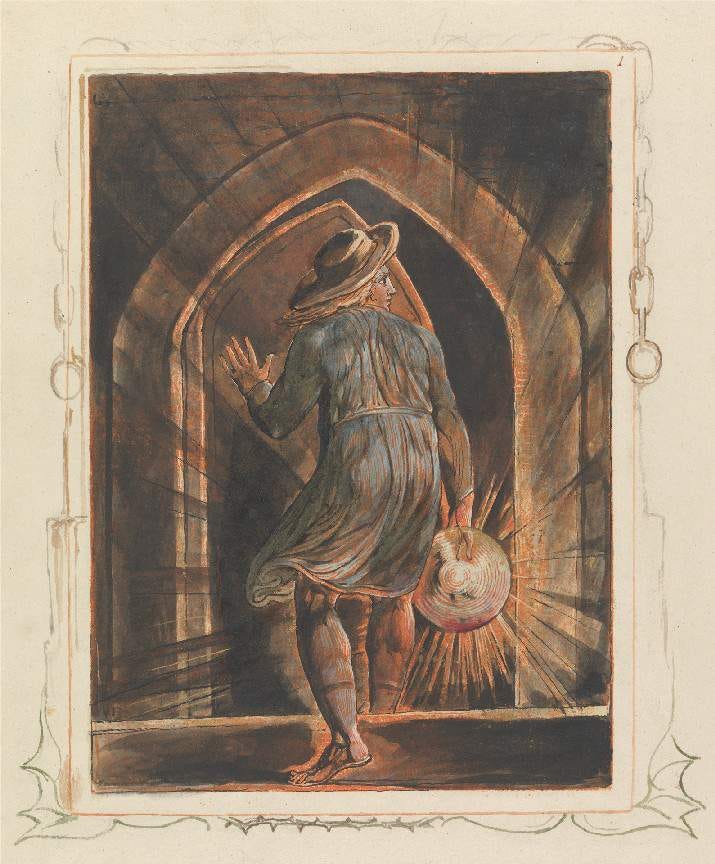
Also, there is a little poetry bonus episode coming soon where I read the poem Tom and I discuss, “Jerusalem ["And did those feet in ancient time"]” by William Blake. The episode art is from the same work that William Blake made himself; a man of many talents!
Thanks for listening to this episode! A brief plug before we begin…
I launched a second podcast and collective art project called Climate Workers Anonymous where people will submit their unfiltered takes on working on climate for me to read on their behalf. Please subscribe and check it out!

Tom Mills has had a heck of a career. He’s worked around the world in mining and agriculture. He was a Stripe Climate Fellow trying to figure out how to embed carbon dioxide removal in agricultural supply chains to create a stable demand pathway that is also delivering real agronomic and social benefits. It’s no surprise he ended up at Mati Carbon, doing enhanced rock weathering on farms in the Global South.
Here are some of his biggest takeaways from his Stripe Climate Fellowship:
Context is Everything: The benefits of these climate interventions depend heavily on where they are applied. That’s true whether it’s improving water-holding capacity, pesticide efficiency, or fertilizer reduction.
Awareness is Low: The gatekeepers to international agricultural policy and climate finance have surprisingly limited knowledge about these CDR methods.
Coffee is Leading the Way: Certain commodity value chains are far more interested than others. Due to strict EU deforestation regulations (EUDR) and consumers who are willing to pay a premium, the coffee industry is highly motivated to adopt solutions that prevent farming from moving to higher altitudes as the climate warms.
Carbon Accountancy Standards Can Block or Enable Progress: If the taxonomy isn’t clear for which types of credits can count against which scopes of emissions, CDR might just remain invisible. Various efforts like the Greenhouse Gas Protocol don’t have an easy system for figuring out how CDR can fit into agriculture, and thus Tom has to look for other ways to stick CDR into the value chain. This isn’t a bad thing—it forces Tom to look to non-carbon benefits that deliver good things to farmers who need help. But it take a falsely-simple carbon crediting angle and turn it into a Rube Goldberg machine of stacked assets.
“The coffee industry was just a great place to be operating. It was solving a real problem and there was a lot of energy and movement in that industry.”
—Tom Mills
And what even is “insetting” anyways?
I think I’ve heard it used in every conceivable way. Sometimes it is expansive and is closer to what I call “thematic offsetting”—you sell an e-waste disposal credit to a computer company whose e-waste is not being treated directly in this disposal pathway. All the way to a sugar company literally has a biochar unit on-site processing their bagasse against their own emissions. And a lot in-between.
Right now, it isn’t super cost-effective for industry to decarbonize using carbon removals given that certain pay-for-practices insets are two orders of magnitude cheaper than equivalent removals in enhanced weathering or biochar. Unless that can be externally monetized via carbon crediting (which typically exports a carbon removal credit to a buyer outside of the company that produced the credit—read, offsetting), or by selling a differentiated product that consumers can recognize. Tom points to a coffee company that literally has biochar on their bag, but I need to track it down for myself and presumably drink some…
There’s a lot more detail in this episode. Tom is one of the most knowledgable people in the world on carbon dioxide removal in agricultural supply chains. I hope you enjoy the show.
Everyone knows about offsetting. But what about insetting? Surely, that's easier. If only we could define it...
In this episode of Reversing Climate Change, host Ross Kenyon sits down with Tom Mills to dig into the physical reality of carbon dioxide removal (CDR) and its intersection with heavy industry, mining, and global agricultural supply chains.
Drawing from his experience working in mining governance across Africa and South Asia, Tom shares how the physical, logistical, and geopolitical challenges of heavy industry perfectly parallel the hurdles facing the scaling of CDR today. The conversation explores Tom's journey into carbon removal while living in India, where he realized how the region's unique geology and agricultural needs make it an ideal landscape for scalable climate solutions like biochar and enhanced rock weathering (ERW).
Tom was a Stripe Climate Fellow, where he focused on embedding CDR directly into global agricultural supply chains. Tom breaks down why certain premium commodity value chains—specifically coffee—are leading the charge in adopting these practices due to strict European regulations and high consumer engagement. From there, the conversation tackles the messy realities of corporate carbon accounting, untangling the nuances of "insetting" versus "offsetting," and exploring how project developers can monetize non-carbon benefits like yield optimization, nutritional density, and watershed protection.
This episode's sponsors
How to fire a carbon market consultant, and how to know when you should

David LaGreca shares his expertise from countless carbon projects during his time at EcoEngineers and beyond
Philip Lee LLP: legal resources for carbon removal buyers and suppliers
Listen to the RCC episode with Ryan Covington from Philip Lee LLP about project finance
Listen to the RCC episode with Lev Gantly about the history and current status of CORSIA
Resources
Check out my new show, Climate Workers Anonymous
Subscribe to the Climate Workers Anonymous Substack
"Jerusalem ["And did those feet in ancient time"]" by William Blake. In fact, the episode art for this episode is from the piece that we discuss. Jerusalem, Plate 1, Frontispiece, 1804 to 1820, Bentley Copy E, © Yale Center for British Art, Paul Mellon Collection.
More from the show
Ad-free episodes and other benefits come with a paid subscription.
Carbon Removal Newsroom, the news show that ran alongside this one, is over. Its episodes are still up, on the feed Climate Workers Anonymous now uses.
Carbon Removal Memes is still goofing around.
The books that come up on this show are collected on my Bookshop shelf.
🎧 Apple Podcasts · Spotify · YouTube
Paid subscribers get this episode ad-free. The ads in the free feed are inserted by Spotify when you press play. They are not in the file I make.
Full Transcript
Ross Kenyon: Hey, thank you so much for listening to Reversing Climate Change. This is Ross Kenyon, host of the show. I’ve been working in climate for about a decade, and running this podcast basically the entire way through. If you go back and listen to some of the early episodes, it’s me learning in public, and I guess I’ve never really stopped doing that. If you’re new here, welcome. Much of the show is about carbon dioxide removal, but it really is about a lot in climate. And climate touches so many issues from the humanities: what it means to be human, where our species is going, what’s happening with our status as beings on this planet, and all the connections to history, philosophy, literature, film, theology, and so much else.
If this isn’t your first time listening, you know what I’m about to do, right? I would love it if you could open up your podcast app and give this show five stars on Apple Podcasts or Spotify, and subscribe so you get the podcast delivered to your phone regularly.
There’s a Substack for this publication, and the link is in the show notes if you’d like to subscribe there. I’m actually trying to move a lot of stuff over to Substack. And I just launched a new podcast over there too. It’s different from this one. Reversing Climate Change is interview shows and monologue shows; this other show is on the old Carbon Removal Newsroom feed, which has been inactive for a couple of years, but I hung onto it knowing that at some point I’d like to repurpose it. There are still a lot of people subscribed to it who are passionate carbon removal people. So I built a new show on top of it called Climate Workers Anonymous. I’ve been describing it as a form of PostSecret for climate.
If you’re in your 30s, if you’re a millennial of some type who grew up in the United States, you probably know about PostSecret. People would decorate a postcard, write on it a sentiment they felt uncomfortable sharing themselves, and mail it in anonymously to be published. I wanted Climate Workers Anonymous to be a space where people can share some of their true feelings about the difficulties of working in climate, about caring about this and daring to believe in a time when climate is not the world’s primary focus. When the world is looking elsewhere and things are difficult. And even when things are not difficult, I wanted a space where people could share things that felt naive, optimistic, evolutionary. What could our species become? What if we were a kinder species? What if we were able to solve some of the persistent, deep, fundamental problems of being human? Or, what if we just need to stare into that void a little bit and sit with it? That’s totally fine too. I’m not trying to find a right answer. I’m trying to make space for people to express their feelings, to feel their feelings, and to connect with others who want space to do so in a way that’s not going to negatively impact their careers.
I’m sure you’ve noticed that if you post optimistic things on LinkedIn, they do fairly well. Whenever I post something critical, or a bit negative, or anything that leads the algorithm to think there’s some sort of theological content in it at all, the algorithm is frowning so deeply at me. LinkedIn is one of those places that feels very booster-ish. That’s what it’s for, you know? The tool is the message, as some people say. And it’s not my job to get mad at the tool for not doing what it was designed to do. But that’s at least partially why I’m moving some things over to Substack.
So if you’d like to follow along with Climate Workers Anonymous, and if you want to submit an anonymous feeling, idea, sentiment, or story for me to read on your behalf, you can submit that over on Substack. I’ll put the direct link in the show notes here.
And if you’re willing to become a paid subscriber of the show — if you love this, if you keep coming back and listening — if you’re willing to chip in a couple bucks a month, I would be so grateful. I’m asking you directly: will you please become a supporter of the show and pay a couple bucks a month to make sure this can keep going? It’s a lot of work. I love it. I do it for its own sake, but some days you wake up and you’re just like, “Ugh, what if I just didn’t?” But no, the show must go on. If you’re a listener, if you love what’s happening here, if you think you can spare the money, please become a paid subscriber. If you can’t, I appreciate you anyway. You’re no lesser in my sight for being an appreciative listener, and that’s wonderful as well.
Today’s show is with Tom Mills. Tom does a great job explaining his background, so I don’t need to spend a lot of time on it here — otherwise you’ll hear a lot of the same stuff when Tom starts explaining it. But Tom’s had a fascinating career working around the world in mining and agriculture. He was a Stripe Climate fellow, which was a very prestigious program that collected a sort of who’s-who of carbon dioxide removal, working to figure out how to advance the industry. His year-long project was trying to figure out how to embed carbon dioxide removal into agricultural supply chains. Sounds easy. Everyone points to it. Everyone wants to do it. Tom’s the guy with the receipts. Tom alleges that there are people who have studied this more than him. I’d like to meet them, because I have a hard time believing it, almost. I really enjoyed speaking with Tom.
He’s now at Mati Carbon, which was the XPRIZE grand prize winner for carbon dioxide removal, and they’re doing enhanced rock weathering in the Global South. We actually don’t talk much about that. If you want more info on Mati, I had their CEO Shantanu Agarwal on several months ago — or maybe more like a year ago at this point — and I’ll put the link in the show notes to that.
In any case, thanks so much for listening. I hope you’ll subscribe to Reversing Climate Change, and especially Climate Workers Anonymous, on Substack. Thank you for listening. I’m so honored that you would spend time hanging out with me. My friends, my colleagues, my peers: thank you for doing this. Here is your show. Here is Tom Mills.
Ross Kenyon: Tom, how many times have we tried to do this? And last time you deliberately staged a power outage to get out of my hard questioning — just nailing you. Why won’t you answer my vicious questions about your career at Mati? Why do you do this?
Tom Mills: Ross, I’m sorry. I think this is our fourth attempt, isn’t it? And yeah, you’re right — the wind was blowing last time and we just couldn’t do it.
Ross Kenyon: I think we were 20 or 30 minutes in, and then it just — poof. I’m like, “What now?”
Tom Mills: Although — we’re in quite a rural part of the UK, and if the wind blows too hard, the trees do fall on the line. So that happens, what, a couple times a year. But it was incredibly unfortunate that we were mid-flow when it hit.
Ross Kenyon: You know what my first instinct was when you said that? I wanted to do “And did those feet in ancient time,” which I only know because Eric Idle just starts singing it in a Flying Circus episode I saw as a child. I’m like, “What is this super-British hymn thing that’s happening right now?” But that’s me transmitting some Anglophilia across the podcast.
Tom Mills: No — we had it at our wedding. And do you know why? Because there’s this line in it about England’s green and pleasant land, amongst those dark Satanic mills. So, you know, during the Industrial Revolution — and my name is Mills. And hopefully I’m not that dark. Well, I’m quite dark, but I’m not that satanic. Anyway, we thought it was a nice reference, and we had to talk about it during the speech and stuff. So we had it at our wedding. It has a place in my heart, that hymn.
Ross Kenyon: Is that line Wordsworth? What is it? It’s obviously a Romantic poet of some stripe, but I can’t... all right, looking it up right now. What’s the — not that I really listen to this — but what’s the Joe Rogan assistant? It’s like, “Jamie, go look that up.” Okay: dark Satanic mills, look that up for us right now. “And did those feet in ancient...” That was William Blake. Okay. William Blake is good too.
Tom Mills: That’s great. It’s a banger — an absolute banger. I like that song. It’s a beautiful one.
Ross Kenyon: But what’s the connection? The dark Satanic mills — skip that part, because ideally you’re not dark or satanic. What’s the wedding connection?
Tom Mills: It’s just — when you’re all together with your closest friends and everyone’s singing it at the top of their voices, it’s incredibly magical and powerful, that song. There’s a power to it as a community that’s pretty wonderful. So yeah, it reminds me of my wedding, so thank you for raising it.
Ross Kenyon: Yeah. You did not expect it to go this direction. Neither did I. That’s improv, baby. That’s how it goes. I love that. I feel like that’s such a nice version of national connection, because it’s some type of British national connection that could have been about anything, really. So — we’re really off topic at the moment, but you know, there are three. The UK’s national anthem is obviously “God Save the Queen,” or the King now. Not the greatest singalong in the world. Then we have “I Vow to Thee, My Country,” a better singalong. And then I would argue the best is “Jerusalem” by Blake.
Tom Mills: And they sort of are — at international events, you know...
Ross Kenyon: Not “Rule Britannia”? You’re not putting that in there?
Tom Mills: I feel like that kind of went out of fashion. It’s not in there for me, unfortunately.
Ross Kenyon: Not enough for you, fashion-wise? I don’t know, I think it’s a fine place to start. The thing with improv is, sometimes — I’ve seen a lot of improv in Chicago and Los Angeles, in comedy — sometimes you’ll see the most well-regarded troupe and they’ll have an off night, and you’re like, “That’s worse than the amateurs I’ve seen.” And some nights amateurs will capture lightning in a bottle, and it’ll be the most sublime piece of art I’ve ever seen. Like, how did you possibly tie all these things together? This is truly incredible. So I always try to make room for a little bit of magic here. Whether or not we achieve it is a separate question, Tom.
But okay. So part of this is — there’s a nice bit of Englishness in here. There’s a nice connection to national community, and there’s also a connection to Romantic thought and poetry, which I’m not sure how deep you are into personally. But when I think of those things, I do think of them as very much connected to agricultural supply chains — although no Romantic writer would ever say “supply chains.” That’s not a Romantic phrase. They’d say something else. But that bucolic connection to the land is something you’re pointing to, I think. Am I right?
Tom Mills: No, I don’t think you are. I think — yeah, everything that’s described in that Blake hymn around the rural idyll, around use of the land — there are some wonderful connections you can draw here. Where we’re maybe stretching it a bit is that my work is pretty Global South–focused, and we’re transporting that hymn from the bucolic pastures of these rolling English hills outside into these amazing tropical landscapes where these practices are. So: agriculture, yes. Romantic, yes. Location — maybe, maybe not.
But for me — I’m back in the UK now, but most of my career has been spent living and working in those rural communities in Africa, and to a large extent in South Asia as well — where there is obviously an English stamp on some of those countries. And there are some interesting parallels. I did a lot of work in the first half of my career in the governance of the mining industry, and I think there are some interesting parallels and learnings between those two industries — mining and carbon removal. They both have a global marketplace. You’re looking at very physical things linked to place — you’re linked to the geography, the climate, the rock. You have a lot of government engagement because you’re trying to export something. So there are interesting parallels there. And also learnings around how you ensure benefits are shared. For me, looking at what’s gone really wrong in the past in some of those mining examples, and what’s gone right, could be useful learnings we can take into this industry going forward.
Ross Kenyon: You might be the most employable person I’ve spoken with. You somehow have deep mining experience and deep agricultural experience simultaneously. I feel like that’s not that big a crossover territory.
Tom Mills: Do you know what? I became really fascinated because both of these things are incredibly physical. I came out of university in 2008, where the big thing was technology, computers — and I wanted to do something very physical. So that’s the reason I went into it. I just found all of those ingredients — geopolitics, logistics, heavy engineering, all those things that we have in the CDR world — I absolutely love it. And that’s why CDR is a pretty exciting place to be working as well, because it shares all of those challenges.
Ross Kenyon: Without a doubt. It’s hard. The combination of those things you’re at least halfway competent at is large. So wait — are you saying you came out of school with... did you do software, or are you saying you—
Tom Mills: I think a lot of my peers were going... the super-smart people were going into finance, or into early-stage software startups, SaaS startups, at the time. And the not-cool kids were going into heavy industry, into mining or these other industries. So that’s where — and I thought, “Yeah, I’m not quite cool enough,” or, “I want to go do something very physical,” as opposed to looking at the SaaS side of things.
Ross Kenyon: Did you read Ernest Scheyder’s book, The War Below — that book about mining? He’s been on the podcast before; he’s a Reuters reporter, and he works on mining and things adjacent to it. He was saying — pardon me if I’m mischaracterizing this — that there’s basically a huge shortage of people who want to work in mining. A lot of young people don’t even realize it’s a field that’s going to be really important. Everyone knows now that we need way more copper and things like that, but the amount of time it takes to train people, and then advance them through seniority to fill all the roles that will need to be filled, is going to take a long time. I think everyone got so focused on the quick wins of software — software eating the world, as Marc Andreessen once wrote. Now what? Is physicality returning? Is it more important than we once thought it was? What happened? Why did we lose sense of the physical world?
Tom Mills: I think it’s a really good question. That point you make around trying to convince people to go into these industries — like going into mining, where we know there’s a massive reliance on critical minerals. I did my master’s research in an area called the Kivus, in the DRC, where the three Ts are — tin, tungsten — this is where a lot of these critical minerals come from, and really understanding the politics around it. It’s incredibly complicated. You need geologists, engineers, social scientists, political scientists — this whole raft of skills. But the industry, because it had a massive amount of challenges and has been extractive — a lot of the profits have been taken out of a number of countries and exploited — there are obviously a massive amount of challenges the industry has faced. And I can see why fewer people are interested in going into it.
Ross Kenyon: Yeah, it does have a feel of — maybe you have to explain yourself to a lot of people for going into that field. Whereas, I don’t know, if you go into software I feel like you’re less likely to face critical comments — though maybe that’s changing with AI now. I imagine if you work in oil and gas, or in mining, or even in agribusiness, you probably get questions on Thanksgiving or Christmas, or whatever holidays you attend with your family, where half the family is like, “Why would you ever want to support these companies and do this kind of work?” I can imagine that probably culturally dissuades people from a career like that, or they know they have to answer for themselves — even though, of course, everyone depends on mining for basically everything we do, and depends on agribusiness for so very much that we do, and same with oil and gas. But I imagine you get uncomfortable questions.
Tom Mills: Yeah. And I think there’s this interesting piece around the fact that a number of those industries will determine the climate — they’re the delta between the amount of emissions you have to make to extract that mineral, or within that land-use change in agriculture. These are where you could really make the big gains, the Pareto gains. I’ve done quite a lot of work in scenario planning in my career — forecasting the future and trying to understand where...
Ross Kenyon: Which I bet you loved.
Tom Mills: It was really fun. Anyway, as part of that work, thinking through where the highest-leverage points are for interventions to do with the climate — a lot of those industries are obviously very high-leverage points to change.
Ross Kenyon: When you’re approaching these high-leverage points, did that lead you into the Stripe Climate Fellows program with a focus on agricultural supply chains? Is that the next big lever to pull — or is that just the next big lever for you personally to pull, with your experience? How do you conceptualize that?
Tom Mills: So I spent the first bit of my career working in the mining sector, in India and in Africa, then I moved over to working in industry, then I moved into working as an advisor within ministries of mines and energy in Africa, but also extensively in South Asia. When I decided I wanted to set up a small business, it was around the time China looked as if it was going to invade Taiwan, and India became this real hotspot of interest, because when people were looking to diversify their supply chains, they were looking at India as the key area. We saw this with Foxconn, with Apple. My clients at the time were asking me to go work out in India. So, having done quite a bit of work in this region, we moved out to India.
And while I was doing that work, I was writing quite a lot — writing a bit academically, on the energy sector — and also doing the scenarios work. It became very clear that India had a massive problem, but also a big opportunity from this area of carbon removal. I stumbled across it when I was writing these academic papers, and I was like, “This sounds incredibly optimistic. This is really exciting. This is a solution.” All the things we get excited about — it has technology and physical environment. And then I was like, “Wow, this could work so well in this context.” Here in India, where I was living, I was like, “This could be the world leader.” This country has all the characteristics to make it an incredible place to produce biochar and to draw down carbon from ERW. It has the Deccan Traps, the Rajmahal Traps — these amazing geological formations. It has heat, humidity. It has degraded, beaten-up soils. It has people who are crying out for this remineralization of their land. And it had shedloads of biomass — it had problems around biomass burning, around methane emissions, that it needed to solve. I was like, “This is a great solution. How do I get in on this?”
So that was my entry point. And then I decided I wanted to invest my time and energy into it, and slowly migrated out of that business and looked at these other options across Africa and Latin America. I was lucky enough to be picked up by Stripe. I invested quite a lot of time building up this trade association, the Carbon Removal India Alliance, which is now doing some great work. So yeah, that was the genesis. That was how it came to pass.
Ross Kenyon: I like seeing more people cross the methodology types. I think it’s really interesting that there are several project developers doing both biochar and enhanced rock weathering — some of which are in India as well — under the same roof. It’s nice to see that you’ve also crossed over there. Historically, we’ve seen them segregated. Do you think we’ll see more people like you, and like Varaha, doing both at the same time? Is that a future pathway for project development?
Tom Mills: I’m speaking for myself here, but I think this is a sensible move. Especially if you’re working and have the trust of a farmer base and a geography, you have different solutions there. I think the holy grail would be seeing how they operate together. I know Maria-Elena Vorrath is doing some amazing work on it — how do we get the MRV to work? The agronomics probably do, but how do we get the MRV to work in that regard? For me, yes, this is something that could work very nicely together — maybe not in the same field at the same time, but in the same geography.
Ross Kenyon: Maria-Elena knows there’s an open invitation as soon as the time is ripe to do so. I’ve long been stumped by her research, and obviously it would be amazing if you could find ways to do these things at the same time. But I have no idea how you can untangle the two active variables here, even at the superficial level of just biochar and enhanced rock weathering. Obviously there’s a bunch of variables nested underneath each of those — how can you attribute causality within an open system like that and make the science good enough? There are a lot of open scientific questions just on those two things separately, especially for enhanced rock weathering right now. So how could you possibly combine them and do good science? There’s a Reversing Climate Change episode that will come out on this topic, because I can’t fully... I’m not a scientist, so I don’t know — is it as I characterize it, or is it somehow easier to do good science on that interaction between the two?
Tom Mills: I’m not a scientist, and I’m not going to try to warrant any opinion on this at all. But what I’d say is, if the agronomics are demonstrating some positive agronomic benefit there, I think we can lean on that and then work out — as the first step — really understand the agronomics. Is this an agronomic tool? Can we utilize both in certain conditions to raise the productivity of the land, and ensure that productivity can increase over the long term? Then there’s a benefit there worth exploring. I have no idea how to untangle putting ERW on the Brita filter of biochar, so I just don’t know. I’m not going to even try. There are some incredibly smart people out there, and I have no idea.
Ross Kenyon: Okay, I won’t force you to answer. I have no idea either. I also respect when people can just say, “That’s beyond the limit of my knowledge — please ask someone else.” A lesser person, Tom, might just ramble some BS and hope that it kind of hung together.
Tom Mills: I can ramble on the agronomics, but definitely not on the drawdown component.
Ross Kenyon: Yeah, fair enough. What did you learn through your Stripe Climate Fellowship? What was surprising to you? What was confirmed? What did you walk away with?
Tom Mills: I went in with a hypothesis: that today there are a number of benefits from biochar and ERW in Global South agricultural contexts that aren’t currently being valued, and therefore aren’t currently being monetized. And if we’re able to monetize them, we’ll be able to spread the cost and therefore go down the cost curve faster. That was the hypothesis. I think about this a bit like shining a torch at the wall — that beam of light is just one white dot. When you put it through a new lens, like a prism, you can see those colors stacking out. But we’re still resting a lot of the weight of the benefit on the carbon.
So for me, one of the big findings was that those benefits are highly dependent on the context in which you apply it. Having gone in pretty gung-ho — “this will work in a majority of contexts” — actually getting to grips with the specifics of what will work where, and which of those benefits will work where... Is it going to be related to the water-holding capacity of the soil? Or to pesticide? Or to fertilizer use efficiency? Those are all slightly different depending on the context. So that was one thing: this is more complicated than I thought.
The second thing was around the awareness among key stakeholder groups. The groups I was targeting — those gatekeepers to international agricultural policy, and the gatekeepers to financing adaptation, resilience, and agricultural and rural development — I was surprised at how limited the knowledge was in this area. That surprised me quite a bit.
The third area was related to which commodities this is of most interest to. During the course of the year, I saw that certain commodity value chains have far more interest than others when it comes to application. The coffee industry was just a great place to be operating. It was solving a real problem and there was a lot of energy and movement in that industry. Other value chains — cacao, sugar, cotton — will probably catch up. Rice will probably catch up as well. But some value chains are further ahead than others. So those are my three takeaways.
Ross Kenyon: What is it about coffee supply chains that makes them so amenable to applying certain types of minerals to their fields?
Tom Mills: I’d say this more on the biochar side — there are just starting to be trials on the ERW side. But, first of all, there’s regulation out of the EU — the EU Deforestation Regulation puts a lot of burden on ensuring those supply chains don’t start to move up the hill as it gets hotter, because that would be a breach of the EUDR. So they’re actively looking for solutions to allow amendments, to allow that soil — to allow that farming to occur at those lower altitudes. That’s one.
The other is that, because that commodity doesn’t get mixed, there’s a direct link between the farm and the consumer, and the consumer is willing to pay a certain premium. So there’s interest from the large CPGs, the consumer packaged goods companies, around achieving their net-zero targets, and it’s very clear, that line between the two. From that you can get both a reduction and a removal. You can get a reduction in methane, which is a big problem, at both the farm level — from the husk — and the milling level. A lot of biogenic waste is going down, getting moved out with water, and there are big methane challenges there, plus the potential to reduce fertilizer as well. And there’s starting to be a cachet around biochar and coffee. There’s a brand in Colombia that has a biochar coffee, which is quite cool.
Ross Kenyon: Where can I buy that, by the way? I want to support it — put it on the bag.
Tom Mills: I think Caravela sell it.
Ross Kenyon: Coffee — obviously there are versions of it that aren’t a luxury product, but especially single-origin coffee is a prestigious product, so it makes sense they’d have enough margin to invest in something like this and put it on the bag, and their consumers are highly engaged. This is not just, “Put it in a little pod, get the caffeine into me, get the brown juice working as fast as possible in my system.” And I imagine there are probably similar dynamics with the luxury-goods phenomenon we’re seeing in carbon removal broadly, on the buyer level — the people who buy it are there because it’s a little bit of a showy thing. It’s way more expensive than what they technically need to do, in many cases. You’re also able to see things like — I think some of the best and most beautiful branding and visual assets that come out of carbon removal are from Alt Carbon. I really love seeing the Darjeeling fields. I get transported just looking at them. I’m always like, “Well done.” I stop to look at this. I don’t always do that for a lot of things. I imagine that has a strong potential single-origin dynamic to it — I drink a lot less tea, so you’ll have to correct me if I’m wrong, but I suspect there’s also a bit of that prestige feeling to it. So will luxury goods, or more prestigious products, continue to lead some of these trends?
Tom Mills: So that’s one avenue — the coffee avenue. But also, coming back to the ERW perspective, I think we’re starting to see these kernels of really interesting outcomes around biofortification — around nutrition, around a better quality of product coming out. I think that’s a driver as well. And I also think yield is a driver. We talked on the coffee side about EUDR, about climate-smart ag, whereas in other commodities — say rice — it’s yield. If you’re providing a soil input into degraded land, you’re also remineralizing those soils, so you’re getting — we’re starting to see this really interesting biofortification within that food source as well. So when we’re talking about food security, we’re not just talking about volume, we’re talking about the quality and nutritional density of that food type as well. I think that will and could drive demand.
One of the other things I should have mentioned with the Stripe Climate Fellowship is that a big driver — maybe this is more of an insetting conversation — but a big driver was around productivity. That’s where this starts to make sense: if you can gain that productivity from an economic perspective. Which sounds quite simple and obvious, but that’s where, on the models, this really starts to make a lot of sense.
Ross Kenyon: On nutrient density — this is one of those things I’ve been hearing about for a long time, and as far as I can tell it hasn’t really mainstreamed, even into the big organic-ish grocery stores. Nutrient density isn’t something we’re measuring, at least not in a very wide way. I’m wondering if technology is going to unlock that. Is it just another thing consumers need to be educated on? Because from what I can tell, a carrot now versus a carrot in Nantes, or a carrot 50 years ago — it’s almost like a different thing entirely. You might not even know what you’re missing. Is there a way we’re going to mainstream that? Is that coming?
Tom Mills: Yeah, and I wonder if this is not going to be driven by the luxury sector. I wonder if it’s going to be driven at the opposite end, when we’re talking about places that need nutrition and are lacking in nutrition. Where’s the margin on this? It could be in producing those foodstuffs in areas where there’s a nutritional challenge.
Ross Kenyon: Is it like when riboflavin is added because there’s a deficiency—
Tom Mills: Yeah. Or where — say the Food and Agriculture Organization — there are places in the world where there’s a nutritional deficit, or a food security challenge. How do we get the most nutrient-dense food? The equation starts to add up in those areas. We’re also seeing investment starting to go into ingredients that have a greater nutritional density — there are equity investments in those entities. So I think there’ll be two poles: one coming up from these areas that require more nutrient density because their population requires it, and also potentially from the higher, more luxury market — and they’ll probably converge somewhere in the middle.
Ross Kenyon: The luxury story is so obvious to me. What’s the name of the grocery store in Los Angeles that’s better than Whole Foods but way more expensive, and has almost become... okay, Jamie, look this up: fancy grocery store, Los Angeles, organic. I’m going to say it, and you’re going to know it — oh, Erewhon. Do you know Erewhon? Erewhon is like the new Whole Foods, the post-Amazon Whole Foods, and it’s very notoriously expensive. If you shop there, it’s very much a conspicuous-consumption status symbol. So the story for nutrient density there is so obvious to me. The kind of person who’s going to go there — if there were a chart they could understand for nutrient density, they’d opt for the nutrient-dense food. But for the low end, the commodity end of this, unless people are trying to avoid something like pellagra and are going to become physically ill, I think the name of the game is cheap calories. Is it not? Or are there places where that’s actually changing, through government or private industry? I just don’t know.
Tom Mills: So there are, in some countries around the world, national programs around nutritional density. That’s where — a lot of my work now is around engaging with these multilateral agencies that can unlock policy, or unlock agricultural policy, or unlock capital. There are programs within certain countries that are being supported, and I think that’s a lever we can pull on that I get quite excited about. Alongside — if we can unlock and demonstrate fertilizer-use-efficiency increases, that for me is another sort of holy grail area as well.
Ross Kenyon: So many people in carbon dioxide removal, and maybe carbon markets in general, look to offsetting, which people know very well: you have a credit originated through some activity, sold to a third party to account for their emissions in some way — or ideally to account for it in some way. And insetting is one of those terms that, frankly, I’ve seen abused. It’s not even clear what it means sometimes. People will use it in ways where it’s like, “We created a thing that was sold to another company in the same industry.” And I’m like, “Okay, is that — that’s offsetting, though, right? It’s thematic offsetting, or intra-industry offsetting, but people call it insetting.” That’s just one example. So, canonically, Tom — explain what insetting is, once and for all, indisputably, inarguably, so we can move on and just call the taxonomy exactly what it is. What actually is an inset?
Tom Mills: Ross, that’s an incredibly difficult question.
Ross Kenyon: I know it is. That’s why you have to do the answers and I just have to do the questions. That’s the best job of all.
Tom Mills: It hasn’t been fully defined, but I’ll do my best. An activity that removes — well, for us, working in carbon dioxide removal — an activity that removes carbon dioxide within the supply shed. And the definition of “supply shed” bears a lot of weight in that statement. It’s a really interesting area where the norms are being set by the industry, and also by people just doing it. Some companies are willing to say, “Well, this is my supply shed.” Some will say, “My supply shed is the physical farm my produce comes from.” Another group will say, “My supply shed could be a farm five farms away. I’ll apply biochar, and I don’t really know exactly which — but within those five, ten farms in that area, I’ve applied it within the region, within the small closed supply region, because I have a trader who has a trader who has a trader, and I know within that it’s going to come from this area, but I don’t know the exact farm. And that farm will change on the day, and then it’ll get blended, and blended again, and end up being part of this mass balance.” So the definition of supply shed is very difficult. It’s definitely not a different country. I’d argue it should be the same region, and the same sub-region. But how you define supply shed is currently still being worked out.
Ross Kenyon: Does an inset require that the carbon negativity produced be consumed by the host organization? An example might be a sugarcane manufacturer. They have an enormous pile of bagasse sitting on their land, and one of the many biochar project developers camps out there and starts pyrolyzing all that bagasse, and then that sugarcane manufacturer is counting the negative emissions from the biochar against the emissions they produce in making and transporting sugarcane. Is that an inset?
Tom Mills: It depends how they use it. If they’re then adjusting the emissions factor of their product, that would be a product claim. If they’re working with, say, Tate & Lyle or Associated British Foods or another company that can claim it against their Scope 3, then that would also be an inset. It sort of works its way through the value chain. But the point is, it’s not sold outside the value chain, and there’s a direct link from the production to reducing or removing within that direct value chain — however you define the end of it. But yes, I’d define reducing the emissions from the bagasse decomposing as an inset, if it’s not sold and it’s utilized within that value chain. However—
Ross Kenyon: Oh, come on, Tom. Come on.
Tom Mills: —the way the carbon accountancy works today makes it incredibly complicated from a durable-removals perspective. We have the GHG Protocol and the Land Sector and Removals Guidance, which makes accounting for both biochar and ERW within value chains, from a Scope 3 perspective, difficult — because it has to sit on a separate ledger to your Scope 3. In the biogas example, that’s a reduction, so that would reduce — that’s quite easy, that sits on your Scope 3. But then the removal from the biochar would sit separately. So there’s not an obvious use case today for that activity, and that’s a real problem.
However, from a product perspective, there is a use case: if we can get the attributes of biochar and ERW somehow included in a product footprint, and have that registered in the Cool Farm Tool or another tool, then that could be a driver of this activity. We also see really interesting work being done in Europe on net-zero oat bars, where biochar is spread onto the oat fields — working through a really innovative substrate company. I believe Carbonfuture is working on that, and they’re able to claim a net-zero oat bar, which has a premium to it. But corporate claims are currently difficult from a reductions perspective.
Where I think insetting could really work is where you start to monetize the other benefits of that activity. Say, in rice, there are big challenges around pesticide residue management — rice coming to the UK is very often rejected because it has a pesticide residue, and obviously that has a financial cost attached to it. So if you’re using ERW to reduce your pesticide requirement, that could have a substantial benefit in terms of less product being lost at the borders. And there’ll be other use cases within these value chains where you can start to inset and stack multiple benefits on top of each other — you’ve inset all those benefits into that value chain, and maybe you spread the cost over a number of different benefits.
I also think about insetting on a municipal or payment-for-ecosystem-services level. Could we say — the UK has the Wye Valley, this beautiful river, the Wye, between England and Wales, which has really large challenges around eutrophication, nitrate runoff from chicken farms? Big problem in the UK. Can we use biochar within that poultry value chain as a way to reduce that nitrate leaching — effectively charge the biochar and use it elsewhere, as a decontaminant? There are these other use cases we could use within certain value chains that aren’t directly related to the carbon removal benefit, that I think would start to make sense over time.
Ross Kenyon: My intuition here is that you studied this carbon-accountancy issue — that carbon removals aren’t snugly fit into the scopes, at least for value chains as you describe — and then looked for other ways in. Like, how do we just not fuss around with this, and find the open window and climb in a different way? Is that kind of how your brain worked on this?
Tom Mills: Yeah. And — we talked about this a bit last time — if we think about that prism, there are these different potential attributes we can monetize. For me it’s about finding who values them, who’s going to pay for it. It may be separate from the carbon. And can we stack them on top of each other? Is an adaptation benefit — when we’re talking about coffee moving up the hill — is that resilience benefit the thing that’s going to monetize this? And then can we sell the reductions, or internalize the reductions? And then can someone sell off the removal? It’s these innovative business models that I really want to try to understand more, and start to unlock.
Ross Kenyon: You could also go in through the front door with a nice suit on, and work with the Greenhouse Gas Protocol people, and try to get them to recharacterize removals.
Tom Mills: Yeah. And Ross, I’m with you entirely on that. In terms of these high-leverage points for policy change, this is one of them — this, and also having these practices included in the emissions-factor tools that corporates use.
Ross Kenyon: My guess on this — and please correct me if I’m wrong — is that it might be parallel to what we’ve seen with SBTi trying to figure out how to make sense of carbon removals, where, as I’ve said on many shows, no matter what they do, someone is going to be very, very angry with them. The politics of how to characterize new assets and fit them into old paradigms that people have built businesses around is very, very touchy. Does a similar thing take place right now if you were trying to change the carbon-accountancy rules for carbon removal within the Greenhouse Gas Protocol?
Tom Mills: So, the honest answer is, I haven’t got in depth into the next iteration of the Greenhouse Gas Protocol. I think it’s worth engaging in some advocacy around it. I don’t know the process well enough, but I think it’s worth us, as a group. I also think a lower-hanging fruit could be around emissions factors.
Ross Kenyon: Is that managed in the same process, or is that external?
Tom Mills: External — and there’ll be a number of providers.
Ross Kenyon: Oh, so you can touch that—
Tom Mills: So, the Cool Farm Tool — there are a number of different providers, and companies themselves will determine, based on academic research, what that emissions factor could be as well.
Ross Kenyon: Oh, so it’s not like WRI manages this?
Tom Mills: There is some — it’s fragmented, but there are also some sources of truth that could be good points to engage in as well.
Ross Kenyon: Okay. One of the bigger insetting issues in carbon removal that I’ve stared at for a long time is that, for whatever reason — I don’t know if this is still true, but it was true when I was looking at it much more closely — Scope 3 reductions are less valuable and less checked than other types of carbon assets. Whereas using an offset for your Scope 1 emissions — those are the things you’re more likely to get dinged on than some pay-for-practices Scope 3 change in agribusiness. I don’t know if that’s true. You’re thinking. That’s part one. Tell me.
Tom Mills: I think there’s a priority here. What can you change, first of all? What can you ultimately change? Where’s the low-hanging fruit? Where are the things we can do immediately? And then you work your way down into the Scope 3 area. For food and beverage, the vast majority of those emissions are obviously going to be Scope 3. And you have a challenge: you share that supply chain with a number of your competitors as well, so you have to get over the free-rider challenge that’s inherent in these industries. And those supply chains are fragmented — you could have quite small end supply chains that you’re working with. So there’s a complication there. However, I think there’ll be a level of optimization for Scope 1 and Scope 2, and then, where all the low-hanging fruit has been achieved, there’ll be a focus on Scope 3. And there is, at the moment — there’s interest in having lower-emission products going up through your supply chain.
Ross Kenyon: Is the value from that high enough to justify the price of producing biochar or enhanced rock weathering? I feel like some of this stuff is still single-digit integers’ worth for Scope 3 insets.
Tom Mills: I think it depends on the commodity type — we may start to see this in some commodities — and on what other problems you’re solving. If you’re trying to stack the whole benefit onto just the carbon cost, then it’ll be a stretch. But if you’re able to come up with an innovative way to monetize a number of those benefits, then it starts to make sense. And as I said before, on an insetting front, if there’s a yield uplift, that drives a lot of this. That drives the economics.
Ross Kenyon: Why didn’t you solve everything for me today?
Tom Mills: I know, Ross. I wish I... why don’t we have this conversation in 2035 and see where we are? I think—
Ross Kenyon: Okay, when it all takes effect. How fun. How fun for us.
Tom Mills: There is one thing I think is interesting that may be worth talking about, and that’s this thing around decentralized or distributed versus centralized on ERW. I think there’s a misconception here. One of the things I was really interested by, going to work for Mati, was that they’re looking at the ERW landscape — and one of the key risks we have now is around delivery risk. If you’re working with a number of very large farmers, you have quite large counterparty risk. Whereas if you’re working with a whole host of small farmers, your counterparty risk is vastly reduced, because even though it’s incredibly complicated, you can have a number of those farmers drop out and it doesn’t matter. Also, there’s a real use and need for it in these environments. So that’s something I think about quite a lot as the sector develops.
Ross Kenyon: I just need to have you back on another time, Tom. I don’t think we really finished. I think there’s going to be more here.
Tom Mills: Let’s do it. Let’s do it.
Ross Kenyon: Thanks for being here. I’m glad we finally made it happen. Thanks for keeping me on my toes.
Tom Mills: Hey, Ross. I enjoy these things a lot, so thanks so much for getting me on.


