


Listen on Spotify, Apple Podcasts or YouTube.
This essay is a companion piece to this episode of the Reversing Climate Change podcast, which you can listen to here on Substack (ad-free for paid subscribers coming soon), on Apple Podcasts, or right below on Spotify. There is also a previous episode that this post is a sequel to.
Everyone gets stuck on Weimar inflation
CW: this episode discusses genocide
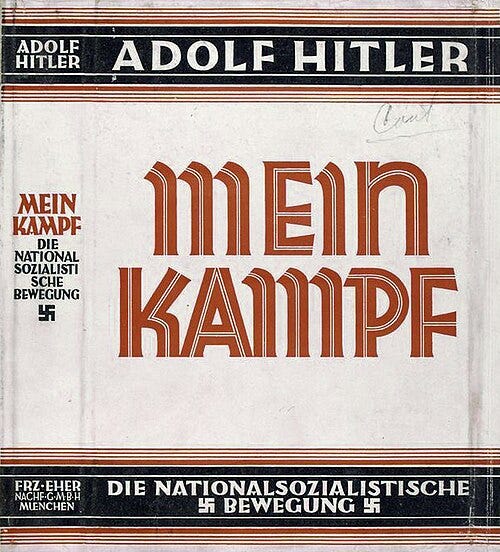
People reference the Weimar Republic's transition to Nazi Germany often. But I think they're missing perhaps the most relevant and frightening insight from Adolf Hitler's memoir, Mein Kampf.
It isn't just that economic uncertainty produces political radicalism. It's that bad things can happen when a group which has dominated a multiethnic empire for a long time is expected to start sharing more political and cultural power with the groups they once ruled.
The overwhelming climate relevance of Charlie Chaplin’s speech from The Great Dictator

How a poetry episode for the Reversing Climate Change podcast accidentally ended up as an hour-long riff on Hitler, political comedy, and why we are ruled by madmen.
People really, and I mean really love to make comparisons to the Nazi Germany. They also like to point to the Weimar Republic which preceded it. And fair enough. There are rhymes to be heard.
The comparison I have most heard in an anecdotal twenty years of being politically online (besides letting anything broadly authoritarian fall into the Godwin’s Law bucket), is that after World War I, Germany was so exhausted by the war itself, reparations from the Versailles Treaty, and then the subsequent hyperinflation that average people could not take care of their families. Germans turned to more radical political ideologies both left and right as a result of raw hunger.
Without a doubt, this is a true insight. When the system cannot help you in your most basic needs, you start wondering “how good could this system really be?” At some point, one has nothing to lose but one’s chains.
But I actually do not think this is the core insight of Adolf Hitler’s two-part memoir, Mein Kampf (1925-1926.)1 Hitler’s complaints about the Habsburg State (call it Austria-Hungary if you’d like) have an eerie ring to them the present-day United States, and I will explain why.
When multiethnic empires become pluralistic
“The process of the Slavization of the Austrian State was advancing year by year... the general development was directed against the Germans.”
— Adolf Hitler, Mein Kampf
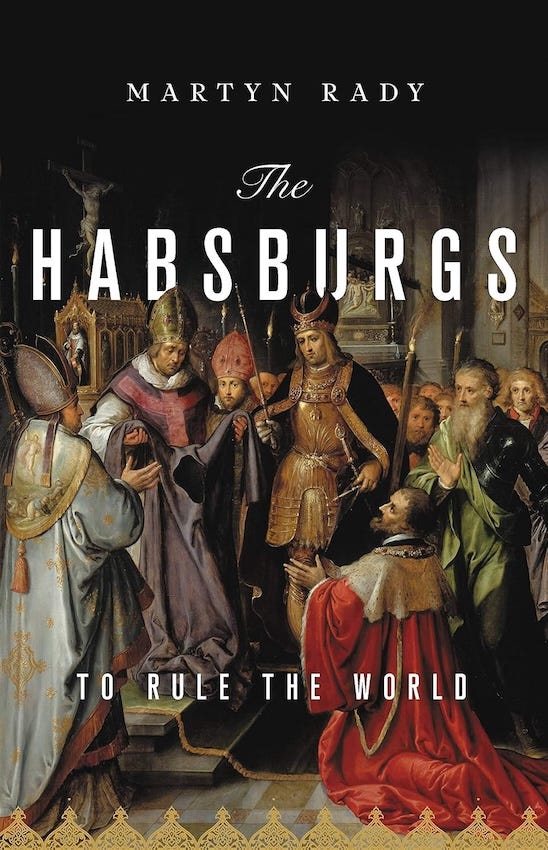
I’m fascinated by what the Habsburgs were able to build and how it was able to evolve. They clawed their way out of the shroud of history in the 10th century as pretty much all “royalty” does. Somehow they had gotten a hold of same land and some peasants in what is now Switzerland, did some fancy genealogy that showed their bloodline Forrest Gumps itself somehow to the Jewish Patriarchs, Homeric heroes, Augustus, Constantine, probably King Arthur and Prester John and God himself if you gave them half a chance. Eventually they rule from Vienna.
The Habsburgs are famous for marrying their way to the top and “conquering” Europe through marriage. There was a period in Habsburg history where Habsburgs controlled the Holy Roman Empire all the way to Spain and the Spanish New World. Much of that was done through strategic marriages and personal unions that would consolidate titles and land holdings in the Habsburg family.2
The long 19th century complicated things for empires. It pains me to compress down such a big story and have to skip religion, the Dual Monarchy, and a bunch else, but the combination of mobility, literacy, industrialization, state capacity, bureaucracy, and about ninety other factors gave rise to new kinds of nationalism.
Much of this new nationalism can be located within Romanticism, and it had a strongly linguistic component to it. That can be both liberatory and punitive. You become French by speaking French as taught in free and compulsory public schools and as approved by the Académie Française. Give up your Gascogne or Occitan dialect and become “French”.3 Or, if you are a Lithuanian dominated by Polish cultural elites or the Russian state has banned your language, borrow Czech orthography to create your own written script and have book smugglers bring you texts in your vernacular to (re)build a nation around.4
A language is a dialect with an army and a navy.
— Max Weinreich
Errors of reading history from the present, by way of Ottomanism
If you’re an empire during this time, you’re watching the subject peoples you rule start to experiment with nationalism, and you actually don’t know yet that the nation-state will soon become the dominant political form. It probably looks ridiculous that these provincial Serbs or Walloons or Ruthenians or Lithuanians would govern themselves instead of a dynasty with centuries of practice wielding power. If they were ever good at it, they’ve been conquered and ruled by others for long enough to be out of practice. This nationalism thing—it’s a fad, like the internet would later become.
That being said, it might be nice to nip nationalism in the bud. And some empires tried harder than others to get ahead of what would later become history.
One of my favorite examples of this was a movement called Ottomanism. The Ottomans were ethnically Turkic steppe horsemen who settled down in Constantinople and expanded over centuries into the Balkans. They were able to Islamize some places more successfully than others (Bosnia, Kosovo, Albania), but also let Christians remain Christian and seek justice in their own courts for many matters if they paid the jizya and allowed some of their sons to be taken to become Janissaries.5
I studied abroad in Istanbul for a semester and took a class on nationalism while there. From what I can recall, I don’t think the Ottomans gave its ruled peoples a lot to get excited about. I don’t associate them with “Oriental cruelty” greater than their neighbors deeper into Europe, but there also just doesn’t seem to be a lot of identity available for a subject to adopt. By the middle of the 19th century, this strikes some Ottomans as a liability. So what if, and believe me, what if… we created our own imperial Ottoman nationalism that our subjects could opt into?
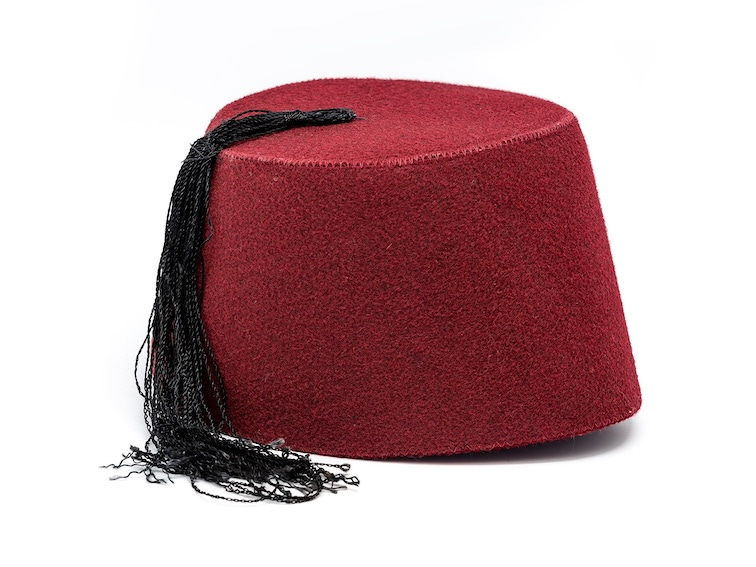
This has always struck me as a little, “how do you do, fellow kids?” but the Ottomans needed to find some way of generating some modern identity stickiness. The Ottomans tried to bring universal citizenship to its subjects6 that irked many Muslims who didn’t want to give up their culturally dominant position with co-citizens who weren’t coreligionists, and also irked many Christians who didn’t want to abandon their carveouts and relate to the Ottoman state as citizens same as any other. For those who did like this new identity, the fez hat became a symbol of Ottoman affiliation and identity.
Of course, things didn’t pan out for the sick man of Europe. The Ottomans were in a period of prolonged decline at least since Jan Sobieski’s cavalry charge at the Battle of Vienna, and dozens of Gallipoli’s couldn’t reverse that trend. It would be a mistake to see that as inevitable or even unique to them—it is totally possible that if we had skipped World War I, Ottomanism might have been a breakout hit—though I can’t say I liked its odds. However, the approach the Habsburgs took in trying to feed incipient nationalisms into their imperial politics had a better chance.
The Red Prince and Habsburg adaptability
The Habsburgs saw the same evidence that the Ottomans did. People were now all getting written versions of their language and becoming aware of themselves as agents of history with a capability of self-governance that stretched back into their noble pasts however long suppressed by their oppressors. How are you going to keep them in the Habsburg State once they have read the Kalevala?!7
The Habsburgs did several things to try to compensate, two of which I will cover, both of which will magnificently lead us back to Hitler.
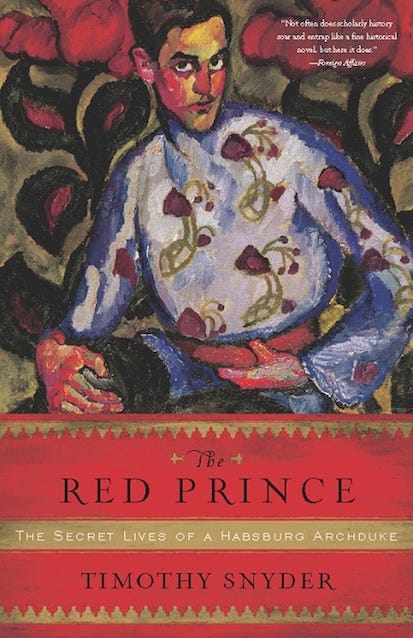
The first is documented in Timothy Snyder’s delightful book, The Red Prince: The Secret Lives of a Habsburg Archduke. It chronicles the life of Wilhelm von Habsburg who was born at the end of the 19th century to a Habsburg father who spoke fluent Polish and was, as far as I can tell, genuinely Polish in national sentiment. This probably sounds strange because it’s hard to think outside of the nation-state with how we have experienced nationality in our lives. But you’ll need to try.
A ruling family as big as the Habsburgs—which crosses so much of Europe—could build genuine loyalty and fellow feeling with their subjects by becoming the branch of royal family which adopted a nationality; learn the language, dress the part, and live amongst them.
If you know much about Poles and Ukrainians, you might know they aren’t always the best of friends (though they seem to be in a good place right now.) They overlap in a part of the world without many natural boundaries (and also the entire Yiddish civilizational zone) but hold plenty of different ideas about who should rule and where. Wilhelm’s father, as a particular type of Polish nationalist, doesn’t have the highest opinion of the Ukrainians.
Wilhelm, rebellious and bright son that he is, gets hooked on the Cossack mythology and the movement for Ukrainian independence and tries to bring them into the Habsburg fold before and during his fighting in World War I. He very much becomes Ukrainian. There’s almost a sense for these imperial figures where you can say something like “Wilhelm converted to Ukrainianism” in a way that doesn’t really make sense to how our brains process nationalistic understanding in 2026.
Now, imagine for a moment that you are an Austrian of German ethnicity who struggles financially and is obsessed with Wagner’s use of Germanic and Norse mythology in his operas. You are raised during the period of Romantic nationalism that stretches your people’s past back very far, perhaps even far enough back to reach to the Aryans of India. And you are ruled by ethnic Germans who are also LARPing at being Polish and Ukrainian while you have to go and get mustard gassed at Ypres?! Why aren’t they fighting with and for actual Germans?! Their focus is so split that they forget they are Germans and they send us to die in the mud and we cannot even claim it is for the glory of the German people.
By my lights, these imagined Hitlerian thoughts ring true to his character. It might be the bias of my life of living through so much populist rhetoric influencing how I wrote this, but this nationalist offense at the out-of-touch elite denying his true ethnicity in order to pretend to be and seek praise from an “inferior” people? Be an American and tell me you haven’t experienced someone share rage of this flavor. This is an echo.
Interethnic meritocracy and its discontents
“The process of the Slavization of the Austrian State was advancing year by year... the general development was directed against the Germans.”
“Did not we boys already know that this Austrian State had, and could have, no love for us Germans? Our historical knowledge of the methods of the House of Habsburg was corroborated by what we saw every day... The Royal House were becoming Czech in every possible way; and it was the hand of the goddess of eternal justice and inexorable retribution that caused the most deadly enemy of Germanism in Austria, the Archduke Francis Ferdinand, to fall by the very bullets which he himself had helped to cast. And he was the chief patron of the movement, working from above to make Austria a Slav State!”
— Adolf Hitler, Mein Kampf
The second way (of many) that the Habsburgs tried to get ahead of nationalism was to include more meritocracy in governance. If you want people to experience their government as something that is a part of them rather than something external that sits on top of them, making sure that those who deserve a role by their qualifications should have it independent of ethnic identity.8
By doing so, it makes the empire seem less like ethnic Germans conquered your ancestors and still do as they wish, and more like a large club of peoples who share a free trade zone, military, and bureaucracy because there are economies of scale and it’s genuinely good for all of us.
But if you’re a borderline lumpenprole artist forced into Viennese utilitarian paint jobs by necessity, these free trade and united-peoples-of-the-empire arguments may not be persuasive.
“In the North and the South the poison of the foreign races ate into the body of our nationality, and even Vienna was visibly becoming less and less a German city.”
— Adolf Hitler, Mein Kampf
Insofar as state jobs can be considered a form of political patronage, the Habsburgs deciding to give away jobs and seats to non-Germans stung to someone who was struggling and cared so deeply about being German. To elevate non-Germans in status and access at the zero-sum expense of Germans may have felt like a betrayal.
You see this meltdown completely when Hitler walks into the Reichsrat, the imperial Parliament in Vienna. Expecting a grand temple of German authority, he instead encountered the living, breathing reality of a multiethnic democracy:
“How immediately I was outraged at the wretched comedy occurring before my very eyes! Several hundred of these representatives were present. Some of the gentlemen did not even speak German, but instead their Slavic mother tongues or rather dialects! It was a gesticulating mass in frantic turmoil, shrieking and interrupting in every pitch of voice...”
There’s something so “why can’t you people just SPEAK ENGLISH?!” about that quote. And it is, all things considered, a minor form of intergroup conflict—certainly by Hitlerian standards. The goal is to prevent its advance beyond this point in societies that are transitioning from having an ethnic core to one which shares power and status among its many peoples.
How exactly is one meant to transition an empire formerly dominated by a single group into one that shares power with the people it used to rule? How can this be done without frustrating that original group to the point of prolonged fury? This is the key theme I could not unsee after reading Mein Kampf. It has stayed with me for a decade, and is a major question for anyone who wants to live in a world a country where we are genuinely neighbors and not adversaries. If we are to have a chance at maturing into the 21st century, we will have to become wise enough to develop personal gentleness and institutional health.
A concluding thought: what if WW1 didn’t start imperial collapse?
It’s hard to look at the world without nation-state eyes. We take it for granted. In some cases the nation-state was probably net liberatory. In many other cases, it all but guaranteed ethnic cleansing. But could Ottomanism have actually worked out had the Central Powers not lost WW1? Could the Pan-European Imperial Habsburg way have given enough to all nations to have resulted in less conflict and more prosperity for the multitude?
Maybe. It’s fun to play at alternative history. Would Hitler have been Hitler had World War I not happened? Or if the Central Powers won? Or even if the Treaty of Versailles were written differently? It is very possible. Hitler may have just been a racist loudmouth. Or maybe he would have adapted to an Austria-Hungary which had evolved beyond its Germanic origins into something broader and genuinely transethnic. If he felt more economically secure and less abused by the government which put him in the trenches, we might have skipped so much absolute grief.
I am not certain how we will mature as a civilization and as a species, but I am certain that it will require us to “bring about the kind of society where it is easier to be good.”9 What we are doing now shows no sign of reducing the intergroup conflict that can only produce misery.
Subscribe to the Reversing Climate Change Substack
Become a paid subscriber for bonus content and ad-free episodes
This Episode's Sponsor
EcoEngineers: a full-service advisory and consulting firm focused on carbon dioxide removal, decarbonization, and carbon markets
2026 EcoForums Training Series: Navigating Global Carbon and Fuel Regulations, Market Mechanisms, and Life-Cycle Analysis Fundamentals
Check out my new show, Climate Workers Anonymous
Full Podcast Transcript
Coming soon…
You might disagree with this if you are wondering if/when the United States Dollar loses its global reserve currency status, but that’s a special kind of macro nerd/goldbug-adjacency that isn’t as common.
If you have heard of The War of Spanish Succession (probably because of pirates) but never taken the time to look into it (and who could blame you for that?), it’s the case of the Habsburg King of Spain dying and sending Europe into their genealogical charts and armies into the field. And sure, genealogy sounds like a boring hobby for the elderly, and it is, but I also do love it.
I actually recommended Eugen Weber’s Peasants into Frenchmen: The Modernization of Rural France 1870-1914 more times than I can count.
Not to go too far into all of the Timothy Snyder books I like in this post, but his book The Reconstruction of Nations: Poland, Ukraine, Lithuania, Belarus, 1569–1999 documents at length linguistic nationalism and some of its roots in Romanticism. Nations as composed of a people who speak a common language is one system of taxonomy that's been in vogue at least since the Treaty of Westphalia (though we usually see it hit its stride more with the American and definitely the French Revolutions). But much of the “history” that stretches deep into the past to find a coherent people is myth-making in the same kind of way described in the body text as the Habsburgs creating their fanciful genealogy. We build ourselves from story. One can take a DNA test or be a citizen of a country or speak a language or have matrilineal Jewish descent, but what that counts for and what one does with it are very different questions, because… we build ourselves from story.
If you want to get into the spirit, The Bridge on the Drina by Ivo Andrić is good. Some of its images remain with me years later. In fact, maybe I should go give it a reread…
This nomenclature changeover from “subject” to “citizen” that is now ubiquitous is also a product of nationalism and this historical process.
Before you respond pedantically here, I need you to know that I know the Habsburgs didn’t make it to Finland. Except, now that I mention this, I should probably double-check.
People generally point to the Imperial exam of China as an example.
The rightfully legendary Dorothy Day.


