


Listen on Spotify, Apple Podcasts or YouTube.
As listeners of Nori podcasts, you might know that we use cryptocurrency in the form of Nori tokens which may become a market-driven price for carbon removal. You also might know we issue non-fungible tokens, otherwise known as NFTs, when buyers purchase those removals. But you may not know the history of the blockchain we run on or how the system works. So, where can you go to learn Ethereum 101?
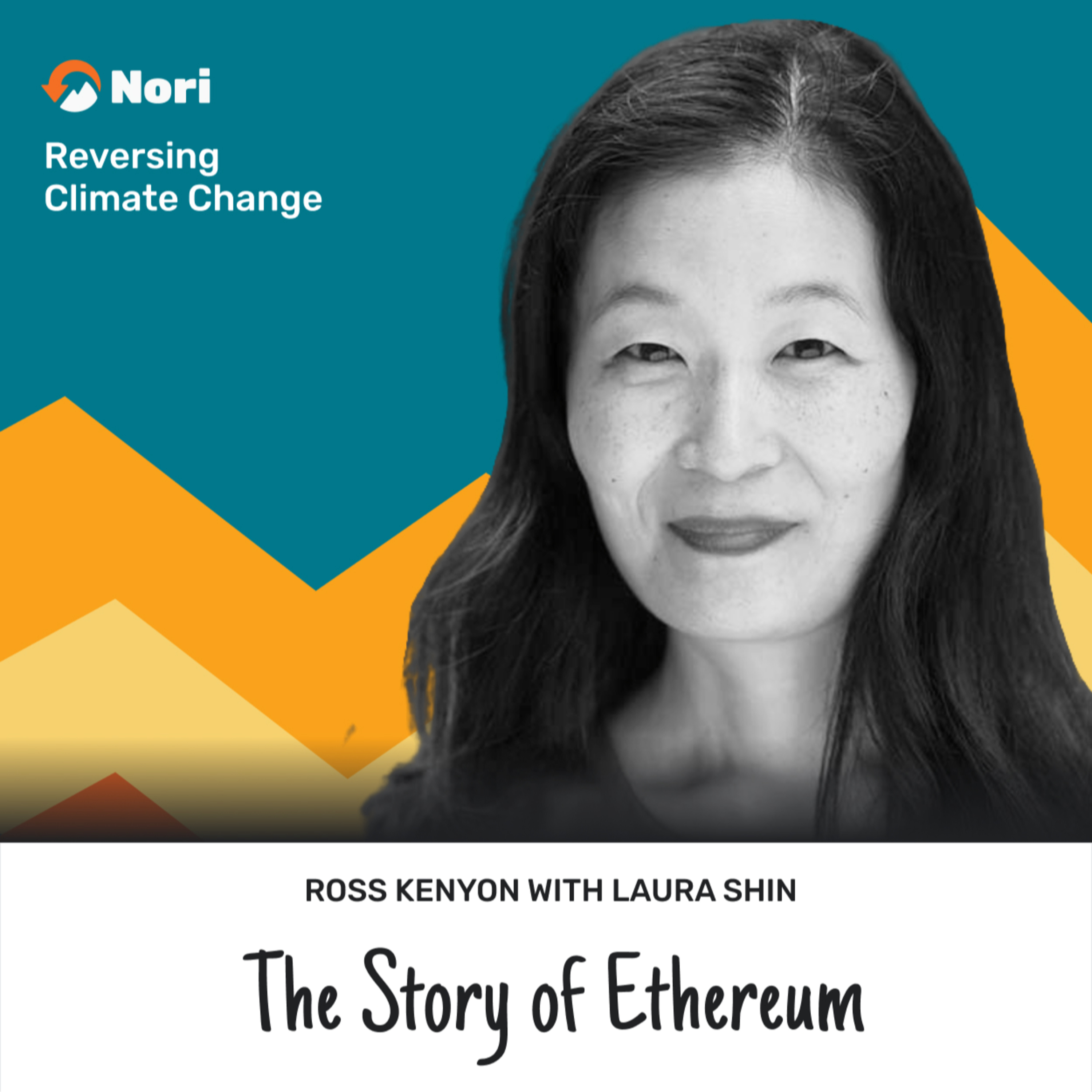
Laura Shin is a crypto journalist and host of the Unchained Podcast. A former senior editor at Forbes, Laura was the first mainstream reporter to cover the blockchain full-time. On this episode of Reversing Climate Change, Laura joins Ross to discuss her new book, The Cryptopians: Idealism, Greed, Lies and the Making of the First Big Cryptocurrency Craze, a history of Ethereum and the ICO mania of 2017.
Laura explains why Ethereum quickly became the second most important cryptocurrency, describing how it was used to raise billions of dollars for decentralized apps and what happened when the DAO to fund slock.it was hacked. Listen in for Laura's insight around why the crypto bubble burst in early 2018, what trends have occurred since then, and why Laura believes that DAOs are the next big thing in crypto.
Key Takeaways
[1:00] How Laura’s book focuses on the story of the ICO craze
[2:02] What it’s like to write about recent history and why Laura was inspired to create a record of what happened in crypto in 2017 and 2018
[6:10] The rigorous fact-checking process Laura went through for The Cryptopians
[8:46] Why Ethereum quickly became the second most important cryptocurrency
[10:44] How the Ethereum blockchain serves as an open design space where developers can build decentralized applications
[18:03] Examples of the fastest and largest fundraising campaigns for apps through ICOs on Ethereum
[18:39] How the DAO to fund slock.it was hacked for $75M
[27:56] The ‘code is law’ debate that occurred in the aftermath of the DAO crisis
[30:00] The cultural differences between the Bitcoin and Ethereum chains
[31:08] What behaviors investors had to learn to participate in the ICO craze and why crypto founders were able to raise billions of dollars for their projects
[35:41] How ICOs compare to VC funding
[36:17] How the 2017 SEC report classifying DAO tokens as securities informed the burst of the crypto bubble in early 2018
[37:59] Why crypto prices dropped early in the pandemic and what’s happened since then
[42:48] Laura’s explanation of decentralized finance or DeFi and non-fungible tokens or NFTs
[52:16] How DAOs work to organize people in a democratic way
[55:02] Why Laura believes DAOs are the next big thing in crypto
More from the show
Ad-free episodes and other benefits come with a paid subscription.
Carbon Removal Newsroom, the news show that ran alongside this one, is over. Its episodes are still up, on the feed Climate Workers Anonymous now uses.
Carbon Removal Memes is still going.
Resources
The Cryptopians: Idealism, Greed, Lies and the Making of the First Big Cryptocurrency Craze by Laura Shin
‘The Inside Story of Mt. Gox, Bitcoin’s $460M Disaster’ in WIRED
Full Transcript
Ross Kenyon: Hello and welcome to the Reversing Climate Change podcast. I’m Ross Kenyon. I’m the creative editor at Nori’s Carbon Removal Marketplace. Laura Shin is a writer, crypto journalist, and podcaster. A former senior editor at Forbes, she left the magazine in 2018 to commit to her podcasts and videos, which you can find at Unchained in your podcast app of choice. And Laura is the author of the new book, The Cryptopians, Idealism, Greed, Lies, and the Making of the First Big Cryptocurrency Craze. Thanks for being here, Laura.
Laura Shin: Thanks for having me.
Ross Kenyon: What is with this enormous subtitle? There’s a lot going on there. It seems like the story of Ethereum and the first cryptocurrency craze runs the gamut from all the good things to all the bad things. Is that an accurate summation?
Laura Shin: I would say so. I mean, so basically the story is the story of the ICO craze, the initial coin offering craze back in 2017, 2018. And as I’m sure you’re well aware, Ethereum was the main platform for that. So a big chunk of the book, probably somewhere in the ballpark of like 75 or 80% of the book is a history of Ethereum. And then as the ICO craze kind of gets going, it sort of branches out to some of the other areas that it touched. But yeah, the book covers all of that.
And as I’m sure you’re well aware, during that period, there was a lot of good stuff happening, but also a lot of bad stuff. And so the book, yeah, covers the gamut.
Ross Kenyon: One thing I was thinking about reading it is that I’ve seen this attributed to so many people. I think the most credible attribution I’ve seen is from Zhu Enlai from the Chinese Communist Party in mid-century. When asked about the relevance of the French Revolution, he said it was too soon to tell. This is like one of those things that everyone always quotes, right? But what is it like writing a history of something that is still so recent that it’s hard to know exactly what the impact of the various projects you described will or won’t be?
Laura Shin: So I wasn’t doing a deep dive into any one specific ICO, but clearly Ethereum itself was something that was significant and is at least here to stay for the short to medium term. Who knows about the long term? But honestly, the fact is because so much of the record of what happened was digital, I was actually nervous while writing it that a lot of the records were being lost. And so I Even though the book kind of ends in early 2018, which is just four years ago now, there were a lot of materials that I still had trouble accessing, but I was able to get a lot of things that have not been published before.
Yeah. There is a lot of new material in the book. As I was telling you before the show, there’s complete whole storylines that haven’t been known before. It’s not just like tidbits of news. It’s like, yeah, just whole complete things that people have not read about or heard about before. So it’s very exciting. I was really glad to be able to get the material to document all that and to put it in the book. The book was very rigorously fact-checked And so when I was writing it, I really was thinking about history.
Frankly, I was thinking, this is a momentous time. It’s like not even just about Ethereum itself, but just about crypto and blockchain technology becoming bigger and that pivotal moment when it started to really hit the mainstream. And so when I wrote the book, I was thinking... I want to portray how momentous this was at the time, but also how new and how different and really bring it alive for people who may be reading this in the future and they may not be able to talk to the players. And so I talked to more than 200 people for the book.
I got so much material, like I said, that hasn’t been seen before or hasn’t been made public before. And so I think people are going to really I had multiple friends of mine who are not crypto people. They’re just like my real life friends read it and they had an understanding the point where like my best friend, she’s an artist and yoga instructor and actress and She knew nothing about any of this. She understood it so well that she actually caught two mistakes that I put in the book. At one point, they had decided to do things one way, and then later they decided to do it a different way, but I forgot to mention that they changed.
And she was like, oh, here in this description, it said blah, blah, blah, but I thought it was going to be blah, blah, blah. And I was like, oh, right, right, right. And there was another one that was similar. And then also my audiobooks engineer, who nothing about crypto when we started, So we started recording on a Monday and Wednesday at lunchtime, he’s asking me all these questions about crypto. And I was like, how do you know so much about crypto? He was like, from your book. Like it was just like two and a half days of recording.
And he understood it well enough. He was asking really intelligent questions. And yeah, by the end, he loved, so first of all, he loved the book. He was like, Laura, you don’t understand. I do more than 150 books a year as audio books. I never even pay attention to them. He was like, He was like, I want to reread this. I need to understand it better. He was all into crypto. He was buying his hardware wallet, all this stuff. I was like, wow, okay. That’s a high praise. Yeah, so I was excited and happy about that reaction.
Ross Kenyon: Great to hear. I’m not surprised to learn how much research went into it. It clearly shows, especially because if I wrote something like this, I’d be worried about libeling someone just because it seems like a lot of this stuff is sort of like so-and-so said what so-and-so was a jerk in this way. And I imagine you have to have a background to say that credibly without getting in trouble, right?
Laura Shin: Yeah. My fact checker and I went through probably the world’s most grueling fact checking process and I’m not joking you, for the first whole six months of last year, I literally, from January to June, and I actually just recounted this at a party on Sunday because I saw this friend I haven’t seen in a long time, but she had just moved to New York like seven months ago, but I haven’t seen her since she moved back. And I didn’t know she was going to show up at this party. And she’s like, how come I haven’t seen you?
And I was like, oh, I was like... I did not leave my apartment for anything non-worker related except for five times between January and June, the end of June. Two of them were my COVID shots. So I was like averaging for the first pass of the fact checking, I was averaging a page an hour, a page an hour, because like my fact checker who didn’t know anything about blockchain technology was asking me a lot of questions and I had to back everything up, but that meant I had to find where I like had all the material.
And then sometimes like for particularly dense paragraphs, I literally was averaging an hour per paragraph. And this book, as you know, is like, it’s almost 400 pages. So I just, I was, it was like trial by fire because I didn’t even know that I was going to have to do that much work for it. And then, yeah, it’s like not only just the technical stuff, which by the way, on a blockchain level, like I was writing about things that I did not myself know before writing about it for the book.
And I’d been covering crypto for years at that point. And then on top of that, the prices were constantly changing throughout the book, right? And every time any transactions happened, we would put the dollar exchange rate, but like calculating all of them and like figuring out like which exchange rate do we use on that day? Because like the opening and closing prices and the highs and lows are like not, they’re all over the map. Then on top of that, all the he said, she said, and like every time somebody says something negative about somebody else and like you want to print that, then you have to run it by the person whom the negative comment was made.
So it’s just like, I mean, it was like beyond, like it was like crazy. So yeah, that’s why the fact checking process was like, Like my fact checker was just like, oh, this is the number one biggest job I’ve ever had. It’s the hardest. But he also loved the book. And he was like, I hope this book does the best out of any book I’ve ever fact checked. And I was like, wow, that’s awesome. And he also got super into crypto.
Ross Kenyon: I think it’s a really helpful book. The first book I often tell people to read is Nathaniel Popper’s Digital Gold, which goes right to Ethereum. Like it’s right on the cusp of being about Ethereum. But it’s basically all Bitcoin about Silk Road and those early days.
Laura Shin: I would say so. Ethereum became the second most important cryptocurrency pretty early on within, let’s see, what was that? Maybe roughly eight months after its launch or something like that. And then it went through some really momentous events shortly thereafter, namely the DAO attack, which resulted in Ethereum’s evil twin, I like to call it, Ethereum Classic. And so that was... It was really the only existential crisis that Ethereum’s ever faced. And I think it provided a lot of lessons for the whole crypto community, not just Ethereum. Yeah, ever since then, Ethereum has not lost its spot as the second most important blockchain, second biggest market cap.
And all the major trends that we’ve seen in cryptocurrency since that period have launched on Ethereum. By that, I mean, so obviously the initial coin offering craze was the first one. And then DeFi, decentralized finance, probably would be the next one. And then next NFTs, which actually sort of predated DeFi, but they only really took off after DeFi. And that obviously was this past year, 2021. And then the way I think everything’s actually trending though, like if I really think about it, is DAOs. Because if you notice, like all the DeFi protocols, they’re all turning into DAOs.
And a lot of the NFT projects, they’re turning into DAOs. So like I actually feel like Much like ICOs, I actually feel like the next big thing is actually DAOs. It sort of felt like it was going to be DeFi. Then it felt like it was going to be NFTs and it kind of still is. But like really the overarching thing is actually DAOs in my – this is just my personal opinion. I’d be curious for your thoughts if you – what you think about that but – I’d certainly see a lot more of them lately.
Ross Kenyon: And I watched the one of my colleagues is really into the Constitution DAO, which had an amazing ending to getting outbid by a billionaire of a hedge fund. Yeah.
Laura Shin: And he’s been public in his negative comments about crypto.
Ross Kenyon: It’s like in my next book, I have like the perfect villain for that episode. Yeah, it was too it was too cinematic. I couldn’t even help it. Let’s assume though that the listener maybe knows something about blockchain and crypto, but not a lot. Some of these words, I don’t even sure, DAO. We don’t think we’ve even talked about DAOs on this show before. Can you help us get a baseline here? Like what exactly is Ethereum? What are they trying to do? What is being built upon it? And talk about some of these phases that you went through its history.
God, that’s a huge question. Can you help us?
Laura Shin: All right. So as with everything in crypto, when you go to explain it, it’s actually best to start with Bitcoin. So with Bitcoin, First of all, it’s two things. It’s both the Bitcoin network, which is the asset that’s native to that network. But Bitcoin, if you look at the white paper, the subtitle is a peer-to-peer electronic cash system. And so the Bitcoin network was really kind of purpose-built for payments. And of course, because of the monetary policy of Bitcoin, the actual use of the asset has turned more to digital gold.
But really, it’s kind of this hybrid, right? It’s like the network was built for payments. The asset, you could say, due to the monetary policy is built more for digital gold. But Even though at the moment it’s being used more in a digital gold way, who knows what’s going to happen in the future. It really could be used more for payments. We are seeing that with things like the Lightning Network that people are using it more for payments and with El Salvador adopting it, they’re having the merchants accept Bitcoin and things like that.
So kind of like how it’s going to be used is still up in the air. But regardless, it’s kind of really restricted to that. There are people that are trying to build things on it, but it’s just more challenging because the way that the scripting language is for Bitcoin, like I said, it was purpose built with that application in mind. However, with Ethereum, Vitalik Buterin was a teenager when he discovered Bitcoin and he got really involved with the Bitcoin community. And he actually began his career in Bitcoin as a journalist and was writing articles about it and even became one of the – I actually forget his title at Bitcoin Magazine, but he was like one of the owners or something like that at Bitcoin Magazine for a period.
And he was noticing that there were a lot of these kind of like next generation blockchains that were forming where they were adding new features on. So it was like beyond payments. They were doing – I don’t even remember all the features, but like I’ll just make them up like escrow or derivatives or whatever. But they were like adding features.
Ross Kenyon: It was like master coin and stuff like that of that era? Exactly. Okay.
Laura Shin: Exactly. And he thought – Well, anytime you add a new feature, there could just be another blockchain that comes along after and it has more features. And so he thought, why can’t it be more like an app store where, you know, in the Apple app store or the Google Android app store or whatever, a developer can think of any idea that they have. Just, you know, it could be like a payments app or it could be a photo app or it could be A video app or it could be a news app or whatever.
It can just be anything. And then they can just upload it there. And so he had this idea to make a blockchain where it was really more about a language and then there would be like an open design space for developers to... We’ll be right back. Meaning there’s no company of Bitcoin with a CEO at the center that is hiring the security people, that is making sure that the payments go through, you know, that is doing whatever, right? Instead, you have these decentralized group of miners that provide security to the network and they’re rewarded by the software creating new Bitcoins and giving those new Bitcoins out to whichever miner adds the most recent block of transactions to the blockchain.
And so Vitalik thought, well, you could have a lot more decentralized things. It doesn’t just have to be a decentralized payment network. It could be a decentralized prediction market or a decentralized file storage system or – it’s hard for me to think of all the examples right at the top of my head.
Ross Kenyon: Infinite number of use cases.
Laura Shin: Exactly. And so he was like – It should just be a language. And then you can create decentralized apps on top of that. And then designers can come up with whatever it is that they want. And it’s not just like each blockchain has specific features. So that was the essential idea behind Ethereum. And that’s why sometimes you’ll hear it called a decentralized computer. Or I have also heard it called, yeah, like a computer in the cloud or whatever.
Ross Kenyon: World computer, I’ve heard too.
Laura Shin: World computer. But the main feature that makes this possible is something called Turing completeness, which I may not remember the full technical definition of this, but it’s basically that feature that lets you create any kind of application that you would like and it’s not restricted. And the language that they created to enable these decentralized applications is called Solidity. So that’s why eventually, yeah, what happened was In terms of my book, eventually they created a standard for new tokens on Ethereum. And this standard is now called the ERC20 token standard. And it’s because there was a message board, Ethereum Request for Comments, ERC.
And the 20th post on there was about how do we create this standard for tokens, for new tokens? And it was the 20th one. So Now we have these ERC20 tokens. And once that standard got created, then it was so easy for people to create new tokens. And they all had these ideas for decentralized applications. And they were all like, we’re going to fundraise. We’re going to do an initial coin offering. And basically what happens at that point is that people send in Bitcoin or Ether or whatever currency it was that the developers were taking.
And in return, so let’s say it was, I’m going to make up the price. Let’s say it was like, you know, one ETH per token. 1,000 of this new coin, we’ll call it new coin. And so if you want to participate in this crowd sale, let’s say that you put in 10 ETH, then you’d get back 10,000 new coin. And then eventually when they launched the network, you can use your new coin for whatever it is that network would enable. So yeah, that’s what happened. And let me just tell you, when that took off, oh my gosh, these people all over the world creating these Or claiming that they were going to create these decentralized applications.
We’re just raking in the money. Like billions of dollars are sloshing around in digital money, wallet to wallet. So yeah, it was crazy. And of course, in this period, scams were rife as well.
Ross Kenyon: You cover this in great detail in the book. Some of the ICOs too, they closed out, reached their max cap within a single block. Yeah. 10 seconds. Yeah, the bad ICO was three blocks.
Laura Shin: And hilariously, because the token was bad, basic attention token, somebody who she founded the main wallet that people were using to buy into these sales. She tweeted, stop sending money, people. It was over in three blocks. And then she wrote, hashtag batshit crazy.
Ross Kenyon: There you go. That works.
Laura Shin: Yeah.
Ross Kenyon: The US was more than a billion, but was that the most? Four billion. Four billion? Oh, wow.
Laura Shin: Wait, am I wrong about that? I thought it was $4 billion. We’ll have to check the facts later.
Ross Kenyon: Yeah, I’m sure whatever’s in there is correct. Is that the biggest one? I think so.
Laura Shin: I think that was the biggest one.
Ross Kenyon: So it was like both fast and enormous. No, E. S.
Laura Shin: wasn’t fast. The reason that they raised $4 billion is because they kept it up for a year. It was like over a year.
Ross Kenyon: Yeah, yeah. Some of them were very fast. Some of them were enormous. Some of them were both. Yes. It was just a crazy time. And then before that, though, there was that big crisis of the Dow. Do we want to retell that story? Is it worth it or is it worth maybe just keep playing through? Yeah, yeah.
Laura Shin: I can tell it.
Ross Kenyon: Okay. Okay.
Laura Shin: So Ethereum did its crowd sale in the summer of 2014. It took them a year to actually launch the network. So they launched it in the summer of 2015. You know, everyone was like excited, like, you know, what can we do with this? And so there was this developer who had worked at the Ethereum Foundation and he had this idea for what he called the Slock device, and he formed a company called Slockit. And the idea was that it would be a device where you could unlock it using an Ethereum transaction.
And so his idea was, oh, you could be kind of like an Airbnb owner, but it would be a decentralized Airbnb where you could put the lock And his team, they initially were kind of like, should we get VC funding? But then they were like, oh, well, maybe we could do a fundraiser, like an ICO. But then they thought, no, we’re going to do something much cooler. We’re going to create a DAO and then ask the DAO to fund us. Like basically all the people who bought into the DAO, who would be the DAO token holders, would then vote on, you know, do they want to fund Slocket or not?
Ross Kenyon: That’s what a DAO is, right? Or like fundamentally.
Laura Shin: Right.
Ross Kenyon: Maybe we should just explain what that is. Yeah.
Laura Shin: So DAO stands for Decentralized Autonomous Organization. And the funny thing is they were calling it the DAO, but the community was kind of upset because DAO is like a general word. It’s like saying, I’m going to call my book, book. That’s the name of my book. It’s going to be book. And then everybody else working on books would be like, you can’t call your book, book.
Ross Kenyon: You can’t use a direct article like that. Is that wrong?
Laura Shin: Right. Right. So anyway, so the point is then they – I actually – I didn’t even manage to put this in the book because there was just too much material. But the point is initially their thought was, well, we’re going to call it the DAO. And then after the DAO forms, we’ll get the DAO token holders to vote on what the actual name should be for the DAO. But of course the DAO blew up before they could even do that. So it just got stuck with the name the DAO. So people got really excited about this decentralized autonomous organization, this DAO, because it was to their mind kind of like a decentralized venture fund where in the US, if you want to invest in a venture fund, you have to be what’s called an accredited investor, meaning that you have to have a net worth of minimum $1 million or $2 million if you’re a couple and Or an income for, I think, at least two years of, I think it’s like $250,000 or $200,000?
Something like that.
Ross Kenyon: And you can’t count your primary residence in this either, as far as I know.
Laura Shin: You can’t have your primary residence what?
Ross Kenyon: That can’t count on your balance sheet for your net worth. So like if you live in your house, you can’t count that. Oh, right. I think that does all of it, yeah.
Laura Shin: Okay. And if you’re a couple, then the income has to be $300,000 for two years running. And so since this is a decentralized venture fund... There are no rules. There’s no jurisdiction. It’s just people all over the globe putting money in. And boy, did they put money in. I mean, they did a fundraiser. And at the end, it was, I think, the highest amount crowdfunded ever. And it was close to $140 million. And then within a few weeks, by the way, within a few weeks, because people were so excited, the price of ETH had gone up.
So within a few weeks, actually, it was a quarter of a million dollars that was in this DAO. And on the morning when it reached that value, it got hacked for 31% of the coins got removed. And hilariously, Ethereum people were calling it siphoned out of the contract. And the reason was the way that this hack worked was, okay, so let’s say that you’re a bank teller and I go to the bank and I withdraw money from my account. Let’s say I have $101 in my account and I withdraw $100.
So most likely, just as a human, this is what we would naturally do. You would hand me the $100 and then you would update my balance to $1 afterward, right? Okay. Well, that’s how this smart contract was coded. So if you’re going to withdraw money from the DAO, because people could take their own money out, that it would update in that order. Okay. So here’s what the hacker did. The hacker created a smart contract that was interacting with the DAO smart contract. It’s very complicated. They had both an address and then they had this what’s called the malicious smart contract.
But essentially, after withdrawing the money, the sending of that money to the address would trigger this other event where basically the malicious contract would get pinged. And then what would happen is the malicious contract would start the process over again at the point where they withdraw the money before the smart contract got to update the balance. And so the contract would take the $100. And then before the DAO smart contract updated the balance to $1, the malicious smart contract would start the process over again at the withdrawal and then take $100 again.
And it was doing that and it did this for hours, but it was actually 258 each time, but it did it for hours. And then ultimately, so 31% of 250 million, what is that? That’s like $75 million roughly, but of course the price was falling. So then of course, maybe later it was less than 75 million, but still the point is they stole a lot of money from The reason that this was such a big deal is that the DAO had been so popular on Ethereum that it actually had gotten 14% of all ETH.
It was actually 14. 6% of all ETH in this one smart contract. It had more money than the Ethereum Foundation. And it had the most money out of any smart contract on Ethereum. And then after he stole that money, then this one person had, or he or she, the DAO attacker, had 4% of all ETH. So, yeah. So, as you can see, this created a crisis. But here’s the funny thing. The way that the withdrawal process worked on the DAO, it was like a timed withdrawal. You couldn’t just take the money and, like, be done.
It was a whole process. And there were different... Periods of like seven days and 14 days and 28 days and all these things. So the attacker’s money was actually locked for the next 28 days. And so they could all see it sitting. Like if you just use what’s called a block explorer, like Etherscan, which... Is a website where you can kind of look up things on the blockchain. Anybody could see the money and they could see which address it was in. And, you know, so this kind of gave them a deadline that they could use to try to rescue the money.
But the other thing is that they actually very quickly figured out how the attack worked. And so once that was public, then anybody could steal the rest of the 69% of the money that was in the DAO. In the main smart contract. So then it set in motion this whole thing where like these people ended up having to rescue the other 69% and then they had to like return the money to all the Dow token holders. And I mean, this process just like took over months. And then on top of that, the various like rescues that they came up with for retrieving the stolen money.
In the end, the only thing that they had left available to them is what’s known as a hard fork, meaning... They basically had to do what’s called an irregular state change. So the blockchain from moment to moment is just like the most recent transactions get added to the new block and everything like makes sense. It’s like just if you’re going to follow what’s going on, like you would be able to follow it, right? But yeah, all the ETH that had been associated with the DAO suddenly got moved over to this withdrawal contract.
And that is how people then, if they had DAO tokens, they would send their DAO tokens back to the withdrawal contract and get back ETH in the proportion by which they had sold them. So anyway, this process took months. It was like totally crazy. There are so many more details I was not even able to tell here. Let me just tell you, this was so bananas. I just had to call with my assistant about this because he just finished the book and he was just like, oh my God, the whole DAO thing blew my mind.
You guys have to read it because it gets so crazy.
Ross Kenyon: Oh yeah, it’s just a wild story. And one of the reasons I think it’s such a fascinating and instructive tale too is the aftermath of this code is law. Should the blockchain be immutable in all circumstances? And my basic understanding of this is that the old school...
Laura Shin: The way I explain it in the book, And just for listeners who maybe aren’t so familiar, imagine if the most important app on the Apple App Store got hacked. And then Apple decided to do something that was dangerous to itself to save that app. Like that is basically what happened here. And that’s why ultimately this other chain, which it’s not even the other chain, it’s basically the original chain of Ethereum on which the whole DAO and everything that happened there got kept, Ethereum Classic. That’s why that emerged because some people were just like, that is crazy that Ethereum is making this change to itself because of an app.
Even if it’s the most important app. So that’s why it was controversial. And that’s why the other chain ended up persisting.
Ross Kenyon: Yeah. So on Ethereum, these are two separate blockchains. You could buy Ethereum Classic tokens or ETH from Ethereum proper. Although even calling it Ethereum proper might get me in trouble with the ETC crew. But on Ethereum Classic, the DAO hack still exists. The person still has the money that they stole. But on Ethereum proper, that did not happen. They did not walk away with the money. Is that right?
Laura Shin: Oh, yeah, yeah. Because on Ethereum itself, like I said, they just airlifted all the money over into the withdrawal contract and then people could withdraw it themselves.
Ross Kenyon: Yeah. Which is such an interesting philosophical fight that goes to the core of various blockchain communities and how they see problems like this should be resolved. And some of it does feel kind of generational to me. And I think Ethereum Classic and the Bitcoin orientation does feel a lot more like your mileage may vary, libertarianism. It’s just sort of like, it happened. You put your money in, you took the ride, that’s your responsibility. Ethereum has always felt a bit crunchier to me, or a bit more socially conscious in that kind of way.
That might be unfair. I don’t know. What do you think about that?
Laura Shin: No, no, I think you’re right, for sure. I mean, if you just look at the cultures of the two chains, yeah, Bitcoin definitely has more of that libertarian bent. And I’m sure you’re well aware of the Kind of cultural signifiers of Ethereum are things like unicorns and rainbows. Definitely not the same vibe.
Ross Kenyon: It’s not like a Gadsden flag. It’s not. It’s a little bit different, I think.
Laura Shin: Yeah.
Ross Kenyon: Yeah. Okay. So Ethereum, the crowd sale. And then the DAO hack, that was a big thing in Ethereum’s history. What are some of the other big watershed moments that have happened that bring us up to the present with regard to Ethereum or maybe just crypto in general?
Laura Shin: I mean, for sure, the initial coin offering craze was, I mean, that’s the climax of the book. And what was really so crazy about that was... There are new behaviors that you have to adopt to be able to interact with crypto. You have to have an understanding of private keys and public keys. You have to have an understanding of how to keep these things secure so you don’t lose all your money. You have to... Learn all kinds of new behaviors in this decentralized world where there’s no company’s customer service that you can call to be like, I lost my private keys.
Help me get them back. Yeah, not going to happen. Nobody’s going to do that for you. Unless you keep your money at a place like Coinbase or Kraken or Gemini or whatever just in exchange and you want them to keep your private keys for you. The reason why a lot of people don’t want to do that is because a lot of centralized exchanges have been hacked over the course of history. Mt. Gox is the most famous, but you can name pretty much any other exchange. I mean, actually, the ones I just named, I don’t think they’ve ever been hacked, but they’re like...
Quite possibly.
Ross Kenyon: The risk is there. This is another philosophical thing. If you don’t hold your private key, you don’t hold your tokens, are they really yours? Are you a part of the philosophy of blockchain or are you just recreating what already exists with banks? This is the fight, right?
Laura Shin: Yeah, exactly. People will say, not your keys, not your coins, because the Mt. Gox people really got screwed. If you lost your Bitcoins during that hack, then what you’re getting back as That’s something that just happened, right?
Ross Kenyon: I think I just saw it happen.
Laura Shin: Yeah. But I would have to do the math on what the fraction is, but it’s really small. Bitfinex had a novel way of handling their hack. They introduced a new token. I don’t remember what it was. It was somehow the value of it maybe was tied to revenues or something. I forget what it was, but essentially they gave this token out to people who You know, had funds on the exchange at that time and they basically socialized the losses. And then within the course of the year, I think the token had recouped enough value that they essentially made all the people whole.
But Binance, they had like funds that they used to just kind of reimburse users. I mean, there’s so many. Like I can’t even begin to list all the hacks. But oh, but what I was trying to say about the ICO craze is just to participate in the ICOs, you couldn’t do it directly from exchanges. They weren’t accommodating that because there were just so many ICOs and they would need to accommodate all these new blockchains. And there were like gazillions. I mean, there were so many having ICOs all the time. And so if you wanted to participate in an ICO, you had to do it from your own private wallet, like using your own private keys from what’s called a self-hosted wallet, meaning one where you’re in charge of your own security.
Right. So the fact that, you know, I don’t know what the number is on the number of people participating because it’s not the kind of thing you can know actually when you’re, because people can have like 10 wallets or 50 wallets or whatever. I mean, they may just have one, but like, you know, a lot of people have a lot more than just one. So it’s not really possible to know what the actual numbers are. But still, the fact that like that number of people participated, whatever that number is, to the point where, you know, they were putting billions of dollars in All these projects where they may not even really know the founders or the project doesn’t have any – it’s literally just a white paper maybe in some cases and it’s just a promise of what they’re going to do.
I mean it’s insane and it sort of shows kind of – Just how eager people were then for returns. I mean, some of it for sure was fueled by the fact that by that point, you now had Bitcoin millionaires and Ethereum millionaires. And a lot of those people were just looking for new places to get more returns. And so that’s another reason that fueled that craze in that way, because the price of Ether rose so much. And like I said, by that point, there were many Bitcoin millionaires and But then to have this whole new class also of Ethereum millionaires, I think really put a lot of adrenaline in the system.
Ross Kenyon: And if you compare that to conventional venture capital funding, the idea of writing a white paper that’s maybe a dozen pages or less and then receiving hundreds of millions of dollars almost instantaneously, the checks and balances within that system, criticize it as you will. They at least do their homework, I think, a little bit more strenuously than some of the projects that May have raised a lot of money.
Laura Shin: I think it depends how much. Okay, okay. Because there are definitely – I mean, we’ve seen this in history too where VCs just have this FOMO moment and they like pile in because they – That’s true. Yeah. But then clearly there ends up being nothing there.
Ross Kenyon: So – But the ICO craze of 2017, my recollection of it was that early 2018, the market started to realize it was perhaps a bit too exuberant, started to come back down to earth. And also there was increasing concerns about whether or not these fundraising mechanisms were in fact legal and that the Securities and Exchange Commission would be tolerant of them. That’s how I remember it. Is that how you recall it?
Laura Shin: Yeah, well, I remember people even were wondering about that in 2016. And, you know, the Ethereum crew, when they held their pre-sale in 2014, they were definitely very concerned about that as well. Eventually, the SEC released a report in mid-2017 saying that DAO tokens, which by that point were defunct anyway, obviously, because of the big hack, but they said DAO tokens had been securities and They laid out a report with all their reasoning to try to probably give guideposts to other projects moving forward, but it didn’t really stem the tide, frankly, for quite a while because that report came out in July.
I think there was just so much momentum already in the system that a lot of the ICOs that were still supposed to happen – Later that year, not only happened, but it continued to grow for several months, well into 2018, frankly, actually. Because here’s the thing. Regulators can only choose certain projects to go after, right? They can’t go after every single one. So my sense is that a lot of people were kind of like, oh, what are the odds that they’re going to go after my project versus another one? I don’t know.
But a lot of people definitely got away with a lot of shady things at that time.
Ross Kenyon: Okay. Yeah. The book I noticed it does end in 2018, although there is an unprinted epilogue, which I imagine you probably wrote more recently that will be in the final book.
Laura Shin: Yeah. Yeah.
Ross Kenyon: But what happened since then? So ICO craze is petering out for legal reasons, for market reasons, for other reasons we may maybe not have discussed here. What happened since then?
Laura Shin: Well, so then there was a big bear market. Yeah. And that lasted, let’s see, so if the bubble started bursting in early 2018, it kind of like really went down until, shoot, I think it was maybe like winter 2019, 2020. And then in 2020, obviously the pandemic hit. And at that time on my podcast, I ran a series called Why Bitcoin Now? Because at that moment, it just suddenly became quite clear kind of like what the merits were of Bitcoin. Because of a lot of the money printing that was happening due to the pandemic.
And one thing that was fascinating was on the day when the first big shutdowns happened, there was a day when both the stock market and the crypto markets were in total pandemonium. And the theory had always been that in a crisis like that, that people would turn to a scarce digital asset such as Bitcoin. But it didn’t happen. The price crashed. Down to $3,000 at that time. And granted, now it’s like up at $40,000, $50,000. So it was just like a momentary thing. But it was just funny that on that day, actually, the theory about it being a safe haven at that time didn’t actually hold up.
And a lot of people were saying that they felt it was because it was just a flight to cash in general. And then on top of that, the Bitcoin blockchain only has a block every roughly 10 minutes. And Ethereum has a block roughly only 12 to 15 seconds, generally like 13 seconds. And there were a lot of people that were like leveraged on some of the big derivatives exchanges. And once the price started dropping precipitously, the liquidations were happening super, super fast. And actually there was some kind of like issue with the fact that happens at a very, very rapid pace on the derivatives market, but on the blockchains themselves, there’s a lag, right?
And people were trying, I think, to maybe withdraw from the exchanges to their own wallets. But that made the blockchains very congested. And hopefully I’m remembering how all this worked. But the point is that because of this issue with the lag and the fact that there was all this congestion, people probably lost more money than they would have otherwise if the blockchains maybe had moved at the same pace as the liquidations. You might have seen more people try to buy in and buy the dip. But it just wasn’t possible because there was too much congestion because the reverse was happening also where people weren’t wanting to put money on the exchange to buy.
The way that tech interacted also caused the price to drop even more precipitously. Yeah, then eventually in the summer of 2020, we saw Ethereum’s DeFi phenomenon take off. But again, because of congestion issues on Ethereum, it could only take off so much. And really the people who benefited the most were either whales or like people who at least had like some amount of, you know, a good amount of money to transact.
Ross Kenyon: Those transactions are expensive, right?
Laura Shin: Yeah, exactly. And they continue to be because Ethereum scaling issues have not been fully resolved. There is some DeFi activity happening on what are called layer twos of Ethereum, meaning these scaling issues. Additional layers on Ethereum that are literally there to have tens of thousands of transactions at any given moment to enable these issues. But it’s very fragmented because what made DeFi on Ethereum so powerful was the fact that the protocols could interact with each other. So when you’re all on one chain and then you want to do multiple things in quick succession to maybe either arbitrage in an interesting way or whatever, like people could make quite a bit of money that way.
But when you have different DeFi protocols on different layer twos, it just becomes a little bit more fragmented and you don’t get that same network effect. But yeah, then I would say the next big trend was corporates buying Bitcoin. But again, we haven’t seen much activity in that front for a little while. But during that time, Tesla bought Bitcoin and put it on its balance sheet, which is a big deal. And then, yeah, the other big thing that happened this past year was NFTs. And as I said early in the show, I sort of feel like watching both DeFi and NFTs, it seems like both of those are moving to DAOs.
And so I wonder if like kind of the next big thing that will encompass both of those trends will be DAOs basically. So we’ll see. I could be wrong, but it looks that way to me.
Ross Kenyon: People listening out there, you might know a lot about crypto, but I’m going to assume that some of you are coming from more of a climate background. And I’ve heard some of these words, but maybe some definitions could be extra useful for you. But yeah, what is DeFi? What’s an NFT? And then we’ll pause there and then we’ll go to DAOs next.
Laura Shin: Okay. So DeFi is decentralized finance. And it’s like I was talking about with Ethereum earlier. These are different protocols that offer financial services in a decentralized fashion. So instead of a centralized exchange, as we discussed, you know, where you kind of put your coins at risk by putting them there because it’s a big honeypot for hackers. On a decentralized exchange, they actually function the way they’re called automated market makers. And basically, people will put up their own liquidity pools, meaning you like, let’s say that you Own ETH and USDC. And that’s a popular trading pair.
USDC is a stable coin. It’s a coin that’s pegged to the value of the US dollar. And so it’s a very popular coin for trading. So what you can do is if you have some amount of ETH and USDC, you can put it up as its own trading pair. You can create your own liquidity pool on Uniswap. And you say, I’m willing to do trades with like this ratio between USDC and ETH. Then you can make your own money from it. Instead of paying the fees to Coinbase for your trades, you’re actually earning by putting your coins up there.
Ross Kenyon: You become the house, essentially.
Laura Shin: But there’s like many people doing that, right? And so Uniswap, it’s very fascinating because, you know, Coinbase, so I don’t know how many coins they have. Let’s say it’s like 50 or something like that. Uniswap has this like massive long tail because it’s just like, you know, like at some point Mark Cuban had talked about how he had put up a liquidity pair. I forget which decentralized exchange it was, but let’s say it was Uniswap, which is the most well-known one. And then later I got hacked, but it was like a very obscure coin, you know, it was like some random coin.
And so that’s why there’s such a long tail because like any random person can be like, oh, like I have these like coins that are, you know, nobody’s ever heard of them, but I’m going to, for anybody who wants to trade them, I’ll put them up. And there are also lending protocols where, you know, you can put your own coins up to be lent or you can use them to borrow. And basically these protocols, what they started doing, and this is why DeFi became so big in the summer of 2020, Is that they started offering like interest rates.
They were trying to incentivize people to do whatever behavior it was that, you know, they wanted on their network. So, you know, if they wanted more people to lend or if they wanted more people to put up liquidity pools or whatever it was. So they would just pay you essentially, you know, it’s sort of like, I forget what they call that when Yeah, like basically the way Uber and Lyft have been subsidizing their rides for years now with VC money, it’s kind of like the same concept. They’re trying to create a user base.
And so they just essentially pay people to do the thing that they want on their network. And they hope that during that time, it attracts like a true organic user base. But what you do see is that, yes, of course, you will get Loyal users. But then you also get what people are calling mercenary capital, which is just chasing these yields. And that’s called yield farming or liquidity mining, where you just are just going for whatever the highest interest rate is on any of these DeFi projects and just trying to earn the most.
But it’s quite risky because I don’t know how closely you follow the news, but in DeFi, there are hacks all the time. And it’s for large amounts of money. Like Just yesterday, there was another one for $140 million. And hilariously, because I do this daily newsletter Monday through Friday, and my assistant and I were trying to figure out what the main story should be. We’re recording this on a Tuesday. So the Monday newsletter, the main story for the Monday newsletter was already about another hack. And so then for the Tuesday when we’re like, hmm, should we do another hack?
Because it’s also, again, a big sum of money, $140 million. But it’s like two days in a row and it’s kind of – they’re so similar anyway. So the point is just like it happens all the time. And it’s kind of like a true Wild West. And so, yeah, you know, some of them will either reimburse you or – There’s a decentralized insurance protocol that’s quite popular called Nexus Mutual that people will use. But the thing is, it only covers certain kinds of hacks. And so one of the hacks recently was basically of what we would call the front end, meaning like the website.
It’s not like a hack of the smart contract. It’s not that the smart contract malfunctioned. And so that’s not covered under Nexus Mutual. And I forget what the amount was of that hack, but like, you know, those people, they’re like, they don’t have a way to, they just lost that money. So the point is like, yes, you can chase the yield, but also beware of the risks because you can also lose all your money. So, or not all of it, but at least a good chunk. So anyway, yeah, there’s crazy, crazy stuff going on.
In terms of NFTs, NFTs are unique digital objects. You can think of them as collectibles. So for instance, let’s just go back to the actual term here, non-fungible token NFT. Bitcoins or ETH are fungible, meaning, you know, I’m not going to be like, I would prefer that Bitcoin over that one. Or I mean, some people might, but generally, you know, it’s like they’re just generally accepted no matter what it is. But with a non-fungible token... They can be a one-of-one, it’s called, meaning maybe there’s a token to represent. A good one is there’s an NFT artist.
Actually, he’s just a digital artist, but he’s recently gotten to NFTs. He sold this one at auction at Christie’s for $69 million. Basically, he’d been a digital artist. He had done a digital artwork every day for I think it was 13 years and it was 5,000 days of digital art. So what they did was they created an NFT of all 5,000 pieces and you sold that for $69 million and that’s a unique piece. And yes, okay, there are going to be critics who are like, oh, but I can look at that and I don’t have to own it, but I can see it.
So what does this owner actually own? Well, they own the thing saying that they are the legitimate owner. So that’s what that is. You know, it’s like, okay, yeah, if I have a JPEG of the Mona Lisa on my computer, am I going to be able to convince anybody that I own it? No, I’m not. So even though I sort of get like what the criticism is, at the same time, no, because nobody’s going to give me a lot of money for my JPEG of Beeple’s 5,000 days, but they’re going to give a lot of money to the NFT owner of that.
As I said, they can be one of ones like that or they can be series. So for instance, let’s say that you’re having an event or no, this is actually a better one. So Kings of Leon did NFTs a little less than a year ago and their highest tier for the NFTs. Yeah. So yeah, so you can sell tickets, but there’s NFTs also being used for things like domain names. So for instance, a lot of people in Ethereum, instead of having, you know, like laurashin. com, it’ll be like laurashin. eth.
And it’s an address where instead of, you know, 0xabc123, whatever the random string is of numbers and letters of their address, you would just have a human readable address. And that’s an NFT as well. So there’s all different kinds of use cases for NFTs, but at the moment, probably art is the most popular. But some source was telling me they think in 2022, music NFTs are really going to take off. So yeah, we will see. And their theory is because music is actually the biggest out of all the classes of cultural artworks, I think, like in terms of the industry and just the sheer number of things being produced.
Cause yeah, probably it doesn’t take as much time to write a song as it does to write a book. Like in my case where I spent four years working on this thing.
Ross Kenyon: Yeah. I guess it depends on if it’s a symphony or a little pop song probably, but yeah, point well taken. Yeah. And we use NFTs too. So whenever we remove carbon from the atmosphere and someone buys that, we issue a certificate, which is an NFT. Oh, cool. But yeah, there’s plenty of uses for it too. I think people are like to jump on the cases that clearly like board apes is an easy target, right? Just because I think the average person’s like, what is this? Why does this matter? But there are use cases that are out there which are coming.
The first use case is for information. Any given new technology are oftentimes of dubious value. I think, for instance, like porn’s relationship to the development of the internet and then like all the things that came after that, like I know a lot of cybersecurity and stuff like that came as a result of that industry. So say what you will, but some of those first applications oftentimes are not things that you might approve of.
Laura Shin: Chris Dixon is a well-known venture capitalist in crypto and he always says that the way technology starts is it looks like a toy at first.
Ross Kenyon: I like that line. I’ve never heard that. I have to employ that. Okay. So that’s pretty much where we are, except now you’re peering into the future. We’re catching some whiffs of it now, of these DAOs. There’s been a couple that I’ve seen recently that were a big deal. Let’s maybe put a pin in it there and let’s talk about DAOs and then we can conclude. How’s that?
Laura Shin: Okay. Yeah. Yeah. So as you know, from my description earlier of the DAO, they’re decentralized organizations and they can really be for any purpose, just the way that any other organization could be for any purpose. Like, you know, you could have an organization to like save the dolphins or you could have one to... Index the web or whatever it is. But the point is, it’s a way of kind of, I guess, maybe more democratically organizing people. I think that’s what the thought is. For instance, with the original DAO, I remember somebody who was involved with that would say, oh, I would do presentations on it and talk about how I was creating a little democracy in the blockchain with each one.
Essentially, yeah, if you’re a DAO token holder of any DAO, then it gives you a say in what that DAO does. There’s typically proposals that are made and then people vote with their tokens. There are different proposals from people like Vitalik Buterin around how to give less weight to whales or frankly give more weight to proposals that have broad support. There’s a type of voting called quadratic voting where Let’s say for option A that, you know, it has 10,000 wallets that voted in favor, but then option B only has like 100 wallets that voted in favor, then the votes from option A would be weighted more.
But the thing is that I feel like even then it doesn’t really work well until you have blockchain-based identity where – because, you know, a whale could easily make like 100 wallets and you know what I mean? They have the money to – A civil attack, right? Yeah, exactly. So it’s kind of hard to really – Try to more democratize things unless you actually have real identities. But that’s the basic description of a DAO. And if you look at, for instance, like Constitution DAO, they literally formed to just try to buy this copy of the Constitution at auction.
Eventually they failed. But that’s a very different purpose from, for instance, like MakerDAO is one of the DeFi DAOs and what they’re is to have this decentralized stablecoin that is backed by other crypto collateral. So I mean, yeah, a DAO can be like many different things. But yeah, it’s basically just not it’s something that is going to be accomplishing something without some kind of central executive team. And, you know, just the way we traditionally accomplish things using startups and whatever it might be.
Ross Kenyon: I’ve seen so many of them. I saw one recently that was to buy a blimp. One that’s, you know, a neighbor or fellow traveler of Nori’s is Klima DAO. So trying to buy carbon credits. But there’s a lot of things that are happening. And yeah, I’m not surprised you identified as a trend because I’ve been hearing about them the last month or so much, much more than I had in any months prior. So is that probably where things are going? And also combine all the other previous things too. There’s gonna be like a DeFi for NFTs DAO.
Laura Shin: Oh, yeah. Yeah, they are doing that because, you know, NFTs can be financialized. And so they are looking for ways to, for instance, use NFTs as collateral or whatever it might be. I mean, there’s the only thing about that might put a damper on that a little bit is then you start getting into kind of securities law issues again. So I’m not sure how all that’s going to shake out.
Ross Kenyon: Yeah, we didn’t even have time to really explain how that works. And there’s a lot to that one, too. I think this is a really good primer, though, for our audience. If you wanted to learn about Ethereum’s history and where it might be going, well, this podcast is a fine place to start. But really, you should pick up a copy of the Cryptopians by Laura Shen. Learned a lot. A lot of stuff in there I didn’t know. Some of the stuff I was like, oh, yeah, I remember this story. I remember hearing about this particular moment of discomfort and anxiety.
Fights between these major luminaries. But there’s definitely a lot of stuff to this story. I’m sad that you had to leave so much out too. This is too much to talk about. You’re trying to cover an entire industry within a book. Is that even possible?
Laura Shin: I know. I know. Yeah. But I feel like for the story that I was trying to tell, I feel like I was able to tell it. I mean, the one thing is, yeah, let’s just put it this way. As you know, there’s this list of characters in the front, and it’s like 50 people. When you have a decentralized story, I mean, it is really complicated to try to drill it down. So yeah, the way to do that and to make it followable by anybody was to try to just pare it down to the most essential points.
And even then, like I said, it still involved 50 people, so...
Ross Kenyon: The only other place that I can remember seeing a big list of the characters like this is the major Tolstoy novels. I think that’s the only other place that I’ve seen a list of characters at the start.
Laura Shin: You have to read the Neapolitan novels by Elena Ferrante.
Ross Kenyon: Does it require that as well?
Laura Shin: Yeah, she did that. And those books are so good. I read them twice, actually. I literally finished the fourth one and then I went back and I went to the first and I read it again.
Ross Kenyon: I know how much people love them. I’ve seen people on Goodreads or other places. They’re so good.
Laura Shin: They’re so good. And what I love about them too is, well, I’m a big Italophile and like I’ve been to Italy 13 times and I speak the language a little bit and it just gives you such a fascinating look at Italy’s history also during a pretty pivotal moment. So anyway, it’s really good. I mean, and it’s also good just like, so I don’t know how old you are, but it tracks like these people from when they were children to like into their 60s or whatever. So- It just gets you really philosophical about life and everything.
I don’t know. I’m trying to pitch my own book, but the Neapolitan novels, they were fictional, but they’re still so good. Mine is very much fact-based.
Ross Kenyon: Is it about when state formation and the unification of Italy, is it around then or is it after that?
Laura Shin: No, I think it’s after that. But it was this period where I think there was just a lot of political stuff going on. And like, the two main characters are both women. And there was a lot happening, like in terms of women in Italy at that time. I’m sure you’re kind of aware and hopefully I won’t offend anybody. But you know, I think people generally say it ranks amongst one of the more sexist cultures. Um, so it was like a very fascinating look at kind of like how women’s role changed in Italy at that time.
And I don’t, I, I just thought it was like, so, so interesting.
Ross Kenyon: Okay. So don’t buy Laura’s book, go out and buy the new Paul King series.
Laura Shin: No, buy them both. The Cryptopians definitely is if you’re looking for real history and you want to know what actually happened.
Ross Kenyon: Well, thanks for being here, Laura.
Laura Shin: Thanks for having me. It’s been so fun.
Ross Kenyon: My pleasure. Thanks for that amazing history lesson. Links are in the show notes to follow Laura’s work, writing, newsletter, podcasting, and this new book, The Cryptopians, which you should absolutely buy and read if you’d like to understand more about Ethereum and the direction of crypto generally. And thank you so much for listening. Thank you so much for listening. If you could please subscribe and give us a great rating and review on Apple Podcasts or a rating on Spotify, that’d be much appreciated. It helps us get our content out to more people.
[Nori promotion cut from the transcript. It's still in the audio, but it no longer applies.] We will catch you next time.


