

Listen on Spotify, Apple Podcasts or YouTube.
Since its founding in 2003, Newlight Technologies’ goal has been to create consumer-driven solutions to reducing carbon in the air. And while that intention has not changed, the Newlight team’s approach has evolved as they consider how to achieve the greatest impact.
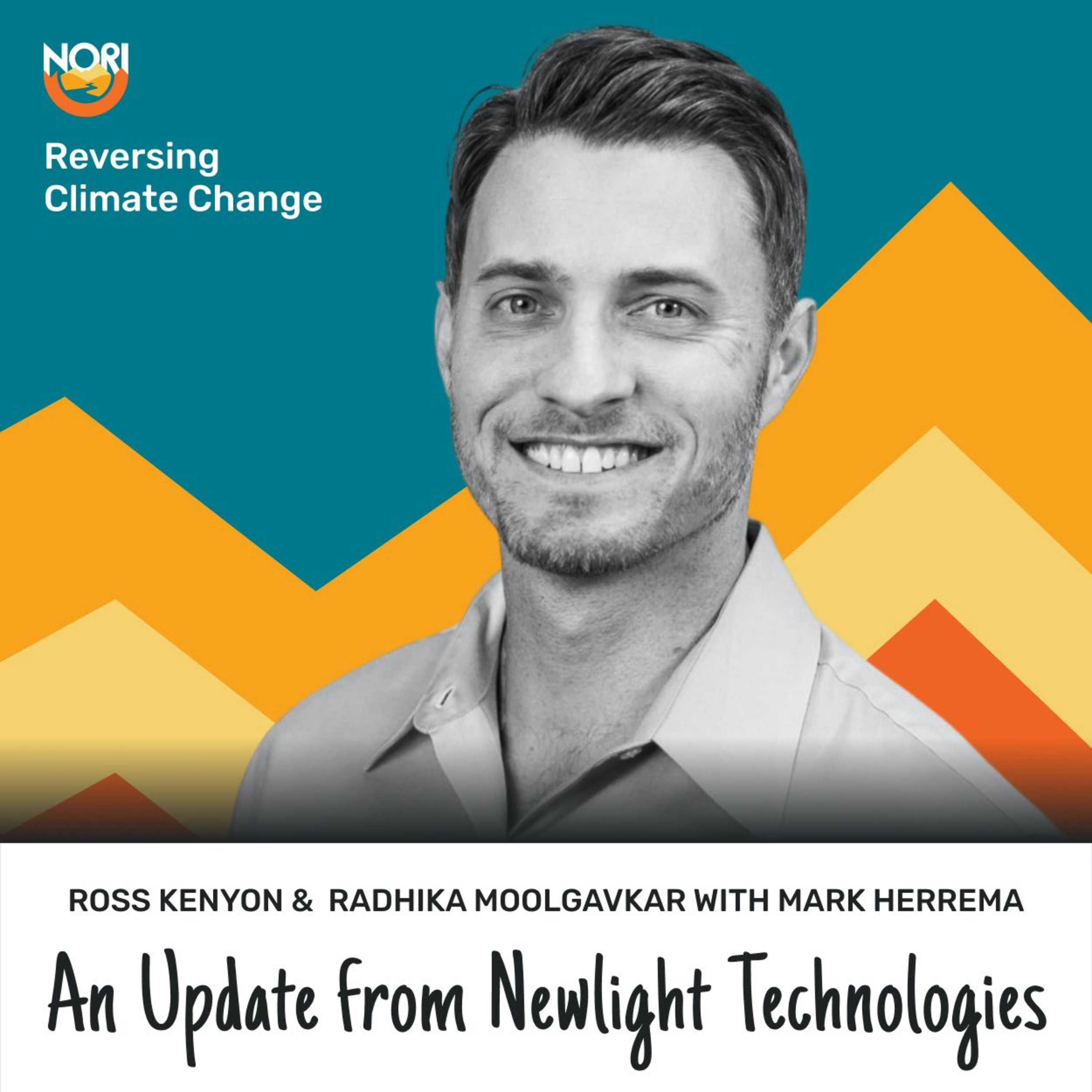
Mark Herrema is the cofounder and CEO of Newlight, an advanced biotechnology company using greenhouse gas to produce sustainable materials and replacements for plastic. On this episode of Reversing Climate Change, Mark joins Ross and cohost Radkhika Moolgavkar, Head of Supply and Methodology at Nori, to discuss what Newlight has been up to since his last appearance on the podcast, explaining how they brought a new plant online in 2019 and why the team chose foodware and fashion as its first two consumer foci.
Mark shares an overview of the AirCarbon production process, addressing where Newlight’s greenhouse gas feedstocks come from and how Newlight uses the blockchain to track the carbon footprint of its products. Listen in to understand how Mark’s thinking around carbon markets has shifted, why it took two years to get Newlight’s methodology approved, and what marketplaces need to change to make the space more attractive to other ambitious entrepreneurs.
More from the show
Ad-free episodes and other benefits come with a paid subscription.
Carbon Removal Newsroom, the news show that ran alongside this one, is over. Its episodes are still up, on the feed Climate Workers Anonymous now uses.
Carbon Removal Memes is still going.
Resources
Mark Herrema on Reversing Climate Change S1E14
Newlight’s Methodology for Greenhouse Gas Capture and Utilization in Plastic Materials
ISO 14067 Carbon Footprint of Products
ISO 14044 Life Cycle Assessment
Full Transcript
Alexsandra Guerra: You’re listening to Reversing Climate Change, a podcast by the team at Nori, the carbon removal marketplace. This is a show about the innovators and entrepreneurs developing solutions to climate change.
Ross Kenyon: Hello and welcome to the Reversing Climate Change podcast. I’m Ross Kenyon, I’m the creative editor at Nori’s carbon removal marketplace. We have a bonus episode — we saw some exciting news come out of Newlight Technologies. It’s been so long since we have caught up. Before we get into that, Radhika Moolgavkar — Radhika, thanks for co-hosting with me.
Radhika Moolgavkar: Thanks for having me, Ross. I’m excited.
Ross Kenyon: Yeah, Radhika is Nori’s head of methodology and also host of our other podcast, Carbon Removal Newsroom, which comes out weekly on Fridays. It’s a roundup of all the latest carbon removal news. If you haven’t listened, you should open up your app and subscribe to it and get some Radhika in your life. Is that the correct frame for that, Radhika?
Radhika Moolgavkar: [unclear], but we’ll go with it.
Ross Kenyon: Mark Herrema, co-founder and CEO of Newlight Technologies, thank you so much for coming back.
Mark Herrema: It’s a pleasure to be here. Great to see you guys.
Ross Kenyon: I was just looking back to when we first did this show, because you were on, I think it’s episode 14 of season 1, and it came out on March 6 of 2018. So more than three years. Christophe was there, Paul was referred to as producer Paul. That used to be how we would run around and do the show back then. You should go back and listen to it if you’d like to see the change over time. But a lot has happened since then, both for us — we sound like babies on the show, and so young and so naive, and now we’re all grizzled veterans — and a lot has happened for you too, Mark. I keep seeing your stuff pop up, there’s cool new products. I don’t know, it just seemed like a natural time to check in. So how’s it been going?
Mark Herrema: Good. Yeah, it’s crazy. It kind of feels like yesterday when we did that podcast, but I’ve got a few more grey hairs since then, so it’s been a bit. But yeah, man, it’s really good. You know, we were kind of in semi-quiet mode for a while there, and then in September of last year, September 2020, we announced the commissioning of our commercial-scale plant that we call Eagle 3. It’s at the facility that you guys toured, but it hadn’t yet been built. And from that facility, we’ve started to launch products into market using AirCarbon. It’s been great, it’s been a lot of fun. Obviously a lot of challenges, but sort of the beginning of a new chapter for us. So despite how turbulent obviously the past year has been for everybody, it’s also been a year of tremendous growth for us. So we’re excited.
Radhika Moolgavkar: So Mark, I listened to that episode, and Ross is so right — so naive sounding, and like babies, but we’ve come a long way. But I was wondering, you just mentioned your new facility, but one thing, you talked a lot about your licensing, your desire to license. Is that still kind of the direction your company’s thinking about going, or are you more focused now on manufacturing? Did that change at all?
Mark Herrema: Well, our focus is ultimately the impact. And you know, when we started this now almost 18 years ago, our goal was to create a market-driven, consumer-driven solution to reducing carbon in the air, and to do that by basically mimicking a technology that happens every day in the ocean. And so it took us about 10 years to figure that out. Once we had a platform there, the running question has been, and continues to be, how can we expand the utilization of this as widely and as fast as we can? So one of the ways to do that is potentially through licensing, but there are a lot of ways to do it. Right now our focus is on going as fast as we can, and then supporting everything that comes from that.
So how that translates is, we’re focused on building plants and building them, putting as much steel in the ground as we can. And then, to the extent that we are able to develop partnerships and relationships that enable licensing, we certainly want to support and do that. What we don’t want to do, though, is we don’t want to kind of wait around and sort of wait for people to take whatever steps. Time is of the essence. And so we’re going to be building as many facilities as we can, and then support any licensing on the way.
Ross Kenyon: The show that we did back then also focused quite a lot on things that I would not describe strictly as consumer-facing things, like packaging. There’s talk of Dell and IKEA in that episode. But now you have two consumer brands, for apparel and food, where that seems very new and exciting. When did that happen?
Mark Herrema: So AirCarbon has a whole bunch of cool features, and because it’s meltable it can be used to replace plastic. And the blessing and the curse of that is that it can just do so many things. We spent the first 10 years literally — not really in, as in kind of, but totally in stealth mode. No website, no public interaction, we’re just focusing on the tech. But we came out of that, we talked to people about what we’re doing, and we just got a lot of requests for the material. So all these great brands reaching out, and of course we were like, yeah, we’ll do that, and that, and that. So we were immediately pulled in tonnes of directions, we’re doing a lot of different projects.
And there’s a lot of good in that, in the sense that we were able to show that this material could be used really on a platform basis to replace a lot of different things. The downside of that, though, is, you know, every company only has so many people and so many hours of the day. So at some point we had to take a step back, because the demand in this space is just vast, volumes are just so big. We had to take a step back and say, all right, where can we provide the most impact today?
And so we said, all right, the two features where AirCarbon really shines is, number one, it’s a naturally occurring material, and because it’s a naturally occurring material, if it ends up in the environment, the environment understands that, it’ll degrade it. So as an example, we’re able to make things like straws that are ocean degradable. That’s distinctive and different and holds a lot of value. And the other one is the fact that it’s carbon negative.
So with those two kind of value points in mind, we said, all right, which industries are the best fit for it today? And we looked at the ocean plastics pollution problem, and it turns out that the majority of product types that end up in the ocean are related to food service. So think of everything from straws and cutlery to, you know, bottles and so forth, but it’s things that touch food. And so we said, yeah, that’s a place where we can have a massive impact. And so we decided to go down that path. And today we’re producing straws, cutlery, and we’re going to be rolling out a whole bunch of different products as well, that are made with this naturally occurring material and thus have a totally different end-of-life story compared to synthetic plastics that never go away.
The other place was carbon negativity — we’ll come back to this, because I think we’ve been surprised by how much interest we’ve gotten on the foodware side relative to that. But we said, you know, where can that have a big impact? So if you’re putting your material in the back of a refrigerator or a car part or something that people just aren’t interacting with, we didn’t think that would have as much of an impact. So we liked the idea of taking a specific industry and saying, let’s help decarbonise this, but put it into people’s hands so they can actually see.
So this is my wallet. I know we’re on the radio, as it were, so you can’t see it, but I’m holding an AirCarbon wallet, and it’s kind of cool. You can hold in your hands something that has a net negative carbon footprint, and with that comes a blockchain number. So you can plug that number into our website and it’ll pull up all the steps in the production process that led to that, from gas all the way through the powder and then into the AirCarbon leather stitched, and finally culminating with the LCA, the third-party LCA that gives the specific carbon impact number on a third-party basis.
So we were hoping that that would kind of really bring it together for someone using this product, and serving not just to try to help decarbonise places that use leather, but also serve as a — maybe, hopefully, you know, not to get ahead of ourselves — but maybe as an inspiration point, to say, look, I’m holding this in my hand, that means that, you know, there’s a whole lot maybe more possible than we initially first thought. So we were inspired by those two pathways, and that’s why we went down those paths.
Radhika Moolgavkar: I’m curious, what’s — like, how often can you reuse your plastic? Where is it, like, washable, or is it immediately biodegradable? Kind of, what’s the life cycle on those things?
Mark Herrema: First thing that you should know is, whenever anybody refers to our stuff as plastic—
Radhika Moolgavkar: Sorry, apologize for that. Your AirCarbon cutlery.
Mark Herrema: I think, you know, so I guess the only reason we do bring it up is because part of our mission is to try to, you know, prevent the flow of plastic in the environment. We think AirCarbon is a great tool to do that. But it has a really interesting property. It just so happens that in its natural form — and this is, again, made in every ecosystem on Earth — it’s hydrolytically stable, so water doesn’t break it down. And what that means is you can use it in your dishwasher, you know, in your home, you’d never notice anything. It is enzymatically degradable, though. So what that means is, if it’s in your kitchen, nothing’s happening. If you take that same straw and cover it with dirt and feed it water, and you grow a Chia Pet on it, then it’s going to start to break down.
So that’s sort of a lucky thing that we had, nature just made it that way. It also happens to have a temperature profile where you can put it through the dishwasher, so you can reuse these things over and over. That’s important to us, of course, from a carbon perspective, but even end of life, you know, just because something’s degradable doesn’t mean we want it to end up in the environment. So it happens to — and again, we got kind of lucky — it just happens that this profile allows us to do all those things.
Ross Kenyon: We should probably catch our listeners up in case they haven’t heard this show. How does this process work? What exactly are these products made out of?
Mark Herrema: Yeah, the AirCarbon production process starts with a microorganism derived from the ocean. So if you come visit our facility, the main reactor that carries out this process is a big stainless steel tank. It’s roughly 50 feet tall. And what we do is, we fill it with salt water, and into that salt water we add a microorganism that’s from the ocean. It’s naturally occurring, it’s non-GMO, and it eats greenhouse gases as its food source. And so we feed it our greenhouse gas, and as we’re doing so it’s growing and multiplying, but it’s also filling its cell with this molecule that the technical name is PHB. And PHB is a fascinating molecule. It’s made in almost all known living things, the human body makes it.
So as it’s growing, it’s filling its cell with PHB, and then what we do is we put that through a multi-step high-pressure filtration process. So we separate microorganism from the PHB polymer, that’s what we call AirCarbon. We turn that into a fine white powder and then into a pellet. And then in pellet form, we can melt that into anything from straws to cutlery to leather sheet or whatever it is. So we’re basically mimicking a process that’s happening in nature all day every day, just doing it on land.
Ross Kenyon: When we last spoke, your feedstocks were from landfills, if memory serves me well. Is that still how you’re getting your methane and CO2 and other greenhouse gas feedstocks?
Mark Herrema: So over the years we’ve run with a number of feedstock sources. So we’ve run with biogas from a dairy farm, biogas from a food waste digester, we’ve done it with landfill gas, abandoned coal mine gas that we take on a wheeled basis through the grid. We’re seeing a number of ways to access the methane side. On the CO2 side, our primary source was, we teamed up with a gas company who is capturing CO2 coming off of an ethanol plant, and then they were delivering that to our facility. So we’ve got a pretty wide range of sources that we have and can use. We do prefer methane right now because it’s got that, you know, meaningfully higher impact — well, it’s 23x the CO2, at least. So that’s really our focus today, and then as we grow, you know, we’ll expand into more emphasis on the CO2 side.
Radhika Moolgavkar: That, you know, brings up a nice little segue into what Ross and I do on a daily basis, which is the carbon market. So how have you been thinking about the carbon markets lately? It’s obviously become a much hotter and much more broadly discussed topic in the last few years.
Mark Herrema: You know, it’s interesting. When we started Newlight, we had this ideology that the technology that we’re developing and the products that we’re making, they needed to be attractive from a consumer standpoint and be able to stand on their own two feet. In other words, without the presence of subsidies or credits or anything like that. So it’s taken us a while to kind of come around to the thought that, hey, maybe this is something that we should look at. I think initially our path was really more based off of consumer communication. When you hold a product in your hand, on its face, it’s hard to know, you know, what is its carbon impact.
So the thing that we did was we teamed up with IBM about three years ago, actually right around the time of that podcast — so many, so many grey hairs ago — and we said, all right, we want to have a way for people to have a verifiable look into the carbon footprint. And that took a pretty big effort to get that in place, and we have that today. But in parallel, we also wanted to have a methodology that showed that our process was capable of generating carbon credits. So we put together another group and worked with Verra, who used to be VCS, and we created a methodology that effectively covers our process. And that was, I think, also somewhere between two and three, maybe two years, to get that through.
And now that that’s in place, you know, we’re starting to look at that and say, well, how do we want to utilize that? And there are different potential pathways. One of them is just, you know, kind of take the credits that come from that. There’s also a potential pathway where you could pass those along. And so we’re evaluating that right now. But it’s now become something that we like, there’s a tangibility to it that we think is important. And so what you’re going to see from us is, over the next few years we’re going to be increasingly involved in that space.
Radhika Moolgavkar: Did you say it took you two years to get your project, your methodology, up and running in Verra?
Mark Herrema: I think it was about that period of time. There were so many steps, and this is not — I mean, this is not a knock on anyone, it’s just a very extensive thing that you go through. Because I think we had, I can’t remember how many third parties were involved, but there’s a lot, and public comments and all kinds of stuff like that you go through, and lots of not just third-party verifications, but then even the third party checks on the third-party verification. So there’s just so many steps to get to that point. It wasn’t an overnight process.
Ross Kenyon: I’d like to hear a bit more about this passing on to consumers. One of the questions that we often face is, if say a company is generating carbon offsets, carbon removals, if they sell those all away, do they lose their status as being carbon negative as a business? How are you thinking about that, or how should we be?
Mark Herrema: Yeah, because you can’t double count. So that is a consideration that whoever ultimately owns them has, has the footprint. At least that’s my understanding. But certainly there can’t be a vestige of double counting.
Ross Kenyon: Are you able to not monetize some of the amount of credits that would, say for instance, a wallet generated — I realize this is way more than a wallet, it would be two tonnes — and you held one back to say, like, hey, this wallet is carbon negative, someone else didn’t buy the carbon negativity of your wallet off of you before you even got it? Does that make sense?
Mark Herrema: Yeah, I don’t know, I haven’t played that scenario out. I mean, all of this stuff is increasingly governed by international standards, you know, ISO standards and whatnot. So you know, it’s gotten to the point now where a question like that, I run through the system as if it’s a legal question. It is, effectively, in some ways. So my short answer is, I don’t know.
Radhika Moolgavkar: It’s interesting to me that you’re talking about increasingly this being governed by international guidelines and ISO standards, because in some ways I feel like there’s still a lot of work to be done out there, and like a two-year registration process to get your project seems like one of the places where we could get better. But that also makes me think about, what do you think the marketplaces should be evolving through, or what do you think needs to change to make them better and more attractive to entrepreneurs like yourself?
Mark Herrema: Well, I think you touched on a good point, which is that the more we can speed up the process and reduce the cost of getting new methodologies, we will see more methodologies. The key is ensuring that they meet quality standards. And, you know, the flip side of a long time period to get something approved is that, you know, it generates trust, having gone through so many third parties, and I think that’s the reason that that’s in place right now. But even still, it does become a barrier to having more things in place that are having an impact. That part’s not positive.
I think the international standards, they appear to be homogenizing, but there’s still work to do. I think, for instance, [unclear] used ISO 14044, or at least something in that realm. The world is continuing to move more, at least from my perspective, to, you know, what should eventually be a single gold standard that everybody uses. That way there’s really good visibility. And then the key is just going to be making sure that there’s unquestionable quality. That’s the flip side to the speed question.
Okay, our business is to take greenhouse gas and use it as a resource and turn it into products. So that being the case, there’s not an element to which, you know, this is tail wagging the dog. This is our core business. So being able to take, you know, greenhouse gas and turn it into a wallet is indicative of, hey, why are we using these either animal skin or these other chemicals? There’s a different pathway. And oh, by the way, if you’ve got attractive economics, then hey, there’s a lot to talk about here.
So we’re just showing that there’s a whole different production pathway, and not only is it a different production pathway, but it’s sort of this nexus of, we can and we need to find low-carbon or carbon-negative ways to produce. And so we’re rolling out different verticals that demonstrate that. And if you then multiply those out by the size of these markets — I mean, imagine decarbonizing foodware, decarbonizing big segments of the fashion industry. Those are things that we want to put in sight and say, this might actually be possible, and if you can do it over there, well, why can’t you do it over there? So that’s sort of where we want to be.
Ross Kenyon: Hmm. Is this a common approach you’re seeing with other companies that are using captured carbon in some way? Or is — because there are some that are consumer facing, but I think a lot of it is probably stuff that the average person doesn’t even know exists, maybe takes for granted. What’s your read of this sector overall?
Mark Herrema: I mean, a lot of the sector is pretty utilitarian, like concrete’s where the show is for that kind of technology, right? The other stuff is interesting and cool, but it’s not really where the volume is going to be. So in that case it’s a little bit more — nothing wrong with this — a little more marketing based, it’s show, it’s [unclear]. I think that’s where the vast majority of the carbon capture world is, at least in terms of carbon to product, and that’s fine. I think it really just depends on the kind of thing that you’re making, you know. For instance, if you’re making a fuel, that’s totally cool and great, but that’s not really something that consumers are going to interact with very much. We just happen to make a material that does result in products that you can hold in your hands and have them be part of your life. So I guess we feel fortunate in that regard, because it’s fun for us too.
Radhika Moolgavkar: Can I ask what your favorite product is that you’ve created? Or is that like asking who’s your favorite child?
Mark Herrema: Oh yeah, I’ve had different flings with different products. There was a time when I was [unclear] fascinated with our straw. It was a bit awkward to really feel so strongly about a straw. But choosing a favorite child is going to be hard. You know, I really, really like our fork. Here’s what I like about it. Obviously it’s carbon negative, but it also, it just works so well. It’s not like that kind of flimsy fork that’s annoying and, you know, you go to go into the salad and it folds over on itself. It’s not too brittle, it’s just great.
And I guess why that matters to me is, we don’t want to make stuff that people have to settle for. And our goal — the reason that I spent my entire adult life in this — is I want to see impact and I want to see scale. I think in order to get there, you’ve got to create products that people love. It can’t feel like they’re settling. And so it’s just a fork, but it also represents something. It means that, hey, this is possible, this is a different path. Now, of course, I’m sitting here — look, my AirCarbon wallet is sitting here looking at me, so I’m feeling a little guilty that I want to say it out loud, but maybe it’s my second favorite.
Ross Kenyon: I have definitely used that wooden fork and it has broken on me, and it is intensely aggravating.
Mark Herrema: Yeah. I mean, you’ve got to worry about those splinters that, you know, maybe they don’t come through, maybe they do, you don’t know.
Ross Kenyon: Or the spork that does nothing?
Mark Herrema: Yeah. Well, those are useless. The one that I’m talking about is terrible.
Ross Kenyon: So that’s the one to beat, sounds like.
Mark Herrema: I mean, I enjoy, you know — I haven’t convinced the team yet to move over to sporks. That’s my next big ambition in life.
Ross Kenyon: Wow, what a sentence. Okay, you mentioned blockchain, what are you using?
Mark Herrema: Yeah, so we teamed up with IBM a few years back and we’ve set up a system where all of our process inputs and outputs are tracked.
Ross Kenyon: And on Hyperledger, is that what they’re still on?
Mark Herrema: Yeah, I think they use their Linux One system, it’s a cloud-based system. And so what we’re able to do is, all of our production metrics flow into this. And so when you plug in this number — each one of these AirCarbon fashion products come with a unique number, so it’s not like there’s 20 of them that have the same, they’re all individually either UV printed or laser etched, and they have basically that number that corresponds to a time, and that time was the moment that the AirCarbon used to make that product was produced. So you plug it in, and it then pulls the data from our system that shows when these different steps happened. And then also on the blockchain is the LCA associated with that product.
So that was a pretty intensive setup. But again, we wanted to make it so it’s like, well, how do I know where this thing came from? So, okay, plug this number in and you can see. And blockchain is so unique in the sense that it’s really the only technology that could give someone that level of assurance that, yeah, this is the pathway. So that was something that we found really attractive. And then you eventually combine that over into the carbon value side, maybe the carbon credit side, you can see a lot of potential there.
Ross Kenyon: I think you’re speaking our language there. Radhika is not going to jump at the bait, listeners have probably had their fill of that one. I think I was going to say, you and Christophe did that great on the first episode. Oh man, Mark, you had some amazing lines. Like, I want to do a trailer of the show and take all the funniest moments and stack them up against each other. And I think one of your lines is a natural fit, which is asking you to define polymer. Do you remember that part of the show?
Mark Herrema: Yeah. I think I nailed that one. Ice cream. Polymer. Period. Just like, mic drop at the end, and we all died laughing.
Ross Kenyon: Yeah, of course, everyone knows what the Latin [unclear] is. Very good. Any predictions moving forward? Where’s the space going to go in the next couple of years? What are you looking forward to?
Mark Herrema: Gosh. Right now it’s all about scale. We feel like we just installed our solar panel, and so now it’s installing a whole lot of solar panels. And not to be flippant with that — what I mean is that we’ve now achieved a scale where it’s now more replication. And that’s really important because that gives us the ability to grow faster.
Ross Kenyon: You mean like internally at the factories that your company actually owns, not licensing, or both?
Mark Herrema: Well, both, but you know, our main focus is us just putting our own facilities up. Like I said, we’re still totally supportive of, and we’ll support, licensing on the way. But yeah, with Eagle 3 now online, it’s growth time. And so that’s really our — or at least certainly one of my central focuses now — is where Eagle 4 is going in and getting that up and going. And then, to your point, figuring out how to proliferate this thing in the smartest way possible.
So we’ll see more product types coming out. One of our ambitions is to launch within the next five years over 90% of the product types that end up in the ocean currently, to show that there is a pathway that we can in fact come close to stopping the consistent accumulation of plastics in the ocean. It’s not going to be easy, it’s going to take a long time, but there is a pathway. And, you know, just continue to have bigger and bigger impact for us.
Ross Kenyon: Maybe you can ask for a tour and get another hard hat, huh? They were also very excited about the hard hats, they talked about that again today.
Mark Herrema: We’ve got some serious goodies now, Ross. We’ve got [unclear], which I find particularly exciting. So there’s that. All of our hard hats are now fully UV-treated, you know, with our COVID protocols. So it’s gotten exponentially more exciting if you want to come by.
Ross Kenyon: I’m like a sad humanities writer, now software guy. Anything that touches hardware, this is very exciting. And you can’t hear because she’s muted herself, but Radhika is dying at my expense right now. We’re going to talk about this afterwards, actually.
Mark Herrema: One cool thing is now we also have finished products being produced on site, so it’s kind of cool. You look over here, you see gas flowing in, or you see the pipes with gas flowing in, and then over here you see straws coming out, and it’s kind of neat. At least — I’ve been doing this quite a while, but it’s still cool to see that these gases are being turned into finished products. So yeah, come on by, we’ll give you some more hard hats.
Ross Kenyon: If someone is loving this show and they want to support what you’re doing, what’s the best way for them to do so?
Mark Herrema: I think spreading the word is great. Letting people know that we’re making these products, both our foodware and our fashion products, and check them out and tell us what you think, we love to get feedback. And you know, I think part of what we want to do is show people that there is another way. If we can turn it into these products, you know, what else is possible? So I think spreading the word is our favorite thing.
Ross Kenyon: I got my eye on one of these wallets, actually. I’m in the market for one, so maybe you’ll see a little purchase come your way here soon.
Mark Herrema: All right. There’s a — we developed a little hexagon pattern on it. So if you’re choosing, I would recommend that one. That’s my personal favorite.
Ross Kenyon: Thanks for the tip. Yeah. Anything else, Radhika?
Radhika Moolgavkar: Nope. It’s super nice to meet you, Mark, that was really interesting and really looking forward to where you guys head in the future. I’m waiting for my glass, non-plastic, AirCarbon water bottle. That’s like the dream.
Mark Herrema: Yeah, yeah, those bother me the most, the water bottles that I see floating in the ocean. It just seems incongruous somehow. I’ll put it this way: that problem will be solved.
Ross Kenyon: So it’s on the radar. Cagey industrial speak, sounds like, but maybe there’s something in the future to come. We’ll see. Thanks for being here, Mark.
Mark Herrema: All right guys, thanks for having me on.
Ross Kenyon: Thank you. Yeah, good to have you here, good to have a catch up. If you like what we’re doing here, please give us a great rating and review on Apple Podcasts, it helps a lot. Hey, go buy some stuff over from Newlight. Links to all the things we discussed are in the show notes, and thank you so much for listening.
Thank you so much for listening. If you like the show, please rate and review it in Apple Podcasts and/or Stitcher. It really helps us a lot to get this content to a wider audience. If you think what we’re doing is useful, interesting, fun — hopefully all three — we certainly appreciate your rating and review. [Nori promotion cut from the transcript. It's still in the audio, but it no longer applies.] And thank you so much for your support.


