
This post is about episode #410 of the Reversing Climate Change podcast. You can listen to it on Apple Podcasts, Spotify, YouTube, wherever you get your podcasts, or right below this very paragraph.
What is remove?
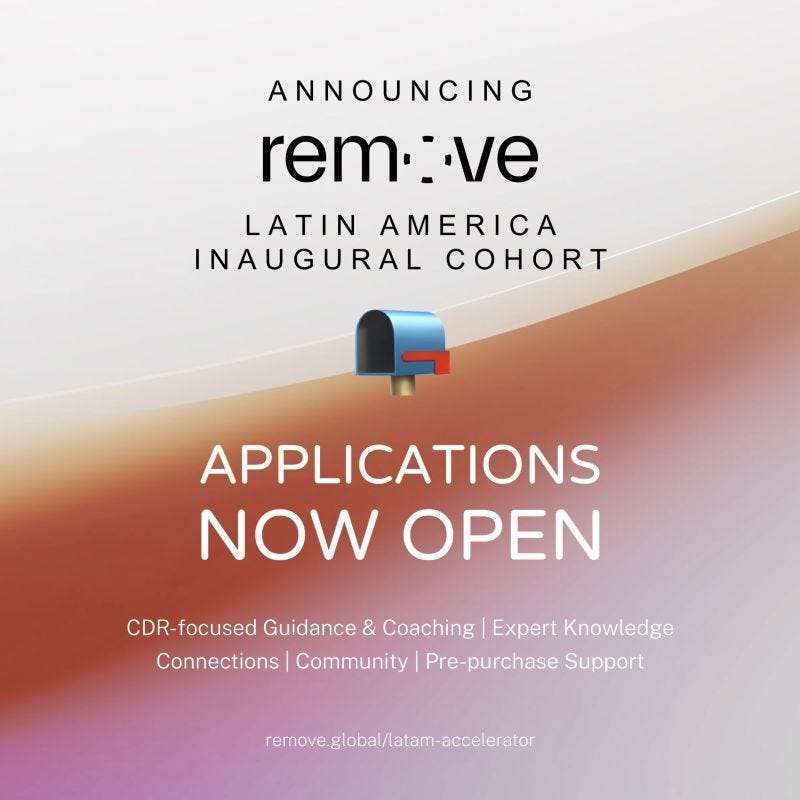
If you’re in CDR, you probably know about remove. They’re a European nonprofit who has trained hundreds of carbon removal entrepreneurs in how to stand their company up. They run accelerator programs across many world regions, and this fall are launching their Latin American program in which I am so proud to coach.
I started working remove after I had been volunteer mentoring in accelerator programs for awhile and had discovered how much I loved the work. I get to collaborate with CDR teams all around the world and help them learn more and go faster. It’s a real treat.
If you are a Latin American carbon remover or know someone who is (or who may soon like to be), be sure to send them the link to apply for remove’s LatAM program.
There are many startup accelerators out there. There are fewer focused on climate tech. Fewer still for carbon dioxide removal. Lucky for us, remove runs the absolute heck out of their programs. And it's been a true joy of mine coaching startups in them this past year. I can't even believe it, but the time has come for another program... In Latin America!
If you are a Latin American carbon dioxide removal project and/or technology developer, you should apply to remove's LatAm cohort. Applications are out now, and there is a chance we might end up working together.
I have had nothing but wonderful experiences with the team at remove. They offer focused training, a powerful network, and an unmatched peer group in your cohort. Hoping to see you there!
In today's episode, cofounders and managing directors of remove, Marian Krüger and Hans Westerhof, join the show to talk about the program, what it means to be ecosystem builders, and how they aim to grow capacity in the Global South generally and Latin America in particular.
This episode's sponsors
How to fire a carbon market consultant, and how to know when you should

David LaGreca shares his expertise from countless carbon projects during his time at EcoEngineers and beyond
2026 EcoForums Training Series: Navigating Global Carbon and Fuel Regulations, Market Mechanisms, and Life-Cycle Analysis Fundamentals
Resources
Check out my new show, Climate Workers Anonymous
Subscribe to the Climate Workers Anonymous Substack
Apply to the LatAm carbon removal accelerator
More from the show
Ad-free episodes and other benefits come with a paid subscription.
Carbon Removal Newsroom, the news show that ran alongside this one, is over. Its episodes are still up, on the feed Climate Workers Anonymous now uses.
Carbon Removal Memes is still goofing around.
The books that come up on this show are collected on my Bookshop shelf.
🎧 Apple Podcasts · Spotify · YouTube
Paid subscribers get this episode ad-free. The ads in the free feed are inserted by Spotify when you press play. They are not in the file I make.
Full Transcript
Ross Kenyon: Hey, thank you for listening to Reversing Climate Change. This is the host, Ross Kenyon, and I am proud to call today’s guests my colleagues. I’ll explain a little bit more about who they are and how we came to work together.
Before I do, two quick little notes. Do know that there’s a second podcast going on. It’s a collective art project called Climate Workers Anonymous, where if you have feelings, experiences, or analysis that you have generated through your work in climate, you can send in an anonymous recollection that I will read on your behalf. We’re like six episodes deep right now, something like that. It’s been really great to see people share things that have clearly bothered them for so long in private. I’ve really enjoyed being able to facilitate that through this sort of PostSecret for climate collective art project, if you will.
Secondly, I’ve been writing a lot on Substack. The podcast itself has a Substack. You can go to rosskenyon.com, which is the same as the Substack. Climate Workers Anonymous is hosted through Substack, so it has a lot of benefits there as well. I’m just trying to use it a lot more. So if you like Substack, come find me: Ross Kenyon, Reversing Climate Change, Climate Workers Anonymous, and also I’ve been trying to get Carbon Removal Memes to pick up over there as well.
Today’s show is with two of my colleagues from remove. If you work in carbon dioxide removal, you almost certainly know remove. They are a nonprofit in Europe that runs accelerator programs for carbon dioxide removal. They tend to focus on different geographies, their programs are geographically split, and they just announced a new Latin American program with support from Milkywire, who also supports so many early stage CDR startups. Really hoping to see more companies come out of Latin America, and how we can give them the greatest chance possible for success.
Hans Westerhof, and I’m taking a risk here, I think you say your last name properly with a V sound, is the co-founder and managing director at remove. Marian Krüger, you have the same title as Hans. How fun, I didn’t realize it was literally the same.
I’ve really enjoyed working with Marian and Hans and the rest of the remove team. They’ve been wonderful the entire way through. I got into coaching because after my previous company Nori closed, I just kind of started volunteering, working in accelerator programs, working with startup founders, trying to figure out what was next for me, and I found out that I really loved the work. I got good enough reviews that I just kind of kept going, felt like I was adding value at a time when I didn’t really know which way was up career-wise, and that has just turned into more and more opportunity. And so I am a startup coach in remove’s programming, and I love it. I get to work with a bunch of different teams that pass through their programs. They teach me a ton. I get to point out all of the big holes that I fell into and how I learned to stop falling into them nearly so often.
If you apply to this program, there is a chance that we will be working together, which could be a very fun experience. If you are a Latin American company, or know someone who is interested in carbon dioxide removal in Latin America, you should apply, or encourage this person to apply. Help make this an amazing cohort of dedicated Latin American co-founders in carbon dioxide removal. We need everyone that we can get using their brainpower to help make this whole thing work.
If you are a buyer or an investor that’s interested in working with Latin American companies doing CDR, feel free to get in touch with me or with Hans and Marian. They will be very happy to figure out if and how there’s a possibility to collaborate here. Thanks so much for your time. Here is the show.
Ross Kenyon: Hans and Marian, thank you so much for being on the show. How have we not done this before, by the way? I guess, Marian, you’ve been on. Hans, this is...
Hans Westerhof: It’s my first time, Ross. Thanks for having me.
Ross Kenyon: It was only a matter of time. We’ve been working together in remove’s programming now for a while, and there’s exciting news coming out of remove that I’m excited to see. You’re expanding. Congratulations. The only organization in carbon removal that’s expanding right now.
Hans Westerhof: We don’t wanna be the only one, but yes, we are expanding.
Ross Kenyon: I know, I’m so sorry. But I don’t know, you’re going to Latin America. Some of the biggest, most successful companies in carbon removal hail from Latin America, and remove now has a footprint there. What’s happening in Latin America?
Marian Krüger: Absolutely. Yeah. For folks who might not know what remove is, we’re a nonprofit that works with carbon removal startups, have been doing so since 2021, and our origin is in Europe, right? We started out working with European founders, and then started expanding to the Global South because, for many reasons that we might wanna get into today, there is plenty of opportunity to deploy carbon removal, certain pathways more than others, but to realize really the megatons and gigatons we need.
At the same time, from a climate equity perspective, it would also be the right thing to make sure that we make carbon removal a just and equitable industry. So we’ve been doing this in India and in Africa as well. It’s been more than 200 startups, and we’ve had the pleasure of working with you as part of those programs as well, supporting those startup founders.
And it was only a matter of time. If you look at where the potential for carbon removal lies, and if you look around the globe and also at CDR.fyi, you quickly stumble upon the Latin American continent, in all its diversity, but one thing is clear: the potential of carbon removal is just tremendous and immense, while the ecosystem itself is in its infancy.
You have players such as Exomad Green. Talking about organizations in carbon removal that are expanding, here’s one, expanding their production lines. But apart from that, it is quite disparate and really in its infancy, and that typically is where we feel comfortable getting in and helping to build the ecosystem, and helping to make sure that the entrepreneurs who are already daring to build carbon removal companies, which in itself, as you well know, is difficult, and doing that in an ecosystem that is immature is even harder.
So that’s where we luckily got Milkywire on board to fund our first cohort there, which we will launch very, very soon, or actually, as when this podcast launches, we will have launched it. Expecting a lot of interesting applications, and then we will start working with the founders on the ground starting in fall of this year.
Ross Kenyon: Anything to add, Hans? Or do you feel like Marian covered it pretty well?
Hans Westerhof: Of course, he covers it really well, right? So yeah, I think for us the premise that we see is that there is a tremendous potential in the Global South, and as Marian said, ecosystems are in infancy, and that we can help by building a bridge between the more well-developed ecosystem in the Global North, if you will, by providing access and relationships to teams that operate in the Global South.
In some countries, there’s just a few teams working on carbon removal, right? So as an entrepreneur, you’re pretty lonely there. There’s not many peers around, and we provide a community and a bridge towards the global CDR entrepreneurial community.
Ross Kenyon: Talking about an ecosystem for carbon dioxide removal developers, or maybe just carbon dioxide removal in general, what specifically do you mean? How much of it is this peer-based community? How much of it is something else? It’s one of those terms that... well, there’s an LBJ line. It’s like, “It’s like grandmother’s nightshirt. It covers everything.” You know? Like, what is not ecosystem, ultimately? Can it not be everything?
Hans Westerhof: I would say that...
Ross Kenyon: I’m not sure if I’m gonna keep that, by the way. That might be too ridiculous. He was a very colorful president, I will say that. I’m sorry, I love that line. Please say whatever thing you were going to say now.
Hans Westerhof: Yeah, keep the line in. The ecosystem is not only peer-based, although that is part of the proposition of our program, bringing entrepreneurs together, but connecting them to registries, protocols, to portfolio builders, to buyers. As we know, CDR is a niche market. There is still only a few players. If you look at it as a global industry, there’s still a limited number of players out there.
There might be a few thousand people, maybe 10,000 people working in CDR. There’s less than 1,000 teams working on CDR, entrepreneurship teams. They all need access to registries, to protocols. They need to develop the right procedures. They need access to buyers. And broadly also, we need a supporting CDR policy ecosystem, which some organizations are really focused on, and others, politicians with a broader mandate, need to incorporate in their mandates.
So doing some evangelizing there is again part of supporting the CDR ecosystem. So maybe, you know, it’s pretty broad in that sense, but I think if you look at it globally, it’s still a limited number of people that are engaged.
Ross Kenyon: I like to say that I’m involved in ecosystem building, but I think for someone who’s especially perceptive, they might just read that as unemployed, because it’s like, “Well, does someone pay you, or are you just helping a really big group of people in a one-off capacity, or what exactly is this?”
I feel like I’m contributing to the ecosystem somehow, but it is one of those things that’s not the same as having cash on the barrelhead, money changing hands kinds of deals. But it’s one of those things where I can kind of feel the connections coming together. Do you have that sometimes, where you know that you made the right intros, you made these things come together that wouldn’t otherwise do it? And is that part of ecosystem building, or am I imagining that for my own ego?
Marian Krüger: No, I do think so. Although, I think maybe to ease your concerns about how that might be perceived, the effects of ecosystem building are not always linear and not always clearly connected to the activities. Or you might only be able to connect the dots afterwards, right? So I think you are active in a variety of things where, in essence, you’re trying to see what sticks.
You look at the ecosystem, you look at the players that are in a system, and you try to see gaps and try to fill them, and not all of the gaps actually need filling, or not all of the gaps immediately lead to an outcome. But unfortunately you don’t always know from the get-go. I’ll give you an example where it’s quite evident for us what ecosystem building means.
Hans already mentioned that for us, a main thesis of going to the Global South is connecting the developers there with the Global North, because that is where the buyers are. Unfortunately, we don’t see a lot of buyers in the Global South, and I don’t see that changing relatively soon. That is where the capital is, and that is also where the supporting, enabling ecosystems such as the registries are, right?
But I think the Global North ecosystem often falls prey to the availability heuristic, right? For those of us who’ve read Daniel Kahneman, the rational homo economicus is not a thing. We’re all terribly biased and actually terribly wrong and bad at making rational decisions.
Ross Kenyon: Speak for yourself, Marian.
Marian Krüger: Okay, I will speak for myself then. But I have the whole of behavioral economics, I’m standing on those shoulders to make those statements. Anyways, the availability heuristic essentially says we only perceive those things as relevant that we have recently been in touch with. So to make this concrete, if I’m a buyer or if I’m an investor, and I see certain developers at Carbon Unbound in Europe, in New York, wherever, those are the ones that I have top of mind if I’m thinking about who to invite for an RFP, or who to buy from, or who to invest into. A lot of the founders from the Global South, for reasons that are financial, or emissions-conscious, or about access, they cannot make it to Carbon Unbound.
So does that mean that they should be considered less in any RFP processes, less for any investment? In our minds, no. But that is a gap that we saw, and we felt it needed to be solved. So just coming out of London Climate Week, we ran an event where we invited three founders from three continents working on carbon removal to give them the space to speak to a group of buyers, investors, and other folks, because otherwise they probably wouldn’t have been able to.
And we know that they specifically just came for this event, otherwise they wouldn’t have made the trip. Because, well, if you’re at a Carbon Unbound and you’re one of 200 developers trying to catch Microsoft once they come out of the bathroom, I don’t think that is necessarily the highest leverage point of either your money or your time.
Ross Kenyon: If you want the highest leverage, you follow them into the bathroom. That’s how you get a... You don’t wait outside. What a rookie mistake. Bad advice, ecosystem builder. That’s great. Well, did that event go well, by the way? Do you feel like there actually were results, in that you were able to overcome the availability bias there and get people to be like, “Oh, maybe we should zoom out a little bit”?
Marian Krüger: I mean, we needed to kick people out at the end because they still wanted to connect. I think that’s always a good sign, right? One thing that landed too, and I’m also looking at Hans, he’s probably also got stuff to say about this. In the main, and you know this, Ross, because I believe you’re also a proponent of this, we think just relying on voluntary carbon markets as a business model is not a smart idea these days, and that in itself is not a bold statement.
I think a lot of the CDR ecosystem would agree. So what does that mean? You diversify revenue streams. You look for other business models. And that is also a main thesis of ours, that we need to enable founders to do this. So we deliberately made sure to have two founders on stage that did this. And why am I saying this?
Not only because this is a thesis of ours, that it’s important that you integrate into industrial pathways, into existing industries, but also because afterwards I was talking to folks who up until recently were rating these projects, right? Rating biochar projects, rating ERW projects, and they said afterwards to me, “Huh, I’ve always looked at these projects and read, oh, diverse revenue streams, co-products. I never knew what this means, and now I finally understand.” Right? So for me, that’s fighting a bias pretty evidently.
Hans Westerhof: And to Marian’s point, just seeing these founders in real life makes a real difference. Again, the recency bias, the people you’re familiar with. There’s of course many great founders in CDR, but if you don’t see them, you don’t hear them speak, you don’t exactly know what they do, why would you engage? It’s difficult, right?
You’re not gonna browse a couple of hundred websites to find a biochar startup to buy credits from. Seeing these people in the room, you immediately see, wow, right? The charisma is there, the dedication is there, the progress is there. People make huge strides and have impressive results to show for.
And suddenly you think, oh yeah, that I don’t know doesn’t mean that it’s not worth knowing. And I think to Marian’s point, just based on this event last week, it’s not only that people stay, but people are indeed also wowed, I think I can say that, by the quality of the entrepreneurs. So it’s not about us, right? It’s not about us. It’s always about the entrepreneurs. You see what these people are working on, and it’s just fabulous, right? In its variety, in the differences, but there’s no doubt about the quality of the work that they’re doing. So that, I think, also led us to believe that, okay, yeah, we should do more of this, and this truly creates an impact.
Ross Kenyon: How much of the gap there is due to knowing these people, seeing them in person? How much of it do you think is investors or buyers not understanding property law in formerly Spanish and Portuguese places? Or not trusting the legal system, or understanding how property rights work, or how seniority works in the case of liquidation, or something like that.
And maybe it’s just not understanding these places as well, not being able to track their politics. Is that a factor, or do you really think it’s just that they’re isolated from where decisions are being made?
Hans Westerhof: Oh, of course. No, yeah, of course, you’re spot on, right? So, early-stage teams, pre-seed, seed, raising some money, but not huge amounts. In that phase, investments overseas, across continents even, doesn’t happen easily, right? And in the Global North, so VCs based in the Global North, they would want to have a manageable sort of portfolio, also geographically.
So of course, to your point, that is another hurdle, right? I’m based in the Netherlands. For a Dutch VC to invest in Zambia and understand Zambia, if that’s not your specialty, is almost unfeasible, right? The transaction costs are way too high for a deal of half a million or a million.
So that’s another hurdle, which is related to the ecosystem that these entrepreneurs operate in. Right now, CDR is maybe a little bit different because it’s a nascent industry. It’s a weird industry. I think we all know that, right? So it’s led by charismatic buyers willing to pay quite some money for their credits, right? It’s by entrepreneurs who so believe in what they need to do that they roll this rock uphill and just take on the challenge. And that might create a little bit of an openness for some early-stage investors to look across the borders and to also take on investments that are a little bit farther away.
But if you broaden the ecosystem and try to get more funding in, you also get more classical funding in, and then those drawbacks that you just mentioned are there. So it’s not only presence. There’s multiple hurdles that we need to overcome in order to grow this industry. Marian mentioned one, which is diversifying revenue streams, right? Because we’re pretty persistent around this sort of thinking, because relying on credits alone for the growth of the industry, yes, it grows. We know that. It grows. It does not grow exponentially. There are not enough buyers to meet the demand, or to meet the supply that we need to deliver.
And in order to have classical proper market mechanisms kick in, you need classic B2B value propositions, right? If I deliver a solution to you that creates an improvement in your business tangibly, then you create demand. And that is the magic of creating scale, right? And CDR does not fit that bucket perfectly. I see you smile, so I wanna see...
Ross Kenyon: Yeah, I know. I want it to happen. I’ve wanted that to happen for so long, but it’s so very hard. But some people are doing it, and successfully too.
Hans Westerhof: Yeah, exactly. And that’s where we need to move, right? So that CDR is not only this thing you do because you feel for the climate goals, but also because it makes radical business sense to do so, right? So we do not have to raise our finger and say, “You need to do this because...” It just makes rational sense to do so. That is only when we unlock that lever.
Marian Krüger: And Ross, I think before, you kind of threw investors and buyers into one bucket by saying, you know, they might feel uncomfortable with their perceived political risk or other risk types that they can retire or feel like they can take on. I do think there’s a difference between the investor side and the buyer side, just because thanks to standards and rating agencies, there is a level of understanding that they can otherwise, as part of the due diligence process that you would go through in an investment process...
You would look at a lot more risk types than as a buyer. As long as there’s risk mitigation in place for non-delivery, et cetera, you might feel more comfortable if the project is Isometric-certified and has, I don’t know, a non-delivery insurance and potentially even a rating. Then in my mind, I don’t necessarily need to care where it’s placed, because while not a commodity, I’m buying something that is less individualized on its location and more on its properties, if that makes sense.
Ross Kenyon: I think so, and they’re not insurmountable problems either. Many of these companies can set up a British private limited company or a Delaware C corp, and then they have their local subsidiary in the country of operations or something like that. There are ways of making investors feel more comfortable, and also, as you know, the tools for buyers to feel more comfortable are pretty robust at this point.
Like, yeah, if they’re on one of the registries and the registry has given it a thumbs up and it has a decent rating on one of the ratings agencies, those are pretty effective proxies for quality, I think. Not foolproof, of course, there’s always gonna be some amount of risk. But that does de-risk it significantly. So, not to be a deal killer there. There are ways around that.
Which kinds of partners are y’all looking for? And are there others that you’d like to connect to besides companies? I guess the question here is what types of companies should be applying, and what are the partners that maybe you want to get involved in this Latin American cohort that could help these companies along?
Marian Krüger: Let me speak about the partners first, and then Hans can tackle the startups. This brings us back to the magic word of this episode, ecosystem. Because of course, an ecosystem is not just the immediate players that are relevant to the startups, but a broader system that can bring to bear new startups.
So that brings us to academia, that brings us to venture builders. But also that is able to sustain these ventures, so that brings us to the financing landscape, be it VCs, be it DFIs, be it other capital providers, and lastly also the policy side. So if we look at our established geographies that we’re active in, be it Europe, but maybe now more India and Africa, we have close ties and partnerships with organizations from all those parts of the ecosystem.
In India, we collaborate with IIT Bombay, the premier research institute working on carbon capture, carbon removal, and a variety of carbon storage options. Professor Vikram Vishal is our partner there. Excellent, couldn’t have a better partner.
I think that is something that in all geos we try to anchor ourselves in, just because the academic landscape isn’t only the springing ground for new startups that we can then support, but also a lot of times advises policy and does research that is not basic research on cation exchange, but how does ERW specifically work in the soils of Brazil with the tropical rainfall that you get there, right? Which is of course then very relevant to our startups.
And then if you go further, on the policy side, think tanks. Think tanks that understand the carbon removal or broader carbon and climate policies in a given geo. Now, that might be quote unquote easy if you’re in India or in Europe because it’s a bloc, or in North America because it’s Canada and the US. So that, I think, is a challenge, to find partners that are able to do that. And sometimes they do not exist yet, so that is then a gap that we try to help solve. We’re certainly not the ones to do that, but we can point that out and help make sure it exists.
And maybe the last thing I’m gonna say, because it’s quite specific and it’s not often top of mind for people, but it is absolutely crucial for these founders in some of the pathways to make it from a first pilot to a first commercial project: lab infrastructure. You won’t think that probably 90% of the startups in the Global South, when they start out, they send their biochar, they send their soil samples to Europe or to North America for lab analysis, which you can imagine what cost that incurs and what timelines that then operates on with all the shipping.
So I think that’s an underestimated lever for carbon removal scale in those geographies, is lab infrastructure, and we’re thinking mostly about biochar and ERW here.
Ross Kenyon: I was at an ocean science conference very recently, and one of the attendees was telling me that they’ve seen a lot of encouragement of Global South startup founders to dive into CDR project development, and the big gap there is that there often aren’t enough local scientists even doing appropriate baselining to make this work. At the very least for mCDR and ocean alkalinity enhancement and stuff like that.
But I imagine that’s true for terrestrial carbon removal as well, just the applied science of that specific geography is not robust enough to support adequate baselining. And it’s one of those things I think people maybe are overlooking, or maybe it’s something that I’ve just overlooked and I’m projecting onto the entire industry. But it was a really nice wake-up call for me to know that that is a big gap.
Marian Krüger: I do think that’s true, and that forces this challenge or this task up onto startups who at the beginning are cash and resource stripped, and that really shouldn’t be their job. But I guess because either they are so determined, or, and probably both, the opportunity is so big, they still do it. So I can confirm for you that that is not just true for marine CDR, it also is true for terrestrial CDR, specifically if we think ERW.
I do think the variety of combinations of soil types and rock types, and then how much rock you distribute, that ideally should have been analyzed before, so the startups can hit the ground running, which unfortunately they can’t.
Hans Westerhof: Only to illustrate how odd CDR is, right, as an industry, that these challenges, which are in fact fundamental scientific unknowns that need to be answered, are on the plate of a startup that is not equipped to do that or should not have to do that. As you know, I’ve worked a lot in more classic B2B environments, and it’s like the equivalent of asking yourself when you have delivered a ton of bricks. I deliver you a ton of bricks at home, right? Nice bricks, Ross, right, to build your house. And then you say, “Oh, is this a ton?” Would be an odd question, right? It’s a little bit of an odd question. So you might not like the bricks and all of that, but, you know, is this a ton? Yeah, I mean, we’re raising our eyebrows, right?
So, we have software installed. Here’s the interface. It does stuff, right? So is it really happening? Well, mm, right. You don’t have these questions. And in CDR it’s very normal to entertain these questions. We think that’s normal. It’s abnormal, right? So it is strange, but we can support indeed by building more local infrastructure, because that’s one of those hurdles again to overcome.
Ross Kenyon: Yeah, I think it’s a really good point. It’s one of those boring points that underlies so much that I think it’s really easy to skip past it and focus on the sexier parts of, like, new technology or better unit economics or something like that. Sometimes it is this simple.
Okay, Hans, tell us about the startups that you wanna see apply here. I wanna know. Make this pitch. You’re a Latin American right now. You’re listening. Buenos días. Thank you for listening. Gracias. Gracias a todos por escuchar. Hans, make the pitch for them. I can do Portuguese as well. Sorry. I got shit like bom dia and saúde and stuff like that, but please.
Hans Westerhof: Then we need Mateus here to speak Portuguese. Yeah, we’re looking for startup teams that work in CDR, right? That want to work with peers, that want to have guidance in a community that truly understands CDR, right? To explain what you’re working on, to really meet with people who are knee-deep in CDR, to get connected into the ecosystem. That is what we’re good for.
Traditionally, it’s startups, it’s pre-seed, seed stage, early stage startups. Sometimes we have more well-developed teams for whom CDR is something new that they need to discover as a sort of byproduct for green hydrogen production, for example. And then, okay, if CDR is an angle that you discover, I think we’re the perfect fit.
Our program is really CDR-focused. You know this, Ross, but you asked me to pitch, right? So not a lot of generic startup stuff. There’s many great startup programs around, and if you need support there, just avail of these programs. We really specifically focus on the idiosyncrasies of CDR, I would say. And if that is what supports you, you should come to us.
We really have no stake for ourselves in your success. Our only success as a nonprofit is the success of the entrepreneurs, right? So there’s no commercial benefit to us to work with you. We don’t take equity, for the listeners who don’t know. Your success is really our success. We’re funded by philanthropies, right, your earlier question. And they look at our success as the success that we create for teams that we support.
Marian Krüger: My strongest pitch would be, you founders will get to work with Ross. So apply.
Ross Kenyon: They get enough of me here. They don’t necessarily need a whole lot more, but thank you. Yeah, I am really excited to return for the Latin American cohort. I love remove’s programming. It’s so well organized and so specific, and it is really encouraging to see the full breadth of founders that you’re able to attract too.
Some of them are, like you just said, Hans, people who are maybe more experienced in a different kind of area, like hydrogen, and they found CDR. Some of the teams I worked with in the Indian cohort have been doing pyrolysis for longer than almost anyone else that I’ve ever met. And it was, like, so impressive that they were like, “Oh, we can also do a specific type of pyrolysis that leads to carbon crediting.” Like, oh, this is fascinating. You might have just leapfrogged everyone else that I’ve ever met, with few exceptions, because of that. And then all the way to people who just got bitten by the bug one day and realized that we needed to remove carbon and they were passionate about doing so, and everything in between.
You’re able to attract founders that really are diverse, that I really like. I haven’t seen that in every program that I’ve worked in, by the way. I feel like that’s somewhat rare.
Hans Westerhof: Hey, Ross, I think it’s not only our program, right? It’s also about the domain of CDR. I’ve been working with startups for 15 years right now, and I do find that the average entrepreneur, if there’s such a thing, that engages in CDR is of extremely high quality, which also, for me personally, makes it a privilege to work in CDR. Of course, all founders are great and dedicated and committed and all of that, but I do find that the average entrepreneur that we see in CDR is of high quality, and I think that has to do with people understanding and dedicating their life to the mission that CDR represents. They feel it’s tremendously, unavoidably important.
And we see many entrepreneurs, as you said, with already a long career changing gear towards CDR, and that is just a privilege to work with.
Ross Kenyon: I’ve seen a lot of people in the middles of their career also decide they wanted to do something that was more meaningful too. Some of the other founders that I’ve encountered outside of CDR, I’ve heard them pitch things to me and be like, “Yeah, we’re gonna make so much money doing this.” I, like, never hear anyone say that in CDR. That guy rubbed me the wrong way. I’m like, “I do not trust this guy at all, really.” But CDR does tend to attract people, I think, who are very much here for the right reasons, very mission-driven, and often had to give up a lot to do this work too. These are professional people that could get good jobs elsewhere. Sounds like you’ve both seen this too. I love that.
Hans Westerhof: Yeah, happens in CDR a lot, disproportionately I would say.
Marian Krüger: I think it’s due to, and Ross, you mentioned, you know, a lot of people that might also be mid-career, they are bitten by the bug, they drink the Kool-Aid, and then you cannot unsee what you saw about climate. And I do think the beauty about carbon removal is that it provides a solution that is easier to grasp, and more direct to the fundamental problem we’re addressing, namely too high a concentration of CO2 in the atmosphere. And here is a solution that actually directly alleviates this, while obviously keeping in mind that it will never be enough to do it, and it only goes together with decarbonization, et cetera, et cetera.
But I do think that is what attracts people that might not have been in climate before and start their climate journey towards carbon removal, because there’s this rather direct problem-solution fit that you might find a bit harder when you go into renewables. And I can speak for myself, because I was in renewables before. I built a startup in solar, and I did feel I wanted to work even closer on the actual problem, which was the levels of atmospheric CO2. And I do think there’s probably no other element in the world that allows you to do this than carbon removal.
Ross Kenyon: Yeah, I think that’s probably true. I’m gonna frame this in a Latin American way. This is pandering, but it’s a good pandering. I’m gonna pander to Borges. So, Garden of Forking Paths here. remove could have chosen something else to do with its sweet, sweet Milkywire lucre. You could have gone into super pollutants. You could have gone into solar radiation management stuff. I’m sure you probably could have raised, and helped support new organizations working on that. Why go deeper into carbon removal? Don’t you know there’s cooler things now? Carbon removal is old and boring. There’s cooler things to be working on. Why are you still here?
Marian Krüger: I guess because we need it. That’s probably the easiest answer. I think there is an argument, and it’s a discussion that we have internally a lot around: in an environment with a VCM that’s barely able to sustain the startups that we have, or the developers that we have in the market currently, does it really make sense to push more developers into that market? Right. It’s a fair argument. And I think we have taken actions because of that argument.
At the same time, us doubling down in the Global South is, I think, due to three reasons. One being the climate equity perspective, right? I think it’s the right thing to do that that part of the world participates in the massive amounts of value that will be generated through carbon removal.
Second, the Global South just on a unit economic basis will allow us to generate massive amounts of carbon removal at prices that are competitive, if not, and likely, better than what we can have in the Global North. So I do think it enables demand for durable carbon removal in a, let’s say, 110 to 145 or 150 US dollar range, which I think if you can deliver at scale there, there is decent demand there, right?
And the third one is, and that might be a bit anti-cyclical, but I would much rather be a direct air capture founder right now, living off of grants, looking to raise my pre-seed maybe in a month or in a year, than needing to raise my Series A right now of 12 million, 15 million in that challenging environment. Because my timelines align actually quite nicely with potential integration to a compliance regime in 2030, right? I can see how my first commercial plant five years down the line could pay into that market. And up until then, I keep my burn low, and I make it till then. So it might be a bit counterintuitive, but you could also argue right now is the exact right time to found a carbon removal startup.
Hans Westerhof: On top of what Marian said, you know, it’s a new market, so you go through all of these predictable phases, right? So, boom, bust. Currently, CDR, challenging. There’s also something like a simple moral imperative, as far as I’m concerned, right? So, oh, it’s not happy-go-lucky in CDR right now. It’s a little bit of a tough environment. Sure. And now we bail out? That sounds like a silly choice to make, right? So for me personally, it’s also, yeah, sure, we should see through these couple of years, and this industry needs to grow. The mission is unchanged.
And of course, there’s other work to do. And, you know, we cannot all of us do everything together. We focus here. We’ve built something. We think we can contribute and keep building value there. I have nothing negative to say about super pollutants. Let other people address those, right, that are equipped to address those better. But for us to bail out of CDR feels like, I can’t even say how wrong that feels, right?
Ross Kenyon: I’m the same way too. I don’t wanna leave. We still need this. Obviously, there are things that will get more attention because they are newer, even though super pollutants is... I called it once recently, it was like the oldest novel approach to carbon that exists. It also goes back to, like, very old parts of the carbon market as well.
But yeah, no, no shade being thrown by me either. We definitely need all of these things happening and being researched and advancing. But also I’m a carbon removal person. Times are difficult right now, but they’re difficult across the space, and it would seem, I don’t know. I like to support founders who are still here, who still feel vocationally called to this kind of work. Sounds like you both do too. So we’re diehards, basically. Carry us out in a pine box, basically, is when we’re gonna leave carbon.
Hans Westerhof: I hope that will be still some time, Ross, before that happens.
Ross Kenyon: Me too. When the last molecule is captured and we create a new ice age, then we can retire, right?
Marian Krüger: If pine box, then please burn me and make sure I don’t decay, so that someone can get at least a credit off of it.
Ross Kenyon: God, that was one of the darkest memes we ever made. It was sort of like a carbon... it was like cremains, cremoval or something. It just had a picture of, like, going into a crematorium. I don’t know that it had that many likes. I’m not sure that it deserved that many likes, but it was creative.
Marian Krüger: Did you just out yourself as the main writer of Carbon Removal Memes, Ross?
Ross Kenyon: Ah, no. It’s known. I have it on LinkedIn. But I also just... it always surprises people. There is a writers room, though, by the way, and I definitely do not make all of them. And I’m just the really annoying person who gets to say, “What’s the editorial on this? What are we actually trying to say? I don’t understand your...” So I get to do that, is really the only distinction between me and everyone else. But yeah, so I guess I’m out now, Marian.
Marian Krüger: Thank you for your work. Thank you for your work. Yeah. Please continue.
Ross Kenyon: Yeah, the most important job in carbon removal.
Marian Krüger: Talking about feeling unemployed, yes. Oh no, we might wanna cut that.
Ross Kenyon: I earned it. It’s okay. This is a tough question for you, ‘cause I don’t even know that you’ve thought about it or wanna be thinking about it, but what do you think is going to be next for remove? Are you gonna go deeper into any of these geographies? Are you gonna find some other way to grow? What do you think will be next, while fully recognizing that you haven’t even done the next thing yet, so, tough question.
Hans Westerhof: Yeah. Well, we’ll be doing the next thing for sure, right? So, work in those geographies and in parallel across all of those time zones, Ross, and then bring people together. So that also brings a limit to our expansion, right? So we can’t go farther east or farther west, because then in time zones it doesn’t work anymore. Or we have to build separate programs, right? But we work now from India to western Latin America. So I think Mexico is the farthest time zone out, that is 12, 12 and a half time zones. Of course, that’s a practicality only. That’s what we will build first, and let us do that, right?
So I think there is quite a big lever that we integrate into our programs, which is what Marian referred to earlier, and that is how we support teams in developing their business models, and where previously it sort of by default centered on the credit market, right? A couple of years ago, right? For a few years we’ve been looking closely at revenue diversification, meaning finding solutions to develop business models outside of credits. And now I think we’re doubling down there, right? To really work with partners in existing value chains who might have a need for the solutions that CDR startups provide. Not primarily for the credits, but primarily for the products or the technical solutions that are being built.
And I think that is, for the coming years, a new angle in our work, or an angle that we’ll be doubling down on. That is not an afterthought, that becomes a central thesis, right? It’s not, “Oh, yes, and let’s also do something like this,” or, “This is also important,” but that we will build programs around this thesis, really to engage industries and startups to work together about integrating biochar in fertilizer value chains, or bio-coal in the steel industry or in the aluminum industry as a reductant, what have you, right? To really build demand for products so we scale this industry.
Marian Krüger: And to be very clear, we’re of course aware that using biochar or bio-coal as a drop-in for PCI coal is not carbon removal anymore.
Hans Westerhof: Sure.
Marian Krüger: But to be very clear, we couldn’t care less if this allowed a biochar developer to deploy 50, to scale to 100 plants, and once the market switches, they can go the carbon removal route. I think we’ve done a great job. So in our minds, that is the future of the next couple of years in carbon removal.
Ross Kenyon: Yeah, I think it’s one of those places where focusing on it being carbon removal potentially holds it back. Like, however you slice bio-coal, which is a term I don’t really like that much at all. I wish we’d found a better name for metallurgical coal but biochar than bio-coal. But even still, like, we need that. That’s a...
Hans Westerhof: Yes, of course.
Ross Kenyon: Can we make that...
Hans Westerhof: Of course. And it’s not CDR, it still works above the zero line, right? So, and to Marian’s point, right? So there is demand, right? In volumes you can’t even comprehend, right, if you hear those numbers. So imagine you find a fit there. Imagine you find a fit there. You’re not walking around with your 1,000 tons and saying, “Hey, Ross, you wanna buy? I’ve got 1,000 tons. I can also deliver you 1,200 if you want, but then I know.” So people only want to talk if you can deliver 20,000, 25,000 tons per month, right? So not immediately, obviously, but if that potential is there. So if you want to build this industrial platform underpinning carbon removal, that is a big lever to pull. Yeah.
Ross Kenyon: And that cracked me up, because the way you were describing it sounded almost threatening to me. I’m like, “Uh, gah, back off. Sure, it’s fine. It’s not carbon removal, but it’s okay.” I love the idea of focusing the program... Being serious now, I love the idea of focusing on a program that has insetting as a goal, or just finding ways to plug into industries, whether or not it’s carbon removal. I think focusing on that as a go-to-market is really powerful. Obviously, when we’re talking with companies, we are all looking at VCM policy and value creating for B2B plays. I think focusing on that third way might be, like, a really cool way to orient a program, or just collect companies that are very well-suited to do so, and then you could gather partners around that.
remove has focused on geographies, and that’s how your programming is often split. I imagine some of that is for time zones, so people don’t lose their minds trying to do it. For me, in the Pacific, it’s 12 and a half hours for India, so I had to be up super early, but I’m that dedicated. I’m happy to do it. And also you probably wanna build a community around a specific...
Hans Westerhof: Yes, of course.
Ross Kenyon: ...group that will see each other and build those. But you could also do it by direct air capture companies or enhanced rock weathering companies. You can gather it that way, or those who are just focused on insetting, or you focus on the go-to-market. There are lots of different ways to taxonomize companies. So are you saying that maybe in the future you’ll focus more on that commercial angle rather than the method of getting there?
Marian Krüger: I think how you would approach it in a more classic B2B context, you would focus them around a problem of a customer, or a challenge that a customer has, right? So we know carbon removal is weird, but let’s make it maybe a little less weird and try this paradigm instead of just going all out on the VCM, right? So if there’s a challenge of a steel manufacturer or the steel industry to have a drop-in for PCI coal, okay, then let’s see what kind of startups we have in the ecosystem, in our program, as alumni, that can match their specs.
Ross Kenyon: That is fabulous advice, and if you’re listening here, listen extra hard to what Marian and Hans are saying. I think this is likely going to be the path to survival for a number of companies, if you’re still able to do so. If you’ve been looking at credits, you’ve been filling out RFPs and trying to get big offtakes, maybe don’t. There’s probably people in your backyard who might need your product for their own sake, for their own reasons that are not credit related. You might have a path to a viable business for that. And even if it’s not removal, even if it’s not going to have the big blue chip offtake, you’re still doing super important work. I still will consider you part of carbon removal. Let me say that. You can still come to the conferences. You’re still part of the club. You’re doing bio-coal? Great. Bio-coal is fine. Keep doing it. Will you guys stamp that? You endorse that?
Hans Westerhof: Yep.
Marian Krüger: Yes, endorsed. Thank you for putting it better than we ever could have.
Ross Kenyon: No, I love that focus. Woo! You’re getting me all hyped here. Yeah, I’ve had, what, four months off now from remove coaching. I’m getting ready to go back. It starts in, what, October is when the...
Hans Westerhof: Yeah. You’re getting back in, Ross, sooner than you think, right? So you have your US-based summer break.
Ross Kenyon: Always so threatening. It always sounds so... So you scare me a little bit, Hans. Yeah, I’m coming back, I swear.
Hans Westerhof: You are. Are you? Yeah. We want you back. So after your US holiday, which is shorter than the European holiday, right? So then before you know it, we kick it off. Yeah. We look forward to that, man.
Ross Kenyon: Amazing. If you’d like to apply, the link is in the show notes to do so. You absolutely should if you’re working in Latin America. If you’re working somewhere else around the world, basically anywhere that’s not North America, there’s a program for you. I guess Mexico is technically part of North America, but they’re gonna be in the...
Marian Krüger: We consider it LATAM. Yeah, we consider it LATAM.
Ross Kenyon: Yeah, it’s sort of an arbitrary distinction in many regards anyways. But pretty much every different geographical focus, there’s a group, except maybe not Asia yet. Maybe that’s another one that’s en route. We’ll see.
If you’re basically anywhere outside of the US and Canada, there’s a specific program for you, or potentially one in the future, and they’re great. I think they’re really powerful programs, and the network is amazing. A lot of these people you will see for your entire time in carbon removal. Many of them are going to be the people that you will hear about one year, three years, five years from now as big, successful companies. It’s a great opportunity, so I highly recommend getting involved in remove’s programming.
Is there anything I forgot to ask you about that we should do now before we close? You’re just waiting for me to ask you, and I didn’t.
Hans Westerhof: I’m afraid to say something because I don’t wanna threaten you, right? So...
Ross Kenyon: It’s just something about that, like, Central European intensity.
Marian Krüger: No, you can be very direct. It’s Dutch.
Ross Kenyon: Oh, it’s Dutch. It’s Dutch. Okay. Got it.
Hans Westerhof: Yeah, yeah. That’s my Dutchness, yes.
Marian Krüger: No, I think we’re good.
Ross Kenyon: Understood. Hans, you feel that way too?
Hans Westerhof: Pleasure chatting with you, Ross.
Ross Kenyon: Okay. Yeah, it’s my pleasure. I’m honored to be invited. I know there’s a lot of people who could be good coaches for remove’s programming. I’m so happy to be involved, and thank you. I’m glad to call you both colleagues, and love the remove team and the programming. My sincere thanks.
Hans Westerhof: Yeah, we love having you on board. Yeah.
Marian Krüger: Appreciate having you, and also appreciate you inviting us on the pod. And yeah, being part of, guess what word I’m gonna use now, our ecosystem.
Ross Kenyon: Ecosystem builders, that’s what we are. All right.