
This is a summary of a bonus episode of the Reversing Climate Change podcast wherein I read the poem, “Jerusalem [and did those feet in ancient time]” by William Blake. You can listen to it wherever you enjoy your podcasts, such as on Apple Podcasts, YouTube, Spotify, or—and in full!
Some of the best art I’ve ever consumed has been Harold improv. And it’s also been some of the worst. An improv troop will start with a single audience-suggested word or phrase and build an hour-long set of interconnecting sketches that ideally tie everything back up with a nice bow by the last gag. When done well, it’s as impressive as any symphony or painting I’ve admired. When bad, imagine watching comedians flailing to find connection with theme and one another for a painful hour—not good! Cringe, even!
This is why with podcasting I always try to leave a little room for randomness to find me. I trust the process. Sometimes it’s a failed joke or reference that doesn’t ultimately make sense and it gets cut. Sometimes that means I get inspired to start singing a hymn that Monty Python’s Flying Circus taught me as a young teenager.
I recently made an episode of the Reversing Climate Change podcast with Tom Mills from Mati Carbon. Tom is formerly a Stripe Climate Fellow, where he busted his hump trying to embed carbon dioxide removal into agricultural supply chains. You can find the full episode and some writing about it
When will insetting work for carbon dioxide removal?
This is a summary of episode #404 of the Reversing Climate Change podcast. You can listen to it on Apple Podcasts, Spotify, YouTube, or wherever you get your podcasts. You can also listen to it literally right below this paragrap…
Tom’s love for rural England, where he still lives, came out. And coincidentally, this very hymn/poem made an appearance at his wedding. It was originally composed in the first decade of the 19th century, and during WW1 it was turned into a popular hymn still well-known today.
In this bonus episode, I spend a few brief moments discussing this poem, William Blake’s relevance to climate and also just humanity’s persistent struggles, and why Romanticism’s simplicity can sometimes do enough and say enough (but not too much) that it can keep coming back again and again and again.
To this end, I recently heard Liel Leibowitz in How the Talmud Can Change Your Life discuss Mimesis: The Representation of Reality in Western Literature by Erich Auerbach. Auerbach argues that Homeric poetry overdefines character motivation such that it is basically exactly as you read it. Biblical writing is so robust because it presents characters and ideas in a way that invites active hermeneutical participation. It isn’t something to memorize and learn so much as something to notice, critique, and dispute for the sake of heaven. It is an invitation to a discussion always in media res, always being recreated by you and those with whom you debate.
Does William Blake get here in this poem? I think that, despite my preamble, it is simple but also tells you essentially how to think about industry and nature. It is simple yet overdefined. It can still be a great and memorable poem (and work of music!) but simplicity alone does not achieve the high aesthetic standard Auerbach lays out (but maybe “Auguries of Innocence” does?)
Judge for yourself.
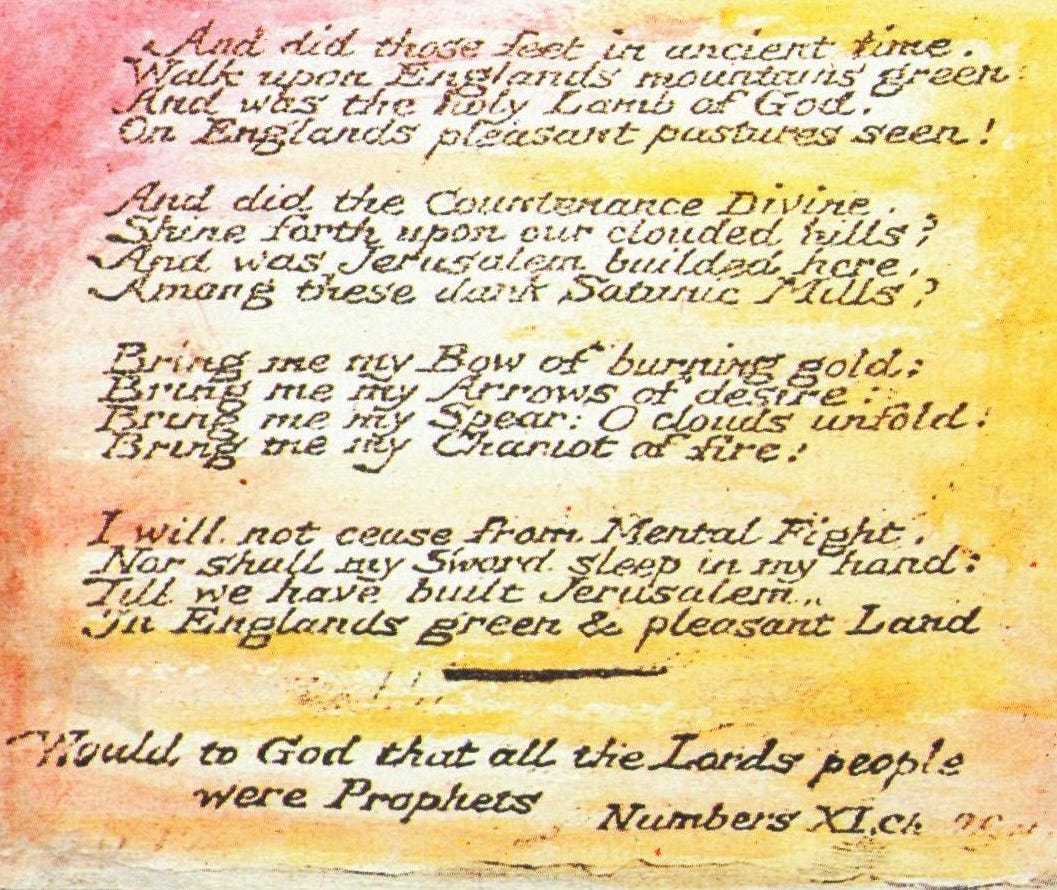
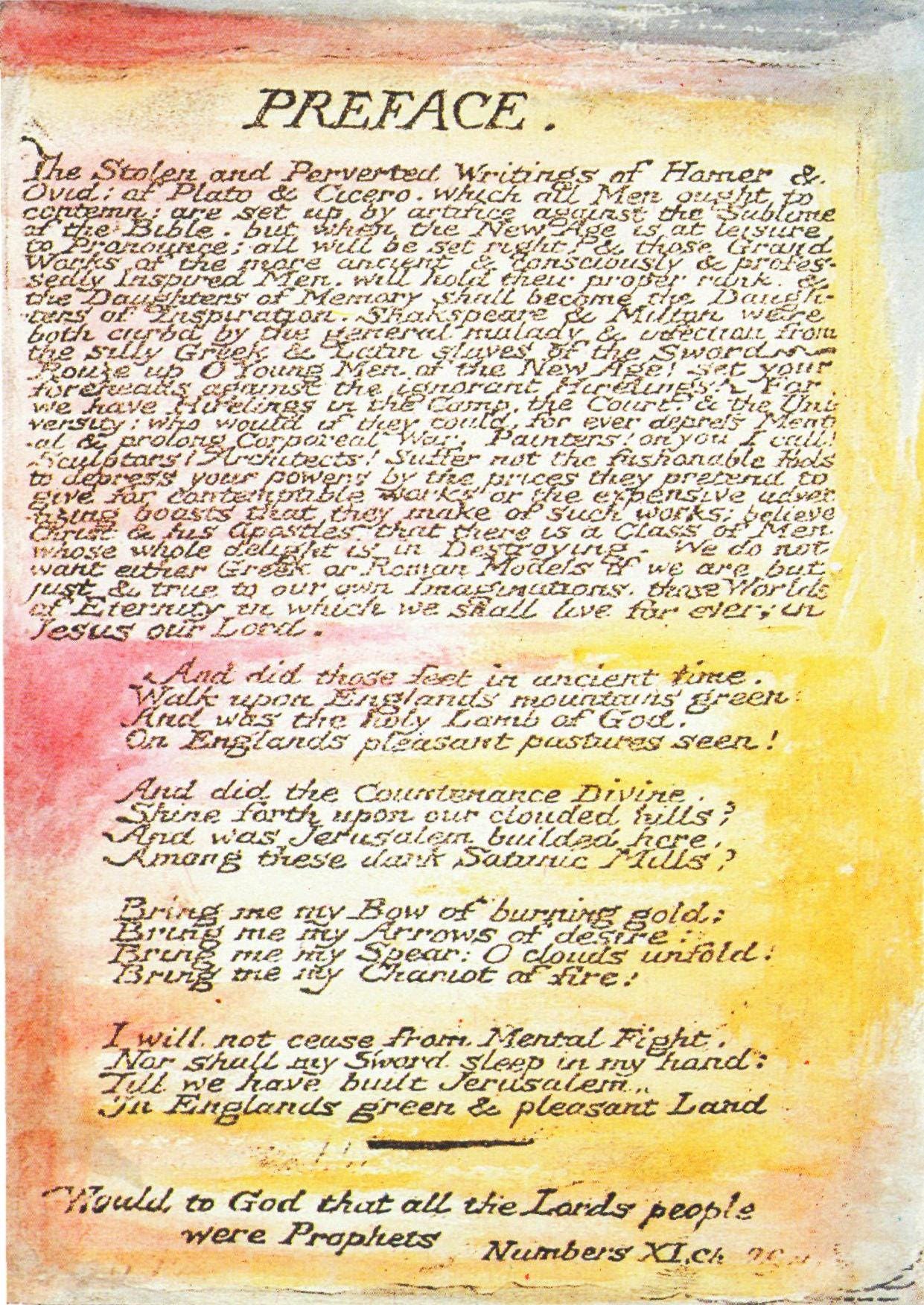
“Jerusalem [and did those get in ancient times]” by William Blake
And did those feet in ancient time
Walk upon Englands mountains green:
And was the holy Lamb of God,
On Englands pleasant pastures seen!

And did the Countenance Divine,
Shine forth upon our clouded hills?
And was Jerusalem builded here,
Among these dark Satanic Mills?

Bring me my Bow of burning gold:
Bring me my arrows of desire:
Bring me my Spear: O clouds unfold!
Bring me my Chariot of fire!

I will not cease from Mental Fight,
Nor shall my sword sleep in my hand:
Till we have built Jerusalem,
In Englands green & pleasant Land.
What does this poem make you feel? Do you miss the slower and simple pre-industrial life (and atmospheric concentration of carbon)? Can a plaintive call to these mountains green inspire you to notice where you are today and what it must have looked like before we put a data center on top it? Or does it make you worry that greater cataclysm is coming if Jerusalem is being rebuilt—surely a sign of the end times? The foreshadowing of the battle to come for the future of England—and maybe by way of synecdoche, the future of the world itself?
Chew on that for awhile. I’m not here to tell you what it means. I doubt I’ve earned the right. And even if I had, why ruin you connecting synapses yourself? Wouldn’t I be doing you some artistic disservice?
I believe that engagement with the arts and humanities can make us better at our climate work and also—dare I say it—live better lives. Sometimes a simple bucolic image can do the work of biophilia and rootedness that something more “serious” could never. But also, it made me notice my environment more today. For this reason, my sincere thanks to William Blake!
In the last Reversing Climate Change podcast episode, Tom Mills and I started talking about "Jerusalem ["And did those feet in ancient time"]" by William Blake (1810), and the 1916 hymn by Sir Hubert Parry that seemingly all Brits know in their souls.
Nobody can define insetting, which is most of the problem

Insetting is the CDR pathway of the future and always will be?
I only knew about it due to a childhood obsession with the dvd boxset of Monty Python's Flying Circus, where in the S1E4 episode, "Owl-Stretching Time", Eric Idle sings this song while being seduced. Unfortunately, I cannot find a good link to this sketch... I can't say I ever fully understood what was happening beyond just the earnestness and absurdity of the situation, but somehow Tom helped me unlock it.
In any case, this is a very very quick dip into Romantic poetry (industrialism bad, nature good; analysis bad, intuition good; simple good, complex bad), William Blake's prominence in films like Jim Jarmusch's Dead Man and HBO's tv series Westworld by way of his poem, "Auguries of Innocence", and how sometimes a work can actually be this simple and stand the test of time.
Resources
Check out my new show, Climate Workers Anonymous
Subscribe to the Climate Workers Anonymous Substack
"And did those feet in ancient time" on Wikipedia
More from the show
Ad-free episodes and other benefits come with a paid subscription.
Carbon Removal Newsroom, the news show that ran alongside this one, is over. Its episodes are still up, on the feed Climate Workers Anonymous now uses.
Carbon Removal Memes is still goofing around.
The books that come up on this show are collected on my Bookshop shelf.
🎧 Apple Podcasts · Spotify · YouTube
Paid subscribers get this episode ad-free. The ads in the free feed are inserted by Spotify when you press play. They are not in the file I make.
Full Transcript
Ross Kenyon: Hey, thank you for listening to Reversing Climate Change. This is Ross Kenyon. I’m the host of the podcast. I did a recent episode with my friend Tom Mills, and somehow we ended up talking about... what do I mean, somehow? I brought up the fact that something he said made me think of the song I originally heard from Monty Python — “And did those feet in ancient time”—which Tom Mills very eruditely pointed out is a poem called “Jerusalem,” ultimately by William Blake.
William Blake is an early Romantic British poet. His work pops up in film and television a decent amount; there are lines that get quoted quite a bit. I originally heard the famous lines from “Auguries of Innocence” by William Blake in Dead Man by Jim Jarmusch, which is a really amazing film that you should see. I actually saw it in a film theory class years and years ago, in my undergraduate years, because it’s considered a revisionist Western. In most films with cowboys and Indians, the cowboys are the good, civilizing force, and the Indians, or Native Americans, are the sort of bad savages who are preventing civilization from advancing. And Dead Man is a really cool film because it flips that. White, quote-unquote civilization is a toxic presence that’s encroaching and corrupting, and it’s actually the Indigenous way of life that’s the thing to be preserved here. I really loved that flip, and it’s a beautiful film. Neil Young does the score; Johnny Depp stars. It’s a good film.
And the famous lines, if you don’t already know them, I’ll read them for you. This is from “Auguries of Innocence,” which is only a small part of the poem:
Every night and every morn
Some to misery are born.
Every morn and every night
Some are born to sweet delight.
Some are born to sweet delight,
Some are born to endless night.
More recently, outside of Dead Man, you probably associate this with Westworld. This is sort of the leitmotif of the entire show. A thematic core of the show is that some beings are meant to suffer, are born into a system that causes them to suffer, and some are born into one that provides them with pleasure, often at the expense of those experiencing endless night. The endless night is dependent upon the sweet delight, at least in a show like Westworld.
And one thing I like about William Blake is that his poetry is so earnest. It often feels very simple. The rhymes are not complicated. “Auguries of Innocence” is a complex poem, and there’s a lot to it, but at least superficially it doesn’t have a lot of technical chops to it. I don’t feel like it’s intentionally obscure. I don’t feel like it’s doing a bunch of fancy footwork meant to throw you off, or something that requires the close reading of modernist poetry. It’s very straightforward. And you’ll see what I mean here. This poem is “Jerusalem,” also known as “And did those feet in ancient time,” by William Blake.
And did those feet in ancient time
Walk upon Englands mountains green:
And was the holy Lamb of God,
On Englands pleasant pastures seen!

And did the Countenance Divine,
Shine forth upon our clouded hills?
And was Jerusalem builded here,
Among these dark Satanic Mills?

Bring me my Bow of burning gold:
Bring me my arrows of desire:
Bring me my Spear: O clouds unfold!
Bring me my Chariot of fire!

I will not cease from Mental Fight,
Nor shall my sword sleep in my hand:
Till we have built Jerusalem,
In Englands green & pleasant Land.
Ross Kenyon: A fairly simple poem in many ways. There’s a strong contrast between a mythological vision — there are artifacts that have spiritual power, weapons, a bow of burning gold that shoots arrows of desire, war-fighting and conquering — and, of course, William Blake observing England during the Industrial Revolution. He’s looking at England’s land being transformed from this bucolic, Old English... you know, you watch something like Downton Abbey — ignore the class dynamics and all of that for a second, but think about what rural life is like, at least for those who enjoy such a thing. It has the slower pace of life connected to the natural world. And then he’s staring at the dark Satanic mills, where people are working very long hours doing repetitive, dangerous tasks, and William Blake is declaring war upon it.
And he also links it to building a new Jerusalem. You’ll rebuild the temple. This is the end times, and any time we’re talking about building Jerusalem, there’s a sense of the apocalypse, of a new world being born. And what a short, effective poem this is. It has Christian eschatology in it, apocalyptic thinking — it’s an apocalyptic poem; he’s got a lot of those. It’s where “dark Satanic mills” comes from. Everyone knows this phrase; it’s very, very common. And is it any surprise that this is sort of a national British hymn that people listen to? A connection to land and its people, lamenting our disconnection from nature, the old pastoral, bucolic, agrestic ways of being.
So, in case you weren’t familiar with that poem, here it is — that was “Jerusalem,” “And did those feet in ancient time,” by William Blake. Hope you enjoyed it, and have a wonderful rest of your day, with or without any more poetry that you add to it.