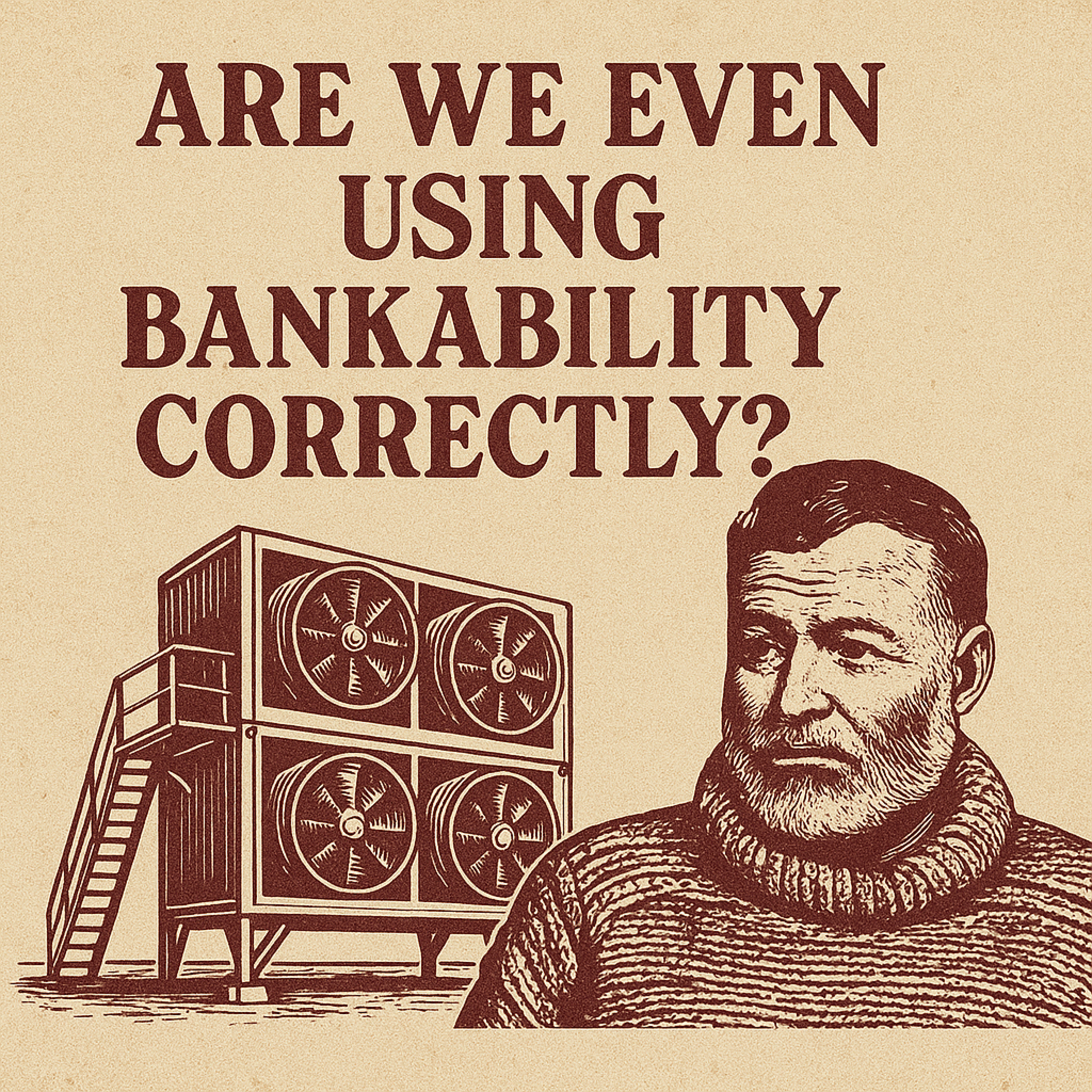

Listen on Spotify, Apple Podcasts or YouTube.
Or "project finance", for that matter? Or are these just the current words we say at happy hours?
Today, we attempt to nail down some of these definitions so we might have a chance of achieving either of these concepts.
Ryan Covington is an attorney and partner in the Climate Projects team of Philip Lee (US) LLP, focused on the development and financing of engineered and nature-based carbon projects. Ryan shares his experience in structuring large financial deals in the carbon removal and climate tech space.
Can carbon removal ever achieve scale without sufficient commercial finesse? Likely not, but isn't it pretty to think so?
This Episode's Sponsors
Philip Lee LLP: legal resources for carbon removal buyers and suppliers
Arbonics: forestry project developer in the EU
Listen to the RCC episode with Lisett Luik from Arbonics
Become a sponsor by emailing carbon.removal.strategies[at]gmail.com
Use this affiliate link to use Riverside to record your podcasts
Sign up for the 9Zero climate coworking space with my referral code
Resources
Become a paid subscriber of Reversing Climate Change
Subscribe to the Reversing Climate Change Substack
Ryan Covington's profile at Philip Lee LLP
Philip Lee LLP's Climate Projects page
The Sun Also Rises by Ernest Hemingway
Midnight in Paris scene with Ernest Hemingway
Full Transcript
Ross Kenyon: Hey, thanks for listening to Reversing Climate Change. I’m your host, Ross Kenyon. Before we get going, I’d love to tell you a little bit about our sponsors. They make the show possible. I would love it if you could listen for just a minute while I tell you about Philip Lee LLP and Arbonics.
If you work in carbon removal, you very well may have come across Philip Lee LLP’s work. I originally saw Philip Lee give a presentation about some of the common provisions within offtake agreements, and I was impressed by the quality of their scholarship and their work, and I’m happy that we’re able to stay in touch and finally do this together. I think the law is an underrepresented part of what happens within carbon removal. We assume it’s the background, we assume it’s the mechanics. It actually takes a very smart and creative person to be a good lawyer. If you’ve ever had a bad lawyer, you know that there’s quite a big difference between a good and a bad lawyer.
What’s good about Philip Lee, beyond the good experience that I’ve had personally, is that they’re also just the largest legal team dedicated to the financing and development of carbon projects globally. They were awarded Environmental Finance’s VCM Law Firm of the Year for each of the last two previous years. They have offices in the US, Europe and the UK. If you have business law needs around nature-based carbon projects or engineered ones, if you’re working with sustainable aviation fuels and the integration with CORSIA, anything to do with the VCM generally, Article 6 of the Paris Agreement, the CRCF that’s coming out of the EU now, get in touch with Philip Lee. If you’re working in this field, you really do need a good eye to the law. These projects need legal care. There’s a lot of structuring that takes place. It’s really not turnkey at this point still, and there’s a lot more innovation and creativity that’s going to be needed to make sure that the legal infrastructure that supports carbon removal is there. The link is in the show notes.
Our other sponsor is Arbonics. Arbonics is great. They’ve been on the podcast before. I did a show with Lisett Luik, which I’ll link to in the show notes too. Arbonics is working on forestry in the Baltic states of Europe. Europe used to be much more heavily forested. The great majority of forestry projects take place in the Global South, which is generally a good thing, but we also do need forestry to take place in the EU and in Europe as well. Arbonics has put out some great research recently about the state of afforestation projects, about the bottlenecks in the industry, why the high quality credits are selling out far ahead of issuance, and what that means for people who want to be buying carbon removal credits for forestry but cannot. It’s a really important set of questions that Arbonics addresses with grace. I would recommend checking out their work. If you want to support forestry, give Arbonics a look. Link is in the show notes there. Thanks for listening, and now I will go into the show itself.
Ross Kenyon: OK, today you people are getting your money’s worth. This show was originally pitched to me at least partially in reference to Ernest Hemingway’s The Sun Also Rises. I told today’s guest that I would do the intro in a Hemingway-esque voice. It’s really more Midnight in Paris than Hemingway himself, but all right. A little bit theatrical, but today’s intro in the style of Ernest Hemingway.
My name is Ross Kenyon. This is my podcast. It is about men and women who fight with risk and finance and carbon and time. It is about the struggle to make something real in a world that often feels unreal. You must rate it five stars on Apple, five stars on Spotify. To give less is weakness. To give more is impossible. Write a review. Tell the truth. The truth will be seen, and it will endure. If you have courage, subscribe, $5 each month on Spotify. You will hear more of the show. You will hear it without the dull rattle of automated ads. You will hear the bonus talks, the private talks, the talks that are for those who pay. $5 buys you that. $5 buys you the clean cut of the blade without the rust.
This show is about carbon removal. It is about men who build projects, who take risk, who try to make wheels turn. Some wheels are strong, some wheels are broken. Many people do not know what makes a project live or die, but Ryan Covington of Philip Lee LLP knows. He knows bankability. He knows the weight of debt. He knows the steel on the ground and the paper on the banker’s desk. We speak of buyers and sellers, of risk and of courage, of whether the market will turn away or lean in. It is not a small thing. It is not a game. It is the work of years and the measure of what kind of world we will have. This is a good talk. It is a true talk. You will learn from it. You will feel it. That is why we are here. That is why the show begins.
Ross Kenyon: Ryan, thank you for being here.
Ryan Covington: Pleasure, pleasure. Appreciate you having me.
Ross Kenyon: First of all, j’accuse. I have an accusation against you. How dare you tell me how to use bankability? I want to use it in however weird a way I want to define it. I want to use project finance in ways that are disconnected from historical experience. Why do you deny me this?
Ryan Covington: That is a great question. I think it gets right to the heart of the issue, which is there seems to be within the carbon removal space a couple of tendencies. One of the tendencies is a desire to reinvent the wheel when the wheel works perfectly fine.
Ross Kenyon: What about a smoother wheel, that’s more elliptical than a purely spheroid object?
Ryan Covington: Perhaps, but I think the wheels that sometimes come out are oblong shaped or have a lot of right angles and they don’t exactly operate that well. So if there is a better wheel invented, I’d be more open to the tendency to reinvent. But I think the outcome oftentimes is a rather odd shape, to carry on the metaphor here.
So we’ve got one tendency in the space, which is let’s reinvent the wheel for some reason. And then the other tendency is we typically look to the wrong parties, the wrong market participants, to define different standards. One of the biggest ones that we somehow found ourselves looking to the wrong parties to define is bankability. We can get into what it is, but it’s a standard that’s applied to much more mature markets. It’s something that’s in energy and infrastructure. It’s a project-wide assessment that’s undertaken by third party funders to decide whether they want to deploy debt there. There’s a tried and true way of assessing that across energy and infrastructure markets and large scale deployments. But because of the absence of true third party financing within carbon removal specifically, we found ourselves looking to a few disparate voices to tell us what bankability is, or to fill the void for a lack of a threshold.
And those participants are the ones that we’re very well aware of. It’s the large tech buyers oftentimes that are establishing market norms or terms. They’re not necessarily telling us what is bankable. They’re not telling us what terms will unlock third party financing. They’re telling us what they require to transact, for their optics. So this is the second tendency I’ve talked to. I think we equate negotiation leverage, or market cachet, or the volume associated with a particular voice, as a proxy for understanding these terms, when those are not the voices that we should be listening to necessarily for determining a very clear objective standard.
Ross Kenyon: Do you think the big buyers that have enough market power to dictate terms like this have done something wrong? Is this within the bounds of normal commercial activity? Is this just what happens in a monopsonistic environment where buyers call the shots? What has led to this? And is this an OK state of affairs for our level of maturity, or did we make some terrible wrong turn here that’s very unique?
Ryan Covington: Lots to unpack there. I don’t think buyers have done anything wrong. In fact, I think buyers are being asked to do too much, frankly. We’re relying on the wrong profile of participants to send market signals and to provide catalytic capital, because of the absence of true third party funders entering the space. So I think the buyers have found themselves propping up the voluntary carbon market, at least through pre-purchases, through offtakes along with catalytic pre-purchases, and they’re being asked to fill the void and dictate and continue to prop the space up. So it’s nothing that they’ve done wrong.
Because of that immense role that they’re playing in the space, to send really important demand signals and to send signals to the third party financiers that this is a durable sector, that this is a sector where there is demand, I think we should applaud their efforts and applaud the big buyers that are sticking their necks out to make long term commitments in the space. There’s an end of that conversation though, which is that we should be engaging more with, and we are at Philip Lee certainly doing so, engaging with large historic infrastructure funders, large commodities traders, large institutional lenders as well, who have very clear cut standards that they have to get through their investment committees in other sectors to define what’s bankable. We’re engaging with them to figure out what you actually need to see in the projects to unlock that third party financing that’s sorely missing from the space.
I think if we bring that profile of player more into the conversation, if we actually ask the [unclear] of the world, what do you require, or the JPMs of the world, what do you require, what do you want to see, I think we’re going to get a very clear answer.
Ross Kenyon: I think we’re all looking for how to attract financiers like that into carbon removal. There’s been some nibbling at it, like the Standard Chartered support for some of these deals with UNDO. There are a couple of these things that are happening within climate tech broadly. But I have to think that if there is money to be made here, people are going to come and make that a reality, because that’s just how business people work. There’s something to happen here, but there’s some question about is there technology risk, policy risk. Are the ticket sizes too small? A lot of institutional money, the deals just aren’t big enough at this stage of maturity for carbon removal to even catch their attention. Some of that is changing now, but is there even enough here to attract people who would finance bridges or major infrastructure projects?
Ryan Covington: 100% valid. If we’re talking about engineered carbon removal specifically, we’re looking at tech efficacy risk. Does the tech actually do what it says it does at the level it says it can? We’re looking at project execution risk. Can the tech developer that’s wearing a project developer hat actually wind up a contract with an EPC that can de-risk the project properly? Can they get through pre-FEED and FEED? Can they line up their transportation and storage arrangements in a way that is actually commercially viable and bankable, for the word of the day? There’s a question of, are there proper government incentives? Is there a compliance market driver that’s going to be the unlock? There are all kinds of questions within eCDR specifically that are keeping capital on the sidelines.
So I think the question is not whether there’s a sufficient level of need right now for the third party financing. I think there is. I think there’s also a question of what can you do now to establish the pillars necessary for the space that would unlock third party financing for the commercial wave of deployments that need to occur before 2030 and throughout the 2030s. We can’t just wait until 2029 and say, hey everybody, commercial scale deployments are starting to come online, let’s rework all those offtakes that you signed that actually can’t attract third party financing. Or, hey, those are really lovely carbon transportation and storage agreements, no funder would ever deploy financing on this project because of the way that you structured your arrangement. The risks are unknown, the liabilities are too extreme, the project risk is allocated to the project developer too much. There are all kinds of things that could come up, but you can’t rewrite and then speed up through the process at the point in time when commercial scale deployments come on. Those deployments take years to actually develop, to get through early stage development, to get through build, to then get into operation, to hit COD and be in operation. These are long term, infrastructure heavy projects.
What have we relied on today? It’s really two, maybe three forms of financing. One, it’s venture capital funders. Traditional VCs, maybe climate VCs, maybe climate hardware VCs, but they typically have played in the market where they’re looking at off the shelf climate hardware tech. They’re not looking for capital intensive, infrastructure intensive projects and how to finance them. That’s not their space.
So then that goes to the second one. There are the large corporates that are either playing in BECCS themselves, doing large scale BECCS projects themselves, cement players, other industrials are similar. You’ve got the energy majors that are doing a model like Oxy, that owns 1PointFive and Carbon Engineering and bought Holocene as well. They’re doing on balance sheet financings essentially to get their projects deployed, to a large extent, or they’re providing the equity financings that the same VCs are co-participating in rounds, or project level debt.
So we’ve got these two. We’ve got VCs that are actually providing some money, but it’s fickle like all VCs. It’s market trends, and it comes and goes, and it’s not committed for large scale infrastructure. It’s just not, as much as we’ve seen large rounds happen in the space. It’s not going to be there when we need the dollar figures that we need to actually get commercial scale deployments done. It’s the dollar figures we need to get pilot scale deployments done, not true commercial scale deployments. You’ve got corporates that can do it either on balance sheet or through subs. And then the last group is this mismatch, that we’re relying on government incentives and grants, catalytic funding and grants through players like Breakthrough that are helping. But again, there’s significant funding that’s being supplied, and it’s to help these project developers through this period where they’re dual tracking tech de-risking at the same time as project de-risking. It’s to get a pilot done, to get an offtake done.
And when we say pilot, because again we’re talking about the space using these terms that either can sound really small or really big or really important or really not, when we’re talking about a pilot, for DAC for instance, this is 500 to 5,000 or 10,000 tonnes per annum that you’re actually trying to remove. Small commercial scale is 20,000 to 50,000. Those are the projects to date that are being financed in the way that I’m talking about. We need to now move very quickly to a stage where we’re at commercial scale, which is 100,000 to 500,000 tonnes of removal capacity for projects coming online in 2028, 2029, 2030 and throughout the 2030s. So the orders of magnitude of removal capacity are directly correlated to the orders of magnitude of capital capacity that we need to unlock.
Ross Kenyon: And who theoretically, if we can solve for that huge set of issues that you previewed up top, who can unlock that capital?
Ryan Covington: I would like to think it’s the project financiers, who have a way of deploying capital against projects that are banked on future cash flows. That’s what project financing is. Limited recourse third party financing, banked on future cash flows generated by a specific project and secured by the assets of that project. It’s not VC financing, it’s not pre-purchases, it’s not corporate balance sheet financing. It is third party debt financing that’s limited recourse in nature, that’s banked on cash flows generated by a specific project. That’s how simple the concept is. But instead we equate project financing with everything else I’m talking about.
So people then say, well, wait a second, there’s capital that’s going into the space. The optics really aren’t the issue that’s stopping more capital from coming, because the VCs are contributing and corporates are interested, there are some corporate strategics that are deploying more capital. But that’s not who we’re targeting. That’s not the form of financing we’re targeting for commercial scale. We’re targeting something very specific, which is project finance. Or project finance, if you want to be a banker. I flop between the two pronunciations, but finance definitely sounds a little bit, I don’t know, snootier. My nose is up a little bit when I say it that way.
Ross Kenyon: I was going to say, it depends on how full of myself I feel that day as to whether I say finance or finance.
Ryan Covington: Yeah, fair enough.
Ross Kenyon: I think in that second category, defined broadly enough, are the big joint ventures of someone like CO280. I did a show with them not long ago, spent a lot of time on how to actually structure deals and the mechanics of them, and they’ve been very successful making joint ventures work. Is that an example of the second category? Is it something else? Are they as good as it looks in that episode? Is it not the right fit for lots of people? Sorry, I’m not really asking you one question at a time, am I? But you can take it any way you want.
Ryan Covington: They’re a really interesting model, and I think it’s a model that’s going to be a pretty key unlock for the space. My understanding of CO280 is they’re what’s called a tech agnostic project developer, meaning that they’re not relying on that dual tracking of tech de-risking at the same time as project execution. They’re focusing heavily on wearing that project developer hat. This is very similar to Deep Sky out of Canada on the DAC side.
In doing so, what they’re saying is, I’m going to rely on third parties who have longer histories of developing carbon capture technology or carbon removal technology. I’m going to go through all the effort and pain of structuring my entity in a way that’s actually financeable from third party debt or venture capital or similar. I’m going to worry about all the key participants that we need for EPC and O&M and similar. I’m going to actually vet those third party tech enablers for the projects. I’m going to line up the key strategic relationships with industrial players or energy majors or large landowners or similar, the feedstock supplies. Theoretically what they can do is say, I’m going to be the one that sits at the centre of all these projects and can map out how all the relationships work.
Which goes exactly to the conversation we’re having today, which is what is bankability. Because what CO280 theoretically can say is, hang on a second, I need to make sure my projects are bankable, because I’m the project developer and I need to attract third party financing or capital for these projects. So CO280 would have to then say, OK, bankability is a project-wide assessment that a lender’s going to go through, and they’re going to say, have I identified all the project risks? Step one, have I identified all the project risks? So they’re wearing a hat with a 360-degree view, and they have the responsibility to actually identify all of them. The second thing, and CO280 is not a client, so I can’t tell you if they’re doing this or not, but what a CO280 could do is actually mitigate the risk. So they can say, I’ve identified the risk, here are the ones that I’ve dealt with by relying on third parties or insurance or other mechanisms to de-risk that issue. I’ve engaged with local governments, local communities, whatever it is, environmental consultants.
The third step is, I now have to go, OK, I’ve identified everything, I’ve mitigated what I could, there’s some that’s left over, and I’m going to allocate that project risk in a way that a funder can actually say, OK, I’m comfortable with the level of project risk that sits with the project developer. I’m comfortable that your carbon transportation and storage provider is wrapping you sufficiently, for example. And because I’m so comfortable, I’ve gone through this project-wide assessment, I can now decide to give you debt and be confident that you’re going to repay it. And not only am I confident that you’re going to repay it, but in an ultimate downside scenario I actually can say I’m comfortable in my level of protection by way of the recourse I have via the security package that’s given.
I’m not saying that’s what CO280 is doing currently, I can’t speak for them, but that’s what a project developer is faced with doing. They’re faced with mapping this whole world. The joint venture concept that you’re talking about is a critical step in this process, because you are leveraging industrial players with key knowledge, that have built projects, that understand infrastructure, that understand risk, that understand this bankability assessment that’s going on. You’re speaking a similar language. So you are de-risking for your funders, either VC or hopefully soon project financiers. It’s an example of that second bucket that you’re talking about, but it’s one that can evolve into a broader, more impactful unlock for the space. If you can leverage those JVs into ultimately project cos, SPV structures that are set up to do one single project, then you can unlock that debt, assuming that we’ve controlled for all those other variables. So it is an example of where the space is going. It’s not an example, as far as I understand it, of this kind of true project finance model where debt is being deployed against a specific project. But it’s a really important step in this process that we’re going along as a space collectively.
Ross Kenyon: I’ve been cheering on the differentiation between project development and tech development. I might infer from your comments you were also cheering this on. Why do you think it took us so long? Those things were co-located for years and years. And once it happened, I started seeing people focus on this. Obviously people who work in forestry are project developers and they’re not all foresters. Why did it take us this long to just become project development people?
Ryan Covington: I think one of the biggest impediments to the space in terms of its growth, and what’s held it back, is actually the reluctance to embrace more delineated and sophisticated roles on projects in a manner that more traditional industry has done. Obviously Oxy via 1PointFive has set up a project developer and they bought tech from third parties, and that’s their model. So there are some that have done it.
I think one of the issues is that the tech enablers are so close to their actual underlying tech. No surprise that they’re seen as the ones that can best de-risk it, and they’re de-risking it via deployments, pilot deployments, which is largely what we have. And they were being venture capital financed. So there’s this assumption that, let the tech developers develop the tech, see how it plays out in reality, and we don’t have to worry about all these other larger participants who have built these projects as much. Maybe we get an EPC involved in the pre-FEED stage for some kind of engineering support. But for the large part we just need to get this out into the wild and see how it performs, and we go from there.
That is a model that is more acceptable, or more understandable, at pilot. It’s way less understandable when you actually jump to small commercial scale or true commercial scale. You can’t in earnest dual track that unless you have very sophisticated infrastructure that’s built internally to do project development, and it’s very clear that one whole business vertical is project development and another one is tech enabling. That’s a completely different vertical. When you try to get people to speak the same language, I think that’s where we’ve had issues.
And quite honestly, this gets to the interface with offtakes. Even as we’ve used the offtake in this model of tech enabler and project developer, we’ve used the offtake as a market signal. But who are we signalling to? We’re signalling to VCs and corporate strategics that might be interested. We’re saying, look, my tech is validated. Not my project execution capacity, not my sophistication as a project developer. My tech is de-risked sufficiently that I got a large buyer to commit to an offtake, and therefore venture capital firms that are getting hundreds of decks of project developers or tech enablers, I want you to lead my seed or Series A or Series B or similar, because look, I’ve got a market demand signal for my project.
That’s a tech validation largely, because you’re speaking a language to both VCs and corporate strategics who might want to acquire that tech or have access to that tech for their own use. You’re speaking a language that says this tech is ready to be used. You’re not speaking a language necessarily to say I’m ready to go across multiple jurisdictions, to interface across multiple governments and regulatory regimes, and talk with multiple funders and different stakeholders, and create a project at a scale that’s akin to developing a solar farm or a wind farm or something similar. These are really complex projects.
So something that’s happening is that for these dual hat tech developers and project developers, at minimum we’re seeing a greater emphasis on the two verticals. Tell me how your tech works. Awesome. Let’s figure out, let’s do the due diligence, let’s see if it actually does what it says. Equally important, who do you have on your team that’s come from traditional energy and infrastructure? What corporate strategic do you have in your back pocket to actually help you with this? What industrial player is supporting you or giving you access or otherwise interested? It’s a question of who is going to help unlock large scale deployments, not does your tech work.
So that offtake in that context, and I appreciate I’m being very long winded on this, it’s less important how it fits into commercial scale deployments. If what we’re looking for is how does this unlock and keep tech developers scaling to enable them to ultimately reach commercial scale, that’s a different conversation than, can the offtake underpin a financing that unlocks the commercial scale. So what can help us get there, versus what is necessary to actually get the project deployed.
Ross Kenyon: I think that’s very astute. My speculation for why this might be, and I’d be curious of your own as well, is I think software culturally calls the shots, and everyone likes the idea of the twenty-something or thirty-something founder having a dream and then building the next world beating brand, and for that happening for carbon removal. But as I’ve grown more experienced as a business person and within carbon removal, the teams that I gravitate towards tend to have more age and more experience, and they do have some of that conventional infrastructure and energy background. Have you put steel on the ground? Have you made some stuff happen? You’re not just someone who worked in a lab and is commercialising tech coming out of university. No shade against that, we need that too.
But if there’s some way to differentiate these business models and say, we’re a tech developer, we don’t want to do project development, our goal is to license this to the corporate strategics in this area and that’s our go to market, actually I think if I was diligencing a deal for a VC I would treat that much more seriously, because they have acknowledged their limits. Whereas this idea that we’re going to do all this stuff, science, engineering, commercial, we’re good at it all. Is there a full stack carbon removal company like that that can do it? There are a couple who are doing fairly well perhaps. But overall I think that expectation is just like the Iron Man configuration of business expertise.
Ryan Covington: 100% agree with that assessment. We’re working a ton with engineered carbon removal project developers. We also work on the nature side as well. I think we’re seeing, and we’re coaching our clients through, that process of being comfortable with the tech licensing play or manufacturing play. We’re coaching them through pursuing deployment opportunities where they’re a tech enabler, or maybe project developer at a smaller scale, and seeing which one fits in their business model more, which one’s actually workable, what speaks to their skill set. We’re looking at opportunities unlocked in different jurisdictions and climates and situations.
And a big one, honestly, that’s a key unlock, is that even if you’re a tech developer that wants to be involved in the project deployment process, having and forming relationships with corporate strategics and other industrial players to be the unlock is incredibly key. So to react to what you’re saying, I don’t think anybody’s 100% figured out how to wear all hats and do all things. I think that there’s a realisation increasingly that you can’t. And it’s a question of how do you specifically build a stack and offering that enables your tech to get out in the wild and used. It might be that you realise that it’s through licensing. It might be that you’re a project developer with a corporate strategic, a JV with somebody that actually helps unlock those projects. But typically the one stop shop, I can do it all mentality hasn’t exactly worked in the space. So I think there’s an assumption of greater sophistication and delineation of roles that’s coming.
Ross Kenyon: Dang. I would love to just see the numbers. If you’re a company out there and you’re listening and you are pursuing a licensing only tech development carbon removal pathway, I’d love to hear from you, because I’m wondering how those numbers actually do pencil. Can they justify a venture capitalist’s portfolio figures? Can that fit inside there any more? Because they’re going to be sharing a lot of the upside with the actual deployment people, and that might actually make it harder to receive that type of funding. In which case what happens to those licensing only companies? Do they have a go to market that could be successful?
Ryan Covington: The space has already seen this work. There are examples of players in the space like Capsol, for instance, that’s been essentially an OEM, the developer of carbon capture technology that can be used and de-risked for various projects. So I don’t think that this is a new concept necessarily. Svante historically as well, in terms of developing actual carbon capture technology. So there’s a model that’s proven out and has successfully scaled in the space in terms of having that clear role.
I don’t think there’s a one-size-fits-all to that approach either. These approaches take different forms. Essentially Carbon Engineering, as far as I understand it, is serving as the de facto, or the actual, R&D arm for Oxy’s low carbon solutions team, and they’re engaging with 1PointFive. They definitely are an Oxy sub and directly linked to it. But their go to market strategy was, we’re the tech developers, we’re the R&D developers, and we now have the corporate backing of a large energy player that can help support our scaling.
There are different softer variations of that, where we’re seeing clients that are engaging with different industries for different licensing, partnership and project deployment arrangements that fit within that industrial player’s viewpoint. It could be co-location on site. It could be with a view towards using their transportation and storage infrastructure that’s being developed out. It could be for access to carbon credits that are generated by the projects. There are a number of different ways that we’re seeing that tech player get their tech out into the wild. It can be a VC play, it can be a corporate strategic play, or it can be, well, I’m going to scale this up and I’m going to be the third party de-risker for it.
And I think there is a question now. I tell a lot of people when they’re looking at the engineered carbon removal space that right now we’re in the prove-it phase. All these technologies are at a prove-it phase. We’ve gone past the hype phase, that’s come and gone very clearly in the space. We’re now in the prove-it phase, and I suspect we’re going to see immense consolidation in the space over the next two years, up to 2027, during this prove-it phase. There’s naturally going to be, via that consolidation, clearer roles, and there are going to be the winners that come out in the 2028, 2029, 2030 deployment stage. So there’s going to be a natural pressure that’s coming from the top down that’s going to make your role clear if you don’t already have a clear role, because of how much pressure there is right now to stand out and actually prove that your tech works or that your project deployment strategy works.
Ross Kenyon: Ignore that big comment you just dropped on us. How dare you say there’s going to be consolidation. We should never face that.
Ryan Covington: Consolidation’s [unclear]. It doesn’t sound as bad when you put it that way.
Ross Kenyon: That’s true. I took a meeting a while ago with a venture studio and they had a model that I really liked. This is not unique to them, this is fairly common, but they pointed it out to me very clearly. One strategy is to look at what large agribusiness or some other large, well capitalised industry has set out for their goals for the next couple of years, and then just reverse engineer companies for acquisition by the people that have money. I would love to see it. I read a lot of decks. A lot of decks come my way for various reasons, and I almost never see anything that’s licensing oriented as their main go to market.
But I would just love to see, yeah, we just want to be acquired by, like, Oxy is the only one who’s really bought a lot of carbon removal stuff today. It’s only a couple of companies. So we’re just going to design sorbent technology that is compatible but different. We have IP that we can sell to them or license to them. That’s just what we’re going to do. I would be like, all right, this may be a single or a double if you’re a VC, that’s not going to be some huge portfolio justifying return, but they’re probably going to make money on it. If you think that deal gets diligenced successfully and they’re on the right track with this, that’s a pretty good thing. I’m wondering, is there anyone out there with the strategy for that? Because someone is probably going to figure it out and make some money doing it. Maybe there’s just too much political risk and market risk right now facing carbon removal to feel secure. It’s not like doing that for hardware or consumer goods. But I love that idea. I’d love to see someone do it. If you’re listening and you have money, feel free to take that idea and run with it. It’s not mine, it belongs to the universe basically.
Ryan Covington: I think there’s something that’s really interesting that’s going on in Trump’s America.
Ross Kenyon: I thought this could be the understatement of the century. There’s something really interesting going on in Trump’s America. You are so smart. Wow. I love that. It’s something really interesting.
Ryan Covington: There’s something that doesn’t get talked about enough within the carbon removal space, and I think it’s difficult to talk about because of the confidentiality and sensitivity in the current climate that we’re operating in. It’s that the type of deal structures that you’re talking about are advancing in the background very quietly for deployments in North America, Europe, the Middle East and elsewhere. And I think there’s a tendency, if we’re going to bring this conversation back, that we look for very clear market signals. Have you signed an offtake with the biggest buyer in the space, or with Frontier or similar? Have you gone through your Series A, and who’s on your investor deck?
What we’re not hearing in the space, because we can’t talk about it, is the number of strategic partnerships that are being entered into in the background, and have been entered into even pre-Trump, that are going on not necessarily as planned, but with a lot of interest and sophistication, that are going to shape who the players are that come out successfully. I know I’m being very vague here, but if people are assuming that venture capital, non corporate strategic venture capital, is the unlock for the space, and that’s the way that we decide whether the space is doing well or not, what I would say, and what we advise a lot of our clients to do, is yes, of course you have to get through that if that’s part of your scale-up effort, and yes, you need to have VCs on your table that understand it. But you really need to be engaging with various industry players who have the capital and the decades of experience in getting energy infrastructure or other industrial projects built.
If you’re not, you’re going to find yourself in the back of the queue for project deployment opportunities, project finance availability, and even VC funding, because you’re going to have lost out on a ton of momentum that’s being built very quietly behind the scenes right now. Again, intentionally very vague and amorphous in terms of what I’m saying. But that viewpoint that you’re talking about is one that very successful project developers are painstakingly following in the background, very quietly, rather than putting their hand up to say what they’re doing. And I suspect that if you’re being strategic and diversifying your partners during this period of uncertainty, especially in Trump’s America, that’s a huge positive for your chances of coming out the other side of this prove-it phase, and being there for having your tech deployed, or building your projects if you’re wearing the project developer hat, come the commercial scale phase that we’re all looking for.
Ross Kenyon: It was a bit amorphous, but all it really proves is that you have your JD, I think.
Ryan Covington: I believe it. Now I don’t even need to look you up.
Ross Kenyon: How do you say the most while saying the least, right? Or say the least by saying the most, however way it goes.
Ryan Covington: It wasn’t that.
Ross Kenyon: It’s very sensible advice if people are able to plug into existing industries, farsighted companies that know that 45Q and things adjacent to it are going to be OK through the Trump years, and whatever comes after it is likely going to re-enhance carbon removal’s status and political options. That’s a good thing to do. Or companies that just know that they need to do it for their own reasons. If agribusiness knows that fertility is not improving and topsoil loss is real, that biochar can maybe help with it and with drought resilience, then OK, those are good things to be plugging into right now that do not have the political risk that just VCM or policy dependence creates for it. That’s almost commonplace at this point, where people are saying, are there alternative go to markets here that we can cotton on to that are not just, please can we have some money, Microsoft, we’re really interesting, come take a look.
Ryan Covington: And I think honestly there’s a whole different segment of people that you should be talking to, either directly or through those partnerships, which is the project financiers. This isn’t theoretical, we’re starting to see it actually play out in terms of offtake conversations, transportation and storage arrangements and negotiations, and how they’re structured. If you don’t have visibility into what a lender requires in terms of assessing the bankability of your project, and whether your offtake is bankable, for example, you’re leaving a ton of leverage on the table in your negotiation with those limited significant buyers in the space. What I’m saying is, if third party funding is a key unlock for your projects, that means that you should be talking with, or have an advisor that’s familiar with, or a corporate strategic that has a relationship with the funder that would actually sit down and look at your offtake.
And say, OK, let me look at this offtake. My first question, how committed or how firm is this offtake? Are the delivery obligations clear? Are there certain delivery volumes? Is there certainty around obligations to actually take and pay? I’m going to look at whether your under-delivery regime, shortfall regime, is pre-baked, and does it actually say what happens in a scenario where you have interim shortfalls and how do we deal with it? Or does it have this really grey, amorphous, let’s agree to agree what happens in the case of this? And what does a replacement credit mean, even if that’s a remedy?
Ross Kenyon: I’m just reacting. I would be very scared if a contract was passed to me that looked like that. That is not good enough.
Ryan Covington: Exactly. If you don’t know that a lender, or a corporate strategic, but especially a lender, is ultimately going to say, I need to be able to pick this up and see that this is a firm offtake, that you don’t have overly broad force majeure regimes or change in law regimes that are too clunky, or you don’t talk about what happens in terms of a changing methodology and how you plan for it. You need to have certainty committed and be able to underpin it. You want to look at it and say, I’m going to pick up this offtake, I’m going to deploy debt against this. What’s your maximum exposure under this? How do you quantify it? Can it be quantified, and how’s it allocated? What does your interim damages regime look like, the remedies? What does your termination damages regime look like, and is it appropriate? How is it undermined or influenced by things like indemnification obligations?
These are all questions that lenders will ask, and do ask already within carbon removal, and ask on every single energy and infrastructure project. They’re going to say, what’s the creditworthiness and what’s the credit support required for this to backstop the obligations of both the project developer and the buyer side. And then the last one they’re going to say is, what does this offtake do? How does it interface with, does it integrate the terms of, the rest of the project? Or is this just an off the shelf template that didn’t move, and it’s not fit for purpose for this project, and it doesn’t account for or pass through all the liabilities?
That framework I just said, the four key questions, every lender will ask those four questions and have numerous due diligence follow-ups to get to the point of it. And that’s for the offtake only. So if you don’t have right now, project developers, tech developers, somebody on your team or an advisor or a corporate strategic, or you’re not talking with those funders already to say, please tell me what your requirements are, and you’re not saying back to the buyers that this is what’s needed, then you are behind in the process. Because bringing in those concepts and those viewpoints is what’s getting projects project financed.
Look at what Chestnut Carbon did in the nature space. They got an actual deal done with Microsoft as the cornerstone, with an offtake that was sufficiently bankable, on top of the security package that was given, for it to get JPM to provide debt to it. That happened in nature, and I know that there are project financing conversations going on to bring those players into the space for engineered carbon removal specifically. And how are they doing it? They’re leveraging those viewpoints and those requirements in a way that you can actually have, not leverage or balance in the negotiations, that’s not a realistic expectation, but you can have the core levers and red flags that you know are going to be deal killers for you, if that’s the way that you’re going to finance your projects.
So to round out that conversation about who are you talking to, how do you get ahead, who’s going to come out the other side. If nobody is actually directly bringing the funder’s viewpoint into the mix, then all we’re doing is regurgitating assumptions and guesses as to what’s going to be required, rather than saying we know with certainty what is required. So I think that we’re seeing those players engaged more, and it just needs to happen at a higher and higher rate.
Ross Kenyon: Couldn’t we finance carbon removal just because it’s the right thing to do?
Ryan Covington: I would love that.
Ross Kenyon: For the Hemingway quote, man.
Ryan Covington: But isn’t it pretty to think so?
Ross Kenyon: Of course. But isn’t it pretty to think so. That’s right. I asked my beautiful, if naive, question hoping to trigger that. I didn’t take the bait.
Ryan Covington: Yeah, you need to run the video back and I can come in eloquently and just drop that one. But that’s fitting, right? That’s the Hemingway nature of the podcast. Even for the most perfect opportunity, theoretically, inevitably some ball gets dropped. No pun intended.
Ross Kenyon: I love that we were talking about the origins for the show and the rather literary nature of the show. The show will sometimes have hardcore business mechanics like we talked about today, and then there’ll be a show that’s just like, OK, we’re starting with Dostoyevsky now, this is where we’re going. But you’re a Hemingway fan. We were talking about The Sun Also Rises and the conclusion of that. I re-read it. I don’t think I’ve read it since high school. Really enjoyed it, but I don’t think I understood it when I first read it. It’s a much sadder book than I recall.
Ryan Covington: I had the same exact response. I read that book in high school. I was 17, living in Belgium, and I had a teacher called Mr Novak, and our entire 12th grade English class was called Finding Hemingway. So we read the complete works of Hemingway, and then we actually took a trip as a class, a small AP lit class, to Paris. We did a week going to the cafes that he wrote at, and sat there and wrote and drank where he drank.
My reaction was, one, why did I think that I had any understanding of what Hemingway was saying at 17? I remember vividly being like, I get it, I really get what he’s going for here. And I just re-read it on the lead up to this podcast also, and I was like, I had no idea what he was saying in the book about loss and let-down and what could have been and should have been, and how you deal with that let-down, and whether it’s worth embracing or holding on to hope or letting it go. Or just kind of having this Zen-like understanding come out of it, which is that there’s a theoretical world that’s pretty to think about, and you can understand and appreciate, but you’ve just got to give it up, or give up the hope along the way at some point.
Which, tie that to eCDR. We shouldn’t give up the hope. And we should also not have a Hemingway-like approach where we put concepts of love or understanding and these lofty Platonic ideals that can never be approachable and are just going to give you heartbreak along the way. So we’ve got to pivot away from positives being a pathway to inevitable let-down, and instead we can bridge what is a space that’s full of its fair share of losses, but also some good wins, and say, look, there’s a very clear path towards happiness and love, and Lady Brett and Jake and the eCDR space can finally run off together and have a few absinthe drinks and look back and say, it’s not only pretty to think about, we’ve actually done it. Go back to Pamplona and actually run this time, rather than looking at the bulls from above on a balcony.
Ross Kenyon: I love it. Somehow you pulled it off. I was like, this might be a little shoehorny, but it actually all fit together so nicely. I also oscillate between having a sort of capital R Romantic hope, and really resenting in some ways how mechanical and financial a lot of carbon removal and climate action is, and just respecting and appreciating the activists who are just like, none of that stuff really matters, we’ve sort of lost the plot if that’s where our heads are at. The dialectic between those two is where I tend to hang out. It doesn’t necessarily make me the most contented of persons working in carbon removal, but it does make me think, and I think maybe that’s the most one can hope for.
Ryan Covington: That’s also kind of a Hemingway attitude as well. He didn’t strike me as the most contented of men either.
Ross Kenyon: No, it doesn’t. Ryan, thanks for being here. I learned a lot. Thanks for letting me ask all my questions about project finance and bankability, and also some Hemingway.
Ryan Covington: Pleasure. Appreciate you having me on. Appreciate all the conversations that you’re having in the space through your podcast. Look, these barely touch the surface of a lot of these issues, and there are a lot of people in the space working on the same thing, so happy to have conversations with anybody else that’s trying to tackle this as well. And I appreciate you putting this conversation more into the mainstream and front and centre as people start to look at a bit more nuance in the space, and the issues that are actually stopping projects from getting deployed and capital actually entering. So I appreciate everything you do.
Ross Kenyon: Thank you, Ryan.