
Episode 397 of the Reversing Climate Change podcast. You can listen on Spotify (subscribe there for ad-free), Apple Podcasts, YouTube, or wherever else you listen. Paid subscribers get the ad-free version right here on the page.
I've had a poem stuck in my head, and it isn't one of biophilia and whimsy. It's about liminality, death, and interregna. Let me read for you one of my favorites and one of the all-time classics of English literature, William Butler Yeats's "The Second Coming".
While beautiful for its own sake, I'll also make a case for the defense of useless things, an argument for the horror genre as a serious art form, and a close reading of a poem that has become a kind of shared vocabulary for moments when the center will not hold.
I work through the imagery line by line, and connect it to everything from Frankenstein and Genesis's exile from Eden, to Tig Notaro's stage presence, to theriantropic madness from The Office's Michael Scott, to H.P. Lovecraft, to Slavoj Žižek on Alfred Hitchcock's The Birds, and more.
The trigger wasn't climate policy rollback or the war in Iran, as you might guess—it was actually thinking about artificial general intelligence, and that the falcon that can no longer hear the falconer.
Listen in to hear more about why "The Second Coming" reads as present-progressive horror rather than past-tense lament, why "troubles my sight" is a master class in economy of language, what monsters are actually for (the etymology connects to the Spanish mostrar—to show; which I minorly mispronounce in my freestyling—forgive me!), how Hereditary, The Babadook, and Jordan Peele's films use horror to talk about grief, depression, and race, and why this liminal moment between world orders feels so monstrous: not because the new world has arrived, but because the rough beast is only now slouching toward Bethlehem.
"The old world is dying, and the new world struggles to be born. Now is the time of monsters."
- Antonio Gramsci
Resources
"The Second Coming" by William Butler Yeats
Paul Muldoon's reading of "The Second Coming"
In Praise of the Useless Life: A Monk's Memoir by Paul Quenon (referenced via Thomas Merton)
Slouching Towards Bethlehem by Joan Didion
Things Fall Apart by Chinua Achebe
Paris 1919: Six Months That Changed the World by Margaret MacMillan
Paris 1919 (album) by John Cale
Pervert's Guide to Cinema — Slavoj Žižek on Hitchcock's The Birds
Treaty of Trianon (I didn't mention this by name, but I've been thinking a lot about how it shaped/shapes Central Europe.)
Id, ego, superego in Freudian psychoanalysis
Michael Scott's theriantrope fantasy/nightmare/prophecy from The Office
More from the show
Ad-free episodes and other benefits come with a paid subscription.
Carbon Removal Newsroom, the news show that ran alongside this one, is over. Its episodes are still up, on the feed Climate Workers Anonymous now uses.
Carbon Removal Memes is still goofing around.
The books that come up on this show are collected on my Bookshop shelf.
🎧 Apple Podcasts · Spotify · YouTube
Paid subscribers get this episode ad-free. The ads in the free feed are inserted by Spotify when you press play. They are not in the file I make.
Full Transcript
Ross Kenyon: Hello. Thank you for listening to Reversing Climate Change. I’m the host, Ross Kenyon. I’ve been a carbon removal entrepreneur for the better part of a decade, and I’m also someone who enjoys poetry. So thank you for tuning into this bonus episode. It’s nice to break things up a little bit with something important, something related, but also not something immediately useful, you might say. In fact, I like the defense of useless things.
Even saying that, I’m like, where does this phrase resonate in my brain? And it comes from the Thomas Merton book In Praise of the Useless Life: A Monk’s Memoir. It’s like, oh, that makes sense. I think there’s something that as life gets faster and faster, it’s harder to justify things that feel useless, wasted time, wasted productivity, could have been doing something else. Opportunity cost is something that we’re thinking about constantly. And you know what? Today we’re going to talk about some poetry. We’re going to talk about economy, not with time, but with words. So that’s what we’re doing today. Thanks so much. I’m going to get right into it.
If I could make a quick ask of you though, if you could please open up your podcast app right now and give this show five stars on Apple Podcasts or Spotify. And if you use Apple Podcasts, write a quick review about why you like this show, that would be much appreciated.
Okay, I’m going to read a poem that is one of the most famous poems in the English language. It was written by William Butler Yeats after World War I, at a time when art was tormented, classical forms, familiar forms no longer made sense in a world with poison gas and machine guns and trench warfare, and just the sheer scale of carnage that threw basically everything that was assumed to be stable into question.
And so this poem often gets trotted out in times of great uncertainty for various lines that resonate. For instance, Joan Didion’s Slouching Towards Bethlehem is a great book and references this line. “Things fall apart. The center cannot hold,” is referenced constantly, from the Chinua Achebe book, also a great novel.
A poem or a work of writing is powerful when you see lines from it show up all over the place. Think about how many movies take lines from something like the Lord’s Prayer or Hamlet’s soliloquy. It’s just being like, okay, these lines have a resonance. They are poetically powerful and they get referenced. And this is one of those poems. And one of the things I like about reading poems here is that I’m not trying to do super deep dives and find obscure things that maybe you wouldn’t have already come into contact with.
What I like about the classics is that when you can appreciate them, you are tuning into a civilizational or planetary conversation about art, about what it means to be human. And that goes beyond what is quickly published and forgotten about, or is so specific to a moment or an insular group that it doesn’t have that sort of resonance that can be echoed a hundred or a thousand years later, in ways that the truly classic works of literature do.
I’ve been thinking about this poem a lot lately. I’ve had lines just pop into my head. And while I can appreciate again how resonant these images are, it’s not for good reasons. This is an apocalyptic poem. It references Christian eschatology very strongly, and I think it makes the most sense to locate this poem within the genre of horror. I think it’s a truly scary poem.
And in fact, there’s a version of it that’s read by Paul Muldoon that I must have watched this thing like a hundred times in the past month or two. I think the reading is masterful and the music that it’s put to is so spooky. It’s a really affecting poem. And I keep coming back to it.
There’s something here and I can’t fully articulate all of the reasons why. But after I read the poem, I’ll come back to some more analysis here, and so I will begin reading William Butler Yeats’s “The Second Coming.”
Turning and turning in the widening gyre. The falcon cannot hear the falconer. Things fall apart. The center cannot hold. Mere anarchy is loosed upon the world. The blood-dimmed tide is loosed, and everywhere the ceremony of innocence is drowned. The best lack all conviction, while the worst are full of passionate intensity.
Surely some revelation is at hand. Surely the second coming is at hand. The second coming. Hardly are those words out when a vast image out of Spiritus Mundi troubles my sight. Somewhere in sands of the desert, a shape with lion body and the head of a man, a gaze blank and pitiless as the sun, is moving its slow thighs, while all about it reel shadows of the indignant desert birds. The darkness drops again. But now I know that twenty centuries of stony sleep were vexed to nightmare by a rocking cradle. And what rough beast, its hour come round at last, slouches towards Bethlehem to be born.
I can’t say I read that half as well as Paul Muldoon reads it. I recommend listening back to his reading.
There are so many things that I like about this poem. The images are powerful. It connects again to another work of classics, the Bible, and John of Patmos’s Revelation. It uses the imagery from the Christian Bible about how the Antichrist will be born.
And one of the great things about a poem like this is that it gets repurposed in times of great uncertainty. And so you might think that my reason for reading this is the war in Iran, but it’s actually not. I was actually thinking much more about the growth of artificial intelligence and artificial general intelligence and whether or not that will be a thing that is coming and how big of an existential risk that is or is not.
And I kept thinking about that because of this line about how the falcon cannot hear the falconer — what is ostensibly the inferior of the falconer has gone and is using its own discretion out of command of what should be commanding it. I’m pretty sure that’s what originally caught my attention. It wasn’t just that there’s war, but I also think there’s also a really strong sense here that what we have built, our expectations around, are eroding. And you can think about how the United States and NATO and its place in the world has been changing over the last year as really one of these moments when the center cannot hold.
Or maybe it feels like maybe the center will not hold, and there’s a question of, are we going to return to a new equilibrium that will be stable that we can count on? Is this just a temporary detour away from the long arc of history, or has this signaled some sort of new world order that is being born right now?
And even the way that this poem is composed — if this was a verb tense, this would be present progressive. The rough beast hasn’t already given birth to the Antichrist in Bethlehem, but actually it is heading to Bethlehem to give birth to the Antichrist.
What’s interesting to think about this is that Yeats is writing after World War I, and people often associate this poem with World War I and its carnage, but given that he’s writing several years after it, he’s not pointing to the war itself, but it’s the aftermath of, we actually don’t know who is going to lead the world and how the world’s order will be structured and what will come about. It actually took several years after World War I to even get to a point of what the peace looks like. The Treaty of Versailles doesn’t take place until mid-year 1919, and there’s a great book called Paris 1919: Six Months That Changed the World by Margaret MacMillan that I really liked. It also reminds me of that John Cale album, Paris 1919, as well, although I think maybe a little less relevant to this discussion.
That sense of progress, of the approach of the beast, is what makes this so frightening of a poem. It isn’t only that things have happened. The poem is split into two parts, and the first part, as far as I can tell, is about what has happened. There’s a sense of spinning, of losing orientation within this widening gyre, this sort of eddy of swirling forces. The falcon, which should be under the command of the falconer, is off, has left the falconer.
I was wondering how the world will change outside of one’s control. And that itself, you can think about so many types of plots that have this theme. Perhaps the most obvious will be Frankenstein, and how Frankenstein’s monster was created to serve Frankenstein, but actually has desires, hopes, dreams, philosophies of its own that it seeks to pursue. But you can also link it even further back to the exile from the garden of Eden. Humans were created by God to follow the rules of God, and they did not follow it, and thus they are exiled.
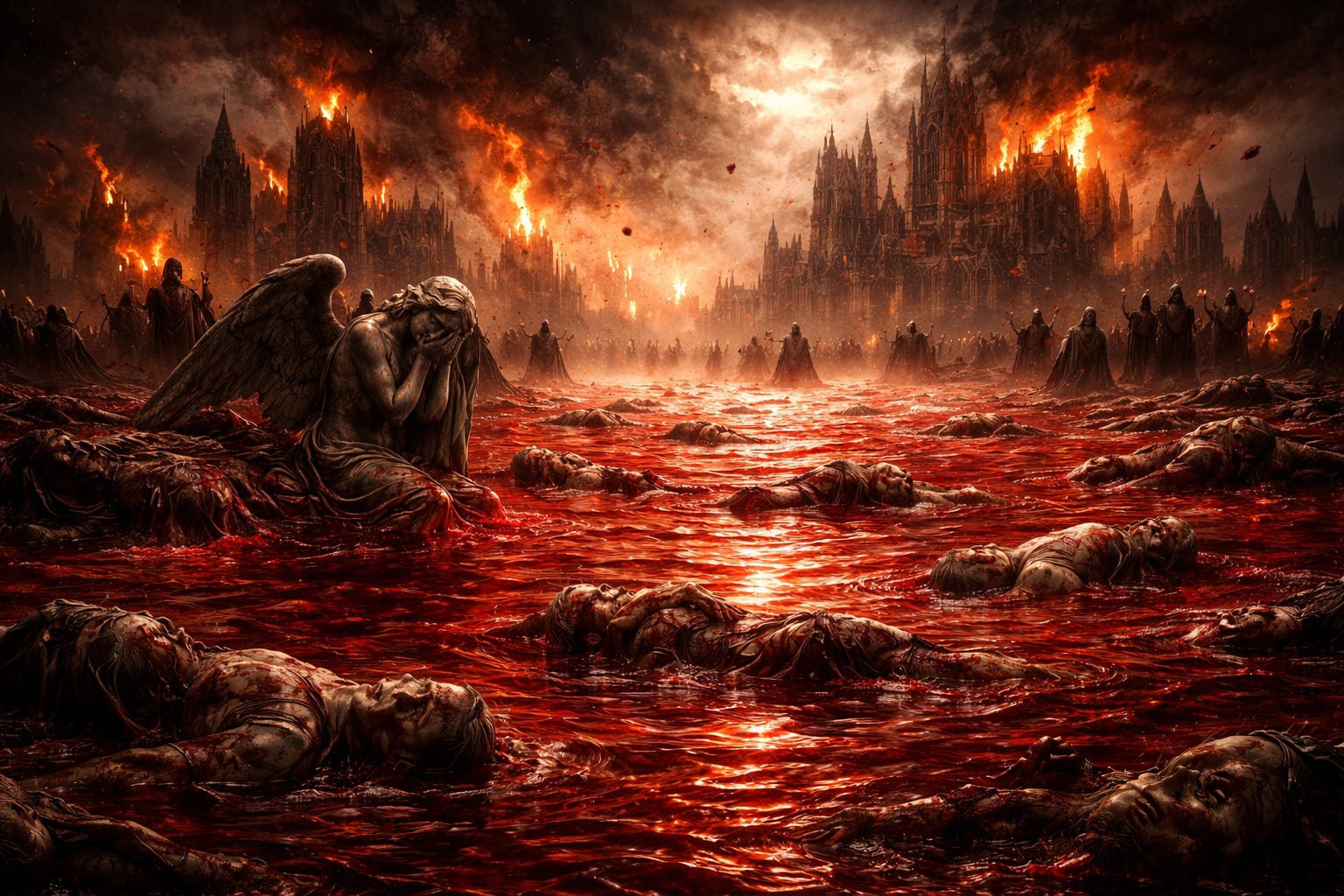
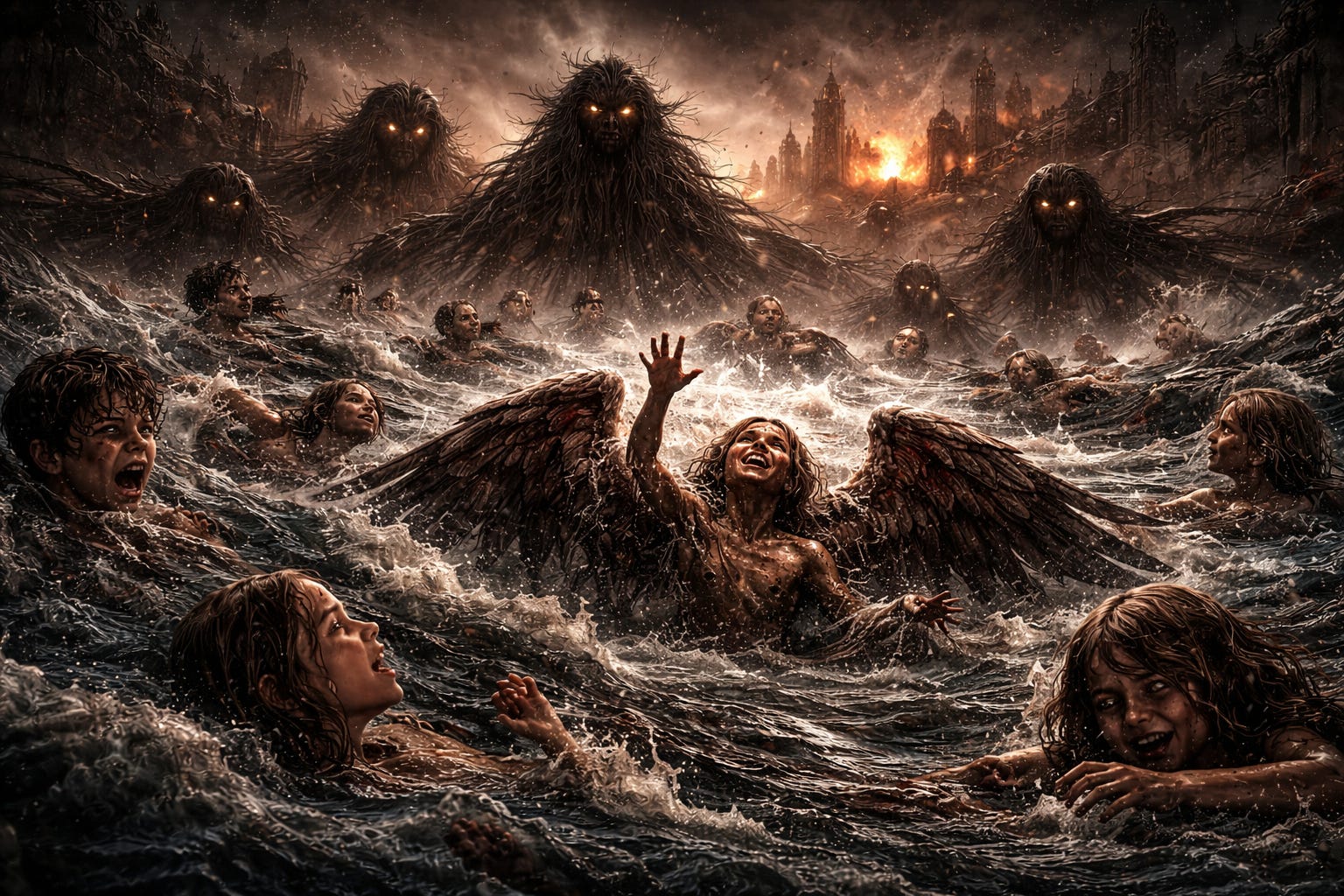
And then what follows is this period of bloodletting — how the blood-dimmed tide is loosed and everywhere the ceremony of innocence is drowned, presumably drowned in blood. What a shocking image this is.
And this line is also one that gets quoted so often and by seemingly everyone: “the best lack all conviction, while the worst are full of passionate intensity.” When I was trying to memorize this poem, I kept getting caught on this line in particular. Especially “are full of passionate intensity,” and I kept saying, “are filled with passionate intensity,” and “filled” is passive. Right? When you say something is filled, it asks the question of who made it full. Who poured the thing that made it full? And that makes it seem like there’s an external agent who has acted upon these people. And I think what’s interesting about this here — this is super close reading and always runs the risk of reading too much into things — but when you say it’s “they are full of passionate intensity,” it locates the agency within the actor itself. So these people are not being misled by some demonic force, nor are they being elevated by angels in a good force. They have done this to themselves and they have made themselves full of passionate intensity. And I think putting it at that level makes sure that the supernatural parts of this poem are a response to human choice and volition.
If humans were just being filled with passionate intensity that was helping prepare the way for this eschatology to arrive on earth, you would start having questions about determinism and whether or not it makes sense to blame these people for creating this new epoch that is arriving.
And I don’t think Yeats is trying to say that we are just passengers in our bodies in time and things happen to us. There is culpability here, and it’s at least partially the result of individual actions. Even though I think when he’s talking about these gyres — I did some amount of research on Yeats and he has some interesting thinking about the nature of time and eras and the zeitgeist and how there are these moments in time where people all seemingly lurch together in a very similar kind of way. And so it isn’t just about the individual person and their soul and how they’re making decisions. It’s almost about these collectivities, these polities, and how they are changing and reacting.
The second part of the poem has a much stronger theological Revelation feeling to it, and I think it ups the spookiness quite a lot, because the first stanza humans can do terrible things to each other without there being some supernatural overlay. The first two lines of the second stanza almost make me feel like he’s pleading for there to be some sort of supernatural answer. Please let there be something beyond just humans did this to ourselves because we are bad or foolish or both. Which is why I love this line: “Surely, surely some revelation is at hand. Surely the second coming is at hand.” That strikes me as extremely plaintive. Like, please let it be the second coming. Please let it be something else. If this isn’t the second coming, whatever is the second coming, presuming that exists, would surely be much worse than what has just occurred.
And the lines that I most like from this poem are not the “the center cannot hold,” “mere anarchy,” “passionate intensity” — those lines that people often seize upon in this poem. I actually really love several images and phrases and the rhythm of several parts of this. So this is more like textual analysis and how the poem actually operates rather than just the concepts of it.
So we also at this point of the poem switch to first person. So now the narrator is now speaking and observing and being a witness to what is happening here. So he says, “Hardly are those words out when a vast image out of Spiritus Mundi troubles my sight.” The phrase “troubles my sight,” I think is really powerful and has such economy to it because you could say something like, “and what I see disturbs me,” but it’s half the length and it’s much more powerful. It troubles my sight.
It is an unusual way to say something, but it’s also not done in a way that feels showy. There are ways of saying something like this that might be much more verbose and equally as unusual, but not as powerful. The confidence here of having such a simple phrase stand alone like this is something that I really respect.
And in fact, I wasn’t planning to tell this story, but it reminds me of this. I saw Tig Notaro do stand-up probably about a decade ago, very nearly a decade ago, if not. And right before she performed, the comic who preceded her had a set that was extremely manic. This person’s vibe was very much based upon neurosis and energy and a sort of mania as he was presenting his comedy, and it left the audience feeling very uncomfortable. You could just feel it in the room like we were not at ease with his performance. And every half second of silence felt like he was bombing, just felt like he was failing in his duties. Due to that lack of comfort, it was not easy to sit there with him and enjoy his performance.
But when Tig came out, she would hold the mic for thirty seconds or something, say one simple sentence, and have everyone rolling laughing, and then would sit for another thirty seconds or so with immense comfort in the silence, with enormous control. We all trusted her because she was so comfortable performing. Of any performance type, I think Tig Notaro might be the most skillful performer I’ve ever seen for that level of comfort and trust and control. It is amazing.
This is a phrase like that. “Troubles my sight.” It is so effective. It makes me think — it’s one of those things where I’m like, wow, how could I speak like that in a way that is creative and unusual without being showy? You know exactly what he means. It’s not like you need a dictionary to look this up. And I really respect that. And he has a number of sentences and phrases that feel this way to me too.
The object of the verb is not something that you would expect. Have you ever thought that twenty centuries of stony sleep could be vexed to nightmare by a rocking cradle? I don’t think you’ve ever thought that sleep could be vexed to nightmare. This sort of juxtaposition with nouns and verbs that unexpectedly have agency back upon the noun is so creative, and it’s such a powerful sentence because this juxtaposition is unexpected.
This might be the silliest thing I’ll say about this poem. “Somewhere in sands of the desert, a shape with lion body and the head of a man, a gaze blank and pitiless as the sun, is moving its slow thighs.” Okay, slow thighs. Also, who possibly could have put these words together? You just immediately think of this lumbering beast.
It just makes me think of the Michael Scott part from The Office, where he’s asking people about their personal religious beliefs, which, you know, not typically supposed to do, and thinking that if only they had prayed to the right entity, it could have prevented this disaster. I had to even look this up. It’s from the episode “Fun Run,” where Michael Scott says, “Maybe believing in God was a mistake. What did people believe in before the Sun? Maybe there’s some sort of animal that we could make a sacrifice to, like a giant buffalo or some sort of monster — like something with the body of a walrus with the head of a sea lion. Always makes me laugh how similar they are. Or something with the body of an egret with the head of a meerkat, or just the head of a monkey with the antlers of a reindeer with the body of a porcupine.”
I was trying to think of what the actual term is for this kind of hybridity, and it’s called a therianthrope or therianthropic morph. You can think of it like certain Egyptian gods as combinations of animals, or of humans plus animals.
I think part of the reason why this imagery here is so successful is that it’s meant to be terrifying. When I think about horror, one person that I think of is HP Lovecraft, which, you know, not everything of his has aged especially well, and I’m aware of this. But what he is very famous for is that his monsters are often the kinds of creatures that are so terrifying because they don’t make sense in the logic of our world.
It will be things like colors that we don’t have names for and shapes that are non-Euclidean and just do not map to the spatial reasoning that we have evolved to recognize. And these are the things that are terrifying in the world of Lovecraft. They’re entities that almost are intruding upon our current reality from a separate reality. And what makes them scary is not their immediate sense of danger. It’s not someone in your house at night with a weapon. Shapes and movement and combinations of animals that don’t go together. This is sort of a way of saying that you are not in control. Something greater than humans is moving here.
I was quoting the end of the doggy door sketch from I Think You Should Leave recently, where Tim Robinson says there were monsters on the world, and how scary that is, that there are monsters on the world.
And I actually have a lot of affection for the horror genre. It’s come up in a couple different shows, but I might as well reintroduce it here. Horror has been an increasingly sophisticated genre to the point I even saw something making fun of the A24 horror films, which, you know, they’re like artsy horror. It’s like horror for people who like Jean-Luc Godard. It’s like a little bit snooty, a little bit intellectual. The kinds of films where you’re like, what is actually happening here?
And one of the rules — I think I got this from Slavoj Žižek, he had said something like, one way of cultural theory’s way of grappling with a horror story is taking the monster out of it. And what is it meant to signify? So in this case, he talks about — he’s on Bodega Bay. I think it’s from The Pervert’s Guide to Cinema, I think is what this is originally from. But he is on Bodega Bay and he is talking about the film The Birds by Alfred Hitchcock and about how a classical psychoanalysis by way of Freud and talking about the ego, super-ego, and id, and how the birds are so strongly associated with the maternal super-ego of this overprotective mother figure that would come in and try to prevent the couple from coming together and being intimate and forming a new family. And this is what the symbolism of the birds is meant to convey: this sort of overprotective mother who’s not ready to let their child go.
And that’s one way of reading it. And this is true for plenty of films, especially the more sophisticated horror films. You can see this everywhere. Like for instance, if you watch Hereditary, which is, you know, top of class — it’s about grief. That film is a beautiful film. Even if you took everything out of it and it was just a family struggling with loss, it would still be a beautiful film about grief. The Babadook is a good example here where it’s about depression and mental illness. The horror films of Jordan Peele are often about race and how that is experienced and processed. So there are people who are using the motifs and the language of horror to make a sort of social point, whether that’s an internal or external force or the combination thereof.
What’s interesting about the Hitchcock example from Žižek is it’s not exactly clear to me. I should probably read up on this and see how much Hitchcock was purposefully trying to tell a story about classical psychoanalysis, their model of the mind — ego, super-ego, id — and how important that actually is to Hitchcock. Or was he tapping into some collective unconsciousness, archetypes? This sort of like a Jungian way of explaining that there’s really not that many stories and that these are patterns that repeat, and he just intuitively knew like, this is what is happening. This feels right to me at this moment when I’m writing it or directing this film, to create it in this kind of way.
Hitchcock was very famously controlling. He said something like, “The actors are cattle. They do what I tell them,” or something like that. So it wouldn’t surprise me if he actually was making a very deliberate choice here with reference to something intellectual. But I think probably what is happening is something much more intuitively driven.
And horror, when it is good, is meant to show — like one of the things that people often say about horror is that “monster’s” etymology is related to mostrar, which is the Spanish infinitive for “to show.” So monsters are often meant to show something about yourself, to communicate something. They aren’t just entities that are inherently malevolent. There’s almost a didactic purpose built into what they are trying to communicate.
Sometimes stories in folklore with regards to hauntings or ghosts — sometimes this is a spirit that needs to be exorcised and banished by some sort of spiritual professional, like a priest if you’re working within the Catholic tradition, or maybe a shaman. But in some of the stories that you will hear, people will have some sort of paranormal or supernatural experience, or this will be part of the folklore, and they will not understand why this thing is coming back to them and scaring them and visiting them. And the solution to some of these problems is, well, have you listened to what they’re trying to communicate? And like, are they looking for something? Do they need something? And then in folklore, sometimes this will be solved by, instead of running, you stand and face it and then understand what is being communicated to you. And you either learn something about yourself, and/or help them pass on to the next plane of existence. Or maybe both.
And that absolutely fits within the mostrar way of understanding what a monster is, that it’s there to show you something about yourself, but you’re also able to help them pass on. You grew as a human, and in growing as a human, you were able to help someone that you were previously unable to help.
Now we’re working our way to the conclusion of the poem. And this section here, I’m pretty sure, is my favorite part. As you might have heard from the Whitman, I think it’s really important to not just have to love the entirety of a poem or work of art. I think it’s totally okay to love certain sentences and maybe not like the whole thing. I think it’s okay to like the plot or the overall themes of a book without liking exactly how it’s written.
And this is a case where I think the sentence has such a beautiful rhythm to it. I find it really fun to say. There’s something about it that makes it really easy for me to remember. Like, some parts of this poem I find are really easy to memorize and some parts of them I will get it wrong every time that I try to recite it.
The part of this that I find so easy to repeat and to have in my brain is this line: “But now I know that twenty centuries of stony sleep were vexed to nightmare by a rocking cradle.”
I had mentioned this earlier — like, yeah, how do you vex a stony sleep, let alone vex it to nightmare? There’s still that incongruity, that mismatch of verbs that don’t typically go with those nouns. That’s really just powerful. But I also just like the rhythm of that. It has a sort of chugging through it. It almost feels locomotive to me.
And I’m already here. I might as well just read the end of it here too. “And what rough beast, its hour come round at last, slouches towards Bethlehem to be born.” Rough beast is another one of these unusual combinations that is unexpected, and one of those ones I come back to quite often. And if you ever hear “a rough beast,” you’ll now know where it comes from.
One final thought that I’ll leave everyone with here. This gets quoted also quite a bit. It’s from Antonio Gramsci. He said, “The old world is dying, and the new world struggles to be born. Now is the time of monsters.” And this fits so nicely within Yeats’s “The Second Coming.” And this poem feels this way too. The center couldn’t hold. Things fall apart. Mere anarchy is loosed upon the world. Yeah, that has happened. The new order represented by the Antichrist has not yet been born. In fact, the rough beast is only just now slouching towards Bethlehem. Should really hurry up. Because the new world is not quite born and there’s this liminal space here of between orders that’s really unsettling. And I think that’s a good part of why the world does feel so monstrous right now — because it isn’t clear what the order is that we are slouching towards right now.
How much of what is happening will roll back and we will look back on this time and say, wow, that was really weird that the world did that for a while and the US did that for a while? Or is there a new order to be born that we will have to adapt to?
This poem is too good to only read once, so I’m going to read it and then I’m going to send you on your way. So here it is one more time. “The Second Coming” by William Butler Yeats.
Turning and turning in the widening gyre, the falcon cannot hear the falconer. Things fall apart. The center cannot hold. Mere anarchy is loosed upon the world. The blood-dimmed tide is loosed, and everywhere the ceremony of innocence is drowned. The best lack all conviction, while the worst are full of passionate intensity.
Surely some revelation is at hand. Surely the second coming is at hand. The second coming. Hardly are those words out when a vast image out of Spiritus Mundi troubles my sight. Somewhere in sands of the desert, a shape with lion body and the head of a man, a gaze blank and pitiless as the sun, is moving its slow thighs, while all about it reel shadows of the indignant desert birds. The darkness drops again. But now I know that twenty centuries of stony sleep were vexed to nightmare by a rocking cradle. And what rough beast, its hour come round at last, slouches towards Bethlehem to be born.
Gives me chills. What a poem.
Spiritus Mundi is the spirit of the world. I suspect it’s another way of saying zeitgeist. I should have said that earlier, but I’ll leave you with that. Thanks for listening. This is much more than I anticipated doing, but I’m glad we got to talk about this poem. I’m glad we got to locate it within the horror genre, and I hope it gave you something to think about.
Thanks for listening.