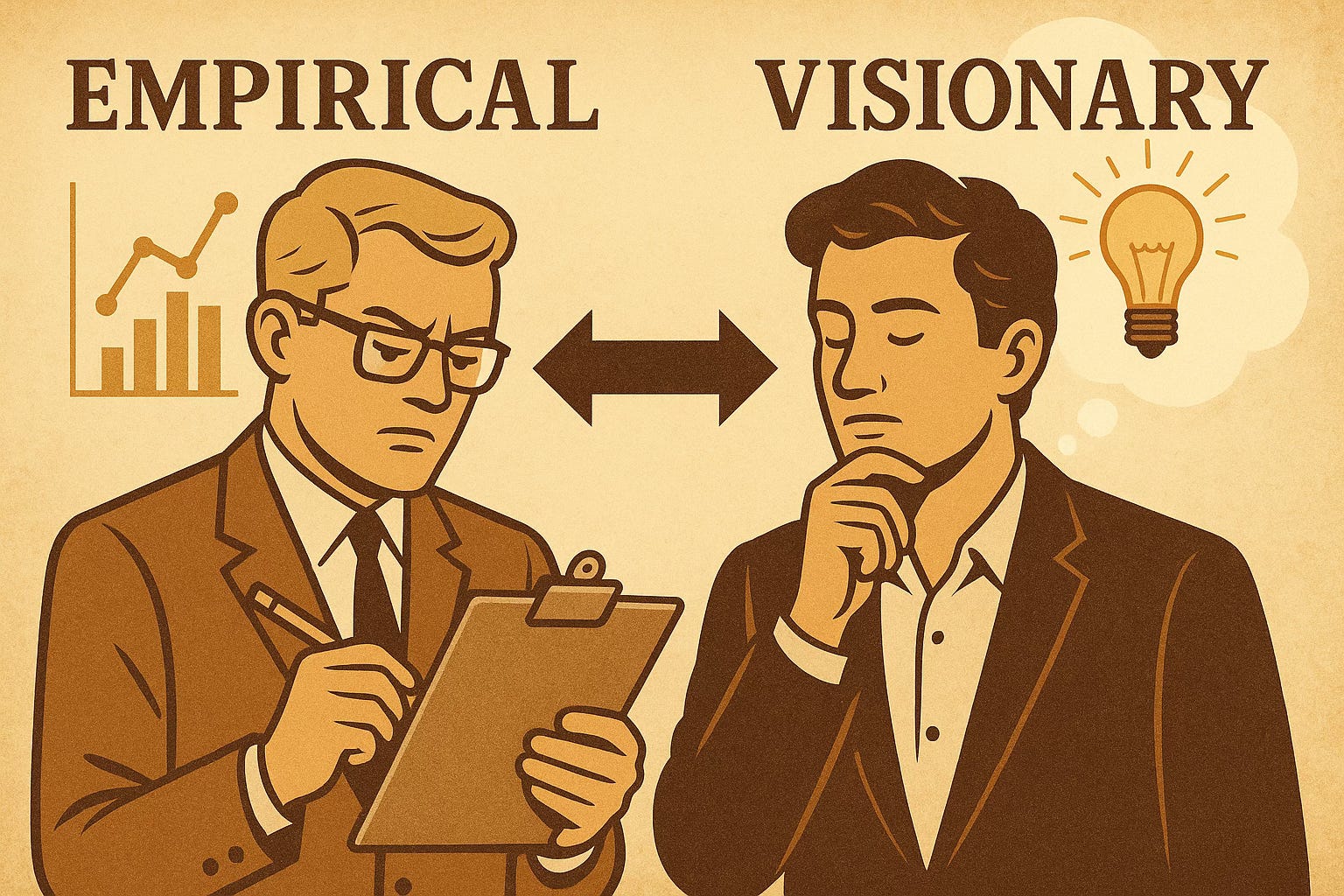
The Keynesian Beauty Contest: A Climate Tech Entrepreneur's Guide to Product-Market Fit
Why being right isn't enough—and how to find the sweet spot between innovation and market readiness
This is an essayistic summary of an episode of the Reversing Climate Change podcast. You can listen to it here on Spotify, Apple Podcasts, or wherever you get your listens in.
There's a scene in Back to the Future where Marty McFly plays "Johnny B. Goode" at a 1955 high school dance. He starts with Chuck Berry's original arrangement, and the crowd loves it. Then he launches into a Van Halen-style guitar solo—wailing, distorted, completely ahead of its time. The teenagers stare in stunned silence. "I guess you guys aren't ready for that yet," Marty says. "But your kids are gonna love it."
That's product-market fit in a nutshell: the difference between being perfectly timed and being perfectly wrong, even when you're technically right.
The Beauty Contest Paradox
John Maynard Keynes, one of the most influential economists of the 20th century, posed a thought experiment that has shaped how I think about business strategy ever since. Imagine a beauty contest where judges aren't rewarded for choosing who they think is most beautiful, but for choosing who they think others will perceive as most beautiful.
This recursive layering—what do other people think other people think?—captures something profound about how markets actually work. It's not just about fundamentals. It's about perception, timing, and the collective psychology of market participants.
Warren Buffett and Charlie Munger built fortunes on fundamental analysis, betting on undervalued companies with strong business models. But as the famous investing adage goes: "The market can remain irrational longer than you can remain solvent." Even with perfect fundamentals, if others don't see what you see, you can still lose everything.
Consider Tesla. (At the time of recording and probably no longer…) By traditional automotive metrics, it shouldn't be the world's most valuable car company. Yet bearish investors who bet against it based on "rational" analysis have been crushed repeatedly. Sentiment matters—sometimes more than spreadsheets.
The Nori Case Study: Too Far Ahead
At my former company, Nori, we took very idiosyncratic positions on carbon removal. We believed the world needed to move massive amounts of mass—ridiculous amounts—and that only commodity markets could handle that scale. Think pork bellies, Brent crude, the kind of markets that move billions of tons annually.
We worked backwards from that vision, trying to build a commodity market for carbon removal. Seven years later, the world still isn't ready. We don't have enough volume to justify commodity market infrastructure or the market depth to support it. We were building for a future that hadn't arrived yet.
My job as strategist was always to figure out: If we're right about this, will we be able to get people to agree with us? Or will we isolate ourselves diplomatically and commercially by pursuing this way of thinking?
You can be right about an issue and still be alone. You can win an argument and have no friends, no customers, no business. It doesn't matter spiritually that you stuck to your guns if what you care about is business success.
The Innovation Dilemma
Here's the paradox every entrepreneur faces: If you do exactly what everyone else does, you end up with the same valuation, the same customers, the same commoditized position. But if you innovate too far ahead of the market, you risk building something nobody wants—yet.
I see this constantly in carbon removal. Companies with bespoke methodologies, doing things radically differently, often struggle more than those building straightforward biochar or direct air capture solutions. The straightforward companies have safety in numbers—policy support, trade associations, clear pathways to market.
But the maverick companies? They're either holding a golden ticket to the chocolate factory or they're dying alone. There's not much middle ground.
The Sweet Spot: Unexpected Yet Inevitable
Aristotle wrote in Poetics that a good ending should be both unexpected and inevitable. The best stories make perfect sense in hindsight—there could be no other logical outcome—yet they keep you on the edge of your seat throughout.
This captures the sweet spot for innovation. You want to build something that feels like an obvious next step in development once it exists, but that nobody saw coming. The gap between where we are and where you're going should be just big enough to create venture-scale returns, but not so big that there's no stepping stone to reach it.
If the gap is too small, you get incremental improvement and commodity pricing. If it's too large, you get the Marty McFly problem—you're playing Van Halen to an audience that's never heard distorted guitars.
Reading the Room
The Keynesian beauty contest framework forces you to think strategically about market readiness. It's not enough to ask: "Is this the most beautiful solution?" You have to ask: "Will others recognize this as beautiful?"
This doesn't mean abandoning your vision or building only incremental improvements. It means understanding where the market is and building bridges to where you think it should go. Sometimes that means doing something less revolutionary in the short term to establish credibility and resources for the longer-term moonshot.
At Nori, we might have been better served building a more conventional carbon marketplace first, proving the model worked, then gradually introducing commodity market features as volume scaled. Instead, we tried to build the entire future infrastructure on day one.
The Entrepreneur's Paradox
Here's the thing about being an entrepreneur: You wouldn't start a company if you agreed with everyone about everything. Why not just join an established company at that point? You're starting a company precisely to do things differently.
But you have to be very careful about how many contrarian bets you stack on top of each other. Each one adds risk. Each one increases the chance you'll be right about everything but still fail because the market isn't ready.
The key is identifying what everyone is wrong about that you might have an answer to, then building the minimum viable path to prove it. You want to be just far enough ahead to be new and novel, but not so far ahead that you're impossible to understand or adopt.
Serving Customers vs. Serving Vision
People often complain about the injustice of marketplace whims—customers valuing one approach over another for seemingly shortsighted or inscrutable reasons. But focusing too hard on customers' failure to "get you" is an unhelpful way to conduct business.
The job of the strategist is to know when you're out too far ahead of your skis. Even if you have a great product, if you're too far ahead of what the world is ready for, it doesn't matter. The distinction between being right and being wrong becomes less important than you might think.
As long as you're not producing unethical results, serving customers what they want while working on incremental stepping stones toward your vision is often the winning strategy. You can be building toward a world you think is correct while still operating in the world that actually exists.
The Long Game
This doesn't mean abandoning ambitious climate goals or revolutionary technologies. It means being smart about sequencing and timing. The commodity market for carbon removal that Nori envisioned might be exactly what the world needs in five or ten years, though it will almost certainly exist within a compliance framework by then. But trying to build it in 2017 was premature.
The most successful entrepreneurs often succeed not because they had the best technology, but because they had the best timing. They found the moment when the market was ready to recognize their solution as not just good, but obviously good.
Playing the Contest
The Keynesian beauty contest isn't just about predicting what others will think—it's about understanding that markets are fundamentally social phenomena. They're about collective belief, shared narratives, and the gradual evolution of what seems possible and desirable.
Your job as an entrepreneur isn't to judge the beauty contest objectively. It's to participate in it strategically, building solutions that can win both today's contest and tomorrow's, creating stepping stones between where we are and where we need to go.
The future belongs to those who can read the room while still pushing it forward—who can be unexpected yet inevitable, revolutionary yet adoptable, visionary yet practical.
In climate tech, where the stakes are existential and the timeline is compressed, this balance becomes even more critical. We need breakthrough innovations, but we also need them to actually break through.