


This is a summary of episode #381 of the Reversing Climate Change podcast, hosted by Ross Kenyon. You can listen on Apple Podcasts, Spotify, or wherever you enjoy your podcasts.
🔹 Quick Takeaways
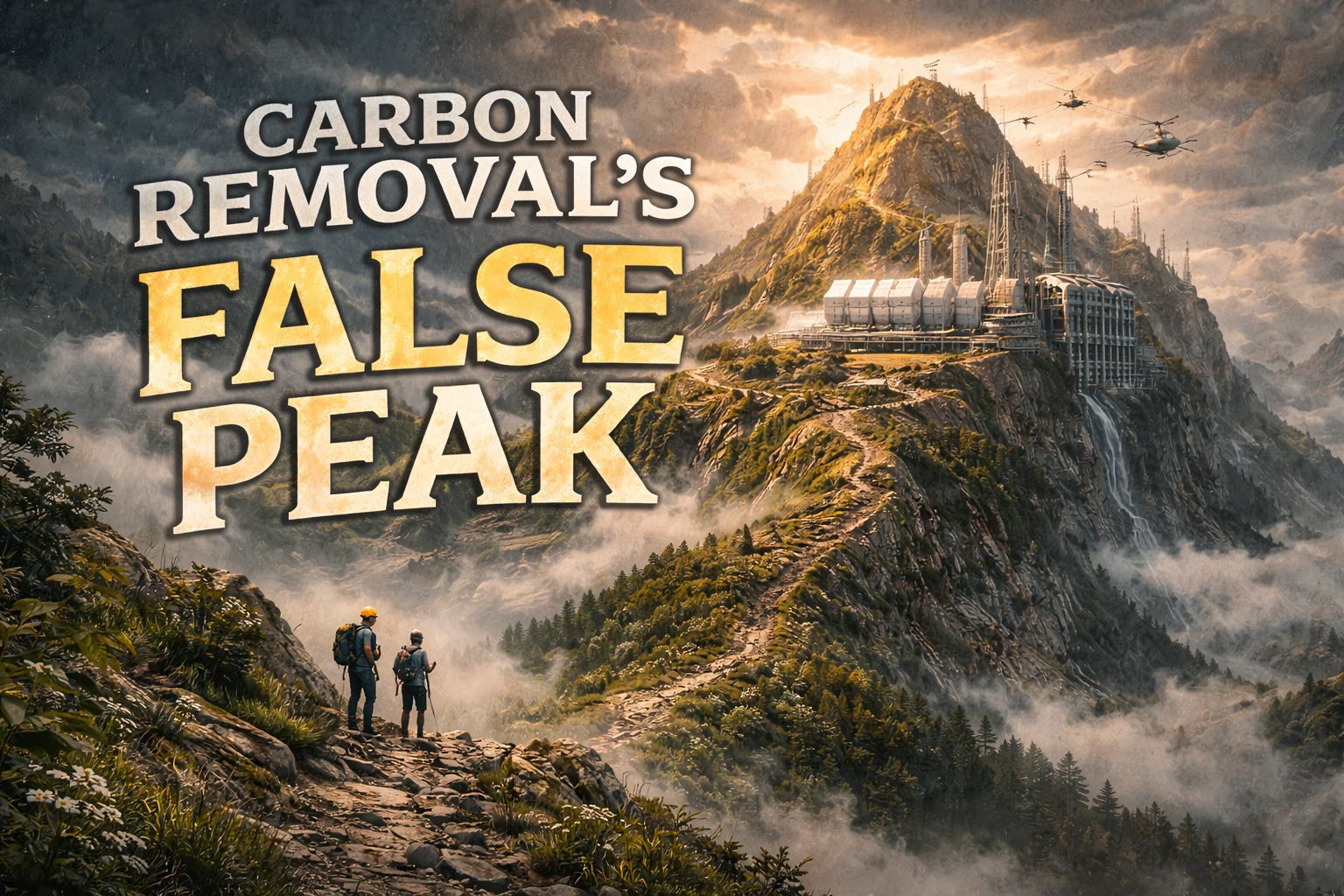
Carbon removal is past its “false peak”—early momentum made the climb look easier than it is. The real mountain is only now visible. Or is it? Are there just sequential stacks of false peaks?!
Policy progress is real but mistimed. Governments are moving, but not fast enough to meet startups’ near-term survival needs.
The central bottleneck is demand, not supply— plenty of capital, talent, and technology exists if someone credible will buy the output.
Voluntary markets were a miracle, not a solution— they proved concept, but will never scale the industry alone.
Carbon removal is a public good: without government signaling or obligation, the market won’t clear.
Advance market commitments (AMCs) are the missing bridge, not necessarily one big pool, but clear, bankable signals that demand will exist.
“Staying alive” is the wrong goal. Building a real commercial-scale project is what separates survivors from hope-casters.
AI demand is coincidence, not destiny. Tech companies buying removal isn’t structural, just fortunate alignment.
Protectionism is real and unavoidable—countries want projects, jobs, and ownership at home, even if it’s more expensive.
Carbon removal won’t scale on climate math alone — it must align with jobs, affordability, energy, and economic development.
📝 After the False Peak
Early carbon removal optimism assumed a familiar arc: innovation → voluntary demand → scale → policy reinforcement. What Deich describes instead is something messier. The field didn’t stall because the tech failed or the science was wrong. It stalled because there is no natural customer for negative emissions.
Carbon removal works precisely because its benefits are diffuse, global, and long-term. Which also means no individual actor has a strong incentive to pay for it at scale. The voluntary market was never a solution—it was a proof-of-life. A strange, improbable one. The fact that companies paid hundreds of dollars per ton at all still borders on the miraculous.
But miracles don’t build industries.
Deich is clear: if carbon removal is going to exist at industrial scale, governments must signal demand before it exists, not after. That signal doesn’t have to be a single global fund. It can take many forms: tax credits, ETS integration, contracts for difference, guarantees, etc. What matters is credibility. Builders need to know that if they construct something expensive, slow, and politically exposed, someone will be there to buy it.
🏗️ Projects, Not Hope
A recurring theme in the conversation is impatience with what Deich sees as the wrong survival instinct. The frame of “just stay alive until policy shows up” is comforting… and dangerous. It produces slide decks instead of steel; pilots instead of plants.
The companies that matter, he argues, will be the ones that build first: commercial-scale projects that generate data, reveal costs, and establish learning curves. Those projects don’t just remove carbon. They make the future legible. They allow investors, policymakers, and buyers to point to something concrete and say: this works.
Without that, everything else is narrative.
This is where protectionism enters the picture. Countries want carbon removal to do multiple jobs at once: climate mitigation, economic development, industrial strategy, political optics. That means free trade purity is unlikely. Carbon removal may specialize geographically—innovation in one place, deployment in another—but national interests will shape where money flows and who benefits.
🕯️ Why This Is Still Worth Doing
Deich doesn’t pretend this is easy, fast, or elegant. He treats carbon removal as what it is: a hard public-goods problem unfolding in a fragmented, protectionist, impatient world.
And yet, he remains cautiously optimistic. Not because the market is working, but because people keep showing up anyway. Builders keep building. Policymakers keep experimenting. The field keeps inching forward, one project at a time.
Carbon removal may never be glamorous. It may never have a clean product-market fit. But if society decides it wants to reverse climate change then this is the work.
This episode's sponsors
Philip Lee LLP: legal resources for carbon removal buyers and suppliers
Listen to the RCC episode with Ryan Covington from Philip Lee LLP
Resources
"17: Noah Deich and Giana Amador of the Center for Carbon Removal"
More from the show
Ad-free episodes and other benefits come with a paid subscription.
Carbon Removal Newsroom, the news show that ran alongside this one, is over. Its episodes are still up, on the feed Climate Workers Anonymous now uses.
Carbon Removal Memes is still going.
The books that come up on this show are collected on my Bookshop shelf.
🎧 Apple Podcasts · Spotify · YouTube
Paid subscribers get this episode ad-free. The ads in the free feed are inserted by Spotify when you press play. They are not in the file I make.