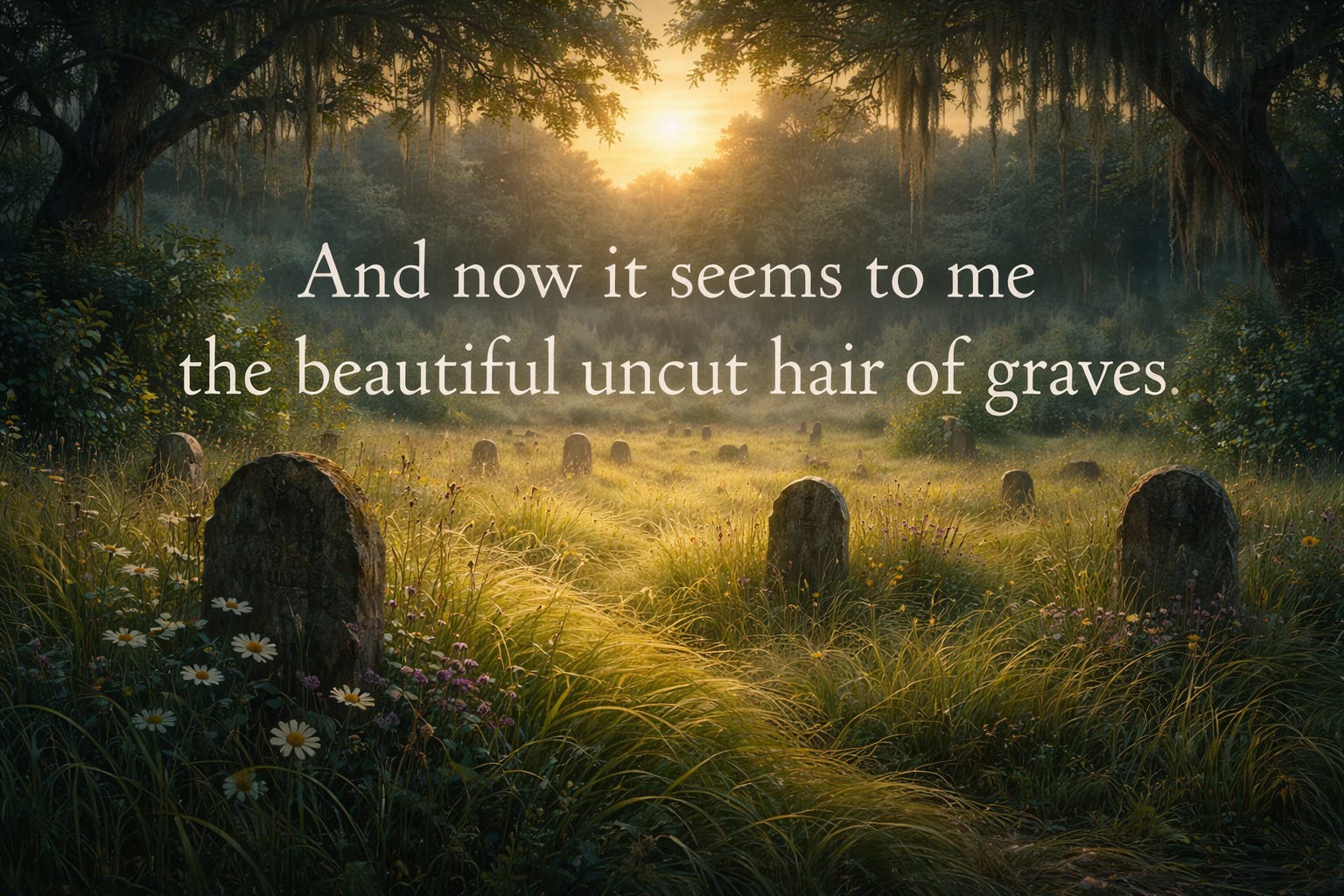
The Beautiful Uncut Hair of Graves
Walt Whitman on the equality of death, and how to approach a big question kaleidoscopically.
This is a summary of a bonus episode of the Reversing Climate Change podcast. You can listen to it on Apple Podcasts, Spotify, YouTube, or right below this paragraph where the full episode is embedded as a video.
🔹 Quick Takeaways
Whitman’s grass is not a symbol with one meaning. It is a cascade of meanings.
The poem resists certainty and embraces interpretive plurality.
Grass becomes a political statement: it grows among all races and classes alike.
Grass becomes theological: perhaps a “handkerchief of the Lord.”
Grass becomes mortal: the “beautiful uncut hair of graves.”
Death is presented not as annihilation, but as transformation.
Equality in death unsettles hierarchies of wealth and status.
The poem moves from metaphor to metaphysics—from hint to declaration, and is this good for poetry or does it violate “show, don’t tell”?
Whitman shows that we do not have to love every line equally to be moved.
Circularity—decay into growth—undergirds both ecology and hope.
The smallest sprout becomes an argument against despair.
Beauty itself can interrupt the seriousness of modern life.
Song of Myself, 6 (the poem itself)
by Walt Whitman, from Leaves of Grass
A child said What is the grass? fetching it to me with full hands;
How could I answer the child? I do not know what it is any more than he.
I guess it must be the flag of my disposition, out of hopeful green stuff woven.
Or I guess it is the handkerchief of the Lord,
A scented gift and remembrancer designedly dropt,
Bearing the owner’s name someway in the corners, that we may see and remark, and say Whose?
Or I guess the grass is itself a child, the produced babe of the vegetation.
Or I guess it is a uniform hieroglyphic,
And it means, Sprouting alike in broad zones and narrow zones,
Growing among black folks as among white,
Kanuck, Tuckahoe, Congressman, Cuff, I give them the same, I receive them the same.
And now it seems to me the beautiful uncut hair of graves.
Tenderly will I use you curling grass,
It may be you transpire from the breasts of young men,
It may be you are from old people, or from offspring taken,
It may be if I had known them I would have loved them, soon out of their mothers’ laps,
And here you are the mothers’ laps.
This grass is very dark to be from the white heads of old mothers,
Darker than the colorless beards of old men,
Dark to come from under the faint red roofs of mouths.
O I perceive after all so many uttering tongues,
And I perceive they do not come from the roofs of mouths for nothing.
I wish I could translate the hints about the dead young men and women,
And the hints about old men and mothers, and the offspring taken soon out of their laps.
What do you think has become of the young and old men?
And what do you think has become of the women and children?
They are alive and well somewhere,
The smallest sprout shows there is really no death,
And if ever there was it led forward life, and does not wait at the end to arrest it,
And ceas’d the moment life appear’d.
All goes onward and outward, nothing collapses,
And to die is different from what any one supposed, and luckier.
📝 The Grass That Undoes Us
In this episode, the work pauses. No markets, no carbon accounting, no civilizational diagnosis. Just a poem.
The sixth section of Walt Whitman’s Song of Myself begins with a child asking a simple question: What is the grass? The brilliance of Whitman’s response is that he (mostly) refuses to answer it definitively. Instead, he offers a cascade of possibilities. Perhaps it is “the flag of my disposition.” Perhaps it is a divine handkerchief, deliberately dropped as a coy clue. Perhaps it is a political hieroglyph that needs deciphering, sprouting alike among every race and class. Perhaps it is merely a child of vegetation itself.
Whitman does not collapse these meanings into one. He lets them coexist.
That openness is part of the lesson. The grass does not demand a single interpretation any more than life does.
🌱 The Beautiful Uncut Hair of Graves
Then the metaphor deepens.
Grass becomes “the beautiful uncut hair of graves.”
It is hard to overstate the force of that image. The dead are not erased; they are transformed. The white hair of old mothers, the colorless beards of old men, the faint red roofs of mouths—all become dark green vitality pushing upward. Death feeds life. The grave grows hair. How can it be both grass and hair?!
Whitman lingers here not in morbidity but in wonder. He wishes he could “translate the hints” about the dead young men and women. The grass seems to whisper that they are not gone in the way we fear. The smallest sprout becomes evidence that nothing truly is obliterated. All goes onward and outward.
Whether or not one shares Whitman’s metaphysical confidence, the emotional gesture is powerful: death is not a wall but a passage.
⚖️ Equality, Mortality, and Perspective
There is also something radically egalitarian in this vision.
The grass grows alike among Black and white, rich and poor. It sprouts over children taken too soon and elders who lived long lives. It covers the graves of congressmen and laborers without distinction.
Death is the great equalizer.
And that realization has consequences. If mortality is universal, then what do we do with our time? Do we cling more tightly to status and accumulation? Or does the knowledge of finitude soften us toward ourselves and toward others?
Whitman does not preach this conclusion, but he gestures toward it. The poem oscillates between playful metaphor and profound metaphysics, but beneath it lies a quiet invitation: remember that you will die, and let that remembrance humanize you.
🌿 Why Poetry Belongs Here
In a world saturated with crisis and optimization, there is something quietly radical about stopping to read a poem aloud.
Whitman reminds us that meaning does not always arrive in arguments. Sometimes it arrives in a phrase—six words that rearrange your interior world. “The beautiful uncut hair of graves” can do work that policy cannot.
“The smallest sprout shows there is really no death,” he writes.
Whether we take that as literal truth or luminous metaphor, the effect is the same: the world is more continuous, more interconnected, and more alive than our fear allows.
Sometimes, amid all the seriousness, we need to look at the grass.
And wonder.