
In other words: The case for bringing your whole weird self to the most serious problem in the world.
Episode 396 of the Reversing Climate Change podcast. You can listen to the full episode on Apple Podcasts, Spotify, YouTube, or wherever you get your podcasts.
As I said in the intro to this episode: this isn’t the show where you’re going to get super quick tech takeaways within 30 minutes that you can drop at your next meeting. It’s something else. You’ll spend this time with us laughing about the absurdity of having a career in climate communications, about life and how we live it, why we make art, and why we even bother doing this climate work when it isn’t always the glamorous, high-paying kind. A good chunk of the reason The Carbon Removal Show is so fun is because Emily is so fun—she cracks me up constantly—and this episode is basically an extended version of Emily’s Language Chat. My sincere thanks to the team at The Carbon Removal Show for loaning me the jingle.
This is the kind of episode you put on and laugh along with us. This isn't the one where you'll get super quick tech takeaways within 30 minutes that you can drop at your next meeting. It's something else entirely.
Emily Swaddle, co-host of The Carbon Removal Show and one of the funniest people in carbon removal, joins Ross for a wide-ranging conversation about life, art, language, climate communications, and the absurdity of having a career in all of the above. A good chunk of the reason The Carbon Removal Show is so fun is because Emily is so fun, and this episode is basically an extended version of her (in)famous segment on TCRS, "Emily's Language Chat".
Emily Swaddle is a storyteller, communicator, and co-host of The Carbon Removal Show alongside Ben Weaver-Hincks and Tom Previte. She's been making the show since 2020, producing deeply researched, highly produced seasons that have become a go-to educational resource for the carbon removal community. Emily brings a unique perspective shaped by her background in the arts, her love of language, and her instinct that the climate conversation needs more humanity, more humor, and far less jargon.
Listen in to hear more about why Emily thinks silliness and vulnerability are underrated tools in climate communication, and why we even bother doing this climate work when it isn't the glamorous, high-paying energy executive type work.
You'll also hear about the Carbon Removal Show Coalition funding model, the tension between monetizing the natural world and actually caring about it, how British class dynamics show up in language and accent, why being a generalist in a specialist world is both a gift and a curse, and what happens when two podcast hosts stop talking about carbon removal policy and start talking about Disney villain queer coding, Mary Poppins, and whether "rabbit tube" should be a phrase.
Special thanks to the team at The Carbon Removal Show for loaning us the perfection that is the "Emily's Language Chat" reggae jingle.
"Whereof one cannot speak, thereof one must be silent."
- Ludwig Wittgenstein
Resources
The Carbon Removal Show podcast
The Carbon Removal Show Coalition
Why Would You Say Something So Controversial Yet So Brave?
Unruly: The Ridiculous History of England's Kings and Queens by David Mitchell
What Makes Disney Villains so Gay?
Money can be exchanged for goods and services from The Simpsons
"The Darmine Doggy Door" from I Think You Should Leave
Range: Why Generalists Triumph in a Specialized World by David Epstein
More from the show
Ad-free episodes and other benefits come with a paid subscription.
Carbon Removal Newsroom, the news show that ran alongside this one, is over. Its episodes are still up, on the feed Climate Workers Anonymous now uses.
Carbon Removal Memes is still goofing around.
The books that come up on this show are collected on my Bookshop shelf.
🎧 Apple Podcasts · Spotify · YouTube
Paid subscribers get this episode ad-free. The ads in the free feed are inserted by Spotify when you press play. They are not in the file I make.
Full Transcript
Ross Kenyon: Hey, thank you so much for listening to Reversing Climate Change. This is Ross Kenyon and I’m the host of this show. I’m just a long-time climate tech and carbon removal guy, I guess you could say.
Before I tell you about today’s guest, if I could please ask you to open up your podcast app and give this show a full rating. Five stars on Apple Podcasts or on Spotify. If you do use Apple Podcasts, a review that you could write is super impactful. If you love this show, it’s one of the most important things you could do, and if you’d be willing to do it, I would be very grateful to you. There’s also an option to become a paid subscriber on Spotify. $5 a month gets rid of all the ads I don’t read myself, and there’s bonus content.
One cool new thing I’ve been doing too is that there are Substack articles that have full transcripts of all the shows that have been published recently, which sum up the episode, have some clear takeaways, the podcast thumbnails, all those things. If you want to see those, you can subscribe to me and/or the show on Substack, the link to which is in the show notes.
And now I’ll tell you about the guest who you probably know if you’ve listened to The Carbon Removal Show — Emily Swaddle, who’s one of the co-hosts there. It’s a great show. Ben Weaver-Hinks and Tom Previte and Emily put that show together and it’s wonderful. I think it’s one of the best pieces of content within climate media. I think it’s really fun and approachable.
And I love all of them, but I’m gonna celebrate Emily here for a second. I think a good chunk of the reason why that show is so fun is because Emily is so fun. She cracks me up. This is the kind of show where it’s about kind of everything. It’s about life and how we live it, and why we make art. Why we even bother doing this climate work, and why do we do it even when it isn’t the glamorous, high-paying energy executive type work, but even when it’s something else — why persist in this thing that we do?
This is the kind of show I think you can put on and laugh along with us, and this maybe isn’t the show that you’re gonna listen to and hope for super quick tech takeaways within 30 minutes that you can go and say at your next meeting and have that latest little nugget of intel. It’s something else. You basically will have spent this time with us laughing about the absurdity of all things — about having a career in climate communications, media, humor. And what exactly that’s like, and what kinds of questions does having that approach allow one to ask?
I’m really grateful Emily and I got a chance to chat. She cracks me up constantly. And thank you so much to the team at The Carbon Removal Show for letting me borrow Emily’s Language Chat, which is — every time this song is played, whenever Emily wants to talk about language — which this show is just basically an extended version of Emily’s Language Chat. It cracks me up. And then learning the origin story of this song is also just so beautiful. So thank you to the team for loaning that to me. My sincere thanks. And here is the show with Emily.
….
Ross Kenyon: Well, it’s unlikely that you’ll be any less prepared though.
Emily Swaddle: That’s true. Actually, I do have a question. I think we’ve already started, but I do have a question.
Ross Kenyon: Okay. What is it?
Emily Swaddle: I don’t know what your editing process is. Not that you have to tell me the ins and outs of it, but do you want me to be slick?
Ross Kenyon: Do I want you to be slick? Like sound wise and knowledgeable and clever.
Emily Swaddle: Yeah.
Ross Kenyon: Or —
Emily Swaddle: Eloquent and coherent and all those things.
Ross Kenyon: Yeah. I mean, some of those things I can fix in post and some things I cannot. Can’t make you like a sage if you are a dullard. And one cannot transform character.
Emily Swaddle: I’ve been asking Ben to do that for years and he’s just like, you’ve gotta give me something to work with, Emily.
Ross Kenyon: I know. Yeah. There’s a limitation here to what you can do. I imagine you could probably just chop up someone’s words to make them say very intelligent things if you have enough of their dialogue recorded. But no, I’m not gonna be doing that. The show tends to be pretty naturalistic and say what you said. So we’re in. So now the pressure’s really on. Can’t save you from yourself, Emily. No one can. Can you save yourself from yourself? Are you able to do that?
Emily Swaddle: It’s not a skill I have yet mastered.
Ross Kenyon: What’s going on with you? I think people are very familiar with your voice. You are such a funny, cool climate communicator, carbon removal basically legend at this point. You’ve been doing it for — how long has The Carbon Removal Show been going? It’s five years, four years.
Emily Swaddle: Yeah, so we actually started the beginnings of it all at the end of 2020. So that was like five and a bit years ago. And then we didn’t release our first season until 2021. We did quite a lot of prep and research and stuff because we didn’t know anything at the beginning. We had to do a lot of prep and research. We still don’t know all that much, so we continue to do a lot of prep and research. But yeah, 2020 was when we first kind of came together as a team.
Ross Kenyon: Wow.
Emily Swaddle: Big year.
Ross Kenyon: Big year. You guys didn’t know that I was already podcasting. You didn’t actually need to do it.
Emily Swaddle: That was literally the first question that came up. It was like, why are we doing this if there’s already this guy doing it? Maybe we should just tag out.
Ross Kenyon: People have asked me that before too, and I’m always just like, there’s a million different takes and stories and I never get to the bottom of any of them and you’re gonna do something different and we need as much of this good stuff as we can possibly get. So yes, let your Emily freak flag fly. And I’m not doing that. I’m not doing the Emily thing. I don’t have Emily’s language chats, basically, is what it really comes down to. All right. We had a detour into that because it came up already, mostly because I was desperately trying to shoehorn that in wherever it would fit. That’s one of my favorite gags of the entire podcast. How did that come about and how did you commission this song?
Emily Swaddle: So the song was a birthday present from Ben to me because our first episode of this current season came out on my birthday and Ben was like editing it and he was just like, you have to listen for your birthday present — it’s in the episode. And at first I was like listening to it, thinking every single little edit was a birthday present. I was like, oh my gosh, is that — no, that’s not it. Wait, is it? No, that’s not it. And then it got to “It’s Emily’s Language Chat.” I was just like, yes, I have a jingle.
So that was really nice. I think it just came about because I am obsessed with language. I can’t really have an in-depth conversation about anything without being like, isn’t it weird that we say that? Why do we use that term? Where does it even come from? And I was just doing that anyway in our conversation, so I was like, we should just include this. And it’s always been that. I think it probably was in the first episode, I don’t really remember, but probably was.
Ross Kenyon: Wow. That’s a fun story. I really like that. And obviously I like language quite a bit. I’m a wordplay enthusiast. I make annoying pedantic observations about how language is used on a regular basis. I like studying language. It’s a thing that I do. I had a philosophy of language professor once, though, who took it to the next level where you could not use an idiom around that guy or he would take it at face value. He’d be like, really? Why would you want to kill two birds with one stone? He would just do it perfectly deadpan for everything. I need to just speak in plain language. We’re going to go Wittgenstein here. Okay, fine. We’ll do that. I’m just not gonna use any idioms around you. Fine. It can be pedantic, but it’s also fun. I like your little language chat.
Emily Swaddle: Thank you. I wonder what it would be like to play with the other end of that spectrum where you just spent a whole day only speaking in idioms and metaphors. That was the kind of thing that I would do and everyone around me would be like, she’s not gonna keep this up all day. And then I actually would and they would want to kill me.
Ross Kenyon: Oh no. They’d want to shuffle you off the mortal coil.
Emily Swaddle: Yeah, exactly. They’d want to come in with one of the stones that they were using to kill the birds.
Ross Kenyon: That’s right. Yeah. I love idioms. And I especially like the King James Bible and Shakespeare. It’s funny if you just read Hamlet and the King James Gospels, you’re like, oh, this is basically every idiom that exists and is still in common use. How many of them just come from the “to be or not to be” soliloquy?
Emily Swaddle: Yeah, it’s mad. I did quite a lot of Macbeth a few years ago — I was in two productions of Macbeth back to back and it was way too much Macbeth. Nobody needs that much Macbeth in their life. And at first I went into it just being like, I’m kind of here for the theater, I don’t know if I’m that into Shakespeare or whatever. And it didn’t take very long before I was like, you know, he’s pretty good at this. This writing’s pretty good. I appreciate this.
Ross Kenyon: Hot take. Shakespeare is good. Did you read David Mitchell’s book on royalty? What is it called — Unruly? You didn’t read that?
Emily Swaddle: No, I didn’t.
Ross Kenyon: Okay. So he covers the origins of British monarchy — I think it starts with Celtic mythology, Romano-British, King Arthur and Anglo-Saxon stuff later with Beowulf. And then all the way up to basically Shakespeare and he ends it by just having a chapter about how someone had to be the best in human history at art. And it just so happens he was born in Stratford-upon-Avon. And it’s Shakespeare. We have him. That’s where the story is going to end for royalty. I do like that bold claim. But sure. Shakespeare is good. Thanks for the hot take, Emily. So controversial.
Emily Swaddle: You’re welcome. So controversial and yet so brave. Because what I’m really bringing to the podcast world is my bravery, my courage.
Ross Kenyon: I think that’s actually — we’re saying it in a joking way, but I think you are bringing something very unique and specific to climate communications work and carbon removal. I don’t think there’s anyone else like you. And people can say that in a backhanded or a four-handed kind of way. It gets to me sometimes too, and I’m just like, I’ll take it. Thank you. Is this praise? It’s not kind of clear. But in this case it’s praise from me to you. I like the way you show up in this space.
Emily Swaddle: Thank you. How do you think I show up? Like I sometimes think I barely show up. I’m not fishing for compliments, but it would be interesting to know how you think I show up.
Ross Kenyon: So, we’ve talked about this some previously, and we don’t have to go there if you don’t want to, but there is a sense of imposter syndrome or “what is one doing” or “by what right do I have to be speaking in public about carbon removal.” And even I have some of those feelings sometimes, where I’m like, does the world really need this much of me running my mouth out there in it? And I think if you don’t have a little bit of that, the people who think the world desperately needs their commentary — I think those are the most dangerous kinds of all. So if you’re gonna lean one way or the other, I like the direction you’re going with it. But you are funny. I can tell when I’m listening to you that I’m actually accessing who you are as a person, where I think for many people there’s a little bit more of a performative nature to this work. Or it feels a little bit more guarded. I feel like I, before we became friends, I knew you just from listening to you, and that’s not true of a lot of people. Sometimes you listen to a podcast and you’re like, no idea what this person’s actually like. Are they kind to animals? I don’t know. I listen to you though. I’m like, Emily’s probably kind to animals.
Emily Swaddle: I love animals, to be fair. Yeah, I could just be a really good performer. And you’ve been drawn into my masquerade.
Ross Kenyon: Yeah. Are you like this secret evil villain? You’re horribly manipulative?
Emily Swaddle: Imagine if I was, but I was using my power for carbon removal. That’s such a specific niche for an evil villain to go down that road. Feels unlikely.
Ross Kenyon: That’s true. I mean, there are people that I meet in professional spaces that scare me, and that doesn’t necessarily mean that they’re bad people, but they are people that I know are — what’s the way to put it? Being a wise and compassionate person is different from the kinds of skills that might make you successful in business. And sometimes they overlap and there are people who are very compassionate people who ended up very wealthy and successful. But the skills are not one-to-one. You do not have to be wise to be successful at business. And in fact, many of the people who are, I’m like, how did you get here? You are like a functioning 14-year-old. But sometimes just that level of maturity or behavior can make you ruthless and very successful in that kind of way. But you don’t have that. And I feel like I’m a fairly decent read of character. Your stuff on The Carbon Removal Show — it’s silly as hell. You’re a joker, that’s obvious. You like to be silly.
Emily Swaddle: It’s good fun.
Ross Kenyon: You’re very, very silly. Without a doubt. It feels very warm to me. There’s also the word that I used for you — I think I’ve told you this before — it’s bawdy. There’s a lot of double entendres and innuendo in the show. And I think it’s driven by you. I’ll hear one that you did and then there was a beat in the podcast and then everyone started laughing and you guys kept it in the editing process.
Emily Swaddle: There’s so much that we do when we’re recording that I kind of look at Ben and I’m like, he’s not gonna keep this in. This is too much. And then it’s such a treat to listen to the final edit and be like, what did he keep in? There’s probably so much that Ben has on his computer of me and Tom just being absolute mess-arounds and not making much sense a lot of the time, but definitely lots of giggling. There’s actually one cold open that we did, and I can’t remember what season it was — I want to say maybe season two — because it was one of the ocean episodes, we were doing marine CDR. And I listened to that cold open and I can hear myself completely losing it. I’m selling some stupid joke. And the funniest thing is that Tom does not understand that the joke is not even funny — it’s ridiculous and supposed to be nonsensical. And he’s kind of like, “No, but Emily, what? I don’t — can you just explain?” And I just lose it. I can’t breathe because I’m laughing so much. And it is quite therapeutic to listen to, to hear yourself completely go out of it with laughter. Kind of takes you there again every time you listen to it.
Ross Kenyon: That’s so nice. And I wish it was a little bit more common. I don’t feel like everyone in this space likes to bring that to the shows, which I get it — you’re doing serious science on a serious world-impacting topic.
Emily Swaddle: And also it’s a vulnerable place to go, right? Because I’m lucky that with Tom and Ben, who I make the show with, we are friends and also coworkers, which sometimes is difficult but most of the time is wonderful. And it means that we have these moments and I can just completely lose it and then be like, hold on guys, I need to pull myself together, because that was proper crying with laughter. And that’s okay. I don’t feel like that’s too vulnerable or fragile in that moment. And I have definitely been in professional circumstances before where I would not have felt comfortable going there, just because there’s a level of keeping it all together that you feel like you’ve got to do so much of the time. So yeah, I think I’m lucky to have a space in which I can just let go and allow the giggles to flow.
Ross Kenyon: Well, don’t giggles help more in career matters? I feel like we all want it. We want it in our life. We like working in workplaces where you obviously get stuff done and you ship, which you guys do. You keep shipping seasons of podcasts that are very high quality and good. Why don’t we prioritize more of the things that actually feel good? I feel like in some cases it can be a liability, even to the extent that I look at my LinkedIn sometimes and it features humor. Like one of the carbon removal memes is plastered all over my profile. And I’m like, to certain types of potential employers, I’m sure they’re like, this guy’s maybe too into memes. Does he do other stuff? But I also don’t know if I’d want to work someplace where it didn’t have a sense of humor. I think that makes the work better.
Emily Swaddle: Yeah. And I think what we were saying earlier about the masquerade stuff and the imposter syndrome — it’s harder to keep up that masquerade if you’re doing the silliness thing, in my opinion. I don’t think I can be silly and then also pretend to know a lot of stuff. I just don’t think it works. And the silliness in a way makes me feel like it’s okay that I don’t know a lot of this stuff. And what I tell myself — because this is what I would tell somebody else who told me about the imposter syndrome — is that I might not be bringing expertise in a specific area of CDR or in-depth understanding of some scientific concept. That’s not what I offer. What I offer is storytelling, essentially, and everything that comes along with that. The reading the room and understanding the flow and maybe pulling back when it’s a bit too much or going for it when there’s space for it. And that is kind of a skill that, although we definitely value it in certain parts of our culture — actors are ridiculously highly paid and famous because they’re essentially good storytellers — but when it comes to serious things, we don’t value the storytelling side. We just assume that the serious stuff is enough to engage people. And it never, ever is. It never is. And from many years ago, I realized the science that needs to be out in the world is so important. And I just wanted to go and be like, it’s okay. Don’t worry about telling everyone, babe. I’ll do it. Because I know you are busy doing the science stuff and that’s fantastic. Do the science stuff. I’ll just tell everyone about it because, no offense, I think I’m a bit better at that. And that feels important. We need all the different skills. So that helps me feel a bit better about not knowing things and asking the dumb questions and having the imposter syndrome, I guess.
Ross Kenyon: Man, there’s so many good things in what you just said. I can also imagine you saying this in a job interview. You’re like, look, hon, you don’t need to — you do the science. Don’t tell anyone about it. Leave that to me. You’re not good at it. I can help you.
Emily Swaddle: It’s not where you shine. You shine in the lab.
Ross Kenyon: Thank you very much for your time. We will let you know if there is a fit. Goodbye for now.
Emily Swaddle: But you know, you’ve gotta bring yourself to job interviews. One time I got a job, I was told after the fact that I kind of got the job because I said “maybes,” which is a very Northern English saying — maybe. Maybes.
Ross Kenyon: Okay. Yeah.
Emily Swaddle: Maybes. And the person who was interviewing me was a Scottish woman who had previously — she said a lot of the people who’d come in for the interview were quite composed and posh, for lack of a better word. And then I came in and I was like, “Oh, I dunno. Maybes.” And sort of letting my slight regional twang come out. And she appreciated that and was like, yeah, you can have the job. So you kind of let the uniqueness flow, you know.
Ross Kenyon: I think so. I think if you obscure those things about yourself, you might end up in an environment where you’re like, oh, actually they hired a version of myself that doesn’t even really want to be here. That was on its best behavior. And it’s only saying the smartest, most serious things.
Emily Swaddle: I’ve been in that situation before where I’ve got the job and then I’ve been doing the job and being like, oh my gosh, I don’t really want this job. But I said I wanted it and I pretended I wanted it so they would give it to me and now I’m here and I don’t really want it.
Ross Kenyon: But you need money to exchange for goods and services — to quote Homer Simpson. And now you’re in it. Now what?
Emily Swaddle: Now I’m in it. That’s the thing. I keep going through that cycle of: oh my gosh, I need money to exchange for goods and services, so I’m gonna apply for all these jobs and projects and things. Just give me something to do and then you can give me the money. And then I get into the thing and I’m like, I really hate this. I feel like this isn’t what life is about. I feel like I can’t keep doing this. I feel like this is killing my soul. And then I get out of it and I’m like, yes, freedom. Oh my gosh. I need to focus my energies on things that are much more valuable to me. And then I don’t have any money. And I go, oh my gosh, I really need money to exchange for goods and services.
Ross Kenyon: Are you trying to do more in science communication? Because I feel like your portfolio is already stacked. It’s really good. Why is it a little bit tricky, or what do you think it is about the job market or what’s going on?
Emily Swaddle: That’s a very interesting question. I do think it’s a really tough job market out there right now for everyone. It’s like nobody knows really how much money they have or who they want to hire or what they want them to do. It just feels like there’s a lot of uncertainty and a lot of desperation, really. And that sucks, but it’s true. And also the other side of this equation is me and my life and really having gone through a process over the past few years of trying to fill my life with the kinds of things that feed me and finding that balance of I do actually need to pay the bills, but I’m not willing to sacrifice — I think there’s more things that I’m not willing to sacrifice than quite a lot of people I know. And that can be confusing for talking to friends about. I don’t have any money and I don’t just kind of want this kind of job. I want something really special. And they’re like, just get a job. What are you doing? So anyway, it’s a mix of those two things, I’d say.
Ross Kenyon: Yeah. Such a funny — okay, I’ll take it to David Mitchell one more time. He has that line about how Americans expect service workers to be happy, and we’re always sort of disappointed when they’re like, oh, you don’t like your job and you’re making me very aware of that fact. This seems highly inappropriate. British people just sort of expect like, yeah, they’re maybe not having the best day and maybe that’s not what they wanted to be doing right now. And so of course they have a little bit of a bad attitude. That’s fine. But it seems like you have kind of a whimsical approach that strikes me as very un-British, at least in that stereotypical way.
Emily Swaddle: Yeah. Lots of people have told me I don’t come across as very British. Also, I like to nap in the middle of the day, which makes me feel very Spanish.
Ross Kenyon: Oh, okay. All right. We’re on something now.
Emily Swaddle: Probably also doesn’t help the job hunt situation if I’m napping most afternoons. Kind of like a toddler in that sense.
Ross Kenyon: Maybe we just need to take you down to a place that has siesta. Maybe you’ve just been born in the wrong place, the wrong time.
Emily Swaddle: I think so.
Ross Kenyon: Yeah. Okay, well, we’ll keep working on that.
Emily Swaddle: I also would really like to be one of those people — you know how there was a certain time in history where if you were an affluent artist, you just existed and your art just kind of came when it came and you could just — that’s probably still the case for a lot of people, actually. But that’s the dream.
Ross Kenyon: You would like a patron. You want like a crown royal or something? You’d like a royal pension, or you want the Medicis to find you or something like that.
Emily Swaddle: Yeah. That’s what I’d like.
Ross Kenyon: Yeah.
Emily Swaddle: Anyone? Can we put a call out on the podcast?
Ross Kenyon: Yeah. Is there someone out here who wants to be The Carbon Removal Show and Emily’s personal patron? I feel like that work should exist. Because what you’re doing is one of those things that’s a very valuable service to everyone, but it makes it hard to get paid because everyone chips in a little bit of money and it’s almost certainly not commensurate with the amount of value that is being created by podcasts that are reaching pretty widely. I imagine a lot of people find out about carbon removal and then they search it and your show is probably very high up on the list, if not the first thing that shows up. And this is a very good educational resource that’s highly produced, and yet it doesn’t strike me as the most lucrative thing. And I know that because I’ve also been podcasting for a long time. It’s hard to make it your primary thing.
Emily Swaddle: It is. Yeah. And also we’re kind of quite an expensive podcast to make in this spectrum because we do a lot of research. We highly produce it. And so it might take us a couple of months to make three really good episodes. And without fully understanding the value of that, you can understand why people are like, well, just interview some people and put it online. Just make them quick and easy for yourself.
Ross Kenyon: Be very careful about what you say next.
Emily Swaddle: Just, you know, hang out with people and post it online. Pretend it’s quick. Which is a very valuable form of podcasting, but just not what we do. We do a completely different way of telling the story, and yeah, it happens to be more expensive. So it is a kind of — and we had for a long time a kind of, every season was like, okay, how are we gonna get money now? How are we gonna fund the next one? Where are we going with this? And we’re still kind of in that space, but we started the Carbon Removal Show Coalition in 2024, which came out of this idea that we want to be a resource for the community of carbon removal. And we didn’t necessarily want to be a resource for one company who wanted to headline sponsor it. We’d had some really good experiences of that, but we just felt that we were moving in a direction that we wanted to feel more connected to the community. And so then it became kind of obvious to say, okay, well maybe the community would like to chip in. And more than just putting that on individuals within the CDR space — so many of our connections were with organizations and the companies in CDR that it made sense to go there and say, would you like to support us, because we are trying to support this industry.
And you know, I am at my core so anti-capitalist and I hate having to think about money, as is demonstrated by the fact that I just want to do my art. I just don’t like the idea that everything has to come down to money. It really doesn’t sit well with me. And this idea of the Coalition felt so much better because it wasn’t like we were selling the show. It felt like a different kind of paradigm. And that is exactly what we sometimes talk about with CDR as well — that it needs, in order to survive and thrive and create a new kind of world, it needs to have a new kind of system. And I was like, okay, well then we need a new kind of system too, because I don’t like the way money is the bottom line. I just don’t like it.
Ross Kenyon: Interesting. Well, I think one of the ways we framed The Carbon Removal Show is as a public good, and therefore you should receive public subsidy. It does seem like the benefits accrue to everyone for shows like yours existing. But it’s hard for companies to internalize the benefits specifically to them and therefore to make a business case for it. Especially as the price creeps up over time and you reach more people and it becomes more valuable real estate. It’s a tough problem to solve, especially because there’s a lot of people probably just free riding on it. They’re like, glad this resource exists. Not gonna chip in anything, but glad that it’s there. Which is fine, by the way, if you’re listening.
Emily Swaddle: It’s okay, you can keep listening.
Ross Kenyon: People have been getting value out of this for six years. I know you’re out there, Brian. Cough up the money, Brian. It’s $5 a month. That’s okay. Even just by listening to the show, it helps get it to more listeners. You’re consuming ads and that is also funding the show and that’s okay. But yours is a little bit trickier though because you guys aren’t running ads in that same kind of way.
Emily Swaddle: Yeah, that’s the thing. You’ve gotta find that balance. And actually, Ben and I — I don’t know if he wants me to tell all his stories — a few years ago we sat down to brainstorm the creation of a very different podcast about rest. Because rest has become this huge important thing in my life, or trying to understand rest and what that means to me. My relationship with rest has become this huge part of my life with various health things and mental health stuff and just all kinds of ways in which it has integrated into my thinking. And I don’t really know what rest is. And that was kind of confirmed by the fact that Ben and I did a few interviews with people and everyone was either straight out like, nobody knows what rest is, or they were like, oh, well it’s not really about rest actually.
Ross Kenyon: It’s about this other thing that isn’t that.
Emily Swaddle: So we decided we really were keen to make this podcast about rest and we started trying to do the sales pitch thing to get funding for it and reached out to all kinds of different organizations that might want to fund a podcast about rest. And we had a lot of difficult conversations between the two of us about where do we draw the line. We want to make this podcast in a way that aligns with our values. So do we really want to collaborate with a company that feels like it’s not aligned with those values, but they could give us a lot of money. Such hard conversations to have.
Ross Kenyon: Yes. I was trying to think through who might be receptive to a pitch about a podcast about rest who might also be an evil company. Like, who overlaps there?
Emily Swaddle: I’ll send you the Venn diagram after.
Ross Kenyon: Thank you. I really appreciate that. For my own education. I’m surprised you couldn’t just fund this off of — whenever I see a double-barreled British person, I’m just like, Ben Weaver-Hinks. Where’s your family estate? When do you join the House of Lords? When your father dies?
Emily Swaddle: I love that.
Ross Kenyon: There’s something about those names. Sorry, Ted Christie-Miller, if you’re listening.
Emily Swaddle: Is that a true fact?
Ross Kenyon: It’s not true?
Emily Swaddle: It’s so not true. Actually, in England, often double-barrel surnames come from — the people I knew who had double-barrel surnames growing up were often like, they had really progressive parents and they just didn’t get married. And so they had two surnames. Really progressive. That was the bar in the north of England in the nineties — children out of wedlock, progressive. Or blended families — step people and blended families. You get double-barrel surnames.
Ross Kenyon: Definitely not half people, but okay. Continue.
Emily Swaddle: You know what I mean? So that’s funny that you associate the double-barrel with the posh thing. I tell you what — Tom Previte has two middle names.
Ross Kenyon: Oh my. Is that a very tweedy kind of thing?
Emily Swaddle: I don’t know. I just think it’s indulgent to have two middle names. His parents had so much time on their hands. They gave him two middle names.
Ross Kenyon: That’s pretty funny. I don’t know where this association comes from in my head though. Maybe it’s the Parker Bowles kind of thing. It’s in my head. So I just imagine that Ben is slumming it as a podcast producer until he inherits.
Emily Swaddle: He’s probably listening — if this is in the actual thing and he listens to this, he’s gonna be like, my God, I wish.
Ross Kenyon: Yeah. Ben, when do you inherit your barony? Maybe you can come on and talk about it sometime.
Emily Swaddle: It’s funny though, because when I first met both Tom and Ben — maybe this is quite a British thing — but I’m from the north of England and they’re from the south and so to me they both sound very posh. And I was kind of like, oh gosh, all these posh people in this podcast. I’ve gotta hold my own, because I’m northern and also the only woman working on the podcast. Before, it was just me and Tom and Ben. We also had a bigger team in previous seasons sometimes. It kind of fluxed a bit. But we did at one point have another woman who was helping us with some of the guest bookings and stuff. But I think she was only working with us for about three months. So most of the time it’s been me with a whole team of men with very British names — Ben and Tom and Sam and Henry. It’s very “Five Go on Holiday” kind of thing. Very cute. But I think it works. So I’m not complaining.
Ross Kenyon: Yeah, it definitely is working. The sort of class system in the UK has always been very interesting to me. And I imagine to an American listening to British accents, you get a free pass. It always sounds smarter. Americans are like, wow, that’s so smart. I’m sure if you’re actually British and listening, it’d be like, that guy’s an idiot. He has no idea what he’s talking about. But I’m glad he has the right kind of accent. It’s like a little bit of a premium. Even like, you’re from the north of England, and we can’t really distinguish that. We’re not able to hear, oh, that’s a lower class, provincial place to be from.
Emily Swaddle: Yeah. It’s funny on a lot of levels. I spent quite a lot of time in America when I was growing up and we definitely got that impression — we’d say anything and they’d be like, oh, so cute, so posh.
Ross Kenyon: Yeah. Extra charisma points for free.
Emily Swaddle: But also this idea of “the British accent” — because there are literally hundreds of accents across the UK even though we’re relatively small geographically. And from my experience — this is something I maybe hold onto a bit too much — I am from the northeast of England, which has a very strong accent, and I don’t really have that accent.
Ross Kenyon: Can you show us though?
Emily Swaddle: Yeah. It’s a Geordie accent. So when I was saying before, the “maybes” — we’d be a bit sort of, “ee mind, hun, I didn’t even know.” This is just Geordie. Very lush. And actually when I’m a bit drunk or chatting to my most Geordie friends, I will become a bit more Geordie. But I don’t really have a strong Geordie accent at all. Although I have heard from Ben that he has kept certain things in the show because he thinks my accent has come out in a word or a phrase or something. He’s like, I just like the way you say that, so I’ll keep it in. But in Newcastle, where I’m from, I can come across as quite posh because I don’t have a stronger accent.
Ross Kenyon: Oh, interesting.
Emily Swaddle: But kind of anywhere else in England, because I don’t have a southern posh accent, I do not come across as posh.
Ross Kenyon: Fascinating. I grew up watching — my grandma loved Keeping Up Appearances and had them on VHS. I watched a ton of Keeping Up Appearances as a kid. As an adult, thinking back on it — oh, this is all class anxiety. The Bucket family, which is sort of a working class English family. And then Hyacinth calls it the Bouquet family. She mispronounces the name intentionally to make it more posh, and her family is always undermining her class aspirations of being a high society lady with gloves on.
Emily Swaddle: I really relate.
Ross Kenyon: That’s not the same thing in America. We have sort of a — we all imagine we’re all equally successful or on the road there, and it’s not determined by our families in the same kind of way that it is in the UK. Granted, it’s probably more mythology than anything.
Emily Swaddle: Yeah, it’s an interesting thing. Growing up, my dad used to live in California, so I had a bit of American culture and quite a lot of British culture. And I was like, oh, there is a problem with race in America. We don’t have that in the UK. We have a problem with class. And then I realized — kind of very similar. It’s not that they don’t exist in one or the other. The framing and the way people talk about it was so different. Here we are back at language.
Ross Kenyon: Back at language. And it’s like what your language communicates about you. Accent, dialect, word choice. There are definitely ways of speaking that are especially tweedy where you’re just like, yeah, this is not the language of the common person. This is guaranteed to alienate many of the people that we might like to reach. I mean, this is where the show started too. I think you’re very successful at making this highly accessible because you don’t take yourself so seriously. It’s funny. And you are not scared of asking a dumb question. And I think that’s maybe the most courageous thing that can be done in many of these cases.
Emily Swaddle: Thank you. Yeah, it’s funny, I think I naturally do that. I was just thinking when you were saying that about the way you speak and word choices — I moved to the Netherlands for my master’s degree and I found myself actively choosing not to say certain words because I knew they were Northern or Geordie and that I would have to explain myself more. And so it just became easier to say the thing that people get. And now having moved back to the Northeast, I’m like, oh, it’s actually really nice to just be able to say the word that I turned off for a little while because now everyone’s just using it.
Ross Kenyon: That is nice. I especially like it when it’s a regional thing. I like language in somewhat of an annoying way where sometimes I will say things like — why use a common word when you can use a $10 word? Why say sad when you can say lugubrious? It’s very annoying. It feels good in your mouth. But it doesn’t always feel good to other people. I was playing disc golf with some friends back in Arizona a couple of years ago, and a friend brought a geologist friend along who I hadn’t met, and I said something really annoying. It was something like, “And what has you sequestered over there?” And he was like, “What? What is that?” It was just way too try-hard. It put distance between us rather than connecting us, which is what language is ostensibly there for — to make it easier for us to meld minds.
Emily Swaddle: Yeah. Well, that’s interesting because originally that is exactly what language is used for, to connect with people and hopefully to connect with many. And yet it is so often used as an identifier of which group we’re in, and particularly which group we’re not in, or that you are not in my group. And I think this is one of the reasons I find it so fascinating — you can’t underestimate how much there is to learn about the words we use and how we use them. It’s an ongoing, lifelong learning process that I love. And I think that’s one of the things I love about it. I learned a new thing the other day. Do you know this, Ross? You know when you say “bury the lead”? It’s not spelled L-E-A-D. It’s spelled L-E-D-E.
Ross Kenyon: I did know that one. I think it’s just because I worked for my school newspaper or something.
Emily Swaddle: Of course. I’m so sorry to underestimate you.
Ross Kenyon: I had one where — yeah. That one’s especially confusing because it’s meant to say put the most important thing up front and that should lead. And that makes it seem like it’s gonna be L-E-A-D, but it’s not. It’s some sort of — I imagine this is like some physical device that people would use for some purpose or something that’s been —
Emily Swaddle: I kind of need to know now. I’m gonna have to look that up. Because you’re right — it should be “lead” as in the leading note of this tale. But it is not. I kind of love it. It annoys me a lot and I kind of love it.
Ross Kenyon: Yeah. Actually, for your thoughts on language as exclusion rather than connection — I’ve also heard that for academic communities. There is some technical benefit to using their precise language of art that they need to communicate about their highly specific ideas, but it’s also used in a way that signals membership and also makes sure they’re not getting the riffraff into their academic conferences. It’s supposed to bind and exclude in the way that certain communities work religiously or in political communities. So it’s probably not correct to think of language as inherently connecting. It’s that, but it’s also excluding. I don’t know which of those comes first or if they’re simultaneous.
Emily Swaddle: I have two siblings who are both dyslexic, and growing up I think I’ve always loved language and words and reading and stuff, and they really struggled with those things. And I just saw how that affected their access to so much, whether it was explicit or not. There was an assumption that if you were struggling with reading and writing, then you wouldn’t be able to go on and do other things because the baseline was you have to be able to do this well. And it just infuriated me because I knew these people and I knew that was not the case. There is so much more to their intelligence than the fact that they struggle with reading and writing. And having said how much I love language, this is me now acknowledging that there’s so much more beyond it. And in those moments where it’s used to exclude, it’s important to keep in mind that it’s just a tool that we use — sometimes very beautifully and sometimes incredibly powerfully. And sometimes just rubbishly. That’s not even a word.
Ross Kenyon: It should be.
Emily Swaddle: And recognizing when it’s one or the other is so important. Assuming everything is wonderful and amazing just because it’s been said in a way that’s wonderful and amazing — that’s kind of the root of a lot of evil.
Ross Kenyon: Yeah. I think that’s very well said and a nice moment that shows you are a humane person in the right kinds of ways. It’s good to have those experiences with disability or being like, the main way of showing that you’re smart in our civilization is punishing to these people. And in a different era that was primarily oral, they would’ve been totally fine. I feel a little bit of this towards myself too, where I am not as numerate as I would like to be. I like working conceptually and come from the humanities and I think a lot of powerful work can be done without bringing unnecessary numbers into it. And it’s one of those things where I have to relearn what a megatonne is. Every time someone says it, I’m like, what is the proper thing I should have inside my head for this? Because I don’t think it’s that important of a thing to know and it doesn’t really impact the work that much. And yet people will talk like that. And I don’t really like it, but I do feel held back by it. If I could just hang on this level with the scientists and engineers — but then it’s accepting that I should know this and I am committed to always strengthening these skills, but it’s not my primary way of interacting with reality. My mind does not go there as a first recourse. In some situations that can be embarrassing or career limiting, but it also unlocks abilities in the more intuitive, linguistic, conceptual space that I think is sometimes cut off from people who are engaged purely in spreadsheets and numbers and megatonne talk. But sometimes when you’re on the business end of it and things are not going well because you’re not able to signal your membership in this specific technical community, it hurts. And then you retreat back to being like, I’m actually really good at this other stuff. And maybe I’m just gonna turn my microphone on and say some nice words.
Emily Swaddle: And it’s gonna make you feel better.
Ross Kenyon: Yeah. One of the things I love — I think you’ll love this too, I’ll try and find the meme so I can post it with this episode. Did you ever play any RPGs or video games?
Emily Swaddle: Not really.
Ross Kenyon: All right. So the way this works — and it’s a terrible name, by the way, every game is a role-playing game — I’ve never really understood how it could possibly be otherwise.
Emily Swaddle: I did play Dungeons and Dragons like three times.
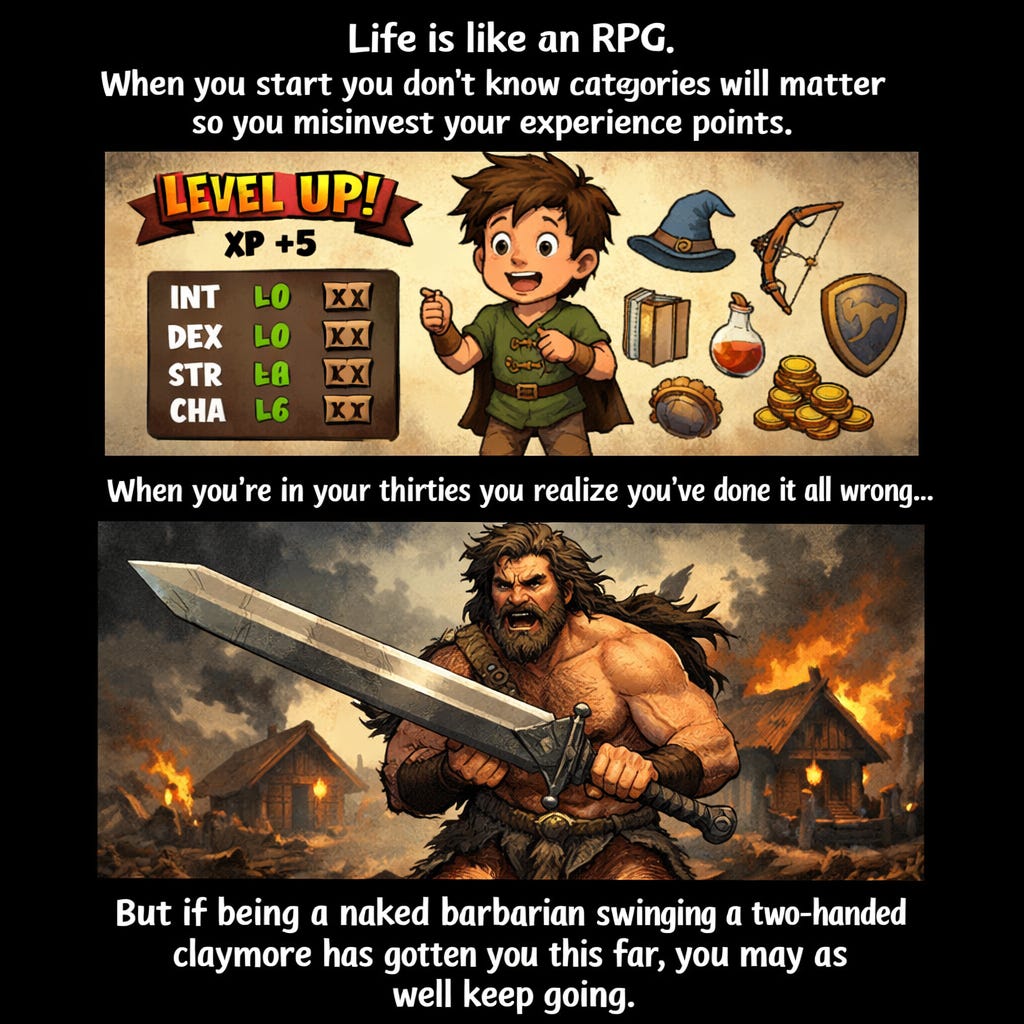
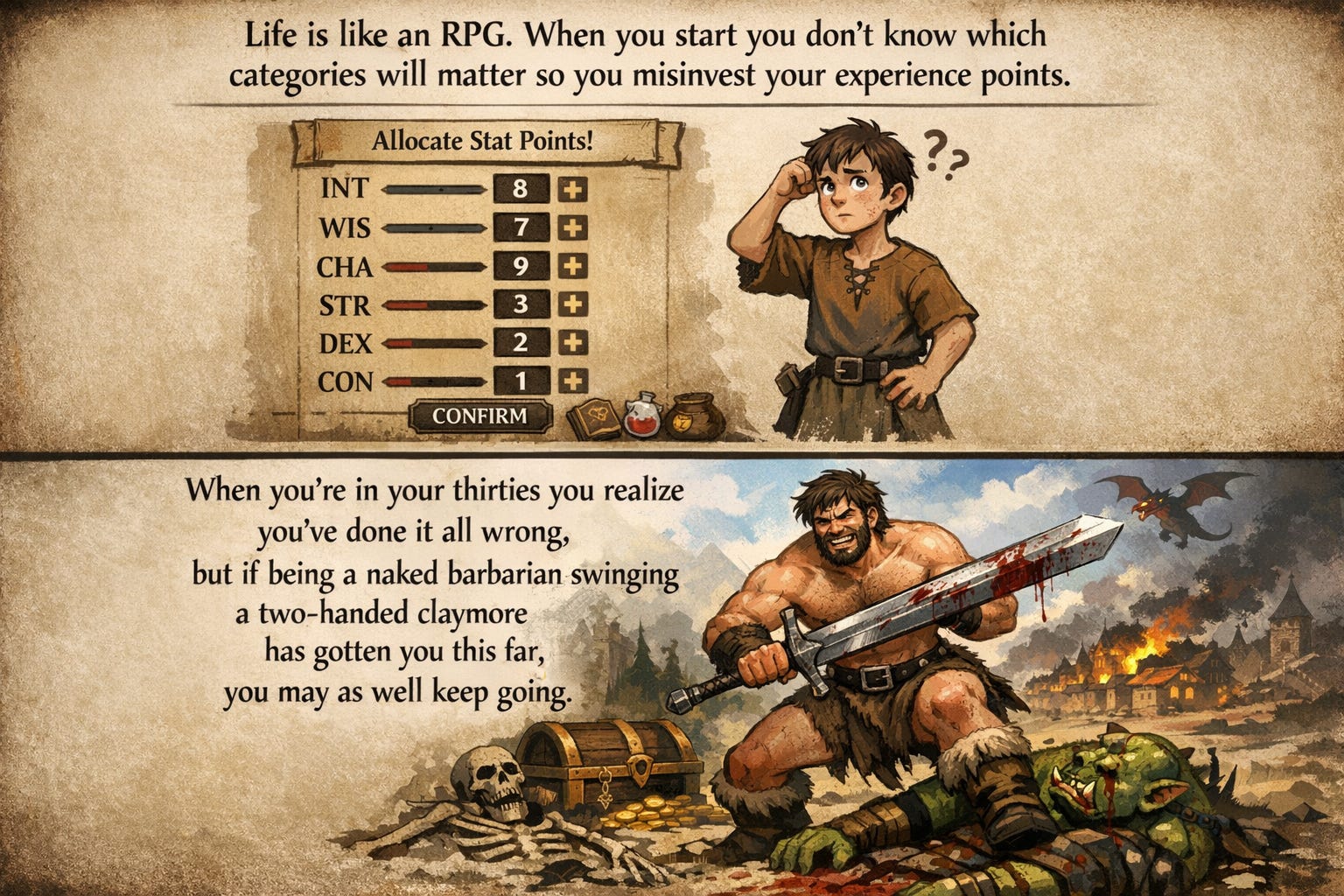
Ross Kenyon: Oh, okay. This is great. You’ll get it then. The way it works with basically every RPG is that when you start the game, you don’t actually know how you’re going to play your character. And by the time you make all the investments into which categories of skills you want to develop, you’re like, oh, I became something that doesn’t actually fit with my playing style. The meme I saw was something like, life is like an RPG and you didn’t realize which categories were important until it was too late. But then you get to your mid-thirties and you realize that if swinging a two-handed battle axe has gotten you this far, you might as well just keep being a naked barbarian swinging that battle axe. It’s too late to change now. You can’t just start over as a paladin. You’re the naked barbarian now. It’s not great in many ways, but you max it out. And that’s kind of how I feel in my career too. Should I go back and get an MBA? Should I go back and get a hard science degree? How could I do this in a more serious way? I’m like, I can still learn a lot of this stuff without having to go back and re-enroll in this expensive way. But I get tempted.
Emily Swaddle: Yeah, I get tempted too. And I think the thing is I’ve got into this habit of just pivoting without the formality of it all.
Ross Kenyon: Without the full what?
Emily Swaddle: Without the formality of it all. I don’t feel like I have to — well, I do feel like I need the training, but I don’t bother, I guess.
Ross Kenyon: Are you too busy resting, taking a siesta?
Emily Swaddle: So for instance, there was a time last year or the year before where I was like, I’m just gonna give everything up and become an actress. That was my plan. I was just gonna pivot hard into theater because I really wanted to. And I was like, oh my gosh, maybe I have to go to drama school or learn how to do this. And I was like, I could just do some acting. And the thing of — if you write, you are a writer. If you act, you are an actor. If you do science, you are a scientist.
Ross Kenyon: Very true. I agree with that.
Emily Swaddle: That thing feels so important to me. And the thing about the role-playing game — I totally agree. And also I completely disagree with it. Because I don’t think anything is set in stone and we can always shift and pivot. And if tomorrow you’re like, I just really want to change my career and go this way, I truly believe you could do it. It would not be easy. And depending on your levels of resources and capacity, there’s probably a lot of sacrifices you have to make. But also it’s possible. I think I have to believe that because there’s so much that I constantly feel like I want to try or that I want to change, that I need that reassurance that it could happen. I could do it.
Ross Kenyon: I like that and I think you should pursue that. It’s a good thing to believe and a good thing to do. I’m trying to figure out the exact right way to react to this. I think you’ll connect with what I’m about to say. My career is very confusing to everyone — both people I know primarily from online life and even to my family. They’re like, what are you doing? And what is this constellation of activities?
Emily Swaddle: Relatable. It’s very relatable.
Ross Kenyon: Yeah. And to me it all has very strong continuity. I can see every step and I’m always looking for things that are challenging and things that have me learn stuff every day. And I also like working with people and doing things that have me relating to lots of people. Every bit of what I do is hitting on that same thing. I know that it’s going somewhere. I don’t really know where it’s going, but I’m also pretty opportunistic about it. I don’t feel like I have some grand plan and I’m also okay with it, as long as I’m able to survive. It’s very much my own unique thing and that’s okay. I am not someone who can easily be put into a box, and that’s both good and bad. Because I will get into interviews sometimes where they’ll be like, you’ve done a lot of marketing. You’re not like a marketer, though. And I’m like, no. But I will hire around the stuff that I don’t have and I bring a bunch of extra cool stuff that you wouldn’t otherwise get from the right-over-the-plate marketer. And they’re like, yeah, we’re gonna go for the more conventional marketer. Okay, fine. Oh, you do strategy? Cool. We’re gonna hire an MBA for that. But you’re gonna get the same MBA answers as probably everyone else. Consider the weirder option. “Consider the weirder option” is a terrible pitch, by the way. Have you considered the more confusing, less scriptable option?
Emily Swaddle: Yes. You could go for this — ask my qualifications. But I am weird, so consider it.
Ross Kenyon: I like that it appeals to the gambling instinct. You’re bringing a wild card on. There’s a chance that undiscovered value erupts in a way that is really cool. Which is true. I’m often able to find stuff that other people have overlooked because of the weird constellation of skills and experiences. That is something I feel pretty confident in saying — this is a service that I offer. But it’s confusing as hell. Do you have some of that in you too?
Emily Swaddle: Definitely. I strongly relate to not being able to describe to people what I do. And also that it depends who I’m talking to as to how I describe it. I don’t say the same thing to everyone.
Ross Kenyon: I feel like imagining some of these scenarios and there’s also lots of “maybes” in there too.
Emily Swaddle: Yeah. And maybes I do this and maybes I don’t.
Ross Kenyon: That sounds like a threat.
Emily Swaddle: Anyways. Yeah. And there’s a recognition in me, even if I can’t necessarily articulate it all the time, that I understand the thread. I think it’s kind of obvious. We’ve talked about the storytelling stuff and that to me is just a word I use very liberally — storytelling. It can be podcasting, it can be writing, it can be acting. I work sometimes at the National Centre for Children’s Books in Newcastle and literally tell stories to children.
Ross Kenyon: Great. Love it.
Emily Swaddle: And I also love to design and put on events, and that to me feels like storytelling because an event is an experience and you’re guiding people through that experience in the same way that you guide people through a story. That feels so — it just makes so much sense to me. And if you’re writing a job application, this can be tricky. Because you have to be like, I know it looks like I’ve done all sorts of things, and I have, and that’s great — trust me, it’s great for you. Let me try and tie them all together in a nice bow in the limited space on this application form.
But yeah, there’s this book that I wish I could remember the name of.
Ross Kenyon: There are a couple of books, maybe we can narrow it down.
Emily Swaddle: It’s about the power of being a generalist.
Ross Kenyon: Oh yeah, I think I’ve read that one.
Emily Swaddle: I read it and it just made me feel really good about myself. Because I am definitely a generalist. And actually, I was listening to — do you know my favorite episodes of your show are what I like to call “Ross Rants”? When you don’t have a guest on and you just kind of stream of consciousness.
Ross Kenyon: They’re pretty improv-based, but yeah.
Emily Swaddle: They’re my favorites. I sort of think along with you as you go down your rabbit hole of wherever you’re going. And it’s very — it always gets me in a good mood as well as making me think about these important questions that you always bring up. And I was listening to the recent one you did about the polycrisis versus carbon efficiency and it just — I find it really hard to work in a way where I’m not thinking about bigger picture stuff, connecting things and thinking about systemic things. And in the world in which we live, it’s really depressing to have a brain that works like that because a lot of the systems are absolutely fucking shit.
Ross Kenyon: I’ll bleep those out. Yeah.
Emily Swaddle: And I also deeply see the importance of the people who are like, this is my thing and I’m gonna do this thing to the absolute best that I can for the rest of my life. That’s not me at all, but I really appreciate those people, because if we don’t have them, then the people who are looking at everything and flittering around don’t have anything to anchor to in the systemic change thing that needs to happen.
Ross Kenyon: No, I think we definitely need people who are able to zoom out and ask some of those big questions. I worry a lot about scientism or technocracy or just this drive where technicians will determine everything without thinking about the more humane parts of what we’re doing here. And it’s hard to put a quantitative measure on humanity. It’s hard to put a monetary value on it. It almost feels wrong. Those are the wrong ways to understand those behaviors. So it probably doesn’t help you or I in emphasizing those things and saying, here’s why you should bring me onto your company for a fixed expense, for an indeterminate amount of value that will be delivered. Let’s do it together. But I think that work is really valuable. And I would do my little Ross rants even if no one was listening.
Emily Swaddle: I would listen. I would listen to a Ross rant any day.
Ross Kenyon: I call them my monologues, but Ross Rant is probably what I should — Ross Rant, trademark.
Emily Swaddle: Rant makes it sound like you’re angry. It’s not got a ranting energy. I’m such a sucker for alliteration. That’s why the rant came out. So you said about putting that monetary value on humanity, and it’s also — this is something I come up against with carbon removal quite a lot — putting that monetary value on the more than human world.
Ross Kenyon: I was gonna say it if you didn’t. That’s a great example.
Emily Swaddle: Don’t say the n-word.
Ross Kenyon: “More than human” is a very specific kind of phrase. But please continue.
Emily Swaddle: Okay. We need to come to this. Yeah, it just makes me feel icky. When we’re thinking about CDR, we talk about co-benefits and we’ve gotta make sure they can monetize this. I’m like, I get it in the system we currently live in, yes. And also I hate the fact that we have to look at this amazing planet that is self-sustaining and can feed us and go, yeah, but how much is it worth? In USD?
Ross Kenyon: It does feel pretty icky. It’s like a category error in some way too. But if you don’t do it, then the question is — is this gonna happen? Because then I worry we need to have some sort of spiritual transformation happen. But that’s hard. I think people are pretty scared of it too. The game theory of it is the part I always come back to for why this doesn’t occur more spontaneously or naturally. If the US just said, okay, we’re actually gonna take a pause on AI stuff because we don’t know how dangerous AGI is or how far off artificial general intelligence is going to be and the ramifications of that. So we’re just gonna try and do some more research and make sure we don’t rush into this. But if we didn’t do it, then China’s probably not gonna slow down and every other agency working on this — they’re not gonna slow down because they know if they don’t, their rival agency in a different country is gonna do it. So we kind of can’t. And once you’re on the cycle, you’re like, where does this end? Does it end in a good place or a bad place? Because it could end in mutually assured destruction and we’re all going to check ourselves because the balance of power ensures that bad actors don’t just wipe everything out. Or it all just falls apart at some point in the near future. That’s a fairly real risk. And the solution to this is probably all the woo-woo stuff that we’ve all been told is not serious business. How we spiritually relate to the rock that we grew out of and how magical that is and how that might actually chill us out a little bit. To recognize some of the pure mysticism of that. There’s a rock flying through space that we grew out of over the course of billions of years. It was pretty unlikely that we would take this shape and we’re able to observe this thing that we spontaneously grew out of. And having a recognition of that should make you be like, yeah, maybe we shouldn’t have as much conflict with the Russians or Chinese and we should probably just figure out how to live here with dignity. And it sounds so woo. But come on. You’re there with me, right?
Emily Swaddle: Ben and I came up with this phrase — there’s “woo-woo,” which we are like, ah, but then there’s “true woo,” which is the woo we can get on board with. Because we recognize it’s woo, but we love it and it’s true. So this is the true woo.
Ross Kenyon: I didn’t cross over, did I, into proper woo-woo?
Emily Swaddle: No, you weren’t even close.
Ross Kenyon: I feel like it’s a little bit cheesy to say out loud where it sounds a little bit like freshman dorm room. There might be certain kinds of smoke floating around in the room. There’s a Bob Marley poster on the wall. But also, couldn’t we get along on this planet? It’s bountiful enough for all of us and we could also have a really good time if we just treated each other more decently.
Emily Swaddle: Yeah.
Ross Kenyon: But it doesn’t seem like we’re doing that. I don’t know how to fix climate change if we don’t do that either. The pure technocratic — we just need the right technology and policy and we can do this — like maybe. But the polycrisis thing probably said it as well as anything else.
Emily Swaddle: Yeah. The tech stuff and the policy stuff will change something for sure. It’s not gonna have zero effect. But is it just gonna get us to the point where it’s survivable and then at that point it’s like, do I want to be in this world? If it’s where I worry it could get to. But then also thinking about that level of stuff is very depressing because I totally agree with what you say. If we don’t have a full — you used the word spiritual revolution and some people would consider that to be the woo-est of woo. But I actually think it’s so true. We are so disconnected from the idea of spirituality that the idea of a spiritual revolution is laughable. And that’s the problem in so many ways. Okay. I’m going back, but tell me your thoughts and feelings about the “more than human world.”
Ross Kenyon: Oh yes. Thanks for bringing it back. I think that phrase signals your membership in a certain kind of ecologically progressive community. It signals respect for animals and sentience of different types. You could say “nature,” but that introduces this dichotomy thing that you probably don’t want to do. I like that it still has hierarchy involved. It’s more than human. It’s not different from human, it’s more than human, which I think connotes a lot of respect for it and likely an indigenous worldview. It’s funny — a small phrase like that. This is just me riffing on it, not even thinking that hard about it, but all of those things are embedded in there. And that’s how powerful that phrase is for me.
Emily Swaddle: Yeah. I don’t remember where I originally got that phrase from, but I’m pretty sure it was some ecofeminist theorist. Maybe Vandana Shiva or somebody like that, could have been. But I really struggle — and I think we’ve spoken about this before — that barrier between like, nature is them and humanity is us. I hate that. And I also hate the idea that there is a hierarchy in that, that humanity somehow sits above the natural world. So I kind of like the phrase “more than human world” because it also reminds me that there’s more than the stuff that I get caught up on so often. All the human stuff.
Ross Kenyon: Which parts of the human experience have got you down?
Emily Swaddle: Oh, there’s everything.
Ross Kenyon: Yeah, totally. I got you.
Emily Swaddle: And then I go to a field and I sit and just try and do nothing for a little bit and listen to the birds or look at the grass. And I just take a deep breath and realize that it’s not actually all this. We make it all this because that’s the system in which we have to exist. But really it’s not.
Ross Kenyon: You’re listening and not watching. Hopefully you can tell the directionality of her gestures.
Emily Swaddle: Yeah. Sorry. That’s not very good for an audio-based medium. But yeah, that’s the thing that really — personally I know I need, in order to survive in any kind of position of working to change things, I have to connect with something greater than myself. And that’s the definition of spirituality. And for me, that means the more than human world, this natural connection that I need to have.
Ross Kenyon: Yes. I think pretty much anything in that position is good. There’s a bumper sticker that I pass — I’ve told this story on the podcast before, but it’s been a while. I suspect it’s someone who came from a 12-step program, because I’m pretty sure this is where the phrase comes from. But his bumper sticker says, “Relax, God’s in charge.” And you don’t have to be a specific type of monotheist to appreciate it. I think humans need to be in their place a little bit. It’s actually not our responsibility to do everything. And the risks of us trying to fulfill that God-shaped hole are maybe more than we can do at our current level of civilizational maturity. And it’s nice to just be like, you know what? This isn’t my responsibility. And I can relax a little bit. The universe is beneficent and I trust that things are broadly trending towards goodness. And I can work on my small little corner of the world. I know that’s kind of a canned phrase that is common. And even still, every time I see it, it makes me happy and calms me down. That’s true. Why am I taking so much responsibility for literally everything? I can’t control all these things. Why am I carrying this with me? I’m actually not in charge.
Emily Swaddle: Here’s my question though. Do you think that’s because you’re a generalist? Do you think those people who work on their niches — that tiny little thing that they obsess over and get better and better at throughout their lives — do you think they have the same worries?
Ross Kenyon: Wow. I’ve never — this is the kind of question a journalist would ask, and this is why you should scoop Emily up while she’s on the market, even though she’s not big on capitalism or money. But that is a great question. I think probably so. I think the kinds of shows that I produce run all over the place, and so seeing connections — I’m pretty freaked out watching the direction of the world and have been for a while. I’m not feeling as optimistic as I typically do. I don’t like being a Cassandra-esque person. I don’t think it’s a fun role to be in. Part of it is because I’m trying to look a couple years in the future, follow the trends and see broadly where they’re pointing and how that affects my personal life, my business life. And that has me freaked out. And I think people who are just trying to be like, well, how do I get the unit cost economics down here, and are just focused on that — I think that is probably more focusing. I do feel better when I am focused on specific discrete problems that have solutions. And I try to keep some problems in my portfolio that are the big “what if” spots on the map. And then I also work with people on basic stuff — how do you explain your weird technology to a generalist VC such that they might take a second meeting with you? Because what you’re doing right now is confusing as hell and it’s not gonna get the second date at all. So I like to have both involved. But yes, I think being a generalist opens you up to blue-sky thinking that can also lead to, “Oh God, what is all of this? What are we doing here?”
Emily Swaddle: And I think one of the tricky things of being a generalist is — I’m speaking for generalists — humans need purpose. We need a sense of purpose. And the people who find the niche thing that they want to do and are of the personality type that fitting into a niche really works for them — purpose, I can imagine, comes much more easily than to a person who’s kind of like, I’ve got my fingers in all the pies and I’m trying to tie all these things together and also make sure everyone’s okay. There is a purpose there, but it’s so vague. It’s not a thing that you can hold onto and be like, look, here’s my purpose.
Ross Kenyon: You know? One sentence to explain it. Okay. Sorry, this is sort of a stupid thing to say, but the fingers in multiple pies thing — who’s out there sticking their hands in pies? Get out of my pie, man. That’s gross. I don’t want that in there.
Emily Swaddle: I kind of love it as an image. I could just imagine going into a place and being like, mmm, yummy.
Ross Kenyon: You like yummy. You like thinking about criminal actions basically, at a pie store.
Emily Swaddle: Yes. A crime that didn’t involve pie.
Ross Kenyon: It doesn’t involve pie. Dumb expression. I really hate the “I wear many hats” expression. I find that one in like three meetings involves someone introducing themselves saying that.
Emily Swaddle: But back in the day, that was the case. If you were a police officer, you had a very specific hat. I mean they still do in the UK. If you were a banker, you probably had a very specific — a different kind of hat than if you were a chimney sweeper. I’m going very Mary Poppins now, I’ve just realized.
Ross Kenyon: Yeah, there’s a banker and a chimney sweeper in there. What kind of hats do nannies wear? That’s the next one.
Emily Swaddle: Yeah. You are wearing a bonnet then.
Ross Kenyon: What about admirals?
Emily Swaddle: Admirals do have hats. The three-pointed hat.
Ross Kenyon: Why is he allowed to have cannons on his roof? Why does that exist?
Emily Swaddle: That is hilarious. Just the fact that this person at some point got so high up in the military that he now is allowed to have a cannon not only just sitting on his roof that he fires on the hour.
Ross Kenyon: I feel like that would not fly at all. Bizarre. Should not have happened.
Emily Swaddle: Great movie though. One of my favorites.
Ross Kenyon: Oh yeah.
Emily Swaddle: I’m such a Julie Andrews fan.
Ross Kenyon: Yeah. I had a little bit of a crush on her when I was growing up.
Emily Swaddle: As Mary Poppins?
Ross Kenyon: No, I’m more of a Sound of Music kind of man. Actually, one of our family jokes — do you need to take that or is it okay?
Emily Swaddle: Nope, this isn’t my house. Somebody else’s problem.
Ross Kenyon: Cool. Do you know the trend to do revisionist novelizations where you take a classic story and rewrite it from a different perspective? Like, Jim from Huck Finn is now James and we’re gonna rewrite it from Jim’s perspective. Or we’re gonna do Wicked from the witch’s perspective. I want to do one for Sound of Music for Rolf, who’s like — he has low self-esteem and he becomes a Nazi. But I would make Rolf an understandable, relatable —
Emily Swaddle: I love that. The villain origin story of Rolf.
Ross Kenyon: But Rolf just kind of sucks. He became a Nazi and then he turned the Von Trapps in at the end. Come on. And then I want to do one for Scar. Our son really likes The Lion King. I’m like, Scar is just a —
Emily Swaddle: Oh yeah. He deserves one.
Ross Kenyon: Misunderstood.
Emily Swaddle: I think he deserves one more than Rolf, to be fair. Because from the beginning, Rolf is like, “I am 17, going on 18. You don’t know anything and I’ll tell you everything.” He’s up himself from the beginning. There is a musical — don’t tell me, it’s coming — called Unfortunate. And it is the origin story of Ursula the Sea Witch from Little Mermaid. And it is camp as hell. It’s jazzy, it’s colorful. It’s an amazing musical. Check it out.
Ross Kenyon: Yeah. I love stuff like that. And Ursula — I’m not surprised it’s camp. Ursula seems like a drag queen. You’d get someone from RuPaul’s Drag Race to come on.
Emily Swaddle: Well, not to get too deep on you, Ross, but there’s so much about early Disney movies where the villain is queer-coded and we all just accept that these people who are the evil ones are probably gay or trans or whatever. That was really ingrained in stories and a lot of the Disney movies that we had growing up.
Ross Kenyon: Interesting. I’m trying to think — all I can think of is Jafar.
Emily Swaddle: Jafar is a really obvious one. He’s the poster boy for queer-coded villains. Then there’s also Scar — I know he’s British and there’s a potential that he could just be kind of posh, but I think he’s also a bit queer-coded in that movie.
Ross Kenyon: He does want to marry —
Emily Swaddle: Maybe Nala is his beard. It’s just for appearances.
Ross Kenyon: Helps them build the pride. There’s a lot of YouTube videos. You can go down a whole rabbit hole about this.
Emily Swaddle: I actually said “rabbit tube” — I wanted to say rabbit hole on YouTube and now I can’t stop thinking about how “rabbit tube” should be the phrase.
Ross Kenyon: Go down a rabbit tube. Yeah. Rabbit hole is also a kind of tube. This is where the show has — you know, it’s time to start wrapping up when this is the caliber.
Emily Swaddle: Yeah, but what about a rabbit tube? This is literally when Ben unmutes himself and goes, okay guys. That’s it. You can just stop now. Thank you. I think we’ve got enough. He tends to do, “I’m sure I’ll get something out of that.”
Ross Kenyon: I’m sure I’ll get something out of that. Okay. Are you able to say anything else about what the next season of The Carbon Removal Show is gonna be about?
Emily Swaddle: I can tell you what the next few episodes are gonna be about. We’ve been doing these kind of mini-series little chunks recently. The next trio of episodes is about the buyer’s experience — the whys, the hows, the whats, and the “how do we make it better” of buying CDR.
Ross Kenyon: Whoa. Those will be studied by suppliers in great detail. Great intel. You should paywall it — it’s a thousand dollars if you want to be a supplier listening to this episode.
Emily Swaddle: No. I’m not about this money stuff.
Ross Kenyon: Oh.
Emily Swaddle: That’s not my vibe.
Ross Kenyon: Not your vibe. Capitalism. Okay, got it.
Emily Swaddle: I’m also gonna send you a poem because I listened to your Walt Whitman. I just love when we can bring in punctuation marks of art into any kind of conversation. It’s my favorite thing. And while we were talking about the nature stuff, a poem came into my head.
Ross Kenyon: What is it?
Emily Swaddle: It’s “Wild Geese” by Mary Oliver.
Ross Kenyon: Actually, I was gonna read this one soon because I had — I was gonna do this one and Yeats’s “The Second Coming.” I know these are kind of greatest hits and they’re well-known poems, but they’re good.
Emily Swaddle: They’re classics for a reason.
Ross Kenyon: Yeah. “Wild Geese” is among the best. There’s a reason why it’s so beloved. There are bumper stickers too — you’ll see around Seattle sometimes — that will be like, “Honk if you want to let the soft animal of your body love what it loves.”
Emily Swaddle: It’s literally the perfect poem. Beginning to end — “You do not have to be good.” She could have stopped there and I would’ve been crying. And then the last line is, “calling to you like the wild geese, harsh and exciting, over and over announcing your place in the family of things.”
Ross Kenyon: Yeah. What an amazing sentence. What if you read it for me and then I published it on the show? Because I was gonna read it myself, but I’d rather you do it.
Emily Swaddle: That would be nice.
Ross Kenyon: Can you give a little Emily exposition on it and talk about what you like about it and why? You saw how I did the Whitman one.
Emily Swaddle: Sure. Yeah.
Ross Kenyon: Send it to me now. Yeah.
Emily Swaddle: That’s one of my absolute faves.
Ross Kenyon: Oh yeah. I kind of had an intuition that you were going to say that. And I am not surprised at all. And it is wonderful. Yeah, I like doing that too. And thanks for saying that. I’m glad you’re out there listening and appreciating it. I know if someone like you likes it, because I want to pull the STEM people towards you some, as part of my intention, but I know if the end result is someone like you appreciating it, I’m like, I think I’m where my people are. I think I’m in the right zone. If Emily’s like, yes, this is feeding me in the right kind of way.
Emily Swaddle: Thank you.
Ross Kenyon: So thanks for sharing that. I really respect what you do and who you are and I think it is very important. I am sorry it isn’t maybe as remunerative as we might all hope, as you’ve alluded to, but I think it’s really valuable work that can be done even in the absence of that. And I’m just really grateful that you are exactly who you are, Emily.
Emily Swaddle: Thank you, Ross. We were talking about how I’m not very British, but I am British in the way that I don’t really like compliments coming straight at me.
Ross Kenyon: Sorry, you had a bunch of them this episode.
Emily Swaddle: I’m just kind of like, mmhmm. Thank you.
Ross Kenyon: Sorry. Do I need to obscure it in some way or negate it immediately after?
Emily Swaddle: I don’t know. Maybe. Yeah. You show it in this way. Thank you. It’s a great thing to model for our emotionally repressed little industry.
Emily Swaddle: Yeah, yeah. Well, I love listening to your show, so let’s just keep making cool content.
Ross Kenyon: Let’s keep making cool content. Thanks so much for coming on, Emily. I know it was a little bit of a who-knows-what-is-going-to-happen today.
Emily Swaddle: I think to sum up this episode, it’s like: Emily talks about how she’s silly, how she’s broke, and how the world is broke. There you go. That’s the tagline.
Ross Kenyon: That’s pretty close, I think. Yeah. Queer-coding Disney villains. There’s a lot of stuff we covered today.
Emily Swaddle: Thank you, Ross. Thank you for having me.