

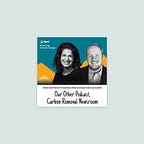

Listen on Spotify, Apple Podcasts or YouTube.
Carbon Removal Newsroom, the sister podcast to Reversing Climate Change, was born out of a desire to explore current events in the carbon removal space from a policy perspective.
But since the show debuted in early 2019, its production team has evolved and so has our approach to discussing the latest in climate news.
Radhika Moolgavkar is Head of Supply and Methodology at Nori and Host of Carbon Removal Newsroom, and Asa Kamer serves as Producer of CRN.
On this episode of Reversing Climate Change, Radhika and Asa join Ross to explain how CRN evolved to focus on the business, policy, and science of carbon removal news and share their favorite episodes from the recent past.
Radhika and Asa explore how podcasting facilitates thoughtful public conversations around meaningful issues and describe how a show benefits when its host approaches the subject matter with a beginner’s mind.
Listen in to understand how CRN stays up on big news in the industry and get Radhika and Asa’s take on the future of carbon removal.
More from the show
Ad-free episodes and other benefits come with a paid subscription.
Carbon Removal Newsroom, the news show that ran alongside this one, is over. Its episodes are still up, on the feed Climate Workers Anonymous now uses.
Carbon Removal Memes is still going.
Resources
Chris Barnard at the American Conservation Coalition
The Boom in Carbon Removal Legislation and Funding on CRN EP045
Noah McQueen of Heirloom on CRN S3EP28
OpenAir’s Toby Bryce on CRN S3EP29
Chan-Zuckerburg Initiative Invests $44M in Carbon Removal on CRN S3EP30
Ocean-Based Carbon Removal on CRN S3EP32
Ton-Year Accounting with Carbon Direct on CRN S3EP31
Eight DAC Companies to Watch in 2022 on CRN S3EP27
Forest Carbon Over-Crediting on CRN S3EP21
Climate Reparations on CRN S3EP26
Carbon Removal Memes on Instagram
Carbon Removal Memes for Climate Restorative Teens on Facebook
Full Transcript
Alexsandra Guerra: You’re listening to the Reversing Climate Change podcast by the team at Nori, the carbon removal marketplace. This is a show about the innovators and entrepreneurs developing solutions to climate change.
Ross Kenyon: Hello and welcome to the Reversing Climate Change podcast with Nori. I’m Ross Kenyon. I’m the creative editor at Nori. Today I have with me one of my colleagues, Radhika Moolgavkar, head of supply methodology at Nori and host of the Carbon Removal Newsroom podcast. Hey, Radhika.
Radhika Moolgavkar: Hi, Ross. How are you doing?
Ross Kenyon: I’m good. It’s nice to have a little crossover here. And also our colleague, Asa Kamer, producer of the Carbon Removal Newsroom podcast. I also put in here Meme Lord and Sopranos Aficionado. Is that okay with you, Asa?
Asa Kamer: Yeah, I accept. Thank you for having me, Ross.
Ross Kenyon: Is this your podcasting debut?
Asa Kamer: Yeah, I believe it is.
Ross Kenyon: Wow. That is very fun.
Asa Kamer: This is the only podcast I would debut on, Ross.
Ross Kenyon: The only one? Okay.
Asa Kamer: Oh, yeah.
Ross Kenyon: Yeah, well, I’m honored. Happy to do a show here about Carbon Removal Newsroom. I’m very curious how much of our audience knows we have another podcast, has listened to it before. I wanted to introduce it, talk about why it’s a cool addition, something different from Reversing Climate Change, how exactly it works, and maybe just get a sense for your personalities. So what if we just started, though, by... Explaining who you both are, how you got interested in carbon removal, and then we’ll work our way into the podcast. And I don’t know, Asa, you want Radica to go first?
Maybe I’ll let you off the hook a little bit, or would you feel better just diving right in? What’s easier on you?
Asa Kamer: I’m happy to go first, or Radica is the host of the show, and I think we want to introduce some listeners to what our show is all about, and that starts and ends with Radica, in my opinion, so.
Radhika Moolgavkar: Oh, well, thanks so much, Asa. I appreciate it. Yeah. So I, how did I get involved in carbon removal? I mean, it’s kind of a long and painful story, but the short version of it is I have always been interested in science. I have a cell and molecular biology undergrad degree. I came of age in the first dot-com boom, so that probably everybody now knows how old I am. And I was really also interested in the intersection of startups and different types of science-based technologies. So speed ahead many, many years, many, many life changes, a husband who moved me all over the country.
And I finally came back to Seattle and had the opportunity to work at King County and In King County, eventually I worked in battery electric buses, so I got my introduction to emission reductions. Again, it spurred my interest again in environmental tech and startups. Heard about Nori through Actually, GeekWire and then had a acquaintance who is an advisor or friend who is an advisor to Nori. And lo and behold, you guys had your seed series funding and you needed somebody with my skill set and it all worked out. And now it’s been like a PhD in carbon removal for me.
Ross Kenyon: Which advisor do you know?
Radhika Moolgavkar: Katie. Katie.
Ross Kenyon: Oh, okay, cool. That’s, I always forget you had a, like a molecular science biology background too.
Radhika Moolgavkar: And you’re a lawyer.
Ross Kenyon: Yeah, you’ve had a quite a varied career. It’s pretty, pretty intriguing. We just collect these wild cards over here, I think.
Radhika Moolgavkar: I have. I’ve been everywhere from Microsoft to a big law firm to a small law firm to the county. So I have experienced a lot of different things with a huge break in working in between. So to all those people who take some time off because of parenting, there’s always a way to get back in. Don’t give up. That’s my piece of advice for the day.
Ross Kenyon: Great advice. Asa, I think, did I meet you originally through air miners? Is that how this happened?
Asa Kamer: Yeah, I think so.
Ross Kenyon: Okay. And how did you find your way into air miners and carbon removal?
Asa Kamer: Well, that’s a great question. I mean, I’ve, you know, grown up sort of a generation, grown up learning about climate change, being concerned about climate change. And even when I was like an undergrad a long time ago, I studied environmental studies as my, you know, focus and climate change and climate science was a big part of that. And I even took a class where I got to study soil carbon sequestration back in the Aughts. So, you know, back in Obama’s first term. And so I always, you know, look back on that and I was like, wow, people are really working on that.
I mean, people say carbon removal is new, but at least in terms of soil and rangelands, there was some work happening on that academically, you know, a while back. And then after college didn’t really stay too connected with climate change in terms of my work. I worked in the mental health field and then was working for my last job was with a local elected official here in the Bay Area and then kind of the And throughout that time, just as a hobby and an interest, you know, stayed up, tried to stay up to date on climate news and what was going on and what was happening.
And just the concept of carbon removal really caught my imagination, just because so much of what I’d learned Climate change and how to address it is just, you know, we have to stop this. We have to, you know, it’s all about what we shouldn’t do. And it’s, you know, framed in this sort of, I guess, like negative way to put it, you know, to put it that way, where it’s like, you know, there’s all these practices we have to stop doing. And that’s obviously very true, but I think it kind of limits the like imaginative and exciting parts of like, I guess my interest in climate change, where I was like, wow, there’s actually something, you know, positive we can build, there’s something new we can do.
And, you know, carbon removal is still very nascent. You know, we don’t want to get too, like, techno-optimist about it, as people would say. I don’t want to overstate how important it will be. But, you know, there’s something really interesting about it. So I wanted to learn more and just kind of was reading what was available online at the time. There wasn’t a lot. I’m trying to remember what it’s called, but Carbon 180 when they had their previous name, I think it was like Center for Carbon Removal, kind of found their website and they were also located in the East Bay where I am.
And, you know, they had a lot of materials and they also had like a, um, You know, a Slack group. So I was like, okay, that’s cool. Like, I’ll see what people are working on. And then that became Air Miners. And then, you know, just started following that. So it wasn’t really professional interest for years. Just I mean, I kind of wanted to learn more about and stay up to date on and kind of geek out on. And then one thing led to another. There’s this podcast and people are making memes and Ross’s.
You know, DMing me about a podcast and, you know, here I am. So it’s kind of a great thing. And I’m also coming off of a break for parenting and for having a new child. So that’s cool that Radica, we can both relate on that. And it’s kind of been a good fit because I get to keep following this topic and, you know, keep up to date on the news and listen to really, really smart people talk about it. So, yeah, that’s kind of what led me here.
Ross Kenyon: We’re lucky to have you, well, both of you really. There was a whole prehistory to Carbon Removal Newsroom too, because I had this idea, it has to be like two, I don’t know when the first episode came out, but the idea probably wasn’t that far before that. Reversing Climate Change episodes, listeners know, tend to be, I usually describe them as evergreen, they’re bigger topics. I try not to do things that will age badly or like right away, like will be out of date. Some of them get kind of loosey-goosey too.
They’re not always directly on carbon removal and there’s nothing else like it. I think now there is the carbon removal show now, which if you’re listening, you should check that show out too. I’m happy there’s a lot of good carbon removal content coming out. I think they have a new season coming too. But when we started it, There wasn’t a dedicated source of regular carbon removal news. And I was looking at shows like Political Climate or The Energy Gang, these great roundup shows where you have panelists who are experts on these topics, running someone through, maybe if you don’t have time to read all the papers.
Well, who really does? Read all the articles and stuff that was happening, listening to all the podcasts. You might have a distillation of that, that some experts think are the things that you ought to know. Carbon removal should have one of those. It was really hard to keep that up among my other duties. And also I usually describe myself as not really being a news. I will wait until after there’s been a world crisis, like a decade, and then I’ll read the history book of it. I’ll be like, wow, that was really messed up.
That was really interesting. But in the moment, I find it too hard to track. So I fired myself from the carbon removal newsroom job. Radhika, I think you’re the biggest news junkie on staff for one of them. I think I’m only a one of many.
Radhika Moolgavkar: It’s like a very academic place we work at, Ross.
Ross Kenyon: That’s true. But I mean, you describe yourself as someone who tracks political news.
Radhika Moolgavkar: I’m a political news podcast junkie for sure. I listen to him. Pretty much every day I have a couple of rotations. Usually also it’s kind of heading towards the law as well.
Ross Kenyon: Oh, cool. I thought maybe that would be a good place to start. I also thought there wasn’t that much carbon removal content that had a right of center voice ever. So I sort of set this up almost like political climate as having Holly, whatever Holly is somewhere on the left, who knows exactly what. And then Chris, our former co-host, for those who don’t know, Dr.
Asa Kamer: Holly Buck.
Ross Kenyon: Holly, I know. So I’m speaking with greater familiarity than is maybe warranted here. But she’s been on RCC so many times now. And I think she’s maybe the most frequent guest that I think we’ve had. I think she’s top of the list, if not. And yeah, so we set it up that way. And then the show’s evolved. I don’t know. OK, so that’s like the prehistory. And then it started with you, Radhika. And then Asa, you were a little bit of a later addition, now integral. But Radhika, maybe start us at the beginning of the season you started with and what’s been your experience of it?
Radhika Moolgavkar: Well, it has been both extraordinarily stressful, but more importantly, extraordinarily interesting. Certainly, Asa’s arrival has alleviated most of the stress, so I am forever grateful for his hiring and his input into the show. But we kind of started, like you said, Ross, with this idea that every week... We would try to feature carbon removal news, but from a policy perspective and have Holly kind of on the leftist side and Chris on the, who’s our other co-host from the American Conservation Coalition, Karis Barnard on the right side. The irony of that is I think they often agreed more than they disagreed and occasionally they disagreed and it’d be fun, but never too vehemently.
They were both obviously very professional, but also it kind of gives you hope to know that They actually agreed on a lot of solutions. And so maybe it’s not so much about the solutions, but about how they’re messaged. But that was too much, right? We couldn’t maintain it. The quality of the programming wasn’t very good overall. I don’t think we had some good shows, but some not so good shows. I could not keep up with enough carbon removal news. And then Ross, I think you came up with this idea of trying to pivot more to a business policy science approach.
And we’d have rotating hosts and Holly would be and I would be consistent. So we did that for a while. We brought Asa on in that timeframe. So we really then expanded the types of topics we looked at. We also brought on Susan Zhu, who’s our business person. And we brought on Jane Zelikova, who’s our science person. Jane’s now gone for a little bit, but Susan continues to be on the business side. And then we’ve just sort of evolved from there because Holly moved on to another position that wouldn’t allow her to be part of podcasting.
And so now we kind of have a rotating guest list and Asa comes up with all sorts of great guests and great topics. And we’ve been diving into it and had some really interesting conversations, particularly on the business side. We still try to keep it a little bit left, right and center-ish. But obviously people tend to agree more than they disagree on these things because we’re all in carbon removal, but have had some really interesting conversations on how you move carbon removal forward and what are the priorities and how you should prioritize and what are the roles of markets versus government.
Ross Kenyon: I have so many painful memories of these growing pains of the show too. I always believed in it. I knew there was a good show in there, but the logistics of getting the right people and the right cadence and all this, I feel like I have a couple of gray hairs just from this show alone. But now it works and I’m really proud of it. It’s my favorite show. It’s the one that I listen to the most frequently on my own and not even because I’m obligated to for work purposes.
I find it to be fascinating. If you care about carbon removal, I don’t think there’s anything else quite like it. Casey, you’re nodding your head affirmatively. Sounds like this is a show also built for you.
Asa Kamer: Yeah, absolutely. I mean, I was a listener first and I remember, I think I’ve told you this, I remember a episode maybe two years ago where you and Tito from Air Miners were going through like a DOE grant list of like sub million dollar grants to various... University groups and startups to work on direct air capture. And I mean, I was interested. I was like, this is the content that I want because I know enough to kind of know what they’re talking about, but want to learn more. And I was like, this is great, you know?
And so that kind of got me hooked. I think that’s going to be the first show I listened to and then I’ve subscribed ever since.
Radhika Moolgavkar: And now you run it, Asa. You’re basically the brains behind it.
Asa Kamer: Well, I’m just trying to, you know, keep up the level it was at. You know, it sounds like there’s a lot of stress and difficulty getting it there. But I feel like since I plug in, I’ve just kind of kept it running. I haven’t had to reinvent the wheel. And also we have a lot of like super informed people who we bring on the show. So it’s kind of easy because I just make a list of the big topics that have happened and kind of let them go at it. So I will take any credit that, you know, comes my way via their like good work and like smart thoughts.
So please lavish it on. But I mean, yeah, a lot of it goes to the good people who are able to get on the show.
Radhika Moolgavkar: I think the beauty of carbon removal right now is it’s growing, but it’s still a small enough community that everybody is excited to talk about it and excited to explore different ideas. There’s much less like polarization, generically speaking, in carbon removal, though it exists. And if anyone’s listened to the show, we talk about it, especially in the Environmental justice movement. There’s a lot of concerns around carbon removal generically, but the people on our show are all just enthusiasts of carbon removal. So it’s always fun to talk to them about how they’re thinking about it.
What floats their boat? What makes them excited? I mean, in that you can’t help but enjoy a show where people are so passionate about what they’re talking about and what they’re thinking about every day.
Asa Kamer: Absolutely. And the level of news, I mean, there’s so much going on with carbon removal, but I still feel like we’re able to hit the top, like most important points. And so we really get like people who are really know what they’re talking about, talking about the most up to date, like things happening in carbon removal. And I don’t think, yeah, that’s something I still enjoy listening to because I don’t necessarily find that anywhere else. And Listeners are now maybe ready for us to stop patting ourselves on the back. But one more thing I’ll say is, you know, today, not to date the show, I hope this is okay, Ross, but, you know, Heirloom, a direct air capture company announced a $53 million rate, you know, fundraising round.
And we had... Noah McQueen from Heirloom talking about their tech and scaling DAC, which is what they’re doing, just a few weeks ago on the show, you know, and I saw recently that Robert Downey Jr. tweeted about the Open Air Collective’s bill they’re working on in New York State and we had Toby Bryce from the Open Air Collective just a few weeks ago. And even Microsoft’s report they put out last week about their attempts to, you know, be carbon negative was something, that effort was something we talked about on a recent business episode with, you know, Susan Su and Naeem Merchant, who was a guest.
And so it’s like, we really, there’s, it’s a contained enough, like, you know, space that we can really touch on the big things that are happening. And, you know, I like to, you know, I like that we’ve been kind of ahead of the curve on some of those big, big topics. And we’ll try to keep doing that.
Ross Kenyon: So many backpats, but it’s loud. When the show started, I had a hard time finding enough shows and it was very intermittent. The first season would be like, I guess this is good enough for its own standalone show. And that was some years ago, but now I don’t even think I think you have to be choosy. Like so-and-so raised another round. Oh, they’re always raising a round. Is this really newsworthy at this point? Oh, so-and-so sold out all their supply to such and such a big company. Yeah, you have to be a lot more choosy.
Also, Ace, I will give you one pat on the back. Being a producer is a really hard job in the sense that if you do your job well, people don’t think you did anything. But if you screw it up, everyone knows it’s you and they’re very mad at you. That’s true, whether it’s filmmaking, whether it’s podcasting. And Radic, I think that’s probably true for your job too, being you’re in this moderator kind of position or trying to keep the show administered correctly so that the flow works. And I know sometimes there’s this tricky balance of how much you want to say yourself versus just make sure the whole thing works well.
Do you vanish into the background and make the show work or is this driven by your personality? What do you think?
Radhika Moolgavkar: Well, I’m sure it’s a combination of both things. I am very, very, when we’re doing the show, I’m actually frequently checking the clock to make sure that we’re moving along and we’re keeping the pace going. People have a lot to say, but it’s got to be meaningful. And so about making that balance when we’re talking, it’s hard sometimes to get people to stop talking, but I always try to be kind of cognizant of that. And also sometimes it’s hard to get people to talk because they’re anxious and they don’t know how to do it.
So I always also try to bring a very loose and relatively not structured style. But there is a little art to keeping things moving forward, which I’m continually working on. I’m not by any means an expert. And then I just try to be a bit humble when I go in there and realize these people are the experts and I’m the person learning. And so I often approach it more from a perspective of what don’t I understand or what is something that I’ve been thinking about that I would like further clarification on in this area and then oftentimes it’s also they will say something that piques my interest.
And I’m like, wait, I need to understand that better. So hopefully people who listen have the same interests as I do, because that’s often what guides this show, not anything pre-existing, though ASA provides me wonderful outlines, but I usually just use that as a framework to then launch off of. And the other thing I often want to do is not let the guests know what every question is because then it feels a little stilted, right? So they prepare their answers, but I’m not going to let you use all your prepared answers ahead of time.
It’s been a great learning experience for me.
Ross Kenyon: I’m happy that you picked up on that classic podcaster interviewer trick. I have to rely on that one a lot. It’s also like the relationship is the more they present or the more famous they are or both, the more used they are to giving a canned answer. And you have to be, you have to outsmart them almost, like find ways to not get them into that.
Asa Kamer: Because once they do, it’s like, everyone has seen this PowerPoint presentation. This is not good. It’s not real.
Ross Kenyon: This is like part of the subtle arts of trying to interview well. It’s not easy. I think some shows I’m like, yeah. I really did a number on that guest and it came out amazing for him, for them and for the show. But I also had some where I’ve been run over like, wow, I did not do a good job. And that show is terrible because I let that person talk because they are a steamroller. I think your instinct is correct here to podcasting being a potentially long form medium. If you allow it to be in the content justifies it of having podcasting is probably as close to a That’s the goal with...
Podcasting, at least as far as I’m concerned. There are many people who have been on the show that I don’t always see eye to eye with, but could you tell? I hope you can’t always. I try to meet them at a level where we can have a good discussion. I think that’s true of Carbon Removal Newsroom as well. I know that’s part of your ethos, Radhika.
Radhika Moolgavkar: Yeah, for sure. I’m at heart a pragmatist. So whatever solutions you want to bring that work, I’m not too worried about where you’re coming from. And I think everybody we have on the show is at their heart looking for solutions to this. And so that’s why it’s even if we have different ways to get into the same goal. Everybody has the same goal. And it’s like I said, early enough in carbon removal that it hasn’t been clouded by all the other things that maybe the environmental movement has been clouded around or sustainability.
Like there’s just not as much baggage attached to the idea right now because it’s early days.
Ross Kenyon: Yeah. Do you feel similarly to that, Asa, or do you have a different take?
Asa Kamer: I mean, yeah, it’s it’s I think it’s hard because I do sometimes follow some of the social media stuff more than I want. And that always turns into a flame more no matter what. And there’s so much there is a lot of like bitterness towards I mean, there are some issues with people who don’t like carbon removal, obviously. But I have talked to people. I mean, I think that like the other side of the coin is I’ve talked to people who are like doing lobbying within, you know, on Capitol Hill and have said that carbon removal is like not partisan.
That like it has broad, like truly broad bipartisan support. And I think that says a lot about where it exists within like our culture and our politics that it doesn’t fall into some traditional category of what camp and what identity follows it. Because obviously like, you know, there’s a lot of issues that fall into pre-existing camps and you kind of obscure the actual topic. So I think the fact that it has this bipartisan support maybe reflects a little bit. Yeah. Anyway, sorry, Ross, that was a long wordy answer.
Ross Kenyon: It’s good. Yeah. That actually makes me hopeful because I know an issue is almost certainly going to be boring if it breaks along conventional partisan divides. Like if I know before anything else, conservatives are going to think this, progressives are going to think this. Well, someone listening, let’s assume that they haven’t heard any of the Carbon Removal Newsroom episodes just yet. What are some recent shows that y’all have done?
Radhika Moolgavkar: Well, I can take a couple and then Asa can take a couple maybe. I’ll name some of my favorites. We just did, and I think it was an Ocean CDR episode with Will Burns and Chris Barnard talking about all of these new and interesting, innovative ocean, deep sea, Carbon Removal Strategies, the National Academy of Sciences has released a report about different types of funding and research that is needed. And it was really, really informative, I thought, and just something that was well, Will did a really nice job of explaining the different technologies in a way that I thought was accessible to all levels and also explaining both the risks and potential benefits of these solutions.
Yes. So the other show was with Carbon Directs, two of their folks, and it was talking about tenure accounting, which is a way to Think through the value of nature-based solutions versus more permanent solutions and how you think about the amount of carbon that’s being sequestered. It’s becoming a much more timely topic right now because there is this disconnect between what we need to do and the technology, especially around permanent solutions. And so nature-based solutions are a good short-term or medium-term solution. But a lot of debate about what that means longer term in particular and what that really means for net zero policy.
So those are both really, I think, the very interesting shows and recent. But Asa, what maybe are your two more favorite shows instead of recent shows?
Asa Kamer: That’s a great question. I admit to looking back at our list just to kind of pick out a few. We did one last. And I highly recommend that one. I mean, it’s always great to have a list. And I think startups that are working on new technology is always sort an exciting topic that people enjoy. And they’re not too sanguine about it. I mean, they definitely get into the business. They get into the business model challenges, they get into the technological challenges, the energy use, you know, it’s not all these eight are going to save us.
But it is fun to kind of run through, you know, with a business lens, some of the different startups. And a week after that, one of them, you know, spoiler, was Verdox, which is out of an MIT research, out of some MIT research, which is doing electrochemical director capture. They had a large, I think, to the tune, something in the range of 50 million companies. Fundraising round like a week after that. And then they also talked about heirloom in this episode, which, like I said, today announced a huge fundraise. So that is a really interesting one.
And Naeem has really like kind of dove into what it means to buy a carbon credit from, you know, one of these early stage companies that isn’t Frankly, even removing any CO2 yet. So that’s an episode I would recommend. And then there’s another one from, I think, November, where it’s a science episode where Holly and Jane, Jane Zelikova, talk about forestry over crediting. And that’s like an issue that I think if you follow carbon removal, you know, but, you know, people may be in more mainstream climate circles, their concept of carbon removal or negative emissions has, you know, the sort of quote unquote easy one is afforestation or planting more trees.
And they get into some of the sort of challenges with actually being able to verify depending on the project. That new forests or well-maintained forests are actually carbon negative, which is not very simple to do. And so, you know, there’s this kind of very easy, I guess, obviously, like people always say this online, but why don’t you just plant more trees? They’re like, oh, that’s cool that you invented, you know, a DAC machine. But have you heard of a leaf? Like it does the same thing. I hate that. I hate that comment so much.
Ross Kenyon: It’s always so smug and so wrong. Yeah.
Asa Kamer: You know, that like encapsulates a lot of people who hate on carbon removal on the internet is like smug and also wrong, but maybe that’s another story.
Ross Kenyon: George Monbiot and Greta Thunberg did one of those, like you should know better.
Asa Kamer: I didn’t say that. I didn’t say that. I would never hate on Greta in public.
Ross Kenyon: Okay, we’re back after a cut of ASA sharing his true thoughts. Please continue.
Asa Kamer: But yeah, so anyway, that episode where they talk about forestry over-crediting, you know, it’s a nerdy topic. It’s, you know, if we did a geek scale, it’s higher up, but it’s really interesting. I mean, it’s not, unfortunately, easy to just remove a tonne of carbon by planting a lot of trees. That would be really cool if it was, and it’s definitely possible to do, but the research into it, you know, paints a very complicated picture, so... Those are two, I could go on, there’s more episodes. There’s one where you have Holly and Chris going back and forth about climate reparations, which is a meaty topic that they just kind of scratched the surface of.
But those are some of my favorites.
Radhika Moolgavkar: The forest one, not that I didn’t know it, but it’s kind of like scarred me forever because now every time I see an ad or something where buy this and we’ll plant a tree, I’m like, no, don’t plant the tree because you might be doing more harm than good. Like monoculture is bad. It’s a little sad when I think about my hope of trees and now I don’t feel as good about them.
Ross Kenyon: You just started seeing it everywhere. I saw one, I had to buy a flight recently and they don’t really tell you that much. They really make you work for it to find the info on them. How many people get suckered into stuff that does nothing, may not be a negative. Probably a fair number of people with good hearts who just are parted with their money for no reason.
Radhika Moolgavkar: Yeah. I mean, everyone likes a tree.
Ross Kenyon: Everyone likes a tree. Everyone likes the tree. Yeah. There’s so many good ones too. If I had to choose, I would say all of the ones that have me speaking are the ones I like the most.
Radhika Moolgavkar: Every single one you were on, Ross, was the best episode ever. Oh yeah.
Ross Kenyon: That’s how I think about it. No, it’s great. I think like such a great deal of pride in this show, being able to just listen and like be involved in it, but very loosely. It’s mostly you two who are driving this thing forward. But it’s like I made a show for my own benefit. I’m like, oh, I need to know this stuff. What if I sort of like executively produce the thing that I need to be successful at my own job?
Radhika Moolgavkar: It’s like getting a PhD in carbon removal. I tell you, I mean, it’s amazing the level and depth of knowledge of the people who come on our shows.
Ross Kenyon: I feel like it’s such a dilettante, both in Reversing Climate Change and Carbon Removal Newsroom. I’m like, hmm, okay, fancy scientist person who is actually enumerate. Speaking as someone who is enumerate, that sounds smart, but thanks for teaching. Anyways, I feel like a doofus half the time. I don’t know if you feel that way ever too.
Radhika Moolgavkar: I mean, pretty much every episode I’m like, okay, wow, that’s in really amazing depth. That I don’t have, particularly the science episodes. I’m always like feeling a little, just a little bit out of my depth and hoping that it doesn’t show too much when I’m hosting.
Ross Kenyon: I had to ask Jane one time to teach me how to read a science paper. There’s a scene in Peep Show where Jeremy asked Mark how to read. He has to read Wuthering Heights. He’s like, how do I read? I know how to like the words. Mark says, look at the page. You probably want to look away now, don’t you? Yes, I do. Don’t look away. Keep going. Look what Jane had to do to read a science paper. Anyway, so this is really undermining the credibility of the podcasting medium as a whole, I think.
Asa Kamer: We just ask the people who do know how to read the papers what to make of it, and they explain it to us.
Ross Kenyon: I think that’s good. Actually, as much as we just dunked on that, your role, I think, is to be a good stand-in for a generally intelligent but non-specialist audience. And they want someone to ask those questions that ground these world-class PhDs in language that they can actually understand. That’s the job, I think.
Asa Kamer: I 100% put questions in the outline that are questions I have. That’s great.
Ross Kenyon: That’s right.
Asa Kamer: Oh, totally. Yeah. And there’s no like secret formula to that. That’s just, okay, I can read the introduction methods, conclusion of a paper, understand 10% of it and be like, all right, they’re talking about rocks here, but like, does it say if it works or not? And You know, whatever. And then just ask those questions of the expert and, you know, hear what they say. And hopefully I can, you know, that maybe comes down, comes down to my level. I don’t want to overstate it. I mean, I think this is a show that a general audience can enjoy.
I don’t want people to be intimidated that, you know, you’re going to learn from it.
Radhika Moolgavkar: Hey, so you have to like bold or something, the questions I must ask for you on your behalf, because I don’t know which ones I might be skipping that you are most curious about.
Asa Kamer: I will. I definitely will.
Ross Kenyon: I think that’s a great technique. How else are you supposed to write a question that you’re not personally interested or invested in? There’s a really surreal working style. How would you even do that? I feel like it would all end up really basic.
Asa Kamer: Yeah. I mean, I think we’re all curious about this topic and about some of the different science or policy questions, things that are sort of You know, like cutting edge, so to speak. And so there is like a level of curiosity. And I think that’s like an asset, not a detriment. I mean, if we were just like pure, pure experts, like I don’t know, like you want to not know everything. So you can have that like beginner’s mind, as they say, of just like asking questions. What’s going on? I don’t know.
I mean, to me, I think that’s how you kind of like unveil certain things that you might not like be able to get otherwise if you’re just like hearing their sort of presentation, like we were saying earlier, you know, you’re getting the slide deck. You might not kind of get to some of the more philosophical, like sort of belief or, you know, some of the, like, I guess, like deeper approaches some of these people might have or why they think it’s important.
Ross Kenyon: Definitely. And I actually was scheduled to go see someone speak in Seattle at the last minute, decided not to in no small part because... I want them to be on the show. And if I see someone else question them for an hour, it won’t be fresh. So I was like, why don’t I just skip this? I’m always really concerned about that. I don’t know if it’s the same for you guys at this point.
Radhika Moolgavkar: Not so much because I don’t think the people we have on the show are probably presenting. And I think because of the format of the show, having three of us on, it’s not a question answer. It’s more of a give and take and me kind of moderating it. But there are always sort of interesting... Paths we go down because you never know how people are going to react versus, like you said, a direct question and answer on stage. So I’m not super worried about the influence other people have on my questions, but sometimes I do worry about the fact that it is a relatively small community.
And so how do you keep the content? You know, Open Air, for example, was on a lot of shows and in a lot of Slack channels for a while. And so how do we keep our questions creative and different? Then what people are hearing and how do you keep the content interesting, even though it might be at its heart similar to something else. A lot of people podcasting and having webinars and stuff across the board all the time.
Asa Kamer: Yeah. Open air, folks. If you’re listening, you need to come on our show and give us sort of an exclusive. Break some news on our show.
Radhika Moolgavkar: That’d be cool.
Ross Kenyon: Yeah. Well, is there anything else we should cover before we conclude?
Asa Kamer: Well, I have, I mean, not really a question, but, you know, we talk about the show a lot and I know you both talk, think about carbon removal a lot. So maybe like you guys could, we could talk about where we think this is all going. I mean, I would love to hear some like subjective, uneducated, not uneducated, but like subjective, like sort of from the hip predictions about carbon removal and what’s going to happen.
Radhika Moolgavkar: That is a hard question, Asa. And I think I’m going to not give you probably a very satisfactory answer because all I know is I’m optimistic about it. And I think in 10 years, we’ll look back and say, oh, it was so obvious, but I have no idea what that path to obviousness is right now. And I’m really right now most interested in the whole dichotomy between Nature-based versus, well, not dichotomy, but the durability questions that are coming up more and more around types of permanence, length of time. I really love what the Carbon Direct people talked about, the vertical versus the horizontal stacking of carbon removal.
And my fervent wish is that net zero and carbon removal would get split apart so you could approach them with different solutions rather than trying to Glom them together, which I think just makes carbon removal that much harder. So those are some of the things I think about, but it’s probably not the answer where you think it’s going to be a few years.
Ross Kenyon: Why just lay that bombshell on us? Even with Radhika buying me some time, I’m not sure I have a really well thought out answer myself. I think I might say that I think a lot about the culture around carbon removal. And a lot of the projects I find rewarding and fun tend to be ones that are creating an educational but fun environment. I think carbon removal is a genuine intellectual adventure and a great place to spend a career for that reason. And both the shows that we work on I think are part of that.
A lot of my effort lately has been on memes. So Ace and I have been doing a lot of work on, if you’re on Instagram, at carbon removal memes. It’s also carbon removal memes for climate restorative teams on Twitter and Facebook. Radic, you’re shaking your head, but that’s a naming convention that is popular among meme pages. Don’t you do that? But I think a lot of those are really fun. Making highly niched content, I think, is important. I think trying to make carbon removal cool and engaging, I think that’s going to be...
Sometimes I describe our work as, if you’ve ever played the Sid Meier’s Civilization Games, our work in creative at Nori is the cultural victory, where carbon removal... It’s like you can win by conquering everyone or you can kind of convert everyone. And I think that’s a big part of what media is supposed to do. We want carbon removal to grow, to encompass lots and lots of people who are not currently in the climate space and create a space for them to be excited and engaged by technology that is genuinely mind-blowing and political problems that are difficult.
Engineering ones too. So I see that as my job is basically to grow the carbon removal space as big as possible to try to teach people that this is important. And these are some of the interesting topics that people of good faith can legitimately disagree upon productively. And this is where it’s fun to intellectually hang out and discuss these things. So I’m hoping that in the next couple of years, those pages and our Podcasts get lots and lots more listeners and we sort of are a good staging area. And there’s other places where people land too, which whether that’s Carbon 180 or Air Miners or Open Air Collective or whatever comes out in the next couple of years that in hindsight seems obvious as Radhika supposes.
I’m thinking in terms of like a large cultural movement. I think that’s my off the cuff answer. Put a gun to my head. Tell me something on a podcast publicly. So what about you Asa?
Radhika Moolgavkar: I think we should turn the question.
Ross Kenyon: Oh, absolutely. Yeah.
Asa Kamer: I agree that I do actually think we’re going to have technological quote unquote carbon removal at a relatively cheap price within the next few decades. And we are going to sort of wonder what all the fuss was about and all the worries about You know whether or not it’s feasible and then like the world will go on and so many of the challenges with climate change will continue and we’ll still have a lot of warming and we’ll have a lot of the like Unfortunate social dimensions and inequitable outcomes of climate change.
And it’ll be a piece of it. And one of the things that got me into carbon removal was Holly’s book, After Geoengineering. And it’s a nonfiction book, but there’s these fictional vignettes. And if I leave the listeners with anything today, you should listen to our podcast, but also you should get this book. It’s really amazing. And it’s all about how The large scale industrial carbon removal systems will impact our society. And yeah, it’s really interesting. So I think we will do it. We’ll have cheap and large scale carbon removal and it will help us avoid the highest temperature rise, but it doesn’t solve many of the other problems that we face.
Yeah, I guess I’m kind of somewhere in the middle of the two camps between people who really believe in it and people who are very against it.
Ross Kenyon: Cool. Thanks for, wow, I feel like you tamped yours down a little bit, Asa. You had all that time to think. You could have spoken for 15 minutes if you had wanted to. No one would have stopped you.
Asa Kamer: I could have. And I’m sure the listeners are glad I didn’t.
Ross Kenyon: Yeah, I might have cut mine down a little bit. Okay. Well, thanks so much for being on the show. Asa, podcast debutante extraordinaire. So happy to have you.
Asa Kamer: Thanks for having me. Great to be here.
Ross Kenyon: And Radhika, always a pleasure to have you on.
Radhika Moolgavkar: Always a pleasure to be here, Ross. Anytime.
Ross Kenyon: Yeah. Feel free to extend an invitation my way sometime. Just kidding. I get all the podcasting I want.
Radhika Moolgavkar: Yeah. Well, when we have an episode on media and carbon removal, maybe you should join.
Ross Kenyon: What’s the Salem Witch Trials play? The Crucible. More white. Putting the stones on them at the end?
Asa Kamer: Yeah.
Radhika Moolgavkar: You’re Arthur Miller for sure.
Asa Kamer: Are you comparing yourself to the persecuted women of the Salem Witch Trials?
Ross Kenyon: No, it’s the For the record, no, let’s not say. It’s the guy. I forget what his name is, but he’s the guy at the end who they’re like smashing with rocks. And his last words are more weight, like kill me faster.
Radhika Moolgavkar: Oh, come on. I would be more than lovely to be on a podcast with. You’d have a great time.
Ross Kenyon: Oh, no, it’d be super fun. Well, definitely, if you’re listening still, check out Carbon Removal Newsroom. It’s a great show. My personal favorite. Learn a lot every time. Ace and Radica do an amazing job at it. And then also, if you like this show, which presumably you do if you made it this far, please give us a great rating and review on Apple Podcasts or Spotify. Thanks for listening. Share it with a friend. And thank you again. Thank you so much for listening. If you could please subscribe and give us a great rating and review on Apple Podcasts or a rating on Spotify, that’d be much appreciated.
It helps us get our content out to more people. [Nori promotion cut from the transcript. It's still in the audio, but it no longer applies.] We will catch you next time.


