

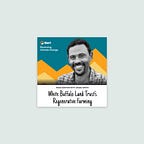

Listen on Spotify, Apple Podcasts or YouTube.
What is the gap between what farmers know now and what they need to know to farm more regeneratively? How do we close that gap?
What is the best way to advocate for the adoption of regenerative agriculture practices?
Jesse Smith is the Director of Land Stewardship at White Buffalo Land Trust, a 501(c)(3) nonprofit dedicated to practicing, promoting and perfecting the principles and practices of regenerative ag.
On this episode of Reversing Climate Change, Jesse joins Ross to explain how WBLT furthers regenerative ag through the development of products, training programs, and scientific research.
Jesse shares WBLT’s focus on teaching the integration of annual and perennial cropping with animal systems and offers advice on attracting young engineers, scientists, and creative artists to the regenerative ag space.
He goes on to discuss the benefit of ecosystem service payments, describing what he views as the unfair advantage producers have in regions with a higher potential for carbon sequestration and what markets like Nori can do about it.
Listen in for Jesse’s insight on using distributed ledger technology and blockchain to support regenerative ag and learn how you can support White Buffalo Land Trust and its consumer-facing brand, Figure Ate Foods.
More from the show
Ad-free episodes and other benefits come with a paid subscription.
Carbon Removal Newsroom, the news show that ran alongside this one, is over. Its episodes are still up, on the feed Climate Workers Anonymous now uses.
Carbon Removal Memes is still going.
Resources
Leah Penniman on Reversing Climate Change S2EP57
Center for Regenerative Agriculture at Jalama Canyon Ranch
California’s Healthy Soils Program
The NRCS Conservation Stewardship Program
USDA Local Food Promotion Program
How a Warming Climate Is Changing Wine on Reversing Climate Change S3EP10
Full Transcript
Alexsandra Guerra: You’re listening to the Reversing Climate Change podcast by the team at Nori, the carbon removal marketplace. This is a show about the innovators and entrepreneurs developing solutions to climate change.
Ross Kenyon: Hello and welcome to the Reversing Climate Change podcast with Nori. I’m Ross Kenyon. I’m the creative editor at Nori’s carbon removal marketplace. Today I have with me Jesse Smith, director of land stewardship at White Buffalo Land Trust. Thanks for being on the show, Jesse.
Jesse Smith: Thanks for having me here. I’m glad to have the opportunity to have the conversation.
Ross Kenyon: Me too. I’ve been enjoying your products for so very long. That persimmon vinegar, it haunts me. It’s a beautiful thing. What involvement did you have in that? We can start there.
Jesse Smith: Let’s start there. Okay. Well, yeah, I guess that’s an appropriate place to start because the process in that product development actually predates my work with White Buffalo Land Trust and actually predates the organization itself, White Buffalo Land Trust. So the product in which you’re referring is a naturally fermented organic persimmon vinegar made from Japanese Fuyu persimmons. And actually the genesis of it was going back to 2013, 14, when my family and I started managing a property that had organic persimmon orchards on it and really saw the need to value add persimmons during the season, specifically the ones that weren’t of kind of high grade.
But we also wanted to create a product that stayed out of the cold chain, that didn’t require refrigeration, and that the process itself of value-adding was one that was approachable and very low impact on our ecology and our climate. And hence, we went through a multi-stage process that included grant subsidies from USDA and product testing and aging. And what we have now is a great kind of foundation product in our persimmon vinegar product.
Ross Kenyon: So that’s just one example of a consumer-facing regenerative ag product, you might say. And there are others. And White Buffalo Land Trust has evolved in a huge slew of educational projects, communications projects, scientific work. Why don’t we introduce people to this whole thing? And then I can go back to talking about the persimmons. Really, the show is about the persimmons. And we’ll get back to that.
Jesse Smith: That was just a little taste. Yeah. Everybody needs a calling card for regenerative agriculture and we like to make ours delicious. So yeah, so White Buffalo Land Trust, we’re a 501c3 nonprofit based here in Central Coastal California with kind of a deep interest and mission to practice and promote these systems and espouse these principles of regeneration in agriculture. And through that lens, we really have these fields of focus that start with direct land stewardship, Boots on the ground, hands in the soil, scientific research and data collection, education and training, and then ultimately enterprise development, product development, giving people the choice, giving people the opportunity to make a difference in how they show up in the world, by how they surround themselves with the things, by how they choose what goes in their body, what clothes they wear.
And that’s really where we feel a lot of this work kind of rolling up. But we obviously need the background of the work being done, the data and research being accomplished. And we need to be training the next generation of farmers to go out there and grow this work.
Ross Kenyon: How big of a gap is there between what farmers know now and what they need to farm more regeneratively?
Jesse Smith: Well, I think that every land steward is going to have a different context in which they’re working and a different kind of set of obstacles and barriers that they’re trying to overcome. But each one is also going to have their own unique opportunities, their unique kind of selling point, if you will, their own specific opportunity to differentiate themselves within the marketplace. So I would say that many people, I think, who are maybe deeply entrenched and invested in a hyper-extractive and a high-input reliant system might have probably a further distance to travel.
It’s not to say it’s insurmountable, but when there is a certain expectation of both process and product of output, whether that be profit or quantity or commodity nature of having the output be very homogenous, then sometimes it’s a very... Big leap in order to understand that more diverse and nuanced systems of agriculture can actually provide a lot of the same value offerings that you’re looking for, but in a different capacity. There’s other people that really are just looking for some functional skill sets. You know, they know that they are already applying compost.
They’re already rotating their animals. They’re already diversifying their pastures or their cropping systems. But they’re looking for the next layer of kind of detail to really optimize their systems and seek new value opportunities within their system.
Ross Kenyon: What kinds of specific skills do you teach them? I saw there’s a lot of intersection with the savory. School of Thought and those methodologies. Is that is that broadly in line with what you’re doing?
Jesse Smith: Yeah, that’s definitely one component. I think that to back up, you know, we often think about regeneration and agriculture with these kind of pillars of soil and water and biodiversity and then, you know, the human systems that are kind of imbued to them all. But we also have a deep interest in seeing both animals and perennial systems being brought back into the context of agriculture. Our diets are very heavily reliant upon annual cropping systems and we have also separated our cropping systems, both annual and perennial, from animal systems. And so bringing those back into relationship is a big piece of what we do.
So in that sense, the Savory Institute and all holistic management practitioners, whether they affiliate with the Savory Institute or not, I think are really aligned with what we see as understanding the role that herbivores have in the historic evolutionary process of intact ecosystems, but also in where we see agriculture moving forward so that we can start to eliminate the amount of off-site inputs by increasing the amount of nutrient cycling that’s done on farm through the gut biome of herbivores in relationship with the soil biome that we’re ultimately growing our food in.
Ross Kenyon: Paint a picture for someone who is maybe less familiar with agriculture. I think when they’re thinking what you described sounds like old McDonald’s farm and what mostly exists right now is absolutely not that.
Jesse Smith: Is that still true? Which part? The piece that we’re trying to copy old McDonald’s farm?
Ross Kenyon: Just that you have like, it sounds like there’s diverse value streams. It’s not like you’re just growing soybeans at scale. It sounds like there’s herbivores running. You probably are moving pastures around. There’s different crops intersecting. There’s probably bees. Wouldn’t be surprised if you had some bees in the mix. You’re selling honey, something like that.
Jesse Smith: Yeah, and I think this is back to your original question or your previous question about where farmers need to go. What is the gap in knowledge that they’re looking for? And each one is the next best step. And so, you know, one project we’re working on right now is addressing keystone cropping system of almonds. I think that nobody can avoid the conversation that almonds are a significant player in the ecological systems of our landscape and the We see a major shift to alternative milks and almond butters. It plays a unique role in the context of all those.
Conventional almond production is very homogenous. It’s very flat. It’s very input-output. It’s very monocropping. When we think about animals and what their role might be in that, it can seem daunting at times with all the food safety and all of the logistics around machinery, but the Allman Project we’re working on is simply utilizing Herbivores in the form of sheep to graze a multi-species cover crop that is mineralizing compost that was applied in this orchard. And it’s a suite of practices that can be layered within a quote-unquote conventional. Whether you’re conventional or organic, it’s still a very conventional approach to almond production.
But we’re now including some of these suites of practices that are seeking to actually deliver outcomes that are regenerating landscapes. And so the animals have a role, even if it’s sometimes just replacing the role of a mower.
Ross Kenyon: So you have an almond orchard, and then you’re growing some sort of cover crop mixture, and you’re running sheep through them. And that’s in some ways replacing the synthetic fertilizer and also just mowing the lawn, you might say.
Jesse Smith: Yeah, that’s a very clear way of articulating all the complexities that go into that. And I think that sometimes that’s really important for both growers and customers to really Get presented these decisions that are made in really complex systems. So this project in itself is four 80-acre plots, two of which are our controls and two of which are our tests. And the two test plots, one is on our certified organic land and the other one is non-organic land. And we’ve applied compost, then planted a multi-species cover crop, and that can bring fertility back to the soil.
But to incorporate that, we’re actually... Putting sheep out there to graze the cover crop down. And as they digest and mineralize those nutrients, it’s then reincorporated into the soil. And so in a multi-year process, we will start to hopefully see these increases in soil health as a byproduct of using biology in order to, quote unquote, terminate understory crops such as cover crop instead of chemistry or machinery. But the healthy byproduct of that is that we have all these pollinators, we have bees, we have butterflies that are able to create habitat within that biodiverse cover crop as well.
Ross Kenyon: I have a gardening question just to ask you because I have been using multi-species cover crop mixes for a while and my yard is functionally just betch at this point. Do I need goats? What do I have to do to get rid of all this? It binds around everything. It’s beautiful. It looks healthy. It’s so happy. It’s too happy. How do I stop it?
Jesse Smith: Yeah, it’s funny because we have a lot of viticulturists. We’ve got a lot of vineyard managers who often... Have vetch in their cover crop, including us as well. And I’ve heard that reflection a few times that it can get a little unruly and sometimes you don’t want vines growing up your vines. But I think that you ultimately hit on the piece is that a practice by itself can’t be regenerative. I don’t believe in any regenerative practices. So a multi-species cover crop mix is not a regenerative practice. It is just a practice that can be implemented within a regenerative system.
And so it’s about process. It’s about management. It’s about adaptability. So if your cover crop mix has a species such as vetch that is unruly, that means there’s another practice that you’re missing in there. And it may be some herbivore. I don’t care if it’s bunnies or bees. Or deer or some sort of other grazing animals. And if none of that, it might be you as a human. It might be you out there with a weed whacker who has to chop that down and then somehow incorporate into your compost and your soil.
So it can’t just be a static, apply the practice and expect the regeneration.
Ross Kenyon: Great advice. Difficult advice. I mean, I think about how to integrate that into my gardening practice, but seems pretty sensible to me. Do you sense that there is a growing popularity of some of these holistic management ideas? Are people starting to see it? I’ve heard people say it sometimes is a replacement of labor for other types of investments because it does require a lot more brainpower, it seems like, to have all these complex systems interacting. Is that a correct way of understanding it or not so much?
Jesse Smith: Well, I think there’s two parts to your question. The first one was, do you see more people adopting these practices? And I think that’s a wholesale yes. I mean, you see this up and down the board. I don’t care if it’s the average gardener who is saying, oh gosh, I want to eliminate... Glyphosate to keep away my weeds and Roundup. I want to include more biodiversity to support pollinators and birds in my yard. And getting a lot more people who’ve just seen movies like Kiss the Ground or The Biggest Little Farm or Red Books.
But there are, you know, you talk about the corporate social responsibility and sustainability plans and the far reaching goals of multinational companies and corporations, whether they be focused on food or textiles and materials or factories. And all of them are looking – I shouldn’t say all of them. There’s a great number of the largest food companies in our economy who have deep commitments that they’re going down a path towards to really invest in regenerative agriculture and looking for outcomes in it. And you see this in the middle ground as well.
You know, you see family farms. You see production scale ranches all looking at this as a way not only of kind of creating more resilience – On their landscape, but also hopefully to create more opportunity for enterprise to develop. Because as you just mentioned, the diversity of the ecosystem function that we’re looking for needs to also be matched with the diversity of enterprises that are there to support it, whether it be honeybees or a lamb operation or, you know, harvesting your hedgerows. But that’s also part of the kind of the repatriation of our rural landscapes.
That’s part of actually providing job opportunities for people in healthy living landscapes. And if you’ve been watching the writings on the wall, there’s people moving wholesale out of cities right now. And there are amazing opportunities that people are trying to create for people to bring the skill sets of engineering and science. And, you know, the creative arts back out to the rural landscape to support this regenerative movement of agriculture. So I guarantee you I’m biased in this because this is what I live and breathe every day. But I see it happening across the board.
And, you know, we have a nonprofit. Our funders are interested in this. The whole wings of their funding arms are devoted to regenerative agriculture. You know, our almond project is funded primarily through the almond processing company, through brands. They’re the ones that are wanting to see this happen. And then the people who are at our courses, our trainings in holistic management or our all hands-on training that are focused on the functional skills of composting or land design or perennial tree propagation. We’re finding people all across the value chain and land stewards from all across the region who are coming to this table.
So yeah, once again, it’s probably just the community of CI Swimming, but I see it everywhere.
Ross Kenyon: I’ve told this story before, but I did a farm stay more than a decade ago. And the people I did it with were first generation farmers. And I almost had a sense that this wasn’t something that you were allowed to do. Farming felt much more like a caste system, like your parents were farmers and therefore you are. The idea of someone choosing to be a farmer seems unbelievable to me, but it sounds like a lot of that is being driven. I imagine that some of these first generation people probably are willing to try things out a different way or break with the old model.
Although I’m sure you work with farmers who are also, you know, older style people who are looking to say like, this is no longer working for my farmers. It’s probably both, right?
Jesse Smith: A hundred percent. We actually just had a conversation this morning that revolved around a question that someone asked about how do we differentiate our offer, educational or training offerings from those that are just beginning farming and those that are kind of Multi-generational established farmers. The best answer I can give is we don’t because having them in the room together is what actually makes the engagement successful. And we just witnessed this in our last course where we had someone who was thinking about getting into farm Looking for land to farm on.
Had all these crazy ideas. These wide-eyed and aspirational ideas. And that was great. It was like there was no barriers to the imagination. And what we really need now is agriculture reimagined. But then they were sitting across the table at dinner from someone who’s multi-generation, who’s very X’s and O’s, inputs and outputs, but also seeing that there needs to be a shift for their family farm, their family ranch to be viable, to provide more opportunity, as well as to have the health of the land improve over time. And so they’re there learning together.
But there’s a great tempering. Both the hard line kind of conventional approach being like, oh, wow, I haven’t thought about that before. People are actually interested in that. There’s actually a market for that. And the person who’s just wide eyed and, you know, aspirational being like, oh, that’s right. I do need to put together a pretty strict budget and I do need to be very conservative about the expectations of time because everything takes more time and more money on the farm. And so those two together, I think, are what makes it key to where we’re headed in our next best step in this.
Ross Kenyon: What would you do to encourage more young people who are looking at careers, thinking of a career in engineering or science or something like that and attracting them to something agricultural? What work is being done on that?
Jesse Smith: Yeah, I think that’s one of the beauties of this work is that it’s multifaceted. We talk about a lot of our work being like the stewards of opening the multitude of doors that people walk through. Because some people are really interested in human health. Other people are really interested in climate change and helping fix that. Other people, it’s really kind of like appropriate technology. Like what tools do we need to be creating in order to support agriculture in the future? Other people, it’s data and science driven. What information do we need to be collecting to show ecological function?
And so through that lens, we all often ask, like, what makes you tick? What do you want to wake up every day, every morning and do? And then if you’re interested in this work, figuring out what your role is in it, what special skill set do you have that is going to contribute to the larger system that we’re working on? And for us, it’s global ecological function. And that’s the largest system that I believe that me as an individual can actually affect change on. And so similarly, I would suggest that people think about what is the largest field that they feel that their specific work, them as an individual, can actually affect change on through different nested holes.
And so I’m always really excited to have conversations with engineers and designers. My background is in design, visual communication design, product design, engineering. And so I love the design process. And I also feel like the design thinking and design mind is really how we’re going to shift the way we’re thinking about this work and this world and ultimately change our minds to get ourselves out of the predicament we may be in.
Ross Kenyon: How’d you go from design to agriculture? It probably looks seamless to you in hindsight, but I imagine it’s not for someone listening.
Jesse Smith: Yeah, for sure. And, you know, as many people probably would say, you know, it took a really good teacher at the right time kind of like saying something or doing something. And so someone stuck their neck out for me when I wanted to take a diversion from a conventional track and said, This designer, this young student wants to go take a permaculture design course in Germany for two weeks and I’ll show up on a weekend two weeks early so he can finish his presentations and take his final tests and stuff like that.
So he can skip out of town a couple of weeks earlier before graduation and go take this permaculture design. And that really, it shifted me from, you know, metals and plastics and woods and widgets and vacuum sealing and all this like stuff about creating products to trees and animals and water and humans and food. And so bringing that same design thinking to elements that evolved over time and ultimately trying to design systems that Avoided planned obsolescence at a great degree, but even could evolve and get better with age. And that was really what I was drawn to was designing systems that evolved with age.
And we were able to eat the bounty of them for generations. And that was really inspiring to me. I love food and it sent me on a wild rabbit ride.
Ross Kenyon: So many conversations have been like, It all started with the PDC I took way back when, and it was all downhill from there. Do you read any permaculture handbooks? They’re so design-focused, too. They’ll be like, this is the exact kind of mound you might want to do, or these are kind of like the shapes that might work. Of course, you have to adapt it to the exact environment you’re working in, but it does seem design front and center, at least to me.
Jesse Smith: Of course. Yeah, very much so. Oh, it’s root to permaculture and to holistic management and to biodynamics. There’s like a whole other lineage that falls through organics and organic production. There’s another lineage that’s very much in like soil health is soil wealth, like post Dust Bowl, you know, America, like we like the value of our country is actually in our soil. And then, you know, even others that are really kind of focused on just regenerative health, regenerative thinking, regenerative business and so now it’s really interesting to see how it’s all kind of coalescing in this kind of movement of regenerative agriculture.
But it’s also important to track those lineages because of how people show up and what they use as defining principles for what regeneration in agriculture is to them. Because there’s discrepancies in how people are defining it. Some people, it’s soil health and soil carbon. Other people, it’s, you know, equity, inclusivity, diversity. Other people, it’s, you know, really focused on animal welfare and biodiversity. And like, everyone’s right, you know, because that’s what needs regenerating in their relationship to agriculture. That’s correct. But it’s also important to communicate that to the public because they’re like, oh, well, why is everyone not agreeing on one standard of regenerative agriculture?
Yeah.
Ross Kenyon: Yeah, I’ve seen a lot of, if not fights, at least disagreement where I’ve seen Leah Penniman’s been on the show and she’s talked about George Washington Carver’s influence. And I think if you talk with someone like Bill Mollison, if you were still around, you’d probably say more about indigenous land management, probably. I’m not sure where he would go. If you talk to Rudolf Steiner and the biodynamic people, it’s all German mysticism, right? That stuff gets pretty out there pretty quickly, I think it’s fair to say. But it seems like all those places, they kind of all lead to the same broad neighborhood, right?
Jesse Smith: Yeah, and I think one of the things that I truly believe in is finding the common ground. You know, find the things that we can all really ground into and believe in and support and then bring our uniqueness, our unique essence to the table to really support that. And so... Yeah, I think there’s a general field that we can all agree upon.
Ross Kenyon: Very nice. What do you spend your days doing? What keeps you busy?
Jesse Smith: Oh, gosh. Other than being a father of a six-week-old, that’s keeping me busy these days.
Ross Kenyon: So you’re a full-time dad, basically. Why are you doing this podcast? You don’t have to do this.
Jesse Smith: Because I’ve got a wonderful wife and a great older sister for her. So yeah, I am a father, two beautiful daughters, wonderful wife who I get to work with. She’s the director of programs and engagement for White Buffalo Land Trust. So great family. I also spend a lot of my time in the decision-making process of what goes on at our Center for Regenerative Agriculture at Halama Canyon Ranch. It’s a thousand acre property out here at the central coast of California. We have a five acre vineyard. We run two herds of livestock or cattle finishing operation and a resident goat herd.
And we have a lot of kind of restoration projects that are just kicking off right now that I’m in planning process. We’ve got a few different grants, both through the USDA. As well as the NRCS. So we’re just, you know, we’re designing hedgerows. We’re working on kind of riparian planting for tree and shrub establishment. We’re increasing our ability to store water, move water, measure water. And then we have a fantastic kind of research data team that I work closely with To set the kind of the methodologies by which we collect soil samples, by which we monitor biodiversity.
And so a lot of my role is kind of like that intermediary of all the things that happen out here at the ranch, whether they be education focused, science focused, or the actual land management here on the property. So yeah, I try to balance my time as well as I can, both for field work as well as desk work. As many farmers who are both advocates for this work may attest, it skews a little bit too much for my liking to desk work, but it’s kind of the nature of the beast.
Ross Kenyon: In your interaction with NRCS and others coming from the public sector, are you seeing a lot of engagement from the policy world? Are things improving?
Jesse Smith: I think that we find more and more the language of government granting agencies starting to move a little bit more towards what we would want to see. For practical kind of implementation. But I think that there’s also a little bit of a language learning as to where we can derive meaning in kind of government granting agency language to apply it to what we want to do on the land. And so I’ve noticed with the Healthy Soils program, with the NRCS EQIP program, with even our Department of Conservation here in California, where we got a conservation easement in our process, purchasing access to steward this land.
There was a lot of negotiations along the way around what we intend to do and what we have authority to do. But specifically the Healthy Soils Program and EQIP funding, I think is just really amazing opportunities for land stewards that want to do this work, that want to establish habitat, that want to support their waterways and riparian buffers and want to do some really great kind of work with livestock. There’s funding out there to support it, especially if you’re already planning on doing it. And that’s really where we want to show There’s opportunities to say, hey, I think that’s their new CIC program.
There’s an incentive program through EQIP. And there’s another one that CSP, I think it’s like the Conservation Stewardship Program. And those ones verge on, hey, this is something that you’re already doing, even if you’ve already gotten government funding to do it. If you continue to do it, we’ll continue to support you and fund you to do it. So, yeah, we’re trying to bring as much into our community as possible, demonstrate the hurdles that it takes to go through to get the money and then share more openly what we feel are valuable avenues for people to do context relevant work in this region.
Ross Kenyon: What’s the relationship between White Buffalo Land Trust and Figure Eight?
Jesse Smith: So Figure Eight Foods is the food brand that is currently wholly owned, White Buffalo Land Trust, our nonprofit. And so it was developed actually also in collaboration with a government grant. This was a USDA grant that was, it’s called an LFPP grant, the local food promotion and production grant that we received at the end of 2019. It supported the growth and development of our persimmon vinegar product, as well as allowed us to create a specific entity and going through a branding strategy process for an actual overarching food brand, which was what became Figure Eight Food so that we can bring new products to market.
And so our most recent SKU that we’ve actually released in the last couple of weeks is a grass-fed, grass-finished beef biltong. And this is carrying... Both the certified humane mark, the American grass-fed mark, as well as the fairly new but outcomes-based land-to-market seal that was put out by the Savory Institute. And this is, once again, a naturally cured with salt and vinegar, never heated, delicious beef snack that also comes from a landscape that is quantifying their carbon drawdown as being negative over the life cycle of their beef production.
Ross Kenyon: I didn’t mean to neglect the biltong because I’ve been snacking on that for some weeks now, in addition to the persimmon vinegar. Sorry, I don’t mean to show favoritism, but that biltong is very good.
Jesse Smith: Well, you’re getting both. So we were excited that we were able to use our persimmon vinegar in the curing process for the beef biltong. So you get a little taste of both.
Ross Kenyon: Yeah, I didn’t realize that, but that’s pretty fantastic. One question I had in relation to having a consumer brand is my understanding as a non-farmer is that many farmers would like to break out of the commodity market. They want to be a direct consumer brand. They’re able to take more of that money home when they can. They have way more control. But it doesn’t seem like there’s enough room for everyone interested in regenerative agriculture to become their own brand. Oh, I see a head cock, so maybe I’m wrong. But if, okay, accept that premise for just a second, and then you can challenge it later.
I’d like to hear that. But is there room for a commodity market for regenerative agricultural products?
Jesse Smith: Oh, yeah. And we probably should have gone sans video because my head cock was just a stretch. I agree with you. No pushback there necessarily. I think that there are some unique opportunities for producers to bring products to marketplace where they are able to control the narrative. Gain as much of the market value add as they can, but it’s not for everyone. A lot of people don’t want to be the ones who are working to figure out the next packaging challenge or doing label reviews with the FSIS for What is claims being made on your path?
It’s been a big hurdle to launch these products. And we knew it, but we wanted to see what it was like because then we can really start to understand what the true cost of bringing products to market is. From being a producer ourselves to being able to go direct to our customers. And through that knowledge, we can understand what it’s going to take As far as a price point to support producers doing the work that we know we need them to be doing on the land base. And so, you know, obviously we get a lot of people asking, well, you know, are regenerative products going to always be more expensive?
Why are regenerative products so expensive? And the same questions were asked of organic products. And I think that the most simple rebuttal is, well, why are conventional products so inexpensive? What’s not being calculated in that process in the externalities? And so the figure eight food brand is a small but growing player in this natural products ecosystem that is really invested in bringing products to market, Source from producers that are caring for their land, caring for their water, caring for their soil, caring for the wildlife and biodiversity that revolve and caring for the people that are stewarding them in a way that really lives up to whatever standards you want to use.
You know, there are there are multiple out there. You know, animal welfare is one. The biodynamics is a great one. The regenerative organic certification is out there as a soil carbon index is out there. Some people are going the carbon credits route and just decoupling the price of their crop or their produce from the ecological function. They’re selling ecosystem service credits. But our brand really wants to be a beacon in the marketplace where people know that when they’re buying this, this is having the impact on the land and in the community.
That their values and their intentions are aligned with. And I’m sure that there will be others. Ours, you know, right now is 100% owned by the nonprofit. So all proceeds go back to continue to support our work in education and research and land stewardship.
Ross Kenyon: Do you worry about the regenerative label being misused, greenwashing? You probably, if I had to guess, you probably think it’s already happening.
Jesse Smith: Is that right? Oh, don’t put words in my mouth, but I think. Okay, sorry, correct me. I think that there’s always a risk of banalization of complex concepts and complex systems for the sake of Clarity for the hope of clarification, but ultimately what happens is simplification. And I think that complex systems can be communicated clearly with well-designed communication strategies. But what we end up doing is trying to dumb it down to, you know, the pieces that are just, you know, we can latch on to, we can have a signbite, we can have a little post about, and it’s something that we’re constantly trying to avoid and ultimately is a difficult terrain to navigate.
What I would say to that is that many of the marks that we’re seeing evolve out of this regenerative movement are, I would not jump to the conclusion that they are greenwashing. I think that they are communicating to a specific audience that has a shared set of values. And what I would ask of each of them and what I have yet to see Anything really overtly egregious towards is to continue to value all the other components of a holistic system of regenerative agriculture, even if it’s not your leading statement, even if it’s not your tagline, such as a carbon credit.
Carbon is, of course, important, but let’s not forget about water cycles. Let’s not forget about biodiversity. Let’s not forget about animal and human welfare. It can be, even if it’s just mentioned and it’s paid a little bit of a lift service, in your mark, that is important to make sure that people don’t come to the table thinking that carbon is the only thing that’s important. And so that’s something that I’m constantly looking for is that people are trying to strip away what they think is extra in service of just a simple, clear communication.
And a lot can be lost in that. And that’s where I think we sometimes verge on dangerous ground of vanalizing this concept of regeneration in agriculture.
Ross Kenyon: Very good insights. I’m not surprised to hear you say it, though. One of the classical criticisms of Alan Savory and holistic management is that it’s so contextual that everything so depends that it’s non-falsifiable. And it’s just, there’s just kind of a big jumble. I’m not sure what you might say to something like that, but maybe that’s just the truth. Maybe everything is so contextual.
Jesse Smith: Yeah. But I think that once you take a step into it, like it’s, it’s one of those things where from afar, if you showed up on the outer skirts of our atmosphere and look down at humans and earth and gosh, like this is just like, this is a mess. Like this isn’t Substack, Substack, Substack, Restack, Restack, Restack, Restack, Restack, Restack, Restack, Restack, Restack, Restack, Restack, Restack, Restack, Restack, Restack, Restack, Restack. That right there is very, very logical. It’s very static. I mean, you know, Alan Saver derived the grazing planning chart that he has used and people have used all over the world for managing complex system.
So I’m going to talk a little bit about how to do that. That knew that ramification, the trickle-down effect, the ripples of that decision were going to change everything else. And you needed a framework to make decisions through. And that’s really what it was about was a framework for making decisions through. What he always comes back to and what I always talk to as well is that what we’re talking about making decisions within your complex context. And so no one’s going to deny the fact that every situation is unique. So we just need a framework to organize that.
Ross Kenyon: Someone who works in carbon and carbon pretty much primarily and everything else secondarily, what am I at risk of missing?
Jesse Smith: Well, one of the pieces that we’re really noticing is the unfair advantage of people working in a carbon market in regions that have a much higher potential for carbon. Sequestering carbon. And for some people who just have a much lower potential of sequestering carbon in their landscapes, entering into a carbon market just doesn’t make sense. It doesn’t make sense from a fiscal responsibility perspective in some situations, unless you have either a large conglomerate of land or a low buried entry of the data collection and remote sensing, all those things. So therein lies the piece of where in that context do we need a credit marketplace that is in service of the ecological functioning of that landscape that needs to be improved.
And for us out here, a lot of times in the West, the carbon cycle and the water cycle are so intrinsically linked. And so we need to be really looking at what a carbon market looks like in tandem with a water market. How do we increase hydrological function in our arid Mediterranean kind of drying landscapes? Because if we can increase the water function, we’re going to increase the carbon sequestration potential. But it might not have to be a one-to-one. One, for the person working in the Midwest for sequestering carbon. But if we can find exponential leaps and bounds in how we slow water in our landscape or how we increase the porosity of our soils or how we reduce the erosion and the sedimentation of our water.
Then we can start to see where the value really lies in coastal communities and fish spawning grounds and riparian buffer expansion. But it might be the wrong moniker to be hanging our hat on when we talk about carbon, maybe more about water. And I know that brings in a whole other layer of complexity for you. And I think that’s where we need to be looking.
Ross Kenyon: Really an important design decision and doing one thing well itself is enormously challenging. Just getting the carbon part right where it’s not glossing over things that should not be glossed over. I mean, it’s taken years for us. And I mean, you’ve seen plenty of carbon markets fail and fall flat on their face on this account. So I can’t imagine also having to keep a track of water to the same level as carbon. I think we need Much more funding, a much huger organization, and the likelihood of failure would be so increased that maybe we do neither of them well.
But I don’t know how to solve that then. What do I do? Solve my company for me.
Jesse Smith: Yeah, well, you don’t need to know how to solve it. I mean, that’s the thing is that, like, I think if, you know, let go of the expert mentality. Like, you don’t need to be the expert in this. I think that what we’re finding over and over again is that if there is a community of people that has shared goals that Then if the entity that’s taking a leadership role is very open in their unknowing, that people are also flocking with resources, both financial and intellectual, to support that cause. And I guarantee you that there is a lot of people out there that are looking at water, water systems, water cycles, and water monitoring a lot more than you are.
Definitely. And they are probably also engaged in this conversation, even if they haven’t evolved a platform such as you have for carbon. And so it’s not about having to necessarily figure out both, but it’s about understanding who else needs to be in the room. What are the strategic partnerships that you need to be curating? And sometimes avoiding the, how do I fix this problem? But instead asking, well, what is really required to shift this system that I’m looking to shift?
Ross Kenyon: That’s good advice for many things beyond just this specific application. Yeah. So are you interested in any sort of ecosystem service payments, water, wildlife, carbon? Does that interest you or are you a bit more tepid on it?
Jesse Smith: No, I think that we’re pretty bullish on that. We’ve gone that route from day one, knowing that to really see the significant change that we hope to see in ecosystem service payments and credits is Being widely available to farmers of all sizes and regions and access, we have to start going forward through as many processes as we can to learn because we are a demonstration. We’ve got to push the envelope and then reflect back to the community what we’re learning, what’s working, what’s not. I mean, our first inaugural benefit at White Buffalo Land Trust, we offset all of the transportation of our guests, The transportation of our food and I can’t remember all the calculations that went into it, but we essentially purchased carbon credits through Nori.
It was a way for us to just open the conversation up to the 200-plus people that were at our benefit, that this is the emerging marketplace. I think we had a handful that came out of that who were like, oh, great. My family offices, we want to offset our carbon. Can we do that through Nori? I’m like, yeah, here’s a contact. Give them a call. It started the conversation around, oh, wow, this is something that’s emerging, that’s possible. We’ve also been exploring – The Regen Network and their blockchain-based ecosystem service platform that brings in co-benefits.
So looking at water and biodiversity and some of the specialty markets there, there’s also been exploration around instead of outcomes-based credit markets, practice-based credit markets, knowing that some of the same quantifiable products Sequestration rates might not be seen in certain ecoregions, but that’s not to say that those producers shouldn’t have similar access to resources to support their implementation and practice shifts, knowing that there are going to be co-benefits and kind of a more kind of cascade of benefits in the ecosystem, even if we aren’t able to measure those specifically. So a practice-based credit market.
So it’s something that we’re really interested in, both the financial opportunities as well as trialing the different methodologies for data collection in order to back them up. And so we have actually a project with a series of grad students with our local University of California, Santa Barbara institution that just began last week, a project to look at These different on-farm data collection methodologies, both through field collection as well as through remote sensing, and how we can also use that to calibrate remote sensing from drones or satellites to really lower the barrier to data authentication and verification.
And hopefully the kind of buttons we keep pushing and the roads we keep traveling down Will benefit not just us, but our whole region and the larger system that we’re seeing evolve around ecosystem service payments.
Ross Kenyon: Yeah, a lot of good thoughts in there. And remote sensing and imaging is very interesting too. And we would like it to be, you know, a small farm that exists. It would be delightful if they could also easily pay for verification and then for the juice to be worth the squeeze for them. But sadly, it’s still far off from that being accessible to just about everyone. You also make a really interesting point about why markets that focus primarily on practices rather than outcomes are so important. I don’t think I’ve ever thought about it quite that way, but if you think there’s a fundamental unfairness based upon the soil type of your region, but you still want people to be practicing regenerative ag in some way and to be rewarded for it, practice-based methodologies for getting those people paid, there seems to be some sort of fairness in there.
I’m not sure exactly how you would Quantify the value of it against something that’s more clear, like a tonne of carbon dioxide or equivalent. I don’t know if you have thoughts on that, but I think that is a very important point.
Jesse Smith: No, I 100% agree. I don’t know if I have thoughts on it yet, but I have some thinking on it. And I have been thinking.
Ross Kenyon: That’s a good line. Okay. Share the thinking.
Jesse Smith: I have been thinking a lot about this because I am a big proponent to, as a fundamental principle, that regeneration is an outcomes-based process. We want to see regeneration actually occurring. And I will stand by that. And yet, I am also really interested in how we can start to tip the scales of adoption. And as many producers have reiterated, a lot of And so if we tie the financial incentives to the outcomes, then back to everything in its unique context, then the same methodologies for data collection and the same payment rates for carbon sequestration are not going to be quote unquote fair across the board.
So is there room for kind of that kind of egalitarian approach to supporting farmers and ranchers to then rely upon practices? And even maybe that would start to need to shift based on price of compost in your region or the cost of labor in your region or distance from material source in your region. These are all questions as well. I think it’s an interesting approach.
Ross Kenyon: Jesse, it sounds like from mentioning Regen, mentioning Nori, that you have some interest or at least comfort with crypto. Is that an accurate take?
Jesse Smith: Yeah, it’s something that I think is an emerging technology that we at White Buffalo Land Trust and myself personally have been really interested in as it applies to kind of the decentralization of information and the kind of democratization of authenticity and verification and very similar to kind of farmer networks, like peer to peer networks, like so much of the value relies in the fact that, you know, there is a shared set of values amongst it. And so we’ve looked at it both as kind of a technology that can support our ecosystem service payments.
I believe that there’s also a lot of opportunity for the ability of distributed ledger technology to provide asset holders access to experience, access to product, access to different functionalities within this space. Holders know all about kind of what is being explored with smart contracts. But when we can really start to automate a lot of the kind of transactional issues of doing business, then you can build a lot of amazing opportunities for people to kind of hold value within a network. And so we’re also exploring NFTs as a tool for value creation for our organization, our nonprofit as well.
Ross Kenyon: I’d donate to you guys. Auctioned off an NFT, I might issue a bit on it. Is that something like you might have in mind?
Jesse Smith: We have one in the pipeline right now. So keep your ears open and please join our mailing list because we have some fun stuff on the horizon, both revolving around our first wine release and our vineyard here, as well as something that’s working in the works that is kind of backed and represented by the different Land-based and ecological base here at the Center for Regenerative Ag. So yeah, we’ll make sure you’re in the know.
Ross Kenyon: Yeah, a wine release. We just released a podcast on wine recently. I’ve been fascinated by wine of late. Are you able to say what it is or is it still secret?
Jesse Smith: Yeah, we’re really excited about our partnership around the grapes that came from our small vineyard here at Halama Canyon Ranch. Our partnership with Sandi Wines, Rajat Par and Sashi Mormon. And we’re working collaboratively with them on a unique kind of buyer’s club for our wine that is held within NFT holders. And so access to the limited allocation of this year’s Pinot Noir is going to be released through there. But also it will give access to other products that come from our property as well. Looking at things like our first release of olive oil and some grass finished livestock as well.
So yeah, we’re really excited about the project that’s in the works and details to come.
Ross Kenyon: Oh man, this is like custom tailored to my interests. There’s a Central Coast Pinot that NFT holders get access to that is also regenerative. Yeah, I’m like your ideal customer actually, Jesse. That’s me. You should put all your advertising by me. There you have it. I’ll tell you if it’s good or not.
Jesse Smith: Fantastic. Yeah, we’re really excited about it. And I think it’s really interesting to us to also explore what is innately unique to Web 3. 0 and distributed ledger technology. We often like to think about what have we been doing that can now just be done on chain? And we’re trying to explore what have we been unable to do in the past That now is only available to be done on chain. And that I think that’s a core question about this kind of integration of Web 3. 0 and distributed ledger technology and crypto and how it can support different forms of agriculture and community building and bringing value to producers.
And there’s obviously still open questions around just the carbon footprint of distributed ledger technology, whether we’re talking proof of work or proof of stake. And I don’t know where your audience lies on that spectrum of understanding. So maybe we don’t open up too much of that can of worms. But it’s something that we’re constantly asking questions of ourselves, of our partners, and exploring where that’s going in the future and trying to align ourselves with the right cause of work.
Ross Kenyon: Well, you guys are so creative. I love what you do. I’m happy to contribute to your work. I’m happy to eat the things and drink the things that you make. If someone’s listening and they also would like to join me in supporting your work, what’s the best way for them to do so?
Jesse Smith: Yeah, I think first and foremost, getting to our website and signing up for our mailing list. We put out all of our content and information there. Follow us on Instagram. We do a lot of smaller posts through our White Buffalo Land Trust Instagram. Figure8foods.com is our website for our food brand. On our website, you can check out to see that we are hosting our second benefit. We haven’t hosted one since our inaugural benefit in 2019. So we have a benefit coming up on May 14th. Tickets are almost sold out, but I think we still have a few tickets in there.
It’s going to be an amazing celebration of land, of culinary, of viticulture. And we’re really excited about kind of bringing our community together once again to really talk about our work here in this region, but also kind of our regional work with other regional partners for anyone who’s excited about Traveling the world and tasting good food and wine, we’re auctioning off some amazing experiences at Stone Barns and Blackberry Farm and our own ranch, as well as a fantastic winery and biodynamic farm in Provence, France. So for people who want to come out and support and dine under the full moon, it’s called Roots of the Future 2, Healthy Soils, Healthy Seas, and it’ll be on the coastal bluffs of Santa Barbara on May 14th.
Yeah, we’re really excited about hosting another fantastic little get-together.
Ross Kenyon: I’m looking at this right now. It looks amazing. I wish I could be down there for this. If you would like to try any of the products that we’ve described here, you can go to figure8foods.com. That’s A-T-E. If you join their mailing list, it’s 30% off your first order. I love this stuff. I could live off that persimmon vinegar. The biltong is delicious. I want this wine. I’ll basically try whatever you guys put out. I’m a big fan. Thanks for being here, Jesse. It was fun chatting with you.
Jesse Smith: Hey, always a pleasure, Ross. Thank you so much for the invitation. And yeah, very grateful that there’s people like you spreading this message and inviting people on to have conversations like this. So yeah, very grateful.
Ross Kenyon: It’s my pleasure. If you like what we do here, please send this to a friend, post it on social media, give us a great rating and review on Spotify or Apple Podcasts. Thanks so much for listening and have a great day. Follow us on social media. We will catch you next time.


