

Data in the music industry is incredibly fragmented. There is no one consistent place to go for information about a work. It’s hard to know where songs are being played or who was involved in creating a piece of music. And this means that a lot of artists don’t get royalties for their work.
What if blockchain technology is the answer?
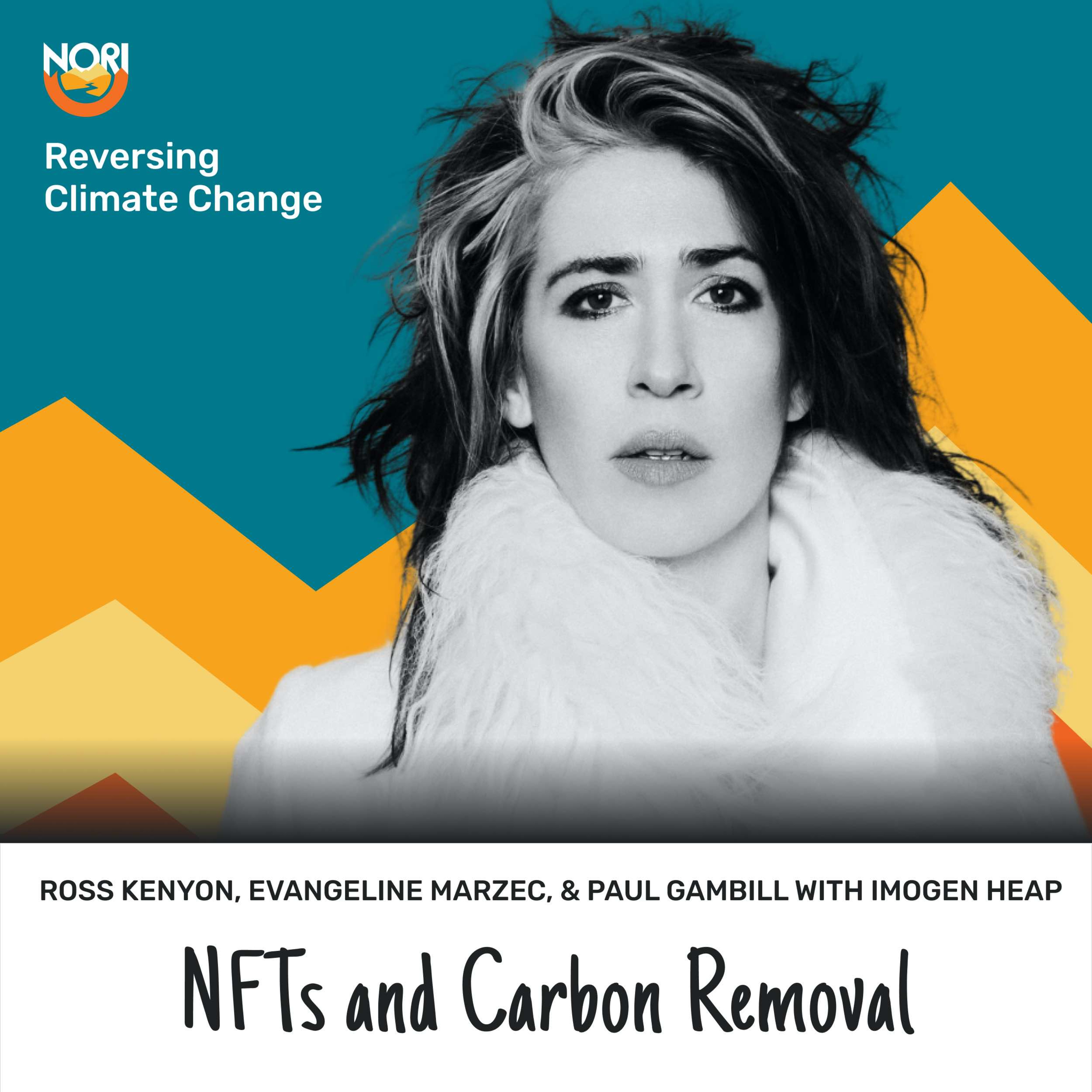
Imogen Heap is the Grammy Award-winning singer-songwriter and record producer behind The Creative Passport, an identity management platform for music makers that runs on the blockchain. On this episode of Reversing Climate Change, Imogen joins Ross, Paul, and Evangeline to explain how the music industry’s challenges around crediting and payment inspired her interest in the blockchain space.
She weighs in on why she launched a collection of non-fungible tokens (NFTs) to raise funds for The Creative Passport and how she devoted a portion of the proceeds to Nori to offset the carbon emissions associated with minting those NFTs. Listen in for Imogen’s vision of a more diverse commercial music industry where artists are empowered to host their own data and share it with others on the blockchain.
Resources
Vinay Gupta’s Hexayurt Project
Paul’s Post on Removing Carbon Emissions from NFTs
Also on this show
Kim Stanley Robinson chats The Ministry for the Future, blockchain and macroeconomics, February 2021
Will NFTs go carbon-negative? With Alexander Salnikov of Rarible, May 2022
Funding for crypto-enabled climate solutions, with Ben West of Gitcoin, November 2022
More from the show
Ad-free episodes and other benefits come with a paid subscription.
Carbon Removal Newsroom, the news show that ran alongside this one, is over. Its episodes are still up, on the feed Climate Workers Anonymous now uses.
Carbon Removal Memes is still going.
The books that come up on this show are collected on my Bookshop shelf.
🎧 Apple Podcasts · Spotify · YouTube
Paid subscribers get this episode ad-free. The ads in the free feed are inserted by Spotify when you press play. They are not in the file I make.
Full Transcript
Ross Kenyon: You’re listening to Reversing Climate Change, a podcast by the team at Nori, the carbon removal marketplace. This is a show about the innovators and entrepreneurs developing solutions to climate change. Hello and welcome to the Reversing Climate Change podcast. I’m Ross Kenyon, I’m the creative editor at Nori’s carbon removal marketplace. Today I have with me Evangeline Marzec, who is one of our colleagues here at Nori. This is your first co-hosting experience. Welcome, Evangeline.
Evangeline Marzec: Hi. Thanks for having me.
Ross Kenyon: So good to have you. You’re Nori’s head of product, and there are good reasons for having you on the show, as we will reveal as we go on. And also Paul Gambill, Nori CEO. Hey, Paul.
Paul Gambill: Yes, I’m back.
Ross Kenyon: You’re back — back for many, many appearances. We’re so pleased to have one of Nori’s customers and partners here: Imogen Heap, artist, tech innovator, longtime Ethereum supporter, and recent partner of Nori’s in getting the emissions from your recent NFT minting. Hey, Imogen.
Imogen Heap: Hello. Very happy to be here with you all.
Ross Kenyon: I’m really sorry to have to do this to you, Imogen, but generationally I just so thoroughly associate you with Garden State. Is that okay to say? Does everyone say that to you?
Imogen Heap: That’s okay. No, you’re either in the Garden State camp or already in the O.C. camp. So I think you’re slightly cooler. That’s good.
Ross Kenyon: Oh, thanks. Yeah, there’s an independent movie theater in Phoenix, the Camelview, which sadly is shut down now. But this is where all the cool kids from high school would troop out to watch smaller, independent and foreign films. And I was one of those pretentious kids, and I remember watching Garden State in the theater. And yeah, very prominent in my memory, and so a lot of surreal nostalgia is happening for me right now. So thanks for indulging that.
Imogen Heap: Hey, does that go — [unclear]. What are you waiting for? Extra nostalgia for you?
Ross Kenyon: I didn’t want to ask you to.
Imogen Heap: You didn’t think— I would never have done it if you’d asked me. Okay. [unclear] That’s, that’s — yeah, quite a thing for me. But I’d like to very much thank Braff and the team there for making such an awesome soundtrack, because it kind of set off an era of brilliant soundtracks that, you know, lifted quite a lot of artists out of obscurity and gave a lot of us our first legs into the industry on a wider scale.
So it was just, like, kind of annoying, the timing, because I was in that band Frou Frou — me and Guy — and we were through and through and through, except that that film came out about two years after we split up, because basically nobody was giving us any breaks at all. You know, the label didn’t push us in any way and it was all a bit sad, and so we just thought, well, we can’t make a living like this. Let’s just go off and try and make a living doing our other things. And then about a year later, actually, the Garden State movie came out and everyone was like, who’s Frou Frou? I want to go see Frou Frou. Frou Frou, Frou Frou — and we were nowhere to be seen. So it’s very sad.
Ross Kenyon: That is sad. That montage, though, with “Let Go” — that’s got to be the thing that everyone remembers, certainly the first thing I think of. That, plus where his wallpaper and his shirt match.
Imogen Heap: I think of that too. Yeah. Yeah. What was that song? I can’t remember. But yeah, that was a perfect moment.
Ross Kenyon: Well, okay, I’m happy to take a stroll down memory lane, but also there are important things to discuss here. Particularly, you’ve been involved in the blockchain space longer than many, many people. How did this— and why is it important to you?
Imogen Heap: Yeah, it was about— it was almost exactly six years ago, but longer. My friend Zoe Keating was around my house. I’d just given birth to a very lovely daughter — Scout is now six and a half — and I was just lamenting the state of the music industry and how frustrating it was that we couldn’t just organize data better, and that there wasn’t one consistent place which everybody went to for information that was verified about a work. It was really hard to know where songs were played and who was involved in songs; there were hardly any credits anywhere other than, you know, you used to have them on liner notes. But I feel almost like a mother — [unclear] — but, like, a mother to my songs, and I am responsible to make sure that everybody is credited correctly and that they’re paid correctly.
And it’s quite an arduous journey to make sure that that happens, because you’ve got to get lots of identifiers, et cetera, et cetera. So I was just kind of hoping that there would be this one place, and when I heard about blockchain tech through Zoe, I just felt that there is something in this amazing tech that needed a bit more attention. And I just got very kind of obsessed through many nights, and then spoke to a few people, namely Vinay Gupta. He was the launch lead of Ethereum, and he really inspired me to just go forth and think more and do some hacks and explore what we could do and think about smart contracts. And so he was a big influence in why I had the energy, or the guts, to do anything, because he was like, yeah, this is a great idea, you should go off and explore, I’ll help you. And he came to our hacks, and then I had many conversations with him. So yeah, he’s a big influence.
Paul Gambill: That’s so cool, I didn’t know that. Yeah, we’re pretty good friends with Vinay as well, and have partnered with Mattereum, his current company, on some stuff.
Imogen Heap: Yeah, okay. So what did you do with Mattereum?
Paul Gambill: Well, maybe a very similar thing to what you did, actually. So they wanted to make carbon-neutral gold transactions, Mattereum.
Imogen Heap: Yeah. And then he’s got this whole other thing about his Hexayurt.
Paul Gambill: Oh, really?
Imogen Heap: Yes. It’s to create these, like, you know, housing for disaster spaces that need housing. And that’s his whole kind of drive, I think, to make sure that that happens. But in the meantime he’s doing these awesome things. He’s just like a man of wonders.
Paul Gambill: Yeah, deeply inspiring. We got connected to him through this other blockchain project that we were friendly with a couple of years ago, when Ross and I [unclear] one day. And I think that was in 2018, so yeah, that would have been like three years ago. And we managed to get some of his time, and we had the most wild three-hour conversation, talking about, like, the future of refugee nation-states and satellite guns and AI drone warfare, but also, like, dating apps. He’s got some thoughts on all of it.
Imogen Heap: Yeah. Yeah. He’s really amazing.
Ross Kenyon: Yeah. Is your main interest in blockchain primarily about the crediting and the payment for musicians? I have friends in the music industry, I know it takes a very long time to settle and get paid for various types of sales, especially digitally. It’s not very transparent, it doesn’t seem very artist-friendly. I see a lot of complaints from my musician friends. So you’re trying to untangle that entire confusing nexus?
Imogen Heap: Well, I think really all I really wanted to do was just kind of share the [unclear], like other musicians were doing as well at the time. I just for some reason got a bit more airspace. I just wanted to share a vision of a future for the musician, and kind of help drive any music industry executives that might want to be thinking about what they might be doing in five years’ time, to have a goal — a more sensible, transparent future that’s sustainable for musicians, rather than, you know, always having to fight our tiny corner. And to enable them, and empower the music industry to always be ahead of the curve, rather than having to fight for scraps.
For new services who want to innovate in the space, it’s hard for them to do so because the data is disorganized, which means they often go to the major labels, because that’s where the only slightly organized data is, in large volumes, with the songs. And then we get our Spotifys and [unclear], et cetera, et cetera, and Apple, obviously — iTunes, Apple Music it’s called, sorry. But then, in the process of doing that, the labels get chunks up front for the privilege of using their music, which the musicians don’t see any of. And then they negotiate these tiny royalty rates, because that doesn’t really matter to them, because the labels have big chunks. And it just makes it hard for any future music service, any music service, to innovate, because there’s this huge financial leap that they have to do, which means VC funding. And I just want to make it easy for services that have great ideas to be able to just get out there and do them, and create more opportunity and diversity in the commercial music space, so that we aren’t just left with a few big companies dominating the environment for distribution of music, and kind of make it more possible for others with bright ideas to do the same.
And I think that the future is in the identity layer: how can we enable and empower musicians to host their own data, decentralizing their own data, and be able to collectively have a really amazing, huge amount of data that’s very useful for services to be able to build new things on, but without those barriers? At the moment they don’t have a mechanism to do that. We’re like at the end of an email or a LinkedIn page. So that’s what this Creative Passport thing is all about, really. That’s kind of after about three years of — I didn’t ever want to make anything. I literally just— I would have been quite happy to just try and make music again after the birth of my child.
But then, through the imagination of this ecosystem that I called Mycelia — which is really just a metaphor for a kind of living, breathing music space where everything contributes to everything else, and it kind of creates these nice loops, and we don’t have just one massive [unclear] and all these tiny little weeds trying to make it, or tiny little saplings trying to make it, and they’re all dying because they can’t get to the light. But Mycelia is enabling us to all see the light and get what we need, the nutrients, which is kind of the music makers. And I just feel like if that bit was organized and sorted, and we were able to share, publicly and privately, data that was useful to the industry, then we could really shift things around and become the dominant force, which we are, but we’re disempowered because we don’t have a way to connect.
I kind of saw in those early hacks tons of companies. I went to, like, a million conferences and did my bit, and loads of music services would come up and they’d show me their awesome things. And [I’d say] how are you dealing with the licensing? And they’re like, oh God, we’re just trying to do our licensing and it’s so hard. And then none of them see the light of day. And it’s just really a shame, because billions of pounds get wasted every year at that hurdle. So yeah, that’s what we want to try and do: just to make it easy for people to innovate in the space, and for musicians to get their data organized, to be prepared for any future exciting things that may happen.
Ross Kenyon: So why did you choose NFTs as the specific solution? And when you talk about NFTs, do you describe that in a specific way to the artists and the folks in your collective?
Imogen Heap: Yeah, I didn’t consider that as being a solution. I was hoping that that would be a possibility to raise funds for our project that we’re doing, because it’s self-funded primarily by me, thanks to Harry Potter play income, because I made the music to the Harry Potter play. But then, of course, when the pandemic hit, all that money just disappeared — like 75 percent of my income disappeared overnight — and all those people that I’d hired for the Creative Passport, and my own team, to kind of build out other projects were all in jeopardy, you know? So we did have furlough, but it didn’t cover quite a lot of the other stuff that was going on. So we just needed— we were hoping that there might be a silver bullet in my relationship to blockchain of the past, that that might suddenly mean that I get, you know— even people who believe that I was there at the beginning of Ethereum [would say], let’s give her a chance, [unclear] money with her NFTs.
But, you know, I realized very quickly that that just wasn’t going to happen, because just like anything, releasing music — you can’t just suddenly release music and expect it to make, you know, bags of money, no matter who you are. You still have to go out there and let people know it’s there, and do the marketing, and live the life, and get on Clubhouse 24 hours a day and promote it. And I didn’t do that, because I just didn’t. I don’t know, I was just naive, like most people. I thought, oh, NFTs are like a success pill, because we only heard about the really extreme successes of, like, millions of pounds. So there was this kind of gold rush idea that we could all suddenly finally be able to earn money with NFTs. But it’s misguided, because it doesn’t show you what’s under the tip of the iceberg, which I was one of. But that’s okay, because it still raised quite a lot of money, but not as much as we’d hoped, otherwise I probably wouldn’t have done it. But now, after time, I’ve realized what more an NFT could be in my own musical environment, and I’m quite excited about exploring that when I get my ducks in a row.
Ross Kenyon: Maybe we should explain a little bit what exactly is an NFT and how you’re using them. Assume that someone doesn’t know what we’re talking about. They’ve just seen someone obnoxiously repeat that acronym at them for the last six months.
Imogen Heap: Okay. Well, even if I told you what it stood for, it probably wouldn’t make any more sense. But an NFT stands for non-fungible token, which means that you can’t exchange it like for like for anything else. So if I had a pound coin and you had a pound coin, and I wanted to give you a pound coin, you could use that pound coin and it would just be a pound coin. But if I gave you a very special teddy that I’d had for my whole life, and there’s nothing else like it and it’s completely— there’s only one in the world, then that would be a different thing. And that’s what these NFTs are, essentially. They’re like a digital representation, or digital pieces of art, or a digital record of a transaction that happened, that means that you own that thing.
And so what I put out— I mean, people have been doing all kinds of things, mainly around digital art, but primarily at the moment around music. But I did work with the designer [unclear], who did the artwork, and my friend [unclear]. It’s very convoluted, what we did. Essentially, what ended up— people ended up buying— there were two buyers, and there’s still a couple out there, still a couple of NFTs that we didn’t sell for the price that we were hoping, a reserve price. So essentially they got a piece of audio that’s like a minute long, but it’s a looped event of, like, some audio for about seven to ten seconds that’s just looped around and around, and then it’s got a piece of visual attached to it that I needed. And it sounds crazy saying that, but anyway.
So they raised roughly— they went for two Ether each. And when you think about what it was, which is, like, a very quickly put together piece of music on this app that I love called Endlesss, people weren’t really buying it for what it was worth. Maybe they were buying it to support what I was doing, and I think that’s what NFTs kind of can be: it’s patronage. You know, you can go off and listen to that piece of music any time of day, it’s, like, right up there and open, so you can go and hear it. I haven’t released it on iTunes or anything like that, because it’s just, like, a looped bit of audio. But it’s out there for anyone to listen to. It’s just that these two people wanted to have ownership of that thing, to say that they have ownership of that thing, and just to show, I think, their support of what I’m doing.
But every artist, every person who creates these NFTs, is different. They might be just some amazing short film that is an NFT, and they might be able to do different things with that film. It’s quite a kind of gray area about what you can do with that. Because one of the people that bought it was this guy Don Diablo, who’s a DJ, musician, very, very successful. And he released his own NFTs and he went for, like, a load of Ether, you know? But he spent a very long time putting these amazing NFTs together, and he really did, like, the whole shebang, for like a year, of raising awareness and doing all the chats, and then he sold it for — I don’t know, it’s like over a million dollars. And fair enough, you know, it’s like a lot of effort, he lived and breathed it. And I just kind of went and put it up as the experiment, and got some money out of it, you know, which I’m very grateful for, because it does contribute quite a lot.
And it was great to be able to share the Nori story and contribute to the conversation about environment and blockchain, and just kind of raise awareness of some options that could be done. So that, for the time being, whilst it is not good for the environment, it’s going to be way better for the environment than the oil dollar, you know? In the future it’s going to be amazing. They might just lift us out of the hole that we’re in, but right now it’s not that. So there is that to contend with as well: those conversations on social media, which did get to me, because it’s hard to share the wider picture and share your belief and trust in a good future that these people, these developers, are developing towards, in 140 characters or whatever.
Paul Gambill: Yeah, it seems like there’s a lot of just misunderstanding. Maybe the carbon emissions of blockchain stuff became, like, really widely discussed and talked about in the last few months. I also think, just to comment on what you’re talking about, like, as you were trying to sell your NFTs and, like, the timing in the market — I think that big one that people sold for, like, 69 million dollars, that was maybe a month, month and a half before your NFT drop was, and, you know, corresponding also with the overall crypto markets too. I think this is a factor: these NFT sales and these auctions and stuff, they’re all happening on blockchains, so on these big NFT platforms like OpenSea, where yours was, and people are buying it with crypto.
And just having been around in the crypto space for a long time, it does feel to me like there are people who have a lot of crypto that they accumulated a long time ago, and it’s, like, easier for them to kind of toss that around into other speculative investments when they’re thinking about NFTs as speculative investments and that kind of thing. And then, literally, like, before your drop happened was when the most recent market peak happened. So as, like, overall crypto values were going down was when you’re trying to launch into the marketplace, and so that was just unfortunate timing. And it feels like NFTs as an asset class are still incredibly early, because, as you said, like, people haven’t really figured out, like, all of the potential that they have.
Imogen Heap: Yeah, yeah, yeah. I’m glad — I’m glad I did. It was more like an experiment, it really was an experiment. I just had higher expectations, because I desperately want to support this project, you know? So I just thought, because everyone around me was like, yeah, yours is going to do so well, because you’re, like, the queen of blockchain from 2000-and-whatever it was. So I just believed that, you know, and then I was disappointed. In fact, it was quite— I mean, I think you were there for when we did the countdown. We were still kind of clinging on to the hope that there might be, you know, some whales lurking, and they might just suddenly pounce on it, like on eBay, you know, at the end of an eBay auction. But it just didn’t happen.
And then finally Don came in and, like, saved the day, and kind of really added his weight to the conversation, and bought — bought one of them, bought the first one — with the intention that he might work on it. You know, he said, maybe we could turn this into a track and then it’d be something else, and it could be worth more money, and then, you know, that could go to the Creative Passport. So that would be a win-win-win. That would be super amazing if that happened, and maybe it will. But I’m glad that I did it, because I didn’t understand the space really before I came into it, the NFT space. I’d just been dealing with this Creative Passport thing over here, and life over here, and mother over here, and had really taken my head out of it, and not really knew what was going on.
So it’s good to just go into it and kind of go, okay, this is where we’re at right now. And it has changed the way that I thought about how I’m going to release music, just as an artist. It’s kind of quite freeing, the thought that there’s a space, there’s a place emerging where you don’t have to release a fully finished song, that you could kind of create collectible, shareable audio, kind of nice items that people could have, like a Cabbage Patch Kid card or whatever, but just, like, really beautiful and musical little moments. Which is what Endlesss— I wouldn’t talk about Endlesss, but what Endlesss is doing: capturing the flow of creativity in the moment, being able to exhibit that, rather than a final finished track, which can sometimes take, you know, a couple of months if you’re me. So there’s something quite freeing about having these smaller instances of, like, micro releases that could be exchanged and enjoyed by the fans in a different way.
Ross Kenyon: Would you do it differently if you did it again?
Imogen Heap: Next time I would lower my expectations. And I mean, I would probably do it differently, because already the space has drastically changed, even just in the last couple of months. I’m sure there are much easier ways to do it. I mean, we did it in quite a complex, convoluted way. We decided to kind of register them on Cargo, because we could then get permanent web storage with Arweave for the items, and then they would be up on the OpenSea marketplace. So I kind of understood, you know, how the wallet works, and what would get uploaded to the wallet, and, you know, all this stuff. And then I really missed a trick in not putting my Creative Passport public profile, you know, in the metadata, because that’s the whole point: how do you know that that was Imogen Heap that created that NFT? It could have just been anyone. I mean, it was me, but, you know, that kind of identity bit, linking to the NFT, is a key thing for kind of authentication.
So yeah, I would definitely think differently about it, and that’s what I’m trying to do kind of now: just thinking holistically about all the bits of my career, and how I can connect the Creative Passport, my identity there, with my app that I have with my fans, with maybe verifiable credentials for when they have achieved a goal, or they’ve collaborated with me in a certain way, and then how that can be used. Maybe it’s a kind of token or currency with other artists, you know, like my friends might get kind of 10% off one of my friends’ gigs, by kind of collecting these verifiable credentials as a kind of milestone in the fandom-artist relations. I mean, I’ve decided on collaborations with my fans, so making music or doing artwork together, or videos together, or, you know, that kind of stuff.
So yeah, it was just good, because all of this stuff — I was like, okay, so that thing that we were hoping would happen six years ago, that’s now called this; and that thing that we were kind of imagining looks a bit like this, and is actually called this. And just kind of putting names to things which have now emerged and are, like, very— “verifiable credential” kind of coming more into the general namespace, the general vocabulary of the technicality of what’s becoming the norm, is helping us to read the things that the tools themselves should have done differently in order to kind of anticipate those needs, or [unclear] some of the process that were harder or easier because of the tools that you had, or the understanding that you were able to have when you went into that process.
I found it extremely confusing. I had to create an identity with OpenSea, had to have a login, also a wallet connected to Cargo. And then how we inputted the metadata is really quite complex. We had to put some code in there. I mean, I didn’t do it myself. We had this guy called Sam Parker, who was the lead of the kind of NFT launch and all the stuff around it, but I was there with him kind of going through and trying to understand it, because that’s what I was also doing it for. I was like, I need to figure this out. But it doesn’t need to be like that. You know, at the moment we’re talking in terms of, like — it doesn’t really feel very music-y. It’s like this thing called OpenSea and there’s Cargo, there’s Arweave, there’s, like— it’s not very— it doesn’t really make any sense. It hasn’t been branded in a way that’s kind of a journey that makes sense. It’s just kind of like you’ve just got to find your own way.
But, you know, already there are companies that are going to make it — already making it easy for you, just to take it up. They take a percentage and they create the NFT for you, guiding you as well, perhaps, into how you might want to represent your copyright, or what that NFT gives you the right to do, because there’s no protection or kind of regulation, which is fun, you know, but it also could maybe bite some people, including me, in the bum later on, when they’re like, no, I paid 2,000 whatever for that, I own this, I’m going to make a [unclear] — I don’t know what they would do with it. But they might decide to release it and not give me any money for it or something, because there’s absolutely no contract that says they can’t do that. We’re just hoping that people don’t, but there should have been. But that’s the thing, it’s like, we’re just learning as we go. But it’s important, I think, you know, that artists who are inclined and have the freedom to experiment should, because we need to figure out what this space is going to be, and we need to play a part in that — not just, you know, the next record label or the next whatever coming up with solutions for us. We need to be driving that future.
Ross Kenyon: So what do you think that that future is going to be?
Imogen Heap: Well, I think that the Creative Passport is there to kind of help us verify ourselves, that we even have to constantly verify ourselves wherever we go, and then we can link that to our musical persona or our monikers or our bands. The idea that ultimately you would put a song up, wherever that is, and all of the users, or all of the collaborators on that work, are registered really easily with something like the Creative Passport, or some identity that links it to them. And that all of this is going to a place which is shared by everyone, whether you’re a radio station, a film company, streaming distribution, streaming, whatever, that you have everything you need and there’s absolutely no excuse not to pay anyone. And, you know, it’s, like, 90%, 99% more automated than it is now, and we don’t have multiple bad data everywhere you go, with fragmented databases, just millions of hours of people’s time every year solving the same problems over and over again for their databases and not for others. And all that money obviously gets taken off the top from music makers. Currently, like, 50% of our royalties don’t reach us, and that’s a ridiculous amount of inefficiency going to the wrong people.
But that’s the problem. It’s like, there’s no incentive at the moment, because that 50% goes to other people, so they’re incentivized to keep the system as it is. But I think the shift is happening. The trick is that we just need to make something that is so ridiculously simple and sensible that these kind of incumbents that are there currently, it would be like business suicide not to use these tools. And that’s what we’ve got to get to, which we can, but I think it’s a soft, slow thing. It’s not a kind of cut and slash and burn and [unclear] the new music industry. It’s this kind of — we have to do it softly, because otherwise we also potentially might, you know, just really make it hard for those musicians who aren’t in the space currently, and who would just be locked into that old world, just being taken advantage of again by the labels with some new distribution mechanism that they just pile on to an old contract with the same terrible percentage royalty.
So yeah, I think what I just want to see is a musician being able to put up a piece of work and it’s kind of effortless. Part of the journey has already been done already in the studio, where you’re the songwriter, producer, you’re the clarinettist, wherever you are. That’s in the door, in your work process. That’s already happening. It’s already kind of accessing and sharing information on blockchain, that’s then seen by other parties, with their true identities. It’s shared with the publisher, the label, the distribution, everyone. And it’s just one long journey, and then finally it’s a thing and it’s out there and ready to do business with the world, and it’s kind of packed with amazing metadata to help it be discoverable, and to help curation in the music space — whether you’re using a running app or a sex app or whatever you want to be using music for — that they can get the music that they need, and you can get paid, and we can have this, like, incredible, alive music ecosystem with, like, thousands more services, and just tons more choice, good healthy competition. You know, monopolies, goodbye.
And allow musicians to kind of define their own little ecosystems, so that, you know, I might have even smaller companies that I like to work with, or seven smaller services that suit me as an artist because of the types of things that I do, and communities start to kind of form around these places. I almost see this like the song being a service, rather than the service for the songs — that the song itself has layers and layers of data and information and interactive kind of points that services can plumb into and access and pay for, so that the people that provided that data [unclear] labels, whenever I receive money for that, every given instance. That’s what I’d like to see.
Paul Gambill: That’s a really cool vision. It makes a lot of sense to me, and just, like, having been in the blockchain space a long time, it’s like, obviously this is the way to accomplish that. You know, since we did this with you, we’ve actually had quite a few different NFT marketplaces and other artists come to us and want to deal with their carbon emissions too. So I wanted to ask, like, what drove you to want to seek that out? Because, you know, you mentioned, like, these various different services that artists and creators need, and it seems like this is perhaps one of those.
Imogen Heap: Yeah, I’m so happy about that, by the way. That’s, like, the best thing that’s come from the whole project, is that other artists and services are coming to you, doing their bit. I’m just so happy about that. Whatever happens, that’s great. And I really think what you did, what you guys do, is brilliant and should be supported, and it’s so great that you make it really easy for musicians to do that, for anyone to do that. I mean, it’s so easy. You go to the website and do the right thing, but then you can have these certificates at the end. And, you know, in time it’d be great to be able to — that could be something that would be, you know, one of the onion layers of the song: that the carbon captured is kind of related to the song, and over time that becomes a metric that you can share, or that might be something that could be curated. You know, that radio stations only play music that has captured a hundred tonnes of carbon, I don’t know, or on [unclear], and, you know, yeah, whatever. Just, like, that’s the kind of unique intersections of information that metadata could have, where really great things can be done.
But at the moment none of that exists, and it’s all separated, and kind of— there’s these bits of information that I myself, the artist, have to make sure are somehow remembered or posted somewhere, and then I have to manage that storyline. But ultimately I want the songs to do that, or I want the Creative Passport to do that, in terms of, like, milestone achievements, that you can easily showcase those, and other artists can confirm the things that you’ve done, or other companies, or, you know, commissions, or being on a TV show, or winning a Grammy, or whatever it is; that there’s kind of proof, verifiable proof, of those things happening, to help you get work, you know, just like anyone. It’s like an amazingly interactive future of workspace, because at the moment the musicians are, like, crammed, stuffed into this one song. There’s the name of the song, and there’s the name of the artist, and there’s the length of time, and maybe it’s on a playlist, but there’s no real other way you can find it.
But if you could search through music about a certain city, or music that only gives 50 percent of their profits to a cancer charity, or I don’t know what, you know, then people could support the things that they care about just by playing their music, and you could go on all kinds of journeys around that, if it was all [unclear]. Yeah, for me, that is, like, the very first example that I wanted to share of how I think a song can not just, you know, distribute money back to the artist, but can also be a showcase of things that you believe in. That, in time, you know, you can have a dashboard where that doesn’t have to stay like that. Like, it might not be that one song always donates ninety percent of their profits, or 5% of its profits, to wherever. It could be that it does a year of that, and then a year of another one, and then a year of another one, and, you know, depending on whatever is going on in your life.
So it’s quite clunky to do at the moment. Like, once it’s written, it’s written in. But I like the idea of just showcasing that, obviously with NFTs, or, you know, we can just distribute those funds however we feel. It’s not defined by an industry which says, well, fifty percent of that goes to the songwriter, and a percent of that goes to this, and then it’s divided up by this, depending on who’s featured, who’s not featured. Like, that’s good for some things, but wouldn’t it be great if you could also just define how much of your profits, or where they should go? It’s a lot of admin to have to write a check out to whoever, you know, every quarter, or, you know, even that’s a pain in the a*s for me to do right now, with the wallet and the money coming in. I have to individually— that’s not connected to a smart contract, which is really frustrating, because that’s the only thing that Tiny Human did six years ago. This one song that I released, which was the first piece of music to use a smart contract — that’s the thing that it did, it distributed monies to wallets. It was created specifically for that case, whereas there are things off the shelf, but not with OpenSea.
Ross Kenyon: Well, then, maybe now— you referred to the social media response to your NFT minting, Imogen. Discourse around NFTs and blockchain in general tends to be quite polarized. People either think that it’s a solution in search of a problem, that it doesn’t do anything, it’s only wasted energy; and then there are people who think literally everything can be put on a blockchain of some variety, even in some cases where you’re like, this is probably not the best solution for this particular problem set. The truth is probably somewhere in between. What do you think the critics of your NFT minting got right, and what do you think they got wrong?
Imogen Heap: Well, they did get right that it is harmful to the environment right now. That’s true. It’s hard to compare it to the existing money space. I mean, it must be comparable or more, it’s just, we’re just used to it, you know, like printing money, the systems and the banks and the movement of money, and all that must be loads more. But it’s new, and it is directly expressing a tonne of heat out there, which is not good. So I hear them and I agree with them, but it’s very polarized, isn’t it? It’s hard to just go, yes, I do agree with you. But I didn’t appreciate the “I’m basically cancelling you because you’ve done this thing”, and this little bit that I know — or maybe they know a lot, you know, but they just have a difference of opinion.
I felt really sad about it, because I was like, I’m not that person, you know? I do think things through carefully. I haven’t done this to, like, buy a Lamborghini. [unclear] That just happened that week after, just by accident. Yeah, that’s why I don’t tell anyone. So it’s just hard to get that across, and I just got tired. I mean, I get tired often of Twitter, and I just thought— it really emotionally affected me, and I kind of went into a slump for a long time, because I could only see, I could only read the negative things, and I took those in, as it’s much easier, as we know, to take those in. There were lots of positives, but [unclear].
And then the next week or whatever, the announcement came out that we’ve, you know, 100 times the amount of carbon that we would have put out has absolutely been taken out, if you create it, you know, in the way that people do. And that was big news on my side. I was like, this is great news, you know, this is amazing. We’ve basically— my carbon footprint of the year has been eradicated, you know, and many other people’s, just by this small bit of audio. But that typically wasn’t shared to the same degree as the negativity. But yeah, you know, that’s just— I guess from that moment I was like, okay, I can’t take this personally, because that’s just silly. I can’t— I wish they shared the positive just as much.
Ross Kenyon: But I think you had some estimate for NFT minting’s carbon emission footprint. What was that again? Point two metric tonnes?
Paul Gambill: Yeah. Yeah. It was about— it’s about point two tonnes. It’s about 200 kilograms of CO2, approximately, for, like, one transaction of an NFT on Ethereum, in a sort of standardized-unit kind of way. And then Imogen mentioned 100 times, so it was 20 tonnes that were removed from that first NFT sale, which is, like, really significant compared to the amount of emissions created. And who knows, also, how much of those emissions were from, like, renewable energy sources too, so that’s assuming a worst-case scenario.
Imogen Heap: Well, it’s really lovely. It was to be able to connect the farmer, yes, to the song, and have this kind of very organic human connection to a very digital piece of art, like the soil and the farmer, and the money was going to that person. And that’s what I really like about Nori: it kind of humanizes the whole process, and it becomes about people doing the right thing. And what’s his name — is it Gary something? Kelly Garrett. Yeah, Kelly Garrett. Yeah. And, you know, here also just him getting pulled into the conversation, and just, like, a lot of people having a go at him, and then him standing up for it and just going, no, but you don’t understand, this is not like, you know, those kind of scam things. This is real, and I’m doing it.
Paul Gambill: Yeah, that was really fun for us to watch, just, like, happen in real time on Twitter. We were, like, sharing those in our Slack and watching it.
Imogen Heap: So yeah, that’s exactly what I want to see.
Ross Kenyon: Yeah. Imogen, besides someone going back and re-watching the Lonely Island video that we also didn’t mention at the beginning of the show, but we love — from SNL. That’s another— there it was, the O.C. parody.
Imogen Heap: Yeah, I didn’t know it’s called Lonely Island. I thought it’s called “Dear Sister”.
Ross Kenyon: Oh yeah. Yes, they do “Dear Sister”.
Imogen Heap: Oh, that’s just [unclear]. And that’s the name of their, like, creative group? The guys are maniacs. I’m sorry, I should know that. It changed my life. It changed— it did change my life, because the trail of events was: it got into The O.C., then SNL parodied it without asking my permission, and then later got it cleared. Meanwhile, thousands of people took to YouTube and created their own parodies. Then somebody had the bright idea that that particular section of that song, because it was a meme, would be worth putting in a song, and sold it to Jason Derulo’s producer, J.R. Rotem. And then, I don’t know what gave that person the right to sell it to J.R. Rotem, because it’s, like, it’s mine. But anyway, sold it to J.R. Rotem, because— I know he also gave it to another artist who I met, and I was like, yeah, yeah. Oh, he also asked us if we wanted to do it, and we were going to do it, but then this kind— Jason really got there first.
And then they released it, and they asked me, and I listened to it and I was like, that’s really good. You know, it’s a really good piece of music. He’d never released anything before, and I was like, sure. I mean, I say yes to pretty much everything unless it’s really offensive and, like, awful, then I’d say no. But mostly I just feel like, well, the song’s a song, it’s out there, you need to let it live and, you know, have babies with— everyone’s having babies with it. And I’ve had thousands— maybe not thousands, but definitely lots of hundreds of versions of that song. And I was pleasantly surprised by how good it was, so I was like, sure, go for it. And then, like, the next month it was all over the radio and, like, number one in the UK and the US and Australia, everywhere, and it basically enabled me to buy my house. Thank you very much, [unclear]. So I’m glad I didn’t get permission in time. I mean, if they had, if they’d tried to ask me, maybe they wouldn’t have done it. Maybe they would have gone— I mean, I would have said yes, but it’s just amusing.
Like, that’s the thing. It’s like, the reason why “Let Go” got into Garden State in the first place is because another band, who shall remain nameless, said no to the original piece of music that they wanted to use there, and it took them a really long time to discover that. So they had it in the movie for ages and it was, like, ready to go, and then they just couldn’t get permission, for any money at all — this band never let people use this song. And so that’s when they, like, panicked and did— Mandy, I think, like, put it in the trailer and then sent it to our publishers. She said, I think, what about this song? I think Zach Braff— [unclear]. I vaguely remember the name. Mandy Moore, anyway. I think she was involved somehow.
And so we got the information into our email. They just said they would like to use this song in a film, and here’s the synopsis, and it’s like 2,000 pounds per side, and we were like, okay, that sounds good. And it was called Large’s Ark, I think, at the time, which is the name of the [unclear], something quarry at the end. The quarry, yeah. And so we said, yeah, go for it. And then all this stuff happened and then it went massive, and everyone was wondering who we were, but we’d already split up at that point.
But what I’m trying to say is that whole process of, like, licensing a piece of work, and spending months and months of stress about whether you can use a piece of music in the film or not, shouldn’t happen. You know, that should be really easy. And that’s another kind of plus point that could happen if the song linked back to a point of contact, say a Creative Passport or somewhere, where the song itself gave you the information that you needed should you want to license it, or a bot kind of fielded some information from you and then maybe you got through if you put in a certain amount of money. I don’t know. But it’s ridiculous that people who really just want to get creative and make a piece of work have to go through these months of arduous, kind of torturous conversations with people to try and license your work, and then they get a no. Anyway, we got lucky because they said no, but we said yes instantly, because we’re, like, nobody, and we liked the idea of the film.
Ross Kenyon: I definitely have a lot of respect for the sort of open-source, remixing ethos. I think it takes a lot of courage to trust that the process will work out for you, rather than holding everything really tightly, hoping you can extract as much money from the deal at the outset as you can. I’m sure there’s a place for that too. I’m sure people have been taken advantage of by having their works used in an unlicensed way, and someone else has monetized it and that person hasn’t benefited. There are cases where, for sure, it’s— but there are some beautiful upsides to it potentially too, like when the Lonely Island just makes fun of your work, and then in turn we see buying a house. [unclear]
And yeah, well, I started off that question by just asking, how can people follow you? How can people support your work moving forward, besides re-watching those YouTube clips that don’t really help you?
Imogen Heap: They don’t really help me. Okay, they have so many. Maybe my tiny amount helps a bit. But in a few years’ time those [unclear] will be mine again, which is very exciting. Okay, so if you want to support me and you like hearing me ramble on, then you can go enjoy my app, which is imogenheap.app. There’s, like, every single demo I’ve ever done, stuff I’m working on right now, conversations I have— I have a chair in my house here where I talk to my fans. And we are developing my AI, set off slowly but surely, hopefully over the years. So we’re kind of creating a knowledge store of information through our questions and answers, and they’re contributing their work to this. Not least, it’s always very exciting.
Ross Kenyon: Wait, so is there a future where there’s, like, an Imogen chatbot?
Imogen Heap: There’s already one.
Ross Kenyon: Oh, wow. Yeah, cool.
Imogen Heap: Yeah, yeah. But you can’t, you can’t go and check it out unless you go to my app, because it’s [unclear]. And it’s just, like, we’re just testing it out, but it’s just a kind of fun project we’ve been doing for about a year. In fact, we had a birthday cake for AI Imogen — Imogen AI — a couple of weeks ago, because it said it was their birthday. I don’t know how they will present themselves in years to come. So yeah, if you want to kind of join in the madness, just go to imogenheap.app. But if you’d like to support the Creative Passport, if you’re a musician and you’d like to donate, then you could do that too. Just go to creativepassport.net and sign up. You know, it doesn’t really do anything at the moment, it’s just a case of, like, getting numbers of people in there who believe in this future, and together we will find a way, by developing it together, which is what we’re doing. So yeah, just come and join in that future space. Build it together with us now. It’s really good, there’s a great community there. So yeah, there’s two ways.
Ross Kenyon: Thanks for being on the show, and thanks for working with us. We’re so happy to have you as a Nori customer and partner.
Imogen Heap: And thanks so much, and thanks for having me on the show. Pleasure. Thanks, Paul and Evangeline.
Ross Kenyon: Yeah, thank you, that was fun. Yeah, yeah, yeah. And if you like the show, please give us a great rating and review on Apple Podcasts. It helps a lot. And hey, go interact with an AI version of Imogen. That sounds pretty fun. Thanks so much for listening and have a great day.
Thank you so much for listening. If you like the show, please rate and review it on Apple Podcasts and/or Stitcher. It really helps us a lot to get this content to a wider audience. If you think what we’re doing is useful, interesting, fun — hopefully all three — we certainly appreciate your rating and review. [Nori promotion cut from the transcript. It's still in the audio, but it no longer applies.] There’s the podcast, there’s a whole bunch else. [Nori promotion cut from the transcript. It's still in the audio, but it no longer applies.] And thank you so much for your support.


