


Listen on Spotify, Apple Podcasts or YouTube.
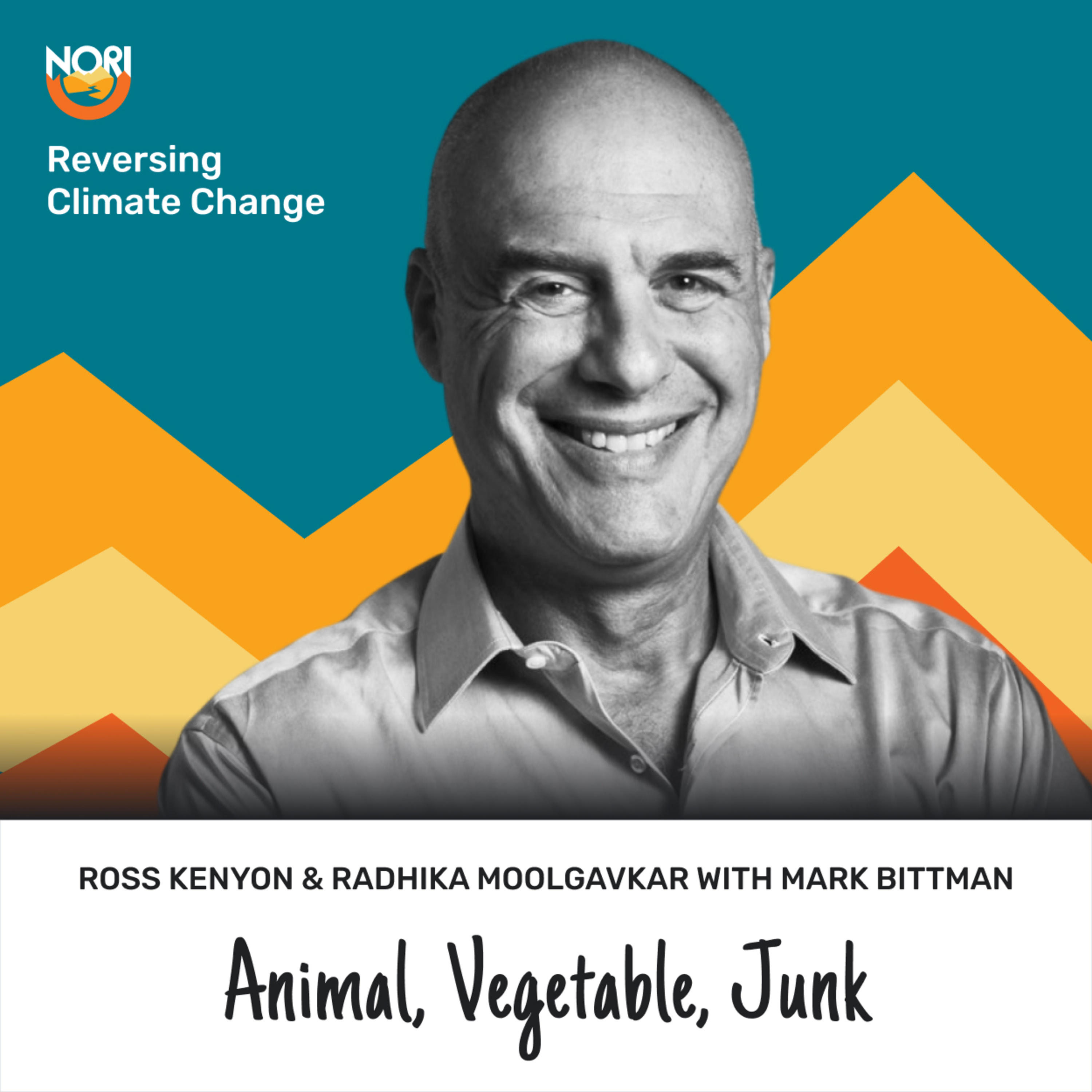
60% of the calories in our food supply are alleged to be ultra-processed junk. So, when did we lose our way? When did we go from growing food to feed our communities to growing food for profit? And how do we find our way back to a just food system—and society?
Mark Bittman is a former New York Times columnist and bestselling author of 30-plus books, including the well-known How to Cook Everything series. His new release is called Animal, Vegetable, Junk: A History of Food, from Sustainable to Suicidal. On this episode of Reversing Climate Change, Mark joins Ross and Radkhika to explain how the food system shaped our history and vice versa, describing how the Enclosure Movement may have turned food into a profit-making political tool and created the health crisis we’re facing.
He weighs in on why educating kids about good food is the first step in creating a just food system and advocates for subsidies to support getting good food to more people. Listen in for Mark’s perspective on investing federal dollars in regenerative agriculture and learn how he thinks about making the phrase ‘land reform’ common in our political discourse.
More from the show
Ad-free episodes and other benefits come with a paid subscription.
Carbon Removal Newsroom, the news show that ran alongside this one, is over. Its episodes are still up, on the feed Climate Workers Anonymous now uses.
Carbon Removal Memes is still going.
Resources
Subscribe to The Bittman Project Newsletter
Animal, Vegetable, Junk: A History of Food, from Sustainable to Suicidal by Mark Bittman
How to Cook Everything: Simple Recipes for Great Food by Mark Bittman
Fast Food Nation: The Dark Side of the All-American Meal by Eric Schlosser
Renewable Fuel Standard Program
Joel Salatin at Polyface Farms
The Omnivore’s Dilemma: A Natural History of Four Meals by Michael Pollan
Full Transcript
Alexsandra Guerra: You’re listening to the Reversing Climate Change podcast by the team at Nori, the carbon removal marketplace. This is a show about the innovators and entrepreneurs developing solutions to climate change.
Ross Kenyon: Hello and welcome to the Reversing Climate Change podcast. I’m Ross Kenyon. I’m the creative editor at Nori’s Carbon Removal Marketplace. Today I have with me a colleague of mine, Radhika Moolgavkar. Hey, Radhika.
Radhika Moolgavkar: Hey, Ross. Thanks for having me. My first time on. I’m pretty excited.
Ross Kenyon: I know, your first time on. We’re starting at pretty high up here with Precise, though, because Mark Bittman, I don’t want to make you blush too much, Mark. Maybe you’re a bit more humble than I’m framing you here. But you’re a former New York Times columnist, the author of many, I even italicized the second many cookbooks, and the author of the new book, Animal Vegetable Junk, A History of Food from Sustainable to Suicidal. Thanks for being here, Mark.
Mark Bittman: Great to be here, Ross, Radica. Great to meet you.
Ross Kenyon: Nice to meet you, too. Indeed. So why this book and why now? And that’s a deceptively simple question, I think.
Mark Bittman: Well, I can keep the answer simple, really. The book is critically important and now because it hasn’t been done yet. So, I mean, we can get into longer answers, but one of the goals of Animal Vegetable Junk, one of my goals is to get people to take food more seriously and to look at what’s important about it and why it’s so important. And The fact is that is often not part of the conversation when we talk about the problems facing us. Food and agriculture is often way down the list or even left off the list.
And this is a fight is a strong word, but a bone of contention between me and a lot of people, colleagues, friends, comrades, whatever, in the climate movement, because I feel like the issue, the situation with fossil fuel is Often presented as an emergency and a crisis, and there’s no denying that it is. But agriculture is often ignored, and that is a huge mistake.
Ross Kenyon: I would say in general, this book does not present the history of food systems as a happy story. And it’s, as I understand it, this reflexive process of the ways in which food systems shape history and the ways in which history, colonialism, imperialism also shape food systems in turn. Is that a correct way of understanding your framing?
Mark Bittman: Yes. You know, I’ve come to, I often do this little qualifying thing, which is that agriculture, which is the foundation of our food system, obviously, has come a long way in the last, let’s say, 10,000 years. And population has grown exponentially in those 10,000 years. So the upside, the undeniable upside is that billions of people have lived who wouldn’t have lived otherwise. That population growth wasn’t inevitable. It was made possible by an accelerated agriculture, by providing, by growing more food. So if you believe that there is value to having billions of humans alive and having many of those lives be positive for the livers, then agriculture has been a good thing.
But it has been also a force for destruction, colonialism, slavery, Genocide, et cetera, et cetera, et cetera. So like so many things that you look at historically, there’s more than one story here.
Radhika Moolgavkar: So Mark, I am wondering, do you see a pivotal moment in history when the food system or the agricultural system lost its way in a point in time where if we had made different choices, things could have gone in a more positive route?
Mark Bittman: Several, actually. I mean, the first is, did agriculture need to be invented? There weren’t that many people on the planet at that point. And those, many of those who existed, and this is all archeological evidence. This is not, there’s no written evidence. We’re talking more than 10,000 years ago, but there is evidence that those people lived better lives than early agriculturalists lived. They lived longer. They grew taller. They had better teeth. They may well have been healthier. They certainly ate more varied diets. So the first turning point is the establishment of agriculture, which made diets more monotonous, made the sort of food population balance a little more precarious.
Increased infectious disease, most likely, because people are living with animals and in villages, often without efficient waste disposal systems. I’m not talking about sewage, but if you’re a hunter and a gatherer, you leave your waste behind. If you’re an early agriculturalist living in a village, until you invent or establish a sewage system, There’s nothing to do with your waste, but use it in the fields if you’re smart or wallow in it if you’re not that smart. So there is an argument most famously made by Jared Diamond that agriculture is problematic from the get go.
But if you accept that exists, Then you have to look at, well, how is agriculture managed? And for the 9,000 years or so between then and what we might call the modern era, it was managed fairly sustainably better in some places than others. There were a number of civilizations where agriculture outgrew itself or population growth outgrew the Ability of that civilization to sustain itself. And those are real stories, but the real turning point came With the Land Enclosure Acts, and with the Crusades, when nobility really started to seize control and to make it more difficult for people to grow crops for themselves, for their families, for their villages, for their regions.
Instead, forcing people, peasants, serfs, whatever you want to call them, slaves, to grow food for profit. And that’s a big change. And That started around 1200, 1300. It accelerated after the plague of the 14th century. And then starting in the 15th and 16th centuries, obviously at colonialism, the beginnings of capitalism, slavery, and a form of agriculture that really led directly to genocide, famines, and what we have now, which is an advanced generation. Stage of capitalism, neocolonialism, imperialism, and food as a profit-making political tool rather than food as nourishment for as many people as possible.
So there are turning points in history. Could things have happened differently? Sure, but they didn’t. I mean, to me, the question is, how do we learn from that stuff and how do we move forward from here?
Ross Kenyon: I also enjoy this revisionist take on the birth of agriculture, because I think growing up, the story is very wiggish, right? Continual progress. We get better. Developers come. It’s always good.
Mark Bittman: There’s a lot of that.
Ross Kenyon: Yeah. And then you read someone like James C. Scott or Jared Diamond. You’re like, oh, actually. Hadn’t thought of it that way. We used to have leisure time and a lack of hierarchy, and it was a lot more flexible and enjoyable and fun compared to Being in some cases, many inches or a foot shorter and eating the same staple grain over and over and over. Yeah, I think that’s a very good point to make. People often point to that as the lapsarian moment for us to have leaving the Garden of Eden, you know, never to go back again.
And also, Because since your take has, okay, I’m going to put words in your mouth. You can tell me if I’m right about it. But you have a sort of left-wing kind of like political economy perspective on agriculture and its development of one of increasing control of hierarchy and structure placed upon people from the top. Is that an okay way to frame your work here?
Mark Bittman: I think that I could have wound up writing about many things, but because I cooked, I wound up writing about food. And that’s interesting to me. And it’s an interesting part of my story, if my story is interesting, my personal story, which is that for many years I was looking for a way to apply my political views, my understanding of history, which of course was growing as I got older, trying to figure out a way to jive that with my work, which was really from say 1980 to 2000, almost exclusively writing about The enjoyment of food and cooking and the values of sort of traditional stuff about cooking for your family and your loved ones and providing real nourishment and how to shop and the joys of traveling and eating and restaurants and other luxuries like that.
And around about 2000, and in large part, thanks to Eric Schlosser’s Fast Food Nation, which was really a groundbreaking book. And even Supersize Me, the movie Supersize Me, which just showed that people were ready to start talking about food in a different, more serious way. And I started to do that. I began by writing How to Cook Everything Vegetarian, not because I was a vegetarian, but because I thought we all needed to become better acquainted with how to cook plant foods. And that led to me thinking more about farms and eventually nutrition.
And then five years, six years after that, I started to write about factory farms and industrial production of animals in particular, but also the kind of intersection between animal overproduction, overconsumption, public health, and the contribution of farming to climate change. And those are all intricately tied And people were not, this was say 2007, people were not seeing this at that time. And since then, it’s become easier and easier for me to make these connections. I had an opinion column in the Times, largely about food, but also about climate and justice, labor, all things that I feel that are associated with food.
And I did that for a few years. And then I left in order to write Animal, Vegetable, Junk, which... Here we are.
Ross Kenyon: When I think about the genre of, or books like this, you could say grand histories, anything that’s covering wide swaths of human history, there’s a risk of oversimplifying or having one perspective or one ax to grind that gets progressively sharpened as it goes. And I think of some of the books that, I mean, they’re often enjoyable books to read. Getting really into the Will Durant’s grand histories as a younger person, his history of philosophy. They’re amazing, but there’s also a risk that you’re trying to fit everything into your version of history, your vision of it.
Did you struggle with this in composing this book?
Mark Bittman: Well, I did. And I think this book, for once, I think I published a book that was published at the right moment. Or not for once, because... How to cook everything was that too. A lot of stuff I’ve done, my timing has been wrong. But here I think it’s right. I thought a lot about what you’re saying. And I really expected reviews and reviewers to say, you’re trying too hard to fit square pegs and round holes here. And no one’s really said it. And I think one indication, literally no one has said it.
I got kind of like a mediocre review from the Wall Street Journal, but I mean, what do you expect from the Wall Street Journal, really? But one thing that’s funny is that in the middle of the book, I thought, in the middle of writing it, I thought, am I hammering too hard on class struggle, to use a shorthand? Am I hammering too hard on The relationship between agriculture and race. Am I hammering too hard on the privileged position of conquering superior genocidal position of Northern Europeans, especially from Great Britain? By the time I finished the book, I thought, did I pay enough attention to that stuff?
Somewhere, like in the middle of the book, I was like, no one’s talking about race. And here I am like writing about race all the time. And by the time I finished the book, people were talking about race. So that’s why I say the timing, I think has been good. If I published it two years ago, I would be getting, I think I’d be getting race baited. I think there’d be a lot of why are you bashing, why are you bashing Western civilization? And now I think those things are much more, Western civilization bashing is much more common.
Ross Kenyon: Very in season right now, yes.
Mark Bittman: Yeah, which, you know, great. I mean, the pendulum will swing the other way. Obviously, not everything that’s happened in the last 500 years is terrible. But if you’re an indigenous person and your history was wiped out or a person of color and you were enslaved or your ancestors were or you were murdered or whatever, Yeah, it wasn’t a good period.
Ross Kenyon: It doesn’t mean we haven’t had some benefits, The reason I asked that is something like the enclosure movement is something that, to what degree is that significant in the creation of modern capitalism? People of a left-wing persuasion, particularly Marxian political economists, think that’s like the key thing that happened. But lots and lots of historians and economists fight over this still. And so it sounds like you almost just went for it and were like, this is the story that I’m telling. But I know there’s a lot of room in here to be challenged on some of these things.
Mark Bittman: Right. And I wouldn’t claim to be You know, it’s clear I’m a generalist. I’m not a specialist in the enclosure movement, far from it. But I understand arguments about the commons and I understand what the seizure of power by the nobility meant in the Middle Ages. And you can see... You can see a line of, you can track how things changed with agriculture and civilization and capitalism and colonialism, trade, mercantilism, and so on. They all track pretty much this at the same time in the same way. My biggest gripe And I think the most goal of this book, whether it’s successful or not, I don’t know, is to kind of elevate, as I said at the beginning, is kind of elevate the conversation about agriculture and eating to the point where, look, you talk about climate all the time.
One of our issues is how do you get people to think that the climate crisis is actually a crisis? What does that mean? No one had any problem believing that COVID-19 Was a crisis. So climatarians or whatever, those of us who are interested in the climate crisis have a problem in that you can’t say this many people are dying per year as a result of the climate crisis. Hard thing to do. We can project, oh, 200 million, 50 years from now, 200 million people a year are likely to die or suffer greatly as a result or right now, 50 million people a year are suffering greatly as a result of climate change, whatever.
But with agriculture and with nutrition especially, we can document that this is a crisis. I can say 300,000 people died from COVID in 2020 in the United States. Big number. 1. 5 million or so died from chronic disease. The leading driver of chronic disease is diet. And the leading driver of poor diet is junk food. I can say that. So why is that not a crisis? It’s not a question I expect you to answer, although if you can, I’d be very happy about that. But the goal is to say this is in fact a crisis, just like income inequality is a crisis.
I mean, some of the things that we think, oh, these are problems, we need to talk about them are in fact way bigger problems than people Give credence to. And I think the way we grow food, process food, market food, the food we provide for people to eat, that is killing as many people per year in the United States as most other things combined, including COVID. So how is that not a crisis? I don’t know the answer to that question.
Radhika Moolgavkar: I want to pivot a little bit because my question is, From one of your earlier comments is kind of around this idea that I read Marian Nestle’s book way back when I’m much older than Ross. So I’ve been thinking about this for probably 10 or 12 years since my children were young. And one of the things that my husband and I tried to do was eat the way Mark, you recommended through CSAs and through, but it was really, really difficult. We found, I wonder, How would you design a system that was a little bit more friendly to people who want to embark in it, but find that like going to a CSA and getting 10 pounds of garlic snapes and two little potatoes is really difficult to plan around and feed a family around?
How do you overcome that?
Mark Bittman: Well, you didn’t have to exaggerate. Your point was good.
Radhika Moolgavkar: I mean, literally one time we got like Five pounds of garlic snapes, and we really did not know what to do with them. We were in Kentucky, home of the garlic snape.
Mark Bittman: Look, I don’t think CSAs are the answer, and I don’t think individual gardens are the answer. They’re helpful. Urban agriculture, also helpful. Farmers markets, making food available. But we have a much bigger problem than any of those things could possibly solve, and incremental change is all well and good, and We should do what we can on every level. But the biggest problem here is that good food is not affordable, accessible, and available to everybody. So yeah, it’s hard to eat better when the supply is really giving you food that’s not so good.
And that supply is determined by policy. It’s not determined by, I mean, it’s determined in part by policy and in part by power. It’s not determined by what’s good for you and me or anybody else for that matter. So food wise, it’s good for the corporations who own the land and do the farming and run the processing plants. But the issue is how do we make good food available to everybody? And then how do we teach our children? Because we’re not talking about something that’s going to be happening On a wholesale basis between now and 2030, we’re talking about making some changes that will lead to other changes that will lead to other changes that will eventually lead to a just fair food system and maybe even a just fair society.
Part of that is teaching children what real food is and how to eat it and how to prepare it, how to enjoy it, as opposed to teaching children that Tony the Tiger is their friend and the most refreshing drink you can Having Coca-Cola and the coolest place to go eat lunch is McDonald’s. That’s what we teach our children now. So no wonder it’s hard to enjoy a roasted carrot, you know, which is one of the most delicious things in the world. But how do you teach a kid that when you’re busy teaching a kid that French fries are the best food there is, right?
That’s what kids learn today.
Radhika Moolgavkar: So you’re advocating for like the French system where they have those beautiful lunches for the for the children.
Mark Bittman: I’m advocating for change on every level possible in the right direction. That’s what I’m advocating. Yeah.
Radhika Moolgavkar: Yeah. I mean, I have to say my children like roasted carrot, but they also love a good French fries. It’s everywhere.
Mark Bittman: And me, too. But you know what? In terms of this conversation, your children are over the hill. I’m not saying their lives are over. I’m not saying they’re doomed. I’m saying their food education was less than ideal. And maybe their children, their children can get a good food education. And we can, we are not going to have, you know, you started this conversation. Really, I love this because I often have to bring this up in a way artificially. You started this conversation by saying, you find that eating a good diet is difficult.
That’s not because... You’re stupid or you’re poor or you can’t think things through or whatever. It’s because you learned as a kid that your food preferences were high sugar, high fat, highly marketable, highly salted, highly marketable foods. And those are what, no matter what your background, if you grew up in the United States as a first or second generation person, Or later, you were taught the Tony the Tiger thing, et cetera. And that was drilled into your head. And all of us adults are, everyone knows that it’s a struggle to change your diet.
Everybody’s had that issue. And I’m not talking about what are commonly called food disorders. I mean, in a way, or eating disorders. In a way, we all have eating disorders. We’ve been trained to eat in a way that’s not good for us. Imagine if we were trained to eat in a way that was good for us. If there were advertisements and commercials for carrots and broccoli and rice and beans and whole grain cereal and blah, blah, blah, blah, blah. We all know what that is. Appreciate the foods of the rest of the world.
Appreciate the way other people eat. Eat like people ate in the 19th and early 20th centuries before this came along. This monster came along and convinced us all to eat badly. That’s the kind of food education we need to be giving our children. It’s not reactionary or saying let’s go backwards in time any more than it is to say let’s train our children in civility. Let’s train our children in crafts. Let’s train our children in many of the things that are Considered cornier passe now, but which we might think have value.
Eating good food has value, but we’re not teaching our children how to do that. And by the way, that food barely exists. I mean, the most surprising statistic I came up with in writing Animal Vegetable Junk Is that 60% of the calories in the food supply are of ultra processed foods. So that by logic, logical extension means 60% of the calories we as a population eat is junk food. So it’s just there. That’s what’s there to be eaten. You have to change that proportion in a way.
Radhika Moolgavkar: Yeah, so I guess that maybe leads to the next question I had, which is, you know, what does removing subsidies do to the food system? And how would that impact these folks who do market ultra-processed food? And let’s say that you were in the Biden administration and you could say, I’m getting rid of this one subsidy. What do you think the subsidy should be? And what impact would it have on, you know, I think on the American food public?
Mark Bittman: Okay, two questions there.
Radhika Moolgavkar: Two questions, yep.
Mark Bittman: I mean, the second one, first, I would end the renewable fuel standard, the ethanol mandate, the subsidy for growing corn for fuel, because that’s really ridiculous. You’re not even growing. You’re growing food crops and using them for an inefficient fuel. That’s just nothing’s crazier than that. But the real question is, OK, suppose you did that. That might be a quarter of the land in Iowa, by the way. I mean, millions of acres in Iowa alone. What do you do with that land? That’s the real question. I want to address the subsidies thing a little differently because people who think that the food system is broken, messed up, whatever, often point to subsidies.
It’s a totally legitimate question. But let me pose this. Suppose it’s expensive and difficult to grow food for everybody. Just maybe that’s the case. The food system works for a third of the people in the world and for probably two thirds, three quarters of the people in the United States works really well. The three of us talking can buy whatever we want whenever we want to. There’s some guilt attached to it for sure, but we get to eat well. But suppose it’s just expensive to do that, that you have to subsidize agriculture.
You have to subsidize agriculture. Just like you subsidize transportation. I mean, a lot of food is about transportation. So suppose you take it as a given that there are subsidies involved. Why would you subsidize bad food instead of subsidizing good food? So instead of saying we are spending some hundreds of billions of dollars to subsidize industrial agriculture annually, let’s spend half of that right now, starting as soon as we can, on supporting developing Farms, food processing, food delivery services, et cetera, et cetera, that will get more good food to more people.
Let’s subsidize that. We don’t even have to change the tax structure. The money’s already there. And let’s take it away from the renewable fuel standard and all the subsidies that corn growers get to produce animal food and junk food. Let’s produce good food and let’s make it neglected food. A McDonald’s salad is two to three times more expensive than a Big Mac. So that’s ass backwards. I mean, that is really ass backwards. So not only should we be incentivizing the sale of salads and disincentivizing the sale of hamburgers, the real cost of making a hamburger, if you Not to get too jargony, but if you internalize the cost of the externalities, the real cost of a hamburger is not $1.
99. So if we start adjusting costs so that we’re encouraging not only the consumption of good food, real food, but the farming of good food, real food. Say we took that ethanol, go back to that, that land that’s being used for growing corn for ethanol. Suppose the federal government magically took that land back and distributed among, I mean, my priorities, I’m not the czar, but to me, if you’re looking at what’s fair, my priorities would be indigenous people and women who were both completely shut out of the land giveaways of the 19th century, black people too, of course.
You took that land and said, These are the standards for farming this land. It’s not going to be farmed in monoculture, industrially. All we ask is that you produce real food, distribute that millions and millions of acres to thousands or millions of people who wanted to farm good food. That’s a big change. I don’t foresee it happening, but I could advocate for it.
Radhika Moolgavkar: Well, Ross and I get the whole idea of, you know, Externalities not being reflected in the price, you know, carbon and all.
Mark Bittman: But it’s exactly the same situation. And a lot of the externalities of the food system are climate related, but there are also public health costs, land costs, labor costs, weird externalities like agricultural workers, retail workers, et cetera, who are receiving SNAP benefits, food stamps. Which means that we taxpayers are actively subsidizing Walmart, anyone who runs a big farm and uses immigrant labor, and so on, because taxpayers are paying for those food subsidies. So if you’re paying people $9 an hour or less, then they need food stamps. If you were paying them $15 an hour or more, you would actually be saving taxpayer money.
So that gets very complicated.
Ross Kenyon: The particular way in which this question was framed is intriguing to me. And I also have a bias towards how much can we do with removing bad policy rather than adding an additional layer on top of the bad policy to try to amend it somewhat. Part of the reason why I see this tension here is that if you spoke to someone who really likes capitalism, someone who’s a libertarian in orientation, they would probably look at the food system and say, this isn’t capitalist. This isn’t free market. There’s so many distorting things happening in here.
And, uh, maybe like Joel Salatin is a great example to, you know, ecologically quite sophisticated farmer, also maybe the most free market farmer I’ve at least ever met. And the modal farm might look closer to Joel’s polyface in Virginia than it would to some economy of scale maximizing 10,000 row crop kind of thing. Do you think that there is room to work together on that? Or do you think I’m way out to lunch?
Mark Bittman: Well, I mean, I agree. This is not free market capitalism, but I don’t think that means that we, I would not agree that means we want to move in the direction of I think one of the things we’ve observed through history, we’ve learned through history, I think that we can see a way for humans to work cooperatively. Now, obviously that’s controversial. Not everybody agrees with that. We’re talking about what I think. And lucky for me, I think we see a way that we could never see before, that during the 17th, 18th, 19th, early 20th centuries, there were fantasies, there were projections that we might get to this place.
We are at a place where we could act cooperatively, and I don’t think that means anything. We try to go to free market capitalism and sort of hope things work out. I think we have to engineer that. And I think you’re right. We have to get rid of bad regulations. But I think we have to gradually institute good regulations and support those farms. There’s a farm in California called Full Belly. It’s northeast of San Francisco in a little valley called Cape. And it’s 500 acres. I wrote about it a little in the book.
It’s 500 acres. It’s cooperatively run. The workers are treated. It ticks every single box. You name it, they do it right. And on purpose. I mean, that’s their goal. And I thought if there were 10,000 farms like Full Belly, that would make a big difference in the food system. I mean, it couldn’t be much fewer than 10,000. 5,000 would be okay. 1,000 would be interesting, but 10,000 would be a big deal. And there’s probably like six or 12. So we haven’t invested in alternative ways of doing farming. If people say there’s no alternative but to do things the way that we’re doing now, I just can’t accept that because we’ve invested all of that.
Not all of our energy, but we’ve invested most of our federal energy, support, regulations, innovation, research and development into industrial farming. We’ve given very little support to how to do things in a way that damages the land less, respects other species more, pays attention to farmers and eaters who are sort of second and third in line after profits. How do we produce food that’s sort of maximum good for the maximum number kind of thing? That’s a much different question than how do we produce food that makes us the most money?
Radhika Moolgavkar: Another seminal book besides Marian Nestle’s books that we read was Omnimore’s Dilemma back in the day. And obviously one of his thesis was sort of big organic was the letter, but not the spirit of what organic was meant to be. And it makes me think of what’s currently happening as the Biden administration rolls out his climate agenda and there’s a lot of interest in regenerative agriculture. And so do you worry that this is actually just going to be another giveaway to big ag that doesn’t lead to the outcomes we want?
Or is this a positive because maybe it is moving the whole industry in a better direction?
Mark Bittman: I don’t believe that the owners, rulers and operators of industrial agriculture are going to solve this problem. I believe that we have to be talking about, yes, about regenerative agriculture, but also about land justice and about economic justice and environmental justice. And when I hear the administration talking about those things and acting on those things, I’ll think that its heart is in the right place. But to bring out a few catchphrases and to re-engineer So that it’s somehow being produced using regenerative agriculture is not doing anyone any favors. It’s just a new form of greenwashing.
So, you know, I was serious. I am serious when I say one of the important things here is to get land into the hands of people who want to farm it well. And that means taking land out of the hands of people who are farming it badly.
Radhika Moolgavkar: How do you do that?
Mark Bittman: You do that by making sure that the 2022 elections go in the right direction. I mean, you do that by passing the $15 an hour minimum wage right now. You do that by strengthening those organic laws. Here’s what I think. I think that there are some changes that can be made, even in this administration, even in the next 18 months, that will show us that change is possible. On the so-called left, which is kind of almost everybody, but everybody to the left of Donald Trump is like relieved in this way that we feel it in our bodies, I think.
Like we’re hopeful and optimistic in a way that we didn’t allow ourselves to be hopeful and optimistic since 2009. And many people who are adults now were children in 2009. So there’s a lot of I think positive feeling around or belief that change is possible. And I think we really have to take advantage of that like now, like what can we do now, whether it’s about food or about climate or about energy, transportation, whatever it is, income equality, racism, what can we get done now so that our base is bigger, that more people believe that change is possible because we’re not gonna like in the next 18 months, Have this massive land reform program.
I understand that. But maybe we can have a massive land reform program within the next 20 years if we show people that it’s worth supporting organizers, activists, NGOs, and even governments who can move things in the right direction. So, you know, I’m advocating for organizing, for activism, for We’re trying to see a real shift of power towards people who want to build a just and good society. We don’t have that now. Food’s a part of that. Food’s obviously not the only thing. It just happens to be the thing that I can talk most easily about.
Ross Kenyon: Whether land reform will become a part of the lexicon in political discourse. Because even with the farther left representatives, AOC, Bernie Sanders, even Dennis Kucinich back in the day, I don’t think I’ve ever heard any of them even utter the phrase land reform. I think it’s like a Latin American thing mostly.
Mark Bittman: I just started uttering it a year ago. And I was like, you know what? I’m just going for it because it’s a real thing. And people are afraid to say it. But the land in this country, in North America, was stolen and appropriated by Europeans from indigenous Americans, who, by the way, were killed in the process. I mean, not to put too fine a point on it. So I don’t know who that land actually belongs to, but it was given away to white European settlers. So, I mean, that’s beyond unfair.
To steal people’s land and kill them and then give it to your friends. So I don’t know how we rectify that situation, but however we rectify it, it needs to be rectified. And that’s called, rectifying is called land reform. So let’s call it what it is. Reparations is about land reform and reparations is about making good on the evil things that you did to other people.
Radhika Moolgavkar: Let me ask this really quickly. Maybe you can answer it in under a minute. I want to know, this is a huge expanse of a book as we talked about, but what is the most interesting thing you learned but could not put in the book?
Mark Bittman: No, I put everything I believed in.
Ross Kenyon: It feels like that, Mark. Yeah. I’ve seen your books.
Radhika Moolgavkar: Look at this.
Ross Kenyon: Is there anything about cooking that’s not in this book?
Mark Bittman: You think that cookbooks, I’m not saying. Many people think that cookbooks are not real books, but What cookbooks have in common with every other kind of book, every good book, is that you start with a lot and you wind up with a lot less. I don’t know how many dozens of books, maybe hundreds, I went through to write animal vegetable junk. I don’t know how many hundreds of thousands of words I wrote and threw out and set aside That’s how books are written. And you hope that you have included the most meaningful stuff that’s been informed by the material that you ultimately had to discard.
Ross Kenyon: That’s a good place to leave it then. If you want to pick up Mark’s book, it’s available in all the places you can buy books, I imagine. Is that right, Mark? There’s an audiobook version of it?
Mark Bittman: Yeah, the audiobook version is read by me, which was a lot of work. We use bookshop.org as a good link for supporting your independent booksellers. Obviously, you can buy the book on Amazon or anywhere else also. But yeah.
Ross Kenyon: Great. I know you have a Substack too. I’ll include links to all of your various projects that you’re working on. And thanks so much for being here.
Mark Bittman: Bittmanproject.com. You can find the book there. We have a newsletter, comes out several times a week. Subscribe. We’d love it, et cetera.
Radhika Moolgavkar: Thank you, Mark.
Ross Kenyon: Thank you, Mark.
Mark Bittman: It was fun. It was really lively. I enjoyed it.
Unknown speaker: We did too.
Ross Kenyon: Well, thank you so much for listening. If you like the show, please rate and review it in Apple Podcasts and or Stitcher. It really helps us a lot to get this content to a wider audience. If you think what we’re doing is useful, interesting, fun, hopefully all three, we’d certainly appreciate your rating and review. [Nori promotion cut from the transcript. It's still in the audio, but it no longer applies.]
And thank you so much for your support.


