

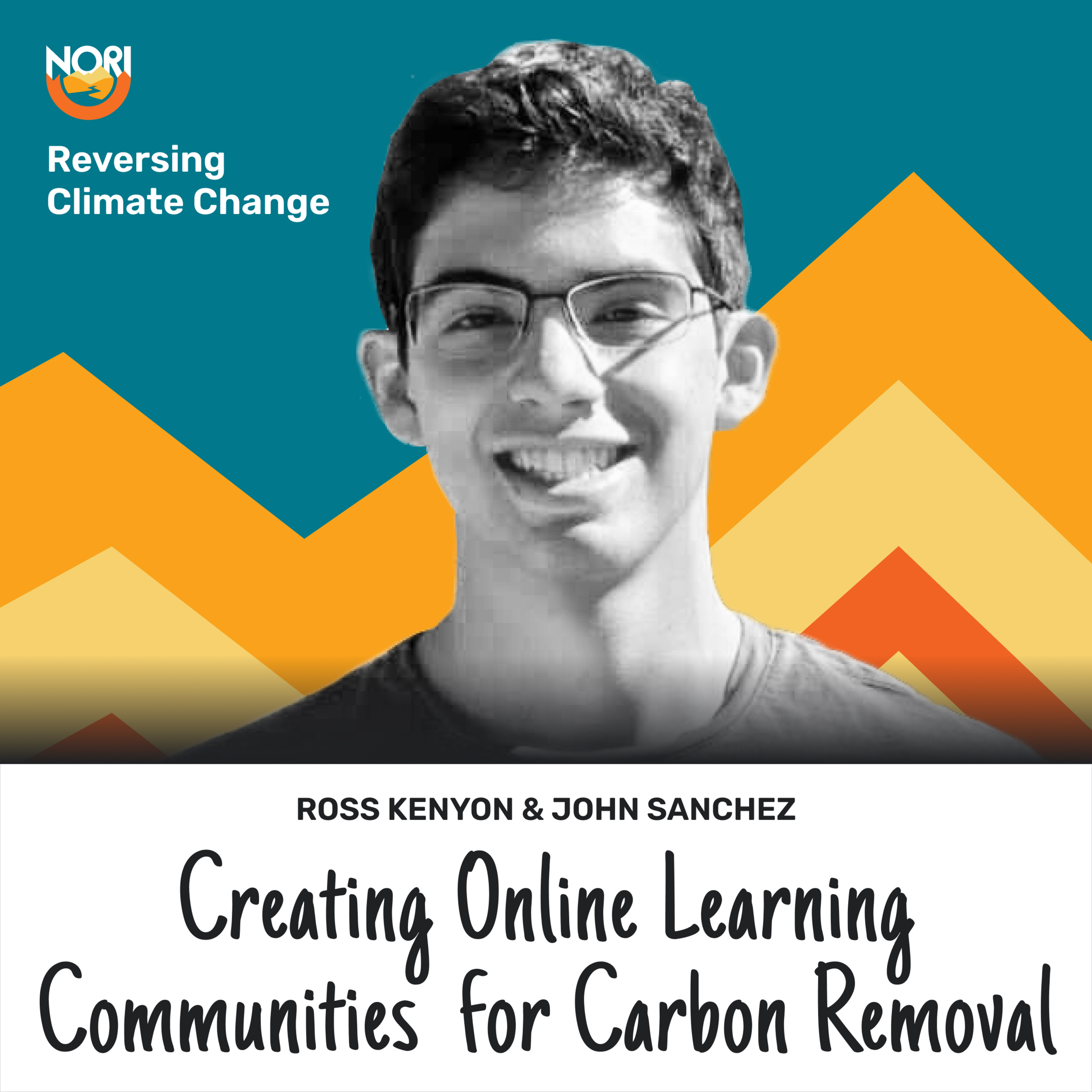

Listen on Spotify, Apple Podcasts or YouTube.
So, you’re interested in carbon removal and curious about working in the climate space. But you’re not sure how your skills might apply, and you don’t know where to begin learning about the different types of carbon sequestration or the major players in the industry.
John Sanchez is the Founder and Curriculum Designer at Carbon Removal Academy and the Co-Creator of the AirMiners Boot Up Program and Problem Pack Climate Sprint Workgroups. He is also building Carbon Visions, a community of college students working on carbon removal solutions. On this episode of Reversing Climate Change, John joins Ross to explain how these experiences facilitate the exploration process for transitioning into the climate space.
John shares his take on what makes a climate community valuable and discusses the debate around ecological versus industrial sequestration. Listen in to understand how John’s love of literature informs his work in carbon removal and learn how his experiences can help YOU uncover your climate affinity and then apply your skills to reversing climate change.
Connect with Ross
Subscribe to the show on Substack @ rosskenyon.com/subscribe.
I also write Carbon Removal Memes and curate Climate Workers Anonymous.
Resources
John’s Travels in Carbon Removal Newsletter
John’s Carbon Visions Slack Community
Biochar & Sawmills Problem Pack Report
Evan Hynes of Climatebase on Reversing Climate Change
World Resources Institute’s Post on Regenerative Ag
The Soil Scientists’ Response Letter to WRI
Full Transcript
Ross Kenyon: Hello and welcome to the Reversing Climate Change podcast. I’m Ross Kenyon. I’m the creative editor at Nori’s Carbon Removal Marketplace. Today I have with me John Sanchez. John, you are a Harvard student on a gap year. You created the Carbon Removal Academy. With Airminers, you built up their boot up program, which some Nori-nots have been going through. You also do a thing called problem packs. You’re all over the place. This is a busy gap year for you. Couldn’t you have just gone to Machu Picchu or something?
John Sanchez: No, a lot of this is based on the fact that we’re in quarantine mode. So that’s a lot of the genesis of these programs is because I was locked down and looking for stuff to do.
Ross Kenyon: Really? Well, yeah. How did you get into the climate world and how did this all happen?
John Sanchez: Yeah, it’s kind of a cool and funny story. Before the pandemic, I guess, in my first year of college, I came in as a computer science guy, picked up an interest in chemistry along the way. Interested in entrepreneurship, but feeling a little bit directionless. But as my virtual spring semester, once the COVID pandemic hit, finished off about a year ago now, I was trying to come up with interesting ways to spend a quarantine, socially distant summer, you know, something to work on, whatever. But I came up with 50 topics that sounded cool to me, things that I wanted to explore further from coding projects to literature and reading to trying out stand-up comedy, just a whole grab bag of things and put them all on scraps of paper in a jar.
And literally each week of this crazy system I set up for myself, just picked something out of the jar and tried to do it that week. And week two for me was explore the climate tech startup ecosystem, which I literally knew basically nothing about. Yeah, that week I listened to a lot of podcasts, including this one, did a lot of reading, was intrigued and very slowly fell down the rabbit hole. Eventually I ran into air miners and the carbon removal world. And that sucked me in further as I sort of became a member of the community and made a bunch of friends there.
And I guess at some point I stopped the cycle because I realized I was onto something with climate and wanted to keep building stuff there. Is there an alternate reality where you’re doing standup right now? I think about that all the time where like every Monday morning I’d like pick something out of the jar and then put it back without looking at it and pick something else. And that would be what I opened. But like the very specific sequence of things that came out of that process is very likely to define my next year’s life.
I don’t know. It’s just kind of fun to think about.
Ross Kenyon: It’s a beautiful and terrifying thing. And I think it multiplies as you get older to think about how much contingency exists within your life and how many random things have shaped its outcomes. What if you had picked a different thing? What if you had gotten into like artificial intelligence? That one came up first and you’re like, oh, the world would be different. Carbon removal would be different, John.
John Sanchez: I hope so. I hope I’m doing things that make an impact. But yeah. Yeah, AI was in there, so it could have happened. Did you end up doing an open mic or anything? No, I didn’t. But one day, maybe when I go back to campus, I’ll be part of their stand-up comedy club.
Ross Kenyon: You should do it. It sort of has a Tim Ferriss vibe to it, where you’re like... There’s like a little bit of a dilettante approach, but you also are really good in... I almost feel like you’re going to put me out of a job sometimes because you’re also really into literature and the creative stuff. If you do that and you’re better at the technical stuff than me, John, what am I supposed to do? You’re going to take food out of my family’s mouth. How could you do that?
No, Reversing Climate Change is a unique experience. The people come here for a reason. Was diplomacy also on one of those little things? Yeah, that was one of the things I could have picked out. Nice. Okay. That’s good. Well, we should probably define all of these different programs. I don’t even know. How do you describe them overall? Experiences, learning experiences, there’s a bit of a MOOC kind of quality to them.
John Sanchez: Yeah, sure. Well, for me, a lot of what I’ve done during the past year sort of revolves around the question about like, you know, what it takes to actually transition into the climate world from the ground up right now. And there are a bunch of people working on this. But to me, the way I see it is like, you know, if someone’s beginning with like a vague interest, maybe in climate broadly, or maybe with an inkling about a particular space like CDR, And then the end space is now I have a job in climate, I’m starting a company, whatever that goal is.
And for a lot of people, I don’t think it’s as easy as immediately... Going to reply to a bunch of seemingly relevant job postings to your skill set. I think there’s a real exploration process required to find your specific affinity, your specific interest, gather knowledge, and then ultimately choose something right. And even within the CDR space, that exploration process is real because the CDR space is interesting in that it’s like a cool grab bag of a lot of seemingly unrelated areas that ultimately come together to all remove carbon from the atmosphere.
But the two projects and initiatives that I’ve got going are sort of related to the different ways that exploration might look and are also sort of community focused and community based learning and community based exploration.
Ross Kenyon: And we’ve been interested in the topic of climate communities and we’ll get into your thinking on how you’ve been building these out. But the first one, I think you started, you came out of nowhere. One day I just woke up and there was a thing called Carbon Removal Academy that existed. And I was like, oh, who is this? What is this? So what exactly is Carbon Removal Academy? Is it still active or has it been supplanted by these other efforts?
John Sanchez: Carbon Removal Academy is active. I just recently revamped the whole curriculum with the latest news and the latest policy coming out with the Biden administration startups that weren’t around when I first created it. But essentially, it’s a curated list of resources. That take you through carbon removal, sort of from the ground up, starting with, you know, what is this field? What scale do we need? And what is it going to require? And then, you know, module by module, it presents sort of a linear sequence of accessible resources that, you know, somebody who doesn’t have a science background and doesn’t want to go through the 500 page PDF National Academy of Science report or something that requires a lot of willpower, but rather, you know, just trying to Ease people in, get them hooked with content that’s already out there and be that source of exploration where you can go through the modules, explore the different spaces and go as deep into that linear sequence of resources as people want.
Ross Kenyon: If someone’s listening and they wanted to go through it, is it something that they join as a member of a cohort or is it something that they do on their own? How does it work? Well, the cohort is where Airminer’s boot up comes in.
John Sanchez: The Airminers boot up is a learning program to sort of get introduced to the CDR space very rapidly. It’s a four week program that goes through a lot of content, but the goal is there to help people understand the basics of each approach and technology to Learn the common vocabulary that everyone in the space seems to have, like what the hell additionality means or something, who the major players are, the companies, and all the while sort of making a close group of friends in the climate space in the process.
And what the people do in there is go through the Carbon Removal Academy curriculum sort of module by module. So we’re recording this in early to mid-April. How many cohorts have gone through boot up so far? There’s been two. We did one in March and we’re just starting the April one. The Slack has about 200 people in it right now, but it’s not like one mass learning experience where everybody’s joining some giant Zoom call or something. The way we have it operating is it’s subdivided into eight to 10 person discussion groups that each meet twice a week for a small, more intimate Zoom call discussion.
And, you know, each of those smaller calls is scheduled to discuss a new CDR topic and is pre-assigned resources for it.
Ross Kenyon: Having people be intellectually stimulated and engaged in important thinking is itself valuable. I don’t mean to diminish that, but has there been anything of consequence beyond that you’ve noticed or any outcomes that you’ve been seeing?
John Sanchez: Yeah, I mean, the goal of the boot up is really just that people find what they want their next step to be. So like, you know, I am a person who’s interested in CDR. And after going through this giant experience, now I have an idea that I actually really like the biochar space. And I’m a true believer now. And I want to go do a problem pack on it or go... Explore the companies in the space or pursue it further somehow. So I really like this idea of affinity to a particular topic that people seem to be developing throughout the program.
And, you know, I think that idea of these smaller communities that are built into the larger world are really valuable because a lot of them, as we were shutting down the private Slack groups for each of the mini discussion groups for the first cohort, they were desperate to find other ways to stay in touch. And it seemed like people really made connections. So for me, that’s goal achieved with the boot up. Have there been any startups that have gotten founded out of it yet? Or are you still waiting desperately for your first one?
Not for the boot up. We’re getting there with the problem pack world, which we can talk about. But again, I think the boot up is more a learning experience where the problem packs are like, well, actually, let’s get a team together to come work on a problem that could ultimately spin out to be something like that.
Ross Kenyon: I love that. They always catch my eye too whenever you post about them. I’m like, dang it, I already work in carbon removal and I have enough problems in front of me at a normal job. So I’m not looking for extra right now, but they always catch my eye and they’re always very thoughtful. Yeah, what exactly is a problem pack and maybe what are some examples of them?
John Sanchez: Sure. Yeah. So the problem pack sort of spun out of after I had done the first big discussion group with Carbon Removal Academy, I sort of learned from the people who are going through it that lots of people feel like they know how to learn about climate change and build up the knowledge that you’d sort of get coming out of the boot up. But maybe they haven’t managed or figured out quite how they want to turn that learning into more concrete action that might stand a chance to remove CO2 from the atmosphere or do something positive for the climate.
So what the problem packs are sort of rather than taking like a learning and producing a bunch of content to consume based approach, The problem packs are a different way of exploring by being three weeks sort of fun, intensive climate sprints. Most of them are focused on CDR right now, but you deep dive with a team of five to six people into a single tangible climate problem. And at the end of the three weeks, you’re held accountable to produce a solutions oriented deliverable, whether that’s a business model or a report or some new tactic to influence the industry, maybe by the end that you present publicly.
Ross Kenyon: I saw one about handheld spectrometry and carbon. I’ve seen some about carbon markets. Give me an example of one in particular here.
John Sanchez: Yeah, sure. So one that I think was a lot of fun that, okay, this is right now we’re in the second round of problem packs as well. In April, I ran the first full round in February and for the February round, there were four problem packs going and I was actively involved in leading all of the four. So it was quite a month. But one of the packs in that first round was having the goal of figuring out whether it made sense to install a pyrolyzer at sawmills to produce biochar from the sawmill waste.
So that was an interesting topic. Sawmills are kind of like, you know, just one possible source of biomass that could produce the biochar. Yeah. The way that group proceeded was we literally ended up calling like a dozen sawmills to talk to them about what they’re currently doing with their waste, what their revenue streams look like with that, whether they’ve heard of biochar and could potentially be interested. We talked to a lot of biochar researchers, companies installing Calling pyrolyzers in different places. And ultimately, after a bunch of brainstorming and thinking about, well, how does it make sense to structure all these ideas that are coming together?
The group produced a really interesting report synthesizing all this knowledge and thinking about whether actually in what conditions it makes sense to actually do this at a sawmill. So it’s an example, I think that stakeholder discussion process where you like go all out and really talk to a lot of people who are working on this right now has been really effective. And a lot of the problem packs that sort of distilling where the problems are, where people’s heads are at this who are actually in the field right now.
And then, you know, taking that knowledge and doing some interesting brainstorming with the team, having fun while you’re doing it, but coming up with something at the end.
Ross Kenyon: I like that you sort of split this between the more passive consumption learning habits and then problem packs being a different, more active approach. Because I can imagine there probably is a linear progression, right? You join Air Miners, you do the boot up, and that’s where you do Carbon Removal Academy. And then you graduate and you do problem packs. Or is that even the right way to see it?
John Sanchez: That’s definitely in line of how we thought about things, especially since with the Buddha, people sort of figure out where their affinity is and what they want to explore more. And then after getting that breadth, the problem packs really provide a source of depth where you can sort of more actively Pursue this, make connections, do some networking, but also ultimately come up with an idea that might become your next thing. But the beauty is that it’s also only three weeks. So like if at the end of the three weeks you realize this wasn’t for me, then you didn’t sign up for some really long term commitment.
You didn’t get a job that you find out you’re not interested in. You just had an interesting time and you can try something new the next time.
Ross Kenyon: Yeah, I think that’s really valuable. Maybe this is a good place to talk about your thinking on how these climate communities, which are proliferating wildly right now. There’s so many of them. I just joined work on climate the other day. I still haven’t worked on climate. Yeah. Yeah, I haven’t really stuck my neck out in there and said hello yet, but I’ve been poking around and there’s so many different things. My climate journey and there’s a bunch of specialized Slack communities and there’s probably a whole bunch of things I’m not even aware of.
I know ClimateBase is trying to do a lot of work on how you actually do this in a scalable, productive way. How should we be thinking about climate communities and where their value lay?
John Sanchez: Yeah, well, for me, the main takeaway that I’ve started to get from running the boot up and the problem packs in similar ways is that a lot of times when maybe you’re in one of these big climate communities, one of the ones with like a thousand plus people in it that are posting in specific channels and there’s conversation going on. But I think Ross, actually, at one point you put it to me as feeling like a member of mass society where you’re contributing and maybe you can post a link at sometimes, but there isn’t really some close...
Friend meeting or it’s hard to find connections in that scenario. But the way we do things at the boot up, as I sort of described, is that we create these smaller sub communities that exist within the larger structure. I think part of the beauty of that is that you sort of get the best of both worlds where we do this fun thing in the boot up where we have a random channel. And with every meeting, we have each team submit like a fun thing. A haiku or an image or something funny to represent their team and sort of establish some sort of team pride among this group of like eight to 10 people who are meeting twice a week.
But what we’ve seen is like there are still interactions that are happening outside of The smaller group settings, you can preserve that at scale, but there still needs to be, in order for a community to be valuable, especially for me, from what I’ve seen, is you need to have some sort of like human interactions where you get to meet people, you build your own set of connections, you build your own set of friends. Those are the times when I’ve always had the best. Like when I joined Airminers, there were maybe only like 10 people last June who were regularly posting.
And when I popped in and introduced myself, all of those people reached out to me and we had really good conversations. I’ve grown a little bit now, and I don’t think if I had joined now, I would have quite the same experience in terms of, you know, immediately finding the people with my similar interests who I can become friends with immediately. So I think for a climate community to be successful, it’s important to have these sort of smaller subcultures within the full thing so that people can find connections amidst the whole.
Ross Kenyon: I definitely think that’s the case. I have posted in other Slack groups before, not in a self-promotional way. It wasn’t like, hey, everyone here should come check out this amazing podcast I just did, and here’s why. I posted something else. I posted things I thought were relevant to the community at large and had a little bit of a crickets kind of reaction to it. I was like, oh. Am I doing this wrong? Or is this more of a sort of like a status hierarchy game and I don’t have enough status to attract any emojis?
Or what is happening that is... I clearly have done something wrong or maybe it’s just objectively boring and no one cares about what I’m posting about. That’s also possible. But being able to actually interact with people on a... Old school, one-on-one basis. I think it’s nice to... One thing I did... Oh God, am I going to say this on the podcast? I’m closing this up for now because it was too much, but I just opened my calendar on Airminers. I’m like, hey guys, I’ve decided that Slack is a bad use of my time for the most part.
I’m just too busy, but I’ll gladly take meetings with anyone if they want to. And so I’ve just had, I don’t know, dozens of random meetings. All of them were pretty fun and interesting. Some of them didn’t have a direct call to action or something we could do as a next step. But I did feel like it was good to take the pulse of the entire carbon removal community, or at least that small subset. It feels like there’s value there. I prefer that over text.
There’s something about text that I find really inhospitable. As someone who loves reading, maybe you... Interpersonally, it’s just different.
John Sanchez: Yeah. I mean, I definitely know what you mean. Definitely sometimes when you post something and you’re seeing how many thumbs up you get, you feel like a popularity contest. But in the small problem pack groups, when you post something, there’s a whole interesting discussion that can often emerge because it’s relevant to the brainstorming that’s going on. And I think it’s ultimately, even when there’s so many fewer people that are actually there in that little private community within the larger thing, I think more interesting discussions often emerge in that setting because people are more willing to engage and more willing to put themselves out there on that smaller scale.
Ross Kenyon: I think that personal touch makes sense. And maybe it’s also... God, John, you’re so much younger. So maybe this doesn’t even make sense to you. The differences between terrestrial versus digital satellite radio. Do you know much about that? Yeah, that’s I think before my time. There used to be radio waves that were beamed by towers and something with electromagnetism. You probably know more about this than me, John, but it happened. And there was a tendency, I think, to rush towards the lowest common denominator within a certain genre.
So at least when I started listening in probably like the 90s or the early aughts, there was a Like a classic rock station. There was an alternative station. There was a Kiss FM pop kind of station. But they all basically played the same things. You could find that in basically any city in America, as far as I know. And then XM came along. And it’s like, you want Howard Stern? Here’s 24-7 Howard Stern. You want Grateful Dead bootlegs? We got that.
You want Outlaw Country? It’s like whatever genre, it just got more and more specific. Nowadays, it’s Spotify. It’s your own exact personal. But that was a gradual process of it happening. In a big group, I think there’s a tendency to sort of like converging among uncontroversial or things that are almost kind of banal in some cases potentially. Whereas in a smaller group, there’s more of a tendency to want to dig in or it’s more niched maybe. Is that the difference between like the mass society versus the core group or something?
John Sanchez: Yeah, I think it is partially this like... I don’t know. I wouldn’t want to be wrong in the My Climate Journey carbon removal channel with several hundred people there watching me be wrong. But if I was just testing out an idea, it’s much easier to do so if there’s a friendly group of seven people that I’ve talked to 10 times before. And I can say like, oh, yeah, I’m just thinking about this. Anyone have any thoughts? It just feels more comfortable, I think, and more productive maybe for that reason.
Ross Kenyon: Dang, I’ve never thought about it in that way. But yeah, if you say something in public as a member of a company, there’s this whole, is this canonical? Is this a Nori thing? Like, can’t I just, is there not a space where I can noodle on an idea and not have a, that’s sort of what you’re trying to get at though, right? Like you want it to be explorative and creative and you don’t want someone to come screenshot and be like, well, John, last week you said this.
What now? Hypocrite.
John Sanchez: Yeah. And I feel like that’s fine once you have your thoughts together, maybe. And, you know, you’re maybe you’re You have a friendly group of people you know is in that bigger channel so that it’s less scary to post there. But yeah, ultimately, I think it’s about creating and fostering these environments where that level of creativeness and that level of, you know, this is very, very tentative. I’m just noodling. But like, here’s a thought. Anybody want to take it further? Who might we talk to in order to develop this idea?
Anybody have further thinking on it?
Ross Kenyon: Hmm. And you think that’s primarily a feature of just the scale? You think maybe if it’s people are maybe kinder in smaller groups or something else?
John Sanchez: Yes, scale is part of it. But I think if I knew every single one of those 300 people and we had built relationships before, then I think I’d have a different feeling. Whereas I think it’s just something about context and something about feeling like That’s the type of thing that belongs in this space versus in a bigger space. Also, it’s worth mentioning that for the problem packs, one major feature of it is that whenever people go to sign up, they have to click a checkbox that says they’re willing to commit to 10 hours per week commitments for every week of the three weeks that it actually runs.
So That’s definitely there to be a filter for people who are not just going to sit it out and wait on the sidelines while other people actually attend the meetings. Because I think as soon as those Slack channels start piling up with people who are less active and less motivated as the other people in the group maybe, then it sort of drags the energy level down or the creativity level down to some extent. The meetings start getting less and less attendance and then the project falls to pieces maybe.
And I’ve seen that happen in some bigger learning group style things where, you know, everybody is welcome and then the meeting comes and there’s three people there out of 100 people in the channel or something. So fostering that right mindset where people are committed and this is a real project that you signed up to do, I think is really important to me.
Ross Kenyon: That’s a great way to put it. I’ve thought a lot about that too, in particular on that episode I did with Evan Hines of Climate Base not long ago about what does our Patreon book club look like if it, you know, air quotes, scales. For instance, we had Kim Stanley Robinson come and hang out with our like 40 book club members. And I could have advertised that and been like, if you want private time with this world renowned science fiction author, pay this amount and come hang out And then would we have just been crowded in with newcomers who don’t actually care?
Would it have taken away from the experience of people who have been there month after month? Does this have to scale? Why does everything have to scale? Is that a way that tech in Silicon Valley has invaded our brains and everything needs this? How should I be thinking about this?
John Sanchez: I mean, I’m very much looking to get a lot of people to do the boot up and to do the problem pack. So that is a scaling exercise. But I think by preserving these small communities within the bigger thing by, you know, you guys, this is a cluster of friends. This is a cluster of people who care about this other topic. You can still scale while maintaining that small community feel. I think the difference with the book club is that Ross Kenyon or Kim Stanley Robinson are finite resources that aren’t going to go meet with all 50 mini teams of book club members at the same time.
So maybe there’s some scarcity in that people are signing up so that they could talk to you specifically or talk to an author specifically that’s there. But I think scaling can still happen within larger communities under the condition that the small groups of friends and connections are maintained. I started thinking about whether or not I’m a finite resource or not. Well, you have finite time.
Ross Kenyon: Yeah, that’s true. But okay, well, how do you scale this? It seems difficult to have, well, for you to administer multiple of these problem pack groups. Is there some point where you’re like, I can’t do more than five of these at a time? Or what happens?
John Sanchez: Yeah, well, the way I’m thinking about it right now is, like I said, in February, I was the team leader for all of the problem packs. Found it hard. Yeah. Given that it’s a 10 hour per week commitment for every problem pack, and I was doing four of them, that was intense. But this one, we’re running six, so slowly moving up. But I’m not actually participating in any of the problem packs. Instead, I had people on the signup form Rank how interested they were in being a team leader on a scale from one to five.
And the people who are on the higher end of the spectrum ended up being sort of taking on the roles that I did during the February round by setting up the meetings and facilitating brainstorming and driving towards that end deliverable. But I’ve been meeting a lot with those team leaders in order to help them learn the lessons that I learned the first time and be effective at whatever it means to run a problem pack. So at sort of one level up, I can sort of have team leaders who run those packs.
But then the next question is like, is there someone who can take over my role as person who helps the team leaders figure out what they’re doing when they start running the problem packs and have sort of team leader managers for maybe a particular topic? So somebody who’s really interested in regenerative agriculture wants to be sort of A little bit a part of several regenerative agriculture packs without having to commit 10 hours per week per any one of them. So they can help the team leaders and be in those Slack groups, but maybe not be full participants and still be managing on the sidelines.
So the question becomes, what are all those topics that people can come into? And how do you create this chain of people being leaders at different areas? But definitely still in flux. And I have a ways to go in terms of building that out.
Ross Kenyon: Why do this? Is it some sort of, you want to see more people in carbon removal? And for you personally, what are you getting out of it? That’s not very accusative. I didn’t mean it that way. You better have it.
John Sanchez: Yeah. Okay. So in terms of why do this, like on a climate perspective, I think there is like you go into work on climate or my climate journey and just every day there’s an influx of people who, like I said, are like, where do I get started? How do I pursue this topic? I’m new to the space. I want to I want to get going on direct air capture, but don’t know where to start. So like, you know, this whole time with Carbon Removal Academy and the boot up and problem packs, it’s always been like, how do you provide more structured opportunities to get involved?
A lot of times when I was talking to people about this topic at the beginning, They were telling me that like, oh, we need to find more ways to connect people with jobs that are relevant to them. But what ultimately popped out the other side of that discussion is like, there aren’t that many structured jobs out there for people to sign up for. And the ones that exist are not looking for the person who knows the most about, you know, regenerative agriculture, but they’re looking for the best software engineer to come build their product or something.
So it’s their skill set that matters more than the knowledge about the For me, it’s like, okay, so if there aren’t that many structured opportunities that exist to plug into the climate world, especially for people who don’t want to be founders, then how can we create more structured opportunities that maybe aren’t jobs, but are interesting ways to, you know, make a dent, do that creative brainstorming and come up with what your next path is, find that affinity so you know what you want to go apply your skill set to.
But, you know, again, on a short term basis. So it’s not like you have to go through the grueling job hunt process first only to find out that they weren’t impressed by your software engineering skills yet, maybe.
Ross Kenyon: That’s a question we face hiring at Nori a fair amount, too, where what is easier to teach software engineering or sort of enough about agriculture, right?
John Sanchez: I could envision a world, though, where, you know, you would want to optimize probably for the person who’s a better software engineer because they’re going to be the ones building your product. But that companies like Nori would send people through either a boot up or maybe problem packs that send them deep into the particular problems that Nori is working on. And then all of a sudden they’ve got their their brain full of ideas about how to shape the regenerative ag space with that combined with that software engineering skill set that they came in with.
Ross Kenyon: No, that’s absolutely right. There’s also something really valuable about people being... Because we have hired people who have found us through the podcast. We have interns or projects that have come through in that way. And that’s also really valuable, having people love what they do and are passionate about it. Most of the people that I think we’ve hired, they came through a climate tech journey of their own where they’re like, I care about climate change. Like, where do I even look? What do I do?
I think that part of it is really important. But if we were sending people through boot up, which we have, like a couple of Nori knots have been through at this point, and I’m sure we’ll continue using this valuable resource. And if you’re listening and you want to get involved, you should join airminers and go through bootup.airminers.org. That’s where you can sign up. There you go. But I think having that level of interest and passion is really important. But if they weren’t also good at their core duties, I think we’d have a hard time figuring out a role for them.
John Sanchez: Right. Which is why the way I’ve begun to think about this is steering people who have skill sets to help figure out where their climate affinity is. I think that’s one of the value adds because, you know, if I’m a really, really talented software engineer who wants to go work on climate change, there’s tonnes of problems I could go work on and like, The right decision for them probably isn’t to just go find all the software engineering jobs and apply and apply and apply. It’s like, okay, well, do I actually, am I intrinsically more interested in the cement world or in the regenerative ag world or in the transportation world or something?
And as you start to explore and figure out where your affinity actually is, that will inform for that person where they want to apply their skillset and which companies they want to go work for or where they want to spend their time. What are you excited about in the next couple years with carbon removal? Yeah, sure. Well, I actually spend time... One of my other smaller projects that I’ve been building is Carbon Visions, which is a... Another Slack community for college students who are interested in the space.
And, you know, we haven’t done very much active outreach to students at this point, but it’s just, you know, people seem to find us one way or another who are interested in the space. And we have, you know, regular discussions about papers and talk about new ideas, but... I think, I don’t know, maybe it’s just being a young person and seeing a lot of other young people getting into the climate world. But it’s just really inspiring as like a new wave of people comes in to help meet climate deadlines and make the carbon removal space and the climate space more broadly, bigger and better.
Ross Kenyon: I think that’s super exciting too. As much as we slash mostly me, we’re a little less comfortable in these bigger mass society kind of spaces. It is nice that I don’t know many of the people in air miners or other places at this point, and it keeps growing. Like, oh, we need this so badly. If everyone can fit in a single room, it’s not going to do anything important probably.
John Sanchez: Well, I feel that way sometimes about the carbon removal academic ecosystem. Because when you look at some of the papers, most of the papers written about carbon removal, they often have the same maybe 15 authors that you could pick out. And a lot of those authors were also part of the CDR primer. And it’s great to have a tight-knit academic community. But between the startup side and the academic world and the NGO space, like, I would love to start seeing a lot of new faces as I know a lot of people are starting to get PhDs in carbon removal or climate related fields and the number of voices talking about the space continues to increase.
Ross Kenyon: Do you have a strong opinion on... I see it go back and forth almost like the tide of the ecological carbon removal only or only industrial or geological sequestration. It goes back and forth. I see someone credible on every side of that seemingly every week. So how should someone think about that debate? I don’t know.
John Sanchez: I think it’s kind of useless sometimes because there are posts sometimes that talk about why... This form of carbon removal or carbon removal of the field as a whole is overrated or people shouldn’t be talking about it or we need to focus on other things. It can be frustrating. And, you know, on a policy level, maybe there is a need to prioritize based on like where that federal budget goes. And that’s a conversation that’s worth having. But I don’t know if I really like when people sort of Loudly scream into the public discourse that what a whole group of people is working on and trying hard to build out for climate change is invaluable or a waste of time just because there’s a lot of exploration and a lot of innovation that still needs to happen.
And calling people out for doing good work doesn’t seem to be very productive often.
Ross Kenyon: I feel pretty similarly. And one of the things I really like about all of your work and all of these programs that you’ve been developing is that I might be reading too much into this and correct me if I am, but there’s a sense of genuine curiosity and not having a final answer already built into the curricula that is refreshing because there are many places you can go that will be all too happy to tell you the exact right answer. And it doesn’t seem like you have that, John.
And I think that’s actually a good thing.
John Sanchez: Yeah, well, some of those debates are even built into the Carbon Removal Academy curriculum itself, like in the regenerative agriculture module. I don’t know if you remember this, but back in, I think, June 2020, World Resources Institute put out a blog post that said soil carbon sequestration is not nearly as effective at mitigating climate as people think it is. A bunch of the like Keith Paustian and a bunch of other big soil scientists put out a letter of response sort of hammering home their argument for why it actually is valuable and has merit.
So both of those, the blog post and the response are in the curriculum so that people can sort of see this back and forth and appreciate that a lot of these things are open for debate and have discourse and have a lot of nuance more than any one side of an argument would like you to think there is. So that’s definitely a value for sure.
Ross Kenyon: I have said this on a previous show. Forgive me if you’ve heard this one, but I think the phrase teach the controversy, that was sort of ruined by the intelligent design scopes trial, kind of like 20th century fallout. But I like that a lot. My undergraduate degrees in history... And a lot of the ways history is practiced in universities tends to be, you’ll be like, this school of historiography approaches the problem this way. And this other school of thought approaches it this other way. And you’re like, God, there’s good insight.
I think the more people are able I think it would help us break out of some of these really intense fights that we have sometimes. It also though makes me a little more charitable than I should be or less willing to commit to a position firmly, which also makes me really annoying to debate against because I’m like, I don’t know. This is an interesting question. I was asked to give a presentation recently and I was like, I don’t know. I’m like kind of okay at asking questions.
I don’t know that I have any definitive answers to give you. Nori, the one way to reverse climate change. I don’t know if I can give that presentation in good faith. Sorry. Got an idea. We’re trying, dang it. But yeah.
John Sanchez: Right. Yeah. No, I agree. I think being intellectually humble is really important, especially when we’re talking about topics as important and often as heated as climate change. Maintaining that attitude serves you well, I think.
Ross Kenyon: Yeah, I think so. It probably at least keeps it interesting for me and I’m sure for you too, that sort of the more you think about these things or the more you look at them, the more angles you discover, it keeps you coming back for more. You could have been doing standup. You could have been doing, what else was in that hat? I gotta know. What else was in there?
John Sanchez: There’s a lot of music, guitar playing. There was a whole section of just random ones. So actually, the way that I found carbon removal specifically and actually dove into the space was that the week after Explore the Climate Tech startup ecosystem, there was read five Shakespeare plays. But after that, there was complete a one week internship. So I was trying to find people to reach out to for this one week internship. And during that climate tech exploration week, I found Tito’s YouTube channel as he talked about the carbon removal space.
So I sent him a quick email saying, hey, I’m happy to do stuff for air miners, maybe produce a YouTube video, who knows. But he responded and we set up a call and that’s how I fell into the carbon removal world.
Ross Kenyon: Good old Tito. Yeah, that’s a great story. I’m really happy that you found your way in such a strange way. A one-week internship, that’s just like a stodge in a restaurant or something. It was like barely even there. That’s creative though. Yeah, okay. Books, Shakespeare. You’re one of the people that whenever we hang out, we always end up talking about books. And they’re always the books that you get to be like, ah, yes. And I was reading Moby Dick the other day.
And you get to pat yourself on the back a little bit. But I think those books are important. I like reading them. I think books that are still being read either stand the test of time for quality reasons or are at least part of our common cultural mapping of the universe and sort of make sense to read at least. Why are books cool?
John Sanchez: Why are books cool? It’s a tough question. Yeah, but I think that is true that like reading a funny scene from Moby Dick or my favorite book is 100 Years of Solitude by Gabriel Garcia Marquez. It’s a great one. And I used to sort of snobbly tell people after I read that like all of life and every human emotion can be found within this book. And that was my pitch. But, you know, for me, I try not to be like that anymore. But still, it’s like I think there’s I think there’s something that You can find ways to tie things in your own life or laugh about these particular characters or connect them with the way that you view other people.
That really helps me and that I get a lot of enjoyment from.
Ross Kenyon: I think that’s pretty close to it. So having this, if you grew up in Europe or America, especially, it’s probably true in other places too, but there just are sort of stock images and idioms that you can pull off the shelf and people kind of like, oh yeah, I recognize that scene.
John Sanchez: Yeah, but I like for me, it’s even that cultural context is important, I think. But even funnier for me, like in 100 Years of Solitude, they’re like all of these one off references that like never come back. Like I think at one point, one character mentions like, and that was the biggest gathering of the community since Big Mama’s Funeral Carnival. And it’s like, what? We never get any reference to that. But sometimes like that, that one line will stick in my head and come up as a frame with which I view some other situation that I find myself in.
He was just thinking of how to set up the prequels. That’s where all the real money is made. Yeah, right.
Ross Kenyon: Yeah. No, that’s interesting. I sort of wouldn’t have pegged you as a magical realism appreciator. I just started reading Midnight’s Children for the first time. That’s Salman Rushdie? Yeah.
John Sanchez: I am utterly blown away. They just pack so much in there. Every sentence is just crafted in such a way that it feels like it captures some essence of an idea. And some people like magical realism for the magical elements. But I feel like for me, that’s sort of an aside to the atmosphere that they put you in and how dense and How much they get into a single chapter that just flows from one mini story to the next and each one is like its own interesting window into a life or I don’t know.
I like it a lot. You’re looking around. Are you looking for a book? No, I was just looking at my shelf.
Ross Kenyon: So yes, you were you’re reading the Bible too, right? How’s that going? Yeah.
John Sanchez: Well, you know, the interest there is fun from one of my favorite podcasts, which is called Literature in History. This is by a guy named Doug Metzger, who has undergone and is continuing a super intense project of creating these two hour mega episodes that sort of march through Anglophone literature, starting with like the Epic of Gilgamesh and Mesopotamia. And I think Anticipating moving towards the 21st century, but there was a whole series on the Bible that, you know, I still haven’t totally sunk my teeth into, but it’s a project that I’m looking forward to in which he has 10 episodes on the Old Testament and a full series on the New Testament.
And I think by now that podcast has like 1.6 million words written total for it. So it’s a crazy project, but yeah, looking forward to that one too. That’s neat. You’ve pitched this show to me so many times and I’ve... It’s so good. It’s like, I don’t need more reasons to have headphones in, but yeah. For me, it matches my aesthetic of trying to build some element of whimsy and fun into the learning process because at the end of every episode, he has a comedy song that reflects on or makes fun of some of the material from the previous episode.
So as someone who appreciates the art of the comedy song and someone who initially came to Tito pitching him on my one week internship saying that I can make an Air Miners theme song, a lot of that sort of style and the material itself as well really goes well with my personality. You think you can go toe to toe with Baba Brinkman for his Air Miners rap? I don’t know. Grant Faber produced a song recently too that is pretty good. Fighting against some high talent here.
We’ll see.
Ross Kenyon: Is there any connection in your head beyond our personal proclivities for literature and art and the humanities and carbon removal? Do you think so? Or are we just looking for ways to connect them?
John Sanchez: Yeah, I mean, you know, this is going to sound cliche, but I think when I read these books, I often think about carbon removal because the things that I do in my day to day, like Boot up and problem pack work sort of layer themselves on top of the happenings in the book. And I feel like, wow, yeah, that makes sense. This character also was thinking about a problem of scaling up, like we’re talking about, or thinking about running up against the limits of some ecosystem, maybe. So even if it’s like, it’s sometimes hard to say that like, You know, we can use the lessons taught to us by the brothers Karamazov to solve climate change because there’s nothing that direct.
I find that the work that I do to build out carbon removal and problem packs and boot up and whatever it is, is often in my mind, in my own mental web, very interlayered with the books that I read. And, you know, for me, that enhances my experience, gives me new ideas and helps me build out solutions that are better, I think.
Ross Kenyon: Yeah, I’m having a hard time seeing that in Dostoevsky. Be like Raskolnikov and Solar Radiation Management. Like in Analysis by John Sanchez. Yeah, that’ll be my senior thesis in college. Yeah, you’re like, okay, not everything is connected. Sometimes a thing is just a thing.
John Sanchez: Yeah, but a lot of dealing with climate is... Interacting with real people and convincing people to behave in a certain way and observing what it will take to get people to appreciate something or to commit to some process. And the human insights that you can get from reading these books are definitely real. And Dostoevsky, I read Brothers Karamazov earlier in my gap year, which is why I’m thinking about him. But I think when you look at how Alyosha or Ivan or some of these characters behaves on a regular basis, it sort of helps me map on to the other people that I’m interacting with.
And again, I think it’s just a frame that then becomes a way of conceptualizing those interactions.
Ross Kenyon: I have that less from Dostoevsky personally, but the one that I do think about probably more than any other is Don Quixote. You ever read that one? I haven’t. It’s on my list for eventually getting there, but yeah, I’ve heard good things. I really liked the Edith Grossman translation too, and she did a bunch of Gabriel Garcia Marquez’s and Mario Vargas Llosa’s translations. But Don Quixote is so funny because the musical Man of La Mancha portrays him as being this noble man out of I’ve stepped with a corrupt world.
But in the book, he’s like dangerous. Like if Don Quixote comes your way in the book, it’s not like a cute old man. It’s like, oh God, there’s a crazy guy with a lance and he’s trying to stab me just because I’m herding my sheep and he thinks it’s an invading Moorish army. There’s a bunch of stuff like that. Yeah. Well, people running at windmills sometimes. That’s the only thing. But I like the idea of, for instance, there’s a bookstore I went to in Guatemala City once upon a time, and it was named after Don Quixote, and it was a sort of like leftist bookstore.
I don’t know that you want to link your politics to this guy because in the book, he’s a guy who constantly misinterprets the world and then acts upon it and makes it worse. So that’s clearly not how you see your politics. Maybe he isn’t just like a noble guy in a corrupt world. But I can see that with the Procrestian bed, that famous parable from Greek mythology. It’s like a cyclops or a giant. And if you stay with him, he has a bed that he’ll either stretch your limbs to match or he’ll cut off your limbs.
Nassim Taleb loves this story as being a case of ideology blinding people. He’s like, whatever though.
John Sanchez: Well, yeah. For me, it’s one thing to have somebody tell you that ideology blinds people, right? I feel like... Most people sort of have some sense of that to some degree, but then to see it unfold in those different ways and to hear what might be like a rote lesson that like could be some maxim that some Silicon Valley guru might present to you. Like that’s one thing, but then it’s another thing to like, Witness the events of the novel unfold and like, have all of the context and, you know, have that lesson framed in a way where for me, at least it hits home much harder.
And like, rather than thinking about the ideology blinding, I have a whole narrative in my head that becomes a map for that particular maxim.
Ross Kenyon: Yeah, I think that’s true. There’s other cases of that where ideology blinds you. It’s sort of something like maybe like an 18-year-old with a Bob Marley poster over their dorm couch might say. But if you read something like A Confederacy of Dunces, which have you read that one? I have. Yeah, I love it. Okay, so...
John Sanchez: Well, in eighth grade, I read that for a book report. And for the book report, I brought... There’s a scene in Confederacy of Dunces where Ignatius J. Reilly becomes a hot dog cart manager that he’s wheeling around. So for my book report, I brought in a prop, which was a set of boxes stacked on top of a skateboard that was my hot dog cart. And I used it as a visual prop, I guess, for... For presenting my take on the book.
Ross Kenyon: Most precocious thing I’ve ever heard, John. I can’t believe you were able to pull that off. Ignatius is a great example of this, right? Like he’s always talking about Boethius and the Wheel of Fortune and the corrupt modern world. And he’s just like lives with his mom and is a slob. And he’s always telling people that they’re completely lacking in theology and geometry, which is perfect. He’s like extremely delusional and like lives in this made up world. And yeah, you could picture some of like the hardcore nature based CDR people yelling at the technology CDR people that they’re all lacking in theology and geometry.
Yeah, there’s there’s maybe maybe you can apply it there if you’d like. But yeah, you don’t ever want to be that guy. And I really don’t. Which is, I saw a great article in the New Yorker recently about how like Patrick Bateman from American Psycho and Ignatius J. Reilly are oftentimes found as protagonists that young men in particular look up to. I was like, these people are, this is a satire. You’re not supposed to like these people. They’re clearly the bad guys. Don Quixote is the bad guy of Don Quixote.
Achilles is the bad guy or like one of the bad guys of the Iliad. You’re not supposed to just go with it. Yeah. Well, I’m sure we could just goof around talking about books forever. Maybe one of the final things we should start wrapping up on though is your love of memes. What is happening in the world of carbon removal memery? Yeah.
John Sanchez: Yeah. It’s so funny in my newsletter, which everyone listening should sign up for, especially if you want to hear about the next problem packs as they get released. The bottom of every issue comes stocked with the latest and greatest in the carbon removal meme space. So I definitely feel very plugged into the zeitgeist of the memes that are going around. But. Yeah, it’s exciting. I like to see people thinking about carbon removal in a way that doesn’t take itself so seriously all the time and where people are happy to just goof around and have a connection on that level where, you know, there’s more levity, more laughs.
And yeah, I’m a big fan of the work that’s being done in that very dignified area. Yeah, dignified me, Marie. Dignified me, Marie. I’m all for it.
Ross Kenyon: Yeah. Well, John, if someone wants to follow your work and get involved in any of this, where should they go?
John Sanchez: Yeah, totally. Well, Problem Packs is beginning to be built out and I’m working on a website for it. That’ll be more official than what exists now. But definitely subscribe to the Substack where I post most announcements at carbontravels.substack.com. You can also check out carbonremovalacademy.com to see all those resources. And like we said before, bootup.airminers.org is where you could sign up for that. But also would love to talk to people about all of these things. If you want to get involved with any of these things or have ideas about how to make them better.
I’m on airminers. I’m on most of those climate communities. So feel free to DM me. I would love to chat.
Ross Kenyon: Great. Links to all those things are in the show notes. And thanks so much for being here, John.
John Sanchez: Yeah. Thanks, Ross. This was fun.
Ross Kenyon: Fun for me too, getting to gab about books. That’s always a pleasure. [Nori promotion cut from the transcript. It's still in the audio, but it no longer applies.] John’s in it. You can come and hang out and talk to John about books sometimes. I don’t know if you mind me saying that, John, but it’s true. It’s been a lot of fun. We have authors come out and chat with us sometimes. And we have a really nice community of people talking about climate books and things adjacent.
And if you like what we’re doing here, please rate and review our show in iTunes or Apple Podcasts. It makes a big difference, helps us get this content out to more people. And thank you so much for listening. Well, thank you so much for listening. If you like the show, please rate and review it in Apple Podcasts and or Stitcher. It really helps us a lot to get this content to a wider audience. If you think what we’re doing is useful, interesting, fun, hopefully all three, we’d certainly appreciate your rating and review.
[Nori promotion cut from the transcript. It's still in the audio, but it no longer applies.] And thank you so much for your support.


