


Listen on Spotify, Apple Podcasts or YouTube.
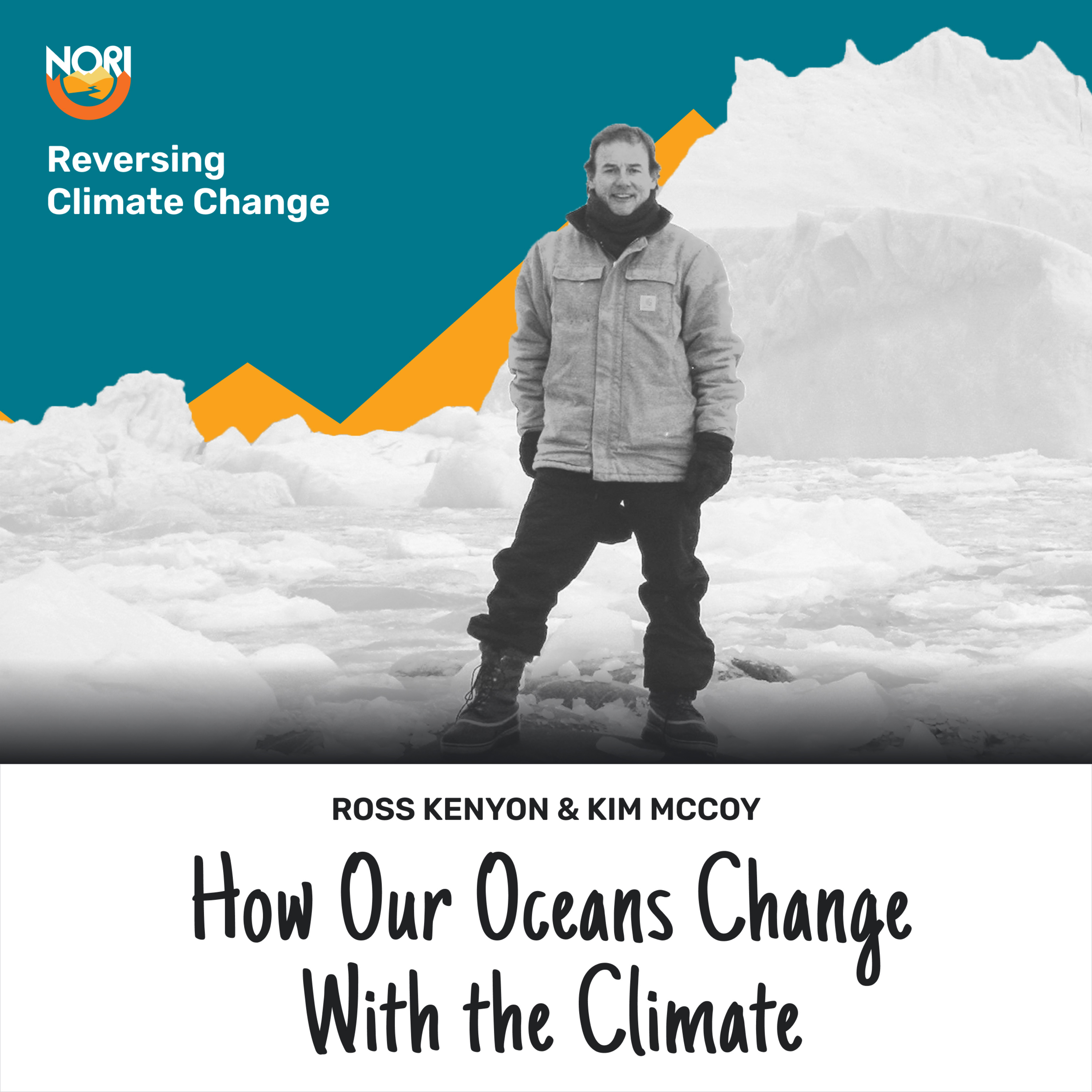
Few of us live at sea, so the ocean doesn’t get as much attention as it deserves in the climate conversation. But Kim McCoy contends that phytoplankton deserve just as much consideration as polar bears, and it’s time for us to understand how rising temperatures impact the water, the wind, the waves, and the weather. After all, we all live downstream of climate change.
Kim is the oceanographer who updated Willard Bascom’s Waves and Beaches: The Powerful Dynamics of Sea and Coast, adding new insights around the impact of climate change. On this episode of the podcast, Kim joins Ross to discuss the impact of changing the amount of energy in a given system (i.e.: adding energy in the form of heat) and explain the relationship between changes in the atmosphere and changes in the ocean.
Kim shares the scientific data around the increase in accumulated cyclone energy fueling Atlantic hurricanes and describes how private property is becoming public due to sea level rise. Listen in for Kim’s take on interventions like iron fertilization and solar radiation management and find out what we can do restore the health of the hydrologic cycle that connects us all!
Connect with Ross
Subscribe to the show on Substack @ rosskenyon.com/subscribe.
I also write Carbon Removal Memes and curate Climate Workers Anonymous.
Resources
Waves and Beaches: The Powerful Dynamics of Sea and Coast by Willard Bascom and Kim McCoy
John Kretschmer on Reversing Climate Change S2EP33
Brian Von Herzen on Reversing Climate Change EP034
Brian Von Herzen’s RCC Bonus Episode on the Documentary 2040
Full Transcript
Ross Kenyon: Hello and welcome to the Reversing Climate Change podcast. I’m Ross Kenyon. I am the creative editor at Nori’s Carbon Removal Marketplace. Today I have with me Kim McCoy, oceanographer who wrote the third edition of Waves and Beaches, The Powerful Dynamics of Sea and Coast by Willard Bascom. Thank you for being here, Kim. Thank you for having me Ross. This book is beautiful. I’m very glad to have you. It’s illustrations and it’s just a beautiful aesthetic experience, which is a wonderful thing to say about something that is either aspirationally a textbook or is a light textbook.
But my understanding is that this book is a classic and a listener listening to the admittedly strange way I introduced you, how could you write a third edition of a book by someone else? What is the story of Waves and Beaches and how did you come to be involved in it?
Kim McCoy: Well, Waves and Beaches went through two prior editions, and I used the first edition when I was in graduate school. And as many classic texts, they go through multiple editions. And Willard had thought about doing a third edition of He handed it to me one day and said, here, read this. And I was taken aback, much older than I am, much more accomplished. And so I gave him my reviews after a couple of weeks and he liked it. So unfortunately, he was hit by a car and died shortly thereafter.
So intervening few years, the estate asked me if I wanted to do the third edition. So Many years later, we’ve succeeded with Patagonia, and it’s been completely updated for the 21st century, and it has a golden thread of climate change through the entire coastal world.
Ross Kenyon: There’s a lot of climate change in the book. It sort of is a thread is maybe a good way to think of it. One other thread that I noticed that helped me anchor all the discussions about oceans and world systems is how important it is to think about the energy that is present in systems like this and what it means in general to increase or decrease the amount of energy within a system. As a non-scientist, is this a theme that I should have picked up on as important as it maybe is or is not?
Kim McCoy: Absolutely, Ross, you hit the nail on the head. So for instance, let’s just take something as simple as a dam that dams a river. So let’s go downstream and I’ll come back up to the dam. So downstream, the amount of sediment reaching the coast is diminished and you have coastal erosion because you’ve reduced the sediments. Now you can view the dam upstream as it’s holding the potential energy of the water in reserve. It goes off and produces electricity or irrigates crops. It does something else other than moving sediments downstream.
So the humans have co-opted, so to say, the energy of the flowing water as it moves down the riverbed, moving sediments and nourishes the coastal zone. So it’s a diversion of energy. And that is happening everywhere we look.
Ross Kenyon: One other application I saw that really caught my imagination is that with climate change and the world heating up, heat is another way of saying energy perhaps, and there’s more energy in the system. And for lack of a better word, the system is more energetic. There’s more weather events. There are more things happening. And when they do happen, the magnitudes are greater. Is that broadly a correct understanding?
Kim McCoy: Yes. For instance, something that people on land can easily understand, certainly in North America, is we have the jet stream. Some people call it the polar vortex. It basically wins its circle in the northern hemisphere. And from left to right, if you will, from west to east. And these have changed in their behavior. And I’ll just give you a simple example. If you had an inclined plane, so a piece of plywood, and you poured a little water on it, the steepness of that piece of wood is not very much.
Water sort of trickles down, meanders left and right a little bit. It doesn’t know what to do. Examples are similar to what’s occurring with the jet stream. It’s meandering larger because the difference, the temperature difference between the lower latitudes and the northern latitudes is less. That potential energy, if you will, is less. So it meanders more. That’s an oversimplification. There are many ways to express that and to view it. But that’s a simple view of what’s happening. So when we get a period in Texas where it’s 85 degrees one day and the next day it’s below zero, like where they just had a terrible cold spell, it’s because the path of the jet stream has been allowed to be altered.
And those sorts of phenomena are going on everywhere. Is it right to attribute weather events like what just happened in Texas as being the result in energy changes overall in the earth system as a whole? Well, it’s always been that way. Yeah. You know, the meanders of a river, the meanders of the jet stream are a function of the flow of energy and turbulence in the atmosphere and flow over water. Small and large pieces of sedimentation. So the paths and the frequency that those paths may be reached is intimately connected with the difference in temperature in the atmosphere.
So fluid dynamics in the atmosphere is driven by temperature, barometric pressure, and relative humidity. When any of those three parameters change in the atmosphere, the path of winds and hence the path of weather will change. That’s no secret.
Ross Kenyon: Yeah, actually, as I’m asking this question, I’m second guessing myself because once you’re at that zoomed out level, the questions you ask are something like, Do changes in the Earth systems result in changes on Earth? And like that’s sort of a tautology or a facile question or what even am I asking?
Kim McCoy: We live above a solid Earth and below a fluid sky. That’s where we are in the ocean and any change to anything above or below will change the ocean and likewise If you change the ocean, it will change the atmosphere. So it’s a dynamic that has periods that are some very short, and I outline that in Waves and Beaches, some so short in occurrence that you can barely see them with an eye, notice them in a second, and others so long and so large, you cannot see them during a human lifetime.
Ross Kenyon: Wow. Wait, sorry. I feel like I missed the beginning of it. Are you saying that there’s waves that are so big that you couldn’t detect them over the course of a human lifetime? Or did I misunderstand you?
Kim McCoy: You understood absolutely right. Now, a figure, I forget the figure, but it’s like 17 or something like that in waves and beaches, has a graph of the different types of waves. And one wave that we are experiencing is the wave of climate change. When the Earth becomes colder than prior, more liquid water will turn to solid water. And what we’re going through right now is the opposite. So during a period of climate warming, as we have now, more solid water is turning to liquid water.
That causes a rise in sea level. That’s a very, very slow period wave. That wave currently has about a six inch magnitude over the last 150 years, 100 years, actually. So that’s 15 centimeters, six inches in 100 years. That’s a slowly rising wave. Wave, a wave of climate change. Now, how large that’s going to get and whether or not we can predict it is yet to be seen. But it’s a slow moving wave. You can view it as a wave of solid ice turning to liquid and moving towards the equator.
That’s what’s happening. Is that a case of an oceanographer taking poetic license or do y’all actually speak like that and view climate change as a wave? That is perhaps one of the original thoughts in Waves and Beaches. Ah, interesting. Chapter five is the winds and waves of climate change in Waves and Beaches.
Ross Kenyon: Cam, what other ideas would you say are original in here? Because the book feels like a reference manual or a textbook almost, but surely there are ideas that are perhaps new or you’re presenting in new ways. What else is in here that is in that same theme or in that same form, I could say?
Kim McCoy: On a very small length scale and time scale, So the very creation of waves, ocean waves are created by the wind blowing on the surface of the ocean and small ripples, actually they’re called capillary waves, very short period waves. The wavelength is the width of your thumbnail, very small, short period waves. The very formation of these waves is based upon surface tension. So surface tension and to a lesser degree, the viscosity, which is a tendency of a fluid to resist shear. So with surface tension, that is dependent upon temperature.
So the very transfer of the wind’s energy into wave energy is being modified. By the viscosity of the water, by the surface tension of the water, both of which are changing. Now, the surface tension is most significant, but both are changing. To my knowledge, no one’s written about this on a climate length scale. What does this do to the general formation of waves? We do know from satellite data that wind speeds have been increasing. We do know that in certain portions of the world’s oceans, the size of ocean waves, these large, many meters, so tens of feet tall waves, they’re changing.
They’re getting a little bit larger. These storms are getting more intense, and they’re very short periods of extremely intense winds. We see that in the hurricane seasons. So there are some things... That are happening at very short length scales that people have not really researched. And there are also these longer period things such as climate change, the winds and waves of climate change that many people have written about.
Ross Kenyon: This relates to a question I had with a former guest. Have you ever read John Kretzmer? Do you know him by chance? No, unfortunately I do not. I don’t mean to put you on the spot. We had John Kretschmer on the show. He’s a sailor and author, done a number of trans-oceanic sails and rounded the Cape and things like that. And we were talking about how climate change is changing his business and how he thinks about sailing. And he was talking about how the window for crossing from the Northeast to Bermuda is shrinking because of hurricane season lengthening.
Worried about changes in the trade winds and how predictable they are. The common understanding of the trade winds is that they are incredibly dependable. And he has at least anecdotal experience of them no longer being nearly so dependable. Have you seen much of that? Is he onto something or is that relatively anecdotal?
Kim McCoy: It’s anecdotal from him, however, it’s statistically substantiated by scientific data. In Waves and Beaches' talk about the accumulated cyclonic energy, ACE, And that’s basically if you add up the number of cyclones and the amount of energy in each cyclone. So if you have a whirring cyclone at 200 miles an hour for two days, it’s a little different than if you have a cyclone with 100 mile an hour for one day. Because of the difference in the speeds, it’s not linear, it would speed the energy. And so there’s more energy going into the Atlantic hurricanes.
That’s well documented. And, you know, we don’t have an infinitely long historical record, but we do have a record going back about 100 years. Many of the hurricane seasons have been extended in the last two decades. And the number of storms, I think last year, I forget, they ran out of letters in the alphabet for the number of hurricanes in the season. So it’s not just anecdotal from sailors. It’s also from the data from scientific measurements.
Ross Kenyon: I’ve seen people try to counter this argument by saying that We experience more extreme weather events these days because of better monitoring, that more people live in these areas, more people live on the coasts, and that there actually is not an increase in extreme weather events. I find this to be a questionable assertion, yet I see it made sometimes. What might you say in response? Well, my own opinion, it is rather questionable assertion. Please, please.
Kim McCoy: However, I mean, if you look at the storm in Galveston, as referred to as Galveston storm of 1900, so 121 years ago, it devastated Galveston. There weren’t that many people in Galveston. But the 2004 Hurricane Katrina devastated New Orleans. And we have indeed more people living by the coastal zone In the coastal zone and in low levels, I think there’s something like 500 million people live below 30 feet of elevation. That’s a large number. So there’s really two ways to view this. One is the amount of devastation is just linear with the number of people living on the coastline and is independent of any data that you may or may not have.
Just, oh, more people living on the coastline, you’re going to have more damage. Okay. That’s one aspect. The other one is let’s just look at the data and let’s not look at how many people are living there. And you look at the Episodic events, things that we call 10-year storms or 100-year storms or 1,000-year storms. What used to be a 500-year storm in some areas is now a 100-year storm because the statistics are changing. And it’s not because we don’t have more data. It’s the data we have is now being massively skewed by ongoing events almost by today’s weather.
And if you look at, for instance, simple thing, the Mekong Delta or the Mississippi Delta, they’ve formed over the last 5,000 years generically. If you look what’s happened in the Mississippi Delta, it’s an absolute ecological disaster. Now, you might have an overlay of really nice, good sound bites of people that are interested in doing business in the Mississippi River Delta, but it’s polluted. It’s sinking. And the people in the coastal region are losing their land and their mineral rights as our land subsides below the legal point of federal versus private land ownership.
And this is not imaginary. So what has been stable for 5,000 years is now unstable. The Mekong Delta is now unstable because of dikes, lots of dikes in Mississippi River Delta too. So the dikes change the flow of water. They cause a flood to discharge lots of water all of a sudden. It flushes sediments out and hence the Delta is not nourished with new sediments. And also you have to buy more fertilizer too. Perform the agricultural activities. So removing the humans from the equation and just looking at the land, yeah, it’s changing big time.
And there’s lots of data. And we’ve got, call it geological and geochemical data from Delta areas through sedimentology and other methods that show that these things have been relatively stable for the better part of 5,000 years. And gee, what a coincidence. Well, we’ve had relatively stable sea level for the last 4,000 years. So, hmm, all right, forget the people. It’s just the deltas are disappearing and a whole bunch of other things are changing. So, Ross, you make up your mind.
Ross Kenyon: Fair enough. Thanks for digging into that for me. You mentioned something that I found very interesting in this book, and there’s a lot more to say about it, but the relationship between shoreline and property and when Private property goes to public property as a result of changing sea level. Man, that just sounds like lawyers are going to get very rich off of that, it sounds like, is what I’m trying to say. How exactly is that going to work? What do you foresee? Can you explain it to our audience?
Kim McCoy: Yeah, property rights are defined in different areas with different datums, but let’s just use for general purpose, the low, low water line. So that’s if you look at, well, let’s just call it low water line. So if you average the low tides, that’s generically under some jurisdictions where the property rights of the individual and the federal government begin. So imagine a slope of land, one in 100. And it’s one foot vertical versus 100 feet out. That means there can be one meter versus 100 meters, doesn’t matter.
And you have a sea level rise of six inches on that one in 100 slope. Well, that means you’re going to lose half of that distance. That’s 50 feet of coastal land you’re going to lose. So that Piece of that demarcation where the private landowner’s land ended and the federal government took over, just moved back towards the new shoreline in favor of the federal government and to the detriment of the private landowner. And also the mineral rights below. So if you’ve got gas and oil rights, or you’ve been sand mining, or you’ve got a shrimp farm or whatever, sorry, dude, you just lost those.
Ross Kenyon: I think you mentioned there too that some of these seizures by the government have already happened in places. Is it sort of pretty open and shut legally? Does that just happen rather easily relative to some prolonged suit?
Kim McCoy: Well, it depends on who’s on the land side. If it’s a gas and oil company that has some mineral rights granted by an individual, They might fight for it if it’s less expensive than the federal government granting that or vice or conversely. So it depends on which side of the argument you’re on and how much money is on which side. And they also stuff between states, you know, for instance, Georgia and Florida are in legal battle in California, Arizona, New Mexico. They’re all with water rights and discharges on the beaches and So, you know, somebody builds a dam upstream, the sediments don’t reach the coastal zone, and then you get erosion.
And then your nice little beach that’s been there for 5,000 years isn’t there anymore. So there’s all sorts of litigation going on. I’m not in that field, but it’s easy to research those if listeners are interested.
Ross Kenyon: It’s very much of interest to me. And I’ll let you off the hook. I won’t make you talk too much more about it if it’s not something that you’re actively researching this way. But I hardly ever hear anyone speaking about this. I think in general, Ocean gets less attention than it should for climate reasons. I think ocean acidification is really scary. I think some of these feedback loops, given the lags in the system, the interaction between the atmosphere and the ocean not being immediately visible in all the kinds of ways that, I don’t know, like some of those cycles take longer than maybe human brains are evolved to notice.
So it feels counterintuitive to us. So we end up looking at polar bears rather than the ocean in some cases. Do you feel a bit neglected in that way, or am I projecting onto
Kim McCoy: you? My mother never neglected me. Climate community overall. Well, as an oceanographer, my focus has been the ocean, you know, aquatic worlds. We’ve worked in lakes also. So we’ve been biased, you know, the earth sciences have been biased towards liquid biology. So I’m biased towards the aquatic world and the Earth, some people refer to it as a cryosphere, you know, the atmosphere and polar caps and the river system, the hydrological cycle, it’s all connected. Well, that is where most of the photosynthesis takes place.
Somewhere between 50 and 80% of all photosynthesis is taking place in the ocean and large lakes. So, you know, we look at, yeah, the polar bears and, oh, the sea otters and, you know, the dugongs and they’re, oh, terrible, terrible things. You know, the pandas don’t have any more bamboo. But out at sea, there’s species we’ve never heard of that are near the brink. But that’s, it’s not the chordata, not animals with spinal cords. It’s the issue. You know, as I mentioned, the phytoplankton is really important.
And there’s between 50 and 80% of the world’s photosynthesis takes place at sea. And one little dude, he’s the smallest photosynthetic organism on Earth. Prochlorococcus, I think is pronounced. The smallest organism that photosynthesizes produces 20% of all oxygen. It’s phenomenal. It’s microscopic. We can’t even see it. And so below the Earth’s surface, internal waves mix the oxygen-rich portions of the oceans with the upper ocean, and it causes this primary productivity to go on. So when we starve the oceans of river discharge, the nutrients that would go normally into the ocean, well, we’re actually cutting off the necessary nutrients for these phytoplankton.
So nobody’s going out there and saying, hey, save the phytoplankton. You can’t even see these dudes, you know, but it’s extremely significant. I think 20% of all CO2 take up is rather significant for something in the ocean, but you can’t see it. Wow.
Ross Kenyon: What do you think of efforts that are typically called iron fertilization or ocean fertilization of dropping iron shavings into the ocean to stimulate the growth of various types of plankton that will die, float to the bottom of the seafloor and be a form of captured carbon? Did I mischaracterize it?
Kim McCoy: Not at all. You haven’t mischaracterized. Luckily, I knew John Martin. John Martin was the marine biologist who I think originally recognized that iron was a limiting factor and they call it ocean fertilization. And there have been several experiments that have been done. I think with somebody off the Northwest, no permits or anything, they’ve got a barge full of iron tailings and threw it in the ocean and then measured primary productivity and saw, oh, well, it went up. So there’s a lot, you know, yes, it’s been not only theorized, John Martin, the original guy, But some wildcat people have actually even done these experiments.
I was involved with a Japanese group that did a very small-scale test of iron fertilization. And yes, it works. And you mentioned the removal of the carbon from the upper ocean. That’s called sequestering. So if somebody wants... Grow a tree on Earth. That’s great. Wonderful. However, when that tree dies, it then decomposes and then once again produces CO2 in that process. So the marine organisms, on the other hand, when they die, they go below the photic zone. They go beyond that high mixing zone in the upper ocean.
They go beyond that and they form the ocean sediments like they have for millions of years. This ooze that you’ll find all over the deep ocean. And that is a very valid way of sequestering carbon dioxide. Now, if you can get something to photosynthesize, like kelp, I believe you mentioned something about kelp. I know some people involved in that effort. There are several efforts. And that is a valid way. If you allow the organisms to die off into the deep ocean, that’s a valid way of getting rid of the carbon dioxide in the upper ocean.
A few million years. That’s significant. We can figure it out in other ways in the longer term.
Ross Kenyon: Yeah. I think the iron fertilization stuff is potentially riskier or spooks people more than something like growing kelp and dropping it into a deep enough part of the ocean where it’s really not mixing with the ocean enough to come back. There’s a group called Running Tide that has been doing this. I know Brian Von Hertzen, who’s been on the show a number of times, talked about his marine permaculture efforts. Super interesting. So stuff like that is going on, though. And I think it’s getting more and more attention these days.
Is that your experience, too?
Kim McCoy: It’s getting a lot more attention. Unfortunately, I, you know, you might call this a form of terraforming, you know. Like some sci-fi. Please bring it on. Terraforming, you know. So there are people that are trying to spray aerosols in the atmosphere to change the albedo of the earth. The albedo is basically the ratio of the incoming solar radiation versus the reflected radiation. And if you increase the albedo, that means that more is being reflected out. And that means that there’s less heat being retained.
In the greenhouse effect, but that doesn’t change the acidification of the oceans. So sort of like the Sorcerer’s Apprentice. You change a little something over here and before, oh, there’s too many. If you remember that Disney Fantasia kind of thing, you know, where there’s a fellow trying to stop the flow of water and. The inundation is just too great for the innovative methods. And I’m constantly reminded of that little cartoon in my head that we’re like The little Dutch boy with the finger in the dike, you know, we’re trying to stop something in a very honest and concerted manner.
But the complexity of it is way beyond human comprehension and certainly beyond political means. The politics of this is everybody’s blaming everybody for everything. But what really needs to be done is we need to make... You can start at sort of city council level and have the codification really of climate change implemented, which means that instead of having city, state, federal, even supranational entities responding to disasters, it’s better to address the root problems than internally combat the symptoms. So that if you Make it legal for, let’s just take a city council, to act when you give some metric, you know, when a storm surge is above a certain level or when seawall is breached at a certain height, some metric.
And you codify that. You said, hey, when these things happen, the city council is already empowered to do something. Now, the Dutch have done that for a better part of two decades. They’ve got it right. They built this $400 million Rotterdam barrier, and it’s worked a couple of times. It’s been around for 20 years. Well, Hurricane Katrina was $50 or $100 billion in damage. Billion with a B. Whereas the Rotterdam barrier that they’ve used twice, it costs 400 million euros. So throw a dart, say $500 million.
That’s, oh, that’s a half a percent. Well, that’s good. That’s money, good, well spent. So if you have, if you take a short-term solution to a long-term problem, you’re continually spending. And You know, you can lease a car for a day and not worry about paying long term insurance costs, but then you’ve still got to lease it the next day. So sometimes it’s better to own rather than lease. And it seems almost like we’re leasing our environment rather than trading long term solutions to these problems.
Ross Kenyon: Okay. Yeah, certainly feels that way. Sometimes it feels more like a payday loan kind of scenario. Well, I did want to ask, maybe it’s good to clarify, because I’m not sure someone listening might have fully grokked your intention. Are you saying that things like solar radiation management are a form of leasing our environment and are there for Or do you find that in iron fertilization to be risky climate interventions that we shouldn’t pursue? Are you in a research phase? How do you feel about that?
I just want to make sure it’s clear.
Kim McCoy: My opinion is that nature has certainly figured out how it interacts with itself for, you know, life on earth is generically three and a half billion years old. And it’s always changing. And it’s got this dynamic that comes and goes and species arise and then they become extinct. Things happen all the time. The environment will continue. It will prevail. However, what we’re trying to do, you know, we’re very smart beings. However, our solutions seem more short term. So, you know, iron fertilization is certainly a method, but we need to change things.
Our introduction of carbon dioxide into the atmosphere, that’s a first order correction. But there are all sorts of other things. I mean, we have wonderful seashore environments, coastal regimes with fantastic opportunities for aquaculture, for recreation, for many other things. Yet we find short term solutions that destroy the environment. So they destroy the We are eating our own golden goose. So yes, we should try these things, but we should iterate fast enough to realize that what we’re currently doing does have long-term repercussions. And those long-term repercussions are in the multi-decades, not in just four-year election cycles or two-year election cycles.
Ross Kenyon: Yeah. What are some good trends happening that people might not be aware of with regard to the hydrological cycle, oceans, lakes? What are some things that we might not be aware of?
Kim McCoy: Well, you mentioned about fertilization efforts and kelp. Kelp is a very nutritious entity. Asian cultures utilize kelp all the time. So dealing with How we produce things that we consume and how we treat our watershed, not polluting it. Fracking introduces millions of tonnes of very toxic stuff unfit for humans into the aquifers. So having coastal, so I’ll look at it more from a coastal vantage point, having coastal Efforts to maintain the health of the sediment loads, the health of the quality of the water. Those things will pay back in time.
You’ll have more lobsters in the coastal regions, more crabs, more fish. But if you kill off the good things going into the You know, one might ask, you know, what town do you live in? Oh, I live in Houston or I live in Miami. It’s really not. Which town you live, it’s what watersheds you live in. When you start looking at it, you live in a watershed, since the hydrological cycle connects us all, the sooner we realize that we’re all connected within the hydrological cycle, the better we can treat our environment and our environment will treat us well.
It’s a big look, you know, from high altitude on a low level. What we can do is what happens upstream affects everybody downstream. Eat things that produce fewer agricultural wastes. Don’t support groundwater extractions, other than for absolutely necessary things. Hydraulic fracking, as I mentioned earlier, puts all sorts of stuff into the aquifers and unfit for human consumption. Try and decrease fossil fuel dependencies. Reduce CO2 emissions. And, you know, these and our nature will reward us. You know, we live in a very fruitful planet.
If we disregard what’s downstream, eventually everything’s polluted. And unfortunately, regardless where you live, we all live downstream of climate change.
Ross Kenyon: Kim, I have a few questions from our patrons on Patreon. And these are listener submitted. And if you’re listening and you’d like to do this, you can join Nori’s Patreon where we do a book club. It’s a lot of fun. And occasionally questions will come out ahead of time that I’ll write down. And yeah. So, okay. The first question here. A little bit dure, but I’m hoping you can give us a positive answer, which is about microplastics. What is happening with them and how can we get them out of the ocean?
Kim McCoy: Yeah, microplastics is a global problem, as we well know. And as before, upstream, be careful what you do. Try not to utilize things that are in plastic packages. The Waves and Beaches has about 150 references of all sorts, and some of those refer to plastics and microplastics. There are some international efforts, I think one of them out of the Netherlands, where there are large vessels and booms, if you will, that collect from the ocean’s garbage patches, these large gyres of floating plastics and debris. And we need to reduce our dependency on the hydrocarbon slash plastic production, because remember that plastics are made primarily from hydrocarbons.
And the sooner we can wean ourselves off of that cycle, the more reduction there will be in the plastic detritus. And that’s a big cycle that Well, thank you.
Ross Kenyon: I’m sure they’ll appreciate that. And we have a second one that I like. It made me laugh. Here goes. I’m going to read her words. She says, Lately, my two-year-old daughter has been asking to see, quote, mommy whales and baby whale So I’ll search on Instagram and there’s some footage shot by drones. And even on a little phone screen, it gives both she and I such a sense of awe at these gorgeous beings. As much as I would love to see them in real life, I don’t want to be a person in their habitat.
But do video drones bother wildlife a lot? What do oceanographers say about that? So speak for the oceanographers, Kim.
Kim McCoy: Okay, I’ve got my oceanographer hat on here. Drones do not substantially influence any behavior of any whale in the ocean. What does influence them is shipping. Shipping noise has increased over 100 fold in the last 50 years. You know, container ships, their propellers turn, they go around, they make a lot of noise. Those certainly disrupt the feeding patterns and migratory patterns of whales. So little drones and small boats aren’t going to harm a whale in its normal behavior. In many cases, whale swim up to boats, to smaller boats.
But large... 50,000 tonne, 100,000 tonne freighters or container cargo ships, those discharge a lot of energy. So sound into the ocean and whale navigate and communicate using sound. So it’s as if you’ve got a jet plane going by, you know, every two minutes. It disrupts your conversational patterns and eventually you just move on to another room. So don’t worry about the drones. Enjoy it. They’re wonderful animals. I’ve been lucky to swim with whale. I’ve been very close to whale many, many times in and out of the water.
And they’re magnificent animals to observe close and afar. All right. So she and her daughter have your blessing to enjoy those YouTube videos. Oh, absolutely. Just as long as they’re not filmed from 100,000 tonne container vessels.
Ross Kenyon: All right. That’s good. Good for them then. Well, if people want to learn more, where can they get your book? How can they support it? What can they do?
Kim McCoy: The third edition of Waves and Beaches is being published by Patagonia. You can find it at patagonia.com. And you can also find the book Waves and Beaches on Amazon and wherever books are sold. I really suggest if you’re interested in going a little bit deeper, you can look at The references in Waves and Beaches that refers to not only to books and peer reviewed papers, but also to coastal management plans, things that people have already done. So cities and countries, they’ve already implemented coastal management plans.
There’s about 10 or 15 of those plans in the references, in the appendices of waves and beaches. So if you want to dig deeper, there’s plenty of stuff in waves and beaches for every level of reader. Over 150 photographs are heavily annotated and captioned so that you don’t have to dive into the intricacies of wave celerity in order to enjoy the book. Everyone can enjoy it.
Ross Kenyon: Great. Links to all of those things are in the show notes. Thanks so much for being here, Kim. Great. And thank you for having me, Ross. It’s been my pleasure. And if you like the show, please tell a friend, rate and review us on Apple Podcasts or iTunes. Helps us get the show out to more people. And thank you so much for all of your support and for listening. Well, thank you so much for listening. If you like the show, please rate and review it in Apple Podcasts and or Stitcher.
It really helps us a lot to get this content to a wider audience. If you think what we’re doing is useful, interesting, fun, hopefully all three, we’d certainly appreciate your rating and review. [Nori promotion cut from the transcript. It's still in the audio, but it no longer applies.]
And thank you so much for your support.


