

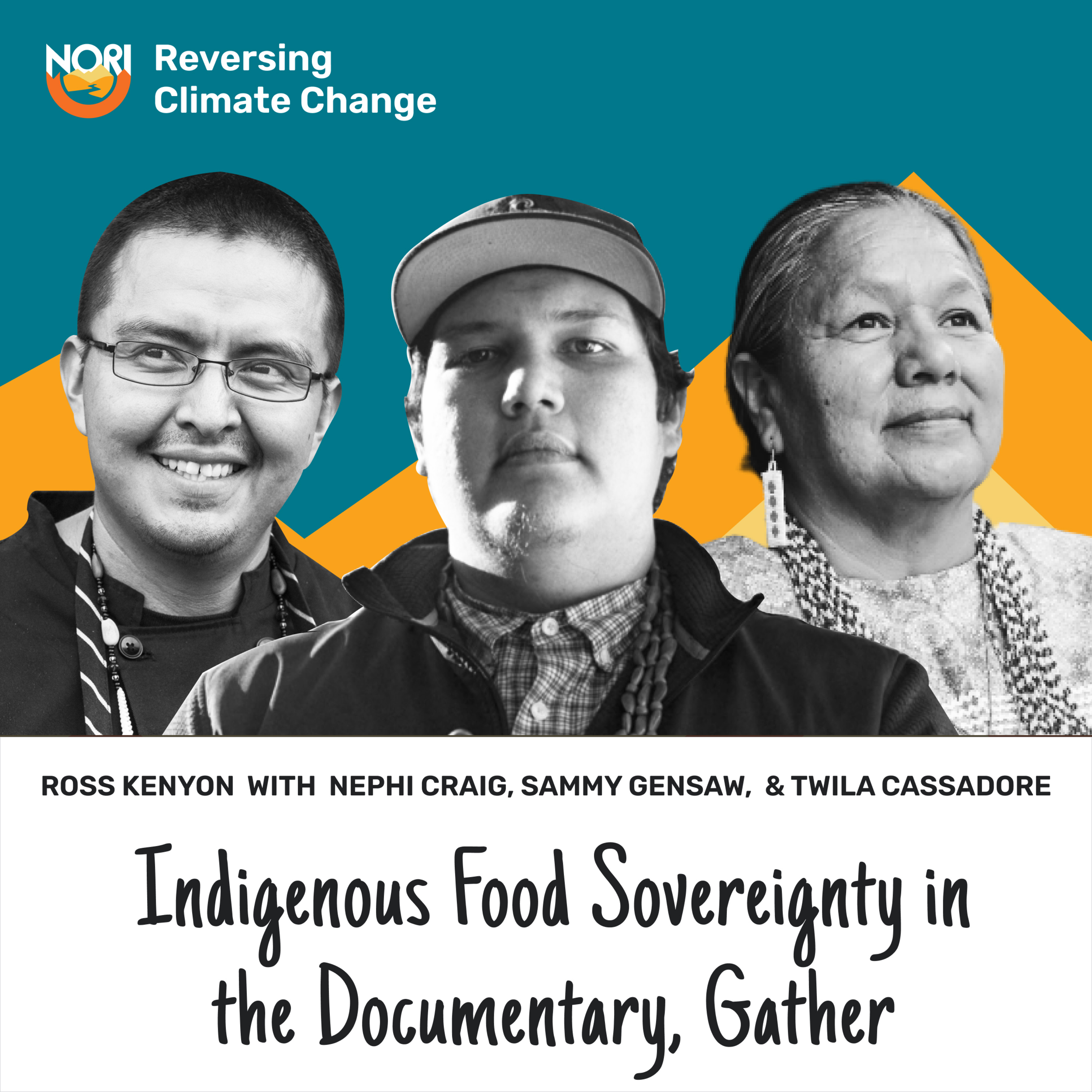

Listen on Spotify, Apple Podcasts or YouTube.
There is a growing movement among Native Americans to reclaim their spiritual, cultural, and political identities. And restoring indigenous food practices is central to this work. The new documentary Gather follows several indigenous leaders as they work toward food sovereignty, demonstrating the hope and healing power of traditional food.
On this episode of Reversing Climate Change, three of the people featured in the film join Ross to discuss how they got involved in Gather and share their work around reclaiming indigenous foodways with the world. First, traditional food forager and educator Twila Cassadore explains the importance of food sovereignty in the context of her work with the Western Apache Diet Project.
Then, Apache & Navajo restauranteur and executive chef Nephi Craig of Café Gozhóó describes his journey through classical French cuisine back to Native food, exploring the power of indigenous food practices in healing chemical dependency and generational grief. Finally, Yurok fisherman and Ancestral Guard founder Samuel Gensaw III offers insight on the Fish Wars of the 1970s and his ongoing fight to protect future generations through indigenous food. Listen in to understand why he believes indigenous values are key in sustaining life on earth and learn what you can do to support Twila, Nephi, and Sammy’s work.
More from the show
Ad-free episodes and other benefits come with a paid subscription.
Carbon Removal Newsroom, the news show that ran alongside this one, is over. Its episodes are still up, on the feed Climate Workers Anonymous now uses.
Carbon Removal Memes is still going.
Resources
Tribal Food Sovereignty Advancement Initiative
Twila Cassadore at the Quivir Coalition
Guardians of the River on YouTube
Full Transcript
Alexsandra Guerra: You’re listening to the Reversing Climate Change podcast by the team at Nori, the carbon removal marketplace. This is a show about the innovators and entrepreneurs developing solutions to climate change.
Ross Kenyon: Hello and welcome to the Reversing Climate Change podcast. This is Ross Kenyon. I am the creative editor at Nori’s carbon removal marketplace. We are doing something different for this week. We have never before had more than one interview subject, discussant, interlocutor, whatever adjective — or I guess that’s technically a noun — you want to use here. We’ve never had more than one guest on, or one group of guests on, at a time. But we recently watched the film Gather, a documentary about indigenous food sovereignty. I thought it was a really beautiful film, both technically and an important one. I learned a lot. I thought it was a fascinating piece of work. I wanted to share it with our listeners.
So if you go to Gather the film — the link is in the show notes — you can learn more. It’s a film by Sanjay Rawal and others. So today we have three of the subjects of the documentary on, talking about their work at the intersection of indigenous foodways, food sovereignty, regenerative agriculture. Just very important ways of thinking about food systems moving forward in a way that isn’t often brought into conversations about agriculture. I think this is important. I think it’s really cool. I also am happy that we’re experimenting with the form of the podcast a little bit. So I hope you enjoy, and here, heading into the first interview, starting with Twila Cassadore. Twila is doing very interesting work on teaching and living the foraging lifestyle, the hunting lifestyle, as much as she can. Hope you enjoy. Here it goes.
Hi, Twila.
Twila Cassadore: Hi, good morning.
Ross Kenyon: Good morning. Thanks so much for coming to chat with me. I really enjoyed the film.
Twila Cassadore: Thank you. And thank you for inviting me.
Ross Kenyon: It’s my pleasure. How did you become involved with Gather? How did this process unfold for you?
Twila Cassadore: It really was a film that was focusing on an Apache chef named Nephi Craig and the type of work that he does in his surrounding. A lot of it has to do with reintroducing traditional food, and he’s a high-end chef, pretty much, so taking this traditional food and really doing beautiful work with it. But for myself, I saw what happened. They’re like, we want to know, you know, where the food came from, or where Nephi’s food came from. That’s where I came in. And when they asked to film here in San Carlos, I never imagined there was a large film. I thought it was just a regular public film that’s gonna be made for the community. And we do have other film crews that do smaller films for the community. So I was pretty much thinking, okay, this is a small family, until the film crew came and I was like, oh my gosh, who are all these people? But they let us be, so I was really happy that they were able to let us share our voices in this film, from my end. Yes. That’s how I ended up on the film.
Ross Kenyon: That’s great. I’m happy to hear all of that. You feature prominently in scenes of hunting and foraging and cooking of this gathered food. What is it exactly that you are hunting? That segment is very memorable to me.
Twila Cassadore: Okay. It’s a white-throated desert woodrat, and it’s one of the several species that grow in this region, and it’s one of the woodrats that don’t really contract hantavirus. So that’s one thing that wasn’t specified during that time. And it’s a winter meat. It’s not a seasonal meat, it’s only meant to hunt in the winter. So it’s about a one-pounder of meat.
Ross Kenyon: Wow. It sounds like you’re quite involved with Nephi, and maybe you’re involved with procuring some of the ingredients that he cooks with. Is there an ongoing relationship in that way?
Twila Cassadore: No, it’s just educating their community. Basically has some of the same sort of food that we have. Some of our desert food they don’t have, but it’s pretty much common knowledge. So for us, it’s just sharing, making sure that knowledge is continued to be shared throughout the communities and throughout the different generations that are to come. It’s just constant learning, just repetition of the same food.
Ross Kenyon: How do you see your work overall and its importance? Is it in passing this wisdom down and practicing it yourself and teaching? [unclear]
Twila Cassadore: Work is very important, and it also connects back to our identity, connects back to the land. I always reference the five seeds, which is language, song, ceremony, prayer, and foodways. And we carry these five seeds, and me handing it to the next generation — of course they’re not going to carry the five seeds, they’re going to carry some of those seeds. And you’re looking at this generation: how many people have those seeds? Really, not too many people carry all five seeds anymore. So what we want to do is reintroduce a lot of that knowledge back into the community openly. Not to, you know — it’s not written, it’s shared knowledge in the community — and we just want to make sure that knowledge continues to be shared, because it really references back to us as indigenous people, us as Apache, and back to our creation story. So everything comes from the very beginning and it always continues.
So we don’t want to lose that knowledge. We don’t want to lose songs and those prayers and the ceremonies throughout time. So to me the work is very important, because it ties to the ceremony, it ties to the land, and ties to the body, mind and spirit of an individual.
Ross Kenyon: Any of these sort of five pathways that you single out — were they at risk at various points of being forgotten or lost? And are they coming back now?
Twila Cassadore: Yes. I mean, see, during — well, it actually did start when the reservation began and people were removed from their land, the landscape. People were put into boarding schools. People were forbidden to do ceremony. People were actually killed — their people were shot practicing their religion — and it became to a point where it was illegal to have ceremonies. So if you had ceremonies, it would be dangerous for you. So through time that slowly came back, and thankfully a lot of that knowledge was not lost.
And so you’re also looking at even religion, like Christianity. Christians will say, oh, you are worshipping the devil. And I was comfortable — we worship one God, we pray to one God. And when they talk about freedom of religion, yet they’re denying indigenous people their freedom of religion. And it makes me think, okay, we talk about freedom of religion in this country, but yet we were stripped away from our freedom to practice these ceremonies, to practice our language, to go and harvest, you know. And you were limited. If you tried to leave the boundary you were shot and killed. So a lot of people had to deal with a lot of the transition, transformation of where we are today. So we’re thankful for what we do have.
Oh yeah, there was just one more thing. And there’s also a time in the 1960s when Agent Orange was sprayed on our reservation throughout the river beds, and that’s where basically everybody almost lived, pretty much lived along the river, because people were dependent on the water for the farming. A lot of people have contracted cancer. There’s a long-term effect of that here on our reservation and it hasn’t been really justified. But it’s just reteaching people what they can plant, how to plant, a different way of educating people — do raised beds, you know, not using the same ground that the contaminated waters have affected. Many of our basket weavers have died from it, because they’re out there in the rivers collecting the materials, and we all use our mouths — that’s where I got messed-up teeth — but we all use our mouth to split the things.
And there was a time when my relatives a little bit older than me would run under the plane and they thought it was cool. They didn’t know what it was, Agent Orange being sprayed. And they would chase the planes going through that. And people no longer foraged because of the areas that were sprayed, and people thought they were getting sick because Christianity said they were worshipping whatever. So in a sense it kind of played into that, not knowing that it wasn’t that, that it was just Agent Orange being sprayed throughout our waterways.
Ross Kenyon: Agent Orange just kills plants, right? A defoliant. Do you remember the rationale, or why this happened?
Twila Cassadore: Oh, they believed it was good for our riverbeds. And so they decided to spray between 8 to 15 miles of our riverways, our waterways, and they said it would help minimize the growth of some invasive species. But they overlooked the fact that people lived along the river, people farmed along the river. A lot of people in the 60s didn’t sleep in houses, they slept outside. So your clothes are hanging outside, your dried food outside, your dried forage food were laying out on tables that were being sprayed. People did not understand the harm that this was causing. And plus you can’t blame them, because we didn’t know, people didn’t know that, and they just knew it was something the government or the agencies said is good for this water.
Ross Kenyon: Wow, that is terribly tragic and, sorry, it’s shocking to hear. Your work on foodways, Twila, I find really interesting, and I’m wondering — seemingly where the Apache reservations are now is within where your people have been for a very, very long time, right? It’s probably in the same region. So these foodways were probably better preserved, potentially, than indigenous people who were moved very far away to new ecosystems, and those foodways are seemingly much more potentially lost, lost to time. Is that a correct way to understand it, or not really?
Twila Cassadore: Yes and no. Some said yes. But you remember that that’s actually many bands brought together from throughout all of the southeastern portion of Arizona, part of New Mexico, Mexico. And they were brought here to San Carlos, 1.8 million acres. At that time you were only placed on 40 acres. So in 40 acres for 20 years, and that was encampment of 20 years of being, how you say, a prisoner of war. And when some of my relatives went back to where the lands were, they were taken away by farmers and ranchers, and they were forbidden to go there either. They suffered other things, but it was a complete transformation and readjusting. And what was beautiful about people here is the resiliency, regardless of the [unclear]. Was the ability to adapt to the situation, ability to transform and learn the other types of traditional foods that were taught to them. And it was a shared knowledge between different bands, not just one group; different bands would have this shared knowledge, and that’s how people were able to support themselves.
So right now at this point we have access to those areas and food. So yeah, we have a large amount of people, we have larger than 1.8 million acres, and there is a lot of food here. Yes, but it’s not enough to support the community, but it is enough for people to go and forage from, and seasonal, all the way from spring all the way into fall. So you always have different varieties of food growing on the landscape, but it’s just getting there. A lot of it takes community, commuting and traveling, and patience — a lot of patience.
Ross Kenyon: I can only imagine. I suspect that many of the people listening do not have foraging or hunting as a part of how they eat, even a relatively small portion of the food that they consume. Why do you think that’s important?
Twila Cassadore: Mostly it gives you food sovereignty, the ability to provide for yourself without being dependent on the government system, like the commodity, these food stamps, but being able to go out and support yourself in a real, holistic way that actually nourishes you, not only mentally, also physically, but also spiritually, and it’s all in combination. Where you can go to a grocery store — yeah, you can buy these things and you can cook equivalent to what this is, but it doesn’t have that same holistic meaning of when you’re out there foraging and being out with the land, being one with the land.
Ross Kenyon: There’s something about — whether it’s food stamps or whether it’s buying in a store, it seems disconnected. I don’t think people really care that much how it got to them, so long as it got to them. And for you there’s a much deeper spiritual pursuit that’s tied up in how we interact with the land rather than a grocery store shelf or something like that.
Twila Cassadore: That’s where the imbalance in life is, is because people are disconnected completely from the land. Pretty much a very small amount of people are still, you know, maintaining that relationship with the land. So when you look at the natural disasters throughout the globe — and some cultures, they believe you do a lot of it because people have lost that connection with the land — and the respect for the land does have effect on all life.
Ross Kenyon: How should someone who is not indigenous, or not connected to the land in this way — do you have any advice for how they might learn from your practices and your thinking? Is there anything that they can do on their end?
Twila Cassadore: I always tell people, support indigenous farmers in your local areas, indigenous growers, producers, people like that that need that support, that don’t have the support. For one, our people, we come from all different cultures, all of us do. And Mother Earth, we walk on her every day, which is [unclear], which is the earth. She don’t see color, she don’t see race. She hears every heartbeat that walks on her. And I tell people we’re all connected in some form, but a lot of people don’t look at it that way. Because when we walk, we don’t stomp on Mom. You know? We don’t do that. We actually walk. You see people walk and run — you hardly see many people stomping on her. In a funny way, I would say they respect her not knowing that they are respecting her, by the way they walk on her and run and do all these activities, because she’s actually listening to everybody.
I would say it’s her heartbeat, and she just loves everybody equally regardless of, this is how we say, yes, indigenous people went through tragic things. Every culture pretty much went through tragic things to come to this point in life, but we have to support each other still and continue to help each other to heal and move forward, and that will make life better, but not to continue to go backwards. Because how we say is, we follow the sun, and the sun doesn’t go backwards, the sun is always moving forward.
Ross Kenyon: Beautiful sentiment. If someone wanted to learn more or support your work directly beyond watching Gather, is there something that you might recommend that they participate in or do?
Twila Cassadore: Oh yeah, grant funding. So that’s one great thing. Yes, there’s only two people that do the same work that I do, that’s myself and another person, an ethnobotanist, and we’re like a two-man crew. Looking at long-term funding is very hard. So when we apply for grants, we don’t meet those grant guidelines, mostly because a lot of them are specifically targeting clinical studies and they require numbers. For mine is, okay, 20 years from now this one person — oh, I remember, I got onions and I got them with my kids and we cooked them. That’s success. But that’s going to take 20 years, and I don’t think grant people are going to wait 20 years to hear that story from an individual.
And taking young people out — I’ll come and share this briefly. Taking a young group of people out there and doing it, it was to hunt also, and these are young girls that I take out. After the whole process, the young girl went home. Grandma talked to her, and Grandma knew where she went. So she asked her, where did you go? Because I went with [unclear]. What did you guys do? Because we went to go hunt some [unclear]. And, oh, you did? Because she knows what it looks like. And Grandma says, okay, did you kill it? She goes, yeah. Did you eat it? And she goes, yeah. Grandma says, how did it taste? And she says, it actually tastes like — you know, the same thing about, tastes like chicken. And so Grandma went to the shelf, sitting there dusty for decades: we ate it like this, we cooked it like this, we still hunt it. Hear all these stories that have been sitting away for decades, because it was shamed upon, considered that it was poor people’s food. Came back to life.
This person was embarrassed — or not embarrassed, but she was shamed for it, considered as poor people’s food. So she put it on a shelf, won’t talk about it. So through time, this is like many decades gone by. You should see this old person and this young kid: so much life came back to them, to this older person being able to share the stories. And it’s like, wow. She was so happy. She was so happy. So I tell people, there are many stories like that with many different people, with food or whatever it is, that is put aside because society said it didn’t belong in our place, and society had a whole different view of wealth. And wealth for me is just to be happy and have food. I got a place to sleep, I’m happy. And for other people it’s, you know — you always say, how do they call those people, the Joneses?
Ross Kenyon: Yeah. Don’t compete with the Joneses. Keeping up with the Joneses.
Twila Cassadore: Yeah, well that’s where it — keeping up with the Joneses, and a lot of people tend to lose a lot in this realistic happy life when they start running to that competition.
Ross Kenyon: That’s certainly true. Are you seeing a lot more of this beyond just Apache? Is this overall a trend that you’re noticing, young indigenous people really feeling like it’s okay to celebrate what you call poor people’s food, or these foodways having new life being breathed into them? Is that something that is happening generally?
Twila Cassadore: Well, I don’t call it poor people’s food. I say it’s what colonization called it, but as we called it, it’s food. You know, it is food, and colonization decided to say, oh, label it — which they love to label everything. But it’s an awakening, and so many people, especially young people, are awakening up and understanding the importance of that connection. And I feel that this is really beautiful. I can’t say it’s a movement; it’s an awakening that’s happening globally. It really is happening, and it’s reconnecting back with the land, and it just feels good. Because one day, when I’m not here, at least I know that there are many more people that feel like I do.
Ross Kenyon: Is there anything that we didn’t cover, Twila, that you might like to talk about?
Twila Cassadore: Oh yeah, we’re going back to grant funding. Anyways, Western Apache Diet Project, out in San Carlos, Arizona, with the San Carlos Apache Tribe. And it’s, you know, funding sources, long-term funding sources, is what we are looking for.
Ross Kenyon: If you’re listening — and we have a lot of listeners out there, it wouldn’t surprise me if someone had connections in this way — please check that out. There are links in the show notes to things that we referenced. Thanks so much for being here, Twila.
Twila Cassadore: Okay, thank you. And then you do have my email, so you can link that in there also.
Ross Kenyon: Be happy to.
Twila Cassadore: Okay, enjoy the rest of your day, and thank you for letting me be a part of your conversation.
Ross Kenyon: All right, thank you, Twila. So happy to have you on the show.
Moving over now to Nephi Craig, who is featured in Gather as well, speaking about his work in fine dining and the world of chefs and high cuisine, and also rediscovering his roots and really trying to feature that prominently, cooking food for his people. Maybe giving up on the Michelin star dream a little bit and trying to do something different with food, in a very valuable way. I can’t wait to try out Café Gozhóó at some point, if this pandemic ever allows me, and I would love to go back to Arizona, drive out to the White Mountain Apache reservation and seek it out there. All right, here is our time with Nephi Craig.
Today I have with me Nephi Craig: chef, culinary activist, writer, restaurateur of Café Gozhóó, of the White Mountain Apache tribe reservation in Arizona, and the executive chef there, to be involved in rehabilitation work for substance abuse. You’ve done everything. Your bio is fascinating. Sounds like you’re pretty busy.
Nephi Craig: Yeah, keep pretty busy. I enjoy the work. You know, like I say, I try to stay a student of the experience.
Ross Kenyon: Student of the experience. Yeah, you caught my eye in Gather, the film, which is what this episode is about — various subjects of that documentary. How did you end up being in Gather?
Nephi Craig: They approached me about three years ago, I believe. They were searching individuals and, you know, on the internet when you look up native chefs or native cuisine or whatever, you find me in the American Southwest, among others. And there’s a long body of work and articles that go back before, you know, 2019. So I just kind of stood out, I guess, and they approached me and initially asked me. And initially I was very hesitant to participate, just because I know from experience also that, you know, sometimes film crews and production teams come in to try to Columbus us, you know what I mean? Like, discover us, and spin their narrative on our survivance, and not portray us in the most accurate way. So I was very hesitant at first.
Ross Kenyon: Wow, that’s quite a thing to have to balance, an additional layer to all the anxiety that goes into filmmaking or having people follow you with cameras. So I’m media — how do I avoid Columbusing you in this way? What’s the correct way to approach a subject like this?
Nephi Craig: Well, I think just approaching it with an open curiosity and sensitivity. I think every time I speak with others or teach, I always ask people to take an honest look at their own personal ethics, and, you know, how it’s packaged and presented, right? Because there’s a number of things that I could say that, if you disagreed with, as a facilitator you could choose to edit out. And a lot of times those can be reflections of our personal biases, you know what I mean? So it’s up to you as an individual.
The film Gather, as the production, as we agreed and began to move forward — very organic. And Sanjay and the rest of the production team were very respectful and cordial about all of the footage that we captured. Sometimes it was so organic that it didn’t even feel like we were in production. I had been involved in other productions, whether it was culinary or cultural, where, you know, things are kind of staged and scripted and that kind of thing. None of that happened with Gather. So it was very organic, and just a couple questions here and there, but for the most part just following through our work.
Ross Kenyon: It feels that way too. It feels intimate in a good way. It didn’t feel very staged. You have certainly seen documentaries where it feels like they’re like, can you redo this again and say this while you’re doing that? And you’re like, okay, to an audience this reads like something that was contrived. So I’m glad to hear that didn’t happen for you.
The responsibility of producing content like that is something that I think about a lot, and the way that I’ve chosen to go is to do interviews somewhat naturalistically. Like, I try to just record a conversation and not change much of it at all. There are sometimes we’ll clean things up for clarity, but that’s mostly on the host, and I try not to edit the words of the people who are speaking too much, unless I take something out of what I said or one of my colleagues said and then it makes what they say not make any sense. But for the most part it seems safest and most honest to just let the tape roll. But I guess if you’re shooting hundreds or thousands of hours of video, that really becomes harder, huh?
Nephi Craig: Yeah. Also, like, in the intro where you mentioned culinary activist, I don’t really see myself as that. I think it’s sad — I think it sounds cool, you know what I mean? That sounds cool. It’s a badass hashtag and it makes people wonder, like, what’s going on with this guy, you know. But in reality I kind of think I’m more of just an on-the-ground practitioner. I’ve been doing this for so long. I’ve seen a lot of the trends come and go. I’ve seen a lot of characters become notable and, you know, build platforms for themselves and then kind of move back into the shadows. So for me there is themes, I guess, of activism, so to some of the word choice and some of the actual work. I don’t know if it’s above or below activism in its, you know, stereotypical sense, but it is definitely action-based.
My paradigm has really shifted since I’ve gone into the mental health area, as opposed to just strictly hospitality and hotel work and fine dining, to where now it’s actually dealing with people and trying to save their lives, you know what I mean? So it’s really on the cusp of that life and death decision in recovery work for me. So I try to be respectful and not be too antagonistic with those terms or themes, you know what I mean?
Ross Kenyon: I think so. Thanks for correcting me on it. Maybe in your own words, how do you see — I think it’s probably best actually if you just tell the abbreviated version of your life’s work and your story, since there’s so many angles to it. And seemingly, at least to an outsider, your life feels very coherent to me, like everything sort of connects in a really interesting way. And that might just be me connecting dots and you’re like, my life is chaos, I just do the best that I can. But it seems like there is something you’re striving to. It does feel like it fits together in a really neat kind of way.
Nephi Craig: Yeah, and my culinary journey somehow has all been able to be woven together into the work I do today. When I first went into culinary school, I looked at it like a fine art, like I was gonna study woodworking or, you know, music or dance or sculpture. So I wanted to go classical, right? Like, I want to learn about how to play music and play classical music, right? I’ll get that understanding. So I went into a culinary school and I gravitated more towards classical French cuisine, just because of all the documented history and how much it’s really changed and altered American cuisine, which by the way is very, very much maturing today.
And so that early kind of mindset was, I want to learn, I want to put in my hours, do my repetitions, you know, get proficient in this style. But at the same time I also wanted to do something with Native American cuisine, because, you know, I had never even heard of any other native chefs, but I knew they had to be out there. I remember when I was a kid seeing some of our — like our ski resort, they used to have at the ski resort up there, they had this hotel that I actually circled all the way around, came back, and was the head chef of, back in the 80s. I used to see carving stations with people with their tall hats, right? He’s the kind of dude — it wasn’t that I was interested in professional cooking then, but it stood out, you know.
Ross Kenyon: The toque made an impression on you.
Nephi Craig: Yeah, for some reason it’s like, what the heck, you know, he’s carving a big ol’ slab of meat. You know, food has just kind of always been there for me in a way. After culinary school, I was lucky to work for a really great chef, Chris Olson, at the Country Club of DC Ranch, and then I trained and worked there. It’s just kind of that mentorship story where a mentor can recognize what the mentee can’t see. And so they’re there to lodge that. I was able to really kind of develop some of my skills and made a lot of mistakes, you know what I mean? I made a lot of mistakes, the young wild skateboarding kid from the rez. And I did well under pressure and structure, but I still wanted my, you know, late night party freedom, and I paid consequences for that.
But I would say there five years, almost five years. And from the time I was in culinary school, my favorite instructor, who was the meanest — you know what I mean, like the meanest and most strict, the toughest one — he worked at a place in our city called Mary Elaine’s at The Phoenician. And all the war stories he would tell and the discipline he had, sample menus of that really classical French place — if I was already gravitating towards classical French cuisine, it really gave this mystique. So every year from 1998, 99, 2000, 2001, I went there and applied, sometimes two or three times a year, and every time I went there I was like, you know, they would [unclear] if I even got an interview, because I’m a rez kid, you know, it’s kind of that attitude.
What I saw in those sous chefs and the chefs there, when I actually got to hop in that elevator, go up to the top of the resort and go into that really opulent setting and see the kitchen — what I saw in the sous chefs and the head chefs, what I saw in their eyes, was that same steely-eyed look of like an Arizona Highway Patrol officer or a Marine Corps drill instructor. You know, that’s what I saw, because I had been, you know, as a young wild kid, I was in a juvenile program in California called Devil Pups, where they send you to Camp Pendleton for like two weeks, you know what I mean? I was a little young Marine, you know, for like two weeks with kids from all over LA, Cali. But there were some Navajo kids there too, you know what I mean. But I rode in a police van to get there, and I was like six — I was 14.
And my dad was a Marine. My uncle was a Recon Marine, both being combat vets. My grandfather was a Navajo code talker. So I grew up kind of around family of Marine Corps discipline, you know what I mean, and pride and honor and all that Semper Fi stuff, you know what I mean? And so when I got to Camp Pendleton, I was like, wow, this is pretty amazing. And, you know, as a young kid I realized how tough I was coming from the rez, you know. I could hike the mountains, I could do the obstacle courses and all that kind of stuff, and I’m not a big guy, you know what I mean? But the drill instructors there, their steely-eyed look and the discipline they had, that really resonated with me. And as I would, you know, leave that and ultimately become an adult and have to interact with cops as a skateboarder, and for other reasons, I would see that same discipline look in their eyes, and I wanted that.
And so when I met those chefs at Mary Elaine’s, it was like, holy crap, chefs can be like this, you know. So that’s what I kind of saw and it made me want to come back and work there. It’s one of those things where I knew a guy who knew a guy who knew a guy who got me a stage, where you go inside a kitchen, you’re like a fly on the wall, picking herbs or doing whatever, and you’re just there to observe. At the end of my two days’ stage, the head chef approached me and offered me a position, and I had to control my emotions, you know what I mean? Inside I was screaming and everything, but calmly, I was in the dining room like, yes chef, I’ll take it.
Ross Kenyon: Were you like prep kitchen or garde manger, or were you going to be on the meat station? Is that one of the busiest stations?
Nephi Craig: That’s Mary Elaine’s, Arizona, right? Yeah. And I was going to be the entremetier, and I was going to be the saucier’s partner. And it’s such a big operation. It’s a real classical kitchen that is the brigade system. There’s the meat station, fish station, hot apps, garde manger, pastry, right? And there’s two people on each station, and it’s a huge team, you know what I mean?
And I didn’t plan to — I didn’t go there applying for a job. My chef that I had worked for for like, you know, five years, let me make all these mistakes, fired me, rehired me, invested time in training. I didn’t know, he didn’t know. He was like, all right man, you gotta get a stage, that’s awesome, you know what I mean? Lucky break, whoo-hoo, come back and keep working for us, you know? But it turned out I got that job opportunity, and without even hesitating I said, yes chef, I’ll take it. And then he’s like, when can you start? Now? Like tomorrow? And he’s like, no, no, do it right, take at least two weeks, give two weeks’ notice, some month if you can, and then come start with us. Let me know and start with us then.
So I didn’t know that that was that code of training and respect for your mentor. So I went and I reported back the following day to work and let my chef know. He’s like, hey man, how’s the stage? And I was like, man, it was awesome. I sat down, I was like, hey chef, they offered me a job and I took it. And it broke his heart. Was he okay? Man, I don’t know, we haven’t really processed what that experience was like, you know what I mean. It was just kind of a — okay, all right, well, good, good for you. It’s like, we got a real busy day today, and boom, we moved on.
But a couple of weeks later we went to this function — he had opportunity to, you know, maybe some time passed or whatever — and he’s like, you know what, I was in the same position as you, where I would have done the same thing, you know. So I think it was some initial — you know, because for me as a chef now, I have trained a lot of cooks and I’ve had people make similar decisions or make similar moves. I’ve had people on my teams do similar things, whether it was for negative or positive reasons, and leave abruptly, and that put a real strain on the team, you know what I mean? So back then I didn’t understand that, but now I do. That’s how I got into that. I was at the fine dining country club level, which was awesome and amazing for everything they were doing, then I was catapulted to the top of my game that I didn’t even really expect, you know what I mean?
Ross Kenyon: Yeah. The Phoenician is a very fancy resort in Scottsdale, Paradise Valley, right?
Nephi Craig: Yeah. Mary Elaine’s at the time was like one of the only five-star, five-diamond properties in the valley, and like one of like 12 on the West Coast, you know, looking back. If the Michelin guide was in America back then, they probably had at least two stars, maybe three, because it was so freaking opulent. And I guess I got what I wanted. It was like f*cking boot camp, you know? I thought I was a strong line cook at the country club, but I got into Mary Elaine’s and it became psychological and spiritual, you know, it became tactile and philosophical, because I saw cooks cooking without touching food. They would sit and write menus, they would say, all right, we want to create this tasting menu to convey this message about rustic French cuisine in America today, you know what I mean? They’d sit down, put something together, and I’m the middleman in that process, right? I’m the practitioner, I’m executing the chef’s vision.
But I’m here because my partner on the meat station had just spent like, I think, three or four years with Thomas Keller at The French Laundry. So he was kicking my ass every day, you know. Big daddy. Yeah, in like the family tree of American gastronomy, I’m one of the branches to those [unclear]. Like my chef at Mary Elaine’s, he had worked with Daniel Boulud in New York for 20 years, or I don’t know, 15 years, and the partner that trained me was with Thomas Keller. So, you know, that’s a part of my own training background.
But anyway, I was able to work there and be there over a year, and it was really difficult, very stressful and very intense. And after about three to six months, after I survived the hazing and, you know, the intensity and all that stuff, I was able to realize that, hey man, I’m a machine, you know, like I’m really organized, I’m really strong, you know. And I was able to also realize my weaknesses too.
But what I always say about getting to Mary Elaine’s at The Phoenician is that when I got to Mary Elaine’s and I was on the meat station the first night, one of my items on the menu was buffalo tenderloin, and it was the classical beef tournedos Rossini being reinterpreted with buffalo from the Great Plains. And next to me on the fish station was a classical salmon roulade being reinterpreted with Quinault River salmon from the Quinault tribes. And so right off the bat, there’s two very powerful indigenous foods that are sacred foods to the people of the Great Plains and to the salmon people of the Northwest. And of course all the other cultivars, you know, chocolate, chili, corn, beans, squash, all these other things that I had already been studying on my own, were throughout the menu.
So that was a very powerful validation of how native foods could be used. And also that philosophical approach to creating a tasting menu, to create a culinary narrative of sorts. So I knew then that something greater had to be possible. How it was going to be carried out, I had no freaking idea, you know, but it had to be done. That’s just what my heart said, you know what I mean.
Ross Kenyon: Yeah. And so where’d you go from there? It seems like this high cuisine fine dining experience sort of set you back to your roots almost. It took you to France intellectually, and then you’re coming back home.
Nephi Craig: Yeah. You see, when I was there on the line working with the team there, and I became an associate myself — I’m in charge of the meat station, cooking the meat, no longer doing just the vegetables — and I was training my replacement, you know, because the saucier cooks the meat and does all the sauces on that station, and ultimately entremetier cooks all the sides, the garnishes and the vegetables. And so I had been promoted to be an associate on my meat station, and I’d trained my replacement. And so in that process I decided that my first son was going to be born, and so I wanted to do something that would mirror the sentiment that I grew up around food.
There were nights on the line where it would just be so intensely busy. I mean, we’re doing 200 covers of tasting menus and all the à la carte stuff and it’s just crazy. And I would put my hands on the cutting board just for a second and look down this long line and see these at least seven different line cooks that are all chefs in their own right, just pumping out amazing, beautiful dishes in this controlled chaos. And I would get this lump in my throat and I would think, what’s my auntie eating tonight? What’s my uncle eating tonight? What are they doing at home? You know, I would feel it, and then I would snap back into my cooking, but I would have these kind of inklings that I was out of my environment, but I needed to be there, you know what I mean?
And so when my son was born in 2003, that’s when I decided that I had gotten enough training and exposure and that something had to be done for native foods. So I left there and decided to start the Native American Culinary Association. And I had wished and dreamed to work at The French Laundry or to work at Daniel in New York, but in doing this, in studying native foods, I felt like my culinary heroes didn’t have what I needed to know or understand. I needed to go back and talk with grandmas and aunties and moms and brothers and people that were on the rez. And so that’s kind of what I did. I just became a freelance independent contractor to do this work, and the field it was, and still is, wide open.
When I set up the concept and began promoting it and talking about it, it drew me away from fine dining, but it opened doors in public health, education, cultural revitalization, diabetes management, prevention. You know, this creative work with adults and youth and elders opened up the doors of agriculture. So it really showed me how powerful and necessary the work was, and this is like 2003, you know what I mean, 2004. From there, from like 2003, 2004 till 2008, I would just work non-stop. I’d have part-time chef jobs and whatnot, but my heart was in the work of developing Native American cuisine to really reflect who we are.
And the dream of doing a three-star Michelin restaurant began to erode, you know. The dream of doing a five-star, five-diamond, opulent, luxurious Native American restaurant began to kind of erode as I would travel from rez to rez, or city to city, and confront and experience things like social injustices, racism — I did encounter those, directly or indirectly encounter loss and health disparities on the ground — and realize that the need outweighed the desire for fine dining. And if I was going to be realistic about my approach to cooking, it had to have this really kind of authentic health component. What that health component would look like, I said, it would constantly evolve and shape-shift, so it very much requires me to stay a student of the experience and go with the pulse of communities, or the pulse of whatever field I might be called into as it relates to food.
So that’s kind of how it’s come full circle. And this whole time — and I talked about it in the movie Gather — I’m dealing with substance abuse and chemical dependency. Fortunately, or unfortunately, I’m high functioning; even when I’m chemically dependent I can still pull things off, but it would also do some damage along the way. And so it wasn’t until coming back stateside and pretty much being unemployable — and plus the recession had, you know, 2008, everything had tanked, and it was very tough for me to find a job. And I’d hand in my resume city after city, and I got all these amazing places and world-renowned travel, and people look at me like, yeah, right. It’s this brown guy from the rez who’s got a really crazy looking resume. That’s just my assumption.
But so I was relying on the independent work for a long time, and in 2009 my father was diagnosed with cancer, and he ended up dying of cancer in 2010. And my dad was one of my biggest supporters next to my mom, and he was also in recovery, and he died sober as well. But my dad is like Superman to me, man. Like I said, he was a Marine Corps dude, he was a cop, he was a PO, you know, he was a great dad, he was a singer and songwriter, he was a humorous [unclear] for recovery in native communities. And when I saw my father wither away and meet his demise because of cancer, it broke my heart in ways that I could not anticipate. It challenged everything that I thought was sacred, from organized religion to cultural themes and prayers and ceremony and all the religious or cultural spiritual paraphernalia. None of it could stop mortality.
And, you know, it was really tough, and so it wasn’t until encountering the loss of my dad that I really kind of had to take a really hard look at life. And I would eventually get clean in 2011, and, you know, after about almost nine months or 10 months of being in despondency and spinning out and just being worried about losing my own life, I finally got sick and tired of being sick and tired, man. And when I decided to put it all away, a sentiment from many of my previous attempts came back to my mind: that a drowning man will grab a sword. And I didn’t know how I was going to live this life, and even know if it would be possible, but I just knew that I was desperate enough and I was drowning, and I would grab anything that was coming my way. And it was going to be recovery.
And so through that, man, the process of grief and loss and trying to be self-determined and relying on the food — I always knew, man, that food would be there for me, that the skills I possessed, no matter where I was going to be, I would be able to at least have a job and at least be able to eat. And I felt like my work ethic could be a part of my reconstruction in my new life, and it turned out to be that. But I was also fortunate to begin working at our tribe’s ski resort on the White Mountain Apache tribe, at Sunrise, shortly during and after my dad’s demise. So when I lost my dad, this big gap in my life was there, but being in the mountains, in our sacred mountains, working with a team of all White Mountain Apaches — and even though it was this old hotel that’s like Hot Tub Time Machine, you know, hadn’t changed since the 80s and stuff — it was the most radical and awakening moment in my culinary pathway.
That taught me so much humility and creativity, because we had absolutely almost no money. We really barely got by, and it was an old kind of rundown kitchen, it was all disorganized, but I was able to teach from-scratch cooking and grow it over nine years. And all along the way just making these realizations and being on the ground dealing with my staff members’ issues with substance abuse, or seeing people come in with black eyes or blue eyes, or people calling out because of the health disparities on the reservation. And it was seeing, despite all of those, the high turnover, and learning more about themes like structural violence, lateral violence, learning about decolonization.
You see, man, it was the foods that brought me to decolonization, not academia. It was the foods that brought me to indigeneity and social justice work, and it was the foods that brought me to those doorsteps, not academia. Sure, I had to rely on articulation from academia, but it was my teams and the mountains and being forced into a creative environment where we had to be resourceful, that it really began to shape and mold. And my sobriety, man, I was seeing sh*t different. I’m nothing like my fine dining counterparts, but I have the same discipline and qualities that make us — and we are nothing like my fine dining counterparts, but we have so much of the same qualities. And it’s the human experience that’s the most important in the process of food and cooking. It’s the reconstructive aspect and the spiritual evolution of people, and multiply that by a team — it’s so powerful.
And so it just made sense, you know. I turned down opportunities to work on the East Coast and the West Coast and larger operations, because the foods — you know, with the clarity of sobriety, they were communicating a different message. Now my heart was softer, my heart was ready for these messages, my heart and spirit were maybe finally in tune enough to hear the promptings of the mountains and the ingredients, you know. And so the foods were basically communicating this message that it needed to be something different. If I were to go to Washington DC or LA or Seattle and open a fine dining restaurant like I had always dreamed, and I could probably really do and be really successful at, I wouldn’t be cooking for my people anymore. I wouldn’t be cooking for White Mountain Apaches and Navajos anymore. I wouldn’t be working with a team of all White Mountain Apache from the same reservation neighborhood as me. I’d be cooking for non-natives in the city.
So I kind of felt it was kind of sad to realize that if I were to leave and open up something off the reservation, I would be being more performative than revolutionary. I would be more performative than actually impacting change on a real micro social level in my community. I’d basically be like a puppet, you know what I mean? I’d be like, oh, there’s that good Indian, the one that does good and he’s not so mean and he’s the one that, you know, you gotta go eat his food and it’s so amazing. But then again, like those moments at Mary Elaine’s: what’s my grandma eating tonight? What’s my auntie eating tonight? And then I wouldn’t be able to transmit this healing experience and reconstructive experience that I had personally witnessed in myself with those that need it the most — the historical validation of our ancestral intelligence, the transmission of indigenous identity through cultivars and foods and group dynamics, the togetherness of cooking and ceremony. I couldn’t be a part of that if I left and went to the big city.
And so all of those things were kind of growing in my heart and mind the longer I stayed within Sunrise. I took that job at Sunrise thinking I would only be there one or two years and put that executive chef position on my belt, you know, I mean, on my resume, and I’d bounce back to the city and get my sh*t together, you know, get my sh*t together and bounce back to the city. But that didn’t happen. I ended up staying almost nine years. In that time, somehow along the way, an opportunity opened up to work with my community’s substance abuse treatment center. The visioning for Café Gozhóó was born through all of those experiences, man. And at that point, that’s when you meet me in Gather, just when I began to start working, about a year at Rainbow Treatment Center. And I’ve been there for years now.
So it’s something that I couldn’t have scripted or didn’t plan, but it was something I always wanted to. As I grew up, it’s what my heart told me I needed to do, and I wanted to do something creative and cool and just f*cking dope, you know, like seriously, like there’s no other way to communicate it. Because like the street life, the skateboarding life, the music influences I have, the real rebellious nature of youth, and how that energetic experience molds us as adults, and how, if we don’t emotionally mature, we can be held back by that, and the grief of letting that go and what to keep. And then addiction work and recovery work — it is blood and guts trench work. You know, it is on the ground dealing with all forms of violence and depression and suicidality. And combine that with culinary arts and creativity — there’s hope in life and food. How do you not offer that, dude?
I do these cooking groups, right, where you teach a whole group of adult men that are rough and tough ass Apaches or natives, and put them in a class and teach them how to make an omelette for the first time. It is f*cking magic.
Ross Kenyon: What’s magic about it? What happens?
Nephi Craig: That room — just intense vulnerability. Like seriously, and vulnerability is where change happens, right? It’s out of our comfort zone. There’s, you know, number one, I demonstrate it. I said, okay, this is nonverbal communication, and I demonstrate all the steps, and then I start talking about what I’m going to cook now. And then they have to pay attention, they have to watch, and then I have — right now, this is how you do it: you add the eggs, you just kind of stir it and cook the egg, do you flip the pan, you do a little bit. Then right here, this is the moment of truth, and I flip it without a spatula, right? And I flip it, I say, all right, it looks easy, right? That’s how you think recovery is. Man, recovery looks easy. But a lot of us just talk a good game.
You just say, yeah, I got all the right words, get me off probation, you know, get me a lighter sentence, get me, you know, blah blah blah, get my wife to take me back or get my job back. You can talk your way out of some stuff, but can you actually behaviorally follow through? So they’re all right, and I got like 10 guys in this group, right, in my classroom, and then I just kind of throw it, drop it on them: all right, you guys are going to do this. And they’re like, oh man, oh no. [unclear] You’re gonna do it. That’s what recovery is about, man. It’s all new experiences. You have to be vulnerable and create new experiences, because we’re wired for trauma and chaos. Now we got to rewire for health and stability and good things, man.
So I had them all line up. I have this like fake omelette that they practice flipping, and one guy stands up, you know, they get up in front of the class — first they’re confronting their stage fright. They get up and they’re standing there, and one guy’s flipping it looking like a fool kind of, you know what I mean, and the other guy’s trying to mix his eggs, and, you know what I mean, not looking like a fool but looking humorous, you know, looking vulnerable. The other guy, with my coaching, I say, okay, this is just like recovery, it’s new as hell, it’s scary, maybe you’ve done it before, maybe you know how, maybe you have all these preconceived notions about it, but trusting the process is trusting my instruction. So I’m going to walk you through it. I’m not going to do it for you, but you have to just follow my directions.
And they do it. They go along, crack the eggs, through the process. And then when it comes down to the flip, that swirling the egg flat in the pan and getting ready for the flip, the first time — that’s like the Super Bowl-winning field goal. It commands slow motion. That omelette flips.
Ross Kenyon: I don’t think I’ve ever done it successfully.
Nephi Craig: But seriously, they get it, the whole group just erupts. And in that moment this possibly violent, possibly afraid person battling addiction has achieved this benchmark just by cooking an omelette, and their peers are there cheering them on. Some people stand up and they all go through it. Some of them drop it, most of them get it. But it’s the process of trusting it and not giving up. And so when you get to see that, it’s just real, it’s so cool, and it’s so humbling and so powerful. And that’s what I like about this. You know, it pushes fine dining way out to the nowhere, pushes all the chef-ness out there, and you’re dealing with people on a whole different level. It just makes cooking real, you know what I mean, and puts it in their hands, and hopefully they keep it forever.
And I’ve had people come up to me on the street, say, hey man, I still cook omelettes, or hey man, I grilled vegetables, man. You know, that’s nice and it’s so cool. You know, I just hope I can help guys be more responsible dads and help people be more responsible parents, and introduce them to new foods. That’s the way I like it. That’s how my work has kind of culminated to where it is today.
Ross Kenyon: Is this what you mean by restorative indigenous food practices? Is it related to your work here with substance abuse and recovery?
Nephi Craig: Yes, it is. And I don’t want it to be just inclusive to addiction work, because for marginalized communities and people of color and indigenous communities, we are all dealing with intergenerational grief and complex grief. We’re all dealing with intergenerational traumas in America — that is global, but more so in America because of the history of systemic racism and oppression. And as our population grows now, and the census anticipates that by 2050 and 2030, in some parts of the United States minority is going to be the majority. So we’re at this point in our generation where we have this really amazing opportunity to begin to shift and create our own narratives, shifting, create our own modalities, shifting, create paradigms, and talk about power dynamics and how resources are distributed, you know, eradicate the term food desert.
And so restorative indigenous food practices is kind of a hope that it can be an inclusive way, an inclusive modality, that can help people to see that you don’t have to be suffering from addiction to maximize its use, that you can understand — and there’s different levels of how we can apply it, from everyday school gardens to, you know, art programs, to new food projects, to professional cooking. It’s to making food more visible, you know what I mean? Because I think that’s one of the most critical goals that I set out to do with the cafe, is that, you know, it’s an old gas station on the end of town, and with all of the typical health disparities that people just love to talk about on the reservation, food is always out of sight, out of mind.
And so, to boil down all that political, legal, activism jargon and just make it straight to the point: we just want to keep native foods in sight, in mind, and let those really powerful community outliers decide for themselves and reconnect and remember food, because food at its most primal form is so powerful. That’s why our food memories are so powerful. It creates neurological connections in our brains, and that’s why they’re so powerful — they’re rooted in our childhood. So, you know, that’s kind of how I hope that it all comes together. And I think that restorative indigenous food practices is an approach to having an all-inclusive articulation for practitioners. I hope it evolves and I hope that it continues to grow, because, you know, it’s nothing new. But if it’s using different language to frame what we’ve already known, it makes sense.
Ross Kenyon: Yeah, that was beautiful. How long was that, like 15 minutes? You made my job really easy, because you were just eloquent. I didn’t want to stop you, there’s so much good stuff in there.
I do have some questions about indigenous foodways and cultures. I was talking to Sammy Gensaw about this a little bit, and I was a little embarrassed that I didn’t think about how hard it might be to sustain a culture in a healthy way while losing access to one’s food, and just how important it is. And one of the things that I have noticed — I’ve been to powwows or tribal gatherings as a visitor before, and I’ve seen things like fry bread and Indian tacos. I think that’s probably what most people think of. I know there’s like an entire continent’s worth of foodways that are actually present within indigenous foodways. Where does someone look? Why don’t we see more of it, or am I looking in the wrong place?
Nephi Craig: Well, you’ve been consuming indigenous foods since you were a kid. You know, 70% of the foods in the grocery store are indigenous foods, with real deep scientific evidence behind them, you know: tomatoes, chocolate, chilies, corn, beans, squash, sunchokes, just a whole number of ingredients. America is built on indigenous foods as a world power, and so it’s the narrative, it’s the historical narrative and the systemic oppression that tells a different story. So when you follow the foods and you follow the cultivars, the botanical histories will tell the truth, the migrational patterns of peoples and animals and plants will tell the truth, the archaeological sciences will tell the truth of foodways. And so, you know, it’s pretty neat in that way.
So I think that it’s really about providing the opportunity for people to identify indigenous foods and indigenous cultivars of the Americas. And from there it begins to open up, and you see that it’s very micro-regional, very much like the cuisines of Asia or India, and it can’t be booked into one category. Fry bread is definitely a part of our culinary history. It’s like the brutality of the salt wars and the spice wars, right? There’s the brutality of the Renaissance and all of these benchmarks that revolve around food and politics and religion in Europe, and we have that same legacy as indigenous peoples too, and we have the same iconic foods and ingredients as well. So I think we’re in a generation that is recognizing that, and some people resent it, some people embrace it, some people deal with it. For me, I look at it as a part of our culinary repertoire and our historical narrative, and I think it’s just like anything else: it’s consumed in moderation.
Ross Kenyon: Is it so prevalent among indigenous peoples in North America because — I imagine that it was probably what was available at the commissary or the rez store, or what was issued by the government as just flour and sugar, and this is something that was available. Is that correct, or am I misidentifying that?
Nephi Craig: You’re absolutely correct. It’s a prison food. You know, after all of these acts of genocide and subjugation, the survivors of war had to be rounded up and put on reservations, which were originally prison camps. If you look at a map of the military forts across America, almost every single one of them are in Indian territories or on reservations. My tribe still has Fort Apache, and Navajo Nation has Fort Defiance. Oklahoma has Fort Sill. All of these forts were to guard settlers, or guard settler colonialism, from natives. So the prison food was the obvious, most inexpensive staples, like you just mentioned, and from there the ingenuity grows. So that’s why there’s fry bread in Florida, Canada, Alaska, Cali, the Great Plains, and here in [unclear]. You know, that legacy of colonization is probably best represented through that iconic food.
And our resilience as native peoples, we’ve added on our own humorous spin as a coping mechanism, I believe. It’s because there’s so many fun jokes and humorous connections about fry bread, a lot of nostalgia about it, but there’s also a much bloodier story behind it. So it’s sweet and sour for sure, man.
Ross Kenyon: Yeah. I suppose one reason we might see less indigenous restaurants or something like that is, if you force people off their ancestral lands where they understand how the food works and the environment provides food, and then they are dropped into a new environment which is oftentimes pretty desolate and not very hospitable — is that potentially one explanatory factor for why we’re not seeing indigenous restaurants being a thing to the extent that they otherwise would be?
Nephi Craig: We are going to continue. We will see a few native restaurants coming up soon. But for the past, you know, 50 years, there’s this traumatic change in our paradigms, where I’m not a fluent Apache language or Navajo language speaker. My parents chose not to teach us fluent Navajo or fluent Apache, because they recognized that we needed to be fluent in the English language to be able to build lives. My mother and father were both taken from the rez and put on a Mormon placement program, and both sent to Utah when they were children.
Ross Kenyon: And is that why your name is Nephi? I was going to ask.
Nephi Craig: Yeah, yeah, yeah. And they basically lived white until their adolescence, you know, and so they would return home and come back and had the recognition of that. And then think about their parents — their parents had to witness, you know, the 20s and 30s and 50s, right, 20, 30, 40, 50s — and their parents had to go through the early 1900s, and their parents had to go through the turn of the century. So it’s not very far away where it was very, very dangerous to be White Mountain Apache or to be Navajo. That is one of the reasonings, but also the access to knowledge, the access to training, the access to education, even just being accepted out there as a person of color. So it’s a generational shift for sure. I don’t think there’s any quick fix, but it’s going to require a lot of us to really put in a lot of hard work.
And so I feel like that’s why it’s been very difficult. And also us as native communities, I feel like we are so focused on just surviving contemporary colonialism and all of the social ills attached, that we’re not restaurant cultures. We don’t have the time or the luxury to contemplate a fine dining opportunity in our communities, nor do we have the resources. We’re too busy in perpetual grief, right? We’re too busy in perpetual resilience, we’re too busy just maintaining ourselves to even begin to contemplate these things. So if we can create the opportunity to knowledge and education, and reclaim this ancestral power that’s in foods, you know, I think it’ll be really cool. I think if more people could see, like I said, that 70% of the foods in every American grocery store are in fact indigenous foods, it would change everything.
Ross Kenyon: I love that reframe. I mean, it’s pretty obvious after you say it, like, yeah, these are all sort of dishes, foods that have become globally appreciated and are certainly staples for North American eaters. How should someone support your work, Nephi, if someone wants to get involved or is inspired by your story? How can someone help, be involved, etc.?
Nephi Craig: Well, I’m pretty open to collaboration. And again, I do my best to be authentic and build relationships on, you know, ethics, and I like to do creative food work. I am a practitioner. I’m a certified advanced relapse prevention specialist and a behavioral health tech. I’ve got all these years of culinary training, so I can train other chefs. In the work that I do now, I can train chefs how to maximize their approach to food and cooking, because the food industry is changing. There is a micro revolution happening in kitchens, detaching from the old abusive guard of the classical method. And that’s why I said American cuisine is transforming and maturing right now. So I’m open to collaboration in all of those fields, and they can just reach out to me, however they find me on the internet or, you know, social media. I’m on Instagram, I’m not too active on Facebook, but you can just look me up.
Ross Kenyon: All right, thanks. All those things are in the show notes. Just to clarify too, are you referring to — I don’t know — the Escoffier brigade system as being abusive, or the relationship to ingredients, or the notorious relationships of chefs to their underlings? What part of it do you think a lot is abusive, or maybe all of it?
Nephi Craig: All of it, man. Well, the militaristic approach to the brigade system, for whatever timeframe, worked, and I still believe that it functions. I still believe that it’s still valuable and it still can work. It needs a reframe, and I think it comes down to the individuals in that structure and how they are trained. I definitely think that there’s a need for a psychological reframing for chefs, really hardcore, you know what I mean, to check the ego and to really realize the behavioral potential, the opportunity for behavioral health in professional cooking. Then, you know, we can really elevate it to the level of a profession beyond where it’s at now. There’s a lot of opportunities for change in those areas.
And with, you know, you see all these superstar chefs now putting their fine dining in little plastic cartons to go, you know — just 11 months ago they would have never dreamed of doing that. They would shoot down anyone that proposed to-go items. You know, we would have barked and just been terrible to anyone that would have proposed what we’re doing now. So the pandemic has forced us into a creative mode and it’s forcing us to change, you know. So I definitely think there’s a lot of room for development, and there’s other chefs talking about this too, so I hope it changes for the better.
Ross Kenyon: That would certainly be good. If someone wanted to come actually eat your food — Café Gozhóó hasn’t opened, in my understanding, due to the pandemic, but it’s still scheduled to open at some point.
Nephi Craig: Yes. Yeah, I hope that, you know, late summer, fall, we can be in operation at some capacity. We are about three and a half hours northeast of Phoenix. And one of my reasonings for turning down opportunities to go to the East or West Coast was because, kind of going back to those classical French — the French history of cuisine there in France — was that if you wanted to get authentic cuisine of Lyon, you had to go to Lyon, you know. If you had to get cuisine on one of the rivers or the vineyards, you had to go way out there and out of the way to get it. And so we’re way out of the way, out on the rez, northeastern Arizona. And so if you want to get a real authentic experience of us cooking, whether it fits your preconceived notion or not, you got to drive all the way to the rez, man. [unclear] and drive the rez, you know?
Ross Kenyon: Well, I’m originally from Phoenix, and, you know, when there’s not a pandemic raging, I make it back there at least once or twice a year, and I will certainly be coming to visit you and eat your food as soon as it is safe, Nephi.
Nephi Craig: Definitely, man. That’s the best way to support. And also, you know, there’s a local farm and other really neat things to see. It’s one of the most beautiful places in the American Southwest.
Ross Kenyon: Great. Links to all those things are in the show notes, links to Gather, how you can watch it and support. And thanks so much for being here, Nephi.
Nephi Craig: Yeah, I appreciate the opportunity. And thank you. Thank you for supporting the film. Please try to get it in schools and get it in curriculum, you know, because it’s a microcosm. There are many other practitioners facing the same challenges. And keep cooking our way towards peace, man. Thanks.
Ross Kenyon: Yeah, so glad we got to hang out there with Nephi Craig. Thank you for being on the show, Nephi, so appreciate your time. And to close out this show, our third and final interview is with Sammy Gensaw of the Yurok people, up there on the Klamath River in northern California. Sammy’s featured in Gather as well, with his work with the Ancestral Guard, a really interesting nonprofit that works on transmitting some of this knowledge and foodways and ways of being, and is also a fisherman. Which — this is the first time I’ve ever had someone call into the show from like a beach cave. That’s never happened. So thank you, Sammy, for really adding an additional layer sonically to the experience that is not present otherwise. Thanks so much for making time to come on the show, and I hope you enjoy.
Hey Sammy.
Samuel Gensaw III: Hey. How’s it going? I’m honored to be on here and have this conversation. We’re right here at the [unclear] River, and it’s really in the thick of eel season, and so eels, they really provide a subsidy in the wintertime. So that’s what we’re out here doing right now.
Ross Kenyon: What led to your participation in Gather the film, and how did that whole process work?
Samuel Gensaw III: What is Gather about? Gather is a great introduction to what’s going on in Indian Country today. What are some of the problems that we are facing as modern Americans? It’s also a great way to open up a conversation as a family. I’m really thankful for the opportunity to be part of that, because it gave us the chance to share what we’re doing on the lower Klamath with the world, and I’m just grateful for that opportunity.
Ross Kenyon: What’s happening with your people, the Yurok, on the Klamath River mouth has been fascinating to learn more about, because I didn’t know about the Fish Wars, which happened on the Klamath River. So it sounds like what you’re doing — there’s a very clear line of continuity between the Fish Wars and what’s happening now. Could you please give us some context on what the Fish Wars were and where you are now?
Samuel Gensaw III: Yes. Oh, the Fish Wars. We were technically one of the last people to go to war with the United States, back in the 70s. They actually had tanks on our river system, they had people in flak jackets and machine guns. They were seizing people’s boats. They just absolutely hated the fact that people were fishing, when they told us that we were not allowed to fish — our people have been fishing for thousands of years. So the people who stood up for our rights back in the 70s, these weren’t [unclear], there were highly respected elders, but a lot of these people were young people. They were young people who were tired of the systematic oppression that was put on people, and they were willing to put everything on the line to make sure that their children, our grandchildren, didn’t have to face the same thing. And I’m thankful they did that, because we are facing battles today, but if it wasn’t for what they did in the 70s, we wouldn’t be where we are today.
Ross Kenyon: And that’s why you are trying so hard to carry on as a fisherman, to pass those traditions on to some of your peers, to pass those skills on. You see this as part of a continuity.
Samuel Gensaw III: I am a fisherman first before all things. I’ve been in a boat since before I could walk. I’ve been on the river most of my life, and you know, I grew up right here floating in a wooden drift boat just like my grandpa did, just like his grandfather did, in the same place, drinking from the same creeks. I’m thankful for the opportunity, because more and more I realize that less and less indigenous people get that opportunity. So what I’m trying to do is I’m trying to make sure that one day I’m not needed, that we won’t need people like me, because we’ll all be too busy catching fish and learning from our elders and doing the things that make us indigenous and helping heal our piece of the earth, and teaching the people around us how to do the same. Because in today’s world, if you’re not adopting indigenous values, reciprocity with the earth, then there’s no way we’re going to be able to sustain life on earth for human beings much longer.
Ross Kenyon: What’s it been like working with younger Yurok folks right now? Or I guess you could even just broaden it out to indigenous people generally. Are people generally interested in reclaiming these older foodways, learning some things that have been lost, or recreating them? Is this a general trend you’ve noticed?
Samuel Gensaw III: Yeah, because the opportunity didn’t exist, because it was taken away from our people, and because our connection to the land is what allows us to create these healthy opportunities. And younger people, when you get that taken away from you before you’re born, before it’s able to be taught to you, then you grow up and you think there’s something the matter with you. And it sets us this kind of bar, that whether you’re traditional or non-traditional, you have to figure out which world to live in, and it’s really hard. It’s a complex system that we’re living in, through this federal system on state lands within our traditional territories. So all these policies and stuff you have to learn at a very young age. You have to [unclear] this for your families and to feed your people, because that’s kind of our responsibility, you know.
To go get basket materials for your grandma, you have to wake up that day and say, you know what, I’m really going to risk my life, I’m willing to risk my freedom in order to carry on these traditions. And that’s a huge responsibility to put on children and a younger generation of people. So we see a lot more people gaining access because we see the political structure changing, we see more people in office that look like us, that talk like us, that acknowledge the land like we do. And that’s an amazing thing, because what affects people in southern California, the same laws affect us up here.
Ross Kenyon: What does being indigenous mean to you? I think people use the term sometimes — I’m not sure that I could really define it in a discrete kind of way.
Samuel Gensaw III: Yes, so indigenous — you have to think about, like, what does that mean? You know, we have to ask ourselves that too, all the time, every day. And for me it’s from understanding that our oldest relation that we have is right here beneath our feet. This is something that’s living, breathing, and we share that connection, and we understand that we are coming from this place on earth. And our ancestors, over thousands and thousands of years, have laid out a plan for us to continue to offer these healthy opportunities to our children: fishing, hunting, managing these lands, applying these daily sciences to our life and allowing our future generations to prosper. It’s not an accident, it just didn’t happen. It’s systematic within indigenous communities, and that’s what got disrupted.
So when I say I am indigenous, I don’t have a choice. There is nothing you can do to become more indigenous. You have to acknowledge your connection with this earth. You have to acknowledge your ancestors’ connection with this earth. And unfortunately a lot of people’s ancestors are connected to sort of gruesome tales, some gruesome events that happened, breeding despair. And it’s okay. You have to acknowledge these things to truly love who you are and understand where you need to be at in this place. These are the things that we need to acknowledge and say, yes, that’s happened, and not live in fear of it, but don’t let it stop you from embracing the fact that we need to take care of this earth. And the people who have been monitoring the ways to do that have been indigenous people. It’s not too late to create unity between everybody in America, so we have a common goal of making sure that our children are safe and our children have a livable climate.
Ross Kenyon: Yeah, it’s beautiful, and I hope we’re able to learn from your work and the work of many people working on climate, and I hope we’re each able to pull it off. For me particularly, I don’t even know what’s the correct term for how I would identify — broadly of European extract, but a big mix. I don’t have a single group of people I can point to as my ancestors. And I think that might be part of the problem for a lot of people like me: I don’t actually think of myself as having ancestors in that kind of way that I can point to, and I don’t have land that I can do that with either. My family has always moved around a lot, both within the United States and, I imagine, even before that. What should someone like me do to incorporate some of this wisdom without sort of adopting a faux appropriative indigenous stance?
Samuel Gensaw III: Yeah, you’re in luck, because I can answer this question like never before. And the reason why is because I took a 23andMe DNA test. The 23andMe DNA test said that I’m part [unclear], and I’ve never been more excited about anything else. And so, like, seeing that connection and seeing how people feel about — I don’t know anything about that, I don’t know anything, but here’s this test that tells me I have some DNA reference over here. And I don’t necessarily trust these tests, but you know, just having that feeling has given me the opportunity to have some insight.
And what I’m thinking is that the best thing we can do is acknowledge who we are. Like you said, your people traveled, you always traveled. Well, even in their travels, they’ve had to treat people right to get where they are. They did something right to make sure that you’re living the life you’re living. So we can look back — we don’t have to know exactly where our roots touched down in the first, you know, couple thousand years on earth. All we really have to acknowledge is that what happened in the past, there’s a great chance that’s going to happen again, and the same things that were affecting your parents and their grandparents are going to be affecting you.
And a great example is the Spanish flu. Imagine if there was knowledge and culture, traditions passed down to people on how to live through a pandemic. Then, you know, a lot more people’s lives would have been saved. That’s exactly what happened in indigenous communities. We’ve taken the accumulated knowledge over generations and passed it down to our children in a way that can be broken down and used in the modern context. And it’s these forms of living, it’s this understanding, that makes us indigenous.
Ross Kenyon: So there’s hope then for people who don’t have an indigenous background to sort of feel like they actually belong someplace, act like they care about it, act like they’re here to stay. Maybe that’s part of the answer.
Samuel Gensaw III: I think it’s like, you don’t have to be indigenous to care about the land, because when we say there’s hope to people even though they’re non-indigenous, it’s the same thing. Like what we say is, there’s a restorative revolution happening right now. And when we offer services, we don’t just offer services to tribal families. We offer services to all families living within the territories of our ancestors, and that’s because we need to do that as community members in rural northern California. These river communities have a lot of strength and endurance, and we couldn’t do that if we were just serving indigenous people.
So for us, being indigenous, it’s a responsibility. And in modern America we are constantly getting pushed under a minority status. So you hear that Native Americans are a minority — even with that, something else that happened on the news — we are just constantly pushed into a minority. But when you truly look at what’s going on here in America, look at all the indigenous people from all over the world that are flocking here right now. You know, by the end of the century there will be more indigenous people living in America than there will be people of European descent. So indigenous people have always been here. The European standard has always been cut off to them because they’re Indian, or they’re Asian, or they’re Chinese, or they’re whatever. But in reality, it’s indigenous people who built America, and it’s indigenous people who are keeping the American dream alive.
So acknowledging your roots doesn’t necessarily mean that you have to be indigenous. I mean, I’m part Irish, you know. So I acknowledge that to the fullest, I’m proud of that as well. People don’t believe me — my great-grandfather was an Irish prince — but you know, that’s on them.
Ross Kenyon: That’s some great advice. If people want to follow your work, if they want to support what you’re doing, where can they learn more, get involved, all of those good things?
Samuel Gensaw III: The most important thing you could do is connect to the local indigenous people around you. And if you can’t do that, feel free to reach out to me and I’ll try to connect you in the best ways possible. You can always support the work we’re doing, because every dollar that we get into our organization we put directly into creating a Victorious Gardens Initiative for new mothers and families. Also, you can check this out: NatureRightsCouncil.com. We have Ancestral Guard on Facebook and also on Instagram. And also, if you want to support indigenous youth here in northern California, we have the site called FishboneTradeCo.com. Everybody that develops our program puts in on making jewelry that is from northern California, that we harvest and cut and make every bead ourselves. We do it, and we offer that: FishboneTradeCo.com.
Ross Kenyon: Links to all of those things are in the show notes. I have to say, Sammy — and correct me if I’m wrong — but you sound generally optimistic about the chances for humanity to turn things around, both for indigenous folks and the planet as a whole. Am I reading too much into your tone, or do you actually feel optimistic?
Samuel Gensaw III: That’s you reading too much into the tone, man. I have [unclear] humanity.
Ross Kenyon: You seem like kind of a joyful — like you have a buoyancy to you. That’s what I’m picking up on.
Samuel Gensaw III: My whole life — my grandma spent her whole life trying to fight for indigenous health care, my other grandma spent her whole life fighting for an indigenous education system in California. I mean, I’m so happy. And that’s the thing, is like, we’re just continuing that. I’m going to continue to provide a healthy opportunity for my people today. So everything that’s in our programs and our services, we’re trying to make people’s lives better today. And one of the things that’s not going to help anybody is feeding into this socioeconomic depression that’s been set upon our people. And, you know, we’re trying to reduce the symptoms of socioeconomic depression by addressing the micronutrient deficiencies, which isn’t easy. And that’s something that we just found out that we’re doing, by a partnership with UC Davis, and they’re teaching us how to collect data. So I’m thankful to be alive, because so many people — we’re less than a fraction of a percent of the original people. I’m part of that fraction, so I feel blessed, I feel responsible, I love it.
Ross Kenyon: Yeah, that’s great to hear. Well, thanks so much for sharing all that with me, Sammy. I’m really happy to have you on. I’m really happy you’re featured in Gather. The work that you’re doing is super interesting and important, and thanks for being here.
Samuel Gensaw III: Yeah. And please look out on YouTube — we also have a little short clip of our gardening work that we’re doing called Guardians of the River.
Ross Kenyon: Guardians of the River. Okay, links to that are in the show notes too. You should click on those things, check them out. And yeah, okay, that wraps us up. That is the show for now. Thanks for listening. I hope you enjoyed this experiment with form. Typically we do something a little more naturalistic, straightforward. I think it’s fun to broaden out how we tell new kinds of stories. This was an experiment. I think it came out pretty nicely, I hope you do too. Definitely check out the film Gather. I thought it adds a lot to the regenerative agriculture conversation that is not always present and should be. So I hope you check that film out. Link is in the show notes if you’d like to support it, rent it, etc.
Thanks so much for listening. And if you like the show, if you could, please tell a friend, send this to a friend, give us a great rating and review on iTunes — also Apple Podcasts, same thing, different name, depending on when you started using it, pretty much. Thank you for listening. It helps us get the word out to more people. And thank you again so much for your time and support.
Thank you so much for listening. If you like the show, please rate and review it in Apple Podcasts and/or Stitcher. It really helps us a lot to get this content to a wider audience. If you think what we’re doing is useful, interesting, fun, all three, we certainly appreciate your rating and review. [Nori promotion cut from the transcript. It's still in the audio, but it no longer applies.] And thank you so much for your support.


