

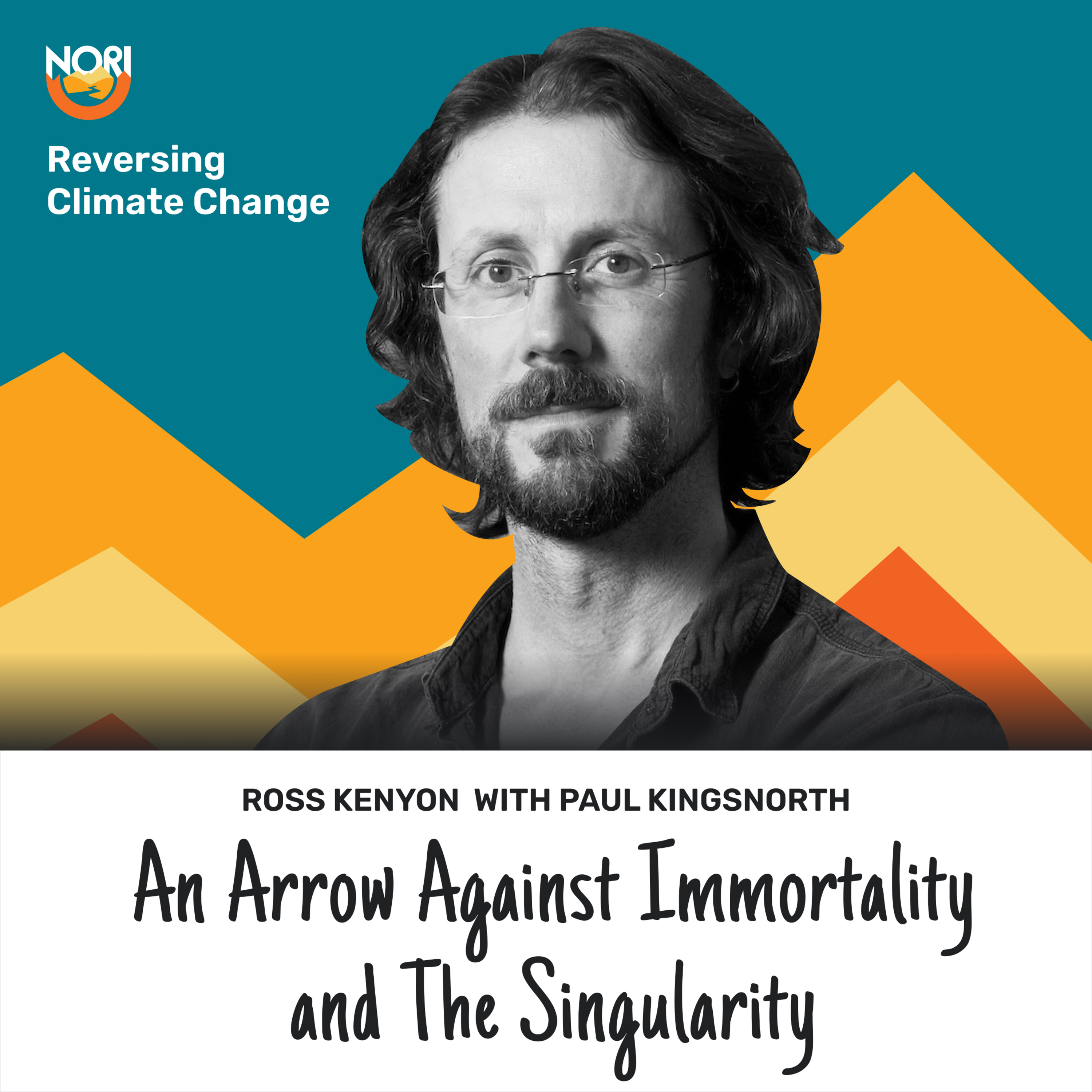

Listen on Spotify, Apple Podcasts or YouTube.
Paul Kingsnorth is tired of talking about the scope of the climate crisis. In his view, we can’t fix climate change. But we can uncover the spiritual root of the problem and explore how we might live through it.
Paul is the founder of The Dark Mountain Project and a prolific writer of poetry, fiction, and nonfiction. His latest release, the novel Alexandria, serves as the capstone of the acclaimed Buckmaster Trilogy. On this episode of Reversing Climate Change, Paul joins Ross to discuss the connection Paul sees between transhumanism and the climate crisis, explaining what’s behind our ideology against limits and why he believes the mind and soul can’t live separate from the body.
Paul shares his take on capitalism versus distributism, describing how systems of radical local democracy would root us in community and prevent the kind of scale that leads to tyranny. Listen in for Paul’s insight on the emptying of the will at the heart of most religious traditions and learn why he believes a connection with something greater than ourselves is key to effective activism.
More from the show
Ad-free episodes and other benefits come with a paid subscription.
Carbon Removal Newsroom, the news show that ran alongside this one, is over. Its episodes are still up, on the feed Climate Workers Anonymous now uses.
Carbon Removal Memes is still going.
Resources
Confessions of a Recovering Environmentalist and Other Essays by Paul Kingsnorth
Savage Gods by Paul Kingsnorth
Ronald Wright on The Progress Trap
What Technology Wants by Kevin Kelly
The Metamorphosis of Prime Intellect by Roger Williams
‘The Immortal’ by Jorge Luis Borges
Rerum Novarum, papal encyclical by Pope Leo XIII
The Kingdom of God is Within You by Leo Tolstoy
Hieromonk Gabriel on Orthodox Christianity and Politics
God’s Secretaries: The Making of the King James Bible by Adam Nicolson
Full Transcript
Ross Kenyon: Hello and welcome to Reversing Climate Change. I’m Ross Kenyon. I’m the creative editor at Nori’s Carbon Removal Marketplace. Today I have with me Paul Kingsnorth, founder of the Dark Mountain Project, writer of poetry, fiction and nonfiction, and the author of the capstone of the Buckmaster Trilogy, Alexandria, which just came out. Welcome, Paul.
Paul Kingsnorth: Welcome. Thank you. Nice of you to have me on.
Ross Kenyon: I’m happy to have you on. I’ve been reading your work for a while now. We do a Patreon book club for the podcast and we read Confessions of a Recovering Environmentalist about a year ago and it made a big splash, made all of us think. I’ve been reading your work since then pretty seriously. And in having you on, though, I understand that you’re a bit sick of getting called on the podcast to talk about the general state of climate crisis. And we’d like to focus a bit more on the spiritual roots of where we are.
Is that understanding correct?
Paul Kingsnorth: Yeah, well, I mean, I have a reputation as a bit of a Jeremiah on this stuff, which is fair enough, really, given everything I’ve written about it. But yeah, I mean, there’s only so many times that you need to be telling people that it is impossible to reverse climate change. Because it is, in my view, anyway. And I’ve thought that for a number of years. And actually, one of the founding tenets of the Dark Mountain Project was that we have to be realistic about where we actually are as a civilization.
Not just in regards to climate change, because that’s just one of the suite of problems we’re facing, right? I mean, we’ve got a mass extinction going on. We’ve got soil erosion. We’ve got all the other horrors. We could sit here all night talking about that, but we won’t because it would be suicidally depressing. But we’ve got all that going on, so that’s where we are. We’re not going to fix that with mass movements or technology or any of the other things that we’d like to think we could fix them with.
So I now take that as red, actually, and I think more and more people take that as red now. So the question then becomes, where does that leave us and what do we do and what might be the reason for this? And that is what interests me now. I think one of the things I wrote about years ago, and I’m hardly the only one to have written about it either, Is this notion of going through the famous cycles of grief when you focus on environmental crisis, you know, the famous Kubler-Ross cycle where you start with denial and then you go to anger and then you go to depression.
I can’t remember exactly what the order is. And I think that as a society, we’ve been going through that stuff for at least a decade now since climate change became a very mainstream conversation. And initially, you know, we started off with the denial that there was even a problem. And then we went to the anger and the demand for activism and then We’ve got to, perhaps we’ve got through the despairing or the depressive phase at the moment, or perhaps that’s where we still are, where we realise that it’s gone so far that anything we wanted to try and do, we should have had to do 100 years ago.
But realistically speaking, where we are now with climate change and where we are with the state of the global economy makes it I don’t know, it’s not feasible to talk about getting the UN together for yet another conference, for example. Nobody even even bothers to take that seriously anymore. So we’ve kind of got to the phase where we’ve we realize that we’re in this enormous ecological shift, you know, which which isn’t we’re not going back, if you like, to where we were. So, yeah, where does that leave us and what’s the root of the problem?
That’s that’s what really interests me now. Where do we go with it? Moving beyond the kind of potential despair of that conversation. Yeah. Yeah. Yeah.
Ross Kenyon: It seems like you locate part of the crisis, as I read you, as being this desire to transcend the body of seeing humans as separate from... Maybe there’s like a mind-body dualism. Maybe you’re taking issue with this to some extent of this sort of technological... Transcend all of our bodily limits and become sort of mind detached from matter. And you think this is ultimately what technology is pointing us toward in some way. Is that halfway? I think so.
Paul Kingsnorth: I saw Bill Gates the other day telling us that everybody in the West should be eating meat grown in labs. You know, this is the kind of stuff you would have seen in an HG Wells novel, a warning about the future 100 years ago. It’s about two things. It’s about limits and it’s about control, I think. And If we take a look at what got us to the point where we could change the climate of the whole planet and tip us into a mass extinction event and destroy half of the rainforests in the world with more of them going every day and all of the rest of this stuff.
It’s a story we tell ourselves backed up by a suite of technologies which comes out of the modern period, really, the Enlightenment, the Industrial Revolution, maybe even the Reformation. We start to tell ourselves that we’re autonomous individuals, that we’re separated from nature, that there is even such a thing as nature that’s separate from us, which is a very modern idea and a very Western idea. We tell ourselves that we, with the control that our technologies give us, can manage and control and improve every aspect of the Earth. And we also tell ourselves that the earth is not a living being or a collection of living creatures that are interconnected and we’re one of them.
We tell ourselves that it’s what we call a collection of resources to be used by us with the technology that we’ve developed. So we create a new mythology for ourselves, which we’ve really been doing over the past few hundred years. We’re now the masters of the planet. We have the ability to control it. We have the right and the duty to control it. That actually is what’s got us to this point. And the advanced suite of technologies that have basically caused all of these problems in the first place are now the thing that we’re told is going to get us out of the problem, right?
So this is something that the historian Ronald Wright called the progress trap. So we create a technology that gets us reliant on the technology but it causes problems which another technology is then required to solve but that takes us further into the progress trap and so we end up where we are now in a situation where we basically can’t live without an enormously advanced suite of technologies which is all around us so that when we look at something like climate change our first response is okay what technology can use for this?
What machine can we use to get us out of this one? So we identify climate change as A problem caused by a particular type of gas going up into the atmosphere. And the solution to that is therefore to replace the technology that creates that gas with some other ones. Get rid of the fuel source, replace it with some other fuel sources. But that’s not the issue. The issue is the control that we’re attempting and failing to exhibit And ultimately, that does lead us towards where Silicon Valley and our advanced kind of techno-gnostic civilization is taking us, which is the separation of the mind from the body, immortality.
I mean, you’ll find these guys over at the Google Corporation talking very openly about this stuff. You know, this is where we end up. We’re uploaded into the cloud. We live forever. We can solve all the environmental problems we created with more of the same kind of tech. It’s an attempt, openly now, to effectively remake human beings, just as we’ve attempted to remake the whole of the rest of the planet. So that’s where we’re going. And Alexandria, the novel that I’ve just written, is an exploration of what that actually means.
I mean, it’s hardly the first work of fiction to have done that, but it takes us into the future and looks at what the kind of two possible paths for our future could be.
Ross Kenyon: Someone listening might... I’ve heard you just dunk on lab-grown meat and say like, isn’t that an improvement though? Or the body dies, becomes sick, our joints ache, wouldn’t it be great to improve that or maybe to no longer need it in that same kind of way? What are they missing in asking those questions?
Paul Kingsnorth: Well, this is where I think it becomes a spiritual matter or a religious matter or an ethical matter maybe. It’s a philosophical question, this, right? Do we have to and should we live within the limits that we’re given? Is that good for us to do that? Are we required to do that and should we? Or should we attempt to break them all, break all the boundaries, break all of the limits? And as I say, the modern project, the modern autonomous individual that we all consider ourselves to be, considers it our duty to bust through all the limits and Bust through all the boundaries, bust through everything that would, as you say, prevent us as individuals from having as much pleasure as possible for as long as possible.
So, you know, why shouldn’t I live forever, for example? I mean, there are plenty of practical answers to that, obviously. One of them being, we’d end up with about 20 trillion people on the planet, presumably. Well, why would anyone bother having children or anything else? But the bigger issue, and this is why I think it’s a spiritual or a religious issue, is that actually... Every traditional culture that’s ever existed, every indigenous culture, every serious religious tradition teaches us that we are part of something very much bigger and that we have a responsibility to that and that we are tied up within that.
And the issue isn’t just about our own personal pleasure or desire. It’s about what’s good for the collective as a whole, which includes everything else that lives. So the question to me becomes, are we prepared to accept limits of any kind, limits on technology, limits on life, limits on Pleasure. Or are we simply going to continue to attempt to go down this road which is trying to abolish them? And it’s my view that the attempt to abolish limits and the attempt to take ourselves out of this web of life and make ourselves immortals, that’s what’s caused climate change.
That’s what’s caused the ecological crisis that we’re in because we decided we could take control. We decided to behave like gods, in other words. Yeah, but that is a philosophical issue. And as I say, the guys down in Silicon Valley, people like Kevin Kelly or Sergey Brin or Ray Kurzweil, they would take strong issue with what I’m saying. And they would say, no, humans don’t have to live within any limits. We have the power to make ourselves immortal and turn ourselves into long living robots if we want to. And they’re on the path to doing this.
This is their project. So they consider it their moral duty to bust through all of these limits that, as they see it, keep us in kind of the chains, chains of the body and chains of nature.
Ross Kenyon: The best arguments I’ve heard against transhumanism about going beyond the body, about becoming immortal, about this sort of technologically assisted permanence, I guess you could say, has been literary. So I’ve read either your writing or one book that made a big impression on me was The Metamorphosis of Prime Intellect by Roger Williams. Have you read that book?
Paul Kingsnorth: No, I haven’t. No.
Ross Kenyon: I think it was a self-published by a programmer who extrapolated what it would be like if we were all uploaded to the cloud. And the people in his... I’m going to spoil this book, but there’s going to be a lot of spoilers this episode, I think.
Paul Kingsnorth: It’s worth warning the listeners at this point.
Ross Kenyon: Yeah, there’s going to be a lot of that. What I found interesting about it is that because people are immortal and live forever, they become bored with normal human experience in the cloud. They experiment with extreme serial killing behavior, extreme sexism. Sexual behavior. They’ve done it all. There’s nothing left to do. They try to kill each other in novel ways because they can’t really die. It’s all pushed to the brink of pain and pleasure. And they end up wanting to escape at some point because it’s hell. They can’t die. They can’t end.
And they’re just caught. And there’s nothing like brings them like sincere joy because everything is unlimited. And without a context of limits or constraints in any way, it’s hard to make choices that matter. And Borges does this in The Immortal. I don’t know if you’ve read that short story too. No, no, I haven’t. Without constraint, how do you do things of value? Is that even possible? And I think you probably agree.
Paul Kingsnorth: Yeah, absolutely. I mean, look, as a writer, as an artist, you can always see this. You will always write better. You’ll always perform better if you have some constraints around you. It’s why a lot of traditional poetry is better than a lot of free verse. Not all of it, but a lot of it. If you give yourself limits, then you have something to push against and then you have something to constrain you. And that’s what a tradition is. That’s why cultures have traditions that they continue. You give people limits and they flourish within the limits.
And again, the modern story is no, no, no. Limits are things that constrain us. We have to destroy them and replace them. But as you say, a world with no limits at all, it actually does end up being hell. But the bigger question, the philosophical question, when you start to talk about things like uploading your mind, Well, you know, what exactly is a human being here? Are we assuming that there’s something within a human being that can be uploaded, that our existence is somehow not embodied? Because the claim there is effectively that your body is just a kind of meat suit that you walk around in.
And inside it is, well, what probably used to be called a soul, but I guess these guys in Silicon Valley probably don’t use that word. They imagine that if they can just imprint the waves in our brain and upload them to something else, We will be there because they see us as computer programs and they see our bodies as hardware and our brains as software. But that’s not what a human being is. A human being is an animal. We’re embodied. Our body is us. It’s not a separate thing. And just as we are our bodies, our body is the world.
So our body can’t live separately from the earth, if you think it can, try holding your breath for five minutes. And your mind or your soul can’t live separately from your body. There’s no evidence that those things could ever be true. So it’s a deeply religious position that these people are adopting, actually. It’s a version of Gnosticism, which is an early Christian heresy, which suggests that the world is materially evil and that you can ascend it using truth. And your spirit can leave your body and ascend into heaven, which is something that the Christians took issue with in the 4th and the 5th century.
So we’ve got a kind of techno-gnostic heresy going on in Silicon Valley. With these guys who believe that a human being is just a collection of experiences which can somehow be made to live forever without the animal part of it. And it’s very unscientific, curiously, but there’s a very good book called What Technology Wants by Kevin Kelly, who I mentioned just now, who’s one of these guys, one of these Silicon Valley utopians. Very interesting book. He’s a very smart man. And it’s well worth reading to understand the kind of technotopianism because he’s very open about the fact that He thinks that technology has a mind of its own.
It’s not just a collection of utilities. People will often say technology is neutral. It’s just what you do with it that matters. And he says quite rightly, no, it isn’t. You know, it has a mind. Technology is going in a certain direction. This thing he calls the technium. He believes is the replacement for human beings. It’s the next evolutionary step. And he very openly, especially towards the end of this book, talks about this as a religious quest. You know, this is the quest to seek God and this is what God wants.
And it goes into this very high flowing kind of religious language at the end. And it’s very interesting because that’s really what’s going on here. You know, it’s very much the religion that is supposed to replace the religions that have brought us to this point.
Ross Kenyon: There’s so many ideas in there. So you and Brian Kelly see technology as maybe being an exercise in pure mind. It also reminds me of like German idealism in Hegel or something. There’s sort of this like... Pure spirit moving in the world. Technology has a teleology all of its own. It isn’t neutral. It’s pointing towards a world where the animal world, the world of blood and flesh is irrelevant, no longer matters, and maybe even be left behind. And this is a major threat as you see it.
Paul Kingsnorth: Yeah, well, that’s where I think we’re going. And it sounds a bit crazy when you talk about it, but you have to read some of the stuff these guys are saying and doing. Ray Kurzweil, who’s one of the leaders of this movement, very, very utopian in terms of the things he believes we’ll be able to be doing in very short time, just a few decades, he believes we’ll have virtual reality at such a pitch that we won’t be able to tell the difference between it and real reality. And as a consequence, people will spend most of their time in virtual reality because it’ll be better because it’ll be like real reality but without the bad bits.
You can have sex with anyone you want in virtual reality. It’ll be brilliant. You can eat what you like. You won’t ever get fat, etc. , And he believes we’ll get to that point so quickly that we’ll effectively migrate to it. He’s the head of engineering at Google. He’s not a fringe voice. So these guys are out there. And I think it’s much less mad and fringe than some people might see it to be. These are the people currently controlling the way that we communicate with each other. And they’re utopians.
They’re techno-utopians. And they absolutely do believe that we can supersede the world of nature, which is messy and dangerous and kills us in the end. And, you know, they’re quite right about that. It does. You know, it’s full of diseases. Look at what’s going on at the moment. Nature is beautiful and stunning and astonishing, but also frightening and terrifying at the same time, obviously. That’s life. So wouldn’t it be great if we could control it, supersede it, or even better, make a new version of it? And that’s really, I think the logic of technological progress is to take us to that point.
And I think that when we look at climate change, for many people like that, it’s an added incentive because they can say, look, well, we’ve really screwed it up now. We really need very advanced technologies to get ourselves out of this. You know, we really need the lab-grown meat and the ground up insects and the tower farms and the etc etc. So it’s a technological leap forward that climate change and indeed COVID actually at the moment are sort of providing an excuse for. We can sort of sit and I’m quite convinced in a mystical way by this notion that actually the technium as Kevin Kelly calls it does have its own teleology in some weird and disturbing way.
There’s something going on. There’s a lovely most sinister sentence I think in that book. He says... Something is using us to create itself. And I think, oh my God, that could actually be what is happening. That could actually be, and then all bets are off if you believe that.
Ross Kenyon: Make the case for the body and why it’s important.
Paul Kingsnorth: Well, it’s important because it’s all we’ve got. I mean, you’d have to make the case that you were anything but a body in order to answer that. Who would suggest that we’re anything but a body?
Ross Kenyon: Can I add a small addendum to this question? Yeah, I do. So I know that you’re interested in various religious traditions, but most of them do have a sort of dualism of that. There’s body and there’s soul. Do you reject that idea too? Are they actually the same thing in your mind? Or how do you... I know you’re interested in that.
Paul Kingsnorth: Well, it depends on the tradition, actually. I mean, they’re all quite different. I mean, and there are different aspects to different traditions. So if you take the traditional... Christian view, for example, I think in the West we tend to assume, I certainly grew up assuming, that the Christian view is that there’s a thing called a soul which can be separated from the body and after you die it goes off to heaven or hell depending on how well you’ve behaved. That wasn’t the traditional Christian view actually at all, the original view for a long time and it still isn’t the view in orthodoxy or indeed Catholicism.
Christians believe in a bodily resurrection, you know, you will die but at the second coming of Christ you’ll be bodily resurrected, you know, in your body again or a new version of your body. And the kingdom of heaven, the kingdom of God is not a place on the clouds. It’s here. It’s a resurrected new version of earth, a better one without all the death and pain. So that’s the original Christian story, actually. So there isn’t really a dualism in Christianity, curiously enough. The soul and the body are not things that are separate.
That’s what I was talking about when I talked about Gnosticism. Gnosticism was an early heresy which said, actually, you know what? Matter is evil. What we think is God is actually an evil force and we are divine sparks of soul trapped in this horrible matter and we have to use esoteric knowledge to get ourselves out and have union with the true God. That’s why I’m talking about techno-gnosticism in Silicon Valley. It’s a disturbingly similar prospect. That’s the early Christian story. And again, any religion that would be referred to as pagan has a deep connection between humans and nature and the human body.
Every indigenous tradition would have that. So there’s certainly... Is probably or maybe, depending on what your beliefs are, some immortal soul, but it’s deeply connected to the body. There’s no suggestion that it could be anything other than that. And if you step out of religion and just look at what science can actually show, you won’t see any evidence that a thing called a soul or a mind could survive without a body. I mean, they’re all deeply interconnected to each other. How would you even measure mind? How would you measure consciousness?
No one even knows how to do that yet. So there’s no... Actual indication that you could even upload a mind into anything else. What would that even look like? We aren’t anything but what we are. The world is alive and we are alive and we’re intimately part of it. And as I say, most indigenous traditions and most traditional cultures will work with that. But modern culture says, no, we want to go beyond that. We don’t want to be embodied. We don’t want nature. We don’t want to be part of this.
We want to build a better world. I think that’s a very religious notion, even though we treat it as if it were rational. I don’t think it’s rational at all. It’s very irrational, actually, to behave like this.
Ross Kenyon: Limits are so uncool, though, Paul.
Paul Kingsnorth: Limits are extremely uncool. What could be more uncool than any limit at all to anything? This is where we are.
Ross Kenyon: Why is that? What is the ideology against all limits or this freeing of humans, this focus on individuality of transcending all boundaries? In some ways, people listening would be like, yeah, what’s the problem with that? This sounds like a really good thing. This is liberating people from oppressive structures. Shouldn’t we be trying to break these boundaries? Isn’t this liberatory?
Paul Kingsnorth: Yeah, well, it is liberatory. It’s liberalism in the broadest sense of the word. The liberal system which has existed for centuries in the West is exactly that. It’s a system which tells us that we have... Autonomy from everything else. So while every traditional culture might see us as deeply connected to our societies, to our families, to our communities, maybe to our nations, to our religions, whatever it was, whatever social and cultural structures we’ve built up over a long time to give us a sense of place and a sense of security and a sense of connection.
And to pass on teachings down the generations. Every traditional society all over the world creates structures like that, which are quite complex and are passed on down generations. It’s modern Western liberalism, which comes out of, again, the Enlightenment, maybe out of the Reformation. And then it’s kind of fueled with oil and coal during the Industrial Revolution, which says, no, we don’t need any of this. The anthropology changes are in the 18th century, and we start to believe there’s such a thing as an individual. Which many places in the world still don’t, many traditional cultures still don’t have this notion that you’re an individual separated from everything else.
It’s a very Western idea, it’s a very modern idea and we start to see all of the structures around us Not as structures which have been created to help to nurture or to teach us, but of things that get in the way of what we personally want to do. So, you know, why should I be constrained by what the church tells me or what the school tells me or what my parents tell me or what my culture says is right or whatever taboo is here today? I should be able to bust through all of these things.
And so we end up in a society in which basically there’s no sense of ultimate truth, there’s no shared values, and there’s no real argument for why we should not do anything. That’s pretty much where we are in the West now, I think. It’s very difficult to argue that anybody should not do anything they want to do. The only argument really that’s acceptable is, well, if it harms someone else, I shouldn’t do it. But then, of course, that’s debatable. What does that mean to harm somebody else? There’s a lot of people around today who would argue that even using the wrong words harms somebody else, right?
So we can’t agree on what that means. So we’re in kind of a situation now, as I see it, it explains a lot of the kind of horrible cultural tension that’s about all the sort of culture wars and the fights and the arguments is that people, many of us cannot see why we shouldn’t be able to do exactly what we want. And we can’t see why anyone else has any authority to tell us anything at all. We don’t trust any institutions. Often with good reason, given the way that many of them behave at the moment, to be honest.
And that’s where we are. So we haven’t got sort of guiding structures. And we’re in this sort of the end game of autonomous individualism. And that’s what’s brought us the ecological collapse as well, I do think. If you’ve got 7 to 10 billion people all basically trying to do exactly what they want, regardless of limits, then the conclusion you come to, or the one I’ve come to anyway, is that actually you have to start re-embracing limits again. But then the question is, how do you do that? What does that mean?
What does that look like? And how would you ever get anyone to do it? Because we don’t want to. None of us really wants to do that.
Ross Kenyon: I’m trying to locate these ideas on a political spectrum, which is maybe an exercise that you might resist. But you also did curate a recent collection of Wendell Berry essays. And I see Wendell Berry as being very much, in some ways, he’s more conservative than conservatives and more progressive than progressives. His writing is always surprising to me. I feel like it’s always making someone mad. In the same way that if you read Catholic social teaching, you’re like, God, there’s something for everyone in here to scream about. And that’s what makes it interesting and fun to read.
Where do you see these ideas? Have you warmed to conservatism? Do you see yourself as interacting with it in a new way? Or is that the wrong way to understand your work?
Paul Kingsnorth: Well, I mean, I would probably like conservatives if they ever wanted to conserve anything apart from money. But I haven’t seen much evidence of that in the last 30 or 40 years. I mean, I think in some ways, if we’re talking about all of it, if we talk about the idea of the autonomous individualism as the idea of the kind of central teaching of modernity, Then when ideas of left versus right, liberal, conservative are all modern notions, they all come out of the Enlightenment really. So they’re all kind of arguing about the degree to which we should have autonomous individualism.
So as you say, you can’t really place any of these ideas on that spectrum. That spectrum in any case seems to be shifting massively at the moment. Nobody can even agree on what left and right means. Are you like a pre-modern conservative? Well, I’m not a conservative. I wouldn’t call myself a conservative because I think, I don’t know, what does that mean? I certainly have a conservative sensibility in some ways, but I have a radical sensibility in others. I mean, I see capitalism as the greatest monster ever created, to be honest.
But yeah, I mean, Wendell Berry is an interesting example. He always calls himself an agrarian. And his central philosophy is that it’s about community and place and working within the needs of the community and place rather than working to what the individual might need. And yeah, plenty of people are critical of that. But as you say, it isn’t ever quite possible to predict what he’s going to think about what you would imagine to be a tribal issue, right? Because he isn’t operating on that tribal level that we would assume to be useful today.
So I do resist being classified, but that’s partly because I don’t know how to classify myself. I’ve never found any political grouping that I would actually agree with. I think G. K. Chesterton had a great quote about this. He said, The whole world has divided itself into progressives and conservatives. The business of progressives is to go on making mistakes, and the business of conservatives is to prevent mistakes from being corrected. And I think that’s a good way of seeing it. I don’t think you have to lend yourself to either of these things.
But the biggest thing for me is that we have created ourselves. We have created for ourselves a deeply selfish culture, I think. There’s a difference between genuine liberation, right, from oppressive structures, which is necessary very often because structures can become very oppressive and humans are pretty oppressive beings very often. There’s a difference between liberation from those structures and the kind of Elimination of so many structures that you don’t have anything left but the individual in a marketplace. And that’s where we’ve got to now. And once you get to that point, the winner is always the marketplace.
And that’s where we are, right? Capitalism wins because capitalism just wants us to be autonomous consumers and producers who can be shifted around the world at will to make as much money as possible for the machine. So that’s where we end up. So yeah, I think that kind of... Broad, autonomous selfishness is what’s brought us here. But yeah, so I think we’d all probably have to end up living like the Amish, but we don’t want to do that really, do we?
Ross Kenyon: Now it’s, again, uncool. It’s not a popular position.
Paul Kingsnorth: No.
Ross Kenyon: I like the thinkers that you’ve singled out, Wendell Berry, Chesterton, which by the way, Chesterton’s as bad as Oscar Wilde in terms of just generating little axioms that are like little turns of phrase.
Paul Kingsnorth: Yeah, that’s pretty much his work, isn’t it? Pithy ad-libs.
Ross Kenyon: Orthodoxy is just like nonstop maxims that he generates. But I like that distributist tradition. I think it’s really valuable. Or you read Hilaire Belloc or Chesterton as a sort of, or have you ever read Rerum Novarum? I haven’t actually, no. Oh, yeah. Dorothy Day turned me on to it. Not personally, of course. I wish that would have been cool. But it stresses the importance of private property on a small scale level as being like part of church teaching, but also is very wary Yeah. Yeah.
Paul Kingsnorth: Yeah, no, exactly. And that’s, I mean, it’s interesting you mentioned distributism because that’s probably, if there was ever a political tradition I felt slightly close to, it would be that one, you know, three acres and a cow. Everybody should have three acres and a cow. And they should, you know, that sort of sense of responsibility that comes from property ownership in that sense. But also, as you say, crucially, the limits on it. Chesterton had another great quote. He said, capitalism is a monster that grows in deserts. It’s one of my favorite quotes of his.
And what he’s saying there is he was having an argument with George Bernard Shaw, which he did a lot. And Shaw was arguing that peasant societies and tribal societies and indigenous societies would inevitably evolve into capitalist societies because they were all based on property and ownership and place and all the rest of that. And so they all had to be sort of swept out of the way and replaced with a giant sort of communal system in which everybody was technically equal, but actually in reality, everyone would be oppressed by the state.
But Chesterton said, look, that’s actually the opposite of what happens. What actually happens is that when capitalism develops, it has to destroy peasant societies and it has to destroy indigenous societies. And we see this happening all over the world now. We can see it happening with the farmers protests in India, what the Indian state is trying to do in destroying the small farmers there so it can turn their land into corporate farms. That’s the history of the last X hundred years of colonialism and land grabs is that you have to destroy all the vaguely distributist cultures before you can create capitalism.
It’s a monster that grows in deserts. Capitalism won’t evolve naturally in a society in which people own a bit of land and know each other in a community and value the place they’re in because there’s always somebody who wants to stop somebody getting too big. Capitalism requires a few people to own everything and then exploit everybody else. The alternative to that says Chesterton is not state socialism because that just ends up with the state exploiting everybody else. It’s this kind of equally distributed small property, which I find convincing. But then, of course, how do you get from here to there?
Probably you don’t. But that’s always the question. I mean, these can be philosophical discussions for a long time, but how do you get there? But yes, limits and size is, I mean, scale is another key thing. That was one of the reasons I was a sort of green activist for so long. Is that the Green Movement was always, I don’t know if it is now, but it was always about scale. It recognised that, as people like Schumacher and Leopold Kaur pointed out, any society, if it’s small enough, can be managed and prevented from becoming a tyranny because the people have some access to being able to control it.
You know, you could have a monarchy with a few thousand citizens in a city-state and if the king became too much of a tyrant, potentially you could just overthrow him. Can’t do that in a monarchy the size of Britain. It’s much harder. So almost anything can operate well on a small scale, but almost anything becomes a tyranny when it gets big enough, which I find quite convincing. That all then becomes about, again, distributism or decentralization, radical local democracy. That’s probably the closest I’ve ever come to a system that I would see as...
Something that works. And that’s mostly how, again, most traditional or indigenous cultures worked. It’s an issue of scale. Anything becomes a tyranny when it gets big enough. And most of the horrors of human history or many of them come from giant powers crushing people under them, you know, whether it’s corporate capitalism or state communism or fascism or any of these tyrannies. Anything gets big enough, it will crush whoever gets in the way.
Ross Kenyon: There’s a great quote. It’s from, I forget which left libertarian said this, but it was something like, You know, Hitler with the machinery of the nation state is a great horror. Hitler at a city council meeting is a different matter entirely. Yeah.
Paul Kingsnorth: Or Hitler is a homeless artist in Vienna that no one’s taking any notice of. Exactly. Precisely.
Ross Kenyon: My politics have changed over time, too. I come from a sort of libertarian, classical liberal framework. That’s where I came up through intellectually, and I’m still wrestling with a lot of those ideas. But I’ve located a lot of how I think about politics in terms of scale lately, about thinking of size. I also think much of the world feels too big for us to feel at home in right now. People don’t know their neighbors, even. They’re not involved in anything. They focus on Presidential politics that are, you know, oftentimes they have very little influence over and it’s very far removed from them geographically.
We watch TV, we yell at each other on the internet, people you don’t even know, but you’re not paying attention to your kids. There’s something about that scale that I find, I think that’s like where I’m most focused now for better or worse.
Paul Kingsnorth: I think that’s really interesting. Yeah. I mean, it’s the way that politics has become a substitute for religion, but also become a substitute for community. As you say, you know, actually you didn’t ought to be in a situation in America, for example, where You get one of two guys that you can vote for every four years and scream at or not scream at. And that’s supposed to be the repository of all your hopes. It actually isn’t anyway. But that’s the way it’s become everywhere. Same in all the countries, really. Everything is so big and everything is so distant.
And the Internet’s a great example of this. I mean, look... And I think... You know, my feeling as well about the rise of all the sort of terrifying, weird conspiracy theories that are around at the moment on all sides, you know, from you’ve got QAnon on the right, all that bonkers stuff, but then you’ve got equally weird conspiracy theories on the left about Russian bots throwing the Brexit vote and all of this kind of stuff. And it’s just because people feel, I think, at some level that everything is out of their control, which it is.
So we can see that there are these great forces in the world that actually are conspiring to do things that we might not like. And they’re not actually satanic pedophile cabals, right? But there’s something, there’s some weird energy that’s feeding into that. We all feel totally out of control. The system, the machine is so big. And we all feel like these tiny little nuts and bolts in it. And you’re right, it’s about a lack of... And that, you can come back to Wendell Berry, right? People are not actually rooted in their community with their neighbors in their place as they’ve been for 99% of human history.
We’re thrown into this giant kind of weird web in which we’re connected to everything that happens in the world and yet not actually connected to anything at all in any real way. And so as you say, then you can spend hours on the internet getting angry about something that’s happened on another continent. But yeah, what’s happening in your house, your neighbor’s house, you don’t know. I think it’s driving us crazy actually.
Ross Kenyon: I think so too. And it’s not to say that there aren’t important things that are worth getting worked up about in that. And it is a great luxury to not have to be actively worried about the president. Many of those policies do affect people who are very vulnerable. So that’s not to say that isn’t important, but just one brief little note there. I’m sure you feel the same way too. But you have moved out into the countryside. You’re now in Ireland. You’ve picked up a scythe. You’re out there tending the land.
You have three acres and a cow, hopefully. You have bantam chickens behind you.
Paul Kingsnorth: I have two and a half acres and some chickens. Yeah, they’re not as much work as a cow.
Ross Kenyon: What’s your situation been like?
Paul Kingsnorth: Yeah, I mean, it can do. The interesting thing is that with the internet these days, if you have the internet, you’re just as connected out here as you would be in the center of London, actually, in a way. So you can still spend all your time on that. You can still disappear down that rabbit hole. But yeah, I mean, we moved here quite a few years ago now, I suppose. We wanted to homeschool our kids and learn some skills and try and grow something. I’ve spent so many years writing and talking about nature without getting my hands dirty that I thought it was time to kind of put up or shut up, really.
Ross Kenyon: Yeah, such a pleasant...
Paul Kingsnorth: Yeah, exactly. Well, also, we were in a position that we were able to do it, which is a privilege. So that’s, you know, that’s a good thing. But also, we wanted to be part of one of those kinds of rooted communities, actually, which... I think that’s a good thing, useful thing to be doing. But again, as much as anything, I think what I’ve discovered is that’s a state of mind. You can still be out here and be completely distracted by whatever distracts you, just as you can be actually very mindful and focused in the middle of Birmingham.
But yeah, it makes a difference to me. I’m a bit of a Like a lot of writers, I’m a bit of a sort of weird recluse, really. I don’t function very well in society. I’m okay. I always like living on the margins, so I’m glad to have been able to escape to them. But if we’re talking about the body and its relationship to nature, it’s really good daily to be reminded of the fact that even on a couple of acres of land, you’re not necessarily the most important thing. Nothing else here is really bothered about what I do from day to day.
The chickens don’t really care. The birds in the garden don’t care. The grass doesn’t care. So the longer you do that kind of thing, the longer you realize that you’re part of a community that isn’t just human as well. It’s as close as somebody like me, who’s very modern and urban, can come to some kind of rootedness in a slightly older way of being, which is not a question of romantic escape, you know, because I still have to go to the shops in my car and Put the internet on and all the rest of it.
So I’m not living in a shack in the middle of nowhere, although I’d quite like to be sometimes. Yeah, it’s just a question of having the opportunity to be able to get myself rooted a bit more, I suppose.
Ross Kenyon: I think you’re right that, you know, the cliche, something a psychologist might tell you is that there’s no geographical solution to a personal problem. So if you locate the root of this problem as humans stepping outside of a great chain of being, there is no longer a God above, there’s no rules, whether you’re reading Ayn Rand or Nietzsche or techno utopians in Silicon Valley, where humans are replacing God and we’re creating our own values and there’s no limits besides what we impose ourselves. That might be the problem rather than if you’re living in the city, you can seemingly still be mindful in the kind of way you’re talking about.
But if you have the wrong values, you might be hopeless no matter where you are.
Paul Kingsnorth: Yeah, absolutely. I used to practice Zen Buddhism for years, and I remember something that one of my teachers told me, that he went to Tibet, and he went up onto the plains of Tibet, and he met these monks, and he went up and he meditated with this Buddhist master on the plains of Tibet for a couple of hours, surrounded by these incredible mountains, you know, the Himalayas and all the incredible Buddhist stupas up there. It’s a beautiful place. And they finish this and then they’re having tea afterwards. And he says to this Buddhist master, he says, well, it’s all right for you because you get to live here and do your meditation up here.
But I have to live in the middle of London. And the Buddhist master said to him, your problem is that your mind is not yet large enough to contain London. That was a very Buddhist thing to say. But that’s the point. If we talk about limits again, we’re really talking about humility. And I think if we talk about Christianity again, that’s the central teaching of Christianity and actually the central teaching of I think of any serious faith that I know. A kind of self-emptying, a loss of your egotism, smallness, limits, that’s all the same thing actually.
So as you say, the sort of philosophical gods of our age, whether they’re the techno guys or whether they’re Ayn Rand or Nietzsche or any of the kind of It’s the ultimate sort of Hitlerian triumph of the will thing, actually. The triumph of the will, which is the kind of essence of fascism, is the precise opposite of humility, which is the emptying of the will. So you take triumph of the will far enough, you either get Hitler or Mussolini, or maybe you get some supposedly left-wing communist tyranny, or you get techno-utopianism, where the will has literally abolished nature.
The alternative is humility, which is living with what Wow. I feel a lot of sympathy for this position too. In the last couple of years, I’ve I’ve been reinterested in Christianity myself.
Ross Kenyon: As being the placing of things between you and God as your choice. Whether you’re secular or not, you’re listening. I think this stands for just being a human in general. If you count up just how often you put yourself first in inappropriate ways on a daily basis, your life is riddled with sin in this kind of way of just how petty and cruel we are in regularized ways. It points super far inward to myself, less so than it is something... I haven’t figured out how to externalize it in a non-preachy or idolatrous kind of way, but I don’t know.
I’ve been thinking about it a lot. I know you have too.
Paul Kingsnorth: Well, I think that’s the work. I was actually baptized as a Christian last month. Are you? Which was something that I’ve become a member of the Orthodox Church, curiously enough, the Romanian Orthodox Church in Ireland, of all places. Yes. Very strange journey. This time last year, I was a kind of eco-pagan. No intention of becoming Christian at all. No interest in it, I didn’t think, but... I was dragged kicking and streaming by a number of circumstances, which I won’t go into in detail, but I ended up in, yeah, I’ve never imagined myself becoming a Christian at all, let alone an Orthodox one.
Orthodoxy is the oldest form of Christianity. It’s the kind of closest to the original thing, very different to the quite rationalist Protestant version of it. But one of the reasons, I mean, you can’t rationalize becoming religious. It’s a deeply irrational thing, but One of the attractions is that when you actually start to study, say, the story of Genesis or indeed the teachings of Christ in the light of the ecological crisis, then as you say, you don’t have to be a Christian to see that actually the teachings are astonishingly relevant. What’s Jesus basically telling us?
He’s telling us that the meek are blessed and not the powerful. He’s telling us that you don’t return violence with violence. He’s telling us that you have to love the people that you don’t like. And he’s telling us that while society as a whole... Jesus sees strength as wielded through brute power. The way we see strength, as he says to his disciples, is through serving other people. So he’s teaching radical humility, which is very hard, and no one can really do it except him. Even his disciples mostly fail. It’s very hard.
Unless you’re Christ, you can’t do it, but you can aspire to it, and you can get better at it every day, and you can see that it’s the truth. And radical humility, and it’s not as if Christianity is the only faith that teaches that, is the alternative to the triumph of the will, which is also the destruction of nature. And I find that the more I read the story of what happened in the Garden of Eden, the more I’m interested. The great myth of Eden, and again, you don’t have to be a Christian to be interested in this, and of course it’s not exclusively Christian, but at the beginning of everything, humanity is in communion with nature and in communion with God.
We’re all in a garden together, right? We’re in Everything, everything’s alive. All the creatures are there. Everything has been created. We’re all together. We’re so close to God that we can see him wandering about in the garden and have a chat with him under the trees. Right. That’s where we are. And God says, look, the only thing you shouldn’t do is eat from this tree, the tree of the knowledge of good and evil. OK, because you’re not ready for that yet. Maybe later you can have that, but you’re not ready for that.
You’ve only just you’re young. You don’t know anything. So just, you know, everything else is good. Stay in communion with the garden. So we’ve got this kind of indigeneity, this primal indigeneity in the garden. We’re totally connected to nature. And then along comes the serpent. And of course, the serpent says, yeah, you know what? God really wants to keep the truth from you. And the truth is that you can be better than him and you can be God yourself. So why don’t you just eat that fruit and then you’ll find out.
So we do. And we say, oh, yeah, look, we could we could do what God does. But of course, we can’t because we’re not able to do it because we’re not ready to do it. And so out we go. We chose to leave. We chose to. That’s what the fall is. The fall is a choice to step away from God. And that’s what the word sin means. The word sin is originally a Greek word. It’s an archery term. It means missing the mark. So when you sin, you’re missing the mark.
The mark being getting back into communion with God and nature, God and creation. So we’re endlessly missing the mark all the time because we want the power of the knowledge of good and evil. So we chose power over communion. We chose triumph of the will over humility. The Christian story being that then Christ has to come down and remind us what we were supposed to be doing and show us a way back. So he’s giving us a path back to the garden. And again, I don’t think you have to be Christian to be interested in that story.
When I look at it that way, I think, okay, this religion that I used to think was irrelevant and oppressive and nothing to do with anything. Actually, when you take the teachings in that way, they’ve got a hell of a lot to tell us about where we’ve ended up because we’re still in rebellion, right? We’re still in rebellion. We’re still eating the apple. Every day we eat the apple. And we say, oh yeah, I can do better than this. I’ll upload my mind to the cloud. Think of it that way.
Then you see the technotopia as an attempt to create a technological version of the Garden of Eden that we can all live in forever, being immortal. We get a silicon transcendence. We don’t need God anymore because we’ve become God. That’s the story. And I find that a very powerful story, a very interesting one.
Ross Kenyon: Yeah. I’m surprised, but also not surprised to hear you found orthodoxy appealing. Pride, humility. Christianity, I think, treats these topics very well. I like the Tower of Babel is probably an example people are thinking of right now. I think of Milton’s Satan or Lucifer to thinking you’re better than God, putting yourself above God, putting things between you and God. This seems to be maybe is this the root as you see it? This is all part of the same story you’re trying to tell with Alexandria and your thinking overall.
Paul Kingsnorth: Well, it does seem to be, but I wasn’t Christian when I wrote Alexandria, although it’s got a lot of Christian elements in it quite deliberately because it’s set a thousand years in the future and the kind of main group of people in it are... A sort of post-apocalyptic indigenous religious community, if you like, in England. And the religion they have is a sort of, it’s a bit of a mashup of certain elements of Christianity and sort of modern witchcraft and Buddhism and Sikhism, all sorts, all the faiths I’m interested in, plus a kind of nature mysticism.
But yes, I mean, I think the reason that orthodoxy came and landed on me and Christianity came and landed on me is that Yeah, that’s the story I’ve always, I suppose, been looking at, been telling. I hadn’t ever seen it in those terms. I hadn’t ever considered it until quite recently. I didn’t consider it a religious story, but I think it is. But what I also realized is I think that despite the many manifest failures of so many Christians over the years to actually live up to this, right? We all know that.
And the same is true of every other religion in the world. Humans are endlessly using religion as an excuse to do the very opposite thing that they were taught to do. And using it as a source of power and abuse and all the rest of it. Despite that, if you actually go to the teachings of it, you can see that they’re warning us about the very thing we’ve ended up doing. And they’re also giving us a way out. But the way out, as you said, is actually through the hardest place, which is your own heart.
Because that’s where you have to start. Like Solzhenitsyn said, the line between good and evil runs not between parties or nations or people. It runs through every human heart. It’s bloody true. We all know that if we’re honest. Again, that’s not easy to sell as a solution to climate change. So that’s why I don’t bother.
Ross Kenyon: No, that’s a tough line.
Paul Kingsnorth: But if that kind of radical humility were at least attempted by people, Some of us in communities, and you can look at modern examples of that, reasonably modern. People like Gandhi were doing that. People like Tolstoy were doing that, forming communities based on this stuff. Don’t have to be a Christian to do it. But those teachings of radical humility, and as you say, the discipline that’s required to actually make them happen, because you have to have a discipline to it. That’s a way out. It’s not a way to solve all the world’s problems.
It’s not a political solution and it’s not an alternative to politics either. By the way, I’m not suggesting nothing else matters. Politics don’t matter. Technology doesn’t matter. I know I can sound like that sometimes. Those things matter. You have to use them and we will continue to use them. But I do think that the root of this is very much deeper than that.
Ross Kenyon: I think so, too. And it stole my thunder a little bit because I was about to bring up Tolstoy as well. I had Christianity kind of landed on me about a year and a half ago, too, where I was raised nominally Christian, went through kind of a jerky atheist phase of No, we’ve all been there.
Paul Kingsnorth: We’ve all been there.
Ross Kenyon: Bland, agnostic. Then I turned 30 and I attribute like growing older, I’m like, I should reinvestigate some of this stuff. And I read Tolstoy’s The Kingdom of God is Within You, which made a big impact on Gandhi and MLK Jr. And That and rereading the New Testament itself for the first time since my adolescence was shocking with how radical it is. And what stood out to me, not only the humility, but just how much is expected in terms of forgiving 70 times, seven times, resist not evil, like how much is expected of you to forgive.
Be that level of kind in imitating Christ. It’s like, why don’t you see this anywhere? Because this is beautiful and would change the planet. But most of the Christians you know, not to judge them too harshly, but most of what I connected with in New Testament and Tolstoy, who’s considered a heretic, by the way, by most people.
Paul Kingsnorth: Well, he was excommunicated, Tolstoy, wasn’t he? By the Orthodox Church.
Ross Kenyon: They did not like him very much.
Paul Kingsnorth: Not their finest hour, I have to say.
Ross Kenyon: But yeah, I imagine some of that really stood out to you too, being like, where is this? Does this exist anywhere? Is it just the Amish and the Mennonites and the Seventh-day Adventists and people who are Quakers?
Paul Kingsnorth: And I think it is. I think it is. And I think that’s, I was actually watching a, I’m watching a lot of talks by monks and priests on YouTube at the moment. It has its uses, YouTube. I mean, it may be leading us towards silicon transcendence. But in the meantime, there’s some great good teachings. But I was watching actually an American Orthodox priest the other day talking about this. And he was saying, look, why are so many Christians, especially in America, but I think we don’t have quite so much politicized religion over here.
I mean, we have a different kind of various religious problems. I think Christianity has been very politicized in America, maybe more than it is here. And In some ways, but, you know, it can be everywhere. But he was saying, you know, why do you get these left-wing Christians and right-wing Christians, conservative Christians and progressive Christians? And he was saying, look, politics functions like a religion in the sense that politics is a great system of meaning that gives meaning to your life and allows you to try and improve the world, right?
So it has a sort of function of religion. So people who are very political who become Christian or who are Christian... Will basically hammer their Christianity into the shape of what their politics was. And you can do that with the Gospels. You know, you can go into the Gospels and you can find lots of left-wing things that Jesus is saying. And if you want to, you can go in there and you can find lots of conservative things and traditionalist things that Jesus is saying too, because he isn’t either of those things.
To come back to what we said earlier, right? You try putting Jesus on the left-right spectrum, you’re not going to be able to, right? He’s all over the place because the spectrum is not the point. But so you could hammer... And that’s exactly what Christ is trying to teach us not to do. But it does require that radical humility and it requires you to look at people, which I’m terrible at by the way, look at people you disagree with and then instead of immediately coming up with the reason why you disagree with them and proving them wrong, just say okay, I’m just going to listen.
I don’t have to agree with you but I’m also going to love you as my brother or sister and then we’re going to have a conversation rather than I’m going to just mob you and insult you and write a blog about why you’re wrong. That’s why the teaching is necessary, right? Why does God have to send his son to earth if he wasn’t to tell us something quite important that we’re not very good at? You know, this is the stuff.
Ross Kenyon: I have a bunch of different questions for you, but I have a theory about why orthodoxy stood out to you. I want to test out and then you can tell me. Okay, let me hear it. Let me hear it. So I read a book. Have you read God’s Secretaries? By Adam Nicholson. It’s about the composition of the King James Bible. It’s really interesting. A great book. Great history. It really helped me wrap my head around Jacobean England, early 1600s, Scotland too. One of the things people say about the King James Bible is that rather than England producing a Baroque cathedral, they made the King James Bible instead during that same time.
Yeah. Well, it talks about... Okay, this goes back to the body. This is coming full circle, listeners. This is all coming back. So the Protestant focus on sola scriptura being only the Bible is a way of privileging the word, which is something that you’ve dealt with in Savage Gods, the book of yours about this relationship with the written word as being a intermediary that we interjected between us and direct experience. And this is why if you go to a Protestant service, the sermon is prioritized. The sermon is the most important thing for a lot of Protestant services.
But if you go to a Catholic or Orthodox mass, it’s much more about communion and the Eucharist. And it’s much more standing, sitting, chanting, praying together. Like the homily in a Catholic mass is only supposed to be a couple of minutes long. It’s not a 30, 40 minute. Like dig through the text and poke out meaning. It’s like, it’s more of like a seasoning on top of the lamb supper. You could maybe see it. Is this connecting? Is this landing at all for you? I think so.
Paul Kingsnorth: I mean, orthodoxy is, it’s like a full spectrum experience, right? So I think that you’re absolutely right. If you go to a Protestant service, it primarily will appeal to your intellect, maybe a bit to your heart, hopefully, but maybe to me anyway, as you say, it’s an intellect. It’s basically a guy giving a lecture. Right. I mean, it’s not so far away from that. And I think that’s actually the Reformation. That’s why the Reformation is the foundation of so much of Western culture, Protestant culture. You know, it’s rational. I mean, there’s so much.
I mean, there’s hardly any theology in Orthodoxy. Right. There’s only two Orthodox saints who are called the theologian, whereas the Protestant West will produce thousands of theologians every week and they’ll all argue with each other. You know, and that’s not a bad thing because some of them have been fascinating. You know, some great Western thinkers. But Orthodox Christianity is... My friend who, one of my great friends here in the church said to me, this is a spiritual hospital and that’s the way to see it, right? So you come in here and it gives you the path to union with God.
And that path is basically mystical, right? So you’ve got, it is a full spectrum experience. You’ve got the incense, you’ve got the songs, you’ve got the chanting. I mean, there’s no speaking in an Orthodox service. It’s all chanted. So you’ve got the candles, you’ve got the icons, and an icon is designed to kind of take you into a holy space. So you’ve got this great collection of things going on which you can’t actually explain, and they have an impact on you, and they don’t really operate at the level of the intellect, or at least not purely there.
So it is a physical experience, and it’s quite a mystical experience. And also in Orthodoxy, you have the great tradition of the Athenite monks and the Holy Mothers and the Holy Fathers, so many kind of saints and mystics and monks still there now. That it’s just a very much more, I don’t know if magical is the right word, but a very much more mystical and otherworldly aspect of the faith. And the other thing about it, again, I’d never realized until recently, is that actually in Christianity, this is true in Catholicism too, God is not just a man in the sky that you might see after you die, which is again a sort of caricature of the Protestant position where God is quite transcendent.
God in orthodoxy is imminent. He’s in everything all the time. So everything hums with the creator. So it’s a very, you know, if we’re talking about the state of the natural world and the natural world not simply being a resource, you know, it’s not a resource. It’s the manifestation of God and he’s in it and he’s all around us all the time. So there’s a very kind of imminent sense to it as well. So it’s, yeah, I think you’re right in that. And it’s that discovery of that much older, I think I’m kind of like you, Paul, where we have a tendency to over-intellectualize everything.
Sounds like it, doesn’t it? We’ve been here for an hour.
Ross Kenyon: Yeah, there’s a lot of this going on in our non-podcasting lives. And I like having a space that is purely devotional, pre-intellectual, and just sort of experiential in that kind of way. And there is an irrationality to it, perhaps. And I don’t have a strong sense of apologetics too. Like I go to Catholic mass, I started going like a year ago, but if someone challenged me on it, I would just be like, I don’t know, the gospels speak to me and I just sort of connect with it. And I like the devotional elements of it.
And maybe some of it is kind of, you know, smells and bells as they call it, the incense, the chanting, whatever. But I think we’ve lost the sense of the devotional and growing up mostly Protestant. I went to mass too, but mostly Protestant. Sort of the focus on the word took away from the devotional elements that now I really connect with. I like the ritual. I like the ceremony. I even like the old Latin mass, the tridentine mass where they do an ad orientum. So they’re not facing you. They’re facing the altar.
Paul Kingsnorth: It’s all in Latin. Yeah, that’s true of an orthodox service as well. You know, the orthodox service is not for you. It’s for God and you’re part of it. It’s not like a lecture or a presentation. It’s like you can come in if you want, but this is us talking to God. That’s what we do, you know?
Ross Kenyon: Some of that connected with you really strongly, maybe even articulated always.
Paul Kingsnorth: Yeah, it did. And I think also, having spent years writing about mythology and studying mythology and looking at other cultures, all of which I now see as a kind of plaintive search for God, which I did realize that partly at the time, but I didn’t really know where it was going. But there isn’t a society that’s ever existed from the smallest tribe down up to the biggest civilization that hasn’t had God in some form at its center. And that hasn’t had ritual as well. Ritual and a kind of liturgical year and a pattern of worship.
And again, come back down to humility. You don’t have to be Christian to see this. If you place yourself under something that is greater than you, the creator, the creation, Whatever aspect of that you’re engaging with, then you’ve immediately put yourself in your place in a good way, you know, which is in your places as part of everything else as opposed to being over it. Who was it who said if you don’t worship God, you’ll end up worshipping yourself? It might have been Chesterton as well. Kind of thing you would have said.
But basically, you know, the notion being that we need, we need ritual. We desperately need ritual actually to connect ourselves with what is higher than us. And the only reason you wouldn’t need that is if you don’t believe there’s anything higher than you. And then we’re back to the triumph of the will. There we are. That’s where that takes us in whatever form. We’re developing a new theology here. You know, this is quite impressive. We should be, it’s just, here we are.
Ross Kenyon: Yeah. Joke, joke, joke, joke, joke. There’s some line from Dorothy Day, I think that’s something like, no one ascends to the pulpit without committing heresy. So I think we just- That’s a good way of looking at it.
Paul Kingsnorth: Yes. Yeah, but you know, you don’t have to. I mean, to be serious, you don’t have to develop a new theology because you already have one. You certainly have one in Christianity, but as I say, you don’t have to go to Christianity to find startlingly similar teachings about humility and about smallness and about the need to worship and about the sense of what it takes for you to Connect to what’s greater than you and I think there’s only been one culture in history which has decided that there shouldn’t be anything sacred at its centre and there isn’t anything higher than us and it’s this one and this is the culture that changed the climate.
So there’s a connection. Here we are, we’re back to the beginning again.
Ross Kenyon: Yeah. I love, yeah, the simplicity and the humility. I think that really matters a lot. It’s changed how I think about it. And in some ways it makes it hard to think about climate broadly because I’m, I’m kind of quite internally focused right now and just trying to be like a better person and how many things get in the way of that. But it sounds like you’re at least able to translate it into story and maybe it helps you somewhat. I’m not sure.
Paul Kingsnorth: Yeah, maybe. I mean, I think there’s a lot of, you know, if you’re involved in politics or activism and that stuff, which I’m not anymore... You’ll get a lot of pushback if you start talking about this kind of internal work, because people will say, you haven’t got time for this, you know, the climate’s changing, we’ve got 10 years to save the world, we haven’t got time for you to meditate for five years, you know, come and sort this out. And I sort of appreciate where that’s coming from. And I think I used to think like that myself.
And again, we’re not talking about an either or situation here. We’re not talking about everybody having to become a Christian monk and forget about anything else, you know. But It seems to me that there is a huge lack of any sense of humility or internal work in our culture and there is not a huge lack of politics and activism. If you haven’t worked this stuff out at least to some degree within yourself, then you go out there into the world and you do exactly what you were talking about earlier. You start off with the hatred of your neighbour rather than the love.
And actually that doesn’t solve anything. That makes everything worse. That’s what creates the culture war. That’s what creates the political fights. When you can demonise... This is so deep at the moment, this kind of demonization of people who disagree with us. They’re not just wrong, they’re the enemy. They’re evil. And that’s right across whatever the political divide is. It’s so common now. What do you do about that? Well, there’s only two options, aren’t there? I mean, one is you can destroy, kill and defeat everybody who’s not like you. And the other one is you can get some humility and start listening to people who aren’t like you.
And we don’t want to do the second one, but it’s the only option. That’s why you don’t return evil with evil, you return it with love, which is really hard. It’s really hard. If somebody insults you, you don’t want to love them, obviously. But the more I think about it, the more I realize with a heavy heart that actually is what we have to be doing.
Ross Kenyon: I’m trying to connect this to other faith traditions too. I’m about halfway through the Quran for the first time right now. That’s clearly a part of the same tradition, the focus on limits, especially the Medina and Surahs where Muhammad is basically giving social teaching about how we should treat each other. Are there other examples? It seems like the placing of the individual at the core of our theology, a secular theology, that’s something that is maybe novel and Western maybe.
Paul Kingsnorth: I think it is. I think it is. I mean, my wife is from Sikh family. Her family were Indian. And so she’s kind of coming back to Sikhism in her sort of middle age, as I’m discovering Christianity and mine. She grew up with all the Sikh teachings. And, you know, I’ve been down to the Gurdwara, the Sikh temple many times. And so, you know, we talk to each other about the different traditions. And, yeah, the teachings of Guru Nanak, who’s the founder of Sikhism, startlingly similar to the teachings of Christ, actually.
Which you would expect if they were drawing from the same well in different ways, I think. But I mean, startlingly similar even down to some of the language he uses. And it’s all the same. It’s all the humility. And I mean, the Sikh tradition is very much about giving. You can walk into any Sikh temple and they’ll feed you a meal, whoever you are. They don’t care who you are. They won’t even ask. It’s a very, very giving tradition. It’s all about giving to the community. And it’s also all about not seeing yourself as an individual.
My wife always says to me, I didn’t grow up thinking of myself as an individual. And so she sometimes says, you know, I find sometimes I just sort of wake up and look around me. And I think this culture is very weird because, you know, we do. We’re brought up to think that we’re individuals, but she wasn’t. And that’s very much part of a traditional Sikh attitude. So it’s very similar. And, you know, I think you’d find similar things in a lot of other traditions. I mean, even Buddhism, which isn’t strictly speaking of faith, it’s all about compassion.
It’s all about giving away. It’s all about humility and poverty and moving away from the notion that yourself even exists, you know, let alone is at the center of the world. So all of them start with this process of self-emptying or this humility, this notion, this understanding that the will is the real danger, the ego is the real danger or the egotism anyway. It’s a difficult thing to discover when you’re kind of 48 because you have to overturn your entire life. But anyway.
Ross Kenyon: We should connect it to your writing too. I imagine if anyone’s listening and they like the general timbre of this conversation, they will like your work. Is that fair to say?
Paul Kingsnorth: Well, yeah, maybe. I hope so. I mean, I think it’s all been, it’s really from the time I started writing 25 years ago, I started nonfiction investigative journalism into how globalization was destroying cultures and communities. And I moved through fiction, which I suppose examined the same thing in nonfiction essays and poetry. And it’s really all about the two, I suppose, the two great loves that So I’m going to say that there’s a spiritual question there about what we value and how we act as individuals or not as individuals. Yeah, the trouble with this, of course, is that the deeper you dig, the deeper you see that the roots of this crisis are actually really old.
You know, this is not just a crisis of whoops, we’ve put the wrong fuel in our power generating plants. You know, this is a big existential spiritual war, if you like. But to me, that makes it actually in some ways more interesting and almost more manageable because actually it comes down to Thank you.
Ross Kenyon: You toy with us a bit too in your writing. I’m not sure you have a discrete answer, but I associate something like John Zerzan talking about symbolic or abstracted language as being the lapsarian moment when we disconnected ourselves. Or sometimes people, when people talk about the Anthropocene, we’ll talk about, was it fire? Was it the fossil fuels? Was it nuclear energy? Where do you associate this original break?
Paul Kingsnorth: Yeah, well, I think this is something I talk about a lot in Savage Gods, which is my kind of crisis book about whether writing is actually part of the problem, you know, the abstraction of the world into words. William Golding, the English novelist, said that the fall was when we developed thought, right? That’s why he said symbolic abstract thought is the fall. So if you get to that point, you’re really in trouble. And that’s almost like John Zerzan went through a phrase of saying that as well in the 80s, that, you know, actually, you know, we need to go back to before language.
You know, which obviously is not really a political position anyone’s going to rally behind.
Ross Kenyon: You know, it’s right on the sign.
Paul Kingsnorth: Well, exactly. Yeah. Well, at least we wouldn’t have to have so many rallies with signs. But yeah, look, it’s abstraction. We’re animals and we use language and that’s our tool. That’s our machine. It’s the abstracted language. So what I’ve come to now, a couple of years after Savage God’s, It’s the realisation that maybe it’s not language that’s the problem, it’s the type of language we’re using. It’s the abstracted language. It’s the language that isn’t connected to anything real. It’s the language that argues about concepts and ideas and grand theories rather than being, as you say, rooted in an actual place or your neighbour or whatever it is that’s actually material.
So there’s something about that, again, abstracted individualism maybe that’s part of it, but... But then on the other hand, as Gary Snyder said, in Western culture, our ancestors are books. We don’t sit around the fire and get our stories from our grandparents. We get them from books. So we’ve got this great line of ancestors on our bookshelves, which is a notion I quite like. So there’s always something to learn from the words, however troubling they might be sometimes.
Ross Kenyon: I’ve been sitting with this question forever. When I did some post-baccalaureate work in philosophy, and I had a professor who was a philosopher of language, and I wrote a paper about Plato’s Cratylus Dialogue, which is about if and how words are different from the things that they describe. And in an indulgent flourish, I wrote something like, oh, what it would be like to think a thought without words. And in Red Ink, I got back, oh, what it would be like to play baseball with no bat and no ball.
Paul Kingsnorth: Yeah, that’s pretty much where you end up, isn’t it?
Ross Kenyon: Okay. What do I do about that? Specifically about abstracted individualism. It’s funny to me too, that you chose Christianity because Christianity and Islam both strike me as sort of universalist adaptations of Judaism, right? Like trying to like make it broader than an ethnic tradition, make it global. The Gentiles are included, but contrast that with animism is sort of like the ultimate and decentralized, like local spiritual traditions, your ancestors, your place are being worshiped. What do you think is the relationship between these? I wouldn’t have been surprised if you went for something that was like neo-shamanic, pagan.
Paul Kingsnorth: Well, I did really. I mean, look, I mean, I was a sort of neo-pagan, as I said, for a long time. My first novel was set in 1066, and it was a book about one of the last pagans in England rallying against Norman invasion and also rallying against Christianity as this great kind of totalizing religion, which obviously it has been. I mean, some of the tyrannies that Christian missionaries have carried out in indigenous cultures don’t bear thinking about, you know.
Ross Kenyon: Sure.
Paul Kingsnorth: And the results of that still coming out now. So yeah, I mean, I didn’t choose Christianity. It chose me. That’s the first thing to say, right? If I was rationally going through a plate of religions, I would not have been Christian. I probably would have been Buddhist, which I was for a while, because it’s a very rational kind of sensible, dry. But then if you’re being rational, you wouldn’t be religious, right? I mean, you’d be Richard Dawkins, who’s very rational, but strangely missing something important. Yeah, I mean, here’s an interesting thing, right?
I live in Ireland, and Ireland, obviously, a very old Christian country, one of the earliest in Europe anyway. Very long Christian tradition, monastic tradition, Catholic, Celtic Christianity first, and then a sort of Romanized Catholicism. But Catholicism in Ireland, even though it’s very Romanized and very centralized and quite tyrannical in some ways, was also weirdly not animist, because a Christian would never quite accept that, but very rooted and localized. I mean, we still have a holy mountain on Ireland. Okay, Croc Patrick, which has a church at the top. And every year there’s a pilgrimage up Croc Patrick and people climb up on their knees and they worship on the top of the holy mountain.
There are holy wells everywhere. You can walk in the woods anywhere in Ireland, you’ll find a well and there will be Mary, the figure of the mother. And there’s things hanging on trees and there’s offerings in the water. And it’s not a worship of the well. Exactly. But the spirit of place, the anima mundi, whatever it is, the genius loci is very powerful. So there’s a strange combination. Well, it’s not strange, actually, of what is a universalist faith with a very particular local landscape folk tradition. And you find that all over the world.
So there’s no... There’s no reason at all why Christianity has to be oppressive of local indigenous cultures. I mean, it’s going to challenge maybe the religious notions if people want to take them on. But there’s no reason it can’t. There’s no reason that has to overwhelm the genius loci or the spirit of the place at all. I mean, it has done, but that doesn’t mean it has to. That’s more about power and empire, actually, which is the opposite of Christianity, actually.
Ross Kenyon: There has been a fair amount of syncretism too. I associate that mostly with Catholicism’s incorporation of saints or the Virgin of Guadalupe being a Latin American phenomenon that is super powerful. But there is quite a lot of room for incorporation within Catholicism. I don’t know about orthodoxy, but at least there’s a saint tradition that’s venerated.
Paul Kingsnorth: It’s a very long saint tradition. And again, the saints are very localized. I mean, all the ancient saints in Ireland are Orthodox saints as well, of course. So anything before 1054, before the Orthodox and the Catholic split, is technically an Orthodox saint as well. But you go to a holy well in Ireland and there might be a local saint you’ve never heard of called someone like Saint Mocula, who’s a local saint from around here. No one knows who he was or where he was, but he was a local saint, very, very local.
So there’s a real localized tradition. And I think in orthodoxy, like in Catholicism, people will try to connect with the saints of the local landscape. One of my favorite from around here is St. Coleman McDew, who lived in a cave in the Burren not far from me for seven years before he was reluctantly told to come out and go and found a monastery and become a bishop. But, you know, he’s a local saint. Again, very local. Not many people have heard of him. You won’t sort of find him anywhere internationally.
But again, it’s this connection of the attempt to connect with God. I mean, if God’s real, God’s universal, right? And a very local and particular way of doing that, which, you know, it is possible. And I think maybe it’s an interesting thing to think about for the future as well.
Ross Kenyon: Well, if someone wants to support your work and dig farther into your thinking, where might you direct them?
Paul Kingsnorth: Well, I’ve got a website, which you can find by Googling me. It’s paulkingsnorth. net. And it’s kind of all on there, I think. All the interesting stuff anyway, including all of my books. You can... Poke around and see which appeal to you. And all my essays, most of my essays that I’ve written over the years are on there for free as well.
Ross Kenyon: Always thought-provoking too. And in both The Wake and Alexandria, you’re playing with the form of language too in really interesting ways. Go read Paul’s books. They’ll make you think. I imagine people listening to this show, it’s called Reversing Climate Change. There tends to be a solutions-focused optimism. You’re going to get a lot of letters about this.
Paul Kingsnorth: It’s very possible that we might. A lot of people unsubscribing, apologies.
Ross Kenyon: No, I think it’s important to grapple with these ideas in important ways and in deep ways. And I think the attempt to gloss over this and only focus on the optimism does a real disservice to what’s at stake and what might be at the root of this. So I’m really grateful for your taking a risk on being on a show that the name of which I had to massage and hopefully get you in the room.
Paul Kingsnorth: Well, I hope I haven’t ruined it for you. But thank you for the invitation. I appreciate it.
Ross Kenyon: No, no, it’s my pleasure. And thanks for listening. Well, thank you so much for listening. If you like the show, please rate and review it in Apple Podcasts and or Stitcher. It really helps us a lot to get this content to a wider audience. If you think what we’re doing is useful, interesting, fun, hopefully all three, we’d certainly appreciate your rating and review. [Nori promotion cut from the transcript. It's still in the audio, but it no longer applies.]
And thank you so much for your support.


