


Listen on Spotify, Apple Podcasts or YouTube.
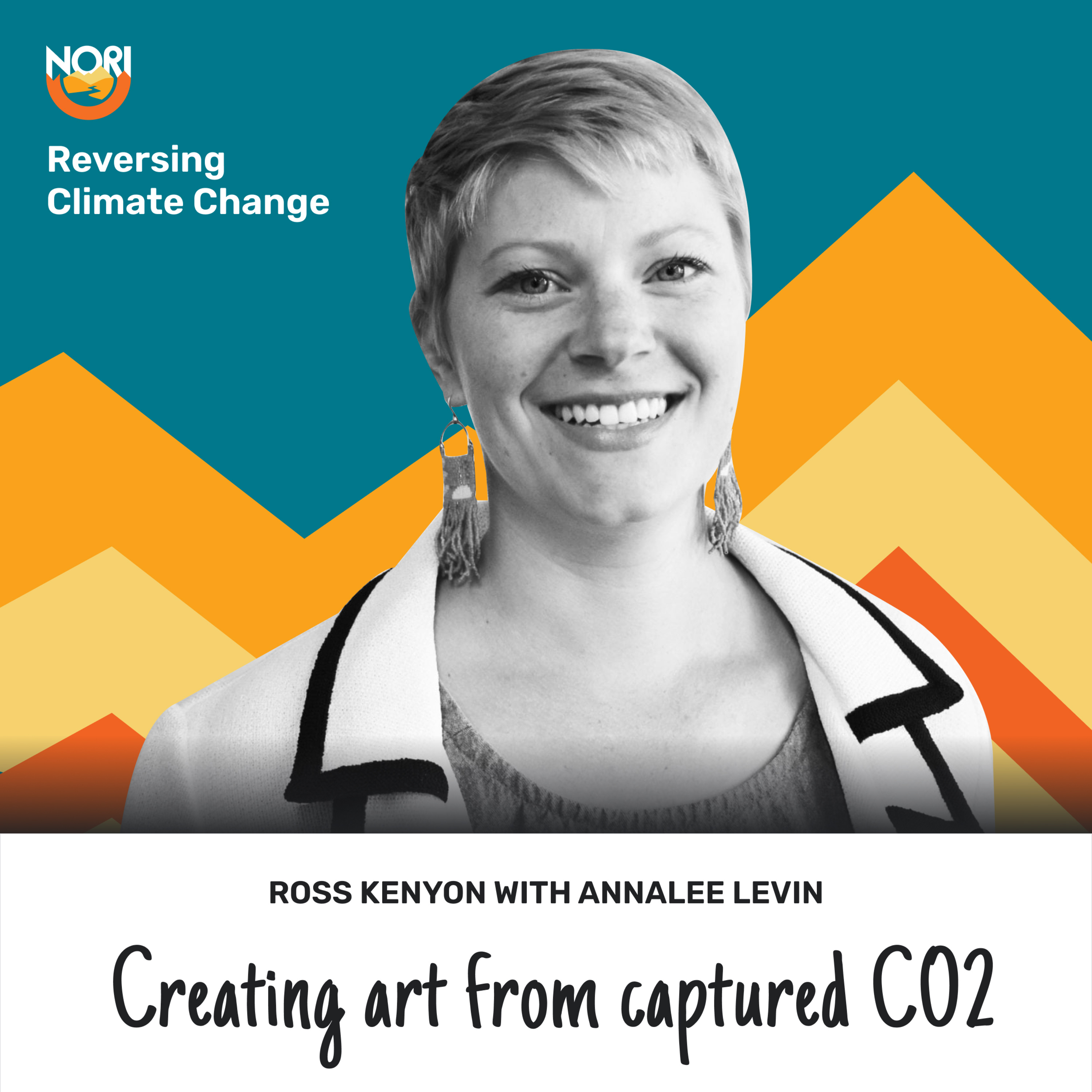
When artist Annalee Levin learned about carbon capture on the Reversing Climate Change podcast, the idea captured her imagination. Knowing that the technology exists to capture and store CO2 in concrete, for example, Annalee set out to find a way to make art out of materials containing captured carbon.
Today, Annalee is the textile, hand embroidery, and sculpture artist behind Captured Carbon Studio, a space for exploring captured carbon as an art medium and avenue for educating the public about reversing climate change. She is also a chef-in-training, an experienced beekeeper and the first ever Artist-in-Residence at Carbon Upcycling Technologies. On this episode of the podcast, Annalee joins Ross to discuss her hands-on approach to making art and explain why she is drawn to physical, material crafts as opposed to other art forms.
Annalee describes how she came to make crayons out of recycled CO2 and shares what she is trying to communicate by using captured carbon in her art. Listen in to understand how organic and industrial materials coexist within Annalee’s carbon removal aesthetic and learn how you can support her work or create your own art using tools that reverse climate change.
More from the show
Ad-free episodes and other benefits come with a paid subscription.
Carbon Removal Newsroom, the news show that ran alongside this one, is over. Its episodes are still up, on the feed Climate Workers Anonymous now uses.
Carbon Removal Memes is still going.
Resources
Captured Carbon Studio on Instagram
Lorraine Smith on Reversing Climate Change EP044
San Francisco School of Needlework and Design
Carbon Upcycling Technologies on Reversing Climate Change EP078
On Food and Cooking: The Science and Lore of the Kitchen by Harold McGee
Carbon Upcycling Pen-100 Nurdles & Talc
Carbon Upcycling Enhanced Fly Ash
Full Transcript
Ross Kenyon: Oh, did you hear that?
Annalee Levin: I did. Was that real? Or was that a sound effect?
Ross Kenyon: Wow. It could have been a sound effect. I just smashed a glass that I was drinking water out of.
Annalee Levin: Do you want to get another one?
Ross Kenyon: I was recording through it too. No, I have a water bottle. I guess it’s probably... I don’t want to deal with this right now. That was not the most graceful start to a show I’ve ever done.
Annalee Levin: That was great. That was really dramatic. I liked it.
Ross Kenyon: Very dramatic. I wonder if I’ll keep it.
Annalee Levin: I think you should keep that. That was a great sound.
Ross Kenyon: Great sound. It just sounded like a sound effect.
Annalee Levin: If you’re listening... You should sell it to a sound effect company.
Ross Kenyon: I should. I should. How do you sell to a Foley artist? I don’t know.
Annalee Levin: But it’s a thing. It’s a thing you can do.
Ross Kenyon: I think the market’s been cornered on glass shattering sounds.
Annalee Levin: I don’t know. They haven’t heard this one. This might be the best one.
Ross Kenyon: They haven’t heard this one. The level of artistry I bring to this shatter... You’re going to want, it’s going to be like, you know, the Wilhelm scream.
Annalee Levin: The what?
Ross Kenyon: The Wilhelm scream. Have you ever heard of that?
Annalee Levin: Uh, no. Is that a specific scream that’s been used in everything?
Ross Kenyon: In so many things. I’m pulling it up right now on YouTube because there’s compilations of it for like every, like just every single movie ever. Okay. Let’s see if you’re. Did you hear it?
Annalee Levin: Yeah, it’s pretty amazing. Do you know about the frog? There’s like this frog sound that’s universal, but it’s actually a frog that’s like from Southern California and doesn’t live anywhere else. And other frogs don’t sound like that, but it’s the frog sound that everybody uses.
Ross Kenyon: Oh, no, I didn’t know that one. That’s pretty interesting. That just became like the universal frog sound.
Annalee Levin: Universal frog sound.
Ross Kenyon: Wow.
Annalee Levin: Ribbit, ribbit kind of thing.
Ross Kenyon: I love that. That’s a funny thing about how post-production works for audio. And have you ever seen someone who actually is a Foley artist who’s creating these sound effects after the fact and how they do it in their studio? Have you ever seen those videos?
Annalee Levin: I haven’t, but I think I read about the dinosaur sounds in Jurassic Park.
Ross Kenyon: Oh, no.
Annalee Levin: I don’t know. It’s like all sorts of different animals combined together, like real animals combined together to make the sound or I don’t know. It’s a fascinating art.
Ross Kenyon: What?
Annalee Levin: Yeah.
Ross Kenyon: I’ve not seen that. So, okay. If you’re listening, you tuned in. That was us having a fun, natural, a kind of cold open start. Like you’re listening to Marc Maron’s podcast and they’re just in the middle of something. In media rest, they call it. That was fun. I’m here with Annalie Levin. Anna Lee, you are a patron on Nori’s podcast, Patreon. Thank you for supporting us. You also do so many things. So we started talking about being a Foley artist and sound artistry. It wouldn’t surprise me that if If you also were involved in that, given how many different media you touch, you’re a textile artist, you work in food, you’re a chef in training, you’re in culinary school, you work at a restaurant, you’re a beekeeper, you create things using captured CO2 as an artist in residence at Carbon Upcycling Technologies.
How many things am I leaving out, by the way? I’m sure there’s just dozens of things that you do.
Annalee Levin: Those are the main ones. Those are the important ones, I think.
Ross Kenyon: Yeah. And Rollerblader or no?
Annalee Levin: Roller skater. Yeah. I mentioned earlier, I do also roller skate, but it’s not a big thing in my life. It’s a minor side project.
Ross Kenyon: Minor side project. Yeah. Okay. So we just named a whole slew of various approaches to art. Is there some sort of relationship between these? How do you understand what you make?
Annalee Levin: I think what’s most important to me when I’m thinking about making art is that... I’m making it based on something in the real world. My artwork has always been some might call it political or about politics or climate change or things that are happening. It’s not necessarily like a lot of artists work from a really personal place. And I wouldn’t say that’s really where my artwork comes from. I mean, I guess it is coming from a personal place because it’s the things that interest me personally. But I want to talk about kind of bigger issues and kind of help to educate people about those things.
And I like to use humor in my work a lot. I also am really interested in things like kitsch and Americana. And so that features a lot in my work. And I think I always think about my work having an audience. So, you know, I really like to make things. So I do a lot of Like knitting, for example, I like to knit sweaters, but that’s kind of something I do for myself personally. And I really enjoy that craft. When I’m thinking about my, you know, so-called art with a capital A, I always envision that someone else is going to see it and hopefully take some meaning from it.
So I think that’s maybe the sort of guiding principle of when I’m thinking about making art.
Ross Kenyon: Hmm. Okay. I didn’t pick up on the impersonality part of it, but I did. I was looking for connections between this because it does seem like there is some sort of connection and much of it seems tactile. Like there’s an interest in materiality versus art that’s hanging in a frame that’s somehow like less interactive. Am I reading too much into that or is that something that you care about?
Annalee Levin: No, that’s definitely true. Materials and material usage is really important to me, but also the tactile aspect of the things that I’m working with is really important to me. I do work a lot in textiles and otherwise I work in sculpture and sometimes they’re textiles that are sculpture or sculpture that is textile, so to speak. And I think it’s because I really like to work with my hands. And that’s not to say that people who work in 2D aren’t working with their hands. So if you’re a painter or you’re drawing, you’re definitely working with your hands.
But most of the things that I make are more kind of more material, I guess, and more sculptural. And that’s just kind of how I relate to the world, I think. I like to shape things, like physically shape things. And that’s how I see things and imagine things. I imagine them in 3D and I have a harder time with sort of 2D space. I sometimes imagine that I could become a painter. And I have ideas of things that I want to paint. Sometimes I try to paint and I always come back to something more sculptural because I just find it much more satisfying personally.
Ross Kenyon: I’d like to figure out why it feels more satisfying. It does to me too, but I feel an outsider to much of that material focus where most of the art that I’ve created in my life or worked on has been either word-based, textual, which is the exact opposite of materiality, or it’s been film, cinema, pick a pretentious word. I’ve worked in that thing. Also something that you experience with your eyes and your brain that you’re not touching. And in the last couple of years, I’ve become increasingly interested in interacting with physical space and objects.
And it does something for me that the less removed from materiality does not do. And I’m not sure I can articulate why. Do you happen to know or give me the language necessary to articulate why it’s important? I don’t know if I can explain it.
Annalee Levin: Yeah, that’s a really interesting question. I think someone said something once about like craft being something learned with the body and not with the mind. And, you know, it’s like, let’s say you’re like editing a film or something. I think that’s more of a mind thing. You’re not really using your body in the same way if you’re editing a film. And so And I like that about craft in general. I mean, again, not that editing a film is not a craft. That’s definitely a craft. But when we’re talking about more material, physical crafts, there’s something about maintaining a connection with your hands.
And, you know, also this like idea of flow, which again, you could have editing a film. But for me, I really get that when I’m working with my hands and I find it really satisfying to get better at something. Because when you try something for the first time with your hands, it’s always difficult. Well, almost always difficult and gets easier over time. There’s something really satisfying about getting better. I teach a lot of hand embroidery. And it’s interesting because sometimes I’ll sit down with a student. Well, pre-COVID, I would sit down in person with a student and I would do something that And they’d be like, oh, you make that look so easy, which I think is also something people say about like ballerinas, like ballerinas look so effortless when they’re dancing.
But obviously they’ve spent years and years like honing their muscles and training those skills. And it’s the same thing, you know, with something like hand embroidery. Like I know where my fingers are. I know where the needle is. I can listen also to the thread and I can hear the thread is doing something wrong because I’ve spent so many thousands of hours doing that thing. And because you can watch me and I’m making it look easy doesn’t mean it’s going to be easy when you try it and you just have to keep practicing.
And the better you get at it, the more satisfying it becomes. So I think That’s what I like about my connection with my hands as I’m working. Like I can feel as I’m getting better with something. Like you mentioned that I’m in culinary school, chef in training. Learning knife skills has been really interesting. And I’m now working in a restaurant and I have these calluses in my hands from cutting stuff with a knife. And it just takes time to get it and to understand and to feel the motion of the knife.
And that’s something I’m very far from mastering, my knife skills, but I’m getting better and it’s constantly satisfying. And, you know, you just continue to learn and learn and learn. And that’s what I really like about working with my hands. Does that satisfy some of the questions, your burning questions about physical materiality?
Ross Kenyon: Oh, I got follow-ups. There’s more to say. I was trying to think too. I think... In all the writing, I got better. But in some ways, I think some of the things I wrote early on are the things that if I reread them now, make me laugh the most, that I’m most proud of. I think some of those, it was like every new writing project, the longer it is, It was almost the harder it would be because the more variables would be interacting over time and you have to pay things off in the right kind of order.
Writing a short story is also hard too. Being succinct and telling a good story with brevity, that’s certainly not easier, but it’s different. I’m trying to think if I ever felt like I was getting so much better at writing that it was able to sustain me. I think the answer would be No, but even just talking with Elizabeth Colbert recently, I always say that her writing, she’s so good that she makes it look easy that when I read it, I’m like, oh, I could write a book. And I’m like, oh, that’s because she’s so good.
So maybe I just wasn’t called to be a writer in that kind of way. But even as an amateur, I do feel what you’re describing about craft, where even if I’m working with wood and not doing so as an amazing craftsperson, I still know that I’m learning and improving throughout the process. And I do find that to be really rewarding in a way where writing and filmmaking did not feel that way. But I can’t say that’s universal. I think that’s more my personal experience. I know there’s editors and directors and writers who do feel that marginal improvement of craft time over time that allows them to keep coming back, I think.
I’m curious if that is actually the main difference, but you think it might be?
Annalee Levin: Well, what you’re saying about like the story, writing a story is an interesting example, because I think there, you’re still working with your mind, you know, you’re working with word, like you are, you’re crafting, you’re moving things around, you’re changing words, and there is some sort of like flow that you can get into with that. But it’s not the same as working with your hands, because when you’re working with your hands, and you know what you’re doing, your mind kind of shuts off, you know what I mean? And so I think that’s kind of The difference between those two examples, your body can truly learn something.
Like if I’m embroidering, my body knows what I’m doing and I don’t have to think about it very hard, if at all, sometimes. Same thing with knitting, you know, I can knit and I don’t have to look at my hands. I can like watch TV or hold a conversation with someone. And so I think the difference between these kind of more physical material kind of crafts versus crafts that involve the mind, you know, they’re both crafts, but they’re different, you know?
Ross Kenyon: There’s something so satisfying in that muscle memory. Knitting is a good example. It was so hard for me to learn how to, you know, the last step in a very basic knit when you’re like pulling the stitch off and then step right before. I had a friend. I don’t think she’d mind me saying that she’s been on the podcast a bunch of times. Lorraine Smith. I had her on a FaceTime. I’m like, Okay. So I’m like at this step and I can’t move it off and have it keep going. Like watch this.
And in hindsight, it feels so basic and I can’t believe it took me so much effort to get it. But now I’ll be, you know, if you’re watching TV or you’re listening to music or a podcast or something, you just do it. And I find it really satisfying. And I don’t know, am I onto something? Is that how you feel too?
Annalee Levin: No, absolutely. I actually find it really hard to... Do something like watch TV or something that involves sitting without doing something with my hands at the same time. Like I find it unsatisfying. Like I’m being lazy. Like, you know, if I’m watching some really trashy television, well, at least I’m knitting because it’s not something that I’m accomplishing at the same time. So it’s both a feeling of accomplishment, but also like my hands are just itching to do something and they need to be doing something at all times. So I don’t know.
It’s kind of a, It’s a strong point and a weak point for me because I can’t truly relax ever because I’m always doing something with my hands.
Ross Kenyon: That’s intriguing. What’s your interest in kitsch? And what is kitsch?
Annalee Levin: Kitsch is really interesting to me because it’s this thing that people love to hate, but ultimately they just love it. I mean, that’s the whole point of it. Like, let’s say you go to the Eiffel Tower, you visit the Eiffel Tower in person and you buy... A little Eiffel Tower and you bring it home and you put it on your shelf and it like holds this memory for you. And I think that’s what I find really interesting about these little like knickknacks and things that we have around the house is that they mean something to you.
They give you some sort of feeling, some sort of satisfaction. Sometimes it’s universal and some people see an Eiffel Tower and they have feelings about it or like Mickey Mouse or whatever. People have feelings about that. And so these items that are more universal, like you can go to someone’s house and you can see these things in their house. I’m generally interested in how people decorate their homes, I should say. And so that’s kind of a thing of mine, like domestic objects and decoration is something I’m interested in. And so you can kind of relate to people in a particular way, depending on how they’ve decorated their house.
But they’re also these like really horrible, like knickknacks. Like, why do I have all these things on my shelf? Like, just get rid of them. Like they’re caught in clutter. Like, you know, Marie Kondo, she would tell me to get rid of these things, but you can’t get rid of them because they mean something to you. And I think it’s an interesting phenomenon. And so I kind of work with domestic objects in my artwork as sort of like a starting point because we all have a connection to these things. I mean, it’s different in all cultures, you know, depending on where you live.
Those particular objects will be different things, but the idea is kind of universal.
Ross Kenyon: I’m trying to think of some examples, maybe like an embroidered thing that says home sweet home or those things you’ll see in suburbia around the country that says gather.
Annalee Levin: Yeah.
Ross Kenyon: Or I also thought of the evil eye. Does that count as?
Annalee Levin: Yeah, I think that counts. It has this sort of like specific symbolism that Which some people take more like seriously in a, you know, semi more religious or spiritual sense. And then for other people, it’s like, oh, I’ve got my I’ve got my evil eye on my bracelet and I’m going to be safe, you know, and it’s a really like kind of base version of the same thing. Yeah, I would definitely count evil eye in that for sure. Back when we were allowed to travel. In 2019, I went to Uzbekistan on a sort of art and textiles tour, which was an incredible, incredible experience.
But they have a lot of like evil eye usage. And it’s, you know, you put it on your textiles or whatever the thing may be on your on your rug, etc. And it’s to help protect you. And so we all need protection. So there’s nothing wrong with that, right?
Ross Kenyon: Yeah, that’s pretty intriguing. I’ve certainly seen a lot of those traveling and I did a semester in Istanbul and yeah, the evil eye is everywhere. All over the Mediterranean, Middle East. Yeah, looks like as far as Uzbekistan, I’m sure it gets all the way. I’m sure it goes farther from there too.
Annalee Levin: Yeah, it’s definitely all over the place. We all need something to believe in. So there you go.
Ross Kenyon: There you go. Man, I saw one thing in your bio that made me laugh. I love that there’s a Royal School of Needlework. Yeah. That sounds like a joke. That would be when Parks and Rec goes to the UK. That would be a thing that they would talk about. It doesn’t sound real.
Annalee Levin: It’s real. It’s real. And it’s in a palace. So I’m not even kidding. I used to go to school at a place called Hampton Court Palace, which is... That’s like a Tudor castle, right? Yeah, exactly. And they have little, I say little, like reenactment, you know, Henry VIII people. Walking around and you can see them in their outfits and they kind of wander around the castle. And it’s yeah, it’s great. It was a really, really fun place to go to school. But yeah, I went there after I graduated from college because I started becoming more interested in hand embroidery.
My mom taught me how to embroider a little bit when I was younger. And then when I was in college, I did a lot of sculpture, ceramics and Things like that. And I actually got into embroidery because I was really tired of being dirty all the time. And I just thought I need a craft that’s clean and that I can do on my couch is literally what I thought to myself. And so I started picking up embroidery again and I made some political pieces that were embroidered and I was like, how do you learn how to do this better?
And so I went on the Internet and I found this woman. I found her portfolio and she had embroidered this dog, this like pictures, perfect dog. And I was like, that’s amazing. It was a painting, you know, but embroidered. And I found that she went to the Royal School of Needlework. And I said, what? And so I looked it up, found it. I initially went to England for a few months and I took some classes and then I became obsessed and I kept going back and back. And then years later, I ended up becoming one of their certified instructors through their program they call the Future Tutors Program.
So in the UK, the teacher is called a tutor. So I did that. And then I moved to San Francisco and I helped to start a school called the San Francisco School of Needlework and Design. And I worked there for a few years. So yeah, embroidery. Traditional hand embroidery is a big part of my education and it’s something I’m really interested in. I take a lot of pride in all the things that I learned at the Royal School of Needlework and I love that I learned to craft in a really, really traditional way.
In a very strict way where you really want to do it right. And if you’re stitching something and the teacher comes around, they’ll tell you if it’s not good enough and then you have to take it out and then you have to do it again to try to make it better. And it’s just a really interesting kind of education that was very different from studying art in school or in college where you kind of just like, sure, you learn real skills. And, you know, you kind of try to master them, but there wasn’t that expectation of perfection that you have at the Royal School of Needlework.
And that’s kind of what they’re known for. And so it’s been really fun as an artist to have that like very specific technical background and then to be able to take it and kind of do whatever I want with it. Because I think when you have foundational skills like that, that really builds your ability to make more interesting work. You know, and then there’s a lot of embroidery artists out there who aren’t traditionally trained who also make beautiful work, much more expressive. I’m actually really, really terrible at making what I would call expressive artwork.
Like I can’t just pick something up and like doodle it and feel good about it. I spend, you know, hours, weeks, months planning a piece before I even start it. And then I spend a thousand hours or however many thousands of hours like stitching a thing or making a thing, whatever it might be. And it’s all like it has to be perfect. Like I have a vision of it and I want it to be I want it to look a certain way. And that’s really important to me. And like the idea of like picking up pastels and I’m just kind of scribbling some stuff like I can’t I can’t do that.
Which is funny because I’m now I’m making these crayons. I guess we should talk about carbon at some point. I don’t know.
Ross Kenyon: Go ahead. I was going to, yeah, I was going to have to lampshade this and be like, I swear this has stuff to do with carbon.
Annalee Levin: It really does.
Ross Kenyon: Yeah. Take us there.
Annalee Levin: You mentioned that as artists in residence with carbon upcycling technologies, the sort of story of how that came to be. And then to talk about crayons, which are related to pastels, that’s how I’m tying this all back in. Well, I was listening to the Reversing Climate Change podcast and That’s why I’m here, really, is because of this podcast in 2019. And I learned about carbon capture. And the idea just fascinated me. It like really, you know, not to be funny, but it captured, you know, my imagination. And, you know, the idea that you can take CO2 out of the air and then turn it into something else.
Like I couldn’t imagine. I had never known that was a thing. And so I became really excited about About the idea of making CO2 into artwork. And I didn’t know what that meant or how to do it. So at the time I was preparing for an exhibition that was supposed to be in Berlin in 2020, but then COVID, so that didn’t happen. But I’m grateful that I had been planning for that exhibition because some of the ideas I was thinking about at the time Carbon capture or working with CO2, it like tied in really well.
And so I was planning on using CO2 as a part of the, like in the exhibition and the pieces for the exhibition. So I went online and I Googled like how to make art out of CO2. And obviously that’s not a Google-able thing.
Ross Kenyon: There’s just nothing?
Annalee Levin: There’s just empty? Not really. I mean, there is now because I’ve been doing it. And there’s actually, there’s another artist that’s been working with carbon upcycling technologies called Luis Merchan. I don’t know if I’m saying his name correctly, but he’s been painting with some of carbon upcycling materials as well. So, so anyway, so I Googled, I found this website called Sky Baron and on the site, they had some like concrete pens and concrete coasters made with CO2. And so I was like concrete. Awesome. Like I can make something out of concrete.
So that was my initial ideas. I wanted to make this installation out of using small sculptures made of concrete. So I emailed Sky Baron and I was like, hi, I’m an artist. I would like to make art using upcycled CO2. Can you help me? And the guy who has Sky Baron, James Kahn, he wrote back to me and he literally wrote something like, Oh, I’ve been thinking a lot about an art installation that uses CO2 recently. And so it’s just kind of the perfect connection. And then he connected me with Carbon Upcycling Technologies, who you’ve had on the podcast.
So people may be generally familiar, but they’re one of the top 10 finalists in the Carbon X Prize right now, which should be announced sometime this year, which is very exciting. So he put me in touch with Carbon Upcycling. And I said, I’m an artist. I want to use some of your materials, yada, yada, yada. So they sent me a few of their materials to play around with. Most of them are like a powder. So what they do is they take CO2 and they absorb it onto these powder materials and that sequesters the CO2 into those materials.
I’m sure they would have a more scientific way of describing it, but I think that’s kind of general idea. They have these big machines that I don’t understand and they do something that I don’t understand, but I get to use the materials. So it’s great. And the first material that was really interesting to me was something they call graphitic nanoplatelets. And it’s basically a very fine graphite powder, you know, being a graphite powder, you know, I immediately thought, okay, I can draw with this. I can paint with this. I can make an ink out of this.
I can dye fabric with it. So I started playing around with all those different iterations and I dyed fabric and I dyed thread and that was really interesting. And then I started thinking about How I could turn it into a writing material that’s like something other than just mixing it with water. And I’m a beekeeper. So I took some of my beeswax and I thought, oh, I can make crayons. So I just melted beeswax and I added the graphitic nanoplatelets and it made the most beautiful, like incredible writing crayon. And that makes sense because the nature of graphite is that it kind of flakes off in these perfect little I don’t know.
It’s like, I’m sure there’s a better term for it. And that’s what makes graphite such a great writing material. And so, of course, when you mix it with the beeswax, it again makes a really great writing material. And so even though, as I said earlier, I’m not much of a pastel kind of drawer type person myself, I like the idea that I could make a set of crayons and share this idea with other people and give other people the opportunity to Make something using CO2 themselves. And so sort of creating a tool for creativity that other people could use excited me, as well as the fact that crayons themselves, like, you know, I consider these to be sculptures and I enjoy the process of making the shapes.
I took a dowel and I sanded it down into a crayon shape. I made a mold of the dowel and then You know, I got to play with a lot of different mixtures of different colors in order to make the set of crayons. And that was a really fun and interesting process. And then actually the most fun part of making the crayons was designing the crayon box. And that kind of goes back to this like idea of like making something with your hands and like crafting. And when I was at the Royal School of Needlework, One of my least favorite things that I had to do was make a box.
It’s like a considered sort of an embroidery sewing technique where you design a box and it sounds really boring, but you design, they’re usually very elaborate boxes. You design an elaborate box, let’s say, and you cover it with fabric and that fabric is embroidered and then it all has to fit together perfectly. So it typically has drawers or it has like a lid that opens or comes off. And so I learned a lot in the process of learning how to make a box. The box, by the way, that I made in school was a refrigerator.
And that’s the shape that it was.
Ross Kenyon: But they’re just like, Annalie, can’t you just follow the rules?
Annalee Levin: I can’t follow the rules. It was so cute.
Ross Kenyon: The bad girl of embroidery.
Annalee Levin: I know. It was so cute. You know those cards that when you open them, they like sing to you or they light up. OK, so I took the mechanism from one of those cards and it had a light in it and I put it in the refrigerator. So when you open the door, the light goes on. It was so satisfying. Unfortunately, the light battery has since died and I didn’t make a mechanism that would make it easy to replace the battery. So now unless I want to take the box apart.
And put a new battery in, the light doesn’t go on anymore. But that’s an aside. So everything I learned in box making at the Royal School of Needlework helped me to make this box for the crayons to go into. And I just really enjoyed making the tiny millimeter adjustments to the box and the little flaps so that they would fold together perfectly. And I was originally hand cutting them. Which is insane. But like the first 10 or 15 boxes I made, I hand cut all of them. And then I eventually found a place where you can have them die cut.
And so they’re just, they come pre-cut and scored now, but I still have to like print them. And the ink that I use to print the boxes has the graphitic nanoplatelets in it. And then I have to glue the boxes. So it’s all very manual, but that’s what I enjoy. So it’s fine. So anyway, so I make crayons out of upcycled CO2.
Ross Kenyon: Yeah, among other things, but I’m holding the crayons. The box is very nicely made and the crayons are beautiful. I was going to ask how you, the dowel makes sense. I can see that’s how you shaped these, but they’re beautiful colors. This is the first time I’ve played with crayons, I think since I was a kid or very nearly. So thank you, Annalie, bringing me back.
Annalee Levin: You’re welcome. You’re welcome.
Ross Kenyon: Yeah, beautiful colors coming off of these. I think if you like carbon removal, you have kids who like playing with crayons and like drawing, or even if you’re just an adult who wants to be transported back to your youth, I think this would be fun. Do you think so?
Annalee Levin: Yeah, I hope so. That’s the idea. I’m actually now working on a set of watercolors, also using carbon upcycling materials. And that’s been really fun because, well, I should say, so when I first experimented with the crayons, I used my own beeswax because I had some laying around, but I only have at any given time, one or two hives. So I don’t actually have that much wax. So I had to buy wax from another beekeeper in order to make all the crayons. But I was reading about watercolors. And if you make watercolors on your own, like at home, and also historically in Honey is a common ingredient.
And so when I read that, I was like, well, I have to make, now I have to make watercolors because I have so much honey. I have an obscene amount of honey. I never even know what to do with all of it, but honey, I forget what the word is. It’s, it’s like humidicant or something like that. The word is something like that. And, and so honey, the way, the way it can absorb moisture, um, That contributes to it being a good ingredient for making a quality watercolor. So yeah, so I’ve been playing around with watercolors recently, making them with my honey and the graphitic nanoplatelets and also a talc material that carbon upcycling produces.
So it’s talc with CO2 embedded in it as well. And then I use earth pigments. I use a combination of earth pigments and man-made pigments. In the crayons, because they found that the manmade pigments drew a lot better than the earth pigments. So an earth pigment is basically ground up earth in essence, or a rock that’s been ground up really fine. And they didn’t work as well as the manmade pigments in the crayons. So I was sad when I had to use manmade pigments, but I suppose I’ve made manmade, used manmade CO2 embedded graphitic nanoplatelets.
So it’s only natural, right? But then for the watercolors, I’m trying to use just earth pigments, which I’m excited about. Indigo works well.
Ross Kenyon: Yeah, that’s what I was going to ask about. So I can see there’s one that is sort of a darker blue and that clearly must be the indigo. Yeah.
Annalee Levin: So that one has, so all four of the colors have graphitic nanoplatelets. The blue one has indigo in it. The brown one has iron oxide and another earth pigment in it. And the green one has chromium oxide and Anyways, they’re all earth pigments and chromium oxide, iron oxide, indigo, quartz, the general ingredients.
Ross Kenyon: Yeah. I was going to ask you this. That’s a funny thing, working with natural ingredients like this and then seeing firsthand how some of the more chemical, industrial, man-made pigments may work better than something more natural. Was that something that you already knew or did it sort of make your stomach turn in a weird way? Are you okay with that?
Annalee Levin: I didn’t really, I’ve actually become really obsessed with pigments recently. So all because of this journey and it’s like, it’s going to get really deep and really dangerous pretty soon. But I watched all of these videos on YouTube about like making pigments in a lab versus, you know, how to collect pigments from the earth and then grind them and then You know, and then there’s dyes versus pigments. So I’m interested in both of them. So a dye dissolves in water where as a pigment doesn’t. That being said, I used graphitic nanoplatelets, which is a pigment.
I use that to dye fabric. So you can still use a pigment to dye fabric, but it’s just kind of a slightly different process.
Ross Kenyon: Is it like a water and fat solubility thing or...
Annalee Levin: Well, it’s a water solubility thing. And then I think it’s also chemically, and I know people who know a lot more about dyeing than I do. So I should say I’m definitely not an expert dyer. I’m an amateur dyer. But dyes kind of bond more chemically to the fibers. There’s something about that as well. Versus a pigment, I think, kind of sits on the surface of, you know, in a way, like kind of more sits on the surface of the fibers, something like that.
Ross Kenyon: But for the watercolors, you’re going for natural pigments or natural...
Annalee Levin: So for the watercolors, I’m using natural earth pigments is what I’m using so far. And that’s kind of what I’ve been playing around with. But the man-made ones are really interesting because I can’t remember which one it was, what video I was watching, but it’s like they take something, whatever the material is, and they put it, you know, all these science-y terms. I’m not a scientist. So they take... They take something and they put it in like a flask and then they heat it and then it emits something. So maybe it emits methane or I don’t know.
It’s all very interesting. And when you get into thinking about sort of the carbon footprint of a thing or, you know, for example, these crayons, like it kind of boggles my mind because it’s Let’s say, for example, I don’t remember if it was chromium oxide, but that is one of the ingredients in the crayons. Chromium oxide, let’s say, made in a lab, you heat something and then it emits something into the air and then it turns into something else. If it’s emitting CO2, but then I also have CO2 in the other materials, then thinking about the overall carbon footprint of the crayon, So I can’t, again, I can’t remember the specifics of chromium oxide, but I definitely remember that one of the pigments, it’s like you heat a thing and then something comes out of it.
And it’s really fascinating to me. And it’s fascinating to me that you can take CO2 and put it into another material to begin with. I mean, that to me still blows my mind. Clearly, I’m super excited about this as a material, as in carbon capture in general, as an idea. And it just, it feels really magical to me. Science, it’s science.
Ross Kenyon: It’s science. Yeah, that’s cool. I definitely dig it. What’s your intention? What are you trying to communicate by using captured carbon dioxide as, I don’t know, feedstock for artistic materials?
Annalee Levin: I think... Currently, my initial and most important sort of intention is just to talk about, well, let’s talk about climate change and to talk about carbon capture as a potential climate change solution. I mean, not potential, it is one, but it’s not very well known to the general public. I think it’s becoming, like I see more and more articles written about it in places like whatever, the New York Times or People are talking about it more, especially now that we have Biden as president. I hope that these sorts of things will become more well-known.
Part of it, too, is what I got from listening to Reversing Climate Change when I first started listening. What I got from listening to the podcast was a sense of hope, which is something that I really lacked. When it came to climate change beforehand, because I kind of thought, oh, you know, we’ve emitted all these things into the atmosphere and now we’re just screwed and that’s the end. And that’s kind of where I was at. And then I listened to the podcast and I was like, oh, wow, people are actually doing things that could maybe help to reverse climate change.
I mean, the concept of Reversing Climate Change itself is really bold and interesting, but I also I’m excited about it. I believe it can happen. I think we can do it. So by making these materials and kind of talking to people about the process and about CO2 and the fact that you can do different things with it, I want other people to be excited and I want other people to have hope because I think there’s a lack of hope out there. So that’s my main objective right now is just kind of the education piece.
And then we’ll see where it goes from there to be determined.
Ross Kenyon: Determined, yeah. Oh, I also have a very nice worry stone that I like to... What is the verb of interacting with the worry stone?
Annalee Levin: I don’t know. I don’t know. I really struggle with the correct verb for the worry stone. And when I’ve written about it, I don’t know. I guess you’ve read it, but there might be a better word. You worry it. I don’t know. You worry it. The worry stone that you have, I should also mention. So that’s made out of concrete and it has... In it, what’s called enhanced fly ash, which is another material from carbon upcycling. And the fly ash, it’s enhanced, so to speak, by the CO2. And that was the original thing when I was looking at the Sky Baron website, this idea of like concrete really fascinated me.
I don’t know if the word is handful or a number of different companies. I don’t know how many different companies are experimenting with sort of sequestering CO2 into concrete, but I know there’s quite a few doing it in different ways. And, you know, that sort of technology, again, is one of these things that gives me hope because when you think about the very small scale of what you can do on a day-to-day basis as an individual in order to fight climate change, you know, like I can walk to work, I can eat less meat, I’m going to use less plastic, like all these things that people are trying to do, I think are great and really important.
But in terms of the large scale of the problem, For me, being able to imagine, okay, what if all of the cement factories in the world captured their CO2 and then put it back into the concrete? Like that’s exciting to me. So these little concrete sculptures, I originally wanted to take and create a big installation, like a big pile of them that people could take one with them as they go as sort of like a reminder of both the fact that climate change is something that’s in our hands, So something to remind you of climate change, but something to kind of give you hope.
And that was kind of my idea with the little worry stones. And they’re actually the original worry stone that I have. I’ve had since I was a child. And so I have this little worry stone. It’s like a little blue stone. And I made a mold of that. And that’s where the sort of pattern for the worry stone that I’m selling comes from.
Ross Kenyon: Oh, wow. I didn’t know that. That’s a nice little personal touch.
Annalee Levin: Yeah. Yeah.
Ross Kenyon: I don’t know if you just got like some sort of CAD file for a worry stone.
Annalee Levin: No, no, I’m not that fancy. I try not to use my computer for anything. When I need something like that, I have to ask someone to help me.
Ross Kenyon: Yeah. Okay. So that’s a really good example and a nice segue to what I was going to ask you about because your work, what you just said strikes me as very earthy, crafty, sort of low tech intentionally. So you’re creating objet dart, which I’m going to assume I’m using correctly and you can tell me if that’s actually wrong.
Annalee Levin: We’ll go with it. Go with it.
Ross Kenyon: Okay, you’re creating object art and you’re using industrially captured CO2 in order to make it. But many of these things are still, I experience as earthy, tactile things. And then also, I’m going to connect this broadly to where you’re going in the future, which is I know you’re interested in cooking. I imagine you want to use regeneratively grown ingredients. I imagine... In the future, you’d like to be creating textiles with regenerative wool or leather. I’m not even, I’m not sure if you ever work with leather, but right? Like there is something that you’re sort of like transcending both the organic and the industrial man-made and they’re sort of coexisting inside of this carbon removal aesthetic.
Is that, is that true?
Annalee Levin: That’s super, that’s very accurate. Yeah. And that’s important to me. I, I’m, yeah, I’m super crafty. I want to do everything by hand, but I’m relying on this material made by this company that’s using a magical machine that I don’t understand and involves lots of science, you know, like, and yeah, and I do want to start a farm. I want it to be regenerative. I want it to be a carbon farm, you know, so to speak. And I want to be like, you know, I want to be like in the dirt.
I want to be like really close to the earth in that way. But I think that we need both things, you know, in order to solve climate change. And so, and I think technology is great, you know, like look at where we are as humans and all the things that we can do, like all the medical technologies we have, you know, like freeway overpasses to speak of like concrete, like I like all of these things. I like I like cities and I like being in the country and I want both of those things.
And I think that we can have both of those things. And I don’t think that they’re mutually exclusive. So I like the idea that I can bring the two together, that I can take beeswax from my backyard and put it together with this material that was magically created by super scientists and has embedded CO2 in it. I think that’s really exciting.
Ross Kenyon: Was that an intentional choice from the beginning or were you just opportunistic about what kind of materials you had access to?
Annalee Levin: I don’t know. That’s a good question. I think that when I can, I do choose to use materials that I have access to easily. Like if I’m working on something in my studio unrelated to carbon capture or whatnot. I use a lot of found materials. I really like to go antiquing. I like to go to like thrift stores and junk stores, junkyards, you know, those materials I really enjoy because they have a history to them. So when I use the found material, it’s both from an ethos of like wanting to recycle something as well as I like the history of that material.
And I think that it makes the piece of art more interesting. So there’s that aspect to it. But then, you know, if I could capture CO2 myself and then use it in my artwork, I would, but I can’t. So I have to rely on others to help me with that. And I think that’s fine.
Ross Kenyon: Yeah, I think that’s fine. I’m just curious how that works in operation. One connection I just made too in my mind is you told me about a book that I’ve been reading and enjoying by Harold McGee called On Food and Cooking.
Annalee Levin: Oh, yeah. Yeah.
Ross Kenyon: Yeah, this book is comprehensive. So we reference a lot of books. Warning, do not buy this book unless you want an 800 page paperweight, unless you’re willing to really dig in. It’s awesome, though. It’s basically like when I think about scientific Approaches to cooking are like the modernist kitchen or Alton Brown or stuff that is focusing on the chemistry of how food is made. But that also strikes me as very antithetical to how I view you too. Basically, I’m viewing you as unidimensional, Annalie, as sort of like an earthy arts and crafts movement throwback.
And you’re so much more than that. And I’m trying to be like, how are you reading these like chemistry approaches to food and cooking? Shouldn’t you be being one of those people who are like, Jacques Pepin being like, I don’t need a thermometer. I just touch the meat and I know what it is inside.
Annalee Levin: I would love to be that person. But ultimately, speaking of cooking, I’m so new really. I’ve only been in this world for the last year or so. And the fact that somebody else has already figured out this stuff for me and can just tell me that it takes six and a half minutes to make a soft-boiled egg, like, great. Like, now I have that information and I can do that, you know? So I think I, you know, we stand on the shoulders of giants, so to speak. Like, if I didn’t read books, sure, I guess I’d have some ideas of things in my head, but, you know, books really help us.
And I like I love On Food and Cooking because it’s so technical. I mean, speaking of eggs, like the egg section is just crazy and the dairy section. I mean, all the different things that you can learn from that book. And then it makes your cooking so much easier. You know, once you understand like how proteins brown and it makes a particular reaction and that’s why, you know, meat tastes a certain way. Like that’s really interesting to me. So I want to know all the science behind it. I don’t want to like, imagine if you had to learn how to cook a steak All by yourself, just you and the steak.
You would mess up so many steaks.
Ross Kenyon: I definitely have, yeah.
Annalee Levin: You know, and that would be such a waste of all those steaks. Like speaking of the environment, you might as well have someone tell you how to do it correctly. And then you don’t have to waste a bunch of time and a bunch of energy. I mean, that’s not to say I love to experiment. I mean, making the crayons, that was a complete science experiment. Like there’s another... I mentioned the talc material from carbon upcycling. For some reason, it did not work with the wax. Something weird happened and it got all bubbly.
And I kept trying to do it different ways, like letting it cool to a particular temperature and then trying to add the material. And I just couldn’t get it to work right. Same thing with the colors, like experimenting with the earth pigments versus the man-made pigments. Sometimes you have to learn those things on your own. And I had to learn these on my own because nobody else has made these crayons before. But if someone had written a book about it, you’re dang right, I would have read that book already. And that’s just, I don’t know, I want all the information that anyone can give me.
And if I can’t find it, I’ll figure it out myself.
Ross Kenyon: Yeah, that’s fair. So in this unfair, unidimensional version of you that I was applying on would be... Like ancestral wisdom passed down from Levin to Levin for history. That’s like your maiden name. Is that actually, is that your?
Annalee Levin: That’s my, yeah, that’s my maiden name. I never changed my name.
Ross Kenyon: Okay.
Annalee Levin: I’m married, but I’m still 11.
Ross Kenyon: From Levin to Levin, all the way back to Anna Karenina. That’s how far back it goes. Yeah, exactly. As opposed to like on food and cooking, which is the opposite of that. Then again, so you can also like, maybe there’s some middle ground. Like I can listen to some mean nose rat teach me about the Mayard reaction. And that’s perfectly fine by me. Like it feels, it can be warm and sciencey. And maybe that’s, maybe that’s the sort of union that we’re, I’m trying to point us towards. Does that make sense?
Annalee Levin: Yeah. I mean, well, I mean, this comes, definitely comes right back around to craft and the idea of making things with your hands. Like, If I read a book about embroidery, I’m not going to know how to embroider. If I read a book about cooking, I’m not going to know how to cook. You have to still do the thing and you still have to use your hands and you have to try it. There’s just no way to get the results and the muscle memory from just reading a book. It’s nice to know about a thing, but to do a thing is really different.
Ross Kenyon: I feel personally attacked, but okay, it’s fine.
Annalee Levin: That was a personal attack on you. I’m sorry.
Ross Kenyon: The thing is, I know all these chefy things and I read these books and I listen to the memoirs and I watch the shows. I’m not really that good of a cook. I try. Dang it. I really try, Annalie. And I keep getting better, but... It’s not nearly as fast as I might like. That’s what I was saying is I wish there was a culinary school for normal people. I don’t know that I necessarily want a culinary career, but I want that baseline. We were talking about I want someone mean to watch me julienne like a million carrots or something.
And then I’m like, oh, I have that knife skill now. Yeah.
Annalee Levin: It helps. I mean, like I described the Royal School of Mutual Work earlier. That’s kind of what it was like. I’m not saying that they were mean and they were like slapping my hand or anything, but, you know, you would do something and they would come around and they would look at it and they would be straight with you. They’d be like, that’s not good or you can do better or, you know, and they just want you to be your best. And I don’t want to be yelled at, but I like that kind of learning environment where someone is straight with me instead of being nice to me and letting me think that I’m doing the right thing.
I want to know when I’m doing something wrong because that’s the best way to improve.
Ross Kenyon: That’s a good way to be. Would you say something similar or maybe a better way to say it is what advice might you give to someone who Wants to get involved with something like this. Wants to be crafty. Isn’t sure where to start.
Annalee Levin: Well, it’s a broad question. I guess you have to first focus your energy on what specific craft you’re interested in and just go with your gut. I mean, if you’ve never tried it before, whether it’s, you know, woodworking or sculpting or, you know, pick some roller skating. There’s great roller skating online videos I’ve been watching recently on YouTube.
Ross Kenyon: For anything on YouTube, it exists.
Annalee Levin: You can do anything on YouTube. Yeah, you just have to jump in. And I think if you can find, you know, it’s a little harder today with COVID and like not being able to meet in person with people. But if you can find a mentor, that’s really helpful. I think if you can find someone who, or a club, I was in a watercolor club for a while when I was in college. Like if you can find a group of people who are interested in the thing that you’re interested in, then you just have to try it and do it.
When I started culinary school last January, it was so nice because all of a sudden I was surrounded by a group of people who were interested in what I was interested in. You know, we all came from such different backgrounds. And yeah. In terms of our regular work or other interests, but we all have this one thing in common. And it’s just really nice to sit down and chat with people. And this is where I’m going to put in a plug for your book club, because I’m in the Nori Reversing Climate Change book club.
Which means that we get to read a book once a month that’s loosely related or directly, depends, related to climate change. And then we all get to hang out on Zoom and talk about the book. And that’s really nice. So yeah, you just got to find your people, I think.
Ross Kenyon: Yeah, thanks for the shout out. I’m glad you’re in there. I’m glad you’re enjoying it. It’s been a lot of fun. We get to have authors come by and hang out sometimes too. That’s always fun. If you want to join that, the link is in the show notes. And speaking of which, Annalie, how can people support your work? How can they buy the things that you’re creating, the aforementioned objet d’art? God, I feel so terrible saying that.
Annalee Levin: Great, and it’s in a perfect French accent.
Ross Kenyon: I can’t fake that one. Yeah, sorry, I tried. I took French too.
Annalee Levin: No, it felt good. If you’re interested specifically in the carbon capture related work that I’m doing, I have a website that’s capturedcarbon. studio, like . studio instead of . com. And I have an Instagram that’s also at capturedcarbon. studio. And then I have an Instagram about other embroidery related things, but not necessarily carbon, which is just annalee. levin. And also a website with my other artwork, annaleelevin. info, all sorts of places. I’m everywhere.
Ross Kenyon: Great. Links to all those things are in the show notes. You should buy this stuff. I think it would make great gifts. It’s beautiful, well-designed. I like that the worry stone comes in a nice little cloth envelope. I don’t know. You have a lot of really nice touches. You clearly put some thought into not just sending me a stone with no context. I feel like it arrived as a... As a thing that you clearly designed very intentionally. Is that how you see it?
Annalee Levin: Yeah, it is. And it’s also, I’m reusing scraps of fabric. So the Worrystone comes in a little bag that has my test prints from a textile design that I did called the Keeling Curve. So based on the Keeling Curve. And so that’s what the printing is on that piece of fabric, but it’s actually my test fabric. Because I’ve also made some They’re not on the website yet, but I’ve made t-shirts and tote bags that have this Keeling Curve print on them. And then I have some other textiles on my website that are, they’re sort of samples for couture garments and which are not for sale, but I’m hoping to make some smaller pieces that will be for sale as well.
So yeah, so I do try to be intentional and also to reuse stuff when I can. And I think that the scrap fabric Turned out really well. It’s little bags for the worry stones. So, yeah.
Ross Kenyon: Any idea where you’re going to go next?
Annalee Levin: I have so many ideas. It’s a little bit overwhelming. Well, the textiles, I’ll try not to say to bore you and say too many things, but the textile samples that I made, I made with sequins, made with captured carbon, and that I handmade out of these little nurdles, which are little pieces of plastic used in injection molding. And those came from carbon upcycling. But so with the textiles, with the sequins, I really want to work with the designer to make a dress or a series of outfits for something like the Met Gala or the Oscars, some sort of big event like that, again, to sort of publicize this idea of putting CO2 into something else, I think is really exciting.
And I want more people to know about it. And I want to make More wax sculptures. Again, using all the waste from all my failed crayon experiments, which I have a lot. I have all this wax in all these different colors. And I have some ideas for some wax sculptures. I have ideas for concrete sculptures. More textiles. Just so many things. So many things.
Ross Kenyon: Wow. And it’s a long-term vision to have... A sort of wild biochar, regenerative farm, restaurant, sculpture garden, carbon negative gift shop. Is that the decision? Yes.
Annalee Levin: You really just, you put all my interests into one and that is my goal. Yeah, I do. I want to have a farm. I want to have a carbon negative brewery. I’m really obsessed with biochar, which Ross and I have discussed previously. That’s a longer story. So many things. I want to have a restaurant. I want to make delicious food, local ingredients, zero waste restaurant, you know, all the things. Lots of carbon removal involved. Save the planet.
Ross Kenyon: Where’s the biochar in these? I sort of would have been surprised if it had showed up in any of these.
Annalee Levin: In the artwork or in the...
Ross Kenyon: In the worry stone or the crayons or maybe some other project.
Annalee Levin: I’ve got ideas. I’ve got ideas. Yeah. I haven’t gone there yet, but I have ideas. And I also have a collection of naturally made biochar, if you will, from a wildfire that burnt down a house, a family house of my families. But surrounding forests all had these like burnt down trees. And I collected all of this, you know, quote unquote biochar from the forest fire. And I’ve used it a bit as like charcoal for drawing. But I also want to make biochar on a larger scale in the future somehow. We’ll do it.
Ross Kenyon: Yeah, that’s super cool. Well, links to all of Annalie’s amazing creative projects are in the show notes. Buy some stuff, look at some stuff, track what you’re doing in the future. Thanks for being here, Annalie.
Annalee Levin: Thank you so much. It’s been great.
Ross Kenyon: Yeah, for me too. And also thank you for being a patron of the show. You can hang with us, do the book club with us. It’s $10 a month. Thanks for listening. Thanks so much. And goodbye for now. Well, thank you so much for listening. If you like the show, please rate and review it in Apple Podcasts and or Stitcher. It really helps us a lot to get this content to a wider audience. If you think what we’re doing is useful, interesting, fun, hopefully all three, we’d certainly appreciate your rating and review.
[Nori promotion cut from the transcript. It's still in the audio, but it no longer applies.] And thank you so much for your support.


