


Listen on Spotify, Apple Podcasts or YouTube.
There is a new pattern emerging in humanity’s long, complicated relationship with nature. Namely, we’re at a point where the problems we’ve caused by intervening in our environment require interventions of their own. But in a world where we can’t fully anticipate the impact of our actions, should we be optimistic about using new technology to solve crises created by the old?
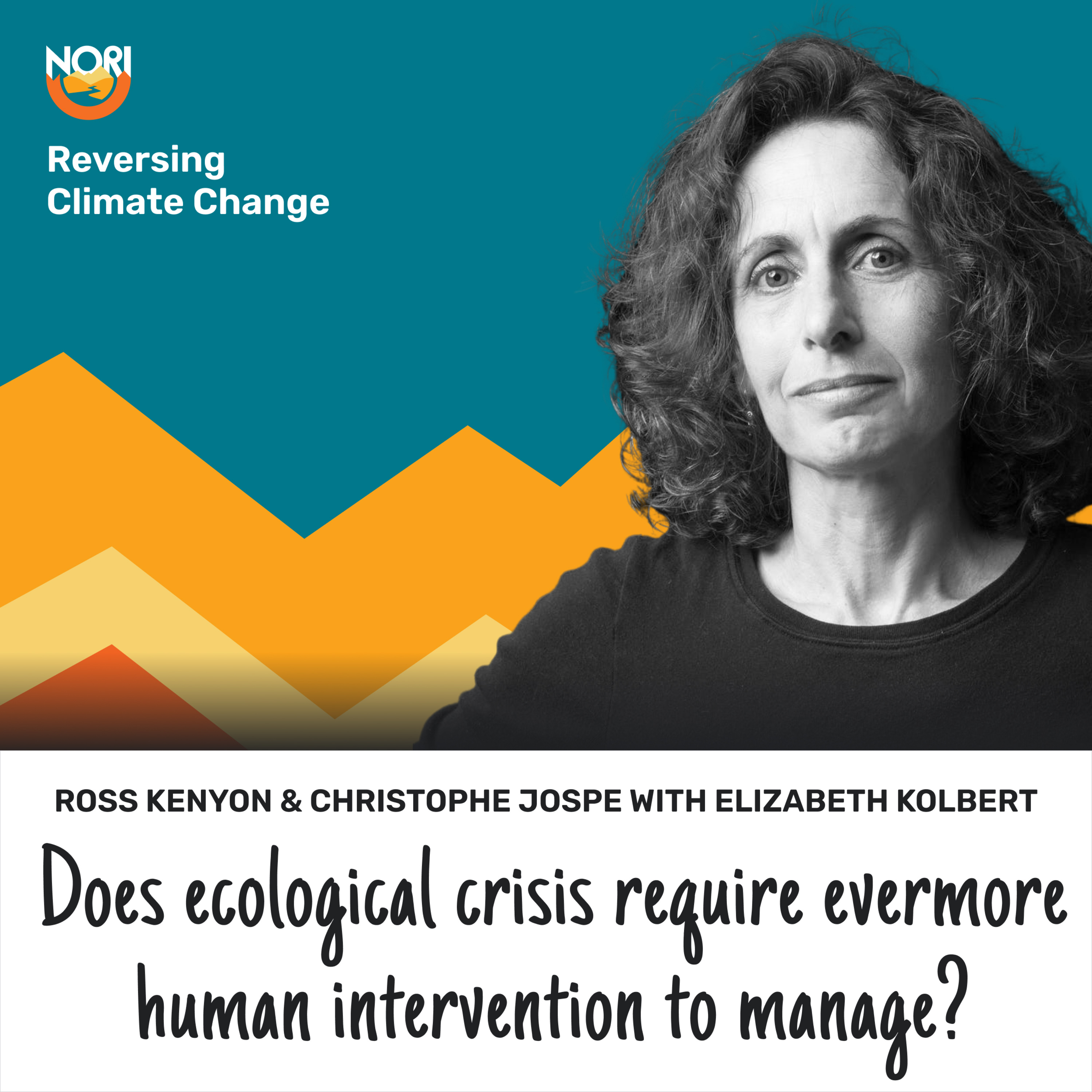
Elizabeth Kolbert is a staff writer at The New Yorker and the Pulitzer Prize-winning author of The Sixth Extinction. Her latest book is called Under a White Sky: The Nature of the Future. On this episode of Reversing Climate Change, Elizabeth joins Ross and Christophe to explain how a reporting trip to see a super coral project inspired Under a White Sky and describe how the book is structured on a continuum—from small, regional interventions to more controversial, global strategies for solving the problems we’ve caused.
Elizabeth walks us through several of the interventions introduced in the book, including an electrified river in Chicago, efforts to gene edit toxic cane toads, and a promising coral sex engineering project. Listen in for Elizabeth’s insight on the ethical concerns associated with interventions like CRISPR technology and solar radiation management and learn how she thinks about doubling down on our efforts to control the natural world.
More from the show
Ad-free episodes and other benefits come with a paid subscription.
Carbon Removal Newsroom, the news show that ran alongside this one, is over. Its episodes are still up, on the feed Climate Workers Anonymous now uses.
Carbon Removal Memes is still going.
Resources
Under a White Sky: The Nature of the Future by Elizabeth Kolbert
The Sixth Extinction: An Unnatural History by Elizabeth Kolbert
Field Notes from a Catastrophe: Man, Nature, and Climate Change by Elizabeth Kolbert
Dr. Klaus Lackner at the Center for Negative Carbon Emissions
The Ministry for the Future by Kim Stanley Robinson
The Leopard by Giuseppe di Lampedusa
David Remnick and Harry Finder on Reversing Climate Change S2EP37
Full Transcript
Ross Kenyon: Hello and welcome to the Reversing Climate Change podcast. I’m Ross Kenyon. I am the creative editor at Nori’s Carbon Removal Marketplace, joined by my longtime co-host Christophe Jospe, who has recently moved on from Nori and is now a NoriNot emeritus, but will still be back on the show from time to time. And I had to tag him in for this one. Hey, Christophe.
Christophe Jospe: Hey, Ross. So glad to be here. Great to pull my co-founder prerogative and show up to this very special episode.
Ross Kenyon: Yeah, we don’t want to over flatter you too much, Betsy. But today we have with us Elizabeth Kolbert, staff writer at The New Yorker, Pulitzer Prize winner for The Sixth Extinction, and author of the new book, Under a White Sky, The Nature of the Future. We have been wanting to do this show for a very long time. Elizabeth’s writing has made a gigantic impact on us both individually and collectively. When I started working at Nori, I didn’t have an environmental background. And one of the first books that Christophe gave to me that catch me up to speed was Field Notes from a Catastrophe, which I really enjoyed and went on to read The Sixth Extinction and was blown away by how interesting the story of geology as an academic discipline could be.
Got a lot out of that book. And then Christophe, I know your experience, you had something sort of like a Road to Damascus kind of moment reading Field Notes, right?
Christophe Jospe: Well, Betsy, basically Field Notes from a Catastrophe left me horribly depressed. It’s one of those books where I can remember where I was in the moment when I felt that way. And I came out of it kind of committing my career to wanting to spend the rest of my time working on climate change, which reduced the depression. So thank you for that. And indeed, listener, you may think Ross’s title is Creative Editor, but it’s actually Chief Librarian at Nori, and your books are aplenty in the Nori office. But maybe we should just get into it, Betsy.
How did you come to write this book in particular?
Elizabeth Kolbert: I think that, you know, all books have a complicated... Or most books, I shouldn’t say all books, all of my books have a somewhat complicated history. But I think that the key moment was about four years ago, I went on a reporting trip to Hawaii. And I was visiting a project that had been nicknamed the Super Coral Project. And the idea behind the project, it was run by a very charismatic scientist named Ruth Gates, who Very tragically passed away about two years ago. But anyway, I went to Hawaii. This was on Oahu.
The idea behind the project was, well, we’ve altered the oceans very dramatically. The oceans are warming up really rapidly owing to climate change. They’re also acidifying because when you pour a lot of carbon dioxide into the atmosphere, as you all know, a lot of it ends up in the oceans and that changes the chemistry of the water. And one group that really doesn’t care for these changes we know is corals, reef building corals. We are getting, they only live in warm water, but they don’t like it when water temperatures rise beyond a certain point.
And we’re getting these events called bleaching events when the corals turn sort of stark white and if it lasts long enough, die. And we’ve had huge die-offs in reefs all around the world, the Great Barrier Reefs, the reefs in the Caribbean, the reefs in the Red Sea. The idea behind this project was, well, we’ve changed the oceans. We’re not getting the oceans of the past back in any foreseeable future. You’re not getting that heat out of the oceans. You’re not getting the pH of the oceans back down in any sort of human timeframe.
So what we need to do if we want reefs in the future is we’re going to have to change reefs as well. We’re going to have to create these new reefs, these sort of human created reefs. And the idea was They were going to cross different, in some cases, different species, in some cases, corals from different parts of reefs and see if they could find crosses that were particularly hardy. And perhaps these could be used to seed the reefs of the future. And the project was really interesting. And as I said, Ruth Gates was a very dynamic person.
And it really got me thinking, this seemed to be opening up a new chapter in our You know, humanity’s long and complicated relationship to the natural world where we had, you know, changed something as vast as the oceans. And now we were going to try to change something as vast as coral reefs to try to counteract the changes to the oceans. And when I started to think about this, I started to see that pattern in a lot of places. And that’s really what set me on the road to this book.
Ross Kenyon: I can see continuity stylistically between your previous works. This feels like reportage to me. Many of the stories in the book are vignettes of various types of climate adaptation. In your previous books, they have grim titles, right? Field Notes from a Catastrophe doesn’t sound super great. The Sixth Extinction, that’s Doer at the very least and probably worse than that. But this book has, there’s sort of like a twisted, maybe like cyborg adaptation in here about using technology to adapt to a world that’s really, we’ve intervened too many times to no longer intervene.
And perhaps you’ve made peace with that. Is that an okay way to sum it up?
Elizabeth Kolbert: I don’t think I’d quite sum it up that way. I think I would say I’m identifying a pattern. We have intervened too often to stop intervening. I will go that far. How’s that? But what the results of that are going to be, I think I leave very open-ended. How’s that?
Ross Kenyon: That sounds fine to me.
Elizabeth Kolbert: You can decide that these interventions, these next-gen interventions, some of which are happening, taking place even as we speak, some of which are much more speculative and futuristic, you can decide, well, those are great, hopeful projects. And I think that’s a very legitimate way to read the book. And you can say, as I think I quote one scientist towards the end, this is a broad highway to hell. And I think that’s also a very legitimate reading. How’s that?
Ross Kenyon: That sounds fine to me. I appreciate the nuance. Christophe and I had a moment before we, when we were preparing the notes for this show, being like, which of these examples and vignettes freak you out and which ones are...
Elizabeth Kolbert: Well, I think that’s an interesting part of it. And it was interesting for me, too. And you find, you know, people who are self-described environmentalists very, you know, have spent their lives and their careers very committed to the natural world, such as, you know, such as it is these days and preserving as much of it as possible, who will fall on different sides of just about every one of these issues. How’s that?
Christophe Jospe: We’ll take it. I mean, it also feels as if there’s, let’s call them interventions, that they exist on some form of a continuum. But maybe it’s not so black and white. It’s not like this is kind of okay. And this is really, really bad. But could you lay out some of the interventions in your book and rank how you feel about them?
Elizabeth Kolbert: Well, sure. I mean, I start the book, the book starts, we’re in Chicago. And we are... Traveling down sort of fake river, man-made river, the Chicago Sanitary and Ship Canal, which was dug around the turn of the 20th century to solve a problem, a big problem for Chicago. And the big problem for Chicago was that it grew up along the Chicago River, a sort of short little river that flowed through the city and to the east into Lake Michigan. And as the city grew up, it Dumped all of its waste into the Chicago River.
It’s human waste, the waste from the stockyards.
Ross Kenyon: The green food coloring from St. Patty’s Day?
Elizabeth Kolbert: Well, that they do purposefully now. That’s done purposefully. This was more just sort of ad hoc. We can get to the food coloring in a minute. And so anyway, it was said that the Chicago River was so thick with filth that a chicken could walk across and never get her feet wet. And the problem with this was not just that it was disgusting, but that Lake Michigan is Chicago’s source of drinking water, the sole source of drinking water for the city. So they were getting all these outbreaks of waterborne disease and they decided something’s got to be done about this.
And the something that was done was this massive construction project, one of the biggest in the world at the time. Dig this canal, reverse the flow of the Chicago River. It no longer flows into Lake Michigan. It now flows out of Lake Michigan and into the Mississippi system. This solved one problem. It solved the problem of drinking your sewage, but it created a new problem. That problem was that you now had joined these two historically distinct drainage basins, the Great Lakes Drainage Basin and the Mississippi Drainage Basin. That allowed species from one basin to the other to pass through this sort of wormhole.
And that became more and more of a problem over the course of the 20th century as both of these systems became heavily invaded systems. They’re both filled with invasive species that are wrecking havoc separately in each basin. And as they cross from one to the other, they were just going to wreak more havoc. And so towards the turn of the 20th century, it was decided something’s got to be done about this and that something. So Congress decided that. And the U. S. Army Corps of Engineers was left to figure something out.
And what they did was they electrified part of the river. So the book begins, we’re on a voyage down this canal, which is a fake river, and now has been electrified to try to keep species from passing from the Great Lakes into the Mississippi. That is an intervention on top of an intervention. I think we can all see that. And it is already happening. And I think that in general, people would say, well, okay, I can deal with that. Maybe some fish are getting a nasty surprise as they try to get across this electric barrier.
But in the end of the day, if it keeps species from moving between these two basins, I can live with that. And I basically... Feel that way myself. How’s that? It was a great fun trip, even though as you go across the electric barriers, it’s electricity being pulsed into the water and there are huge signs. Do not go in the water. You could absolutely end up electrocuted. And then as the book goes on, we see more and more things that raise the hair, let’s say, on the back of your neck until we finally get to the ultimate intervention, at least in my view, or one of the ultimate ones, I suppose there are even more dramatic ones we could consider, which is, and I’m sure you’ve talked about this on the program, solar geoengineering, the idea that we don’t like the climate that we’ve created by dumping a lot of carbon into the atmosphere.
So now we’re going to counteract that, try to counteract that. By spewing either sulfur dioxide or calcium carbonate, and we’re not sure exactly what, diamond dust potentially into the stratosphere to bounce sunlight back to space and try to counteract warming with a form of artificially induced cooling. So they really build on each other. And I think that solar geoengineering is immensely controversial and should be, rightly so. So in between and in between, we get, you know, gene editing and all sorts of other possibilities. But I think we start small and regional and we go global and worldwide.
Ross Kenyon: Okay, I can see the ordering of the book then perhaps a little bit more clearly. Yeah, the canal being electrified, it doesn’t seem nearly as dangerous with the widespread effects. Certainly not relative to Asian carp making it into the Great Lakes, which is why it’s electrified. Although it does seem, it’s very steampunk, very World War I. The idea of an electrified river, rivers are not supposed to be electrified. It just feels unnatural and wrong to me in a very particular way.
Elizabeth Kolbert: Yeah, I mean, steampunk is a good word for it, actually. I never thought of it that way, but that’s really, it’s very, you know, to say that it’s jury-rigged is, you know, to put it mildly. But, you know, these are immense projects, multi, multi-million dollar projects. And as I discuss in the book, there’s a plan. People don’t feel that the electric barriers are necessarily sufficient to keep, as you mentioned, Asian carp, that sort of So Asian carp, I’m not sure everybody is familiar with the Asian carp store, but Asian carp are, you know, the name suggests it’s one species.
It’s really four separate species of carp that were imported from Asia to fulfill various, once again, and then weird story, Ecological functions. They were supposed to work as sort of biocontrol agents and reduce the need for chemical controls. They got loose. They’ve just taken over big swaths of the Mississippi system. In some places, they’re as much as 90% of the biomass. So they’ve done really, really well at the expense of other creatures. And it’s worried that the electric barriers are not enough to keep them out of the Great Lakes. And so there’s a whole other $775 million set of barriers that are in the planning phase right now that will have bubbles and noise and sort of crazy.
I mean, it gets crazier and crazier as you go along.
Christophe Jospe: Yeah, and I really liked, I mean, effectively how the carp is this example of, you know, when we use a species to solve one set of problems that we’ve caused, it creates a whole new set of problems and you just weave these examples entirely throughout the book. You know, I can’t help but... You know, thinking about coral, I learned a lot about coral sex through your book, which is a fun one.
Unknown speaker: Keep it PG-13 though.
Christophe Jospe: Yeah, sorry. Well, we won’t go more around here than that, but I mean.
Elizabeth Kolbert: Corals do have sex, although not the way that mammals do, let’s put it that way.
Christophe Jospe: Right. And it doesn’t happen all that frequently. It’s really just once a year. And people get really excited during that one time a year. But that, you know, that seems like a pretty good intervention for us to at least try to save the barrier reef as an okay barrier reef, maybe no longer great. It’s like a breeding program. That’s what you’re referring to? Why are we trying to mess with coral sex in the first place?
Elizabeth Kolbert: Well, that gets back to the story that got me going on this whole book project. The super coral project that I mentioned that I went to Hawaii to see that it was just getting going in around 2016. And I just went back last year, right before the pandemic, and it has continued on. It was a joint project of American researchers and Australian researchers under the direction of an Australian researcher named Madeline van Oppen. And this is not a blanket statement, but many, many species of corals are hermaphrodites. So they produce these little bundles that contain both eggs and sperm.
And they release these into the water once a year. And it’s an amazing, amazing event as millions and billions of these tiny little bead-like bubbles float to the surface. They’re sort of pinkish colored. And they break apart and then you get all these crosses in the water. And what the researchers were trying to do at this aquarium, basically, a marine biology research center was to engineer the crosses. So, you know, if I’m a coral out on the reef, we have the spawning event and then whatever bumps into whatever, that’s what you get.
But what they were trying to do is bring together corals, for example, from different parts of the reef. Some parts of the reef are very far north. So in Australia, the north is the hot, you know, nearest the equator. And some are further south where it’s cooler. And they were trying to bring them together, create hybrids basically. And there’s something, there’s a phenomenon that’s called hybrid vigor. And it’s possible that some of these crosses will be more heat tolerant than either of their parents. And that’s what they were testing out.
Ross Kenyon: That one doesn’t sound nearly as potentially innocuous as the Ship Canal. I could also see something like is introducing new species or new hybrids into some of these areas that could carry some risks. Just introducing new species anywhere can. I mean, the book is a whole litany of cases like that, right? Is there any risk that hybrid corals like that do spread in an invasive kind of way? Or would that be good at this point? I don’t know.
Elizabeth Kolbert: Yeah, it’s not uncontroversial. Let’s put it that way. And for a number of reasons, one, not so much because you’d be introducing an introduced species because the species, you know, those are all corals from the Great Barrier Reef. There are several issues. One issue is there are hundreds of species of corals that built the Great Barrier Reef and that still are building the Great Barrier Reef, although less and less effectively has that. You can’t go through this effort presumably for every single species. It won’t necessarily work for every single species.
The best case scenario here is you manipulate some species, you get a reef that’s dominated by that species. You still get a very different reef. You never get the same reef again. But things are so bad, the prognosis for the Great Barrier Reef, the official prognosis, I mean, every, I think, five years, this group called the Great Barrier Reef Marine Park Authority is compelled to give a prognosis for the reef. And their last one was quite dire. And so, you know, in the best case scenario, you would have a reef dominated by A couple of hardy species, but that might be better, you know, than the alternative.
Now, the other question, and now these are really, really, you know, huge questions, unanswered questions. The other question is, you know, how do you how do you reseed a reef? I mean, even if you have a very hardy coral, the Great Barrier Reef is the size of Italy, you know, so we’re talking about just how do you even get them out there? You know, it’s not a it’s not a trivial effort. Let’s put it that way.
Christophe Jospe: Yeah, and on some level, as you point out in the book, all the work we’re doing is sort of just buying ourselves time with the hope that humanity can clean up its act. But let’s talk about CRISPR, which is the Clustered Regularly Interspaced Short Palindromic Repeats. I did not know, for one, that you could home order CRISPR. Some kits to do some of this work. And, you know, maybe some listeners fall on one side or the other or aren’t quite sure. But there’s, you know, you bring up people like Josiah Zahner, and he says that the people who are freaked out about gene editing are looking at it wrong.
What does he mean by that?
Elizabeth Kolbert: Well, I think that quote, I’m actually sort of channeling the thoughts of not Josiah, whose thoughts I don’t want to claim to know because I’ve never met him, but a scientist named Mark Tizard, whom I met in Australia, who was working with CRISPR to try to remedy a terrible invasive species problem they have there, which we can talk about. But his point of his that people are looking at this through the wrong end of the telescope is people get very freaked out about the idea of moving a couple of genes around.
So I’ll give you an example. There’s actually a You know, the American Chestnut Tree. Was pretty much wiped out by a fungal pathogen that was imported to the US sometime around the turn of the 19th to 20th century. And so chestnut was a very dominant tree in the part of the world that I live in, Western New England. It was one out of every four trees was a chestnut. Virtually everyone was wiped out by this pathogen. And now scientists in Syracuse, New York, have created a Chestnut tree that resists this blight.
And they did it by moving basically one gene around. You can’t plant these trees. You can’t buy one because they’re transgenic and they’re waiting for permits. And we’ll see whether they actually get the permits. So that’s one gene that’s been moved around. Now, the pathogen had many genes. That was moved around just completely unwittingly, willy-nilly. We move... Plants, animals, your dog, your cat, you buy a crate of something, some plant, who knows what’s in there? We’re constantly moving things around the world. And everyone who’s listening to this will be able to think of a story of, oh, there’s a new species, there’s a new species.
Pest species that’s recently come to my neck of the woods. And that’s because people are moving stuff around all the time. And many times species are moved with it. Sometimes, as I say, they come, you know, in the packing material, whatever, you know. And his point was, look, you know, that’s moving around 20, 30,000 genes at a time, as opposed to one or two genes. And really... You know, we have to think about this clearly. We have to be clear minded about it, not just sort of have some kind of simplistic view of what’s natural and what’s not natural.
How’s that? That was his point, his argument.
Ross Kenyon: We’ll put aside the solar radiation management for a second, because I think that’s the one that probably freaks the most people out. But all the things with CRISPR triggers sort of basic bioethical concerns with me too. How many times has the Jeff Goldblum Jurassic Park line come up? I don’t think that humans maybe should be messing with genes in that way. Who knows what might happen? But then again, there’s a good counterexamples in the book. He says that some kid asks a question, He’s like, you eat a chicken, do you grow feathers?
I was like, that’s true. Am I stupid? Am I a child, Betsy?
Elizabeth Kolbert: Yeah. Well, that’s a very funny example. So I went to visit, in the research for the book, I went to this really high biosecurity facility, one of the most biosecure facilities in the world in a city called Geelong in Australia, in Eastern Australia, not far from Melbourne. And If you’ve ever seen the movie Contagion, there’s like a shout out to Geelong. We sent some sample to Geelong. So it’s a very sophisticated, high-tech place. And one of the projects that this scientist, Mark Tizard, whom I mentioned before, who made the point, we move genes around, we just move them in the form of whole genomes, not single genes.
He had done a lot of work on poultry, which are actually pretty difficult to gene edit for complicated reasons that I won’t go into, but they had successfully, one of the first things, a lot of sort of kind of warm-up exercises that people do for gene editing is they insert a fluorescence gene in just to see if the technology is working, the technique is working, and they’d inserted a fluorescence gene into chickens so that if you were to shine a UV light on the chicken, so it was a jellyfish gene, That codes for a fluorescent protein.
If you were to shine a UV light on this chicken, its skin would glow this weird color. And they bring in school groups sometimes and they show them these chickens and the kids go, oh my God, that’s so creepy. If I ate that chicken, would I glow? And his response to that is, you eat chicken all the time, do you grow feathers and a beak? That’s just not how genetics works. So there is a certain amount of mystification, I would say, and misunderstanding about gene editing. And I absolutely don’t want to come across as an advocate or apologist for gene editing.
I think there’s a lot of ethical questions, as you suggest, and there’s a lot of potential for But I do think that we have to be, or we should be, we are eating genetically modified food all the time, all the time. If you have eaten anything today that has corn or soy in it, you have eaten a genetically modified organism.
Ross Kenyon: Well, the example that you chose to illustrate the potential upside of CRISPR and gene editing with the cane toad in Australia, I mean, that’s a pretty hard thing to say no to, even if you do have bioethical concerns. So it left me wondering, how strong are my convictions on bioethics? Am I flexible? How do I even judge this? But yeah, what is happening with the cane toad and what might happen with CRISPR?
Elizabeth Kolbert: So what they were doing, you know, as they say, a really secure facility. So I guess I’ll back up a little bit and just give people a little bit of the background of cane toads. So cane toads are these enormous toads. They’re Really notable for their size, they can grow to be as big as nine pounds and the size of a dinner plate. So very unusually large toads. They’re native to South America and Central America and also actually the very southernmost tip of Texas. And what happened in the last century, once again, is they were exported around the world with this idea.
They’re voracious eaters, as you can imagine, to keep up their great bulk. That they would eat the beetles and the beetle grubs that were plaguing sugarcane crops. So they were exported first to the Caribbean and from there to Hawaii and from Hawaii to Australia. And it’s extremely doubtful that they ever did the sugarcane any good. They don’t eat sugarcane grubs, but they ate everything else. And they just went in Australia in particular, they went completely crazy. There are millions and millions and millions of them now. And they are sort of expanding their territory every year in Australia.
And they’re a big, big problem because not only do they outcompete a lot of native wildlife because they’re just such big eaters, but they’re highly toxic. Australia doesn’t And so, what they were trying to do in Geelong was gene edit the toads to be less toxic, basically. And the idea there was you could use these detox toads potentially to train Australian wildlife not to eat toads because if they ate the gene-edited toads, they’d feel ill, but they wouldn’t actually die. And that might give them this idea, don’t eat these toads.
But down the road, it was also possible to potentially gene-edit them to detox. Be unable to reproduce. I mean, there are all sorts of possibilities here once you start tinkering with an organism’s genome.
Ross Kenyon: You could breed it so that I think the example used is that the gene that would be edited was only present in the X chromosome. And so there would be no, no, it was other way around. It was coded in, no, wait.
Elizabeth Kolbert: It was on the Y. It was on the Y. Yeah, but that was for a mouse. That was for a mouse. I’m not sure what amphibian chromosomes even are, so I’m not going to go there. So that was another group I visited in Australia, in Adelaide, and they were looking at trying to gene edit mice. And here the idea was... Invasive rodents, so mice and rats, are a tremendous problem. They’re especially a problem on islands. So when people sailed around the world, they brought with them mice and rats everywhere, everywhere, including islands that people decided, oh, this place is too much of a fly speck.
We can’t even live here. But they left everywhere. Mice and rats. So everywhere you go on the planet, there are now mice and rats that are not native, especially to these islands, and they can be extremely destructive. They can be very fierce predators, and they can also eat everything else out of existence. So there’s been a lot of effort around the world by conservation groups to de-rat and de-mouse islands. Some of them have been really quite successful. And if you visit an island, and I have in New Zealand that had been de-ratted, it’s a completely different place.
And then you can restore some of the native birds, etc. , which you just can’t do if the rats are there. But the problem is that... You have to drop poison and that has its own problems, which, you know, on some level are obvious, but we could also talk about them if you want. But on some level, it’s obvious that dropping poison has problems and it specifically has problems, particularly has problems on inhabited islands. So here the idea is, OK, we have all of these islands that are, you know, infested with mice and rats.
Could we Gene edit a mouse or rat that would carry a gene that would basically wreck the reproductive capacity of the species. And that, in order to do that, then we were getting into sort of a second generation of gene editing, something called gene drive. And CRISPR, which is a new sort of suite of genetic techniques, pretty new and totally revolutionary, Allows you to basically insert the instructions to gene edit yourself into an organism. And so that can be perpetuated generation after generation if you do it properly. And that was the idea behind that project in Adelaide.
It had not yet succeeded, but I should mention, or I will mention that There are gene drive mosquitoes and there’s very serious talk about releasing them in malarial parts of the world where malaria is a big problem and pushing out these traits that would crash the population of mosquitoes. So putting gene drive mosquitoes out onto the landscape and hoping that they will disseminate this trait that basically kills them off.
Ross Kenyon: That’s really hard to say no to if you could create sterile pest species, if we’re even using that term anymore. That’s a really big deal. And it’s hard to look someone in the face who might otherwise die from malaria and be like, sorry, I just don’t think humans should edit the genome of these. I don’t know that I would have the...
Christophe Jospe: I kind of want to come to the defense of the mosquitoes here, though, Ross, because if we decimate mosquito populations, what’s going to happen to the species that eat the mosquito populations or create some balance that may not result in some, you know, mass starvation down the line? And that I think it’s kind of like we don’t really know how big of a storm we’re going to cause till we’ve caused it. And at that point, maybe it’s too late.
Ross Kenyon: Also a very valid point. Do you want to respond to that, Betsy?
Elizabeth Kolbert: No, I mean, I think they’re both. I mean, you guys have gotten to the heart of the matter. I mean, on the one hand, there are very powerful arguments for doing some of these things. And on the other hand, they’re very powerful arguments for, oh, my God, how can we fully anticipate the impacts?
Ross Kenyon: Is there any case, I mean, the only one I can think of off the top of my head of an introduced species that was in general, a net positive, almost certainly are just domesticated, like meat, animals, like introducing chickens around the world. That seems like that was a species that did okay around the world or cows, maybe, maybe not. I don’t know. Is there any time for us? Ecologically, probably not. Is there any introduced species that worked out ecologically? Is there a single one?
Elizabeth Kolbert: Well, there are a lot of introduced species that are kind of probably, and once again, this kind of gets to the difficulty of even observing things from a human perspective. There are probably a lot of species that were introduced around the world that are sort of neutral. They didn’t take over the landscape. They probably didn’t kill anything off. They took up some space. They took up some food, but they weren’t so successful that they really radically altered the landscape. That’s probably true once again, but I’m saying that From a human perspective, if I were an ant, you know, or if I were a microorganism, would I feel the same way?
Quite possibly not. So that’s just sort of a function of our ignorance to a certain extent, or it may be a function of our ignorance. It’s very hard for us to say. But as I say, there are probably a lot of species like that. The species we tend to pay attention to are the species that for whatever reason, and scientists have had a hard time coming up with the characteristics, so you’d like to be able to predict what’s going to be a really good, successful invasive species. It’s hard to do.
But the species we tend to pay attention to are the ones that got introduced and for whatever reason, just took over the landscape. For example, cane toads, they were just so immensely successful that they had a big impact.
Ross Kenyon: I just love the Victorian optimism of scheming that way, being like, bring this one over here. It’ll eat the bugs in exactly the way that I intend and it’ll work out just fine.
Elizabeth Kolbert: Well, I mean, I’m going to be frank and say we still do that. We now say, oh, we’re, you know, we’re much more careful. We do a lot of studying. And that’s absolutely true. But once again, we can only study what we’re looking for, you know. And so there are still cases, lots of cases where we bring in, you know, Insects, let’s say we are constantly bringing in, you know, we get a pest insect and then we’ll introduce another insect that parasitizes that insect. Very careful studies are done now. And some of these are probably big success stories, but some of them still have unintended consequences and perhaps even unobserved consequences.
So we’re still doing that all the time.
Christophe Jospe: So let’s talk about direct air capture. And Betsy, I really enjoyed this part of the book because I too have tasted cucumbers from the Climeworks plant in Henville and sat in Dr. Klaus Lackner’s office. I actually helped co-found the Center for Negative Carbon Emissions and laughed at some of the New Yorker cartoons and In Klaus’s office, yeah. By the way, listener, if you don’t subscribe to The New Yorker, please do. We have not been paid to say this, but it is a very fine magazine. But I don’t know if you can say it on the air, but I’m going to ask it anyway.
What didn’t you say about direct air capture in your book that you were really thinking as you dug into this story and started exploring it?
Elizabeth Kolbert: Well, I mean, direct air capture is a really, I think something that’s really important for people to realize and probably the listeners of this podcast do realize is, I shouldn’t say direct air capture, but carbon dioxide removal, let’s use a more general term for it, is already really built in to a lot of the calculations that we make. So when people talk about, we’re going to try to keep average global temperatures from exceeding From going up by more than 1. 5 degrees or even more than 2 degrees C, there tends to be a lot of carbon dioxide removal embedded in those model runs.
How’s that? And that’s sort of the phenomenon that the book is about, which is, okay, all of these things, we’re kind of counting on them. Can we count on them? And carbon dioxide removal, I think, is a really interesting one, as I say, because Unwittingly, the world is sort of already committed to carbon dioxide removal on a pretty large scale. And the question of whether it’s feasible or not is one that will be answered over the next several decades. But I think it’s going to be a huge research push. And I think that there are all sorts of ideas out there for how we might do it.
The good thing about doing it with a bunch of machines is that it’s measurable. You know how much carbon you’re taking out and you know where it’s going. There are a lot of sort of quote unquote natural ways to do it, which are much fuzzier. Those are also another set of choices that we’re sort of facing as it were.
Ross Kenyon: I think DAC or carbon dioxide removal in general is Doesn’t strike me as too risky. I’m biased. I work at a carbon removal company. So we like it. We like all of it for the most part, so far as it’s reasonably credible, ethical, et cetera. So I’m going to mark this one as a risk for maybe moral hazard reasons that we don’t decarbonize. I think that’s a fine risk to be concerned about. Am I missing anything, Kristoff? Is it okay to maybe move on from DAC and not be overly concerned?
Yeah.
Christophe Jospe: I think so for sure. I was just mostly curious if there was something particular about these machines that struck the imagination or the creativity or maybe thought about things in a way that others aren’t yet thinking. But I think you hit the nail on the head which is it is still early in the ways... In which we deploy this requires a lot of investment and it’s worth doing in and of itself. And the certainty that we have that we’re pulling it out is much greater certainty than intentional interventions that might have sinks on a shorter timescale.
So I guess, you know, CDR or carbon removal often gets lumped in with its ugly stepsister, SRM, solar radiation management, which you touched on a little bit. But I also, I mean, you’ve spent a lot of time in different parts. I think you’ve been north of the Arctic Circle and you’ve seen the ice sheets melting and the sort of urge for saving ice sheets is a form of SRM. So indeed there as well, there are different flavors behind it, as well as, you know, even in talking about the coral reefs, that’s some form of SRM and trying to put a cloud over it.
So is it even fair to categorize all forms of modifying the albedo under the same banner?
Elizabeth Kolbert: That’s a good question. And I, to a certain extent, have to punt here. You know, I’m not an atmospheric scientist. How’s that? I will say that, you know, so there’s several different approaches to, you know, what there are all sorts of terms that are thrown around, as you say, albedo management, which, you know, on some level, you know, so, so solar, you Geoengineering or solar radiation management on a global scale, you know, we talked about you would throw something reflective up into the stratosphere. You’d actually have less direct sunlight hitting the earth.
That’s one proposal. Then on a more regional scale, you could, as you were suggesting, there’s this idea you could do marine cloud brightening. They are also seriously thinking about that for the Great Barrier Reef. Could you sort of shoot salt into the clouds that would nucleate the ideas that would create, can change the atmosphere conditions? I’m not going to go into the sort of technicalities, but create brighter clouds. And that would then reflect more sunlight back to space. But do it on a sort of regionalized level. And then there are people looking at, should we be sprinkling glass beads over the Arctic sea ice to reflect sunlight back to space?
Because as the Arctic ice melts, More sunlight, you know, more open water, more sunlight’s absorbed by the water, et cetera. So there are all sorts of ways they all have the same basic idea. Well, we’ve got to, you know, reflect more sunlight back to space. Once you get in, once you start talking to people in that world, people have their, and it’s like having your favorite child, you know, people have their favorite method and the people who are in favor of doing Tinkering with the global thermostat will tell you, well, if you tinker with the regional thermostat, that could have unintended consequences.
You can’t tinker with the regional, just tinker with one region without tinkering with another region. That’s not how the climate system works. The people who are working on marine cloud brightening and enhancing the albedo of the Arctic, they will tell you nothing scares them more than trying to Tinker with the whole thermostat of the earth, you know, what could possibly go wrong? This is a regional, it’s much more sort of directed and short lived. So these are questions that these are scientific questions that I don’t feel capable of answering, but that I think are going to get more and more attention in coming decades.
Ross Kenyon: Do you buy the prediction that I’ve seen many places and it’s one of the social scientists questions I guess asked about SRM quite a lot. And it also shows up in the early chapters of Kim Stanley Robinson’s The Ministry for the Future, which is that there is a... A heat wave in India kills tens of millions of people within a week or two. And then India goes rogue and decides to participate in SRM in the stratosphere to prevent their citizens from dying en masse again. It’s somewhat likely that if it does become deployed, it will happen in that sort of emergency response.
A country says they’re not willing to pay the price for climate change and just goes for it. And I think that’s the really scary thing about it. Do you buy that scenario or not really?
Elizabeth Kolbert: Well, I think that the good news and the bad news, how’s that? Is this a good news, bad news story? It’s not that simple. You know, I mean... You have to have a fleet of aircraft ready to deploy this. This has to be deployable. I mean, we’re not even sure it’s deployable at this point. And once you’ve done that, once you’re India or even a very powerful country like India... You know, aircraft can be shot down. And so there’s no, I think it’s very, it would be very hard for a single nation when other powerful nations, you know, just as a practical matter.
And this is no, you know, this Kim’s book is a great book and it raises really interesting questions. But I think as a sort of question of geopolitical practicality, Can you, and I’ll flip the question back to you guys, can you imagine if the U. S. were not keen on this, just saying, okay, India, you run these, you have to do it constantly, right? This is not a one-shotter. This is a constant replenishing of the stratosphere. Okay, you just keep doing that. We’re just going to sit back and let you do it.
It’s hard to imagine that. So you have to imagine that A consortium of the world’s most powerful countries. Then I think you’re getting somewhere that I think is absolutely, you know, theoretically possible.
Ross Kenyon: Such an obvious rebuttal that with aircraft carriers and bases around the world, I imagine that if the world hegemon says no, it would be very difficult to go rogue in any sort of sustained way.
Elizabeth Kolbert: Yeah, I mean, it makes a good story. You know, people talk about it’s so, you know, cheap, quote unquote cheap. You know, one, you know, Michael Bloomberg could do it or whatever with his spare change, you know, but it’s just not that easy.
Christophe Jospe: And while that’s true, I think it kind of begs this broader question that weaves its way through your book about we’re not doing certain things because they’re just not politically palatable. I mean, even looking at what’s happening in New Orleans, it’s not yet politically palatable to let New Orleans go back the way nature might like it to and sort of float back to the sea. But at some point, it actually may become so and that might actually happen really quickly. And so I guess just kind of generally, when... As someone who observes patterns, when do you see something that’s politically unthinkable becoming palatable?
Elizabeth Kolbert: I think that’s a really good question, and I don’t have a really good answer for it. I think that one of the themes of the book is that we’re at a stage where we’ve set so much change in motion that we’re going to be spending a lot of energy and money on Just trying to, you know, to change things very dramatically to keep them the same. I quote this line from The Leopard where he says, for things to say the same, everything must change. And in the context of The Leopard, you know, which is a novel about Sicily, they’re referring to politics.
But it can also be applied to sort of geophysics at this point. So, you know, a case like New Orleans... Everything has to be rebuilt or modified to keep a city like New Orleans and increasingly it’s going to be a city like Charleston or a city like Newport News or eventually a city like New York from going underwater. And we’re going to devote a lot, a lot of effort, I believe, to doing that because the way we live now and now We don’t pick up and move anymore. For most of human history, people picked up and move.
When things weren’t working out where you were, you picked up and moved. That worked pretty well for 250,000 years or so, but it had stopped working so well when we took up agriculture and a sedentary lifestyle, and it certainly doesn’t work in 2021. The question, at what point do people say, this Just isn’t worth saving anymore. I think that things have to get pretty bad, pretty bad. And we have to run out of resources before we abandon a major, let’s just say, a major American coastal city. But at what point we may say, well, we just have to do that.
That’s a moment that I don’t think is going to be very pretty. Let’s put it that way.
Ross Kenyon: No, it absolutely would not be. Well, one question that I have been thinking about it for a long time and your book certainly casts a new light on it. Stuart Brand’s very famous comment of we are as gods and might as well get good at it, which he later updated to we are as gods and have to get good at it. How should we be thinking about humility and hubris at this moment in time? Do you think our model of humans conquering or remaking nature in our image is still the dominant paradigm for now?
Will it change? How should we be conceptualizing our place on this world? Is it time to give up that mental model?
Elizabeth Kolbert: Well, I think we’re in a bind. Let’s put it that way. You know, we have set a lot of things in motion, a lot of processes in motion. We don’t control them, but we’ve set them in motion. And so it’s very hard for us now to say, well, let’s just let the chips fall where they may, you know, because it gets back to this point where we’ve set so much change in motion that we are potentially... Many of our coastal cities, just to name one of the gazillion examples, could fall victim to it.
So now to say, oh, well, that didn’t work. That mucking around with nature didn’t work. Let’s just sit back and be more humble and live closer, lower down the food chain, as it were. That’s a hard one to impose at a point where we have 8 billion people on the planet, where many of us, half of us, you know, of the three of us here sitting here, you know, like one and a half of us is here owing, for example, to You know, synthetic fertilizers. It’s very hard to say suddenly, okay, well, that whole experiment, that’s run its course.
Let’s figure out a new way. And that’s exactly what the book is about. You know, we’re kind of in the middle of this experiment, as it were, which has been a long time in Being assembled, you know, it’s just in the last 50 years or so that it’s really, really taken off. But we, you know, we’ve been at work on this on some level slowly, but surely for, you know, quite a long time now. As it were, as this sort of, you know, as it were chickens coming home to roost, as it were, it’s very hard to say, okay, let’s just completely change course.
And that’s the moment that I’m actually trying to identify this strange thing Unprecedented, wild moment in human and Earth’s history. We are at a unique moment in Earth history and how that’s going to play out and what we should do in response to that is a very much an open question.
Ross Kenyon: Do you think an argument like that might be able More full control of the genome and the various genomes on planet Earth that our various attempts to dominate the Mississippi River have failed. Therefore, we need to do it even more. We just keep doubling down over and over and over again. And the problem is that this way of understanding ourselves and our relationship to Earth is a failure. And you will only compound the failure by continuing down this path. What do you say to a critic like that?
Elizabeth Kolbert: I am a big fan of Paul Kingsdorth. And I quote him several times in the book. And I think he’s a wonderful writer and a very powerful thinker. And I think that’s a very compelling argument. But I also think that the reverse is a very compelling argument. I really do. The idea that suddenly we’re all going to Become hunter-gatherers. What are we going to do? Not possible. Just not happening. Truly not possible. When the world was full of people who lived off the land, lived off of hunting and gathering, there were maybe a couple hundred million people on the planet.
That’s just not viable anymore. And I think it raises just... You know, the most profound questions. One of the privileges, as it were, of being a journalist is I don’t feel like I have to have answers for those questions. And I will quote Paul Kingsnorth. I think he says something and I’m not quoting him properly either, but he says, you know, I’m not sure anyone has any answers right now, but raising, sometimes you can raise the right, at least you can raise the right questions. And that’s really what I am trying to do.
Christophe Jospe: Near the end of your book, you talk about techno-optimism and techno-fatalism. And I’m wondering if you could define those for our listeners. And also, when does techno-optimism become techno-fatalism?
Elizabeth Kolbert: Well, I think that there’s a lot of techno-optimism out there in part because people just love new technologies and in part because there’s a lot of money to be made, frankly. There’s a lot of people pushing techno-optimism because it’s very profitable. And I think that there’s a lack of alternatives. I mean, even if you say, well, we need to cut down our carbon emissions, those are still technological solutions. There’s no one out there saying, well, we should just cut our ties to the grid and we should all live without electricity.
It’s just that people are saying, well, we should get our electricity from a new source, a more 21st century source. So, you know, on some level, we’re all techno-optimists. How’s that? You know, as Keen said. But, you know, on another level, techno-fatalism, which is a term, I don’t know if it’s really a term or if I just invented it. I’m not sure. But anyway, it’s more just like, well, what the hell are we going to do? What are our options here? You know? And so, I really just, once again, personally, I’m not a techno-optimist.
And I’m not even sure I’m a techno-fatalist. But... The pattern that I was trying to look at in the book was, it’s a little bit like that meme, only wrong answers, only hard choices. There are no easy choices. Choices here. And our pattern has always been, it has never been to go back. It has never been, okay, well, that technology didn’t work. So we’re just going to stop developing new technologies. It’s always been, okay, let’s think of a new way, a new technology to solve the old technology. Have we run out of tricks?
Are we going to run out of tricks? These are questions I can’t answer, but I think they’re, as I said before, questions worth posing.
Ross Kenyon: Betsy, I think we’re coming near the end of the show, and I do want to talk about the mechanics of writing a little bit, if you’d indulge me on that topic.
Elizabeth Kolbert: Sure. Sure.
Ross Kenyon: You’re a writer. I think I’ve said this when we had your colleagues from The New Yorker on, David Remnick and Henry Finder. You’re a writer that I’m a writer. Christophe writes too. And you’re a writer that hides the craft so well that I sort of forget that there’s artifice involved in composition. I’m like, oh, this looks easy. I could just go and do this. So I find your writing especially beautiful and well done.
Elizabeth Kolbert: Thank you.
Ross Kenyon: Yeah. I don’t mean to overbake the compliment or anything, but it’s true.
Elizabeth Kolbert: Well, I appreciate it.
Ross Kenyon: Yeah. One thing I wanted to ask you about is I really was blown away by the sixth extinction and I didn’t expect to like it nearly so much because if you pitch that book, it sounds kind of like, do I really want to learn about the history of geology and how people were thinking about this? But I thought one of the useful ways of Posing this book was in these two terms that are, you know, in distinction against each other, uniformitarianism and catastrophism. Do you think that was a useful, how much of the work is done by just having a really neat dichotomy that you can contrast like that?
Is it less than I think, or is that a lot of the work being operationalized there?
Elizabeth Kolbert: Yeah, no, that was, I mean, I think that’s a very good point. And, you know, I think that dichotomy, which turns out, you know, not to be a clear dichotomy, there’s no, it doesn’t turn out that the world is either the way the catastrophists imagined or the way the uniformitarianists, is that a word? I’m not sure, imagined, but sort of a hybrid. I mean, as I say, I think I quote someone, once again, I quote a paleontologist in the book who describes the history of the earth as long periods of boredom interrupted occasionally by panic, you know, and the question of whether we’re sort of in one of those panicky moments right now for life on earth.
That was a very important through line to the book. Absolutely. That we spent You know, X number of years with a sort of biblical catastrophist view of things. Then we had this sort of modern scientific Darwinian, Lyellian view. Everything happens slowly. The past is the key to the present, blah, blah, blah. And then we suddenly got, you know, like a meteor, you know, falling out of the sky, this revelation that there have been catastrophes in Earth history and they have been... Disproportionately important in terms of shaping the makeup of life on Earth.
And so you and I and all of our listeners are here in some very profound way because an asteroid killed off all of the dinosaurs.
Ross Kenyon: Okay, thank you for indulging me. I had to ask a forum question like that. But go ahead, Christophe.
Christophe Jospe: This has been a delightful conversation. Thank you so much, Betsy, for coming on the show. If people want to follow your work, how can they do so and where can they buy the book?
Elizabeth Kolbert: Well, I hope they can buy the book wherever books are sold. How’s that? And I’m not going to name names for fear of offending my favorite booksellers, but there are the biggies and there’s your local bookstore. And there’s a website. There’s a website for the book. I have a website. And on the New Yorker website, that’s where most of my journalism goes up. So yeah, there you are.
Ross Kenyon: A lot of which is about carbon removal, actually. We see a lot of folks from this podcast have shown up in your reporting.
Elizabeth Kolbert: Exactly. Exactly. Yeah, exactly. I know that. Yeah.
Ross Kenyon: Well, great. Thanks so much for being here with us, Betsy.
Elizabeth Kolbert: My pleasure. Good to meet you guys.
Ross Kenyon: E-meeting, yes. And thank you so much for listening. Well, thank you so much for listening. If you like the show, please rate and review it in Apple Podcasts and or Stitcher. It really helps us a lot to get this content to a wider audience. If you think what we’re doing is useful, interesting, fun, hopefully all three, we’d certainly appreciate your rating and review. [Nori promotion cut from the transcript. It's still in the audio, but it no longer applies.]
And thank you so much for your support.


