


Listen on Spotify, Apple Podcasts or YouTube.
We live in a point-and-click society where labor is seen as something to overcome. But what if we’ve got it wrong? Philosopher turned farmer Dr. Scott H. Moore contends that entertainment doesn’t have to be passive. In fact, activities like reading Dante, growing tomatoes or fixing our own plumbing can bring us a lot of joy and satisfaction—and maybe even transform the way we see the world.
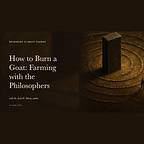
Dr. Moore is an Associate Professor of Philosophy and Great Texts at Baylor University and the author of How to Burn a Goat: Farming with the Philosophers. Today, Dr. Moore joins Ross to discuss the connections among philosophy, the Classics, theology and farming, explaining how Wendell Berry inspired his decision to become a farmer, and exploring how great works like Dante’s Divine Comedy remain relevant in modern life.
Dr. Moore challenges us to rethink our notion of labor, describing the rewards of problem-solving with our hands and engaging in activities like gardening or woodworking—as opposed to just buying the things we want. Listen in for Dr. Moore’s insight on making leisure more intentional and learn how Christian thought and the Classics can help us cultivate a sense of gratitude and initiate meaningful conversations about what really matters.
Resources:
Dr. Moore at Baylor University
How to Burn a Goat: Farming with the Philosophers by Scott H. Moore
The Divine Comedy Volume I: Inferno by Dante Alighieri, translated by Mark Musa
The Great Courses: Dante’s Divine Comedy
The Problem of Pain by C.S. Lewis
Good Clean Fun: Misadventures in Sawdust at Offerman Woodshop by Nick Offerman
The Unsettling of America by Wendell Berry, narrated by Nick Offerman
Joel Salatin on Reversing Climate Change EP072
Quill Robinson on Reversing Climate Change S2EP18
Leisure: The Basis of Culture by Josef Pieper
Sorry, ran out of space! Will update these notes with the full list when room is expanded.
Full Transcript
Ross Kenyon: Hello and welcome to the Reversing Climate Change podcast. I’m Ross Kenyon. I am the lead strategist at the Nori Carbon Removal Marketplace. Today I have with me Dr. Scott H. Moore, Associate Professor of Philosophy and Great Text at Baylor University and author of How to Burn a Goat, Farming with the Philosophers. Hi, Scott. Good afternoon. Good afternoon, indeed. Thanks for being here. I really liked your book. It caught my eye. How could it not? Talking about farming, talking about philosophy, and also the goat burning.
Maybe that’s a good place to start. What is with that title?
Dr. Scott H. Moore: Well, it comes from an episode. It’s the first story in the book about one of our goats that accidentally died, got her horns caught in some feed buckets. And it was fairly early in our farming adventure. And we had to figure out what to do with 150 pound dead goat. And we ended up burning it and it was food for thought.
Ross Kenyon: Yeah. How did you find yourself in a position to have to care for a late goat? How does this happen to someone?
Dr. Scott H. Moore: We had long enjoyed being in the country and we had dreamed of living in the country for a long time. And I’ve been reading Wendell Berry for 25 years. And as I sometimes said, you know, you can only read Wendell Berry for so long before you finally give in. And we moved out to the country.
Ross Kenyon: Yeah, that’s a good line with Wendell Berry and certainly true. In the last couple of weeks, I read The Memory of Old Jack and Remembering. And I always say that the Port William novels are just distilled nostalgia. Yeah. Like the times gone by of the family farm in that era. And they’re also mournful, but they’re beautiful books too. I really like existing in that world. Sometimes I don’t even remember what happens in a particular book. I just remember the way it made me feel.
Does any of this connect with you?
Dr. Scott H. Moore: Yes, it certainly does. I mean, I love those books, especially Remembering. I think it’s an extraordinarily powerful book. As a professor of not just a philosophy, but of great texts, I teach Dante’s Divine Comedy regularly. And that’s the Dante book that starts in hell and moves through purgatory and has a kind of vision of paradise at the end. So I love those books. I’ve been writing and thinking about Barry for a long time, and I’ve read and reread these books, most of them many times.
Ross Kenyon: Wow. I did not make the Divine Comedy connection, but I recently finished. I was reading a canto or two a day through all three parts, and I finished it, I think, about a month ago. Wonderful. Yeah, it was my first read-through. I read the Mark Musa translation. I don’t know if you care for that one or not.
Dr. Scott H. Moore: You know, it’s a very good translation, and I have used it. It’s not one of the ones that I use now. We’re going to get into this. I’m so happy that you dropped that so close to the surface.
Ross Kenyon: I know classics people, they’re always trying to say, trust me, they’re still relevant, and no one believes them, but... Dammit, Scott, I want to believe, and we have to find a way to make this relevant. So we can get into that, unless you feel the need to immediately respond to any of that.
Dr. Scott H. Moore: For someone to pick up the Divine Comedy and start reading it, it presents some enormous challenges. And some of those are just the fact that it’s a It’s a poem in 100 Cantos, a poem written in the 14th century about Italian politics and Catholic theology. So there are all kinds of barriers that someone might find. But as soon as you get into it and you begin to realize what’s happening here, you realize that it really is a timeless story. Of a man who has lost his way.
He’s lost his way and he can’t find his way back precisely because of his own vices, his pride and his greed. And he needs to return to where he came from. He needs to return to those teachers and those texts and those beliefs that made him who he was. And it’s a journey through hell and purgatory and all the way I was just teaching it with some students, and we were talking about the very end of the Paradiso, in which Dante has this vision of, at the very end, Canto 30 of the Paradiso, he’s meeting, Beatrice points out the spot where Henry VII, who will be crowned the Holy Roman Emperor, is going to sit in the Empyrean realm, and the kind of tensions Between the various levels of government and authority that we all find ourselves in.
And I was just thinking about the last few weeks with COVID. You know, we’ve got governors arguing with the president. We’ve got mayors arguing with the governor. You know, who has authority? Who’s responsible? Who’s going to solve and address these problems? And how does our own spiritual health and pride deal with our Rather tenuous relationships with the various levels of government that we have to experience. I mean, that’s Dante’s problem, and it’s the problem that’s on the CBS News tonight. So...
Ross Kenyon: Yeah, that book is surprisingly political. And I remember seeing, I forget which canto it is in Inferno, but it’s the one with simony, which is the selling of church offices. But a whole slew of popes are pushing each other down, one on top of the other one. I’m like, wow, this is the Middle Ages and you’re depicting popes in hell. Are you not concerned at all? But I don’t know. He hates Boniface, though. That’s no secret, right?
Dr. Scott H. Moore: Yeah, no, that’s exactly right. But it’s 200 years before the Protestant Reformation, and he’s addressing precisely some of the same things that the Reformers addressed, which are the selling of religious goods and services that we find.
Ross Kenyon: Yeah, I thought that was really quite something. Although I feel a bit pedestrian because I did prefer – I preferred Inferno to Purgatorio and preferred Purgatorio to Paradiso. I know that’s like the least erudite way to prefer them, but I loved all the – so the Contra Posse for the listener, I’m sure you know this, but – But for the punishments in Inferno and even in Purgatory, it’s supposed to be like an ironic twist on it. And some of those I thought were so beautifully poignant and sad and funny.
I feel like I got a lot out of it. I think it would be interesting just as a secular reader. I think you could still get quite a lot out of those for living a good life to this is me desperately trying to make this relevant. There’s good things in there, too, if you are not a devout Catholic reader in 2020 to still appreciate it.
Dr. Scott H. Moore: I hope so. Yes, I mean, there’s no question about that. I think those of us that are Christians, we find a special relevance here, but it’s not for nothing that it is one of the four or five most important books in the Western canon for people of all faiths or even of no faith.
Ross Kenyon: I guess now that I have you here and we’re already talking about it, I can ask a question that I’ve had. Do you know that famous line? I think it’s from The Problem of Pain by C.S. Lewis, his famous hell is locked from the inside. Are you familiar with that?
Dr. Scott H. Moore: You know, it’s been a long time since I’ve read The Problem of Pain, but I think I know what you’re talking about. I don’t remember the exact quotation.
Ross Kenyon: Yeah, yeah. I’ll try to put it in the show notes or pull that section out if you’re listening and you’re curious. But C.S. Lewis has a famous section about how hell isn’t just a punishment imposed upon a sinner. Hell is like a sinner who has locked God out of one’s life. And there is a section in Inferno that reminded me of that. And I want confirmation or disconfirmation of that. I think it’s Farinata. I think that’s his name. But Dante is talking to him on his level in Inferno.
And this guy is insistently wanting to know which family Dante is from and trying to play this one-upsmanship. But he’s literally being tortured for eternity, cut off from God, cut off from all hope. And he’s still playing this status game and seemingly is oblivious to the fact that he is actually in hell because he’s so self-involved. I could not get over that. Is that an accurate reading, Scott?
Dr. Scott H. Moore: Well, yes, there’s probably a little bit more that we could say about Ferranata dell'Uberti. But the main point that you’re pushing here that’s consistent with what Lewis said is absolutely right. Hell is God giving people what they want, which is separation from God. And the contrapasso, the notion that we have here is that the sins are their own punishment. So if I’m an angry person and my life is characterized by wrath, Then it’s that very wrath and that very anger which is the source of my own punishment, and not just in the afterlife, I mean, even right now.
By contrast, the souls that we meet in Purgatory, we meet Manfred, who was a really bad guy, and some others. And what’s clear is that it’s just one tear, one Maria, he says. One tear of remorse is enough for one to be saved. The implication, of course, being that those that are in hell shed not one tear of remorse. So, you know, and there’s a deeply contested question here about the reality or the goodness or the truthfulness of eternal punishment in hell. But Dante’s point is that hell is God giving people what they want, which is separation from God, and that our punishments are our own sins.
I mean, what it is that we do.
Ross Kenyon: Yeah, that’s interesting. That’s probably my read of it, too. One other interesting thing about Dante, I swear we’ll go back to something adjacent to climate soon. Well, if we’re talking about hell, there’s a lot there for climate. Oh, yeah? Oh, take us there, then. I was going to go somewhere in another direction. Let’s go there. I just meant temperature. Oh, God. Is it that simple? Wow. Very superficial read, Scott. I’m disappointed. Scott, where would you say your interest in philosophy and classics and theology, where does that meet with farming?
Which one drives the other? And how did you make these connections here? What we just talked about with Dante, is that just something when you’re out there riding around on your mower or taking care of cows and chickens and goats? Or is there something deeper going on?
Dr. Scott H. Moore: Well, you know, it’s a little hard to always know. I think that most of us are prone to certain sorts of self-deception all along the way. I tell my students that philosophy is just thinking hard about life. And etymologically, it’s the love of wisdom. And one of the things that the farm does is it presents a reality to us that is not easily manipulated into a kind of consoling fantasy. The animals have to be taken care of. The gardens have to be tended. You have to have rain.
You have to take care of these things. It’s a reality which stands over against ourselves. And therefore, it leads itself to lots of connections with reflection on how best to tend this and how best to take care of these matters. And those are all deeply philosophical questions when we begin to think about what does human flourishing look like and what kind of life should we live? When you add to that, that the farm is a great laboratory for the integration of knowledge. I mean, biology, economics, chemistry, geology, politics.
I mean, all of these things come together in the context of the life lived amidst the fields, cultivating The agros, that’s what agriculture is. It’s ripe for philosophy and for philosophical reflection. So I think it’s right there. I think it’s, for me, it’s hard to do this kind of work without allowing my mind to reflect and to contemplate what’s significant, what’s of value, how to solve very particular problems, but also where the significance of solving this problem lies. I think it comes together in lots and lots of ways.
Ross Kenyon: Yeah, I like that too. And I’ve been thinking quite a lot about crafting lately and how much of my life do I want to purchase versus participate in more actively. And I find I enjoy my life more when I am more involved in it. There’s something about just ordering stuff. Granted, I love the dopamine rush as much as anyone of getting a package and shopping. But I’ve been trying to focus on what I can actually do. I was reading Nick Offerman’s book on woodworking recently.
Do you happen to know him by chance? I’ve seen him on shows and I have read some things that he does, but I certainly don’t know him personally. Yeah, that would be cool if you did. Well, he’s a huge Wendell Berry fan. In fact, he reads on Audible, The Unsettling of America and another book of his actually I was surprised to see the other day. But yeah, he calls Wendell Berry his favorite author and a great book on woodworking. And it definitely inspired me to dive back into some unfinished projects and to do that more seriously.
I think he might be quoting Wendell Berry about how the unifying of intellectual labor and the problem solving with your hands is this like humanity’s sweet spot. And I think we’ve erred so far into just... You know, cogitating, writing, reading, banging on keyboards that I don’t think a lot of people really experience that unification that for me, it feels like coming home. It feels like really rewarding. I’m sure it feels like that to you, too. But I’m not sure people are experiencing it nearly as much as maybe they’d like to.
Dr. Scott H. Moore: Well, they’re not experiencing it as much as they could precisely because in most cases they’ve been given a vision that labor is something to be overcome. Wendell has a wonderful line in which he says that we have made labor We don’t fit for nothing then to be avoided. We don’t recognize the goodness that comes from this. And we don’t value people who are engaged in this kind of labor. And so there’s a corrupting mechanism that follows from this. We look down upon people that are engaged in physical labor as if it weren’t valuable when, of course, none of us would be here if there weren’t people that were in fact engaged in precisely these kinds of things.
And one of the things that we very quickly discovered And I think that there is a lot of work, but it’s extraordinarily valuable work. To the life cycle and the ways in which we are dependent upon the rain and dependent upon the seasons and how these things change, we are all thoroughly corrupted by being able to go to the grocery store and buy watermelons and The middle of the winter. And we don’t think about the fact that those watermelons had to be stuffed full of chemicals to be shipped 2,000 miles to get them to us.
I mean, so we’ve just become accustomed to a certain kind of convenience here that most of us have never thought about. And if we really think about it, we realize that a watermelon that you eat in January It tastes like it’s traveled for 3,000 miles filled with all kinds of chemicals as opposed to waiting for summer and waiting for that time of the year when this is an appropriate reward for the kind of work that’s done. And better yet, got a little bit of a spot. You can grow your own, and you don’t have to have any land.
I mean, if you’ve only got an apartment and a sunny window, you can grow some cherry tomatoes. If you’ve got a patio, you can grow tomatoes, peppers, and onions, and all of a sudden, you’re in the salsa bag. And that may not be the very best salsa that you’ve ever had in terms of what you might buy from a store, but it’s going to taste the best to you because you grew all of those products and you participated in that cycle and you began to understand these things.
I mean, I think that these kinds of habits, these ways of being are absolutely formative for the kinds of people that we can become. Merely because I had enough vegetables to make a couple of jars of salsa, but because I’m participating in this process and now I’m thinking and I’m attuned to the changes that are happening in the world. And rain is no longer something that inconveniences my weekend. It is absolutely essential to the preservation of humanity.
Ross Kenyon: A lot of beauty in those statements. So you think being involved in craft to some degree means a more present orientation or an increased capacity for being present and taking pleasure individually? And, you know, quotidian living, I guess you could say. Absolutely. Absolutely.
Dr. Scott H. Moore: I mean, I don’t know what kind of craft work you do, Ross, whether you do some woodworking or some leatherworking or, you know, whether you’re, I mean, you’re cooking. I mean, all of these things that we engage in, they’ve been diminished because we’ve moved them into hobbies rather than thinking of them as characteristic of our lives. You know, I mean, if you’re into woodworking or you’re making some things here, that piece of furniture or that, you know, maybe, you know, it’s an ornamental piece for the kitchen table or for the cabinet.
Your life has gone into that and you know about the shape of the wood and you know about how many times you had to sand it and how much involved and what goes into that. A world where we just, you know, point and click and get something else from Amazon. Those things get thrown away when they break and wear out, which of course they will because they’re not designed to last because they want us to buy another one. And yet when we begin to participate in these things, we are transformed.
I was listening to your interview with a wonderful Virginia farmer. Joel Salatin, and you were talking about the Michael Pollan piece. And one of my favorite Michael Pollan quotations comes from one of his TV shows in which he’s talking about food preparation. And he says, some people think that cutting onions is an inconvenience and an obstacle to real life. But cutting onions is actually real life. That’s really where it is. Yeah.
Ross Kenyon: Wow. You’re clearly quite passionate about this. And I’m newer to this. Did this take you a lifetime to learn? Or did you kind of already know this before you wanted to get a farm? Or maybe is this why you wanted to get a farm to begin with?
Dr. Scott H. Moore: You know, it all combines together, Ross. I mean, you know, you have kind of an idea about something, and you have role models, and you have people that you emulate and you look up to, and you’re frustrated. I mean, you see sort of how things go, and so you try a little bit of this. I mean, our first... Our first gardens were in fact in the suburbs and they were exactly salsa gardens. It’s because I like hot peppers and growing some jalapeno peppers in our part of the country is about the easiest thing in the world to do.
You can hardly go wrong with it. And then you begin to experiment with a few other things. You try some hybrid tomatoes and then you try some heirloom tomatoes and you begin to learn the different kinds of varieties and then You know, the bugs come and they kill them all and you have to start over again. Well, that’s all part of the learning process. And it becomes exciting. I have told lots of people that our little farm is a thousand and one science fair projects.
There’s a kind of curiosity about the world and what’s going to happen if we do this and what can we learn from this situation. It’s great fun. I mean, but it’s also extraordinarily rewarding.
Ross Kenyon: I don’t doubt it one bit, even from my much smaller scaled down urban homestead model. I remember reading something about how the word amateur used to be a compliment and how it used to be this great thing when in the early days of baseball as a national spectacle, people who were amateurs, that was like a point of pride. And there’s something about once the big money started changing hands, it sort of changed it A little bit. Do you know the story or like the philology of amateur and how that changed over time?
Dr. Scott H. Moore: Sure. It comes from amour. I mean, to be an amateur is to be a lover. Yeah, that makes sense. With whatever it is. You do it for the love as opposed to doing it for the pay.
Ross Kenyon: Yeah, I can see that. I am not good at all of the things that I do. I have been making bread, sourdough and otherwise for a while. I’m just, I’m not a good baker and I keep trying because I think it’s fun and I like learning from the microbiology and chemistry of it. I feel like I get, there’s something about it that I just like doing, but even if people are bad at their crafts that they’re practicing, I think it’s just good for us. I feel better and more I think that’s absolutely right.
My wife is a really fine baker and she makes bread almost every day. We really don’t buy
Dr. Scott H. Moore: bread anymore. It’s wonderful. It’s sort of like everything else. Once you kind of start going down this road, A, you’re going to get better at it, and you’re going to realize how gummy some of that stuff that we were buying at the grocery store was. It’s perfectly formed, and it’s perfectly cut, and it goes into the sandwich bag very easily. And maybe it’ll, not maybe, it will certainly last longer on the shelf than our homemade bread. But it doesn’t begin to compete in terms of the taste, especially when it’s hot.
And it’s not, and you lose that rewarding capacity of participating and engaging in just this task.
Ross Kenyon: Do you think... In some measurable ways, we as a society in the United States have become just more specialized as time has gone on and we’ve lost this ability to fluidly move between, yeah, 1001 science fair projects, as you said.
Dr. Scott H. Moore: Well, I think that’s characteristic of affluent societies. I mean, we have gotten to the place. I mean, we... Where in most cases, when we want something done, we make it happen by purchasing it or buying it or by hiring it or by renting it. And we become accustomed to thinking about those kinds of things. And there are certainly benefits to that. I mean, this last week we had a little plumbing problem and I think I made about four or five trips to Lowe’s and Home Depot to get the right part and to take back the wrong part and then the part that I broke and then well I mean I’m sure it would have been a lot easier to hire a plumber and maybe if you come back to me next week when I have a flood you’ll say hey you should have hired that plumber but for a small project like this It’s important, I think, to be able to say, okay, I can figure this out.
We’re not averse to technology here. We can look it up on YouTube. We can see how people do these things. Now we participate in the process. If we learn to do this now, well, maybe we’ll be a little bit better next time. I think that’s an important part of cultivating virtues of sustainability and self-sufficiency in these ways. And certainly during a time of pandemic, it’s very important for us to be able to begin to take care of some of our Newton.
Ross Kenyon: This has come up, I think at least once before we did one with Quill Robinson of American Conservation Coalition, which is a conservative environmental group. And we ended up talking about founding of the United States and about this idea of Republican virtue. And in order to have democracy, you need a well-educated citizenry and they need to be The dream of people like Thomas Jefferson in particular was that you’d have these independent human farmers who are small landowners who were, you know, they would farm by day and read about Rome in the evening, basically.
And I don’t know that we, if you swap out Rome for true crime, then we do have some of that. But I don’t know that we are approximating that goal as a citizenry, perhaps. Maybe you’re seeing something different from me. I don’t know.
Dr. Scott H. Moore: You’re absolutely right. I mean, we haven’t, and that’s largely because it hasn’t been modeled for us, right? It’s not a part of our imagination to imagine that’s something to aspire to. In most cases, I mean, life is hard, things are expensive, and a lot of us are tired. And the last thing in the world that we think about adding to our day Is, okay, well now we gotta make bread. Or I’m gonna go out and dig potatoes. Or read Homer. Or read Homer.
Because we’d rather sit there and watch Netflix. Well, there’s a similarity, right? I mean, both of them are in fact entertaining and can be inspiring in all kinds of ways. But our culture has implicitly taught us to try and... That leisure means... Not working. And that’s a kind of complicated story, but that’s not the best way to think about leisure. And it ends up being corrupting in a certain kind of way where I just try and get out of work. Well, we are tired and life is expensive and we do enjoy and desire our entertainments, but it’s a false model to think That my entertainments should entirely be passive, where I just sit there and take it in.
Ross Kenyon: Yeah, I don’t think we would blame anyone for indulging in that. Maybe there are some people for whom this is... Not laudable. I think a lot of people, yeah, they’re just, you know, if you don’t make a lot of money and you’re tired and life is hard even under the best of circumstances. So I don’t know that we’re trying to cast aspersions or anything there.
Dr. Scott H. Moore: Well, no, of course not. I mean, and lots of times we haven’t been inspired to read Homer or to read Dante or something like that. And no one has ever convinced us that it’s worthwhile. And it is, in fact, a lot of work. It’s more difficult. But to recognize that it’s worth the effort to put in, you’ve got to be equipped to do that. And that’s very difficult and very challenging in a world that is frequently not committed to those ideals. And it’s unable to pass on either the skills or the inclinations to engage in those kinds of endeavors.
Ross Kenyon: Oh, sure. I feel very lucky or privileged to be able to indulge in those sorts of activities. I absolutely feel like my relationship to the concept of leisure has changed. I think multiple essays of yours in this book do great. I’m going to do a great job of addressing this, both doing it and getting it done and the one or ones that Joseph Pieper’s Leisure the Basis of Culture come up. But if I’m tinkering around the house or I’m managing my compost heaps or gardening or pruning roses or checking out my sourdough proofing, All of those things I find, uh, pleasureful and they’re, they’re laborious, but I also had a serious plumbing challenge that was just within my ability to deal with it much like yours.
And I had to go, I think three or four times to various plumbing stores and I eventually figured it out. And, oh, it was, I don’t know. I, you probably felt a great deal of pride, didn’t you? You’re not a plumber, but you, you sort of learned, you solved a problem. It’s a great feeling.
Dr. Scott H. Moore: Yeah, yes. It’s a great feeling. And also, there’s a little bit of apprehensiveness. Did I do this right? Is it going to last? Yeah, that’s spooky.
Ross Kenyon: But you might even qualify this as a form of leisure for you. Did that feel like leisure? Or how exactly are you using this? That did not feel like leisure to me. My plumbing did a little bit because I felt like intellectually stimulated and I got something done. So I got to check something off of it. But I think it was elective. I probably could have just called someone and then spent my time watching Netflix, but I didn’t. Is that leisure? What do you mean by that, I guess, in general, too?
Well, before the interview started, or maybe I’m not supposed to say that. You’re going to break the fourth wall on us, Scott? I don’t know how you feel about postmodernism. You cannot acknowledge that. It stays inside the text.
Dr. Scott H. Moore: Okay, there’s another whole set of conversations here. But we’re talking about Pieper’s wonderful book, Leisure, the Basis of Culture. And Pieper, Joseph Pieper, a great German Catholic philosopher of the last century, He does not mean merely the avoidance of work. He also doesn’t mean working hard and just valuing it. He means that intentional cessation of the work that we have to do with an eye toward attentiveness to the world around us and to the capacity to reflect upon that Which attention brings to us. And so, you know, there are lots of tasks that we engage in that as I think about them, I begin to reflect on what’s at stake.
But leisure is actually those times in which I stop from Digging the fence posts for the new pigsty, and I watch the pigs, and I reflect on their extraordinary intelligence and the life that is given to these magnificent And what my relationship is to them and how it is that I should go about thinking about them, even the ones that I’m going to process that are going to end up in the freezer someday. There is a connection here, the recognition that we feed them and they feed us, and that cycle of life that’s involved here Is crucial for sort of understanding the tasks that come in the farm and those that come in our outward life in all the many ways in which we are engaged by the world and its challenges.
Ross Kenyon: That’s a lovely overlap when you can find that sweet spot and that mix there. What’s the link between that understanding of leisure and Christian thought? Because where does that overlap happen?
Dr. Scott H. Moore: Well, I’m a Christian, and I think it’s the most natural of ways for there to be an overlap, because I understand my life as a life that has been blessed by grace, and it is not of my own sort of achievement here. And my opportunity is to be a steward of the gifts that I have received, both material and spiritual and emotional and intellectual. And so there’s a great sense of gratitude that emerges there. Gratitude not only of my family and friends, but of my students and of the various institutions that I’m involved in, including church and ultimately and finally to God.
And I think that if we look at the history of Christian thought and Christian theology, one of the things we find are enormous resources for reflecting on precisely what this sense of gratitude is and the way that it transforms me From sort of who I have been to who it is that God wants me to be and how I can be a good steward precisely of those gifts. I think that it’s the most natural thing in the world. Now, of course, the church is filled with tragedy and with culpability, and ours is not a story that is free from blame.
Far from it. A pilgrim story. It’s a story of going forward, of attempting to be faithful amidst the challenges that we find ourselves in.
Ross Kenyon: Yeah, there’s quite a lot there. That spirit of leisure, as you described it, and gratitude seems quite, for lack of a better term here, in vogue. But there doesn’t seem to be much representation of Christianity as being present-focused. Most people, when they think of Christianity, probably think of either past sins or what happens after you die. I don’t think there’s a lot of room in there for actual presence-centered engagement with your work in a meaningful, biophilic life environment. I think it’s a great tragedy that Christians in all ages would have focused only on the life to come or only on the present life.
Dr. Scott H. Moore: Christ says in the Gospels, I came that you might have life and have it more abundantly. And that abundance of life is not about material possessions, what the health and wealth gospel would want to say, but the fullness of all that life can be. And it was never merely about what happens after one dies. We were talking about Dante, and I think that many of the great Thinkers in the church would recognize that the life that one lives with God after one dies is a great mystery in all kinds of ways.
The goal of the Christian life is not fire insurance. The goal of the Christian life is fellowship with God. The first question of the Westminster Catechism, I’m not a Presbyterian, but it says, what is the chief end of man? It is to glorify God and enjoy Him forever. And there is a joyous character that should characterize our lives here. And so we’re cutting ourselves off with at least half of what the Christian life is if I think that it’s only about sort of trying to stay this side of some kind of imaginary line so that I can get into heaven and avoid hell.
That’s to completely miss the point.
Ross Kenyon: Hmm. Yeah, and those afterlife questions too, I’ve read this like Gregory A. Boyd stuff on annihilationism too, or like David Bentley Hart’s basically everyone gets in. And then I’ve also, even in Dante, there’s not only mythologicalism. Psychological figures in various realms of the afterlife, but also pagans, some of which were rescued in the harrowing. It’s like Old Testament figures got rescued when Jesus was crucified and before he was resurrected, if my understanding is correct. But even Dante is sort of, I don’t know how much liberty he’s taking with theology there, but that’s definitely in the mix.
Yes, I think you should change the name of your show to The Divine Comedy Revisited. I’m just an opportunist, Scott. I just wait for it. That’s great.
Dr. Scott H. Moore: You know, that’s one of the really longstanding questions and important issues. The connection between the Greek and Roman mythological world, pagan philosophy and pagan literature, and the rich Christian traditions, Christian theology and Christian literature, we find those integrated and merged and indoctrinated. He will refer to Christ as Apollo. He will speak of the rebellion against Jupiter or Jove by the giants as like unto the rebellion against God. So we find this kind of integration all the way through the Comedia. And we do, in fact, find some unlikely people in various places.
I mean, the first and foremost of the unlikely people that we encounter is That is Cato, guarding the slopes of Mount Purgatory at the very beginning of the second canticle, Purgatorio. Cato is not a Christian. He’s a virtuous pagan. He should have been in limbo. He’s a suicide. He should have been in the realm of those who commit violence against themselves. And he was an opponent of Julius Caesar. And Dante puts Brutus and Cassius at the very pit of hell with Judas as among the most damned of all those.
And yet here is Cato on the slopes guarding the beaches of Mount Purgatory, and scholars have for Centuries speculated about why Cato is there, and there are obviously lots of reasons here, but perhaps none of them are as persuasive as just the recognition of the inscrutable grace of God, that whatever it is that God is up to is above and beyond our formula and our Narrowness of vision that we have here. Cato shouldn’t be there, but Cato is there, and he’s there because of God. And so we find these kinds of instances throughout the Commedia.
Ross Kenyon: Yeah, I thought that was a really nice unexpected touch in Dante because most of the people I know, now that I’m older, I know a fair number of theologians and many of them are quite silly and open-ended and just genuinely fun to speak with. But I think when most people think of people who are serious about religion, they seem... Stead, kind of scary, inflexible. And it’s fun that Dante carves out such a strong space for the inscrutability of God as a Christian. There are rules that are operating that words cannot convey.
In fact, I forget which canto it is in Paradiso, but words just start to fail, right? It’s just sort of like, yeah, I’m trying. I’m sorry. I don’t know what to say. No, that’s...
Dr. Scott H. Moore: That is certainly the case. I mean, over and over again, Dante the character will say in The Paradiso, I can’t do justice to what it is that I am seeing here. You know, you talk about the seriousness and the silliness. I think about G.K. Chesterton. I mean, Chesterton’s wonderful line that it’s easy to be heavy. It is hard to be light. Satan fell because of the gravity, the heaviness of his character. And when he recognized that Chesterton himself probably weighed 300 pounds, you see the joke and the good self-sense of teasing here.
This notion that we are inclined to a certain kind of seriousness such that we miss some of the joy that comes from the easiness, the lightness that comes from our lives. But that’s a wonderful, wonderful gesture to learn.
Ross Kenyon: Yeah, I hadn’t heard that one. That’s quite interesting. Well, what should someone listening think about? Not just Dante, but great books, Western canon, the classics. What should they think? And what is the overlap with climate change? The stuff with farming and philosophy, this is par for the course for the podcast. In fact, a fan made a bingo card for the show, and Wendell Berry was just his own square. Whenever Wendell Berry gets mentioned, you put a token down. So... We’re familiar with this.
Great books are not as present here. And I’ve been trying to find a way in, as I mentioned. What is the connection with climate change? Or how might we make this, Dante and others, relevant to stuff that we care about?
Dr. Scott H. Moore: Well, that’s a huge question, Ross, and I’m not sure that I know the answer here. I mean, I think I would say that first of all, you know, great books aren’t a thing. You get a bunch of smart people together and ask them what the great books are and they’re not going to all agree. And so we recognize right off the bat that Reading the great books is not a bucket list, right? It’s a way of life. It’s something that you’re engaged in. And things will come on and off the list depending on sort of where we are and what we’re thinking about and where our life’s situations are.
But the reason that people have been reading Homer for almost 3,000 years are listening or thinking about this is because of its perennial value, the fact that there’s something about the human condition that speaks to us. We’ve been talking a lot about Dante. This book was written in the early 1300s, the 14th century, right? So, I mean, we’re 700 years away from this book, and here we are on a podcast through computers on the internet talking about this guy that was kicked out of his town. Because of political entry and writes this incredibly long and challenging poem, 700 years later, there’s got to be something here or people wouldn’t keep coming back to it.
It’s because of the recognition that there’s nothing new under the sun. And we continually find ourselves addressing these perennial human questions. What is happiness? And what should my life look like? And who can I count on? And Is there a God? And if so, what does this God require of me? And how do I take care of those that I love? And why do bad things happen to good people? These questions do not go away. And they’re the questions that the great books answer and address over and over again.
And we begin to recognize that they transcend historical time. They transcend history. They transcend race. They transcend religion. That’s why we keep coming back to them over and over again. And it’s why the list is always changing and always growing and things that we’re discovering and seeing that we’ve perhaps never seen before. I usually say I like reading books inside of this broad Western tradition because it’s like being part of a multi-thousand year book club. The thing is, you know, there’s a lot of reflection in the conversation that these texts are written by dead white European males, and there’s a very limited and skewed perception of place in society, and they’re giving You know, there’s a lot of truth to that.
It’s also the case that those societies were geared in such a way that many, many people from society didn’t have access to the education or to the opportunities. These are important things to think about and to talk about and to find the voices and to listen to them. That doesn’t mean that somehow or another those other voices have to be eliminated or not taken seriously. One of the things that we very quickly discover is that there’s a great deal more diversity than we might have imagined. St.
Augustine is an African. Dostoevsky is a Russian. Cervantes is a Spaniard. I mean, these are very different cultures, very different worlds, and they shouldn’t all be sort of looped together as if it were just sort of Western civilization were one thing. It’s not one thing by any stretch of the imagination. To the extent to which we have the opportunity and the occasion and the talent to be able to integrate Eastern authors, we need to do that as well because there’s a great deal to be learned here.
I have a colleague who regularly teaches Confucius' Analects with Aristotle’s Ethics together in this sort of picture, sort of Eastern and Western picture of what human flourishing looks like. And it’s a powerful course he teaches here because we’re talking about the human spirit. Talking about what does it mean to be happy as a human being? So I think that these books open up this conversation for us. They open it up in a way that allow us to have that meaningful conversation about matters that matter. And they’ve been doing this for hundreds and hundreds of years.
And we get to be a part of that conversation.
Ross Kenyon: That’s a very good way to put it. And that’s also what attracts me to reading the Analects of Confucius or read the Upanishads or the Bhagavad Gita or the Dhammapada or any of those texts from the Indian subcontinent. Those have also been read by so many people and been so influential in those societies and to a lesser extent to European and American ones. But there’s a line from Paul Theroux’s The Mosquito Coast. Granted, this is said by the insane father who leads them on a mission into the jungle.
But he says he read the Bible to understand Western civilization’s operating system. And it’s sort of like core software and see where it went wrong. And that’s part of it, too. I like understanding that these were influential on people who made important decisions and helped shape the world that we inhabit today. I found that Chesterton quotation.
Dr. Scott H. Moore: Can I read the whole thing? Oh, yeah, go for it. This comes from Orthodoxy, and here’s the claim. He says, Pride...this is Chesterton talking about pride and seriousness. He says, Pride is the downward drag of all things into an easy solemnity. Seriousness is not a virtue. It would be a heresy, but a sensible heresy, to say that seriousness is a vice. It is really a natural trend or a lapse into taking oneself gravely because it is the easiest thing to do. For solemnity flows out of men naturally, but laughter is a leap.
It is easy to be heavy. It is hard to be light. Satan fell by the force of gravity. So wonderful Chesterton quotation there.
Ross Kenyon: Yeah, that guy could turn a phrase. That’s very interesting. Whenever I am engaging with religious work, I always feel gravitated a bit towards more mystical interpretations of it. I think there’s a lot to like about Quakerism. I like that there’s not a strong doctrinal element of trying to specify ahead of time. Or even in Catholic Mass, I like that they’ll say, let us prepare to celebrate the sacred mysteries. You’re just like, oh, it’s a mystery? Like, it isn’t all totally worked out? That being said, I don’t know how they square that with something like the various creeds that they recite or profess, I should say.
What does it mean for it to be a mystery, but then you also have all these creeds where you say all the things that you allegedly know? How does that work? Is this too far afield, Scott? Well, it’s not too far afield, but it’s going to make your show a lot longer. Oh, no.
Dr. Scott H. Moore: We might have to, if we’re going to integrate the joyful mysteries and the sorrowful mysteries with the creeds, we probably need to have our own show for that. I mean, the credo is just Latin for I believe. And these beliefs are a confession of faith. And every confession of faith also involves mystery, right? Because there’s a limit to what we can and cannot know. And in the case of when the Catholic speaks of the joyful mysteries or the sorrowful mysteries as part of the rosary, I mean, they are in fact reflecting on those aspects of Christ’s life and of the teaching that we have here that defy our capacity to put them in a box, to understand these things.
But that doesn’t keep me from being able to say, I believe X. And I confess that belief with other people through the ages. Transhistorical, transnational, transracial, all of these things go beyond. They are something that I have with all believers through the ages. And so, you know, the idea that I would believe something and yet there would be mysteries to it is not at all mysterious. It would be really mysterious if I claimed that I knew everything about any of the things that I claimed I know, whether it’s on the farm or in my profession or in my marriage or even with regard to my own self, who it is that I am.
There are inscrutable mysteries as we try to understand these matters. Yeah, I wonder if that’s something that maybe to a pre-modern mind was totally natural. And given that we live in the era that we do, it just strikes the ear a little bit different. Yeah, I’m sure it does, but it’s a kind of falseness. And I think that your show is a particularly good place to expose this sort of falseness because there are lots of people that think they know all that there is to know.
I mean, you think about all of these climate change deniers who think that because they’ve got a little bit of data, they can extrapolate from that as to what... What must be the case or what is not the case or something along these lines? There are always mysteries. And yet in the midst of the mysteries, there are certain things that we can’t not know and that we can’t not see to be the case. And so we confess those things and we seek to understand what we don’t know.
And sometimes we bump up against the limits of knowledge. There are things that we can’t know here. But our age, the age of the point and click, the age of the pocket computer, the age of Wikipedia, lives under the fallacy that anything can be known and known without effort. And that’s just not the case.
Ross Kenyon: I’m so glad you said that. You brought us all the way back to where we needed to end up. Scott, thanks for being on the show. Well, Ross, thanks for having me. I appreciate the invitation, and I’m so glad you enjoyed the book. Oh, it’s great. Yeah. If you’re listening, the link is in the show notes, How to Burn a Goat, Farming with the Philosophers. Plenty of good questions, lots of good analysis, some funny anecdotes. It will definitely make you want to do as much or as little as you can with the amount of space that you have available to you.
I did that for me. So yeah, well done, Scott. You made me have more farmer envy. Well, if you’re ever in Texas, come on down. Love to have you here. Yeah, that’d be great. If you’re listening, thank you for being a fan of the show. I hope you like this sort of, I don’t know, quasi-esoteric turn that this took. If you want to talk more about these books, I would love excuses to do so. So if you feel strongly about it one way or the other, feel free to reach out at podcast at nori.
com. Rate and review us on iTunes, Apple Podcasts, Stitcher. Tell your friends and thank you so much for listening. Thank you so much for listening. If you like the show, please rate and review it in Apple Podcasts and or Stitcher. It really helps us a lot to get this content to a wider audience. If you think what we’re doing is useful, interesting, fun, hopefully all three, we’d certainly appreciate your rating and review. [Nori promotion cut from the transcript. It's still in the audio, but it no longer applies.]
And thank you so much for your support.


