

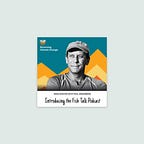

Listen on Spotify, Apple Podcasts or YouTube.
Here in America, we like stories with happy endings. Our media usually comes with a clear message and unanswered questions make us uncomfortable. But Paul Greenberg knows that there’s no simple answer to complex problems like climate change.
Paul is the award-winning food and environmental writer behind titles like The Climate Diet, American Catch, and Four Fish. On this bonus episode of Reversing Climate Change, Paul rejoins Ross to discuss his new podcast, Fish Talk, and reflect on the advantages of podcasting as a medium for open-ended storytelling around complex issues.
Paul describes the homesteading and terrace garden projects he’s working on right now, explaining why he's cautious about monetizing his hobbies and if and how a friendlier form of capitalism might support creatives. Listen in for Paul's insight on how our political system informs the way we approach both storytelling and complex challenges such as overfishing and climate change.
Key Takeaways
[2:33] The themes of environmentalism, eating and catching fish featured on Fish Talk
[7:37] Paul's take on the advantages of podcasting as a medium vs. journalism or documentary filmmaking
[12:40] How happy endings are part of the American capitalist model of storytelling (and why that won’t work for the climate crisis)
[17:03] How Paul thinks about eco-Leninism and how the role of journalism in society has changed
[21:32] Why it's so challenging for the US to reach a consensus on big issues like COVID and climate change
[25:08] How we fixed our overfishing problem in the US (and how that problem compares to the climate crisis)
[27:56] How we outsource our polluting industries to China and what might happen if the Chinese decide they want a clean environment
[29:52] The homesteading and terrace garden writing projects Paul is considering right now
[34:27] Why the idea of a deep meditation on his climate safe acre in the Adirondacks appeals to Paul
[39:37] Paul’s commitment to deprogram himself from the relentless selling he grew up with
[44:01] How a friendlier form of capitalism might support creatives
[45:23] Why Paul likes homesteaders Helen and Scott Nearing’s ideal way to organize a day
[48:42] The danger in monetizing our hobbies
[50:43] How Succession and the Monty Python films successfully critique capitalism and religion
Connect with Ross
Subscribe to the show on Substack @ rosskenyon.com/subscribe.
I also write Carbon Removal Memes and curate Climate Workers Anonymous.
Resources
Paul on Reversing Climate Change S2EP61
Monty Python’s Almost the Truth on Netflix
Full Transcript
Alexsandra Guerra: You’re listening to Reversing Climate Change, a podcast by the team at Nori, the carbon removal marketplace. This is a show about the innovators and entrepreneurs developing solutions to climate change.
Ross Kenyon: Hello and welcome to the Reversing Climate Change podcast. I’m Ross Kenyon. I’m the creative editor at Nori’s carbon removal marketplace. Today I have an alumnus here with me: Paul Greenberg, fisherman and author of Four Fish, American Catch, The Omega Principle, and his latest book, The Climate Diet: 50 Simple Ways to Trim Your Carbon Footprint, upon which we did our previous podcast episode together. But today we’re going to talk about a new podcast that you have come out with, Paul, called Fish Talk. So thanks for being here.
Paul Greenberg: My pleasure. It’s nice to be on the other end of the podcasting universe for a little while.
Ross Kenyon: Yeah. I’m very curious to hear about your podcasting experience. A lot of people ask me about starting a podcast and what it’s like. There’s a lot of jokes about it [unclear]. I’m looking forward to it.
Paul Greenberg: Yeah. Well, I sometimes say the worst part of having a podcast is having to tell people you do a podcast, because I’m a grown man and they go, “Of course you have a podcast, everybody has one.” Well, you know, we were talking before we started recording about our mutual connections to the former Soviet Union. And, you know, I used to work in the former Soviet Union, and so I spent a lot of time in Kazakhstan, Tajikistan, Uzbekistan. So I’ve just been referring to the whole world as Podcastistan. Yeah, I guess it’s sort of — it’s a little bit like a banana republic, you know, where some people have amassed huge fortunes, but the vast majority are peasants tilling the fields, growing cotton with their calloused hands.
Ross Kenyon: So, wow. Okay. So yeah, it’s like Gimlet and Joe Rogan, and then the rest of us by the sweat of our brow out here, right?
Paul Greenberg: Pretty much.
Ross Kenyon: Okay. We’re going to stage a revolution.
Paul Greenberg: Probably not. Probably just talking to the ether. Some full disclosure: my partner, my life partner, was an item with Alex Blumberg of Gimlet, and I knew Alex Blumberg back in the day when Gimlet was just an idea.
Ross Kenyon: Well, how about that. Okay, that’s good that you have that disclosure there, present, just so people listening know.
Paul Greenberg: Well, you know, people don’t want — you know, in academic papers you’re supposed to show your conflicts of interest. That might be right, that’s a conflict of interest. I don’t know that this counts. But yeah, whatever. It’s a fun wrinkle to the story.
Ross Kenyon: Yeah. All right. So Fish Talk though. It’s a great show, I listened to all of it. I really just enjoy these topics, and podcasting is maybe a great venue for this, that maybe are not obviously the most interesting. I know that’s a little bit of a pejorative way to frame it, but really, there’s a lot to talk about with fish. Your books are all super interesting in the same way. There’s a lot of nuance happening within the world of fisheries, and this is a way to explore it. That’s my take on what you’re doing, at least. Is that probably accurate?
Paul Greenberg: Yeah, and you know, in a way it’s kind of directed — you know, when I was a kid I was such a lunatic fisherman that literally, if there were a puddle that I passed on vacation, I would perk up and be like, anything in there? And what I’ve come to realize over the years — I’ve done a lot of public speaking around my fish books — what I realize is that in any audience, I look out over the audience and it’s usually, you know, your foodie, sciency, blah blah blah, and then in one corner I can always see them, are the fish people. And I know they are the people who would cast that same lure into that same puddle.
So to some degree I think the podcast is directed at those people, but it’s also directed at those people as they’ve grown up and understood that there’s an overfishing crisis and there’s a climate crisis, but that also we’re in this foodie moment. So it’s kind of meant to be a Venn diagram of eating fish, environmental stuff, catching fish, that kind of thing. So that’s what we had in mind when we put it together.
Ross Kenyon: There are some interesting avenues too, like the idea of what even is the correct term for this lab-grown shrimp.
Paul Greenberg: Yes. Yes. Well, so yeah, so in our first episode, which is called “Goldilocks and the Three Shrimp,” we try three different kinds of shrimp. We try a wild shrimp, a farmed shrimp — and this actually is not a lab-grown shrimp, it was a vegan shrimp. And there are lab-grown shrimp on the way, but to be clear, what we were tasting was something called Mind Blown shrimp, which is this product that’s been put out by the Van Cleve seafood company, and it’s basically made out of konjac powder. Which, you know, I don’t know how deeply you go into food. You strike me — where do you put yourself on the foodie spectrum?
Ross Kenyon: I would say more foodie than not. Yeah, I know a lot more about it than I’m able to prepare it. Listeners to the show — sometimes, you know, like with [unclear], a fair amount about food. And I just read chefs’ books and cookbooks sometimes, really.
Paul Greenberg: I mean, in a sense, everybody’s foodie game got amped up by the pandemic, you know, and everybody was doing all the cooking anyway. But back to the Mind Blown shrimp: so we brought in a chef. Each episode of Fish Talk has a chef who has relevance to the topic at hand, and in this case we brought in a great chef named Andrea Reusing. I think she’s won a Beard, and she’s somebody I know from North Carolina days and from a kind of interesting environmental and social justice chef organization called Chefs Collaborative. So Andrea came on and we taste-tested these three shrimp, and I mean, you can listen to the podcast and see how it came out. I don’t want to necessarily reveal the whole thing.
But I think people who know me from my fish books know that they kind of go up until the emergence of plant-based seafood, and now cell-based seafood, that’s coming just around the corner, and we can talk about that if you like. So in a way, having a podcast was an opportunity to go back to some of these emerging things in seafood. Like, I don’t think I’m ever going to write another fish book. I’ve written three fish books, and I often say that I’m not famous, I am fish famous, and I kind of would like to be famous for something else — or at least, I don’t really need to be famous anymore, but I just would like to write about something else.
At the same time, I maintain myself as a lunatic fisherman. I’m always like — some people check Facebook; I quit Facebook, I check fishing reports. And so I always am looking at what [unclear] is catching in Jamaica Bay, what the captains are getting off Point Lookout. The podcast, in a way, lets me keep a foot in the water, so to speak, and kind of keep extending these stories into the future that I’d already reported on.
Ross Kenyon: I think so. And I can understand you wanting to break out of this fish space. I’m not sure the podcast was a step in the right direction for that, ultimately.
Paul Greenberg: Well, no, I mean, you know, when you write a book — when you write several books — you spend a lot of time on the radio, and I’ve been with great interviewers and bad interviewers. I’ve been on Terry Gross a number of times. And I realized that there was this whole skill set that potentially I could develop as an interviewer, that given a little bit of opportunity, a little bit of funding, was there. So yes, I was ready to throw my body on the pyre of fish once again, but in the process I think I learned another skill. But also — I don’t know if you feel this way, prior to launching your podcast. Like, what was your background as a journalist and as an investigator of topics?
Ross Kenyon: Probably the most relevant thing was I worked on documentaries of various types, mostly digital, nothing that made it theatrical, but quite a lot of filmmaking. I think it’s the most connected.
Paul Greenberg: Well, I mean, what’s interesting, right, so as a documentarian — and I think this is true as a print journalist as well — you realize that there are like hundreds of hours of conversations that you had that are really interesting, that really go into something very deeply, and then, especially when I write for the New York Times, they just boil you down, boil you down, boil you down, boil you down, and you get, you know, this two-hour conversation becomes a sentence. And it ain’t like a hologram, where you can shine a light through a snippet of holographic film and get a whole picture. It doesn’t really work that way with journalism.
And a lot of times there’s also — I think it was Didion who said that writers are always selling somebody out. And you do feel that way in the editing process, because you cut away so much of what that person is about and just turn them basically into a vehicle for your own ideas. I feel like the podcast done correctly is much more of a level playing field, potentially. You still have your fingers on the controls of the editing, but you do allow for a longer thought process.
Like, for example, in the shrimp episode there’s this guy named Flavio Corsin, who I met in Vietnam back in, you know, the early 2000s, mid-2000s. And Flavio is an incredibly interesting guy. He’s like very tall, speaks fluent Vietnamese, but he speaks like an Italian, like with all this crazy gesturing and stuff. And — we’re doing video, you and I, right now, so you can see my reactions, but listeners, imagine a Vietnamese person. Like, generally the height factor is a factor when you’re talking to somebody who’s six-three, six-four, and he would sort of bend down at them and he would be gesturing on top of them, telling them about what makes for sustainable aquaculture and what doesn’t.
Anyway, he was just a very layered, complex, interesting person, who had like a million girlfriends in Vietnam, and it was just very fascinating, and it was so nice to be able to return to Flavio, somebody I really liked, and have a long, meaningful conversation. The other thing, I think, also, is as a journalist — I don’t know, I like to make friends. I have a lot of friends in my life, and it’s a bit of a problem that I don’t ever think of the people I interview as sources. I always think of them as people I want to get to know. So I guess this was another opportunity to express that part of my personality.
Ross Kenyon: All that is very interesting, good to say. And Flavio is nothing if not a character. Yeah. Too many double negatives there — Flavio is a character, is what I’m trying to say. It comes through very strongly in the show. Yeah, I agree with you, too. I thought filmmaking was pretty challenging, to tell a complex story in general. Like, if you watch documentaries, most of them have a little bit of an axe to grind. Most of them have that conclusion of writing your congressman about this or that at the end of it, or especially with a food topic or something like that.
There is — there is a lot of room to let things sink in and think about it, really. There’s something of films that don’t do that. I think The Act of Killing is probably the last time I saw one where I was just like, what even happened there? I’m just gonna let that sink into my soul. But a lot of them have a strong activist bent. If you listen to this podcast, you probably like it because I don’t feel like the show has a really strong activist bent. We talk to a lot of people who believe lots of different things. So maybe if you’re a fan of the show you self-select into the crew of just curious people who are down for the intellectual ride.
Paul Greenberg: Yeah. I don’t know. I don’t know. I mean, you know, I do feel like there is a tendency of journalism to try and end — and within the rubric of journalism I include the sort of cookie-cutter documentary or activist documentary — which is to tie things up with a message. And it’s also, to me, a very American thing. You know, I lived and worked abroad quite a bit in my 20s and 30s. I lived in France, [unclear], and lived in the former Yugoslavia. And you look at a European movie, right, a high-quality French movie: it does not really end like an American movie. Most of the time things are left very unresolved, very uncommitted. And to me, that’s a much more truthful way of approaching life.
I think it’s one of the reasons I actually get to the dead end that Americans have gotten themselves into in this moment of climate crisis, actually, because there’s actually not really a happy ending coming. You know, there’s a complicated messed-up thing and we’ll probably struggle through. It’s a little bit like — my son is taking AP European History right now, and we’re in the middle of the Thirty Years’ War, and, you know, what a mess. And it doesn’t really end up with a kind of great situation at the end of it. It’s just a mess. And that’s the mess that we’re in.
Ross Kenyon: So again, going back to what makes a podcast good: I think you said you can leave things kind of open-ended and a little bit fun. Yeah, I suppose so. The podcast is nothing except for that, you know — got another double negative, that’s confusing. So it does leave lots of unanswered questions, and that’s part of the fun, because I don’t feel like me or anyone else probably has all the relevant answers with regard to that. In European cinema, definitely the case. Have you seen Adaptation, or seen it recently?
Paul Greenberg: Love Adaptation. It’s like way, way up there.
Ross Kenyon: Oh yeah, it’s one of my faves too, but I love that because the whole movie, you know, he’s trying to avoid turning the movie into some three-act structure, horrible, formulaic movie, and then he asks his brother for help and it turns into one, and then the movie finally clicks and it works, and it isn’t just about anxiety and unresolved little moments of tension.
Paul Greenberg: That’s right. Well, if you’ll recall, his brother sort of had a hand in it, but the person who really kind of starts moving him in the direction is guiding — Bob McKee. Bob McKee is played by the guy from Succession. What’s his name? Brian Cox. So Brian Cox in Adaptation: Bob McKee is played by Brian Cox, you’ll recall.
And prior to seeing Adaptation — my brother, who is a screenwriter, who wrote Halloween H2O, who wrote Children of the Corn Part 3, who has a story credit on the most recent Pet Sematary, who is the most Hollywood guy you will ever imagine — so we went, as a birthday present he got me tuition to a Bob McKee story course. So my brother and I and my good friend Chrissy [unclear], a playwright here in New York, we all three went and had two days of Bob McKee telling us about story, correct structure, you know: surprising but inevitable. That’s what he says. Surprising but inevitable.
And if you’ll recall, the Charlie Kaufman character, he’s so stuck that he goes to a Bob McKee seminar, as run by Brian Cox. As Bob McKee says, just whatever you do, don’t use a deus ex machina — and then of course that’s what he does, to end the whole thing and bring it to a tidy, nice conclusion. But yeah, and you know, it really busts my balls that way. Everybody is roped into this. And to some degree, if we want to get super meta and go back to climate, this happy ending is part of capitalism’s story that tells you that it’s all going to work out. And you think about where these two films come from — well, they come from capitalism.
This is going back to before I was a fish guy, before I was a Russia guy. I went to Brown University, and there I studied semiotics.
Ross Kenyon: Really?
Paul Greenberg: Yeah. I mean, actually I was a Russian major, but it would have been a semiotics minor had Brown had minors. But in any case, I was really into semiotics, and then when I started becoming a journalist, I went back to Brown for the Boston Globe Ideas section and interviewed all my old semiotics professors to understand, like, what semiotics was all about, what semiotics is all about. You know, as Roland Barthes said — he has a great phrase, something like, I had this fantasy, I had this dream, that by deconstructing the narratives that the bourgeoisie tells itself, I might block by block deconstruct this myth and reveal what reality really is. So there’s a lot of, you know, clove-cigarette-smoking, black-turtleneck-wearing nonsense that goes on in the semiotics program, but it is true.
The more I get into what — [unclear], you know, the internal sh*t of story making and the way that capital affects story making — it is totally true, but over and over and over again we creators are telling these bourgeois fantasies to maintain the illusion that [unclear] would like us to maintain. And part of that story, as an environmental journalist, is that we will find a way. We fixed the ozone hole, [unclear]. So the same narrative is kind of trying to work with climate, except it’s not working, because the very things that create the climate crisis are the very underpinnings of capitalism. So you can’t really use bourgeois storytelling to dismantle this beast that is destroying the planet, and how we got here.
Ross Kenyon: Go commie on me here.
Paul Greenberg: What — I mean, you know, the thing is, you can enjoy the splendors of capitalism and still be disgusted by it. You know what I mean? Foie gras is delicious, but in fact, we’re all having it shoved down our throats. And it may not be you or me, or your generation and my generation, that ends up cracking this nut.
Ross Kenyon: I have been thinking a lot lately about — I’ve been reading a little bit about eco-Leninism and different takes.
Paul Greenberg: Malm’s book, is that what you’ve been reading?
Ross Kenyon: I’ve been reading around Andreas Malm’s book.
Paul Greenberg: Have you had him on the show?
Ross Kenyon: No. I heard one of his other ones, though. I saw his recent one was about, uh, yes, eco-Leninism, and yeah, dictatorship of the proletariat coming, and it’s the only way out.
Paul Greenberg: I mean, at the same time, I lived and worked in the former Soviet Union. I lived and worked first in the Soviet Union and I lived and worked in the former Soviet Union, and saw what a complete sh*t show that situation was, both vis-à-vis the environment and vis-à-vis just, like, the totally normal comforts that people need in order to live their lives. So neither solution seems to have worked, in part because I think what anyone will realize is that the Soviet Union was not a true socialist state, and, you know, people rose to the top like the pigs in Animal Farm — you know, all animals are equal, except some animals are more equal than others. And that’s what we had in the Soviet Union. Now, I didn’t expect this to go there, and sorry — sorry, sir, we can go back to the fish if you want.
Ross Kenyon: I’m giving you a chance to break out.
Paul Greenberg: That’s exactly what — thank you.
Ross Kenyon: I think there’s a lot of interesting stuff that you crammed into that, and a lot that’s worth unpacking. I remember one argument I had some years ago with a friend who is like a dyed-in-the-wool Leninist, classical Marxist, which — he was one who did not like this sort of postmodern focus on stories and semiotics, especially ones that say, for instance, if you say that there is reality lurking under, you have to just peel away the bourgeois layer of storytelling and then you can peer into reality. Or someone who’s like a postmodernist or metamodernist might look at that and say, it’s all stories all the way down, the bourgeoisie exploiting the proletariat is one story among many. And I feel like he was so invested in that story that it was the only story that could be told within his way of thinking. It’s very orthodox, very weird, very hard to argue against, too.
So I’m a little careful about — I think this show has a respect for a kaleidoscopic view of stories, and recognizes that some of them reveal as much as they obscure, at the same time being able to flip between them. Maybe you buy that, maybe you don’t. Maybe it takes away from your revolutionary —
Paul Greenberg: Yeah. Well, I — listen, I’m also the child of shrinks, so, you know, so I understand that kind of — a contract is a contract is a contract. And hey, aren’t you looking forward to The Matrix 4? Is there more to be said on that? I don’t know. I’m looking forward to it, you know, just even talking about taking, you know, Baudrillard and all that. Sure, there are always going to be realities underneath realities. But I personally just don’t have confidence in the current paradigm of, you know, call it dialectics, if you will.
There’s, you know, if the journalistic dialectics are like, there’s a problem, the journalist sees the problem, the journalist exposes the problem, the problem goes to the lawmakers, and the lawmakers resolve it, and the problem is solved, and we move on to the next problem — like, that whole loop seems to be really not connected anymore. Maybe it was never connected, but there doesn’t seem to be, you know, especially with the undermining of journalism in general, there doesn’t seem to be a real feel — the real feeling is that there is no consensus of government. So therefore you can’t have a message coming from journalism that causes significant change within the way that governments work.
So I just feel like that thing that we — I mean, I’m sensing a like mind in that, you know, probably similar forces brought us into the world of wanting to report, right? Like, wanting to address problems, wanting to somehow bring things to the light. We weren’t necessarily going to throw ourselves into solar engineering if we didn’t have the chops for that particular thing, but that somehow, by elevating the voices of solar engineering into this public forum, we were going to address this problem. But I just feel like we’re coming up against something too big. All of it’s too big. We’re not big enough. I think if we were making memes, we’d probably be a lot more persuasive.
Ross Kenyon: Yeah, that could be.
Paul Greenberg: The other thing that guides me sometimes is, have you ever read a book called Ecotopia, by Ernest Callenbach? And it was a book, it came out in the mid-70s. I only came across it because at the time — and this loops us back to fishing — but my first sort of professional job in fish was, I took a year off from college and then I got a gig with the Student Conservation Association in the mid-80s, counting salmon in the Coast Range of Oregon. So every day I just walked up rivers counting salmon, actually non-existent salmon, because at the time they were logging the sh*t out of the Coast Range, and so the salmon runs were winking out right and left.
But there was this guy, a graduate student at the time, who would pick me up in the truck. His name was Steve Hurley, and he’d be like — he’d slam the door and, “But today, I just want to talk about my reusable cup. My reusable cup is really — if only everyone had a reusable cup.” And he would go on this like long monologue about some particular environmental thing. It took about an hour to drive from Eugene to the Coast Range, and he’d go on and on and on. And then, you know, at the end of it he’d slap a piece of literature on my lap and say, read this. But the one thing that I really did read was this book called Ecotopia.
It was a bestseller in the middle 70s. It was written by Ernest Callenbach. And the concept is that Washington State, Oregon and Northern California secede from the United States at some future date, not too far into the future. And it’s a kind of Gulliver’s Travels, and our hero — I can’t remember what his name is — he works for the New York Times-Post-News, like some conglomerate back in New York. He receives the first Ecotopian visa, a journalism visa, and so he’s invited to Ecotopia like 15, 20 years after independence to report back on what goes on in Ecotopia. And that has always stayed with me.
It’s not that great a book, but I mean, it sold over a million copies. Of course, he has sex with an Ecotopian in a hollowed-out redwood tree, which is awesome. And he does all these things, he explores Ecotopian medicine and explores Ecotopian war games, which are these ways of releasing tension and so forth. But it’s never left me. Even though, again, it’s a cheeseball book — I’ve written about it a little bit for the New York Times — but I can’t help coming back to that idea that we need a reboot and restart. Like, I don’t see an evolution of where we are to where we need to get as a society.
Ross Kenyon: You don’t think there’s a nicer, squishier version of capitalism coming? It’s going to pull it off?
Paul Greenberg: I don’t see it. I just don’t see it. There could be in other countries, maybe, you know, where there’s more of — it could happen in Denmark, maybe. But to me, I do think there’s some credence to the fact that — I think there was a book that came out actually around the same time as Ecotopia, or a few years after it, it was called, I think, The Nine Nations of North America, and it was sort of describing the United States basically being five or six different countries. And I think that’s kind of what we’re dealing with when you need to come to — I mean, look at COVID, right? Like, what’s more of a mortal threat, and that we couldn’t come up with a consensus when there actually was visible harm right in front of us? It seems doubtful.
Ross Kenyon: Yeah, we sort of [unclear] the fact that maybe the country is just too big in general to be governed effectively. It’s too big, too diverse, and that makes it really hard to make good decisions at times, and we really have so little influence over it. I used to have really strong opinions about so many things; as I’ve gotten older I’ve relaxed that standard I held myself to once upon a time. Because also, one of the reasons why that Leninist friend of mine drove me a little bit crazy was because he was a mirror image of a younger libertarian version of myself, that had my own formulas for running everything through and coming to a hard-line conclusion about it.
Paul Greenberg: Yeah, but you know, I don’t want to stray too far from my Fish Talk podcast. And to argue the other side of it, this country actually really did fix our fisheries. You know, we were headed towards a total overfished Mediterranean-type situation — the Mediterranean being one of the most overfished bodies of water in the world, with multiple nations surrounding it — and, you know, the same sort of thing where you have multiple jurisdictions and all these different states in the United States that are sovereign over their waters out to about 10 miles out to sea. And you would think that we would have just driven our fisheries into the ground, but actually, first with the Magnuson-Stevens Act in the middle 70s, that kind of set us on the course to at least trying to figure out what stable fisheries would be. And then with the amendment in 1996, the Sustainable Fisheries Act, we basically made overfishing illegal in this country, and have more or less executed that plan.
Now, I was talking with Carl Safina, who’s actually a guest on the show — I think he’s on the striped bass episode that we do in Fish Talk — he was saying, you know, we were talking at one point, he said, when you think about it, fisheries are kind of quaint as a problem compared to something like climate change, because it’s [unclear] not fish so much, you know. And so far we haven’t built cities in the sea. We haven’t, you know, ripped up the actual infrastructure that makes the ocean work. So just simply figuring out what’s the right formula for allowing people to fish while at the same time allowing fish populations to maintain a certain base capital — as the fishery sciences like to think of fish populations as the sort of, you know, the money in your bank account, and that in an ideal scenario you’re really just catching the interest off of that bank account.
So anyway, all that’s to say, through a number of different tweaks that we did to the American fisheries, we more or less have gotten there. The problem is that 80 to 90% of our seafood is imported, and that is the escape valve from which we escape our own regulation, and then import all sorts of illegal stuff and poorly farmed stuff and things like that.
Ross Kenyon: So it’s a pretty common strategy for many industries these days, right?
Paul Greenberg: Yep. Yep, for sure, for sure. But very rarely do they — well, no, I was about to say very rarely do they end up in a net environmental benefit, but I guess you could say that they do. I mean, when you think about the degree to which we’ve outsourced our industry to countries that are now bearing the brunt of the pollution that those industries carry — the garment industry, all those kinds of things. So yes. And, you know, now we’re into this, you know, to circle back to this whole kind of capitalist conversation we were having, and this Marxist conversation, now we’re in this position where a country like China, which was bearing the brunt of the pollution that the goods of the world required for their production —
Now we’re getting to the point where, what does happen when China gets to a point where they decide that they want a clean environment and they are no longer willing to allow polluting industries to be based in China? What does the United States do at that point? Do we just move to another kind of range of sort of poor countries that are going to be the receptacles for our bad behavior? Or will the loop finally be closed, and will we actually as a globe have to kind of come up with global standards for protecting the planet? I don’t know.
Ross Kenyon: It seems more likely that it’ll just probably move somewhere else. I think that’s happened a number of times.
Paul Greenberg: Yeah, but what is interesting is that, like, if you go back to fisheries, China actually is starting to be pretty seriously concerned about its local fisheries, and is starting to actually listen to some of the NGOs who have been talking about trying to kind of come up with sustainable fisheries policies in their nearshore, just because they realize that their population requires fish and they have a huge coastline and it’s largely overfished at this point. So trying to kind of get that to some kind of balance — it’ll be interesting to see what happens in the next 10 years in terms of fisheries. Which is why I’m prepared to keep reporting on these stories, because I think they are ever-evolving.
Ross Kenyon: Sure. There’s going to be more to talk about with fisheries. But I also know you don’t only want to be doing that, as we’ve referred to a few times. I imagine you have a couple other arrows in your quiver you’d prefer to be shooting in the meantime. What have you got going on?
Paul Greenberg: Well, a couple things. This year, during the pandemic, I bought an acre of land, and I didn’t buy it with any particular cohesive idea in mind. It was just that I wanted to own some piece of land that was climate safe. So I did a fair amount of research to try and find what I was looking for. I ended up in the Adirondacks, which is about six hours north of New York City, and it’s kind of in a climate sweet spot. Although, you know, I’m sure you’ve had many guests on your show who say there’s no place that’s safe from climate change, but in the near term, when you look at the Adirondacks, you know, they are high, but not like crazy high that you’re in an alpine situation.
But generally, you get a one and a half degrees Celsius of cooling for each thousand feet of elevation that you gain. And then they’re considerably far north, they are wet, and they are only going to get wetter according to present models of people that are looking at the Adirondacks. And they’re going to get a little warmer, and frankly right now the Adirondacks are too cold for me. It’s not unusual to have a string of days in January in the -20 to -30 range, where it used to be not unusual — but they’re warming to a point where it’s interesting, because a lot of people from Massachusetts, some parts of southern Vermont, are actually moving to the Adirondacks because they miss winter. And the Adirondacks, being high enough, north enough and wet enough, generally speaking, you’ll get at least a couple of months of real winter.
So anyway, so I bought this acre and I’m just sitting on it and deciding what to do. You know, I wrote this book just before The Climate Diet, I wrote this illustrated book called Goodbye Phone, Hello World. And it was like an illustrated book that did pretty well. And I’d myself given up my iPhone, except, as we said, just for recording purposes. So my illustrated editor at Chronicle is waiting for another book from me. And so the book I’m thinking about doing is called 50 Dreams for an Acre, and it’s just an illustrated book where I want to like explore — I want to talk to a lot of land use people, energy people, and just try to find out, like, what would you do with an acre? And I’m not 100% sure I would build something on this acre, but if I did, how would I do it?
And then, of course, there’s just all different — you know, I don’t know if you feel this way, but the life of the journalist is so increasingly fractalated or something. It’s just getting more pixelated. And so recently Medium came to me and offered me a deal. Like, you know how there’s Substack and Patreon and Medium, and they’re sort of going to different individual authors and saying, if we pay you something, will you be a regular contributor, and this will kind of hopefully prompt other non-paid contributors to kind of provide fodder for all that. So I have this deal with Medium. They’re looking for like longitudinal stuff, so some sort of like year-long journey. So will the year-long journey be about my acre? It could be.
The other thing that I have going on here is that, you know, I live at Ground Zero in New York, and for the last 15 years I’ve maintained a terrace garden which I refer to as the Ground Zero Garden. And if you look online, I did a piece about it for the New York Times and for the Guardian, two different pieces, for the 20th anniversary of 9/11. And so I continue to develop that, and so that might be my longitudinal story. You know, we are salad self-sufficient up here on the 10th floor for maybe nine months out of the year. We produce one bottle of wine, which is called Château [unclear] — but in French, if you want to say somebody’s a total loser, that’s what you say.
So that’s the story. So maybe what I’m working on is kind of ping-ponging back and forth between my acre upstate and my terrace down here, but it’s inchoate enough not to really be a book proposal quite yet. And you know, nowadays, especially if you’re a white guy trying to sell a book, you really need a really solid book proposal if you’re going to be able to come out of the gate strong. So rather than rush into writing another book, I’m kind of content to have a podcast, to have a Medium column, to let the ideas kind of accrete. You know, my son is now headed to college age soon, and so the immediate pressures are not on me as they were. So I’m trying to take a little time to let these things breathe a little bit. So that’s where I’m at.
Ross Kenyon: A lot of good ideas in there. It sounds interesting, and I would be happy to listen to or read it. Okay, you being a potential homesteader, that’s fun. Typically a right-wing hobby. So it’s nice to hear a little —
Paul Greenberg: Well, you know, not exclusively. But I know, I know. I also had thought about — another way of looking at this idea is like Walden 2.0, or at this point 3.0, in the sense that, you know, I reread Walden as part of my research for Goodbye Phone, Hello World. And you know, it’s not really about homesteading. It’s really about clearing your mind out and about focusing on — I don’t know, what’s important. You know, it’s living the life of a poet and taking moments as they come, and many other things. I do like the framework of focusing.
You know, before COVID I travelled a tremendous amount. I probably was on the road a week out of every month, or maybe every two months, reporting on stories all over the world, and it took COVID for me to realize that I actually really had come to hate that. Turns out I don’t really like traveling anymore, and to go into a deep meditation on an acre seems really cool to me. The other thing I think is really interesting is, you know, it’s a little bit like, as a freelancer you’re always a little bit working an angle. Like, you’re always like, how can I get this? So the idea has occurred to me: could I get a war going amongst all the composting toilet companies, for example, to see who would supply the composting toilet to my acre? Could I get a war going between all of the micro home kit builders to get — who’s going to give me the kit?
And it’s a little like stone soupy, like, you know, the tale of stone soup. You know, I’ve got the stone. All I need are walls, roofs, windows, electricity.
Ross Kenyon: That’s a great idea. That’s a solid gold idea. Great opportunity for your brand.
Paul Greenberg: Yeah. So, I mean — also, it’s, I don’t know, you know, this is, you know, before we started talking, before we started recording, I asked you if we could go a little meta on this. It’s a little hard to figure out in this whole model where is the income coming from. You know what I mean? Like, nobody — especially the Gen Zs of the world, millennials of the world, are supposedly averse to self-promotion. So you’re not supposed to self-promote, you’re not trying to sell anything. So if you’re not selling anything, you’re not earning anything, so everything seems to be on the level of barter. So I guess that’s the question, that existential question I’m proposing, is like, could we barter? Let’s talk. Can we talk, green home kit company? Can we talk, composting toilet company? I’m ready to talk.
Ross Kenyon: You think they’re that hip to Gen Z? They probably have some older guys used to like, oh yeah, we pay — this is the amount that we pay for this amount of brand value that is being generated. Because it is barter. I mean, what’s the difference, really? But yeah, it is very indirect and rather abstract, for how much value is being created for Nori as a whole.
Paul Greenberg: Yeah. Yeah. I mean, that’s sort of what happened with, you know, with Fish Talk. You know, we were sponsored by Sitka Salmon Shares, and you know, it was a sort of interesting genesis story in that sense, that Nic Mink, my co-host — I first met him because he’s a professor in southern Illinois at a little college, Knox College, and Four Fish had come out and I was sort of on the lecture circuit, and I came and lectured. And then after I lectured, he put me in a car with three undergrads to drive me back to the airport far, far away in Chicago. And then a truck in front of us dumped a load of two-by-fours onto the highway and blew out all four tires. We ended up at the side of the road, and talking with Nic on the phone a lot, trying to solve it and get me to the airport. Eventually I missed my flight. But anyway, so that was my introduction to my co-host.
And then, in the course of my lecture, you know, somebody had asked, you know, what is the future, how can we solve this fish problem? And I was like, well, we really need to think about local distribution of seafood, dee-da-dee-da. So something I said — I mean, I don’t know, Nic will probably say otherwise, but something I said might have seeded something to Nic, and lo and behold, Nic started Sitka Salmon Shares from southern Illinois, and it became a really successful home delivery company. And then I ran into Nic again when I was making — I did a Frontline doc with actually Frontline’s creator David Fanning, who turns out to be a crazy, crazy fisherman, and we were going all over the world for this doc, and we were in Sitka, Alaska, like, having a salmon cookout and trying to shoot a scene, and who should show up but Nic Mink, walks out of the forest. It’s like, okay, man, I haven’t seen you since southern Illinois.
And then, you know, whatever, I did my documentary, and meanwhile Sitka Salmon Shares grew and grew and grew and grew. And during the pandemic they had a huge year, as anyone who did home delivery of food did, and they had an excess, and they said, hey, you know — Nic said, you want to do a show together? And that’s pretty much how the Fish Talk podcast was born. And so that was pretty interesting. I mean, you know, but as you say, we weren’t in any way obligated to burnish the brand of Sitka, but I think you’re right, I think the consumers want to know that this company that is selling you fish is actually concerned about the future of the ocean.
Ross Kenyon: I think if you were more sales-y, you’d probably be counterproductive. I’m a pretty passionate gardener, and there’s a great permaculture nursery out of Portland called One Green World. I think I found them just by doing research on companion plants and nitrogen fixers, and they just had some great articles about it. Like, I should read more, but at no point were they trying to sell to me too much. And in fact, if they had, I would start not trusting them as much. In fact, they even talk about some plants which they do not carry, if memory serves.
Paul Greenberg: Oh, that’s really good. That’s the funny thing. I mean, you know, so I’m like, I think we have a little bit of space between our generations, you and I. And like, I grew up watching really sh*tty television that was just rife with sh*tty ads. And that’s one of the things we play a little bit with on Fish Talk. Like, in a tuna episode of Fish Talk, I took a snippet from Charlie the Tuna, the StarKist thing. Now, this character actually still exists. He’s actually considered one of the most recognizable advertising characters in history.
But here’s the scenario. Charlie the Tuna is the tuna. I think he’s Jewish, actually. Like, he’s like a Jewish tuna, because he’s like very kind of schleppy, [unclear]. He feels kind of excluded from the club, you know what I mean? Like, there’s something so Charlie: all he wants to do, he wants to be caught and killed and eaten by the StarKist people — it is very, very Jewish, yeah — by the StarKist consumers. Like, oh, just kill me, please. I’ll do anything. And he keeps saying, I have really good taste, and he makes modern sculptures, he likes those classical things, to show that he has good taste. And then of course his little fish companion says, but Charlie, StarKist doesn’t want tuna with good taste, StarKist wants tuna that tastes good. And then the snow comes down and the fishhook — sorry, Charlie, we’re not going to kill you and eat you and put you on a sandwich in the club. It’s sick. It’s a sick, sick, sick, sick ad.
But anyway, going back to what we were talking about, that’s what I grew up in, you know, relentlessly selling all the time. And because we only had — it was pre-cable, there were only three sh*tty channels of television on all the f*cking time. Your parents didn’t care about you, you were in your room doing your homework in front of the television with relentless advertising, and you embedded it yourself. And I’m like, sh*t, man, my brain is infected with this stuff. So then f*cking millennials and Gen Z people come along and go, hey man, don’t sell to us, just tell us about what’s good, and then we’ll come along. And I’m like, okay, but my brain is infected with capitalism. Help me, help me.
So, you know, this kind of brings it full circle to some degree. Like, this is why I’m so angry at capitalism, because they infected my brain. I watched too many episodes of Little House on the Prairie interspersed with Alpo dog food ads and StarKist tuna ads and Beefsteak Charlie’s selling unlimited shrimp and salad bars. I mean, it’s enough. So I feel like maybe what I should do with the time remaining to me on Earth is spend a lot of time trying to deprogram myself, and hopefully deprogramming my listeners, readers, et cetera.
Because — so, my partner, Esther Drill, she started one of the really successful early web 1.0 companies called gURL.com. And the concept of that was that when she was a teenager, you know, there was only sh*tty body image stuff for girls available, like Seventeen magazine, [unclear]. And so they created this company called gURL.com that was like all body-image positive. They wrote a bestseller called Deal With It. And it was really cool, it was really groundbreaking. Then they got bought by a packager called dELiA*s, and they sold to something else, and who should buy it eventually? Seventeen magazine.
So capitalism is endlessly creative in co-opting and sucking you in. So, you know, it’s a little bit like a host virus, you know, we creators, I think, are the host; capitalism is the virus. We’re trying to outpace it, and every time we take a step forward it takes one more step to try to infect us. So my plan for the next 30 years: I’m lowering my overhead and raising my aggression, and trying to be more good, less co-opted.
Ross Kenyon: I think of what it would look like if it weren’t within a capitalist paradigm.
Paul Greenberg: Well, there’s a problem there. I do believe in the profit motive, in terms of keeping you motivated to do stuff. You know what I mean? Like, I mean, I think, gosh, I mean, if I didn’t have to earn a living, I don’t know that I would write anything. Writing is very exhausting and hard.
Ross Kenyon: And I imagine even as a pro like you — okay, is it miserable? How miserable?
Paul Greenberg: I mean, it’s often miserable. There are great moments that happen, and I’m glad to have written what I wrote. But you know, going back to your question, could capitalism take a more friendly form? I just think, you know, I actually lived in France for a couple of years and I commissioned a lot of freelancers, you know, camera people, sound people, etc., etc. What’s interesting about France and the French model is that in France there’s not really such a thing as a freelancer. When you hire a freelancer, you have to pay into their benefits, their retirement, their medical, et cetera, et cetera, et cetera. And I kind of feel like that kind of model would work, because you as a creator, as a creative, you only have so many creative years, right? And it doesn’t occur to you in the storm of creativity that you’re in, in your 30s and 40s, that you’re ever going to run out of juice. I think a kinder system would take that into account.
Ross Kenyon: Yeah, I suppose so. And I do think that one of the more pernicious elements of our current economic system is, as much as I don’t love political memes, one that I thought was pretty interesting was, I think it was just some tweet someone had about how capitalism trains us to monetize all of our hobbies. It’s like, you can’t just knit, now you have to start an Etsy store, be a knitting entrepreneur. You can’t just enjoy knitting, you have to also turn it into like an entire brand.
Paul Greenberg: That’s right. That’s right. And you know, that’s the thing, is that, you know who has been a big influence on me in that respect is — have you ever read or heard of the Nearings, Helen and Scott Nearing? So they wrote a book called Living the Good Life, and they were some of the early homesteaders, and they kind of helped start the homesteading movement, first in the 30s and then later on in the 60s, because they homesteaded from the 30s all the way forward and they got rediscovered by the hippies in the 60s and 70s.
But the Nearings had an ideal way that you should organize your day, that you should have, you know, let’s say that there’s a 15-hour day of stuff that you’re going to do before sleeping. So one third of that would be bread labor — and in their case it’s actually physically farming. One third of it would be vocation, in the literal sense of calling, like, be it knitting, be it violin playing, whatever. And one third of it would be community development, you know, giving yourself over to the betterment of the community.
And I mean, Scott Nearing was one of those virulently anti-capitalist figures, as well as his partner Helen. They were hugely anti-capitalist in their framework. But that model — I ended up writing about them because I wrote a piece called “The Brand Called Vermont,” about Vermont and how Vermont kind of got this image that it has, and then discovered the Nearings in the process, and then eventually wrote a whole piece about them and visited their homestead and came to know it. There’s now a homesteading training institute on the property of the Nearing homestead in Cape Rosier in Maine, and you can actually apply — the Nearings are long dead, but you could apply to be the Nearings for a year and live on their homestead and root through their compost pile.
Ross Kenyon: Someone will tell you you’ve always been the groundskeeper, something spooky like that. The Shining on you, I guess.
Paul Greenberg: But I mean, that model has always been key to me, and meanwhile I haven’t really lived that life. I’ve been living in New York City, and you know, there’s not a better instrument for accruing debt than living in New York City. And, you know, fortunately I think we’re not particularly in debt, my partner and I, at this point. But, you know, I was going to say on his tombstone, but I think Nearing doesn’t even have a proper grave; there’s like a signpost that says the thing that he says, one of his maxims: pay as you go. And I think that’s the life that I would like to live.
And you know, with kudos to podcasts — the Fish Talk podcast, or any kind of podcast — it is nice that now there are these formats that can be vocations again. If you lower your overhead and have a reasonable lifestyle, any of these things that you and I are doing, any forms of these communications, are pretty cheap to do and they can be done. It’s just, you know, getting off of the profit train, or getting off the debt train, that is, you know, requisite if you’re going to actually live that kind of life.
Ross Kenyon: Yeah. I almost want to revise the comment I made, to: how many things would you do were you not paid, or have to do? Because surely there’s plenty of work, even under a non-capitalist framework, that one must do. Even Lenin quoted St. Paul, right? He who does not work shall not eat. So even still, you’re going to have to do some work under there. What is the difference? Actually, I’m not even sure. Maybe it’s like internalized that you have to do this to be successful, or some sort of commercials infecting your brain as a child and programming you in that way. I’m spinning my wheels here.
Paul Greenberg: I mean, I think that, you know, we’re primates and we’re very affected by status. I mean, there are countervailing forces, right? Like, there’s the Buddha, who tells us that status and ego are distractions from the true real truth, which is this underlying reality of moment to moment and moments fading away, passing us literally right before our faces. And being in that stream versus, you know, the capitalistic, egotistical framework, which says that my work is important and it’s bigger than time to some degree. And so that’s why we pursue this myth.
Not to tie one more bolt into this whole thing, but it’s like, this is why Succession I think is such an interesting show right now, and getting people involved in it, because it is about, like, did my life mean anything, did I establish an edifice that will echo through the generations? But I’m really ready to step away from it, to tell you the truth. You know, it’s like, I never really was very much of a money person and I don’t really require a great deal. And I think you’re right, one has to be really careful about making one’s vocation into a profit center in some way, or let’s say an ego center in one way. I mean, I gardened down here at Ground Zero for ten, fifteen years without ever putting a brand on it. But as I started to exit my whole fish thing, like, oh gosh, I guess, you know, so I started calling it the Ground Zero Garden, and it’s a little bit of a label or hashtag or whatever, but you know, maybe [unclear]. I shouldn’t go that far with it.
Ross Kenyon: I want to talk about Succession real quick though.
Paul Greenberg: Okay, sure. Yeah, I haven’t gotten that far with it, so, you know, careful.
Ross Kenyon: I won’t. No spoilers here. One, I think Succession — I love Peep Show. Jesse Armstrong is one of the co-creators. Peep Show is probably my favorite show of all time, and this show has so many great Peep Show Easter eggs in it, and I just love it. Beautiful show. Probably the most successful piece of anti-capitalistic propaganda I’ve seen on television. Watching it, I’m not inherently anti-billionaire like some people are — that show makes me feel it, though, where I’m like, wow, no one should be this rich, these people are terrible. But also, those people should be in therapy and probably not that interested in running Waystar Royco. It doesn’t make you happy. There’s nothing there. Stop corrupting Greg. Greg is a good boy, and you’re ruining him.
Paul Greenberg: No, it’s true. It’s true. And you know, I grew up in Greenwich, Connecticut, which — I’m pretty sure the Roys would have had a house in Greenwich. Were you born and raised West Coast?
Ross Kenyon: Yeah, in Arizona, but [unclear], definitely.
Paul Greenberg: So, like, granted, just like — I grew up, I went to private school in Greenwich, but I would say, I lived in Greenwich, but we didn’t, we rented. We didn’t own. My mom always rented cottages from giant estates, you know, crumbling estates. And so we would live in the liveryman’s cottage, you know, it wasn’t a proper house. So anyway, I grew up amongst these having people. It’s funny, every once in a while I will return to Greenwich to give a talk or whatever, and I’m just always struck by how empty they are, you know, by like how hollowed out by money they are, and that this assumption that just because you’re rich, that you’re smart. You know, that’s a really weird thing, and it doesn’t really hold true in other countries necessarily, but here it really holds true.
It’s like, I’ve outsmarted everybody, and that’s why I’m rich — whereas I feel like the English gentry are very comfortable being stupid and wealthy. Like, I don’t know if you saw, on Netflix there’s a series about Monty Python, and there was a very — [unclear] — every big interview, a lot of comics, and they ask all the English comics, what was your favorite Monty Python skit? And all of them: the Upper Class Twit of the Year. A classic.
Ross Kenyon: That’s so perfect. One of my favorites is always the All-England Summarize Proust Competition. Right? It’s about the nature of time and memory and things passing, and the buzzer would go — mmm, sorry.
Paul Greenberg: Yes. Yes. Yes. Monty Python is like the mix of the very erudite and the very stupid at the same time. The sweet spot.
So I’m watching this Monty Python documentary and I was just really struck by the fact, I always thought that the Holy Grail was considered the Holy Grail, like their best movie ever, trying to be the best movie ever. But Life of Brian actually rates far above it. Like, it’s considered like number two by a lot of people, and some people number one for Life of Brian as well.
Ross Kenyon: Love Life of Brian.
Paul Greenberg: Yeah, you know, I think I need to re-watch it. I think I saw it, you know, like, unlike you I was seeing these things as they came out, and so, you know, I saw Holy Grail when it came out and then I saw Life of Brian when it came out. I just wasn’t old enough to appreciate Life of Brian. But now it’s funny, my son, you know, he’s been studying, as I mentioned, he’s doing AP European History, and so we’re reading a lot about the Reformation and the split between Luther and the church, and then Luther and Calvin, doo doo doo doo doo. And now, what I’ve been watching, they have various clips of Life of Brian in the documentary, and like that moment when there’s the followers of the gourd that Brian drinks from, and then there’s the followers of the shoe. No, the shoe is the truest. No, the gourd is the truth. So I have to say, I think I’m going to go back and watch it. I’m going to just reflexively say that I think it’s probably the better movie.
Ross Kenyon: Yeah, you should absolutely re-watch it. And you know, the sacred gourd and the shoe. My favorite was always the Sermon on the Mount, where they’re in the back and can’t hear very well. It’s, I think it’s, blessed are the cheesemakers. What’s that, cheesemaking? And then the cheesemaker says, are they going to listen to us? No, no, he’s speaking metaphorically. He means all the small industries.
Paul Greenberg: Yeah. But in the documentary there’s actually a funny thing where they cut to, you know, of course it was a huge controversy at the time, or “controversy,” as they say. And so Michael Palin and John Cleese had to go on air with like a bishop and some other religious leader, and the religious leaders are just total twits, you know, and they’re having to like deal with them. And later on, you know, John Cleese is like — the bishop is like criticizing them for all these transgressions, and meanwhile the bishop turned out to be gay, and like, you know, it was all this complicated thing.
Ross Kenyon: Going to go and watch this, then. That sounds right up my alley.
Paul Greenberg: It’s on Netflix now. I think it’s like an 8 or 9, but it’s, you know, it’s for true Python-a-philes, which I sense I’m speaking with one right now.
Ross Kenyon: Oh, yeah. I mean, I grew up with — I mean, the first thing I think I really loved was definitely Holy Grail. I think kids like that one more. Yeah. You don’t know enough about the Bible to think Life of Brian is really funny, or understand that. Yeah, sort of like the 30s AD in Palestine, revolutionary activity, and Messianic — someone could easily be mistaken for one.
Paul Greenberg: Yeah. Yeah. Yeah. No, it’s really good. They showed that scene from Life of Brian that’s also really funny, where it’s like, you know, there’s this sort of terrorist Judea cell, you know, and they go around the circle: what have the Romans ever brought us? And then it’s, uh, the aqueduct. Oh yeah, well, you know, that — but that’s quite good, quite — but what else is there? [unclear] And the roads. It’s like that.
Ross Kenyon: And this is so tangential, but I have to tell the story. When I was in college, I think I was a freshman, Terry Jones — he directed a lot of the Python movies. He’s one of them, too. In fact, the voice that you’re doing sounds like him doing a lady’s voice. But so, he was speaking, and I got there first. I got there like two hours before the event, oh my God, so I could get the best seat, because we were having dinner. I was like, I want to sit next to Terry Jones, I can’t even wait. And so I get in, I’m the first in the room. The first seat I choose is the only one that is marked Reserved. I sit next to it. The dean sat there. The dean! Honestly, I’ve never been more disappointed and crestfallen, I think, in my life.
Paul Greenberg: Really?
Ross Kenyon: I don’t want to talk to the dean and his wife.
Paul Greenberg: That’s really terrible. Sorry about that. Well, Terry Jones, this is all over this documentary, and I guess he and Terry Gilliam co-directed the Grail, which is what made it complete hell for everybody.
Ross Kenyon: I didn’t know that.
Paul Greenberg: Yeah. Yeah. Yeah. So watch the episode on the Holy Grail and watch the episode on Life of Brian.
Ross Kenyon: I’ve pitched Michael Palin on this show before, I think, too, but I realized that was a long shot. But he had some book that was halfway related, and I’m like, yes, I would love to meet Michael Palin.
Paul Greenberg: Well, you know, you remind me — one thing I wanted to make sure I told on this interview was, you know, how, like, stupid internet sh*t just drags you all over the place. And for whatever reason — oh, you know, it was the fact that William Shatner went into space, and I was, you know, with — was it SpaceX that he went into space on? I feel like I must have missed tracking this too closely. So he went into space, and so inevitably I went over to his Twitter feed and I looked at his — to get the best Twitter bio ever. The Twitter bio [is] something like, proud Canadian, former captain of the USS Enterprise, no podcasts.
Clearly there must be a bajillion Star Trek podcasts that are like, hey, Mr. Shatner — yeah, I mean, Captain — would you possibly be on my — I can’t even imagine. You ready? No podcasts. Like [unclear]. Captain, I respect that. Totally: no podcasts.
Ross Kenyon: I wouldn’t dare. [unclear.] If you’re only going to do one, it should be mine.
Paul Greenberg: That’s right. That’s right. Well, I do have a niece who’s training as an astronaut, so, you know, maybe through her I can work the channels.
Ross Kenyon: Yes, if you can make that happen. Yep. This show was very fun. I feel like we got away from it, but I think people have a good sense of your voice, who you are, and if they enjoyed this and spending time with you, surely they’ll enjoy your work and your podcast.
Paul Greenberg: Yeah. Yeah. And you know, fish — you know, today fish, tomorrow the galaxy.
Ross Kenyon: Yeah. I want to track your homesteading project, if you do it.
Paul Greenberg: Yeah, of course. There’s a little thing up on Medium right now as part of one of my first pieces as a paid columnist. I think it’s called “Is There Any Place Safe From Climate Change?” You could link to that if you feel like it.
Ross Kenyon: Nice, sure, happy to do that. Links to all these things are in the show notes. And thanks for coming back on the show for an extended bonus episode that was honestly mostly about television and comedy, it seems.
Paul Greenberg: Yeah. Yeah. Yeah. Well, it’s always a pleasure to talk to you, Ross. You know, I recognized the wide-ranging mind the first time we spoke, and I’m glad we were able to flesh it out a little even more.
Ross Kenyon: Yeah, me too. Thank you, Paul. And if you like the show, please give us a great rating and review on iTunes. Spotify started doing that too, recently, and so if you’re on Spotify, give us a great rating — that would help a lot. And thanks so much for listening.
Thank you so much for listening. If you could please subscribe and give us a great rating and review on Apple Podcasts, or a rating on Spotify, that’d be much appreciated. It helps us get our content out to more people. [Nori promotion cut from the transcript. It's still in the audio, but it no longer applies.] We will catch you next time.


