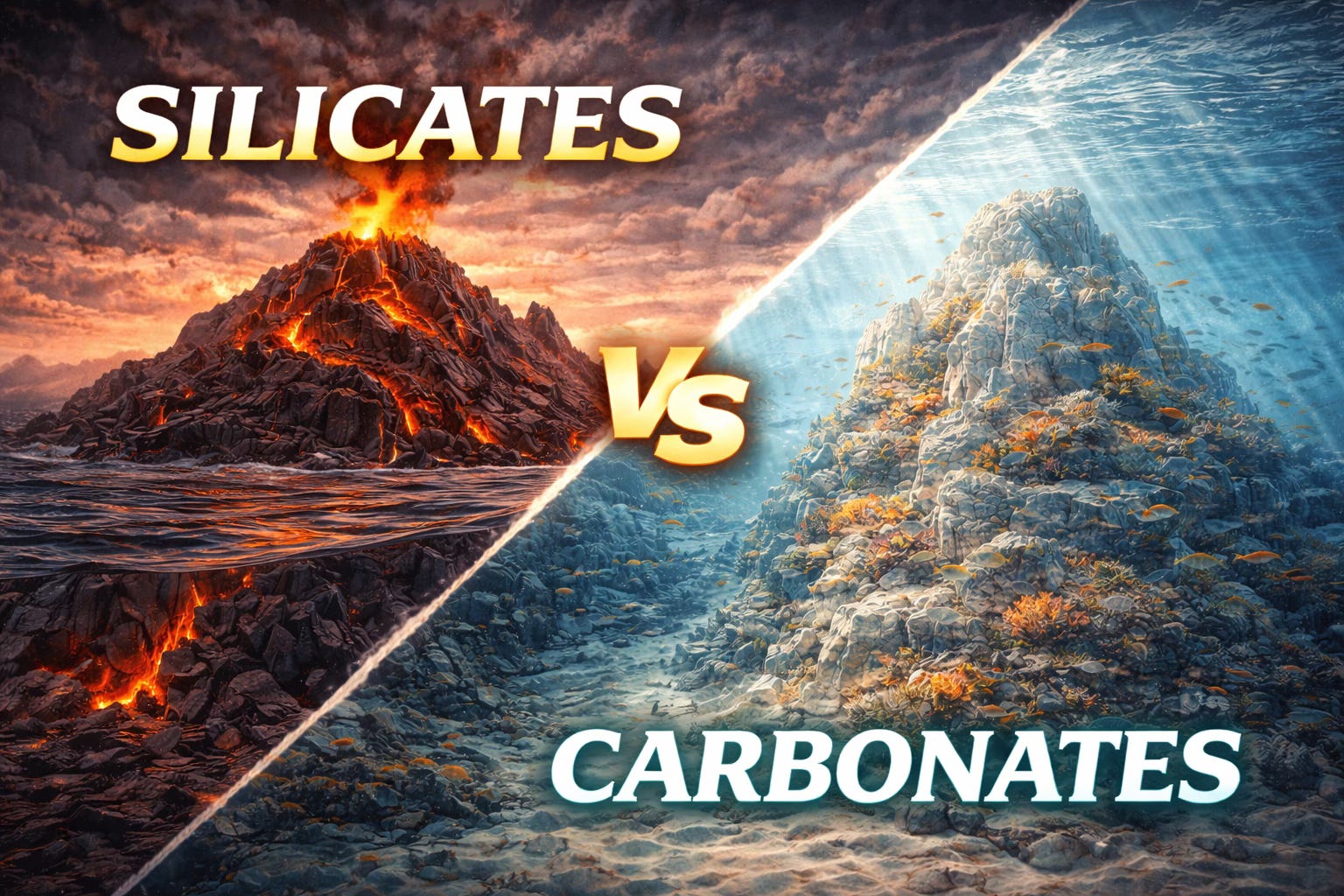
Carbonates, Silicates, & Path Dependency in Enhanced Rock Weathering
Dr. Tyler Kukla on how the 1996 IPCC report led commercial and scientific work in carbon removal towards silicates and away from carbonates.
This is a summary of episode #382 of the Reversing Climate Change podcast, hosted by me, Ross Kenyon. It is available on Apple Podcasts, Spotify, or wherever you get your shows. The video version of the show is also uploaded right below this if you prefer to listen in here.
There’s also bonus content from this episode on Spotify for paid subscribers.
🔹 Quick Takeaways
Enhanced rock weathering is already path-dependent—early assumptions are shaping investment, research, and markets.
Silicates dominate the field for narrative reasons as much as scientific ones.
Carbonates can remove CO₂ under some circumstances, but have been sidelined without enough scientific justification.
A single conservative IPCC assumption from the 1990s mattered enormously—even if it was reasonable at the time and a good faith conservative placeholder.
System boundaries drive conclusions—what “counts” depends on what you choose to measure.
Silicates offer a cleaner story—no carbon in the rock, no risk of emitting fossil carbon.
Carbonates weather much faster, but their embedded carbon complicates accounting.
Additionality is harder to sell when a practice already exists as agliming—even if it’s accidentally removing CO₂.
Good projects can be excluded by design choices made long ago even when new science and approaches emerge
Policy may be necessary, but not neutral—subsidies and rules and what counts as settled science can create new path dependencies of their own.
📝 How a Field Chooses Its Story
The episode is less about rocks than about how scientific fields quietly converge around narratives. Kukla frames enhanced rock weathering through path dependence: once a field commits to a story that is simple, defensible, and legible to outsiders, alternatives face an uphill battle—even when evidence suggests they’re worth exploring.
Silicates won early not because carbonates don’t work, but because silicates fit a compelling frame. They align cleanly with the “natural thermostat” story: over geologic time, silicate weathering has regulated Earth’s climate. Speed it up, and you get carbon removal. Carbonates complicate that picture. Not because they’re ineffective, but because on long timescales their net effect cancels out.
That distinction matters scientifically. But it matters even more narratively. “We’re accelerating Earth’s thermostat” is an elegant sentence. Carbonates require footnotes.
🧱 When Conservatism Becomes Destiny
One of the most striking moments in the conversation is how much weight Kukla places on an IPCC methodological decision from 1996. Faced with uncertainty, the IPCC assumed—conservatively and for responsible reasons—that all carbon in applied carbonate rock would be emitted. That assumption made sense for emissions accounting. It was careful. Restrained.
But it echoed. It shaped how enhanced weathering was first explained, funded, and legitimized decades later.
Silicate proponents could say: we avoid those emissions entirely. And even after the science became more nuanced, the story had already stuck. Early choices didn’t just guide the field—they narrowed it.
This isn’t a tale of incompetence or malice. It’s a reminder that reasonable decisions under uncertainty can harden into structural constraints long after their context has changed.
🧪 Measurement, Markets, and Missed Possibilities
Kukla repeatedly returns to a subtle but crucial point: carbon removal markets reward what can be cleanly measured, not necessarily what works best. Carbonates struggle here. Their signal can be noisy. Their additionality can be contested. Their effects depend heavily on soil chemistry, rainfall, and system boundaries.
As a result, potentially valuable projects may never be built, not because they fail scientifically, but because they don’t fit the accounting scaffolding we’ve erected. That scaffolding is now intertwined with venture capital, registries, and political economy. Changing it later will be hard.
Policy mechanisms could help—subsidies, pay-for-practice models, public procurement—but Kukla is careful not to treat them as a panacea. Policy expands what’s possible, but it also creates new defaults, new incentives, and new lock-ins.
🧭 Why This Conversation Matters
What makes the episode compelling is its refusal to declare winners. Kukla doesn’t argue for carbonates over silicates. He argues against premature closure. Against mistaking a good story for a complete one.
Enhanced rock weathering is still young enough that its future isn’t fixed, but only if the field is willing to question its own narratives. That requires humility, flexibility, and a tolerance for complexity that markets don’t naturally reward.
The risk isn’t choosing the wrong rock.
It’s choosing the right one too early and never looking back.