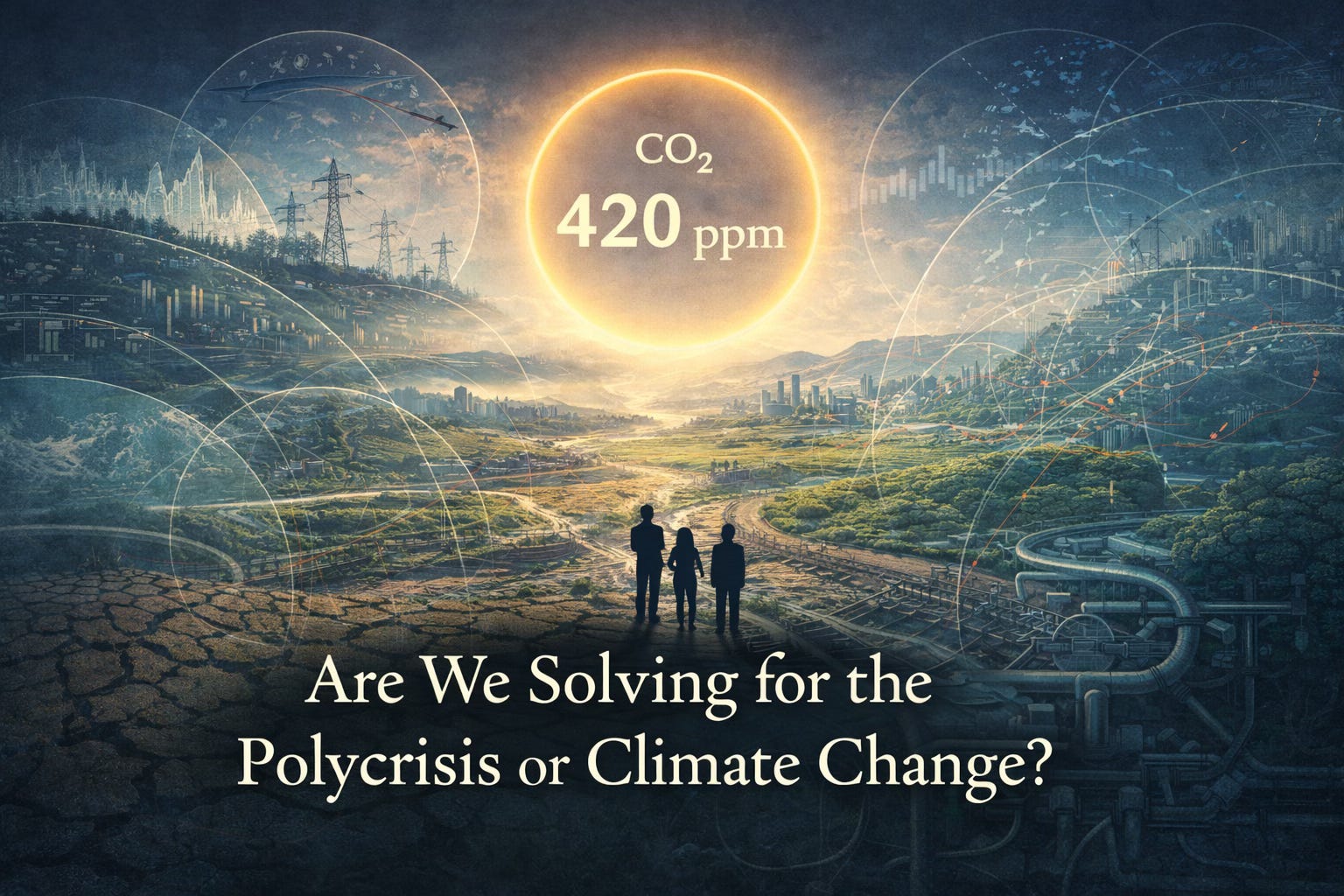
Carbon Efficiency vs. the Polycrisis
Is the goal to rapidly remove carbon with BiCRS, or to redesign the systems that got us here with biochar?
This is a summary of episode #387 of the Reversing Climate Change podcast. It can be heard on Apple Podcasts, Spotify, YouTube, wherever else you listen to podcasts, and also right below this text is the full episode.
🔹 Quick Takeaways
Carbon efficiency measures how much feedstock carbon becomes durable removal.
Some approaches (like biomass burial/BiCRS) optimize heavily for efficiency.
Others (like biochar) sacrifice efficiency but generate broad cobenefits.
This debate isn’t merely technical—it’s philosophical.
The carbon efficiency camp is focused on lowering atmospheric greenhouse gas parts per million (PPM) as fast as possible.
The polycrisis folks sees climate as one expression of a broader civilizational crisis.
Commodification could scale removal dramatically.
Commodification could also flatten complexity into a single tradeable metric.
A “ton is a ton” might work financially—but not ecologically.
Productive tension between these views may be necessary.
Trying to solve everything at once risks solving nothing.
Trying to solve only one thing risks missing the deeper problem.
📝 The Fight Beneath the Fight
On the surface, the carbon efficiency debate looks technical.
How much of the carbon in biomass actually ends up durably stored? How much is lost in conversion? Is 90% better than 50%? Should buyers prioritize maximum atmospheric impact per dollar?
But beneath those questions lies something deeper.
What are we actually trying to solve?
If climate change is primarily a parts per million (PPM) of greenhouse gases in the atmosphere problem—if the overriding moral imperative is to reduce PPM as quickly and cheaply as possible—then carbon efficiency is an obvious north star. Durability and volume become the defining metrics. Simplify, standardize, commodify. Make a ton fungible. Let markets do what markets do.
In that frame, anything less efficient looks like a distraction.
🌱 Biochar, BiCRS, and the Shape of the Problem
Contrast that with biochar.
It emits some carbon during pyrolysis. It is less carbon efficient. On a spreadsheet, it will lose this fight.
But biochar also plugs into agriculture, soil health, water retention, fertilizer reduction, wastewater treatment, toxicity mitigation, even construction materials. It interacts with the living system rather than bypassing it.
This is where the polycrisis lens enters.
If climate is not merely a carbon accounting issue but part of a nested civilizational stress test—biodiversity collapse, soil degradation, chemical toxicity, geopolitical fragmentation, fragile food systems—then perhaps carbon removal should not be judged solely by atmospheric efficiency.
Perhaps the point is not just to bury carbon, but to repair systems.
And now we are no longer arguing about efficiency.
We are arguing about worldview.
📈 The Seduction of the Single Number
Markets like simplicity.
A ton is a ton.
Durability can be denominated in years.
Financial instruments can be built.
Liquidity can grow.
Conservative capital can enter.
This path could scale carbon removal dramatically.
But it requires abstraction. It requires compressing a complex ecological and social reality into a small set of tradeable characteristics. It assumes that lowering PPM is sufficient, or at least primary.
For some, that feels clean and powerful.
For others, it feels reductive and spiritually hollow.
If we commodify carbon removal, do we accelerate salvation… or reify the logic that created the crisis?
🔥 Productive Friction
The temptation is to pick a side.
But the episode resists that.
PPM-focused thinkers bring discipline, focus, and scale logic. Without them, carbon removal risks dissolving into holistic aspirations that never materialize into measurable impact.
Polycrisis thinkers bring humility and systems awareness. Without them, carbon removal risks becoming a sterile financial instrument detached from biospheric reality.
The friction between them is uncomfortable, but maybe necessary.
Each side prevents the other from going too far.
🧠 Listening to Your Reaction
One of the most important moments in this show is not about biochar or BiCRS at all. It’s the invitation to notice your gut reaction.
Does commodification feel exciting? Or does it feel “yucky”?
Does holistic integration feel inspiring? Or does it feel naive and impractical?
Those reactions matter.
Because this debate is not ultimately about feedstocks or pyrolysis temperatures. It’s about what kind of civilization we are trying to build on the other side of climate disruption.
Lowering PPM is enormous work.
Redesigning civilization is even bigger.
The real question may not be which is correct, but whether we are wise enough to let both approaches sharpen each other without collapsing into dogma.
Carbon efficiency is a metric. The polycrisis is a diagnosis.
The future likely requires grappling with both.