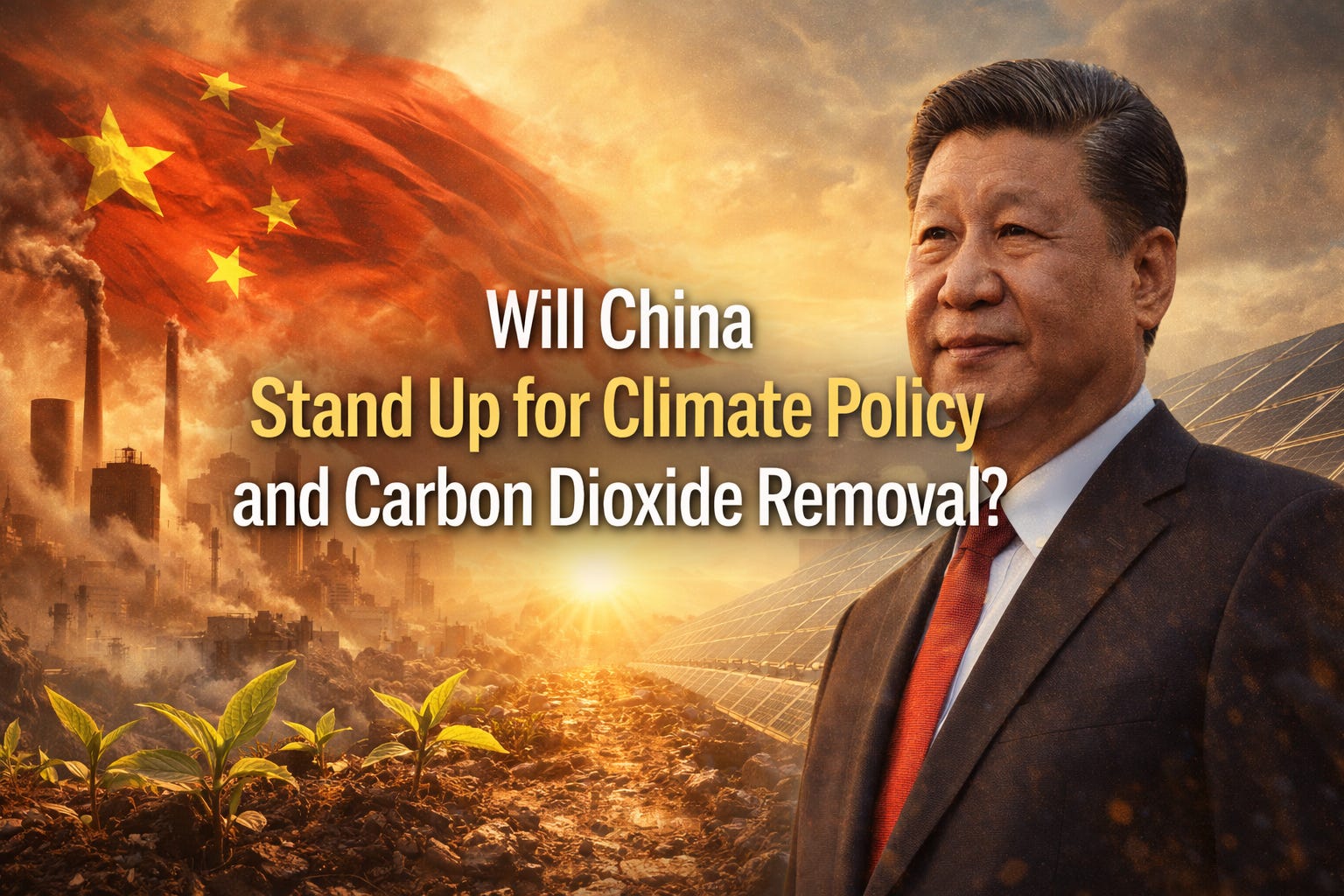

Episode 394 of the Reversing Climate Change podcast, in which Ross Kenyon brings back returning guest Sarah Godek—his self-described “sinologist on call”—to address the biggest country he left out of his recent monologue on the political risks to carbon removal: China. You can listen to the episode on Apple Podcasts, Spotify, YouTube, whichever other app you use, or the full episode
If the US pulls out of climate action, is there room for China or another country to fill the leadership void? Or without the US, does climate multilateralism fall apart entirely?
This episode is a direct response to my recent monologue episode, "How Carbon Removal Loses: The End of "Pre-Compliance"", which walked through the political risks to climate and carbon removal policy in a world where the US pulls back. I looked at Canada, the EU, its various member states, and Japan as possible safe havens. One country I left out was China. So I invited Sarah Godek back on as my "sinologist on call" to help set the record straight.
Sarah Godek is a returning guest and very knowledgeable about China. Our previous episode—a conversation about realism and liberalism in geopolitics, born out of a piece she co-wrote with Grant Faber on carbon security—is linked in the resources section and is a useful first step before diving into this one.
In this episode, Sarah walks me through China's energy security priorities, the difficult role coal plays in Chinese strategy, Tencent's CarbonX Prize, the absence of a clear institutional home for carbon removal inside the Chinese government, and the much harder question of whether climate multilateralism can survive without American leadership.
Listen in to hear more about what the "intangible third thing" of world leadership actually is (Sarah argues it's capability — the ability to make other actors stop) and why the war in Iran is a very different status hit for the US than the war in Iraq was; why a peaceful reunification with Taiwan is still the preferred outcome in Beijing, and what that says about the value of legitimacy; how China's environmentalist movement today more closely resembles the US in the 1960s, and how the principle that "green mountains are gold mountains" shapes Chinese carbon removal policy (heavy on sinks and reforestation, light on engineered CDR); what the 15th Five-Year Plan might or might not change; why China frames historical emissions as a Western problem—"if we didn't break it, why must we buy it?"—and what that means for whether China will ever take the mantle on CDR specifically; and Sarah's closing framing... it isn't that the US leaves a gaping hole the world flounders in. It's that the world will continue on without us, and the risk isn't punishment for not being at the table—it's being on the menu.
This episode's sponsors
Philip Lee LLP: legal resources for carbon removal buyers and suppliers
Listen to the RCC episode with Ryan Covington from Philip Lee LLP about project finance
Listen to the RCC episode with Lev Gantly about the history and current status of CORSIA
Rainbow: a developer-centric carbon removal registry
"Why carbon markets need field engineers, not just scientists" on Rainbow
"What scientists actually do in carbon removal" on rosskenyon.com
Resources
338: Carbon Security & the Geopolitics of Carbon Removal—w/ Sarah Godek
"Carbon security and the geopolitics of carbon removal" by Sarah Godek & Grant Faber
391: How Carbon Removal Loses: The End of "Pre-Compliance"
More from the show
Ad-free episodes and other benefits come with a paid subscription.
Carbon Removal Newsroom, the news show that ran alongside this one, is over. Its episodes are still up, on the feed Climate Workers Anonymous now uses.
Carbon Removal Memes is still goofing around.
The books that come up on this show are collected on my Bookshop shelf.
🎧 Apple Podcasts · Spotify · YouTube
Paid subscribers get this episode ad-free. The ads in the free feed are inserted by Spotify when you press play. They are not in the file I make.
Full Transcript
Ross Kenyon: Hey, thank you so much for listening to Reversing Climate Change. This is Ross Kenyon. I’m the host of Reversing Climate Change. An alumna of the show is returning today. Sarah Godek is back. She did a really great show with me last year. She and Grant Faber wrote a piece about carbon security and geopolitics that was really great, and that made me want to do a show with her. And then the show ballooned into just, how do we think about schools of thought with regard to global affairs, foreign relations, geopolitics? And then we ended up doing a really cool show about realism and liberalism within geopolitics. So if you haven’t heard that, that would probably be a good first step. And the link is in the show notes.
This episode is at least partially a response to the monologue episode I put out recently called How Carbon Removal Loses. It was about some of the trends around right-wing populism and domestic politics and how that influences climate policy overall. And if having the US as world leader pull out of climate politics means that other countries become a safe haven for climate companies and climate policy, or is that actually maybe not as durable as it seems. I analyzed several countries that carbon removal folks like to point to, such as Canada, the EU, and various member states, and Japan. But I had left out China. And China is one of those places that people still put a lot of hope in as an enormous economy, as a leader in its own right, that also has some really powerful realist motivations for pursuing a cleaner energy system.
But I didn’t have all of the detail here that I really would’ve liked in order to treat it with sufficient care. So I invited Sarah on to help me set the record straight and to give me a good answer of whether or not China can be a bastion of climate leadership and carbon removal leadership in a world without American climate and carbon removal leadership to the same extent that we once had.
Before I launch the show, if you wouldn’t mind opening up your podcast app and giving this show a full rating and writing a review if you’re on Apple Podcasts or any app that allows you to write a review, that’s massively appreciated. But in any case, here is my show with Sarah Godek.
Ross Kenyon: Sarah, welcome back to the show.
Sarah Godek: Thanks for having me back on, Ross. Good to be back.
Ross Kenyon: Yes. I think back on our podcast that we recorded often. I think it was such a fun show. I want to do more shows like this. And I recently did this monologue show where I expressed some of my concern about Japan, Canada, the EU, various member states within the EU for carbon removal policy as the world may be changing its focus or looking in different directions right now. And a careful and astute listener might have listened to that show and said, well, what about China? You mentioned it once, but are they not going to take the mantle and be the clean energy transition leader for this new era of human development? And I frankly do not know enough about what is happening in clean energy politics and just energy politics broadly within China. So I invited you back on as my on-call China-ologist. Basically, please tell me what I need to know. Was my diagnosis too grim? What are the green shoots in China that we can look forward to? Help me get a better sense of what I’m missing.
Sarah Godek: Sure. And always love the opportunity to talk about China, so feel really grateful that you left the entire country and its policy to me. That’s a lot of responsibility.
Ross Kenyon: For you, yeah.
Sarah Godek: Yeah, it’s a lot of responsibility. But I’m happy to offer some reflections. I definitely think it’s a challenging moment for the clean energy transition. There’s no doubt about it. What we’re seeing unfold across the world — you alluded to it in your podcast, sharing that there’s obviously some kind of Maslow’s hierarchy of needs here where there’s just a giant focus right now on energy security. But clean energy can be a piece of that, and that’s obviously been a huge part of China’s strategy as they’ve considered going from a world that relies on fossil fuels to what the future looks like. And you’ve seen them become a huge leader in what they call the three new things or the new trio — solar panels, new energy vehicles, and batteries. And especially looking into long-term storage batteries is a huge new area of focus and research as well at universities.
So I think that obviously there’s challenges, but China at least is eager to show that it can meet its own carbon goals. And I think that other countries are too. I think that there will be some loss of ambition and there will be some countries that try to — I don’t want to say weasel out of their goals, but will use this as an opportunity to say, well, maybe we can take a step back. But I think that there’s other countries like Canada, for example, that will be even more energized to move forward as the US sometimes takes a step back from the world. While that creates a bit of uncertainty — and in the current era that we’re in, a lot of uncertainty — it also creates a sense of, I think, it energizes states that want to prove that they themselves can take up the mantle and demonstrate their own global leadership capabilities in this space.
So I think Canada’s a great example. I don’t know if you saw, but Mark Carney had given a really strong speech earlier this year that many people are calling a sort of watershed moment for middle powers and their own ability to set their own path. So I think those are some things that we can look at — both China’s dedication in the space, but also other countries’ dedication to their own goals and even desire to move beyond what they set to try to fill in gaps that maybe the US has left.
Ross Kenyon: With regard to these gaps that the US has maybe left, how important is world leadership? It’s sort of an amorphous term. It sounds like a lot of BS can be smuggled in underneath a term like that. Why do countries care about prestige or status or how they’re perceived in this way? Is it not just about wealth and power? What is this secret third thing that is important, and how does it actually operate?
Sarah Godek: I think there’s a few things. One of them is just sheer power. Obviously that still plays some role. I think the other is reliability. And then the third is capability. I think this last piece is really important because we haven’t really seen many actors that have been able to, in aggregate, replicate the role of the United States. I think the war in Iran is a perfect example right now where we’re seeing a complete lack of leadership, and the United States in many ways is still calling the shots. And there’s pushback and there’s world leaders that are obviously — and rightfully — pushing back against some of the actions that are being taken, some of which I believe personally are likely illegal under the laws of war. But I think at the same time there’s still a reliance on the US to do something. Who is going to make the United States stop? And I think that that’s the sort of intangible third quality — this sort of capability where there’s not really a credible actor in this scenario that can make the United States stop what it’s doing. There are many actors that can maybe come together and try to pressure the United States into behaving differently, but we’re obviously seeing a pretty emboldened United States under Trump’s second administration that seems to feel — and seems to be the case — that they can just do what they want.
So I think that’s the intangible third quality that is very difficult for other countries to replicate, and that most of them may not want to. They might not necessarily want to say, hey, do something different.
Ross Kenyon: I’m trying to compare this moment to the war in Iraq. Granted, it was slower. There was more trying to coordinate among allies, trying to have this be like a multilateral military action. It wasn’t a sort of surprise for everyone. And so there was more time to build and work the diplomatic alliance network and try to make things kind of all come together. It didn’t work. I remember — I don’t know if I’ll keep this in the show — but I remember my dad pouring the French wine down the drain in 2003 and being like, well, France is not supporting the US in Iraq, so we are not buying French stuff.
Sarah Godek: Do you remember Freedom Fries?
Ross Kenyon: Freedom Fries. Yeah, for sure. And so the US did have some amount of — its status was challenged, but it doesn’t seem to have permanently negatively affected its standing in the world in a way that I can discern. The US is still broadly seen as the world leader for technology and innovation, and ultimately what the US says broadly goes internationally. And my interpretation of this is that it felt invincible. And we’re seeing now actually that the US can really harm it by playing too rough, by being less reliable, by being unpredictable. Some of these things mean that your allies balk at you. They question whether or not the alliance is stable enough. The middle power stuff starts happening where it’s like, oh, the US is not going to be the stable anchor for trade agreements that we once had planned on. And I think Trump is operating under a framework where he thinks: we’re the US, we’re the most powerful, we’re the biggest, baddest people, and everyone’s just going to fall in line because we’re the US. And people are not behaving in the way that maybe he predicted they would just go along with it. And now you’re seeing it change. I’m just trying to figure out what is different between how harmful the war in Iraq was to the US’s status, relative to what’s been happening in Trump 2, where it does feel like the status is actually eroding in a really big way — even though the war in Iraq also posed really big challenges for what the world thought the US maybe was.
Sarah Godek: Well, I think what’s important to remember about the wars in Iraq and Afghanistan was the place from which they started, which was widespread approval. I mean, 99 to 1 in the Senate to make a declaration of war. There was a declaration of war to begin with. It was something that had gone through a process, had pretty widespread public support because we had been attacked. That was the sense in 2001 after 9/11 — that we are under attack. And I think that’s why you saw broader support, not perfect, but broader support from our allies, specifically NATO allies, because there actually was an attack. We were attacked, and there was a sense that global terrorism was a serious problem that had the potential to seriously disrupt not just our country but other countries.
So I think that fundamental state of affairs in 2001, in the years that followed, made it a very different landscape from what we’re now seeing with Iran, in which we were not attacked on American soil. And we have launched a campaign that does not have congressional approval and does not have public approval. So I think that’s why the conditions, especially the pushback we’re seeing from our allies, is so fundamentally different.
And I think with respect to Trump, there was a sense, I believe, in the Trump administration, that they thought this would be fast. They thought this would be like Venezuela. And there are decades of war games that US generals, US military infrastructure gamed out through tabletops and saw that many of the things that we see happening are exactly the things that they expected to happen, that Iran had said they would do. A lot of this is not necessarily a surprise. But I think you start to get into a situation where the most accurate information is not necessarily making its way to Trump. There are many people who are surrounding him that may increasingly be telling him what he wants to hear because that’s who he chooses to surround himself with. And that just creates a classic dictator problem in which the information you’re receiving is very different from the actual reality. And so that makes your ability to make good and accurate decisions that accomplish the goals that you’re trying to achieve much more difficult.
Ross Kenyon: The generous interpretation of these events too is that it’s confusing because it’s meant to be confusing. Contradicting means you can — I’ve called it like a southpaw quality. Like you don’t exactly know where the next blow is going to come from because it’s very unpredictable. But it’s also possible that there’s just not a really well thought through plan either.
Sarah Godek: Oh, I was just going to say that. I mean, it’s a classic case of, oh no, my war plans didn’t go how I wanted them to. Set everybody ever. And once war starts — and it’s challenging because they’re not even calling this a war, even though it basically is one — it’s really challenging because once it starts, things start to spiral in all of these completely unpredictable ways, insofar as it’s really challenging to know how one effect will trigger next-order knock-on effects. And so that’s, I think, what makes war so challenging and why the fog of war arises — because you can predict human behavior to a certain point. But you start to get into really crazy complexities. These are some of the things that AI in a military context is being used for — to try to better model some of those second, third, fourth, fifth order effects. But it really does get into a situation where you have to make decisions based on all of the available information in the moment going forward. But that’s going to look very different from how you imagined it when you first set off on this adventure, so to speak.
Ross Kenyon: Yeah. All of the second, third, fourth order effects that we’re seeing — and we certainly haven’t seen the end of it — but rising energy prices create problems for incumbent governments and leaders everywhere. That becomes a kitchen table issue. That’s really impactful and bad. Also changing how the war in Ukraine is being conducted and how sanctioned Russian energy assets are. And that changes the calculus for various things too. And then you have unpredictable things like Zelensky being involved with Gulf states, bringing drone warfare expertise over there. And how does that change? And then you have Marine Expeditionary Forces from East Asia going into the Middle East and leaving Taiwan less covered than it would otherwise be. And how does that change Taiwan, and what does it tell China about how the US will behave in a potential reunification event with Taiwan? How exactly would that play out? I cannot string all these things together because they’re so ongoing and so really complex. But I imagine this probably is changing the tabletop war gaming dynamics of how Taiwan would play out for China and how they’re thinking about that. Or maybe not. How is it impacting Chinese leadership? Have you seen anything that you’re able to share?
Sarah Godek: I mean, these kinds of events are great for Chinese military strategists because it gives them a really great window into US military behavior. That being said, I do think that US military behavior probably looks somewhat different these days under Trump 2.0 than it might in a traditional scenario. So I think that there is a little bit of variation there. But at the same time, it provides invaluable insight into the kinds of weapons we have, the ways in which we’re willing to use them, what kinds of tactics we use to affect certain military goals. And all of that data can be taken up through intelligence, through satellites, and put into a broader database of thoughts on how the US behaves in wartime scenarios.
So obviously any kind of opportunity to see how we engage in warfare is a bonus to China’s military strategists when they consider a Taiwan scenario. But that doesn’t necessarily change their calculus on a Taiwan scenario. And I think the reason for that is more ideological. Because I think when we think about what Taiwan is to China, the stronger ideological goal for China and Chinese leadership is to reunify in a peaceful way. And I say that with the thinking that what they imagine in that scenario is that people on the island of Taiwan all wake up and say, you know what, we want to be part of the People’s Republic of China and we would like to reunify with the motherland. And the reason that that’s such a desired scenario is because it would provide a really strong point of judgment for the Chinese system and its desirability. And that’s, I think, why that outcome is still the preferred outcome. Because taking it by force is something that I believe that China’s leadership thinks that they can and will do if they feel a need to do so, but I still don’t think it’s the preferred option. So obviously how we behave in warfare influences how they consider what a potential contingency could look like, should it come to that. But that doesn’t necessarily mean that their calculus on whether they want a contingency at all has changed.
Ross Kenyon: Wow, that’s a really fascinating answer. Obviously it’s better not to have a war in these cases. They’re expensive, they’re disruptive, and people typically don’t want them unless they have to, or they look like they’re quick and easy, and maybe it’s faster than some peaceful unification process here. But your answer here goes back to this initial secret third thing, status leadership question — where maybe there’s a theoretical reunification scenario where Taiwan would be okay with it, and that thumbs up to the Chinese Communist Party, I’m sure, would feel really good in a way that if they conquered it, they would have a little bit of that pariah tinge over, there’d be like an occupied province of theirs. And that doesn’t feel as good as “China is so good that we’d rather rejoin than remain independent and part of the broader North American, European worldview liberal democratic order. We’d rather join the motherland.” It is really hard to quantify how valuable that type of leadership and that status boost is, and what does it enable China to do with that? It gives them more credibility. Reinforces that their model of political economy and politics is more justified, that the system that they support and endorse continuing on with is a legitimate form of government, which is sometimes under question. Is it all of those things? What exactly is the value of that status?
Sarah Godek: Well, I mean, this goes back to the broader history of the People’s Republic of China, which was formed under really adverse conditions, when there was quite a lot of US opposition to communism. And under those conditions there was a really strong emphasis on trying to prove that China’s communist system was something different from the capitalist system. And so it was very oppositional — that’s a good word. It was very confrontational and there was a very strong desire to show that this was separate and new and different and better. Now obviously China has sort of dropped the illusion of communism in all but name, which the party retains but did consider dropping at one point.
Ross Kenyon: Really? Wow.
Sarah Godek: Yeah. Very, very interesting tidbit. But you know, now it’s socialism with Chinese characteristics is the system. But it’s still — there’s still this sense of an adversarial nature of the US, of the US trying to contain China, which from China’s perspective is not a new thread but rather a persistent thread that lasts across history. Which I think maybe feels a little bit weird to us because in the US we see our leaders change. We see great changes over the years, and we don’t necessarily always do the best at reflecting on the continuity in our strategy or posture because we feel like things are so different, especially under different eras of presidents. Whereas in China, they spend a lot more time — because their system has perhaps much stronger through-lines in terms of ideology, in terms of policy and the slow ways in which things have shaped over time, but also some rapid periods like the reforms of the eighties and nineties. And so I think sometimes they look at our system and they see maybe more continuity than we actually have.
So I think going back to what this means for the Chinese system is, I think they want to show that they have something that is unique, that is distinct from the Western model of capitalism. And I believe that they think that showing this model and its benefits and having others adopt it are pieces that contribute to something like global leadership. And so I think that there’s been a really strong desire to inject Chinese solutions to global problems. That’s been a really constant theme. And I think there’s a lot of lessons there for China’s energy transition and carbon removal as well, that we can get into. But I think that that focus on injecting Chinese solutions to global problems demonstrates that they’re interested in showing the benefits of their system and that they can contribute new and unique ideas based on that system, in a way that shows why China should be considered not just a responsible major power — which is the current framing — but sort of lurking in the background, not necessarily stated, perhaps one day a world leader.
Ross Kenyon: Yeah, the understudy just waiting for their shot for the main stage. Such a good way to set this up. And I wanted to bring this back to when we first spoke, we were talking about liberalism and realism within foreign affairs and geopolitics and those broad schools of thought. And the way that I understand how the US is positioned here, and from Trump’s perspective, the Biden administration and Democratic presidencies tend to have a liberal geopolitics that does not suit the US. In fact, we are an oil and gas superpower, and we are throwing ourselves under the bus by clean energy politics that — we don’t have aluminum and rare earths to the same extent that our rivals do, or China does. And we are basically riding the bike and sticking the stick inside of the bike wheel and crashing ourselves to essentially no benefit, for some like muddle-headed liberal status victory that is disconnected from realist geopolitics.
In the same way towards China: okay, China has these clean energy materials, huge amounts of aluminum and much of the refining capacity of so many minerals and many of the rare earths that are needed for various types of clean energy. And there’s a question here of how much of China’s support for the clean energy transition is a liberal orientation of, oh, look, we are doing this because it’s the right thing to do, and how much of this is just realist, because they have coal, as you’ve noted, but not a lot of oil and gas, and clean energy is a way for them to have exports and to secure their own energy needs. Even from a purely realist geopolitics that doesn’t care about any sort of abstract values, they’re just needing to do this because it’s the energy that they have available to them. So how are we meant to understand what is driving Chinese energy politics?
Sarah Godek: That’s such a good question, and there’s so much that goes into it. Because there is the energy security element, which I think personally is the most important. But then there is also the desire to be a global leader. But I think there’s also really interesting lessons from Chinese environmentalist movements here too, because I think that a lot of the ways in which China frames the clean energy transition, and how they even treat carbon removal specifically, has to do with Chinese conceptions of nature and what it means to restore nature.
So, just to talk a little bit about the energy security piece: right now coal makes up about just a little over half of China’s energy consumption, with non-fossil energy making up somewhere around 21.7%.
Ross Kenyon: Oh wait, is it beautiful clean coal, or is it something else?
Sarah Godek: So sometimes, yes. There actually has been a focus on clean coal in China. In fact, I would say that’s actually quite a strong focus — cleaning up coal, because China has so much of it. And I think that this is really the thorn in the side of China’s clean energy strategy, because they are just sitting on so much coal, so many untapped coal reserves, and that is just really challenging from a country that prizes social stability, which relies to a pretty strong degree on energy stability. It’s really hard for them to look at those untapped coal resources and say, you know what, we’ll just leave them in the ground. That’s hard.
Ross Kenyon: We have the same thing here too.
Sarah Godek: Exactly. Yeah. It gets to — it’s a sort of mirror framing in terms of how the US thinks about oil and natural gas. So I think that coal is a really big challenge, and I think you see those interests reflected in China’s both new 15th Five-Year Plan as well as their broader carbon peaking goals. So you see a lot of reference to like the orderly transition from non-fossil to clean energy. And there was also, I think, some academic debate over what counts as clean energy. So I remember seeing sometimes coal being lumped in with clean energy sources, like only oil was the dirty one — which again, resonates with the idea of trying to split off a US-dominated world order from a Chinese conception of how the world could look.
So I think with respect to the energy transition, they’re really under a lot of pressure to make sure that their energy first is secure. Blackouts are still sometimes a challenge. And it’s hard because there are these dual goals that they have of growing but also growing their clean energy capacity at the same time. But sometimes the clean energy capacity might not be able to meet that demand. And so coal or other fossil energy sources could sort of fill in that gap. So their number one priority is to make sure that the lights stay on in many parts of China, some of which are recently developed. There’s been quite a lot of change in China over the last even decade. And they want to make sure that the standard of living they’re starting to provide in more rural or isolated areas is able to be the same level that has been promised. They don’t want blackouts.
So sometimes they’ve seen local-level officials, in an attempt to meet carbon peaking or clean energy targets, sometimes they’ve just simply shut the factories down or turn the lights off to show that they’ve met their emissions goals. And Chinese leadership very quickly made it clear that this is not what we intended at all.
So I still think that energy security is still number one for them, much like most countries on earth. So that’s obviously going to be a big part of their strategy. But there is also a desire to see that not destroy the environment. And that is both from a local and macro perspective. I think that China is much more close to some of the major environmental movements that we saw in the US in the sixties, for example. They’re sort of closer to that time period where there was a lot of activism surrounding dirty air and dirty water. And so I feel that there is some of that that influences their energy policy today.
So there’s a lot of focus on reforestation. That’s actually a huge component, and that influences their carbon removal policy too. There’s a lot of focus on carbon sinks — that is, I think, the biggest focus in China’s overall policy right now. And so I think it’s because they’re closer to that era in which there was really dirty air in China, there was really dirty water in China. And there’ve been tons of efforts to clean that up. And now the sort of guiding principle is that green mountains are gold mountains.
Ross Kenyon: Is that just like a very literal translation kind of thing that sounds kind of goofy in English but is more beautiful in Chinese?
Sarah Godek: Yes.
Ross Kenyon: Okay. That’s not unique to them. That’s literally every language if you translate literally. But okay. Interesting.
Okay, two big nested questions for you. One: are we going to see more carbon removal specific policy and events and competitions like the Tencent deal that is recurring in China right now? That is maybe a nice opportunity for carbon removal companies that are seeing opportunities around the rest of the world vanish or be pushed out further in time or shrinking. And then secondarily — gosh, this could take us all the way through to the end of the show pretty much — with the US pulling out of the UNFCCC and Paris and things like that, is there a chance for China to replace the US in terms of being a world leader, if not generally, at least with regard to climate policy? Is that a powerful enough status that they hold onto right now that they could generate enough commitment to these goals that it could replace what the US once provided for world order? Is it possible for them to do that? Sorry, those are two enormous questions. Good luck.
Sarah Godek: No, they’re both good questions. Those I think are kind of the two key questions that I was excited to address today. Because one of them was about prizes and like ops for domestic policy, and then the other was, will China replace the US role on climate policy? And I think those are both really great questions.
To talk about the prizes and the landscape in China’s domestic carbon removal policy: I definitely don’t think that the world will likely be able to count on China in this regard. So I think what is really unique about the Tencent policy is that Tencent as a company — for those who are not familiar with Tencent, it’s a massive Chinese company that runs WeChat, which is the proverbial Swiss Army knife app of China, in which people make reservations, talk to their friends, post videos, post articles, post academic articles, watch videos, book movie tickets, do banking, pay their friends. It’s like imagine if you had Facebook and academic journals and YouTube and Venmo and Eventbrite and movie ticket apps — like imagine you just have all of these apps and services all rolled into one giant app that everyone uses for most, or at least many, activities.
So it’s quite a famously wealthy company. They have made a commitment to reach carbon neutrality by 2030. That’s a pretty aggressive timeline, and so I think that’s partially why you see such a focus for Tencent on their Carbon X Prizes. So they have finished the first round. Those winners were announced a couple years back. They just announced the top 30 for Carbon X 2.0 in, I think, October of last year. And they’re now going to be moving forward soon with the deadline for applications for infrastructure for Tencent — I think it’s called Binhai campus. So they are accepting applications for either carbon neutral or carbon negative building materials for that campus. So I think the campus is maybe about 30% complete — I saw one statistic — but they still have quite a long way to go, and they’re obviously interested in incorporating more players.
I think what’s interesting between the first prize and the second prize is that the first prize was only Chinese companies and entities. And in the second round they expanded that to have a more international scope. So you see a ton of US companies on there. Some names like Octavia, Heirloom, very familiar names. And so I think that that’s a really interesting shift, because I think it highlights two things. I think it highlights Tencent’s expanded ambition, but I think it also highlights the fact that Chinese companies and entities alone are insufficient to meet that demand. So I think that piece is key. Because there are some Chinese companies that are doing really great work. I was looking at some of the projects and feeling pretty excited about some of them. There’s some unique processes there. There’s a 1,000-tonne-level demonstration that China University of Petroleum in Beijing has applied for under this prize.
Ross Kenyon: Expand on them. Go Moonrise, go Moonlight, go diligence all of these Chinese companies. Come figure it out.
Sarah Godek: Due diligence in China is a whole other animal. But I mean, there’s capture materials, there’s mineralization, biomass, solid liquid air capture — all kinds of projects from Chinese entities, a lot of universities, which I find to be encouraging because that means there is likely some level of government support in the form of projects or demonstration projects.
But what’s interesting, as I was going through this and looking at some of these entities and looking through China’s energy policy, clean energy policy, and carbon removal policy, is that there’s not really a great home institutionally for carbon removal. There are companies that have committed to net zero policies. Another is Sinopec set a goal for carbon neutrality by 2050. China itself has a carbon neutrality goal for 2060. But policy doesn’t really put carbon removal as a really big piece of that. And I think there’s a couple reasons for that. The first is that there’s not a great home for carbon removal in the ministries of China’s government.
So I was looking, and there’s a few different places that it could live. I think probably the most likely would be the Ministry of Natural Resources, which handles forestry but also has a couple other geological bureaus or centers that I think will be likely involved with sequestration efforts and permanent storage. But there’s also some of it that falls under the Ministry of Ecology and Environment, which handles the air side of things, because they handle air pollution, for example. But there’s also the National Development and Reform Commission, which manages China’s development plans and action plans for peaking and emissions. But then there’s also the Ministry of Foreign Affairs, which handles the international engagement side of things, which I think is a challenge for carbon removal because that means that some of the policies that are going to govern this technology ultimately will be split across multiple agencies with disparate stakeholders who have different goals at each of them.
So I think that’s one challenge for carbon removal policy in China — that it doesn’t necessarily seem to have a great centralized home. Maybe Ministry of Natural Resources is maybe emerging as one that would be a little bit more centralized, but still influenced by those other ministries, which makes it a bit of a challenge in terms of just lobbying for your own desires and goals.
But there are a lot of universities widely spread across China, also in Hong Kong, that have great projects that they’re clearly pursuing. And that probably indicates some level of government support through the demonstration efforts. So I think it’ll be really important to see what comes out of the 15th Five-Year Plan. Right now, all we have is an outline. And once the full plan is issued, then there will be sub-plans. And I think that matters because the way that policy making in China goes in terms of these plans is that once the major plan is established — well, let me back up a little bit.
So first, what happens is, in the formation of the five-year plan, there is a lot of consultation with governments around China, local governments, provincial governments, and companies, and they all give inputs into this plan and what they think they can do. Companies, individuals from companies, all may weigh in. Academics, scientists, especially at the Chinese Academy of Sciences, which is China’s sort of premier science research organization. And then once the major plan is built and established, that allows agencies to issue their own sub-plans. So provincial governments, for example, will issue sub-plans. Ministries will issue their own sub-plans. And other plans must fit into the sort of superstructure of the goals of the 15th Five-Year Plan, and show how it is in accordance with them at minimum.
So right now, we haven’t really seen that much reference to carbon removal. There’s been much more reference to things like green hydrogen. Carbon sinks came up a lot. I had found — let me see what the specific name is — there’s a foundation, it is the China Green Carbon Sink Foundation, and they seem to be very active. It’s pretty rare for an NGO organization like that to be super active in this space as a sort of leading entity. But that seems to be where there’s been a lot of government attention — on the idea of looking at natural ecosystem carbon sinks and how to improve their uptake of carbon.
So I think that kind of gets back to what I was talking about earlier with respect to China’s environmentalist movements and push for a cleaner environment. Because there’s a sort of strong focus there on the natural elements of things, of like, how can we take this beautiful resource that we already have and make it better? And so I think that’s more of China’s focus.
But starting to see some projects from companies. There was one really unique project that was something to do with like bio-coke and capture in the process of that. So that’s pretty interesting. So you’re starting to see a little bit of that industrial tie-in.
Ross Kenyon: Is that the metallurgical biochar? Is that what that is? Bio-coke. I imagine that’s just a new term for it. They keep coming out with new terms for it. I can’t keep up.
Sarah Godek: Yeah, it’s something to do with the steel making process.
Ross Kenyon: I imagine it’s the same.
Sarah Godek: Yeah. That’s cool.
Ross Kenyon: They’re making biochar then, but it’s metallurgical coal.
Sarah Godek: Yeah, so it was a project from Beijing Forestry University that is in the new round of Carbon X 2.0. So yeah, seeing a lot of science. But I think that we won’t necessarily expect really big policy from China on carbon removal. And I think it’s one of those things that’ll be sort of operating in the background.
And that kind of gets me to the second question that you posed, which is: will China replace the US role in climate policy? And focusing on the carbon removal piece of it specifically. I think what’s challenging here is you’re starting to get to the question of whose responsibility is carbon removal. And China sees itself as responsible for reducing emissions, certainly, and for making sure that it compensates for its historical emissions, maybe. But when you talk about climate change, I think that China will focus more on the role that traditional emitters have played and that it will focus more on the historical emissions. That’s been a really big focus in China’s policy and talking points on the clean energy transition — who is responsible for the past harms. And they will place the blame squarely on specifically the US, but also other Western emitters that already have pumped tonnes of CO2 into the atmosphere, and will see them as more responsible for cleaning up after it.
So I think that there is an opportunity for China to do carbon removal in the future, especially as this ecosystem starts to build out. But I think you’re more seeing supporting technologies in their efforts, where it might not necessarily be the actual technology itself, but it might be ways to support it. And so I think that there’s maybe a role there for them to play a supporting role for efforts elsewhere. But I don’t necessarily think that China will take a leading role, and that’s partially because from China’s government’s perspective, it’s not necessarily China’s responsibility.
But I think the silver lining there is that companies are invested in ensuring that they themselves meet carbon neutral goals, and there may be more impetus to do so in the future. And that’s where you could maybe see a bit of a shift in that calculus, where: okay, if we can reduce our emissions, but we still have these leftover emissions from construction and infrastructure building, then we’re going to need something to make that up too. But I think there’s been more of a focus on low-carbon materials.
Ross Kenyon: That’s so fascinating. I would not have anticipated that historical responsibility angle for carbon removal — for residual emissions is not our responsibility, that’s for, you know, when we had the unequal treaty system and that was going on, you guys were industrializing, and this is basically your fault. Like, why should we be developing the technology and paying for the stuff that you basically created this issue? I haven’t heard that said out loud. But that is one potential framing for this too. They could also say in the future, it doesn’t matter whose fault it is. We are the world leader and we aspire to be this, and the problem needs to be solved independent of culpability here, and we are going to stick our necks out. We need to develop carbon removal and climate policy in the absence of the US or everyone will suffer. They could make that play. Is it likely? What do you think?
Sarah Godek: They could. But it’s not necessarily consistent with the posture that they’ve shown up to now. I think that there’s been — so, for example, when the US withdrew from the Paris Accords, they said that they regretted the decision and that nothing about their goals had changed. Like, China remains committed to their own. So I think there is a moment where you could have seen them step in and say, oh, we can do more. But again, there’s really this piece of responsibility. If we did not break it, then why must we buy it?
Ross Kenyon: So it is just the US or nothing. Like, I guess the hope that frames this question is, can climate multilateralism exist without US involvement? I think everyone is hoping that the answer is yes. And my asking you to come on the show is at least partially to tell me, yes, it is maybe possible, and here’s how. And what you’re telling me is that maybe the US’s leadership is irreplaceable, at least for now, when it comes to climate policy.
Sarah Godek: I would say it’s more that the world will continue on without the US. I think that that’s more of the framing that I would use, is not that the US has left this big gaping hole and everyone will just flounder and suffer and die. I think it is more that countries will say, well, what can we do without them then? I think you’re seeing a lot of that in Europe of, you know, what is possible without the US, and starting to imagine what does a world that isn’t dominated by the US look like and how can we increase our own relative influence in that?
So obviously China will be opportunistic in ensuring that standards are in accordance with Chinese goals, as other countries will be ensuring that international standards align with their own goals. But I think that just means that we will have less of an opportunity in the United States to promote our own interests. It’s the classic adage of: if you’re not at the table, you’re on the menu. And I think that we will be on the menu when we see that standards internationally that we are subject to, not necessarily because of some kind of compliance measures that are strict compliance measures that like, oh, we have to abide by them or something bad will happen to us, some kind of punishment or retribution. I think it’s just that we’ll be left out, and the world will move on without us, and we will become more isolated as a result, if we continue this current course.
Ross Kenyon: Sarah, thanks for coming back on. I realize I’m asking you some of the hardest questions to forecast probably in the entire world. So thank you for doing a sterling job. I feel like you did it. Thank you for doing it.
Sarah Godek: Absolutely. And thanks so much for having me back on again, Ross.