
A Climate Seder
What Passover's story of Exodus can teach us about catastrophe, comfort, and doing the hard work of climate action.

This is a summary of an older episode of the Reversing Climate Change podcast with Sarah Tuneberg. You can listen to the full episode on Apple Podcasts, Spotify, YouTube, wherever you get your podcasts. You can also listen to the full thing right below this paragraph.
Quick Takeaways
At the time of recording, Sarah Tuneberg was the CEO and co-founder of Geospiza, a climate risk assessment firm. She also served as Colorado’s COVID testing czar during the pandemic, scaling the state’s testing from 50 samples per day to over 50,000. The experience reinforced what she already knew from climate work: we almost always know catastrophe is coming, and we’re almost always surprised when it arrives.
The episode walks through a Passover Seder—the ritual Jewish meal celebrating the Exodus from slavery in Egypt—and draws out climate parallels at each step. The Haggadah (the text that guides the Seder) is deeply customizable, and Sarah’s family keeps theirs in a manila folder that gets rearranged every year.
The Seder tradition of reclining—getting comfortable with pillows and stretchy pants before doing hard intellectual and spiritual work—maps to a key insight about climate engagement: people may do harder things when their basic needs are met. The all-or-nothing framing of climate action (no meat, no flights, no plastic ever) may be counterproductive.
The Four Questions, traditionally asked by the youngest child at the table, connect to Greta Thunberg’s rhetorical power: taking an incredibly complex story and distilling it to its simplest, most transmittable terms. If even the youngest can tell the story, it cannot be forgotten.
Tikkun Olam: the Jewish concept of “repairing the world,” isn’t just charity. It’s an active obligation to dismantle broken systems. In climate terms: it’s not enough to reduce your own footprint. You have to be engaged in the structural work.
The plagues of Exodus—hail, pestilence, drought, darkness—are functionally the same natural disasters that climate change is intensifying today. As Sarah put it: “They’re not making new natural disasters for us. They’re the same. We just made them worse.”
“Next year in Jerusalem”—the traditional closing toast of the Seder—becomes a climate intention-setting exercise. What does your “next year in Jerusalem” look like for the climate?
Ancient Plagues, Modern Catastrophe
This episode was recorded and released during Passover 2021—a year into the pandemic, with Sarah Tuneberg freshly off a nine-month stint as Colorado’s COVID testing czar. The original recording had been planned for the previous year’s Passover, but the pandemic intervened, which turned out to be fitting: the story of Exodus is, at its core, a story about catastrophe that people should have seen coming.
Sarah’s professional life sits at the intersection of risk and preparedness. As CEO of Geospiza, she worked on climate risk assessment; helping organizations visualize, understand, and act on the risks that are already baked into our changing climate. Her pandemic work reinforced the same lesson: we model these disasters, we run exercises to practice for them, and then when they arrive, we act shocked. The plagues of Exodus, she argued, are the same disasters we’re dealing with today—hail, drought, pestilence, darkness. We haven’t invented our way out of any of them. We’ve made them worse.
Comfort and Capacity
One of the more surprising climate insights came from an unlikely place: the Seder tradition of reclining. At a Passover meal, you’re supposed to get comfortable—extra pillows, a good chair, wine at prescribed intervals. The idea is that you can do very hard intellectual and spiritual work while also being at ease. Sarah drew a direct line to climate engagement: the prevailing narrative that caring about climate means deprivation (no meat, no flights, no plastic) may actually reduce people’s capacity to engage. If we accommodate people’s basic needs and comforts, maybe they’ll have more bandwidth for the harder work. You can have anything, she suggested, but you can’t have everything.
Ross extended this to a broader framing about basic needs: if you’re struggling to eat, you’re not going to be thinking about abstract problems that might affect your grandchildren. Climate change is still, for some listeners, elective to think about. Meeting people where they are—comfortable, fed, not in crisis—might be the precondition for meaningful climate action, not an obstacle to it.
The Power of Simple Language
The Four Questions are a centerpiece of the Seder. They’re asked by the youngest child at the table; a ritual that ensures the story of Exodus is transmittable across generations, stripped down to its most essential terms. Sarah connected this directly to Greta Thunberg: after decades of Al Gore and climate policy wonks, it took a teenager speaking in the simplest possible language to make the message stick. The power wasn’t in complexity. It was in clarity.
There’s also a startup analogy in there: if you can pitch your idea to a third grader and they can retell it, you might actually understand what you’re doing. Sarah suggested this says more about venture capitalists than third graders.
Nobody’s Coming to Save Us
The conversation took a theological turn when Sarah described a strain of post-Holocaust Jewish theology: rather than waiting for a single messianic figure to arrive and fix everything, the obligation falls on all of us to create the messianic time ourselves—to end poverty, inequity, violence, and war through our own collective work. The parallel to climate is obvious and uncomfortable: nobody’s coming to save us from ourselves.
This connects to Tikkun Olam, often translated as “repairing the world.” Sarah was careful to distinguish it from ordinary charity. Tikkun Olam isn’t just giving money or reducing your carbon footprint. It’s an active obligation to dismantle the systems that cause harm. In Holocaust terms, the distinction is between people who simply didn’t participate in atrocities and the “righteous Gentiles” who actively hid people, smuggled, and subverted. Not participating isn’t enough. You have to do the work.
The Same Plagues
The most direct connection between Exodus and climate is the plagues themselves. Hail that devastated crops in ancient Egypt is the same hail that devastates crops today. Drought, pestilence, wildfire, darkness—these aren’t new categories of disaster. They’re the same ones, amplified by greenhouse gas emissions. Sarah found it fascinating that thousands of years of human civilization haven’t produced new natural disasters. We’ve just made the old ones worse.
The Haggadah also prompted an interesting discussion about the “hardening of Pharaoh’s heart”—a passage where God seems to prevent Pharaoh from letting the Jews leave, ensuring more plagues must be visited on ordinary Egyptians who had no say in their government’s decisions. The revisionist reading asks: how do we include mercy for the everyday people who suffer from decisions made by those in power? In a climate context, this maps onto the tension between developed nations (who benefited from fossil-fueled industrialization) and developing nations (who are told to bear the costs of decarbonization without having enjoyed the benefits).
Next Year in Jerusalem
The Seder closes with a toast: “Next year in Jerusalem.” For a historically diasporic people, it’s a phrase layered with melancholy and hope; an acknowledgment that you’re not where you want to be, combined with the belief that you might get there. Sarah suggested this as a climate intention-setting exercise: what does your “next year in Jerusalem” look like? Less plastic? Solar panels? Something structural? The point isn’t perfection — the whole arc of Hebrew scripture is a story of people falling short and trying again — but intention, renewed annually, in comfort, with wine.
Full Transcript
Alexsandra Guerra: You are listening to the Reversing Climate Change Podcast by the team at Nori, the Carbon Removal Marketplace. This is a show about the innovators and entrepreneurs developing solutions to climate change.
Ross Kenyon: Hello and welcome to the Reversing Climate Change podcast. I’m Ross Kenyon. I’m the creative editor at Nori, the Carbon Removal Marketplace. Today I have with me an alumna, Sarah Tuneberg, CEO and co-founder of Geospiza, and more recently, Colorado’s COVID czar. What a sentence. I’m so privileged to get to say such a thing. Welcome, Sarah.
Sarah Tuneberg: Thanks for having me.
Ross Kenyon: Yeah. This show has been so long in the making. We tried to last year and we were gearing up for it. In fact, this outline that we’re working off of was built a year ago, but the pandemic happened and it prevented us from doing this Passover episode.
Sarah Tuneberg: A long-gestated podcast is a good thing. I’ve reflected deeply on it in moments across the last year, and I think we’re better for it now.
Ross Kenyon: You really had time to think about this over the last year.
Sarah Tuneberg: Occasionally when you were like, hey, are we gonna do it? And I was like, yes. And then I’d be like, ooh. Such good things to think about. And then it was all COVID all the time.
Ross Kenyon: Yeah, I can imagine. If you go back and listen to Sarah’s original episode, we were talking about climate risk and how various organizations are working to visualize that, understand that risk, and act on it in cases where they can. Is that an okay summary of your work?
Sarah Tuneberg: Very, very good. It’s the understanding that you need to take the changes to reduce the risk, and as we’ve seen over the last year, we live in a world of risk. A world where we do very poorly at preparing for that risk.
Ross Kenyon: I feel like you’re getting at something specific. Is this potentially related to your pandemic work? Does this all flow together for you?
Sarah Tuneberg: It does actually, because I think that one of the deep learnings of my career and my work is that all of the things we think of as surprises or natural disasters or anything like this — we know that they’re likely to come. We do the modeling about them. We even do exercises to practice for them, and yet when they happen, we’re like, oh my gosh, what are you talking about? We had no idea. How could we ever have known this was gonna happen? We pretty much always know. And so it’s a human problem, and I think we’ll talk in our episode about catastrophe in the form of the plagues. And so even back in biblical times, we had natural catastrophe and they are, turns out, not that different than what we’re dealing with now. So that we’re surprised is surprising to me.
Ross Kenyon: Yeah. I was thinking — if a Geospiza in biblical times would be a Caesar, right?
Sarah Tuneberg: I think so. Yeah.
Ross Kenyon: That’s the joke I’m trying to make. I don’t know the exact way to package it. We’ll just leave it at that.
Sarah Tuneberg: I like it. It’s funny.
Ross Kenyon: Yeah. Okay. Before we get into the Passover story and how climate relates — what happened in this last year for you? What was it like working with Colorado state government and the pandemic response?
Sarah Tuneberg: I’ll say that I’m not sure yet. I feel like it has been a year of incredible intensity and loss and the hardest work I’ve ever done in my life, and that the work was so intense and driven that I feel like I lived in a state of adrenaline or fight or flight for nine months and I’m not yet sure exactly — I’m not sure if I even laid down the memories in my brain yet. It’s still just sort of stewing around up there. But what I will say is it was a year of people coming together and doing their absolute best and just trying with everything. A lot of the work was very intellectual, very academic, very brain — and yet you would see people’s bodies on video calls just sort of tense up and move forward. And you could see that my colleagues and the people who were all across the world working to solve this had every cell in their body in it. And it was an incredible thing to witness.
Ross Kenyon: I’m not sure. We should have another episode next year, maybe at this time, and we can reflect on all of this.
Sarah Tuneberg: I’m not quite there yet. Still just trying to take a breath.
Ross Kenyon: Wow. It sounds pretty raw still then. Well, I’m sure we’ll try another podcast in a year and then three years later when we actually do it, then we can talk about it. Maybe that’s enough time to reflect.
Sarah Tuneberg: Yeah, I think that sounds like plenty.
Ross Kenyon: I’m trying to remember how exactly this came up the first time you were on the show. I think we were just talking about the plagues of Exodus. You had recommended this book that I have here, which is Jonathan Safran Foer’s — another podcast alum — his New American Haggadah. I worked through it. It was the first one I’ve ever read and experienced, except for I went to a friend’s Seder once. I guess that was the only other time I’ve referenced one of these. But I got a lot out of it. And apparently these are quite customizable. A lot of people customize their Passover Seder to feature different elements of the story and different themes. But I suppose before we get to the customizability, maybe we should just start with the bare bones. What is the story of Passover? What is the Seder? Let’s set a nice foundation for everyone.
Sarah Tuneberg: Sure. Absolutely. So Passover is one of the oldest Jewish holidays and it celebrates the Jews’ exodus from slavery in Egypt. It’s a big momentous event in Jewish history — that the Jews were able to leave slavery and bondage in Egypt and go into the desert where they began to wander, which then led them to entry into Israel. And enshrined in all of this legend and myth are lots of details — the giving of the Ten Commandments comes in this place. This is the early, early days. Not Genesis, not the beginning, but the story of Exodus. One of the things that’s very wonderful and beautiful about the Passover story is that it is a holiday oriented around lots of traditions in the home and lots of storytelling. It’s not a single night — it is a many-night event. There’s a first night Seder, a second night Seder. You can do it for up to eight nights, differing in traditions. And so in Judaism, there is a lot of — as with any faith tradition — there’s a lot of food, a lot of ritual, but Passover to me is the one where it’s just magnified. And the Haggadah, the book you reference, is the story guide. It’s the text that guides us through the meal. We have a meal, and Passover is where the prayers happen. So you sit at the table with your family and friends and you process through the story, and there’s wine and specific foods. It’s a real feast of the senses, of intellectualism, and of questioning. It’s a pretty wonderful holiday.
Ross Kenyon: I think that’s a great place to start. And if you’re listening and you’re not familiar — a Seder is, as I understand it, just the name of the actual celebration or the event itself of Passover? Is that the correct way to understand it?
Sarah Tuneberg: So a Seder is a meal. And it is a special meal in that there are prayers and storytelling and foods and wine. So it’s the event. You build them together to make Passover.
Ross Kenyon: Okay, understood. I was familiar more with the pretty basic story of Exodus and how Passover is celebrated, but my understanding is that you can customize this a great deal and people will write Haggadot that feature different themes. And so we seized upon an idea of a climate Haggadah or a climate Seder. Have you been to many Seders, and how much customizability do you feature in your celebration of Passover?
Sarah Tuneberg: Let me preface this by saying this is Judaism and Passover from my perspective. And with all things Judaism, as many people or Jews as there are, there are perspectives. And Judaism is a tradition of questioning and study — that is the best, that is the highest art, the holiest activity. Study all of the Torah and the books and the teachings. So this is my perspective. You have a different classic Jewish text. It is not static. It’s malleable. It’s adjustable. My personal family Haggadah is like a mess. It’s a manila folder that is a mess of stories. And every year we sort of discuss which ones we want to highlight. Are we going short? Are we going long? Are we doing lots of singing? Are we talking? What’s the point? And then we’ll sort of adjust and then make copies and pass them out. Others — my grandparents used the modern Jewish Reform Judaism Haggadah. It was a book. We did the whole thing. There was no messing around. You just did the one. And then there’s other things — I’ve been to a feminist Seder where it was all about the women of the Torah, and it was all about adjusting to the lens of feminism, and it was very cool. So it’s this idea: reflect on what you need to in the moment. And I think one of the other things that’s fascinating and unique is that you do it in a meal. So you’re also sharing food and you’re drinking wine if that’s your jam. The Haggadah calls for wine in particular places, so you can get a little tipsy and then the discussion — it’s exciting. It’s lovely.
Ross Kenyon: Yeah. The story of Exodus is a story of slavery and then the Jews escaping and as a nation leaving Egypt and going their own way, and they sort of get lost on the way, right? They’re out in the desert for a while. So it’s sort of somber, but it seems celebratory too at the same time. Is that correct?
Sarah Tuneberg: Yes, absolutely. And there is redemption. It’s a story of redemption and freedom, and that is something that is incredibly celebratory. I am blessed to have never been enslaved, but I don’t imagine — I don’t know what that experience would’ve been like for them. And it’s also a story of incredible loss and trauma. The killing of the firstborn of each of the Egyptians. It’s horror, right? That’s trauma like we couldn’t even contemplate. And the plagues are terrible. As with life, I think, there’s levity, there’s celebration, there’s grief and loss, punctuated by redemption.
Ross Kenyon: Passover itself — the name is about the firstborn Egyptians being killed, right?
Sarah Tuneberg: Correct. And then the passing over — the Jews would put lamb’s blood over their doorway.
Ross Kenyon: So the message was for the Jewish houses to mark their doorsteps and their gates with lamb’s blood, and the Angel of Death would know to pass over those homes.
Sarah Tuneberg: And that tradition has been pulled forward. Now the holiest prayers are tucked in a scroll and put in the mezuzah on the door. So it’s a linkage — now Jewish homes are always marked.
Ross Kenyon: Oh, that’s interesting. I’ve seen mezuzahs on people’s doors before, but I learned about that from Curb Your Enthusiasm. I think much of my knowledge of Judaism is Larry David related.
Sarah Tuneberg: As it should be.
Ross Kenyon: A fair amount. But I didn’t know there’s a connection between the mezuzah and Passover.
Sarah Tuneberg: They’re linked in a prayer. But I think this is to me always the interlinkages. In Jewish tradition, we study and we reference and we note. So it’s very common in a book of Torah to have one passage and then a whole three quarters of a page of — Maimonides said this, Hillel said that, this person said the other thing. So they get muddied. Some prayers reference back.
Ross Kenyon: I saw the scholar Jonathan Haidt say that argument and debate is a fundamentally Jewish cultural characteristic. It sounds like you might agree with that.
Sarah Tuneberg: Indeed, and I think it comes back to some degree to the story of Passover, which is in Passover — the first diaspora of many. For the Jews, they had to leave everything. You couldn’t take anything with you. There’s the unleavened bread — the matzo doesn’t have to rise, so they just take what they can. But the most portable, highest-value thing in Jewish tradition is education. Nobody can take it away from you. In your diaspora you get to keep everything that’s in your head. And so I think that’s always been the root of the Jewish debate culture, the Jewish intellectualism — you can take all of our things, you can put us in a ghetto, you can enslave us, but you can’t take what’s in our heads.
Ross Kenyon: What even is the correct way to understand that? Somber, sad — but it’s been turned to a strong positive at the same time.
Sarah Tuneberg: Totally. It’s powerful. It’s a nice subversion of what one might expect.
Ross Kenyon: That’s great. I think this is a really good baseline to move from. How exactly does one celebrate a Seder when you host it? In the Haggadah that I have, there’s a whole bunch of things you say together, exercises, thought experiments that you debate through. How do you do it?
Sarah Tuneberg: In my tradition, we have a usually big family Seder. It’s family of choice and family of birth. Invite lots of people, extend out the table. And it begins with the washing of the hands in our tradition. And that is a marking of specialness and ensuring that you are prepared — that’s how I experience it. You wash your hands. And I think in some traditions — sometimes at our house — you wash another’s hands. So you pass a bowl, a ritual washing — not a real one, there’s no soap. You hold your hands over the bowl and the person pours it over and then you pass it along. So it begins that way, which to me is an interesting reflection in the context of climate change — a cleansing, a beginning, fresh.
Ross Kenyon: A nice clean start. You have to get your house in order, get yourself taken care of, and then you’re prepared to proceed. Okay, so then there’s this ritual hand washing. Where do you go from there?
Sarah Tuneberg: So one of the key traditions is that you recline in Passover. You have an extra pillow, you get your comfy chair, your stretchy pants — my family, because you eat a ton — but you recline. And we’ll come to the Four Questions. But one of the questions is: why on this night do we recline? There are lots of reasons why, but the one I think about is that we can do this very hard work, this big reflection and event, and also be comfortable in doing it. And perhaps in being comfortable, we have more capacity to think and more capacity to be reflective. In the climate lens, I think a lot about the idea of comfort and being able to be okay as a barrier to the changes we need to make. There is this idea that you have to be a vegetarian and walk everywhere and never take an airplane again. And it’s this very restrictive life if we’re gonna have a carbon-neutral or carbon-negative life. But I think the Jewish teaching of this reclining idea is that we can do very hard things and still have comfort. Maybe we can do harder things when we’re comfortable. If we accommodate ourselves and our base needs, maybe that gives us greater capacity. And maybe if it wasn’t this all-or-nothing, you gotta do everything, no plastic ever forever — we’d get more people on the side of minor changes. To me it comes back to this idea: you can have anything but you can’t have everything. And maybe we need to let people have a little bit and they’ll do better work on the climate.
Ross Kenyon: That’s an interesting idea. I imagine it’s easier to care about something abstract that may affect your children or grandchildren to a far greater degree — something farther away — if you’re not struggling to get your basic needs met. You’re able to zoom out a little bit. It’s easier to think about things that are farther away. Of course, climate change isn’t farther away for everyone, but at least for some people listening, it is sort of still elective to think about.
Sarah Tuneberg: Oh, I think that’s a really good framing — this idea of basic needs being met allows you to have space to worry about other things. If you’re struggling to eat and all you can do is eat the meat or whatever — yeah, I agree that resonates with me deeply.
Ross Kenyon: If all you get is free manna from heaven and you really want quail — I love that part of Exodus. If you’re listening, after Egypt, the Jews are in the desert and they get free bread that tastes like it’s been flavored with honey and they’re like, hmm, we don’t really like it that much. We’d like — can you get any quail up there, God, that you can send down? Does that crack you up? Is this intentionally funny?
Sarah Tuneberg: It does crack me up. And I think there’s so many things like that, which leads to the really good questions of why, what on earth — and the multi-authorship of Hebrew texts. There isn’t a single author, there’s so many. I have never actually read any of the reflection, but I would love to see — why quail and not honey? Are there quail in the desert? Is it a remnant? Is there a memory there? I have no idea, but I agree it’s hilarious. It also speaks to this — it’s never good enough. Wandering the desert, you get free food and you’re like, but really what I want is the quail. Come on, dude.
Ross Kenyon: I grew up in Arizona and there’s tons of quail there. So — quail in the desert.
Sarah Tuneberg: There you go.
Ross Kenyon: Yeah. I think I got this from Amy-Jill Levine — her work’s come up on other podcasts. She’s a Jewish scholar of the New Testament. So her perspectives are always really interesting. She had something about trying to understand the humor and how much of the scripture is actually intended to be funny, in her opinion. And reading Exodus like that — I reread it for this podcast — one thing that always gets me is Moses on Mount Sinai. He’s up there for 40 days getting the tablets, getting the Ten Commandments. And he comes back and the Jews are already building a golden calf. They’re already building an idol. And he’s like, that’s the one rule, guys. You know this doesn’t work, right? This is how God gets really mad at you over and over again. 40 days, not even that long.
Sarah Tuneberg: It’s nothing! 40 days. And this idea too — I’m a planner, right? I’m an emergency manager. How much planning did they have to do to already have constructed it at 40 days? They’ve been working on that since he went up there.
Ross Kenyon: You had to gather all the jewelry from the people. You had to melt it down. You had to make the cast. There’s a whole series of operations.
Sarah Tuneberg: Yeah, I agree that this was what they were gonna spend their time on instead of whatever else.
Ross Kenyon: I don’t know. It is possible this is not intended to be funny, but the whole shape of Hebrew scripture, as I understand it — if there is an agreement with God, the Jews break it in some way. And then some prophet will scold them and they’ll sort of come back into God’s good graces, and they break it. It’s this cycle of coming back to God and then losing the way and coming back. Is that how you see it, or am I imposing that?
Sarah Tuneberg: No, I think that’s true. That’s accurate — it’s one of the many, but yes. And isn’t that like human? Isn’t that the way of humans? Oh, it’s all great. Thank you, thank you. Oh, we’ve done a little sideways. Please forgive me. I need a guru. You are gonna help me get back. Oh, I’m back. Okay. I think it’s really common. It’s like exercise and meditation. It’s universal. It just can’t stay good forever.
Ross Kenyon: Yeah. I think the overall shape of Hebrew scripture, if we accept that interpretation, is a sticky story because it rings true to us. Resolutions is a funny lens — you make these resolutions and then you don’t really keep them. You keep trying and trying, but you fail.
Sarah Tuneberg: I appreciate that even the prophets fail. That’s one of the things I love — even the ones who do the best work aren’t perfect. So there is no perfection. Just continuing self-improvement. You can always be better at Judaism.
Ross Kenyon: You can always be better at Judaism. It’s a great line. Okay. Sorry, I let us down into tangents — hopefully related enough — but let’s get back into celebrating Seder. What comes next after the reclining?
Sarah Tuneberg: So I will admit it has been two years, though I’ve had many every year of my life. My Seder last year was a little sketchy — I had COVID and it was my birthday. My birthday falls in Passover, which as a small child was a huge bummer because I didn’t get a real cake. I got some sort of flourless nonsense. But in real life it’s nice now. Good big party. And there’s matzo brei, which is sort of like French toast made with matzo. And this isn’t a subject of huge division — some people love it and think it’s the greatest thing in the world. And I’m pretty sure it’s like eating paper with maple syrup on it. I’ve got no love for the matzo brei. But anyway — essential and quintessential of the Seder are the Four Questions. The Four Questions are part of the Haggadah. They are asked by the youngest child, and it is long-held tradition to learn the Four Questions as a small child. It’s a big thing when you can do it. If you can do it in Hebrew, even better. There’s a song. The questions are: Why is this night different than all others? Why do we recline? Why do we eat bitter herbs? Why do we eat only flatbread? And there’s another one. Maybe we’ll look it up. I’m not the youngest — so I never had to learn them anyway. The service is inclusive. It isn’t just the adults speaking. It is about all people, including the youngest child, who has a very important role. And I think about this in the context of climate — it’s really important. Because we talk in Passover about very difficult subjects: slavery, redemption, sadness — sadness is an understatement — unbelievable loss. And we give that storytelling responsibility to children as well as adults. And I think in doing that, we are ensuring that the story is transmittable between generations, that it isn’t too lofty or intellectual, and that we get it to its simplest terms so that we cannot ever forget it. And that even the youngest knows it. And this comes up for me with Greta Thunberg a lot. We had Al Gore and all sorts of other prophets of climate change. And it wasn’t until Greta came along and was able to give us this incredibly simple message that a lot of people heard and that a lot of people were able to internalize and also transmit — the story of climate change. And so I really think deeply about this idea of ensuring our storytelling is appropriate for everybody and that everybody can then tell the story.
Ross Kenyon: That’s a really clever connection with Greta’s rhetorical approach and maybe her personality generally — speaking forcefully in very clear language. She also has a bit of that Hebrew scriptural prophetic thing going for her too, as social critic. Those prophets are railing against the civilization and society as they see it. That seems very Greta-esque.
Sarah Tuneberg: I think the thing I find especially Greta-esque, and in the tie to the Four Questions, is taking this incredibly complex, multifaceted story and being like, here’s the four key things, and I’m just gonna talk about them incredibly simply. Not as a criticism, but simply and elegantly. We don’t need all the big words, all the big government talk. Here’s what’s happening, here’s what the consequences are, here’s how we can stop it, and we need to do something about it now. And I just think it’s really beautiful — the idea of being able to have power with simple language, the most power. And also not negating the idea that even the smallest person, the youngest, can make magnificent change.
Ross Kenyon: Yeah, that’s a really beautiful sentiment. And it’s nice that it’s included ritualistically — it’s always the youngest child.
Sarah Tuneberg: Always the youngest child. And when you go to adult Seders, it’s very funny. When I went to Seders in college, it would be like, when’s your birthday? Because we were all really young, but there was always the youngest.
Ross Kenyon: That’s good to know. Well, yeah — these questions. Why is tonight different? Why recline? Why the bitter herb? And why do we eat flatbread and matzo? The bitter herb stands out to me. Do you recall what that one might be about?
Sarah Tuneberg: So the bitter herb is to remind us of the time of slavery. And we dip our bitter herb — in the United States, in most traditions, the bitter herb we eat is parsley — and we dip it in salt water and eat it to remind us of the tears of the enslaved. And the bitterness of the work and being enslaved people.
Ross Kenyon: So this is the somber part. Some of these thematically — it feels like you’re telling kids a sad story. You’re explaining why the bitter herb, why you’re eating flatbread — you’re eating matzo because there wasn’t time before fleeing Egypt. You had to make the bread. You didn’t have time to let it leaven. Is that right?
Sarah Tuneberg: Yeah. Didn’t have time, had to go. So you baked it really fast so that you had something, and that something was a cracker.
Ross Kenyon: Right. Okay. So then after this, the kids get their answers. They’re able to learn. And by the way, if you’re not able to explain your ideas in terms that a low level of understanding can access, there’s always an open question of how well you actually understand those ideas. I think it’s an important exercise in general.
Sarah Tuneberg: Yeah. In the startup world, there’s always this idea of pitching to a third grader. If you can, and a third grader can understand and then retell you what your business is — I think that might say something about venture capitalists more than third graders, but.
Ross Kenyon: Okay. Throwing some Passover shade, I see. Yeah. Where do you go from the Four Questions? What happens next?
Sarah Tuneberg: So again, this is sort of a meandering story and it’s different in different families. There’s wine, there’s all sorts of parts. But one of the things — and this might be a little out of order — but thinking about Greta as a messenger leads me to the idea of Elijah. Elijah the prophet — the idea of a ghost. We don’t really have ghosts in Judaism, but kind of like a ghost. At Passover we have a glass of wine for Elijah, and we also at a point in the service towards the end open the door for Elijah. Elijah is the one, I believe, who will arrive prior to the Messiah. So there is an idea in Judaism that a human form will come first to a particular coastal village in Israel, and Elijah will appear first and sort of guide through. And we make room for Elijah, who’s considered a stranger, because we don’t know when Elijah’s gonna come. So we make space for a stranger. And I think about this in lots of different ways. It’s this weaving of a thread of connection and humans over time. And the Passover message that one, we make space for people we don’t know. Traditionally in Passover, you are supposed to invite anybody who needs a home for Passover. Nobody should go without a meal. So we make space for the stranger. We also, in our tradition, think about Elijah as this ancestral arc — this connection where my grandparents, my great-grandparents, the people all the way back to Europe and before that, wherever they came from — making space for Elijah, this force that was gonna welcome the Messiah. And we still do it every year. And I think it’s a really beautiful thing that you pour a glass of wine — gonna make it comfortable. Not only is there a seat, but there’s also wine for Elijah.
Ross Kenyon: I don’t know how many times this happens in Hebrew scripture, but I feel it’s gotta be dozens — the admonition that you were once slaves in Egypt and so the expectation is that you need to extend a helping hand, to be charitable, to be kind. Is this related?
Sarah Tuneberg: I don’t actually know if it is directly, but there’s a good connection there. This idea of making space for the stranger — you were once slaves in Egypt, so you need to be more thoughtful and more caring. And tzedakah, the giving of charity, is really important.
Ross Kenyon: You were also telling me about an interesting idea — an idea of the Messiah within Jewish theology as maybe the people overall or the time overall, rather than a single person. Can you explain how that works?
Sarah Tuneberg: Yes, absolutely. The experience of being a Jew in history has been one often of incredible trauma. You have slavery in Egypt, subsequent wars, the Inquisition, and then obviously the Holocaust. And I learned it as post-Holocaust theology, which is: rather than expecting a single human-formed savior, a messiah, to come and save us all and usher us into the messianic period of peace — instead it’s incumbent on all of us to create the messianic time. That we together can create the peace, create the kindness. It’s funny, all of the things that are coming up for me, I’m thinking of the opposite — ending poverty, ending inequity, ending violence, ending war. If we do that, that will make the time of the Messiah, rather than us waiting for it or waiting for somebody to save us. We need to do the hard work to make it be. And I think about that in the context of climate: nobody’s gonna save us from ourselves. We have to do the work. And perhaps the time of the Messiah — the first thing we need to do is to not have climate change, to stop the greenhouse gas emissions.
Ross Kenyon: Oh no, just put it out there. Just a thought, huh? That surely will be part of it. Is this — one term I’ve seen used frequently in these circles is Tikkun Olam. Is this all related in your mind?
Sarah Tuneberg: Yes, it is. The idea of doing good — and not just doing good, but there’s an idea of righteous good in Judaism. It’s not just doing good because you’re supposed to, but actually doing the work of change, the work of charity, the work of help, the work of dismantling broken systems that harm others. It’s righteous work. It’s the work that we all should be doing. The shorthand, probably unfairly truncated version of it, is Jewish social justice. It’s not just about charity. There’s this idea of charity — you give, you donate money, you donate food. That’s not enough. In Judaism, you have to be socially just. You have to do more. You’re not allowed to stand by and let the bad thing happen. You actually have to be an active participant in dismantling. I think about this a lot in the terms of the Holocaust — there’s this idea of righteous Gentiles, those non-Jews who hid people, who undermined the Nazis, who smuggled, who did other subversive activities — because it’s not good enough to just not have participated. You have to actively do the right thing.
Ross Kenyon: Do we even have a word in English that expresses that? I feel like you have to explain that idea.
Sarah Tuneberg: No, I don’t think we do. Which is why we talk about Tikkun Olam. Jews don’t have shorthand — we’re like, we’re doing Tikkun Olam. And you’re like, what is Tikkun Olam? And you’re like, it’s justice, but it’s righteous and it’s powerful and you don’t have a choice. You just have to do it. There’s a lot.
Ross Kenyon: So circling back to a couple of things we’ve already talked about — we also in Judaism make space for righteousness and comfort at Passover. We’re talking about incredible loss and an incredible story of redemption, and we do it reclining. And when we think about climate change, it’s not enough to just be — you have to be actively engaged in the justice component.
Sarah Tuneberg: And for me, I think a lot about my role in the world in climate. It looks like helping people who don’t have the space or the capacity to make those changes. To what you said about if your basic needs can’t be met, how can we expect you to make space for this very hard work? On the global scale, we talk a lot about developing nations and what work they need to do. And I think there’s this idea of, well, screw you, Western countries — you got to have all the benefits of coal-fueled development. Why can’t we have that? But this idea that we all have to do the hard work, and maybe some of us have to work harder to compensate for those who can’t. I don’t know — that’s a little half-baked.
Ross Kenyon: That’s okay. I think there’s something there. We should talk about the plagues, right? I think this is what everyone thinks about when they say, oh, they’re doing a climate Passover episode — the plagues. Rivers of blood, frogs, hail, climate change, natural disasters.
Sarah Tuneberg: Yes. And to the point I said earlier — one of the things I find absolutely fascinating is that the plagues of slavery in Egypt and Exodus remain the plagues that devastate huge swaths of our human population in this current year. They’re not making new natural disasters for us. They’re just kind of the same.
Ross Kenyon: No, they are the same.
Sarah Tuneberg: So I think of hail especially — hail, wildfire. Hail devastated crops in the time of slavery in Egypt for Jews in the same way it does right now. And the catastrophic effects of climate change are the same as the catastrophic effects that God rained down on the Egyptians to free the Jewish slaves. It’s absolutely fascinating to me. And we have not innovated our way out of it. We’ve made it worse.
Ross Kenyon: In fact, we’ve made it worse. Yeah. So you think — I mean, that’s the most obvious link. There are many ways to spin the story of Exodus to be about freedom and relate to the climate, but focusing on the plagues — that strikes me as the most one-to-one comparison. Is that how you see it too?
Sarah Tuneberg: Yeah, absolutely. I think this is how we got here in the beginning — natural hazards have been the same since the time of, they’re still the same, and climate change is just — to me, sometimes I think about it: are the plagues coming full circle? Are they so bad that we are in a time of global human catastrophe that we’ve magnified with our greenhouse gas emissions? Or is it just a continuation?
Ross Kenyon: I think a lot about what is the lesson of the plagues in climate. I’m very interested in this too, and I don’t think I have a great interpretation of it. It’s a genuine puzzle. And I’m sure a lot of ink has been spilled on this. But okay — if you haven’t cracked open Exodus alongside us — Moses will go to Pharaoh, say “let my people go.” And Pharaoh seems to be okay with it. But then there’ll be a sentence that says God hardened Pharaoh’s heart. Why? It seems like Pharaoh would have let the Jews leave Egypt, but the hardening of the heart — why? I don’t get it.
Sarah Tuneberg: I don’t know. And I think this is one of the heavily debated passages. It would be interesting to hear in comments what people’s theories are. But is one of the ideas that the Jews didn’t deserve it enough yet, that they hadn’t done enough? Or was it an idea that in order to not go after them and chase them down — which they do, the Egyptians do, leading to the parting of the Red Sea — that without the trauma of the plagues, would the Jews be able to make a break? I also think the Old Testament Hebrew Bible God is a mean one. There might be funniness, but it is a vengeful God. A God that is punishing and harsh. And the last thing I’ll say is that there’s an idea that religion and the Torah and the Bible and all of these texts are written to explain very difficult things. You don’t have an answer, so religion is a function of trying to answer all of these things. And in a time when it was probably very terrible — there was boils and pestilence and drought and darkness — there couldn’t have been another explanation than that God had to harden Pharaoh’s heart to do it again. I don’t know. What about you?
Ross Kenyon: I don’t know. It’s a hard one. It’s related to what’s typically called theodicy — the problem of evil. Why does evil exist? Why does God harden hearts? To a modern reader, Abraham going up Mount Moriah with Isaac to sacrifice him, and then at the last second being saved — that doesn’t seem like such a great test of faith. The things done to the various peoples — that really seems like conquest and maybe genocide. It doesn’t strike the modern reader as unobjectionable good. But one thing I liked about reading this Haggadah especially is the revisionist take on some of these stories. God is hardening Pharaoh’s heart multiple times over. And the people who are suffering are regular Egyptians who are having their crops ruined or their firstborn killed by the Angel of Death. They’re living in a dictatorship, right? Pharaoh is in charge. These people are not in a democracy. They have no control over their government, and yet they’re the ones who are suffering. So the revisionist take here is: how do you include mercy for Egyptians inside of the Passover story for Jews celebrating Passover? Is that part of your tradition too?
Sarah Tuneberg: No, it is not a part of my tradition, but that doesn’t mean it’s not a worthy addition.
Ross Kenyon: Not just a dictatorship, but a monarchy. He was born into it.
Sarah Tuneberg: Yeah. A monarchical dictator — worse. You get to be born the dictator. Like North Korea.
Ross Kenyon: I think it’s a really wonderful and sad idea — that we had to include that so that we could have a little empathy for the other people.
Sarah Tuneberg: I think there is an idea that, oh, there were slaves of the Egyptians. But it’s not like those everyday Egyptians had the power to make a difference. Though in a Tikkun Olam reflection, it would be incumbent upon those everyday Egyptians to be fighting the power and saving the Jews. So I don’t know.
Ross Kenyon: Okay. So what we just did — that’s a part of Passover, right?
Sarah Tuneberg: Yes. You’re reinterpreting the story and asking these questions. That’s the tradition. And I think the reason we eat and drink and are in comfort is because we want to ask these questions. Because the text isn’t static. It’s about questioning and making space.
Ross Kenyon: And another seminal, most important part of the Seder —
Sarah Tuneberg: Is that you say “Next year in Jerusalem.” May we be together for Seder next year, but in Jerusalem. So this idea — the story of Exodus: they wandered and then they made it to Israel, though 40 years later. Interestingly, in that lifespan, the people who were enslaved never actually made it to Jerusalem. The idea of the wandering was that you truncate the memory and you have a new generation who starts fresh. That’s why it took so long. Because I don’t know if you’ve ever been to the Sinai Peninsula — it’s actually very small. And the idea of wandering there for 40 years — bad directions. But God wouldn’t let them. And God didn’t let Moses enter, because there is this need of fresh starts.
Ross Kenyon: So to me, in this time of coronavirus and global pandemic, “next year in Jerusalem” — I think last year especially it resonated with a lot of people, and I think it will this year too, because we’re nowhere near the end, unfortunately.
Sarah Tuneberg: Which is: what is next year? What do we want for next year? “Next year in Jerusalem” can mean so many things. It’s being brought out of slavery. I imagine in the Holocaust, people thinking about next year not in the camps, being free. For hidden Jews in Spain post-Inquisition, the idea of “next year in Jerusalem” was about being able to be public in their celebration of Passover. And so I think that is one of the most — to me, it resonates the deepest. What is our vision for next year? Passover will happen every year, and what do we want? What do we mean by “next year in Jerusalem”?
Ross Kenyon: I like that. There’s something really poetic about that sentence. It sounds almost like a toast, right? “Next year in Jerusalem.”
Sarah Tuneberg: Exactly.
Ross Kenyon: Given that Jews are throughout their history so often a diasporic people not in their traditional homeland, there’s a hint of irony or melancholy I’m picking up on. Is that in there?
Sarah Tuneberg: I think it is absolutely there. For a people who are historically pushed around geospatially, hidden, and spread thin — the idea of having a place where we will all be next year. It’s melancholy and also so much hope. One day we’ll get there. Next year in Jerusalem. We’re not there now, but we’ll get there eventually. And maybe it’ll be next year.
Ross Kenyon: That’s a beautiful sentiment. If someone is listening and they celebrate Passover and they want to incorporate some climate elements into their Seder this year — we’re gonna release this the week of Passover, so they’ll have time to prep — where might you steer them? What might you tell them?
Sarah Tuneberg: I think talking about what “next year in Jerusalem” means in a climate context — and also the pandemic context. What does it mean for next year? And in this idea of setting intentions and recognizing our humanness of falling down on them — what is your intention for where we’ll be next year? Is that family? Less plastic? Solar? I don’t know what it is, but what is your climate intention? What does your “next year in Jerusalem” look like? I think also, because it’s so wonderfully illustrative, talking about the climate plagues and coming up with them for your family and having that discussion. Even in the Seder, you could do planning — or you could just in the moment say, what are the plagues of climate? I also think that having more empathy is a key feature of the Passover story as well as what we need in climate change. So maybe finding the empathetic component. What about you?
Ross Kenyon: I think those are all good points. I don’t know, given that my experience is so limited, but I do like the malleability of the story. What does it look like if we map this — freedom from slavery in Egypt into freedom in the Sinai and Canaan beyond — what does that look like in a climate context? Is it appropriate to say we’re in a suboptimal position now with regard to how we treat each other and the climate, and what does it mean to move to a just, Tikkun Olam kind of world in the making that is waiting to be born?
Sarah Tuneberg: Yeah. I like this idea of kindness with righteousness — what do we have to do to be freed from the bondage of this? What is this that we’re in right now? And do we not like it enough that we’re gonna go asking to be freed? Do we have to ask, or do you just sort of make it be?
Ross Kenyon: Who’s our Pharaoh?
Sarah Tuneberg: Yeah, I don’t know that I want to name a specific person. I don’t want to lay that on anyone necessarily. My recommendation for your climate-centric Seder: have a discussion about who’s the Pharaoh these days. It’s probably not an individual. Maybe there will be some, but also — what entities and what structures, what systems? And how do you be righteous in your seeking of undoing and dismantling?
Ross Kenyon: Well, maybe that’s a good place to leave it. It certainly is time to do the work. If you listen to the show, you’re already one step on it.
Sarah Tuneberg: Yeah. I’m excited to hear about people’s climate Seders.
Ross Kenyon: Do you even get to talk about a Seder plate? What is it?
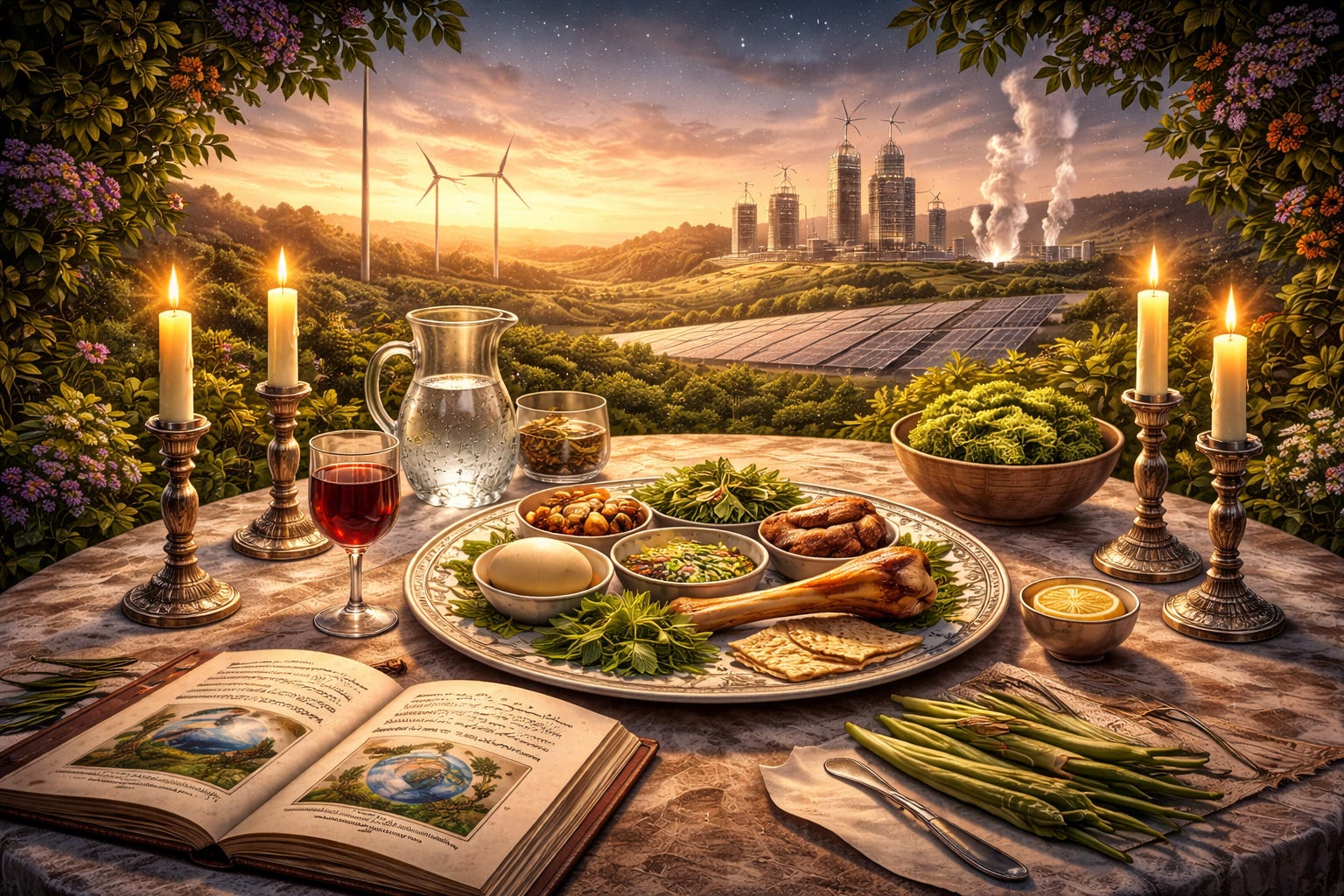
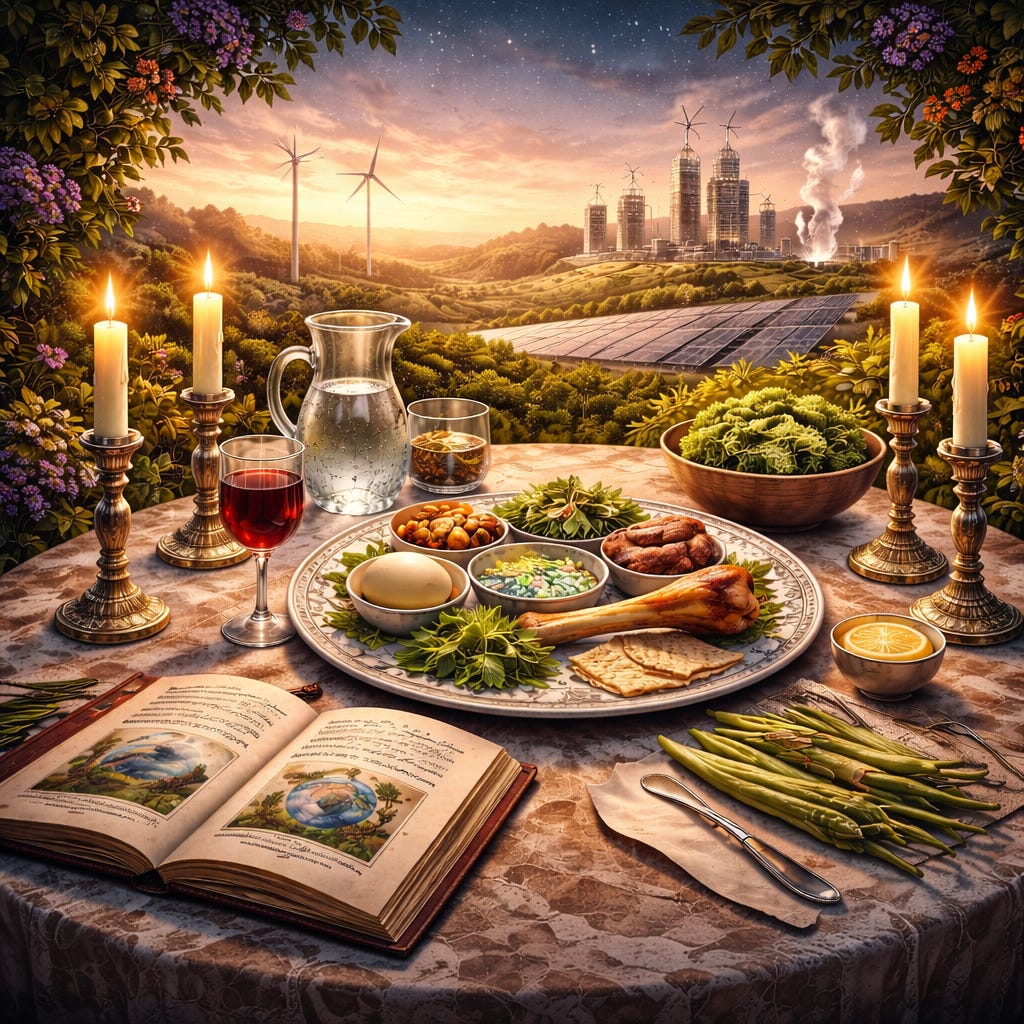
Sarah Tuneberg: A Seder plate is the ritual crockery or dish on which we place particular symbols that we reference through the meal. There is a lamb shank in the center representing the marking of the door. There is an egg that represents rebirth. There is the bitter herb, the salty water for the tears, charoset — which is a paste that represents the mortar of the bricks that the Jews laid while they were in slavery. It’s made out of apples, and depending on where your family’s from — where my family’s from, we make it with a paste that’s apples and walnuts and cinnamon, and it’s boring and dry. Or Sephardic Jews, who add a ton of dried fruit and lemon and wine — the good stuff. In Judaism you have lots of different traditions to pull from. Anyway, the Seder plate is the center visual of Passover, and you place the foods around it and work your way through as part of the Haggadah, the service. And there are new Jewish traditions about adding items to the Seder plate to reflect particular themes. And so if you were to make an item on your Seder plate connected to climate change, what would it be? If you were to make space for a new item on your Seder plate about climate — what would it be?
Ross Kenyon: Interesting. Do you have any ideas for what you might do?
Sarah Tuneberg: No, not yet. I imagine there are vegan Seder plates. Surely people have done work around this.
Ross Kenyon: Yeah. I’m sure if you looked up “climate Seder” or “climate Haggadah,” surely some resources must exist at this point. You sort of independently came to this — it was like, oh, we should do this. But we’re probably not the only ones.
Sarah Tuneberg: I can’t imagine we’re the only ones.
Ross Kenyon: So I’m excited to hear about it. Feel free to write in. Well, thanks for being here, Sarah.
Sarah Tuneberg: Thanks for having me. And whatever it means to you — next year in Jerusalem.
Ross Kenyon: Next year in Jerusalem. Indeed. Well, thanks so much for listening. I hope you had a great time hanging out with Sarah and me talking about Passover. We’ll catch you next time.
Alexsandra Guerra: Well, thank you so much for listening. If you like the show, please rate and review it in Apple Podcasts and/or Stitcher. It really helps us get this content to a wider audience. You can keep up with Nori at nori.com, where there is a newsletter — that’s nori.com/subscribe. There’s a podcast, there’s a whole bunch else, or you can send us an email at podcast@nori.com. We are also now on Patreon at patreon.com/noripodcast. If you’d like more content, engagement, and community — thank you so much for your support.