


Listen on Spotify, Apple Podcasts or YouTube.
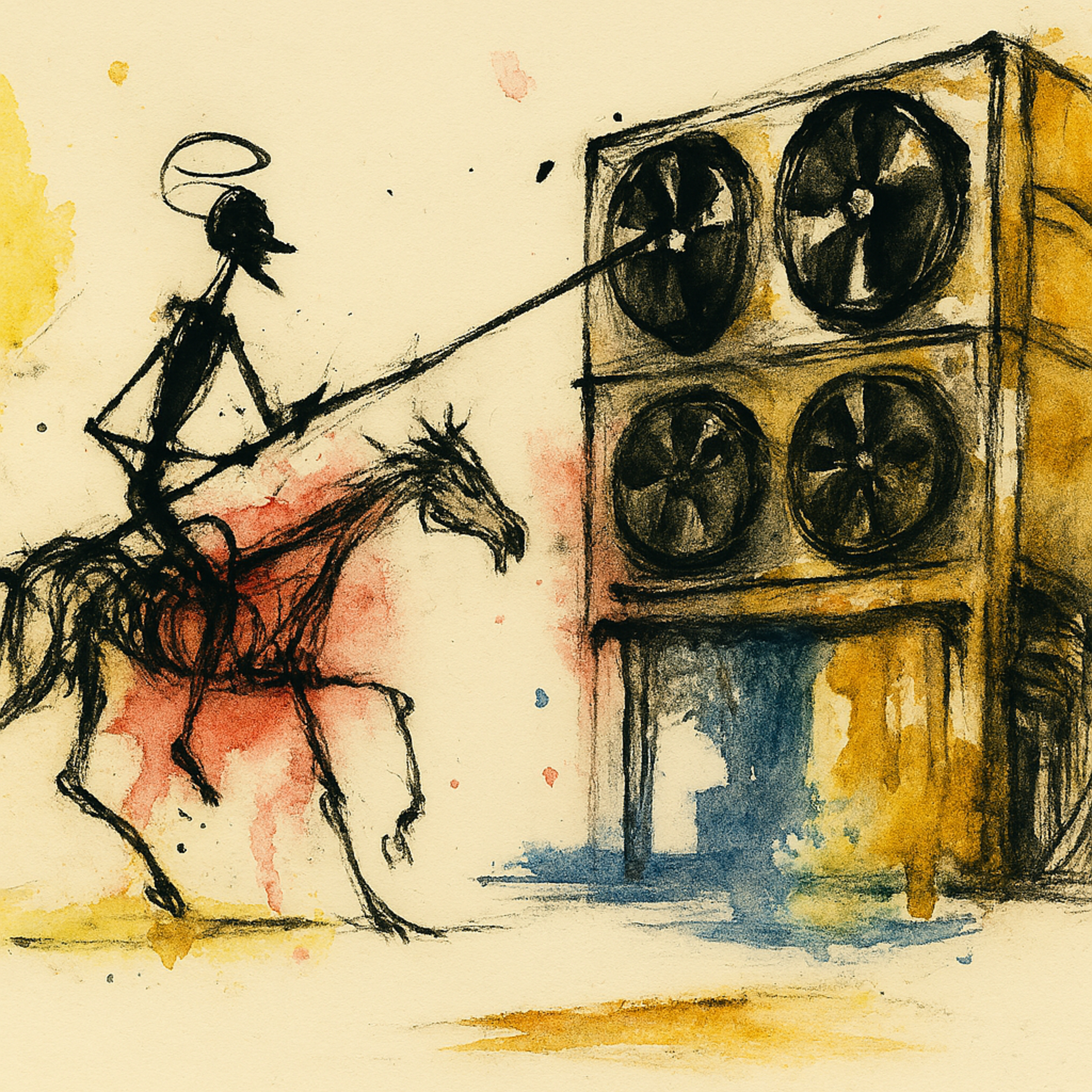
Is that a noble man rejecting modernity and embracing tradition? Or is it a lunatic with a lance trying to disembowel a shepherd?
The Ingenious Gentleman Don Quixote of La Mancha by Miguel de Cervantes (Saavedra) is the much beloved literary classic—and perhaps the world's first true novel—but its reputation goes far beyond the book itself. The character has spawned his own adjective: "quixotic", which gets levied at anyone who dares to dream a bit too big.
But is this a word kind of like "epicurean", whose true meaning is subverted by modern use? I believe the answer is yes.
This episode goes out to all of the climate people who dare to dream of a better, kinder world, and why I don't think your critics know what being "quixotic" means.
This Episode's Sponsors
Philip Lee LLP: legal resources for carbon removal buyers and suppliers
Arbonics: forestry project developer in the EU
Listen to the RCC episode with Lisett Luik from Arbonics
Become a sponsor by emailing carbon.removal.strategies[at]gmail.com
Use this affiliate link to use Riverside to record your podcasts
Sign up for the 9Zero climate coworking space with my referral code
Resources
Become a paid subscriber of Reversing Climate Change
Subscribe to the Reversing Climate Change Substack
"(What's So Funny 'Bout) Peace, Love And Understanding" by Elvis Costello & The Attractions
It's hard for me to think about Don Quixote without also thinking about Sir Digby Chicken Caesar from That Mitchell and Webb Look since it is so clearly based upon Sancho and Don Quixote...
And also Ignatius J. Reilly from A Confederacy of Dunces
Reject Modernity, Embrace Tradition meme
"Golden Helmet of Mambrino" from Man of La Mancha
I didn't explicitly name cases of left-wing nostalgia, but you can look to the Paris Commune (and earlier revolutionary moments in France), primitive communism, republican Spain, the consensus capitalism nostalgia of Michael Moore, etc.
Henry VIII: King and Court by Alison Weir
Full Transcript
Ross Kenyon: Hey, thanks for listening to Reversing Climate Change. I’m your host, Ross Kenyon. Before we get going, I’d love to tell you a little bit about our sponsors. They make the show possible. I would love it if you could listen for just a minute while I tell you about Philip Lee LLP and Arbonics. If you work in carbon removal, you very well may have come across Philip Lee LLP’s work. I originally saw Philip Lee give a presentation about some of the common provisions within offtake agreements, and I was impressed by the quality of their scholarship and their work.
And I’m happy that we’re able to stay in touch and finally do this together. I think the law is an underrepresented part of what happens within carbon removal. We assume it’s the background. We assume it’s the mechanics. It actually takes a very smart and creative person to be a good lawyer. I think if you’ve Thank you. We’re awarded Environmental Finance’s VCM Law Firm of the Year for each of the last two previous years. They have offices in the US, Europe, and the UK.
If you have business law needs around nature-based carbon projects or engineered ones, if you’re working with sustainable aviation fuels and the integration with Corsia, anything to do with the VCM generally, Article 6 of the Paris Agreement. The CRCF that’s coming out of the EU now. Get in touch with Philip Lee. If you’re working in this space, you really do need a good eye to the law. These projects need legal care. There’s a lot of structuring that takes place. It’s really not turnkey at this point still.
And there’s a lot more innovation and creativity that’s going to be needed to make sure that the Link is in the show notes. Go check out Philip Lee. Our other sponsors are Bonix. Bonix is great. They’ve been on the podcast before. I did a show with Lizette Luik, which I’ll link to in the show notes too if you want to go listen to that show I did with Lizette. Bonix is working on forestry in the Baltic states of Europe. Europe used to be much more heavily forested.
The great majority of forestry projects take place in the global south, which is generally a good thing. But we also do need forestry to take place in the EU and in Europe as well. Arbonics has put out some great research recently about the state of afforestation projects, about the bottlenecks in the industry, why the high quality credits are selling out far ahead of issuance, what that means for people who want to be buying carbon removal credits for forestry but cannot. It’s a really important set of questions that Arbonics addresses with grace.
I would recommend you checking out their work and also just checking out Arbonics in general. If you want to support forestry, give Arbonics a look. Link is in the show notes there. Thanks for listening. And now I will go into the show itself. Thanks for your time. Here it is. Hello, thanks for listening. This is Reversing Climate Change. It’s a monologue show today. I am the host, Ross Kenyon. I am a climate tech and carbon removal entrepreneur. If you love this show, a great rating and review would go a long way.
It helps get the show out to more people. If you could please just open that app right now, real quickly, write a review on Apple Podcasts. This show is unique and I love listening to it. It could be literally that simple. It can really help the show. Also, if you’d like to become a paid subscriber, it’s $5 a month. The programmatic ads are removed, you get bonus content, and you have my gratitude. You have my gratitude anyways though too. Thanks for listening to this.
The last show that I did, Ended up in some interesting places, the radical vision for Christianity and pacifism and some of the ideas that other cultures and traditions have independently discovered and been a part of. That being said, there’s something about pacifism or ideas that tend to be touchy feely for lack of a better word. New-agey, love-oriented, mercy-adjacent, maybe. It has the risk of being a freshman dorm room-esque, where in the immortal words of Elvis Costello, what’s so funny about peace, love, and understanding? Ends up a little maudlin.
It’s just, it’s not... It’s hard to talk about without it sounding trite, because it is one of those things that’s been devalued or abused or hypocritically alluded to over time. And that’s one of the reasons why, if you read the Gospels, you’re like, oh, wow, this is strikingly radical, so much more radical than you would ever expect, given what passes for much of Christianity most days. The radicalness of that vision is something that I think it’s closer in some ways to Jainism of truly trying not to harm other sentient or even just living beings.
Something that requires enormous acts of sacrifice. When you’re walking, you have a little broom where you don’t accidentally step on insects, that kind of level of devotion. What’s so funny about peace, love, and understanding is that there’s some serious risks to it, too. I think whenever people think about big ideas, big transformations, there’s a charge that is likely to be leveled, which is being quixotic. Named, of course, after Don Quixote, the ingenious man of La Mancha, And so I want to just talk about Don Quixote because I’m a fan.
I just reread it. I hadn’t read it in probably 15 years. Gosh. Yeah. Pretty close. Maybe like 13 years. I reread it recently and there’s so much to say about it. And what it has to say about idealism and just believing in anything is a lot different than the typical way we have of understanding who Don Quixote was literarily. For background, it was written in two parts, 1605 and 1615, written by Miguel de Cervantes. It’s a very funny book. This time period is considered part of early modern history.
You’re coming out of the Renaissance. The world as we might recognize it now is starting to take shape with science and the industrial revolution and stuff is starting to move in a way that we would recognize as being modern. He’s a contemporary of Shakespeare’s. Modern languages are coming into their own in the same way that Cervantes had a huge impact on Spanish, or maybe I should say Castilian. The same took place for Shakespeare with English. The book is so funny. There’s so many great segments of it.
Everyone always talks about the tilting at windmills thing, which, you know, tilting is another way of saying jousting. I know that because I recently listened to a book on Henry VIII. I’m like, oh, tilting, huh? Interesting. That’s what they called it. Don Quixote is, as far as I can tell, a member of the minor landed gentry living out in the countryside. He’s someone that gets obsessed with medieval tales of chivalry like Orlando, Roland. They’re filled with adventures. There’s magic involved. There’s supernatural elements.
There’s war. There’s courtly love and romance and if this ever existed, which it didn’t really, it’s quite a stylized version of medieval chivalry in the first place, but whatever, it didn’t happen the way that it’s portrayed in those books. And Don Quixote... Is just living out in the countryside and gets obsessed with these books and believes that the highest role that he can fulfill is to become a knight errant and wander the countryside in search of damsels to save and Moorish armies to defeat and giants to slay and things of that nature.
In the process he enlists a peasant named Sancho Panza to join him as his sidekick. And Sancho is a really fabulous character because he sees reality more clearly than Don Quixote does. He understands what’s happening, but somehow he still allows himself to be bullied into carrying out Don Quixote’s mad vision. Something really funny about the psychology of people that can see the truth, but yet can just sort of be overpowered by someone who is so confident, so charming, so persuasive. That’s instructive here. And even if you don’t read it in that way as something that has a political or ethical or psychological purpose, I think it’s also just a very funny character.
Sancho has some of the best lines in it. One thing about Don Quixote that... Pertains to this carbon removal climate, how imagination is used that is troubling is that I’m pretty sure it stems from Man of La Mancha, the 70s musical starring Peter O'Toole. And Sophia Loren about Don Quixote. Don Quixote in The Man of La Mancha is this sort of noble character and the modern world is corrupted and dirty and Things are not going well for humanity. And Don Quixote is pointing backwards to a time that has an Edenic feel to it, a return to the garden.
Things were better back then, and yet modernity is garbage and should be rejected. There are parts of Man of La Mancha where he accurately calls out bad behavior of others and stands for nobility. There’s also times when he’s honestly just like a dangerous, psychotic person who misunderstands reality. Perhaps most famously is the song, The Golden Helmet of Mambrino. The episode is also in the book. Where there is a barber who’s traveling, who has, as far as I can remember, a brass bowl that helps for shaving people.
And Don Quixote thinks that it’s actually the golden helmet of Mambrino, who’s a Moorish king. I think it’s from the Epic of Roland. He basically challenges the barber and attacks him in order to steal it away from him. It’s played for laughs in the movie. The song is... And it’s kind of funny to watch it with a sense of dramatic irony where it’s like, hey, this actually isn’t the thing that you think it is. But in the book, I have a hard time, even upon rereading it, I tend to see it as he’s a dangerous person.
God help you if Don Quixote shows up when you’re on the road in Spain. Because it’s not going to go well. There are cases where I can just pull cases out of the book without even having to try too hard. One of my favorites is that he sees dust on the horizon and he thinks it’s a Moorish army thing. Moving through Spain and there’s two armies that are coming to collide and he needs to join the army on the side of Western civilization and push back the Moors and it’s sort of like framed in this quasi crusader medieval romantic kind of quality to it.
And it’s literally just shepherds moving sheep around the plains and they’re kicking up dust because they’re moving sheep. And so imagine you’re just a shepherd herding your sheep and there’s a guy dressed in some crazy equivalent of steampunk garb for your time charging you with a lance trying to defeat the Moorish army that’s literally just you with your sheep. You know, terrifying. There’s cases where he comes across someone who’s transporting lions and forces them to open it so that he can fight the lions. He sees prisoners being moved to the galleys, many of whom are being punished for...
Pretty serious crimes. And he releases them and forces the release from the guards. And then the prisoners just beat him up basically and take his stuff. Many of these things are played for laughs and many of them are super funny. I think the book Don Quixote is out there and looking to play tricks on him should he show up at their door. So it has this sort of self-referential, intertextuality, pre-postmodern vibe to it, where it’s like aware of itself as a work of art from within the work of art that’s surprisingly sophisticated for a work from the early 17th century.
It’s pretty amazing. But I actually don’t think that Don Quixote is the person that you want to use as a criticism, as sort of an avatar of idealism that’s easy to attack. And there are several reasons for this. One is that I don’t think the problem with Don Quixote is that he’s idealistic. I think the problem is that he’s often psychotic. He’s had a psychotic break with reality in some of these cases. He either cannot see the truth or can see it, but pretends There are cases where Dulcinea, who is his lady love that he’s always trying to charm and do service to, is basically just a peasant woman from town.
And he lifts her up to such an extent that doesn’t even really make any sense, but he just needs an anchor. Of a lady love that he can devote himself to. And it doesn’t make any sense. Like Sancha is always trying to tell him like, yeah, I just saw her. She’s like the strongest woman around. And when she belches, everyone can hear her. And I don’t think that’s Dulcinea and Don Quixote, of course, is Greatly offended by the suggestion that she is not this elegant, most pure, most virtuous of women.
Almost all of the conflict that Don Quixote finds himself embroiled in are cases where he misunderstands reality and then intervenes in the hopes of changing the outcome, which is not a problem of idealism. It’s a problem of a failure to see things as they really are. And it’s possible to say that’s about idealism, but I think that tries to overdefine this too much. I think it’s trying to say that believing that things can be different is a type of psychosis. And I think that’s a misdiagnosis of what’s happening here with Don Quixote.
I think a better way of understanding him beyond just this person is disconnected from reality and his poor information causes him to make poor choices. I think Don Quixote is primarily about the misuses of nostalgia. Nostalgia can be misused by many different political orientations. It’s not unique. I think if you’re idealistic or get accused of being quixotic, I think the chances of the person who is the recipient of that criticism being on the left is pretty high. In fact, one time I was in Guatemala City and down by the central square, the Zocalo, there was a leftist bookstore called El Quijero or something like that.
And I had thought that was a really strange name for a political bookstore because as someone who really likes Don Quijote, I think the last thing you would want to say is that this person who misunderstands reality and then intervenes in it in order to change it to how I want it to be and for it to go terribly, terribly, even for the people I aim to help. That’s a very powerful conservative critique of progressivism in the same way that when a couple episodes ago I talked about The French Revolution and Edmund Burke’s criticism of the French Revolution as trying to rewrite social rules to an extent that was so rationalistic and so disconnected from human experience and tradition that it could not help but lead to the guillotine.
It was a bad plan, basically. So I found that to be a really bizarre naming convention. I’m sure, I hope they mean well. Maybe the cultural significance of Don Quixote is just different in Latin America or in Guatemala specifically. I don’t know. But I’ve never been able to forget that experience of going in there and wondering about using Don Quixote as your mascot, essentially, for a political belief. Of course, misusing nostalgia is not unique to progressives either. I mean, there are various things that people who are left of center point back to golden moments of progressive or leftist thought theory and action.
Nostalgia is also very effectively used by people on the right as well. There’s a really strong tendency to look back to times like the pre-Vietnam era of American history as a time when a man was a man and you could work a union job and support a family and things were happening. We’re good. It was a good time to be an American where we were culturally ascendant, militarily, diplomatically ascendant. And that’s something that we can look back to as a really powerfully good time for America.
Of course that faces its own very obvious critiques as well. Humans have a really strong desire to project themselves out of the present. I enjoy revisiting places from my childhood, even ones that have painful memories attached to them. There’s something about being there and thinking about the passage of time. Were things simpler back then? Was it a better time? Was that the peak? Was that as good as it was going to get? There’s also the desire to project forward in time, to hope for the future.
I think the singularity and transhumanism have an inverted nostalgia to them too. Where in the future, we won’t feel pain. We’ll live forever. We’ll conquer death. We’ll no longer have scarcity. And this is something that we should look forward to and pass us by in the present. There isn’t a need to understand ourselves or the present moment because what exists for us is deep in the past or deep in the future and we can visit them in our heads anytime we want. And even if we don’t want them to come, there’s an inexorable approaching of the future.
We became more future-oriented, I think, as a species as we sped up the curve and the parabola got steeper for human development. I think once that started happening, it makes sense that we live our lives primarily in the future. But there’s some serious pleasure in looking to the past as well. I think Don Quixote is a good example of why you don’t do that. The past was not necessarily better. Don Quixote was transported back several hundred years. He’d fit in no better than he would in the early modern era in Spain.
He projects himself into a past where he fit in better, where things felt different, where nobility was still present. But in fact, knights and feudalism were not necessarily better than Arising bourgeoisie and the emergence of the middle class in Europe and trade and urbanization becoming more prominent. I don’t know if we can look back to the times of active royalty as being more virtuous. In fact, I think it’s pretty hard to read much royal history and still have that way of thinking. So that’s all to say, don’t let the thought of having any ideals, any hope for the future, Any concern that we’ve made a wrong turn as a species or as a polis make you worry about being called quixotic, that you’re idealistic and not realistic.
That’s okay. I think sometimes it’s nice to push the boundaries of what is realistic, but don’t be quixotic in the way that I’m describing. That is literally a form of political and ethical psychosis. I hope you enjoyed this brief wander through Don Quixote. I hope you give it a read sometime. It’s a lovely book. Very funny. And thanks for listening.


